
 100% FREE ACCESS
12th Standard Syllabus & Materials
12th Standard
TN 12th Maths Applications of Matrices and Determinants Sample Question Papers Study Material - QB365 Set A
NEW12th Standard
TN 12th Computer Applications மின்னணு தரவு பரிமாற்றம் Sample Question Papers Study Material - QB365 Set A
NEW12th Standard
TN 12th Computer Applications மின் - வணிக பாதுகாப்பு அமைப்புகள் Sample Question Papers Study Material - QB365 Set A
NEW12th Standard
TN 12th Computer Applications மின்னணு செலுத்தல் முறைகள் Sample Question Papers Study Material - QB365 Set A
NEW12th Standard
TN 12th Computer Applications மின் - வணிகம் Sample Question Papers Study Material - QB365 Set A
NEW12th Standard
TN 12th Computer Applications திறந்த மூல கருத்துருக்கள் Sample Question Papers Study Material - QB365 Set A

Published on: 28/11/2025
Download Tamil Nadu 12th Standard Maths question papers, model tests, one-mark questions, important questions, and public exam papers in PDF format. Free study materials and answer keys for TN State Board students.
Questions + Answers key
Take MCQ Maths Test
1.
Let A =\(\begin{bmatrix} 0 & 1 \\ 1 & 1 \end{bmatrix},B=\begin{bmatrix} 1 & 1 \\ 0 & 1 \end{bmatrix}\)be any two boolean matrices of the same type. Find AvB and A\(\wedge\)B.
2.
A pair of fair dice is rolled once. Find the probability mass function to get the number of fours.
3.
Evaluate the following:
\(\int _{ 0 }^{ \infty }{ { x }^{ 5 }{ e }^{ -3x }dx } \)
4.
Assume that the cross section of the artery of human is circular. A drug is given to a patient to dilate his arteries. If the radius of an artery is increased from 2 mm to 2.1 mm, how much is cross-sectional area increased approximately?
5.
Evaluate the limit \(\underset{x\rightarrow 0^{+}}{lim} (\frac{sin \ x}{x^{2}})\)
6.
Find centre and radius of the following circles.
2x2+2y2−6x+4y+2 = 0
7.
Find the rank of the following matrices by minor method:
\(\left[ \begin{matrix} -1 & 3 \\ 4 & -7 \\ 3 & -4 \end{matrix} \right] \)
8.
Find the principal argument Arg z, when z = \(\frac { -2 }{ 1+i\sqrt { 3 } } \)
9.
If \(\hat { 2i } -\hat { j } +\hat { 3k } ,\hat { 3i } +\hat { 2j } +\hat { k } ,\hat { i } +\hat { mj } +\hat { 4k } \) are coplanar, find the value of m.
10.
Is cos-1(-x) = \(\pi\)-cos−1(x) true? Justify your answer.
11.
Prove that q ➝ p ≡ ¬p ➝ ¬q
12.
Evaluate the following integrals using properties of integration:
\(\int _{ -5 }^{ 5 }{ xcos } \left( \frac { { e }^{ x }-1 }{ { e }^{ x }+1 } \right) dx\)
13.
Two balls are chosen randomly from an urn containing 6 red and 8 black balls. Suppose that we win Rs. 15 for each red ball selected and we lose Rs. 10 for each black ball selected. X denotes the winning amount, then find the values of X and number of points in its inverse images.
14.
Compute the value of 'c' satisfied by the Rolle’s theorem for the function f (x) = x2 (1 - x)2, x ∈ [0,1]
15.
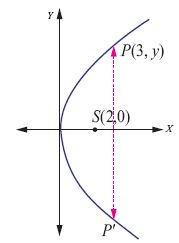
The parabolic communication antenna has a focus at 2m distance from the vertex of the antenna. Find the width of the antenna 3m from the vertex.
16.
A particle acted upon by constant forces \(\hat { 2j } +\hat { 5j } +\hat { 6k } \) and \(-\hat { i } -\hat { 2j } -\hat { k } \) is displaced from the point (4, −3, −2) to the point (6, 1, −3). Find the total work done by the forces.
17.
Solve the equation x3- 5x2- 4x + 20 = 0
18.
If |z| = 2 show that \(3\le \left| z+3+4i \right| \le 7\)
19.
Find the value of
\(tan\left( { cos }^{ -1 }\left( \frac { 1 }{ 2 } \right) -{ sin }^{ -1 }\left( -\frac { 1 }{ 2 } \right) \right) \)
20.
If A = \(\left[ \begin{matrix} 8 & -4 \\ -5 & 3 \end{matrix} \right] \), verify that A(adj A) = (adj A)A = |A|I2.
21.
Verify whether the following compound propositions are tautologies or contradictions or contingency
((p⟶ q) ∧ (q ⟶ r)) ⟶ (p ⟶ r)
22.
If w(x,y, z) = log \(\left( \frac { { 5x }^{ 3 }{ y }^{ 4 }+7{ y }^{ 2 }{ xz }^{ 4 }-{ 75y }^{ 3 }{ z }^{ 4 } }{ { x }^{ 2 }+{ y }^{ 2 } } \right) \) find \(x\frac { \partial w }{ \partial x } +y\frac { \partial w }{ \partial y } +z\frac { \partial w }{ \partial z } \)
23.
If the probability that a fluorescent light has a useful life of at least 600 hours is 0.9, find the probabilities that among 12 such lights
(i) exactly 10 will have a useful life of at least 600 hours
(ii) at least 11 will have a useful life of at least 600 hours
(iii) at least 2 will not have a useful life of at least 600 hours.
24.
A pot of boiling water at 100o C is removed from a stove at time t = 0 and left to cool in the kitchen. After 5 minutes, the water temperature has decreased to 80o C , and another 5 minutes later it has dropped to 65oC. Determine the temperature of the kitchen.
25.
Solve the Linear differential equation:
\(\frac { dy }{ dx } =\frac { { sin }^{ 2 }x }{ 1+{ x }^{ 3 } } -\frac { { 3x }^{ 2 } }{ 1+{ x }^{ 3 } } y\)
26.
27.
Salt is poured from a conveyer belt at a rate of 30 cubic metre per minute forming a conical pile with a circular base whose height and diameter of base are always equal. How fast is the height of the pile increasing when the pile is 10 metre high?
28.
Identify the type of conic and find centre, foci, vertices, and directrices of each of the following :
9x2−y2−36x−6y+18 = 0
29.
Find the non-parametric form of vector equation, and Cartesian equations of the plane passing through the points (2, 2, 1), (9, 3, 6) and perpendicular to the plane 2x + 6y + 6z = 9
30.
If z = x + iy and arg\(\left( \frac { z-1 }{ z+1 } \right) =\frac { \pi }{ 2 } \), then show that x2 + y2 = 1.
31.
If tan-1 x + tan-1y + tan-1 z = \(\pi\), show that x + y + z = xyz
32.
If ax2 + bx + c is divided by x + 3, x − 5, and x − 1, the remainders are 21, 61 and 9 respectively. Find a, b and c. (Use Gaussian elimination method.)
33.
34.
If 2+i and 3-\(\sqrt{2}\) are roots of the equation x6-13x5+ 62x4-126x3+ 65x2+127x-140 = 0, find all roots.
35.
In the set Q define a⊙b = a+b+ab. For what value of y, 3⊙(y⊙5) = 7?
y = \(\frac{2}{3}\)
y = \(\frac{-2}{3}\)
y = \(\frac{-3}{2}\)
y = 4
36.
For any value of \(n \in \mathbb{Z}, \int_{0}^{\pi} e^{\cos ^{2} x} \cos ^{3}[(2 n+1) x] d x\) is
\(\frac{\pi}{2}\)
\(\pi\)
0
2
37.
The value of \(\int _{ 0 }^{ \pi }{ \frac { dx }{ 1+{ 5 }^{ cos\ x } } } \) is
\(\frac{\pi}{2}\)
\(\pi\)
\(\frac{3\pi}{2}\)
\(2\pi\)
38.
Linear approximation for g(x) = cos x at \(x=\frac{\pi}{2}\) is
\(x+\frac{\pi}{2}\)
\(-x +\frac{\pi}{2}\)
\(x - \frac{\pi}{2}\)
\(-x - \frac{\pi}{2}\)
39.
If \(u(x, y)=e^{x^{2}+y^{2}}\),then \(\frac { \partial u }{ \partial x } \) is equal to
\(e^{x^{2}+y^{2}}\)
2xu
x2u
y2u
40.
A random variable X has binomial distribution with n = 25 and p = 0.8 then standard deviation of X is
6
4
3
2
41.
42.
The solution of \(\frac{d y}{d x}+p(x) y=0\) is
\(y={ ce }^{ \int { pdx } }\)
\(y={ ce }^{ -\int { pdx } }\)
\(x={ ce }^{ -\int { pdy } }\)
\(x={ce }^{ \int { pdy } }\)
43.
The maximum product of two positive numbers, when their sum of the squares is 200, is
100
\(25\sqrt { 7 } \)
28
\(24\sqrt { 14 } \)
44.
A balloon rises straight up at 10 m/s. An observer is 40 m away from the spot where the balloon left the ground. The rate of change of the balloon's angle of elevation in radian per second when the balloon is 30 metres above the ground.
\(\frac{3}{25} \text { radians } / \mathrm{sec}\)
\(\frac{4}{25} \text { radians } / \mathrm{sec}\)
\(\frac{1}{5} \text { radians } / \mathrm{sec}\)
\(\frac{1}{3} \text { radians } / \mathrm{sec}\)
45.
If ATA−1 is symmetric, then A2 =
A-1
(AT)2
AT
(A-1)2
46.
If A = \(\left[ \begin{matrix} 7 & 3 \\ 4 & 2 \end{matrix} \right] \), then 9I2 - A =
A-1
\(\frac { { A }^{ -1 } }{ 2 } \)
3A-1
2A-1
47.
The coordinates of the point where the line \(\vec { r } =(6\hat { i } -\hat { j } -3\hat { k } )+t(-\hat { i } +4\hat { j } )\) meets the plane \(\vec { r } .(\hat { i } +\hat { j } -\hat { k } )\) = 3 are
(2, 1, 0)
(7, -1, -7)
(1, 2, -6)
(5, -1, 1)
48.
49.
If the normals of the parabola y2 = 4x drawn at the end points of its latus rectum are tangents to the circle (x − 3)2 + (y + 2)2 = r2 , then the value of r2 is
2
3
1
4
50.
The radius of the circle 3x2 + by2 + 4bx − 6by + b2 = 0 is
1
3
\( \sqrt {10}\)
\( \sqrt {11}\)
51.
If the function f(x) = sin-1(x2 - 3), then x belongs to
[-1, 1]
[\(\sqrt2\), 2]
\(\\ \\ \\ \left[ -2,-\sqrt { 2 } \right] \cup \left[ \sqrt { 2 } ,2 \right] \)
\([-2,-\sqrt{2}]\)
52.
The principal argument of \(\cfrac { 3 }{ -1+i } \) is
\(\cfrac { -5\pi }{ 6 } \)
\(\cfrac { -2\pi }{ 3 } \)
\(\cfrac { -3\pi }{ 4 } \)
\(\cfrac { -\pi }{ 2 } \)
53.
The polynomial x3 - kx2 + 9x has three real zeros if and only if, k satisfies
|k| ≤ 6
k = 0
|k| > 6
|k| ≥ 6
54.
1.
Then A∨ B =\(\begin{bmatrix} 0 & 1 \\ 1 & 1 \end{bmatrix}\vee \begin{bmatrix} 1 & 1 \\ 0 & 1 \end{bmatrix}=\begin{bmatrix} 0\vee 1 & 1\vee 1 \\ 1\vee 0 & 1\vee 1 \end{bmatrix}=\begin{bmatrix} 1 & 1 \\ 1 & 1 \end{bmatrix}\)
\(A\wedge B=\begin{bmatrix} 0 & 1 \\ 1 & 1 \end{bmatrix}\wedge \begin{bmatrix} 1 & 1 \\ 0 & 1 \end{bmatrix}=\begin{bmatrix} 0\wedge 1 & 1\wedge 1 \\ 1\wedge 0 & 1\wedge 1 \end{bmatrix}=\begin{bmatrix} 0 & 1 \\ 0 & 1 \end{bmatrix}\)
2.
\(S=\left|\begin{array}{l} (1,1),(1,2),(1,3),(1,4),(1,5),(1,6) \\ (2,1),(2,2),(2,3),(2,4),(2,5),(2,6) \\ (3,1),(3,2),(3,3),(3,4),(3,5),(3,6) \\ (4,1),(4,2),(4,3),(4,4),(4,5),(4,6) \\ (5,1),(5,2),(5,3),(5,4),(5,5),(5,6) \\ (6,1),(6,2),(6,3),(6,4),(6,5),(6,6) \end{array}\right|\)
Let X be a random variable whose values x are the number of fours.
The sample space S is given in the table.
It can also be written as
S = {(i, j)} , where i = 1, 2, 3, 6 and j = 1, 2, 3, 6
Therefore X takes on the values of 0, 1 and 2.
We observe that
(i) X = 0, if (i, j) for i ≠ 4, j≠ 4,
(ii) X = 1, if (1, 4), (2, 4), (3, 4), (5, 4), (6, 4), (4, 1), (4, 2), (4, 3), (4, 5), (4, 6)
(iii) X = 2, if (4, 4) ,
Therefore,
| Values of the Random Variable X | 0 | 1 | 2 | Toatal |
| Number of elements in inverse images | 25 | 10 | 1 | 36 |
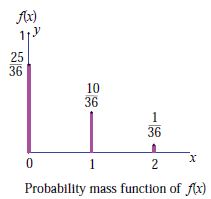
The probabilities are
\(f(0)=P(X=0)\cfrac { 25 }{ 36 } \)
\(f(1)=P(X=1)=\cfrac { 10 }{ 36 } \)
and \(f(20=P(X=2)=\cfrac { 1 }{ 36 } \)
Clearly the function f(x) satisfies the conditions
(i) f (x) ≥ 0, for x = 0, 1, 2 and
(ii) \(\underset { x }{ \Sigma } f(x)=\sum _{ x=0 }^{ x=-2 }{ f(x) } =f(0)+f(1)+f(2)=1\)
\(=\frac{25}{36}+\frac{10}{36}+\frac{1}{36}=1\)
The probability mass function is presented as
| x | 0 | 1 | 2 |
| f(x) | \(\frac { 25 }{ 36 } \) | \(\frac { 10 }{ 36 } \) | \(\frac { 1 }{ 36 } \) |
(or)
\(f(x)=\begin{cases} \begin{matrix} \frac { 25 }{ 36 } & for \ x=0 \end{matrix} \\ \begin{matrix} \frac { 10 }{ 36 } & for \ x=1 \end{matrix} \\ \begin{matrix} \frac { 1 }{ 36 } & for \ x=2 \end{matrix} \end{cases}\)
3.
\( \because \int _{ 0 }^{ \infty }{ { x }^{ n }{ e }^{ -ax }dx}=\frac { n! }{ { a }^{ n+1 } } \)
\(n=5,\quad a=3 \)
\(=\frac { 5! }{ { 3 }^{ 6 } } \)
4.
Given r = 2 mm
dr = (2.1 - 2) = 0.1 mm
Area = πr2
Approximate area dA = 2πr dr
= 2π (2) (0.1)
= 4 π (0.1) = 0.4 π mm2
5.
If we directly substitute x = 0 we get an indeterminate form \(\frac{0}{0}\) and hence we apply the l’Hôpital’s rule to evaluate the limit as,
\(\underset{x\rightarrow 0^{+}}{lim}(\frac{sin \ x}{x^{2}})=\underset{x\rightarrow 0^{+}}{lim}(\frac{cos \ x}{2x})=\infty\)
\(\underset{x\rightarrow 0^{-}}{lim}(\frac{sin \ x}{x^{2}})=\underset{x\rightarrow 0^{-}}{lim}(\frac{cos \ x}{2x})=\infty\)
As the left limit and the right limit are not the same we conclude that the limit does not exist.
Remark
One may be tempted to use the l’Hôpital’s rule once again in \(\underset{x\rightarrow 0^{+}}{lim} (\frac{cos \ x}{2x})\) to conclude
\(\underset{x\rightarrow 0^{+}}{lim} (\frac{cos \ x}{2x})\)\(\underset{x\rightarrow 0^{+}}{lim} (\frac{-sin \ x}{2})\)=0
which is not true because it was not an indeterminate form.
6.
Equation of the circle is
2x2 + 2y2 - 6x + 4y + 2 = 0
Dividing by 2, we get
x2 + y2 - 3x + 2y + 1 = 0
Here 2g = -3 ⇒ g = \(\frac { -3 }{ 2 } \)
2f = 2 ⇒ f = 1
and c = 1
∴ Centre is (-g, -f) = \(\left( \frac { 3 }{ 2 } ,-1 \right) \)
and r = \(\sqrt { { g }^{ 2 }+{ f }^{ 2 }-c } \) = \(\sqrt { { \left( \frac { 3 }{ 2 } \right) }^{ 2 }+{ 1 }^{ 2 }-1 } \)
= \(\sqrt { \frac { 9 }{ 4 } } =\frac { 3 }{ 2 } \) units.
7.
\(\left[ \begin{matrix} -1 & 3 \\ 4 & -7 \\ 3 & -4 \end{matrix} \right] \)
Let A =\(\left[ \begin{matrix} -1 & 3 \\ 4 & -7 \\ 3 & -4 \end{matrix} \right] \)
A is a matrix of order 3 \(\times\) 2
∴ \(\rho \)(A) ≤ min (3, 2) = 2
The highest order of minor of A is 2
It is \(\left| \begin{matrix} -1 & 3 \\ 4 & -7 \end{matrix} \right| \)= 7-12 = 5 ≠ 0
∴ \(\rho \)(A) = 2
8.
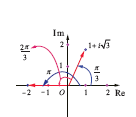
ang \(z=\frac { -2 }{ 1+i\sqrt { 3 } } \)
= arg(-2)-arg \(\left( 1+i\sqrt { 3 } \right) \) \(\left( \because arg\left( \frac { { z }_{ 1 } }{ { z }_{ 2 } } \right) =arg{ z }_{ 1 }=g_{ 2 } \right) \)
= \(\left( \pi -{ tan }^{ -1 }\left( \frac { 0 }{ 2 } \right) \right) -tan^{ -1 }\left( \frac { \sqrt { 3 } }{ 1 } \right) \)
= \(\pi -\frac { \pi }{ 3 } =\frac { 2\pi }{ 3 } \)
This implies that one of the values of arg z is \(\frac { 2\pi }{ 3 } \)
Since \(\frac { 2\pi }{ 3 } \) lies between \(-\pi \), the principal argument Argz is \(\frac { 2\pi }{ 3 } \)
9.
Since the given three vectors are coplanar, we have \(\left| \begin{matrix} 2 & -1 & 3 \\ 3 & 2 & 1 \\ 1 & m & 4 \end{matrix} \right| \) = 0 ⇒ m = -3
10.
cos-1(-x) = \(\pi\)-cos−1(x)
Let cos-1(-x) = \(\theta \) ..(1)
\(\Rightarrow -x=cos\theta \)
\(\Rightarrow x=-cos\theta =cos\theta =cos\left( \pi -\theta \right) \)
\(\Rightarrow \pi -\theta ={ cos }^{ -1 }\left( x \right) \)
\(\Rightarrow \theta =\pi -{ cos }^{ -1 }x\) ...(2)
From (1) & (2) \({ cos }^{ -1 }\left( -x \right) =\pi -{ cos }^{ -1 }\left( x \right) \)
\({ cos }^{ -1 }\left( -x \right) =\pi -{ cos }^{ -1 }\left( x \right) \) is true.
11.
| p | q | q ➝ p | ~p | ~q | ~q ➝ ~p |
| T | T | T | F | F | T |
| T | F | T | F | T | T |
| F | T | F | T | F | F |
| F | F | T | T | T | T |
The entries in the columns corresponding q ➝ p and ~p ➝ ~q are identical and hence they are equivalent.
q ➝ p ≡ ~p ➝ ~q
Hence proved
12.
Let \(f(x)=xcos\left( \frac { { e }^{ x }-1 }{ { e }^{ x }+1 } \right) \)
\(f(-x)=-x\quad cos\left( \frac { { e }^{ x }-1 }{ { e }^{ x }+1 } \right) \)
\(=-x\quad cos\left( \frac { { e }^{ \frac { 1 }{ x } }-1 }{ { e }^{ \frac { 1 }{ x } }+1 } \right) \)
\(=-x\quad cos\left( \frac { 1-{ e }^{ x } }{ 1+{ e }^{ x } } \right) \)
\(=-x\quad cos\left( -\left( \frac { { e }^{ x }-1 }{ { e }^{ x }+1 } \right) \right) \)
\(=-xcos\left( \frac { { e }^{ x }-1 }{ { e }^{ x }+1 } \right) \)
\([\because cos(-\theta )=cos\theta ]\)
= -f(x)
\(\therefore\) f(x) is an odd function
\(\therefore \int _{ -5 }^{ 5 }{ xcos\left( \frac { { e }^{ x }-1 }{ { e }^{ x }+1 } \right) } dx=0\)
13.
Let X be the random variable denotes the Winning amount.
X (Both are black balls) = Rs. 2 (-10) = Rs. -20
X (one red and oneblack ball) = Rs.15-Rs. 10 = Rs. 5
X (both are red ball) = Rs. 2 (15) = Rs. 30
= {-20, 5, 30}
The sample space consists of 14C2 = 91
X = -20, Both are black balls= 8C1 = 28
X = 5, One black, one redball = 8C1 x 6C1 = 8 x 6 = 48
X = 30, Both are white balls = 6C1 = 15
| Values of random variable | 30 | 5 | -20 | Total |
| Number of points in inverse image | 15 | 48 | 28 | 91 |
14.
Observe that, f(0) = 0 = f (1), is continuous in the interval [0,1] and is differentiable in (0,1). Now,
\(f'{x}=2x(1-x)(1-2x)\).
Therefore, \(f'(c)=0 \) gives c = 0, 1 and \(\frac{1}{2}\)
which \(\Rightarrow c= \frac{1}{2}\in (0,1)\).
15.
Let the parabola be y2 = 4ax
Since focus is 2m from the vertex a = 2
Equation of the parabola is y2 = 8x
Let P be a point on the parabola whose x -coordinate is 3m from the
vertex P (3, y)
y2 = 8 × 3
y =\(\sqrt { 8\times 3 } \)
= \(2\sqrt { 6 } \)
The width of the antenna 3m from the vertex is 4\(\sqrt { 6 } \) m.
16.
Resultant of the given forces is \(\hat{F}\) = ( \(\hat { 2j } +\hat { 5j } +\hat { 6k } \) )+ (\(-\hat { i } -\hat { 2j } -\hat { k } \) ) = \(\hat { i } +\hat { 3j } +\hat {5 k } \)
Let A and B be the points (4, −3, −2) and (6, 1, −3) respectively.
Then the displacement vector of the particle is
\(\vec { d } =\vec { AB } =\vec { OB } -\vec { OA } =(\hat { 6i } +\hat { j } -\hat { 3k } )-(\hat { 4i } -\hat { 3j } -\hat { 2k } )=\hat { 2i } +\hat { 4j } -\hat { k } \)
Therefore the work done
w = \(\vec { f } .\vec { d } =(\hat { i } +\hat { 3j } +\hat { 5k } ).(\hat { 2j } +\hat { 4j } -\hat { k } )\) = 9 units.
17.
If P(x) denotes the polynomial in the equation, then P(2) = 0.
Hence 2 is a root of the polynomial.
To find other roots, we divide the given polynomial x3−5x2−4x + 20 by x − 2 and get Q(x) = x2 −3x−10 as the quotient.
Solving Q(x) = 0 we get −2 and 5 as roots.
Thus 2, −2, 5 are the solutions of the given equation.
18.

\(\left| z+3+4i \right| \le \left| z \right| +\left| 3+4i \right| =2+5=7\)
\(\left| z+3+4i \right| \le 7\) .............. (1)
\(\left| z+3+4i \right| \ge \left| \left| z \right| -\left| 3+4i \right| \right| =\left| 2-5 \right| =3\)
\(\left| z+3+4i \right| \ge 3\) ............ (2)
From (1) and (2) we get, \(3\le \left| z+3+4i \right| \le 7\)
19.
\(tan\left( { cos }^{ -1 }\left( \frac { 1 }{ 2 } \right) -{ sin }^{ -1 }\left( -\frac { 1 }{ 2 } \right) \right) \)
Let \({ cos }^{ -1 }\left( \frac { -1 }{ 2 } \right) =x\)
\(\Rightarrow \frac { 1 }{ 2 } =cosx\)
\(\Rightarrow cosc=cos\frac { \pi }{ 3 } \)
\(\Rightarrow x=\frac { \pi }{ 3 } \)
Let \({ sin }^{ -1 }\left( \frac { -1 }{ 2 } \right) =y\)
\(\Rightarrow \left( \frac { -1 }{ 2 } \right) =siny\)
\(\Rightarrow siny=\frac { -1 }{ 2 } =-sin\frac { \pi }{ 6 } =\left( \frac { -\pi }{ 6 } \right) \)
\(\Rightarrow y=\frac { -\pi }{ 6 } \)
\(\therefore { tan }^{ -1 }\left( cos^{ -1 }\left( \frac { 1 }{ 2 } \right) -{ sin }^{ -1 }\left( \frac { 4 }{ 5 } \right) \right) \)
= \({ tan }^{ -1 }\left( \frac { \pi }{ 3 } -\left( \frac { -\pi }{ 6 } \right) \right) ={ tan }^{ -1 }\left( \frac { \pi }{ 3 } +\frac { \pi }{ 6 } \right) \)
= \(tan\left( \frac { 2\pi +\pi }{ 0 } \right) =tan\left( \frac { 3\pi }{ 6 } \right) =tan\left( \frac { \pi }{ 2 } \right) \)
= \(\infty \)
20.
Given A =\(\left[ \begin{matrix} 8 & -4 \\ -5 & 3 \end{matrix} \right] \)
adj A =\(\left[ \begin{matrix} 3 & 4 \\ 5 & 8 \end{matrix} \right] \)
[Interchange the elements in the leading diagonal and change the sign of the elements in the off diagonal]
|A| = 24 - 20 = 4
∴ A(adj A) =\(\\ \left[ \begin{matrix} 8 & -4 \\ -5 & 3 \end{matrix} \right] \left[ \begin{matrix} 3 & 4 \\ 5 & 8 \end{matrix} \right] \)
=\(\left[ \begin{matrix} 24-20 & 32-32 \\ -15+15 & -20+24 \end{matrix} \right] =\left[ \begin{matrix} 4 & 0 \\ 0 & 4 \end{matrix} \right] \) ....(1)
(adj A)(A) =\(\left[ \begin{matrix} 3 & 4 \\ 5 & 8 \end{matrix} \right] =\left[ \begin{matrix} 8 & -4 \\ -5 & 3 \end{matrix} \right] \)
=\(\left[ \begin{matrix} 24-20 & -12+12 \\ 40-40 & -20+24 \end{matrix} \right] =\left[ \begin{matrix} 4 & 0 \\ 0 & 4 \end{matrix} \right] \)...(2)
|A|I2 = 4\(\left[ \begin{matrix} 1 & 0 \\ 0 & 1 \end{matrix} \right] =\left[ \begin{matrix} 4 & 0 \\ 0 & 4 \end{matrix} \right] \) .....(3)
From (1), (2) and (3), it is proved that
A (adj A) = (adj A) A = |A|I2
21.
| p | q | r | q ⟶ r | p⟶ q | q ⟶ r | (p⟶ q) ∧ (q ⟶ r) | ((p⟶ q) ∧ (q ⟶ r)) ⟶ (p ⟶ r) |
| T | T | T | T | T | T | T | T |
| T | T | F | F | T | F | F | T |
| T | F | T | T | F | T | F | T |
| T | F | F | F | F | T | F | T |
| F | T | T | T | T | T | F | T |
| F | T | F | T | T | F | F | T |
| F | F | T | T | T | T | T | T |
| F | F | F | T | T | T | T | T |
∴ ((p⟶ q) ∧ (q ⟶ r)) ⟶ (p ⟶ r)
The given statement is a tautology.
22.
Given w(x, y, z) = \(\left( \frac { { 5x }^{ 3 }{ y }^{ 4 }+7{ y }^{ 2 }{ xz }^{ 4 }-{ 75y }^{ 3 }{ z }^{ 4 } }{ { x }^{ 2 }+{ y }^{ 2 } } \right) \)
Let (x, y, z) = \(\frac { { 5x }^{ 3 }{ y }^{ 4 }+7{ y }^{ 2 }{ xz }^{ 4 }-{ 75y }^{ 3 }{ z }^{ 4 } }{ { x }^{ 2 }+{ y }^{ 2 } } \)
⇒ w = log f ...(1)
⇒ ew = f
f(λx, λy, λz) = \(\frac { { 5\lambda }^{ 3 }{ x }^{ 3 }{ \lambda }^{ 4 }{ y }^{ 4 }+7{ \lambda }^{ 2 }{ y }^{ 2 }\lambda x{ \lambda }^{ 4 }{ z }^{ 4 }-75{ \lambda }^{ 3 }{ y }^{ 3 }{ \lambda }^{ 4 }{ z }^{ 4 }{ }^{ } }{ { \lambda }^{ 2 }{ x }^{ 2 }+{ \lambda }^{ 2 }{ y }^{ 2 } } \)
= \(\frac { { \lambda }^{ 7 }(5{ x }^{ 3 }{ y }^{ 4 }+7{ y }^{ 2 }{ xz }^{ 4 }-{ 75 }y^{ 3 }{ z }^{ 4 } }{ { \lambda }^{ 2 }({ x }^{ 2 }+{ y }^{ 2 }) } ={ \lambda }^{ 5 }f(x,y,z)\)
∴ f(x, y, z) is a homogeneous function of degree 5.
∴ By Euler's theorem,
\(x.\frac { \partial f }{ \partial x } +y\frac { \partial f }{ \partial y } +z\frac { \partial f }{ \partial z } =5.f\)
⇒ \(x.\frac { \partial }{ \partial x } ({ e }^{ w })+y.\frac { \partial }{ \partial y } ({ e }^{ w })+z.\frac { \partial }{ \partial z } ({ e }^{ w })=5.{ e }^{ w }\) [using (1)]
⇒ \(x.{ e }^{ w }\frac { \partial w }{ \partial x } +y.{ e }^{ w }\frac { \partial w }{ \partial y } +z.{ e }^{ w }\frac { \partial w }{ \partial z } ({ e }^{ w })=5{ e }^{ w }\)
⇒ \(x\frac { \partial w }{ \partial x } +y\frac { \partial w }{ \partial y } +z\frac { \partial w }{ \partial z } \) [Divided by ew]
23.
Let p be the probability of the useful life hours of a fluorescent light.
n = 12
P = 0.9
q = 1-p = 0.1
P(X= x)= nCx px qn-x, x = 0, 1,2, .., n
(i) Exactly 10
P(X = 10) = 12C10(0.9)10(1 - 0.9)2
= 12C10(0.9)10 (0.1)2
(ii) Atleast 11
P(X≥11) = R(X = 11) + P(X = 12)
= 12C11(0.9)11 (0.1)1 + 12C12(0.9)12(0.1)6
= 12C1 (0.9)11 (0.1) + (0.9)12
= 12(0.9)11 (0.1) + (0.9)12
= (0.9)11 ((12)(0.1) + 0.9)
= (0.9)11 (1.2 + 0.9)
= (0.9)11 (2.1)
(ii) Atleast 2 will not have a useful
P(X,10) = 1 -P(X > 10)
= 1 - [P(X = 11) + P(X = 12)]
= 1-(2.1) (0.9)11
24.
Let T represent the temperature of the boiling water and Tm represents the temperature of the kitchen.
By Newton's law of cooling
\(\Rightarrow \int { \frac { dT }{ T-{ T }_{ m } } =K\int { dt } } \)
\(\Rightarrow log(T-{ T }_{ m })=Kt+logC\)
\(\Rightarrow log(T-{ T }_{ m })-logC=Kt\)
\(\Rightarrow log\left( \frac { T-{ T }_{ m } }{ C } \right) =Kt\)
\(\Rightarrow T-{ T }_{ m }={ Ce }^{ Kt } ...(1)\)
when t=0,T=100
\(\therefore 100-{ T }_{ m }={ Ce }^{ 0 }\)
\(\Rightarrow C=100-{ T }_{ m }\)
\(\Rightarrow becomes,\ T-{ T }_{ m }=(100-{ T }_{ m }){ e }^{ Kt }\)
Also when t = 5, T = 80
\(\therefore 80-{ T }_{ m }=(100-{ T }_{ m }){ e }^{ 5K }\)
\(\Rightarrow { e }^{ 5K }=\frac { 80-{ T }_{ m } }{ 100-{ T }_{ m } } ..(2)\)
When t = 10, T = 65
(2) \(\Rightarrow\) 65 - T = (100-Tm)e10K
= (100-Tm)(e5K)2
\(=(100-{ T }_{ m }){ \left( \frac { 80-{ T }_{ m } }{ 100-{ T }_{ m } } \right) }^{ 2 }\)
[using(2)]
\(\Rightarrow 65-{ T }_{ m }=\frac { { (80-{ T }_{ m } })^{ 2 } }{ 100-{ T }_{ m } } \)
\(\Rightarrow\) 6500-65Tm-100Tm+Tm2 = 6400+Tm2-160Tm
\(\Rightarrow\) 6500-6400 = 165Tm-160Tm
\(\Rightarrow\) 100 = 5Tm
\(\\ \Rightarrow { T }_{ m }=\frac { 100 }{ 5 } ={ 20 }^{ o }C\)
Hence the temperature of the kitchen is 20oC
25.
\(\frac { dy }{ dx } +\frac { { 3x }^{ 2 }y }{ 1+{ x }^{ 3 } } =\frac { { sin }^{ 2 }x }{ 1+{ x }^{ 3 } } \)
This is a linear differential equation
\(\therefore P=\frac { { 3x }^{ 2 } }{ 1+{ x }^{ 3 } } ;Q=\frac { { sin }^{ 2 }x }{ 1+{ x }^{ 3 } } \)
\(\therefore \int { pdx } =\int { \frac { { 3x }^{ 2 } }{ 1+{ x }^{ 3 } } dx } =log(1+{ x }^{ 3 })\)
\(\therefore I.F.={ e }^{ \int { pdx } }={ e }^{ log(1+{ x }^{ 3 }) }=(1+{ x }^{ 3 })\)
\(\therefore\)The solution is \({ ye }^{ \int { pdx } }=\int { Q{ e }^{ \int { pdx } }dx+c } \)
\(\Rightarrow y(1+{ x }^{ 3 })=\int { \frac { { sin }^{ 2 }x }{ 1+{ x }^{ 3 } } (1+{ x }^{ 3 })dx+c } \)
\(cos2x=1-2{ sin }^{ 2 }x\)
\(sin2x=\frac { 1-cos2x }{ 2 } =\int { { sin }^{ 2 }xdx+c } \)
\(\Rightarrow y(1+{ x }^{ 3 })=\int { \frac { 1-cos2x }{ 2 } } dx+c\)
\(\Rightarrow y(1+{ x }^{ 3 })=\frac { x }{ 2 } -\frac { sin2x }{ 4 } +c\)
26.
27.
Let h and r be the height and the base radius. Therefore h = 2r. Let V be the volume of the salt cone.
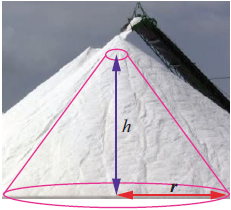
\(V=\frac{1}{3}\pi r^{2}h=\frac{1}{12}\pi h^{3}; \frac{dV}{dt}=30\) mtr3 / min.
Hence, \(\frac{dV}{dt}=\frac{1}{4}\pi h^{2}\frac{dh}{dt}\)
Therefore, \(\frac{dh}{dt}=4 \frac{dV}{dt}.\frac{1}{\pi h^{2}}\)
That is, \(\frac{dh}{dt}=4\times30\times \frac{1}{100 \pi}\)
=\(\frac{6}{5\pi}\) mtr / min.
28.
9x2- y2- 36x - 6y + 18 = 0
Given equation is 9x2- y2- 36x - 6y + 18 = 0
⇒ 9x2 - 36x - (y2 + 6y) = -18
⇒ 9(x2-4x)-(y2+6y) =-18
⇒ 9(x2 - 4x + 4 - 4) - (y2 + 6y + 9 - 9) = -18
⇒ 9(x-2)2-36-(y+3)2+9 =-18
⇒ 9(x-2)2 - (y+3)2 = -18+36-9
⇒ 9(x - 2)2 - (y + 3)2 = 9
Dividing by 9 we get, \(\frac { { (x-2) }^{ 2 } }{ 1 } -\frac { ({ y+3) }^{ 2 } }{ 9 } =1\)
This is an equation of the hyperbola whose transverse axis is parallel to x-axis.
a2 = 1, b2 = 9
∴ c2 = a2 + b2 = 1 + 9 = 10 ⇒ c = \(\sqrt { 10 } \)
\(e=\sqrt {1-\frac { { b }^{ 2 } }{ { a }^{ 2 } }} =\sqrt { 1-\frac { 9 }{ 1 } } =\sqrt { 10 } \)
a) Center is (2, -3)
⇒ h = 2, k = -3
(b) Foci are (h + c, k), (17 - c, k)
⇒ (2 +\(\sqrt { 10 } \), -3), (2 - \(\sqrt { 10 } \), -3)
(c) Vertic ar (h + a, k) (h - a, k)
⇒ (2+ 1,-3), (2-1,-3)
⇒ (3, -3) (1, -3)
(d) Equation of directrices are x - 2 = \(\pm \frac { a }{ e } \)
⇒ \(x-2=\pm \frac { 1 }{ \sqrt { 10 } } \)
\(x=2\pm \frac { 1 }{ \sqrt { 10 } } \)
⇒ \(x=2+\frac { 1 }{ \sqrt { 10 } } \) and \(x=2-\frac { 1 }{ \sqrt { 10 } } \)
29.
Given plane is passing through the points
\(\vec { a } =2\hat { i } +2\hat { j } +2\hat { k }, \vec { b } =9\hat { i } +3\hat { j } +6\hat { k } \)
Equation of the given plane is 2x + 6y + 6z = 9. It can be written as \(\vec { r } .(2\hat { i } +6\hat { j } +6\hat { k } )=9\)
Since the given plane is perpendicular to \(2\hat { i } +6\hat { j } +6\hat { k } \), the required plane is parallel to \(\vec { c } =2\hat { i } +6\hat { j } +6\hat { k } \). Hence, parametric form of vector equation of plane passing through two points and parallel to a vector is
\(\vec { r } =\vec { a } +s(\vec { b } -\vec { a } )+t\vec { c } ,s,t\in R\)
\(\vec { r } =2\hat { i } +2\hat { j } +\hat { k } +s(7\hat { i } +\hat { j } +5\hat { k } )+t(2\hat { i } +6\hat { j } +6\hat { k } ),s,t\in R\)
Cartesian equation of the plane is
\(\left| \begin{matrix} x-{ x }_{ 1 } & y-{ y }_{ 1 } & z-{ z }_{ 1 } \\ { x }_{ 2 }-{ x }_{ 1 } & { y }_{ 2 }-{ y }_{ 1 } & { z }_{ 2 }-{ z }_{ 1 } \\ { c }_{ 1 } & { c }_{ 2 } & { c }_{ 3 } \end{matrix} \right| =0\)
\(\Rightarrow \left| \begin{matrix} x-2 & y-2 & z-1 \\ 7 & 1 & 5 \\ 2 & 6 & 6 \end{matrix} \right| =0\)
⇒ (x-2)(6-30) - (y-2)(42-10) + (z-1)(42-2) = 0
⇒ (x - 2)(-24) - (y - 2)(32) + (z - 1)(40) = 0
⇒ 24x + 48 - 32y + 64 + 40z - 40 = 0
⇒ -24x - 32y + 40z + 72 = 0
\(\div\) - 8 we get
3x+ 4y - 5z - 9 = 0 is the Cartesian form.
∴ The parametric form of vector equation is
\(\vec { r } =\vec { r } (3\vec { i } +4\vec { j } -5\vec { k } )=9\)
30.
Now, \(\frac { z-1 }{ z+1 } =\frac { x+iy-1 }{ x+iy+1 } =\frac { \left( x-1 \right) +iy }{ \left( x+1 \right) +iy } =\frac { \left[ \left( x-1 \right) +iy \right] \left[ \left( x+1 \right) -iy \right] }{ \left[ \left( x+1 \right) +iy \right] \left[ \left( x+1 \right) -iy \right] } \)
\(\Rightarrow \frac { z-1 }{ z+1 } =\frac { \left( { x }^{ 2 }+{ y }^{ 2 }-1 \right) +i\left( 2y \right) }{ \left( x+1 \right) ^{ 2 }+{ y }^{ 2 } } \)
Since, arg \(\left( \frac { z-1 }{ z+2 } \right) =\frac { \pi }{ 2 } \Rightarrow { tan }^{ -1 }\left( \frac { 2y }{ { x }^{ 2 }+{ y }^{ 2 }-1 } \right) \)= \(\frac { \pi }{ 2 } \)
\(\Rightarrow \frac { 2y }{ { x }^{ 2 }+{ y }^{ 2 }-1 } =tan\frac { \pi }{ 2 } \) ⇒ x2+ y2 − 1 = 0
\(\Rightarrow { x }^{ 2 }+{ y }^{ 2 }=1\)
31.
\({ tan }^{ -1 }x+{ tan }^{ -1 }y+{ tan }^{ -1 }z={ tan }^{ -1 }\left( \frac { x+y+z-xyz }{ 1-xy-yz-zx } \right) \)
Given \({ tan }^{ -1 }x+{ tan }^{ -1 }x+{ tan }^{ -o }y+{ tan }^{ -1 }z=\pi \)
\(\Rightarrow \pi ={ tan }^{ -1 }\left( \frac { x+y+zxyz }{ 1-xy-yz-zx } \right) \)
\(\Rightarrow tan\pi =\frac { x+y+z-xyz }{ 1-xy-yz-zx } \)
\(\Rightarrow 0=\frac { x+y+z-xyz }{ 1-xy-yz-zx } \quad [\therefore tan\pi =0]\)
\(\Rightarrow x+y+z-xyz=0\)
\(\Rightarrow x+y+z=xyz\)
32.
Let P(x) = ax2+ bx + c
Given P(-3) = 21
[∵ P(x) ÷ x + 3, the remainder is 21]
⇒ a(-3)2 + b(-3) + c = 21
⇒ 9a - 3b + c = 21
Also, P(5) = 61
⇒ a(5)2 + b(5) + c = 61
[using remainder theorem]
⇒ 25a +5b + c = 61..........(2)
and P(1) = 9
⇒ a(1)2 + b(1) + c = 9
⇒ a + b + c = 9 ............(3)
Reducing the augment matrix to an equivalent row-echelon form using elementary row operations, we get
\(\left[ \begin{matrix} 9 & - & 1 \\ 25 & 5 & 1 \\ -1 & 1 & 1 \end{matrix}|\begin{matrix} 21 \\ 61 \\ 9 \end{matrix} \right] \overset { { R }_{ 1 }\leftrightarrow { R }_{ 3 } }{ \longrightarrow } \left[ \begin{matrix} 1 & 1 & 1 \\ 25 & 5 & 1 \\ 9 & -3 & 1 \end{matrix}|\begin{matrix} 9 \\ 61 \\ 21 \end{matrix} \right] \)
\(\overset { { R }_{ 3 }\rightarrow { R }_{ 3 }-9{ R }_{ 1 }\\ { R }_{ 2 }\rightarrow { R }_{ 2 }-25{ R }_{ 1 } }{ \longrightarrow } \left[ \begin{matrix} 1 & 1 & 1 \\ 0 & -20 & -24 \\ 0 & -12 & -8 \end{matrix}|\begin{matrix} 9 \\ -164 \\ -60 \end{matrix} \right] \)
\(\overset { { R }_{ 2 }\rightarrow { R }_{ 2 }\div \\ { R }_{ 3 }\rightarrow { R }_{ 3 }\div 4 }{ \longrightarrow } \left[ \begin{matrix} 1 & 1 & 1 \\ 0 & -5 & -6 \\ 0 & -3 & -2 \end{matrix}|\begin{matrix} 9 \\ -41 \\ -15 \end{matrix} \right] \)
\(\overset { { R }_{ 3 }\rightarrow { R }_{ 3 }-\frac { 3 }{ 5 } { R }_{ 2 } }{ \longrightarrow } \left[ \begin{matrix} 1 & 1 & 1 \\ 0 & -5 & -6 \\ 0 & 0 & \frac { 8 }{ 5 } \end{matrix}|\begin{matrix} 9 \\ -41 \\ \frac { 48 }{ 5 } \end{matrix} \right] \)
\(\overset { { R }_{ 3 }\rightarrow 5{ R }_{ 3 } }{ \longrightarrow } \left[ \begin{matrix} 1 & 1 & 1 \\ 0 & -5 & -6 \\ 0 & 0 & 8 \end{matrix}|\begin{matrix} 9 \\ -41 \\ 48 \end{matrix} \right] \)
Writing the equivalent equations from the row-echelon matrix we get,
a + b + c = 9 ............(1)
5b + 6c = 41 ................(2)
-8c = -48
⇒ c = 6
Substituting c = 6
⇒ 5b + 36 = 41
⇒ 5b = 5
b = 1
Substituting b = 1, c = 6
a + 1 + 6 = 9
⇒ a + 7 = 9
⇒ a = 9 - 7
⇒ a = 2
∴ a = 2, b = 1, and c = 6
33.
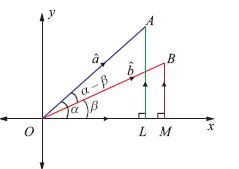
34.
Since the coefficients of the equation are all rational numbers, 2+i and 3-\(\sqrt{2}\) are roots, we get 2-i and 3+\(\sqrt{2}\) are also roots of the given equation. Thus (x-(2+i)), (x-(2-i)), (x-(3-\(\sqrt{2}\))) and (x-(3+\(\sqrt{2}\))) are factors. Thus their product.
((x-(2+i))(x-(2-i))(x-(3-\(\sqrt{2}\)))(x-(3+\(\sqrt{2}\))) is a factor of the given polynomial equation.
That is, (x2-4x+5)(x2-6x+7) is a factor. Dividing the given polynomial equation by this factor, we get the other factor as (x2-3x-4) which implies that 4 and −1 are the other two roots. Thus
2+i, 2-i, 3+\(\sqrt{2}\), 3-\(\sqrt{2}\), -1, and 4 are the roots of the given polynomial equation.
35.
(b)
y = \(\frac{-2}{3}\)
36.
(c)
0
37.
(a)
\(\frac{\pi}{2}\)
38.
(b)
\(-x +\frac{\pi}{2}\)
39.
(b)
2xu
40.
(d)
2
41.
(a)
42.
(b)
\(y={ ce }^{ -\int { pdx } }\)
43.
(a)
100
44.
(b)
\(\frac{4}{25} \text { radians } / \mathrm{sec}\)
45.
(b)
(AT)2
46.
(d)
2A-1
47.
(d)
(5, -1, 1)
48.
(c)
49.
(a)
2
50.
(c)
\( \sqrt {10}\)
51.
(c)
\(\\ \\ \\ \left[ -2,-\sqrt { 2 } \right] \cup \left[ \sqrt { 2 } ,2 \right] \)
52.
(c)
\(\cfrac { -3\pi }{ 4 } \)
53.
(d)
|k| ≥ 6
54.
(b)

12th Standard Syllabus & Materials
12th Standard
TN 12th Computer Applications வலையமைப்பு வடமிடல் Sample Question Papers Study Material - QB365 Set A
NEW12th Standard
TN 12th Computer Applications களப்பெயர் முறைமை (DNS) Sample Question Papers Study Material - QB365 Set A
NEW12th Standard
TN 12th Computer Applications வலையமைப்பு எடுத்துக்காட்டுகள் மற்றும் நெறிமுறைகள் Sample Question Papers Study Material - QB365 Set A
NEW12th Standard
TN 12th Computer Applications கணினி வலையமைப்பு ஓர் அறிமுகம் Sample Question Papers Study Material - QB365 Set A



Tamilnadu Stateboard 12th Standard Subjects
Maths

Chemistry

Physics

Biology

Computer Science

Business Maths and Statistics

Economics

Commerce

Accountancy

History

Computer Applications
Biology
Computer Technology
Computer Applications
Computer Science
Business Maths and Statistics
Commerce
Economics
Maths
Chemistry
Physics
Computer Technology
History
Accountancy

Tamil

English

French
Tamilnadu Stateboard Standards


