
 100% FREE ACCESS
12th Standard Syllabus & Materials
12th Standard
TN 12th Maths Applications of Matrices and Determinants Sample Question Papers Study Material - QB365 Set A
NEW12th Standard
TN 12th Computer Applications மின்னணு தரவு பரிமாற்றம் Sample Question Papers Study Material - QB365 Set A
NEW12th Standard
TN 12th Computer Applications மின் - வணிக பாதுகாப்பு அமைப்புகள் Sample Question Papers Study Material - QB365 Set A
NEW12th Standard
TN 12th Computer Applications மின்னணு செலுத்தல் முறைகள் Sample Question Papers Study Material - QB365 Set A
NEW12th Standard
TN 12th Computer Applications மின் - வணிகம் Sample Question Papers Study Material - QB365 Set A
NEW12th Standard
TN 12th Computer Applications திறந்த மூல கருத்துருக்கள் Sample Question Papers Study Material - QB365 Set A

Published on: 28/11/2025
Download Tamil Nadu 12th Standard Maths question papers, model tests, one-mark questions, important questions, and public exam papers in PDF format. Free study materials and answer keys for TN State Board students.
Questions + Answers key
Take MCQ Maths Test
1.
If \(\rho\) (A) = \(\rho\)([A| B]), then the system AX = B of linear equations is
consistent and has a unique solution
consistent
consistent and has infinitely many solution
inconsistent
2.
3.
If A = \(\left[ \begin{matrix} 2 & 0 \\ 1 & 5 \end{matrix} \right] \) and B = \(\left[ \begin{matrix} 1 & 4 \\ 2 & 0 \end{matrix} \right] \) then |adj (AB)| =
-40
-80
-60
-20
4.
If A is a 3 \(\times\) 3 non-singular matrix such that AAT = ATA and B = A-1AT, then BBT =
A
B
I3
BT
5.
If the direction cosines of a line are \(\frac { 1 }{ c } ,\frac { 1 }{ c } ,\frac { 1 }{ c } \), then
\(c=\pm 3\)
\(c=\pm \sqrt { 3 } \)
c > 0
0 < c < 1
6.
If \(\vec { a } =2\hat { i } +3\hat { j } -\hat { k } ,\vec { b } =\hat { i } +2\hat { j } -5\hat { k } ,\vec { c } =3\hat { i } +5\hat { j } -\hat { k } ,\) then a vector perpendicular to \(\vec { a } \) and lies in the plane containing \(\vec { b } \) and \(\vec { c } \) is
\(-17\hat { i } +21\hat { j } -97\hat { k } \)
\(17\hat { i } +21\hat { j } -123\hat { k } \)
\(-17\hat { i } -21\hat { j } +97\hat { k } \)
\(-17\hat { i } -21\hat { j } -97\hat { k } \)
7.
8.
If a vector \(\vec { \alpha } \) lies in the plane of \(\vec { \beta } \) and \(\vec { \gamma } \), then
\([\vec { \alpha } ,\vec { \beta } ,\vec { \gamma } ]\) = 1
\([\vec { \alpha } ,\vec { \beta } ,\vec { \gamma } ]\) = -1
\([\vec { \alpha } ,\vec { \beta } ,\vec { \gamma } ]\) = 0
\([\vec { \alpha } ,\vec { \beta } ,\vec { \gamma } ]\) = 2
9.
Consider an ellipse whose centre is of the origin and its major axis is along x-axis. If its eccentrcity is \(\frac { 3 }{ 5 } \) and the distance between its foci is 6, then the area of the quadrilateral inscribed in the ellipse with diagonals as major and minor axis of the ellipse is
8
32
80
40
10.
The centre of the circle inscribed in a square formed by the lines x2 − 8x − 12 = 0 and y2 − 14y + 45 = 0 is
(4, 7)
(7, 4)
(9, 4)
(4, 9)
11.
The eccentricity of the hyperbola whose latus rectum is 8 and conjugate axis is equal to half the distance between the foci is
\(\frac { 4 }{ 3 } \)
\(\frac { 4 }{ \sqrt { 3 } } \)
\(\frac { 2 }{ \sqrt { 3 } } \)
\(\frac { 3 }{ 2 } \)
12.
If \(\sin ^{-1} x+\cot ^{-1}\left(\frac{1}{2}\right)=\frac{\pi}{2}\), then x is equal to
\(\frac{1}{2}\)
\(\frac{1}{\sqrt{5}}\)
\(\frac{2}{\sqrt{5}}\)
\(\frac{\sqrt3}{2}\)
13.
If the function f(x) = sin-1(x2 - 3), then x belongs to
[-1, 1]
[\(\sqrt2\), 2]
\(\\ \\ \\ \left[ -2,-\sqrt { 2 } \right] \cup \left[ \sqrt { 2 } ,2 \right] \)
\([-2,-\sqrt{2}]\)
14.
If sin−1x = 2sin−1 \(\alpha\) has a solution, then
\(|\alpha |\le \frac { 1 }{ \sqrt { 2 } } \)
\(|\alpha |\ge \frac { 1 }{ \sqrt { 2 } } \)
\(|\alpha |<\frac { 1 }{ \sqrt { 2 } } \)
\(|\alpha |>\frac { 1 }{ \sqrt { 2 } } \)
15.
16.
17.
18.
A polynomial equation in x of degree n always has
n distinct roots
n real roots
n complex roots
at most one root
19.
If |z1| = 1, |z2| = 2, |z3| = 3 and |9z1z2 + 4z1z3 + z2z3| = 12, then the value of |z1+z2+z3| is
1
2
3
4
20.
The value of \(\sum_{n=1}^{13}\left(i^{n}+i^{n-1}\right)\) is
1+ i
i
1
0
21.
If u = sin-1 \(\left( \frac { x+y }{ \sqrt { x } +\sqrt { y } } \right) \), Show that \(x\frac { \partial u }{ \partial x } +y\frac { \partial u }{ \partial y } =\frac { 1 }{ 2 } tanu\)
22.
23.
Find the area of the region bounded by the curve 2+x−x2+y = 0 , x-axis, x = −3 and x = 3.
24.
Water at temperature 100oC cools in 10 minutes to 80oC in a room temperature of 25oC.
Find
(i) The temperature of water after 20 minutes
(ii) The time when the temperature is 40oC
\(\left[ { log }_{ e }\frac { 11 }{ 15 } =-0.3101;{ log }_{ e }5=1.6094 \right] \)
25.
The equation of electromotive force for an electric circuit containing resistance and self inductance is E = Ri + L\(\frac{di}{dt},\) Where E is the electromotive force is given to the circuit, R the resistance and L, the coefficient of induction. Find the current i at time t when E = 0.
26.
27.
A ladder 17 metre long is leaning against the wall. The base of the ladder is pulled away from the wall at a rate of 5 m/s. When the base of the ladder is 8 metres from the wall.
(i) How fast is the top of the ladder moving down the wall?
(ii) At what rate, the area of the triangle formed by the ladder, wall and the floor is changing?
28.
A particle moves along a line according to the law s(t) = 2t3 − 9t2 +12t − 4, where t ≥ 0.
(i) At what times the particle changes direction?
(ii) Find the total distance travelled by the particle in the first 4 seconds.
(iii) Find the particle’s acceleration each time the velocity is zero.
1.
(b)
consistent
2.
(a)
3.
(b)
-80
4.
(c)
I3
5.
(b)
\(c=\pm \sqrt { 3 } \)
6.
(d)
\(-17\hat { i } -21\hat { j } -97\hat { k } \)
7.
(d)
8.
(c)
\([\vec { \alpha } ,\vec { \beta } ,\vec { \gamma } ]\) = 0
9.
(d)
40
10.
(a)
(4, 7)
11.
(c)
\(\frac { 2 }{ \sqrt { 3 } } \)
12.
(b)
\(\frac{1}{\sqrt{5}}\)
13.
(c)
\(\\ \\ \\ \left[ -2,-\sqrt { 2 } \right] \cup \left[ \sqrt { 2 } ,2 \right] \)
14.
(a)
\(|\alpha |\le \frac { 1 }{ \sqrt { 2 } } \)
15.
(b)
16.
(a)
17.
(a)
18.
(c)
n complex roots
19.
(b)
2
20.
(a)
1+ i
21.
Note that the function u is not homogeneous. So we cannot apply Euler’s Theorem for u.
However, note that f(x,y) = \(\frac { x+y }{ \sqrt { x } +\sqrt { y } }\) = sin u is homogeneous; because
f(tx,ty) = \(\frac { tx+ty }{ \sqrt { tx } +\sqrt { ty } } \) = t1/2 f(x, y), \(\forall \) x, y, t\(\ge \)0
Thus f is homogeneous with degree \(\frac { 1 }{ 2 } \) and so by Euler’s Theorem we have
\(x\frac { \partial f }{ \partial x } +y\frac { \partial f }{ \partial y } =\frac { 1 }{ 2 } f(x,y)\).
Now substituting f = sin u in the above equation, we obtain
\(x\frac { \partial (sinu) }{ \partial x } +y\frac { \partial (sinu) }{ \partial y } =\frac { 1 }{ 2 } sin \ u\)
\(x\quad cosu\frac { \partial u }{ \partial x } +y\quad cosu\frac { \partial u }{ \partial x } =\frac { 1 }{ 2 } sin \ u\) ...(19)
Dividing both sides by cosu we obtain
\(x\frac { \partial u }{ \partial x } +y\frac { \partial u }{ \partial y } =\frac { 1 }{ 2 } tan \ u\)
Note:
Solving this problem by direct calculation will be possible; but will involve lengthy calculations.
22.
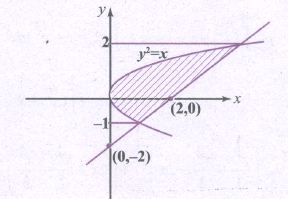
23.
Equation of the given curve is 2+x-x2+y = 0
| x | 0 | 2 | -1 |
| y | -2 | 0 | 0 |
\(\Rightarrow\)y = x2-x-2
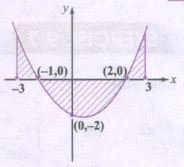
\(\therefore\) Required area= \(\int _{ -3 }^{ -1 }{ ydx } +\int _{ -1 }^{ 2 }{ -y } dx+\int _{ 2 }^{ 3 }{ ydx } \)
\(\\ =\int _{ -3 }^{ -1 }{ \left( { x }^{ 2 }-x-2 \right) } dx\int _{ -1 }^{ 2 }{ (2+x-{ x }^{ 2 })dx } +\int _{ 2 }^{ 3 }{ ({ x }^{ 2 }-x-2) } dx\)
\(={ \left( \frac { { x }^{ 3 } }{ 3 } -\frac { { x }^{ 2 } }{ 2 } -2x \right) }_{ -3 }^{ -1 }+{ \left( 2x+\frac { { x }^{ 2 } }{ 2 } -\frac { { x }^{ 3 } }{ 3 } \right) }_{ -1 }^{ 2 }+{ \left( \frac { { x }^{ 3 } }{ 3 } -\frac { { x }^{ 2 } }{ 2 } -2x \right) }_{ 2 }^{ 3 }\)
\(=\left( -\frac { 1 }{ 3 } -\frac { 1 }{ 2 } +2 \right) -\left( -9-\frac { 9 }{ 2 } +6 \right) +\left( 4+2-\frac { 8 }{ 3 } \right) -\left( -2+\frac { 1 }{ 2 } +\frac { 1 }{ 3 } \right) +\left( 9-\frac { 9 }{ 2 } -6 \right) -\left( \frac { 8 }{ 3 } -2-4 \right) \)
\(\\ =\left( \frac { -2-3+6 }{ 6 } \right) -\left( \frac { -6-9 }{ 2 } \right) +\left( \frac { 18-8 }{ 3 } \right) -\left( \frac { -12+3+2 }{ 6 } \right) +\left( \frac { 6-9 }{ 2 } \right) -\left( \frac { 8-24 }{ 3 } \right) \)
\(=\frac { 1 }{ 6 } +\frac { 15 }{ 2 } +\frac { 10 }{ 3 } +\frac { 7 }{ 6 } -\frac { 3 }{ 2 } +\frac { 16 }{ 3 } \)
\(=\frac { 1+45+20+7-9+32 }{ 6 } =\frac { 90 }{ 6 } =15
\)
24.
Let T be the temperature of water at any time t.
Then, by Newton's law of cooling,
\(\frac { dT }{ dt } \infty (T-{ 25 }^{ o })\)
\(\Rightarrow \frac { dT }{ dt } =-\lambda (T-25)\)
\(\Rightarrow \int { \frac { dT }{ T-25 } } =-\lambda \int { dt } \)
\(\Rightarrow log(T-25)=-\lambda t+C\) ...(1)
At t = 0, T = 1000e in (1) we get
\(\therefore(1)\Rightarrow\)log75 = 0+C
\(\Rightarrow\)C = log75
\(\therefore\)(1) becomes, log (T-25) = -\(\lambda\)t + log 75
\(\Rightarrow log\left( \frac { T-25 }{ 75 } \right) =-\lambda t...(2)\)
When t = 10, T = 80oC
\(\therefore log\left( \frac { 80-25 }{ 75 } \right) =-10|\)
\(\Rightarrow log\left( \frac { 11 }{ 15 } \right) =-10\lambda \)
\(\Rightarrow \lambda =-\frac { 1 }{ 10 } log\left( \frac { 11 }{ 15 } \right) \)
Substituting \(\lambda\) in (2) we get
\(log\left( \frac { T-25 }{ 75 } \right) =\frac { 1 }{ 10 } log\left( \frac { 11 }{ 15 } \right) t ...(3)\)
\(\Rightarrow log\left( \frac { T-25 }{ 75 } \right) =\frac { 1 }{ 10 } log\left( \frac { 11 }{ 15 } \right) \times 20\)
\(={ \left( \frac { 11 }{ 15 } \right) }^{ 2 }\)
\(\Rightarrow \frac { T-25 }{ 75 } ={ \left( \frac { 11 }{ 15 } \right) }^{ 2 }\)
\(\Rightarrow T-25=\frac { 121 }{ 225 } \times 75=\frac { 121 }{ 3 } =40.33\)
\(\Rightarrow T=40.33+25\)
\(\\ =65{ .33 }^{ 0 }C\)
So the temperature of water after 20 minutes is 65.33°C
(ii) putting T = 40oC in (3) we get
\(log\left( \frac { 40-25 }{ 75 } \right) =\frac { 1 }{ 10 } log\left( \frac { 11 }{ 15 } \right) t\)
\(\Rightarrow log\left( \frac { 1 }{ 5 } \right) =\frac { 1 }{ 10 } log\left( \frac { 11 }{ 15 } \right) t\)
\(t=\frac { 10log\left( \frac { 1 }{ 5 } \right) }{ log\left( \frac { 11 }{ 15 } \right) } =\frac { -10log5 }{ log\left( \frac { 11 }{ 15 } \right) } \)
\(=\frac { -10\times 1.6094 }{ -0.3101 } \)
\(\therefore\) t = 53.46 minutes
25.
Given E = Ri + L \(\frac{di}{dt}\)
\(\frac { E }{ L } =\frac { Ri }{ L } +\frac { di }{ dt } \)
\(\Rightarrow \frac { Ri }{ L } +\frac { di }{ dt } =\frac { E }{ L } \)
This is a linear differential equation
\(Here\quad P=\frac { R }{ L } and\quad Q=\frac { E }{ L } \)
\(\therefore \int { pdt } =\int { \frac { R }{ L } dt } =\frac { R }{ L } t\)
\(\therefore I.F={ e }^{ \int { pdt } }={ e }^{ \frac { Rt }{ L } }\)
\(\therefore\) Solution is i\({ e }^{ \int { pdt } }=\int { Q{ e }^{ \int { pdt } }dt+C } \)
\(\Rightarrow i{ e }^{ \frac { Rt }{ L } }=\int { \frac { E }{ L } . } { e }^{ \frac { Rt }{ L } }dt+C\)
\(\therefore i{ e }^{ \frac { Rt }{ L } }=\frac { E }{ L } \frac { { e }^{ \frac { Rt }{ L } } }{ \frac { R }{ L } } dt+C\)
\(i=\frac { E }{ R } { e }^{ \frac { Rt }{ L } }+C\)
\(i=\frac { E }{ R } +c{ e }^{ -\frac { Rt }{ L } }\)
When E = 0,
\(i=0+c{ e }^{ -\frac { Rt }{ L } }\)
\(\Rightarrow i=c{ e }^{ -\frac { Rt }{ L } }\)
26.
27.
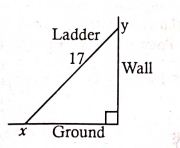
Let AB be the position of the ladder at any time t such that OA = x and OB = y
Then OA2 + OB2 = AB2
⇒ x2 + y2 = 172
Given \(\frac { dx }{ dt } \) = 5 and x = 8
When x = 8, 82 + y2 = 172
⇒ y2 = 289 - 64 = 225
⇒ y = 15
Differentiating (1) with respect to 't' we get,
\(2x\frac { dx }{ dt } +2y\frac { dy }{ dt } =0\)
⇒ 8(5) + 15 \(\frac { dy }{ dt } \) = 0 [∵ x = 8, \(\frac { dx }{ dt } \) = 15, y = 15]
⇒ 40 + 15\(\frac { dy }{ dt } \) = 0
⇒ \(\frac { dy }{ dt } =\frac { -40 }{ 15 } =\frac { -8 }{ 3 } \) m/sec
∴ The rate of top of the ladder moving down the wall is \(\frac{-8}{3}\) m/sec
(ii) The ladder, the wall and the floor forms a right angled triangle.
Area = \(\frac12\)xy
Differentiating with respect to 't' we get,
\(\frac { dA }{ dt } =\frac { 1 }{ 2 } \left[ x\frac { dy }{ dx } +y\frac { dx }{ dt } \right] \)
\(=\frac { 1 }{ 2 } \left[ 8\left( -\frac { 8 }{ 3 } \right) +15(5) \right] \)
= \(\frac { 1 }{ 2 } \left[ \frac { -64 }{ 3 } +75 \right] =\frac { 1 }{ 2 } \)
= \(\frac { 1 }{ 2 } \left[ \frac { -64+225 }{ 3 } \right] =\frac { 1 }{ 2 } \left( \frac { 161 }{ 3 } \right) \)
= \(\frac { dA }{ dt } \) = 26.83 sq.m/sec
28.
Given s (t) = 2t3 − 9t2 + 12t ≥ 0
On differentiating we get
V(t) = 6t2-18t+ 12 ... (1)
= 6 (t2 - 3t+ 2)
= 6 (t - 1) (t - 2)
Now V(t) = 0
⇒ 6 (t-1)(t- 2) = 0
⇒ t = 1, 2
The particle changes direction when V(t) changes its sign.
If 0 ≤ t < 1 then both (t - 1) and (t - 2) < 0
⇒ V(t) > 0
If 1 < t < 2 then (t -1) > 0 and (t - 2) < 0
⇒ V(t) < 0
If t > 2 then both (t - 1) and (t - 2) > 0
⇒ V(t) > 0
∴ The particle changes direction when t = 1 and t = 2 sec.
(ii) Total distance travelled by the particle in the first 4 seconds is |s(0)- s (1)| + |s (1) - s (2)| + |s (2) -s (4)|
s(0) = -4
s(1) = 2(1)3 - 9(1)2 + 12 (1) - 4
= 2 - 9 + 12 - 4 = 1
s (2) = 2 \(\times\) 23 - 9 \(\times\) 22 + 12 \(\times\) 2 - 4
= 16 - 36 + 24 - 4
= 0
s (4) = 2(4)3 - 9(4)2 + 12 (4) - 4
= 128 - 144 + 48 - 4 = 28
∴ Is (0) -s (1)|+ Is (1) -s (2)|+ Is (2) -s(4)|
= |-4 - 1| + |1 - 0| + |0 - 28|
= |-5| + |1| + |0 - 28|
= 5 + 1 + 28 = 34 m
(iii) Given s (t) = 2t3 − 9t2 + 12t ≥ 0
[acceleration = \(\frac { dv }{ dt } \)]
When t = 1,
Acceleration = 12 (1) - 18 = -6 m/sec2
When t = 2
Acceleration = 12 (2) - 18 = 6 m/sec2

12th Standard Syllabus & Materials
12th Standard
TN 12th Computer Applications வலையமைப்பு வடமிடல் Sample Question Papers Study Material - QB365 Set A
NEW12th Standard
TN 12th Computer Applications களப்பெயர் முறைமை (DNS) Sample Question Papers Study Material - QB365 Set A
NEW12th Standard
TN 12th Computer Applications வலையமைப்பு எடுத்துக்காட்டுகள் மற்றும் நெறிமுறைகள் Sample Question Papers Study Material - QB365 Set A
NEW12th Standard
TN 12th Computer Applications கணினி வலையமைப்பு ஓர் அறிமுகம் Sample Question Papers Study Material - QB365 Set A



Tamilnadu Stateboard 12th Standard Subjects
Maths

Chemistry

Physics

Biology

Computer Science

Business Maths and Statistics

Economics

Commerce

Accountancy

History

Computer Applications
Biology
Computer Technology
Computer Applications
Computer Science
Business Maths and Statistics
Commerce
Economics
Maths
Chemistry
Physics
Computer Technology
History
Accountancy

Tamil

English

French
Tamilnadu Stateboard Standards


