
 100% FREE ACCESS
12th Standard Syllabus & Materials
12th Standard
TN 12th Computer Applications மின்னணு தரவு பரிமாற்றம் Sample Question Papers Study Material - QB365 Set A
NEW12th Standard
TN 12th Computer Applications மின் - வணிக பாதுகாப்பு அமைப்புகள் Sample Question Papers Study Material - QB365 Set A
NEW12th Standard
TN 12th Computer Applications மின்னணு செலுத்தல் முறைகள் Sample Question Papers Study Material - QB365 Set A
NEW12th Standard
TN 12th Computer Applications மின் - வணிகம் Sample Question Papers Study Material - QB365 Set A
NEW12th Standard
TN 12th Computer Applications திறந்த மூல கருத்துருக்கள் Sample Question Papers Study Material - QB365 Set A
NEW12th Standard
TN 12th Computer Applications வலையமைப்பு வடமிடல் Sample Question Papers Study Material - QB365 Set A

Published on: 28/11/2025
Download Tamil Nadu 12th Standard Maths question papers, model tests, one-mark questions, important questions, and public exam papers in PDF format. Free study materials and answer keys for TN State Board students.
Questions + Answers key
Take MCQ Maths Test
1.
Find the value of \({ sin }^{ -1 }\left( sin\left( \frac { 2\pi }{ 3 } \right) \right) \)
2.
Find the value of \({ sin }^{ -1 }\left( sin\left( \frac { 5\pi }{ 4 } \right) \right) \)
3.
For what value of x does sinx = sin−1x?
4.
Find the period and amplitude of y = sin 7x
5.
Find the principal value of sin-1\(\left( -\frac { 1 }{ 2 } \right) \)(in radians and degrees).
6.
Show that the polynomial 9x9+ 2x5- x4- 7x2+ 2 has at least six imaginary roots.
7.
Solve the following equations,
sin2x - 5 sinx + 4 = 0
8.
Solve the equation x3- 5x2- 4x + 20 = 0
9.
Find the value of sin-1\(\left( sin\frac { 5\pi }{ 9 } cos\frac { \pi }{ 9 } +cos\frac { 5\pi }{ 9 } sin\frac { \pi }{ 9 } \right) \).
10.
Find the domain of sin−1(2−3x2)
11.
Solve the equations
x4+ 3x3- 3x - 1 = 0
12.
13.
Solve: \(2\sqrt { \frac { x }{ a } } +3\sqrt { \frac { a }{ x } } =\frac { b }{ a } +\frac { 6a }{ b } \)
14.
Solve: \(8x^{ \frac { 3 }{ 2x } }-8x^{ \frac { -3 }{ 2x } }\) = 63
15.
Solve the following equation: x4-10x3+ 26x2-10x + 1 = 0
1.
\({ sin }^{ -1 }\left( sin\left( \frac { 2\pi }{ 3 } \right) \right) \)
= \({ sin }^{ -1 }\left( sin\left( \pi -\frac { \pi }{ 3 } \right) \right) \) \(\left[ \because \frac { 2\pi }{ 3 } \notin \left[ \frac { -\pi }{ 2 } ,\frac { \pi }{ 2 } \right] \right] \)which is the principal domain of sine function
= \({ sin }^{ -1 }\left( sin\left( \frac { \pi }{ 3 } \right) \right) \) = \(\frac { \pi }{ 3 }\) \(\left[ \because sin\left( \pi -\theta \right) =sin\theta \right] \)
2.
\({ sin }^{ -1 }\left( sin\left( \frac { 5\pi }{ 4 } \right) \right) \)
= \({ sin }^{ -1 }\left( sin\left( \pi +\frac { \pi }{ 4 } \right) \right) \) \(\because \frac { 5\pi }{ 4 } \notin \left[ \frac { -\pi }{ 2 } ,\frac { \pi }{ 2 } \right] \)
= \({ sin }^{ -1 }\left( sin\left( -\frac { \pi }{ 4 } \right) \right) \)
= \( \frac {- \pi }{ 4 } \epsilon \left[ \frac { -\pi }{ 2 } ,\frac { \pi }{ 2 } \right] \)
3.
Let y = sin-1x
When y = 0, 0 = sin-1Ix
\(\Rightarrow\) sin(0) = sin (sin-1)(x))
\(\Rightarrow\)sin 0 = x
\(\Rightarrow\)x = 0
Hence, solution to (1) is x = 0. Also, graph of sin x and sin-1x intersect at origin (0, 0).
4.
The amplitude of sin x is 1 [Max of sin x curve is 1]
\(\Rightarrow \) amplitude of sin 7x is also 1
If p is the period of the function,
then f(x+p) = f(x)
Since the period of sine function is \(2\pi \)
The period of sin is \(\frac { 2\pi }{ 7 } \)
amplitude = 1
5.
Let sin-1 \(\left( -\frac { 1 }{ 2 } \right) \) = y. Then sin y = -\(\frac{1}{2}\)
The range of the principal value of sin-1x is \(\left[ -\frac { \pi }{ 2 } ,\frac { \pi }{ 2 } \right] \) and hence, Let us find y \(\in \left[ -\frac { \pi }{ 2 } ,\frac { \pi }{ 2 } \right] \) Such that sin y = -\(\frac{1}{2}\). Clearly, y = -\(\frac{\pi}{6}\)
Thus, the principal value of sin-1\(\left( -\frac { 1 }{ 2 } \right) \) is -\(\frac{\pi}{6}\). This corresponds to -30o.
6.
Clearly there are 2 sign changes for the given polynomial P(x) and hence number of positive roots of P(x) cannot be more than two. Further, as P(-x) = -9x9- 2x5- x4- 7x2+ 2, there is one sign change for P(-x) and hence the number of negative roots cannot be more than one. Clearly 0 is not a root. So maximum number of real roots is 3 and hence there are atleast six imaginary roots.
7.
sin2x - 5 sinx + 4 = 0
put y = sin x
⇒ y2-5y+4 = 0
⇒ (y-4)(y-1) = 0
⇒ y = 4, 1
Case (i)
When y = 4, sin x = 4 and no solution for sin x = 4 since the range the sin function is [-1, 1]
Case (ii)
When y = 1, sin x = 1
⇒ sin x = sin \(\frac{\pi}{2}\) [\(\because sin \frac {\pi}{2}=1\)]
\(x=n \pi+(-1)^{n} \frac{\pi}{2} \forall n \in z\).
8.
If P(x) denotes the polynomial in the equation, then P(2) = 0.
Hence 2 is a root of the polynomial.
To find other roots, we divide the given polynomial x3−5x2−4x + 20 by x − 2 and get Q(x) = x2 −3x−10 as the quotient.
Solving Q(x) = 0 we get −2 and 5 as roots.
Thus 2, −2, 5 are the solutions of the given equation.
9.
\(={ sin }^{ -1 }\left( sin\frac { 5\pi }{ 9 } cos\frac { \pi }{ 9 } +cos\frac { 5\pi }{ 9 } sin\frac { \pi }{ 9 } \right) \)
= \({ sin }^{ - }\left( sin\left( \frac { 5\pi }{ 9 } +\frac { \pi }{ 9 } \right) \right) \)
(\(\because \) sin A cos B + cos A sin B = sin (A + B))
= \({ sin }^{ -1 }\left( sin\left( \frac { 6\pi }{ 9 } \right) \right) \)
= \({ sin }^{ -1 }\left( sin\left( \frac { 2\pi }{ 3 } \right) \right) \)
= \({ sin }^{ -1 }\left( sin\left( \pi -\frac { \pi }{ 3 } \right) \right) \) \(\left[ \because \frac { 2\pi }{ 3 } \notin \left[ \frac { -\pi }{ 2 } ,\frac { \pi }{ 2 } \right] \right] \)
= \({ sin }^{ -1 }\left( sin\frac { \pi }{ 3 } \right) \) \(\left( \because sin\left( \pi -\theta \right) =sin\theta \right) \)
= \(\frac { \pi }{ 3 } \) \(\left[ \because \frac { \pi }{ 3 } \quad \varepsilon \left[ \frac { -\pi }{ 2 } ,\frac { \pi }{ 2 } \right] \right] \)
10.
We know that the domain of sin−1(x) is [-1, 1].
This leads to −1\(\le\)2 - 3x2\(\le\)1, Which implies -3\(\le\) -3x2\(\le\)-1
Now, -3\(\le\) -3x2, gives x2\(\le\)1 and ............(1)
-3\(\le\)-3x2\(\le\)-1, gives x2\(\ge\)\(\frac{1}{2}\) .........(2)
Combining the equations (1) and (2), we get \(\frac{1}{3}\le x^2\le 1\). That is \(\frac{1}{\sqrt3}\le |x|\le1\), Which gives \(x\in[-1,-1\frac{1}{\sqrt3}]\cup[\frac{1}{\sqrt3},1]\)
since a\(\le|x|\le b\) implies x \(\in[-b,-a]\cup[a,b]\).
11.
x4+ 3x3- 3x - 1 = 0
Sum of the co-efficients = 1 + 3 - 3.- 1 = 0
⇒x = 1 is a root ⇒(x - 1) is a factor
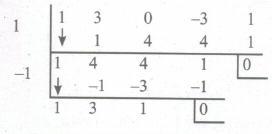
[Using synthetic division]
∴ x = 1, 1 are the roots and the remaining factor
\(\Rightarrow x=\frac { -3\pm \sqrt { 9-4(1)(1) } }{ 2 } \)
\(\Rightarrow x=\frac { -3\pm \sqrt { 5 } }{ 2 } \)
∴ The roots are 1, -1, \(\frac { -3+\sqrt { 5 } }{ 2 } ,\frac { -3-\sqrt { 5 } }{ 2 } \).
12.
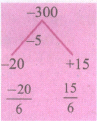
13.
Put \(\sqrt { \frac { x }{ a } } =y\Rightarrow 2y+\frac { 3 }{ y } =\frac { b }{ a } +\frac { 6a }{ b } \)
\(\Rightarrow \frac { { 2y }^{ 2 }+3 }{ y } =\frac { { b }^{ 2 }+{ 6a }^{ 2 } }{ ab } \)
\(\Rightarrow ab({ 2y }^{ 2 }+3)=\left( { b }^{ 2 }+{ 6a }^{ 2 } \right) y\)
\(\Rightarrow 2ab{ y }^{ 2 }+3ab-\left( { b }^{ 2 }+{ 6a }^{ 2 } \right) =0\)
\(\Rightarrow 2ab{ y }^{ 2 }-y\left( { b }^{ 2 }+{ 6a }^{ 2 } \right) +3ab=0\)
\(\Rightarrow 2ab{ y }^{ 2 }-{ b }^{ 2 }y-{ 6a }^{ 2 }+3ab=0\)
\(\Rightarrow by(2ay-b)-3a(2ay-b)=0\)
\(\Rightarrow (2ay-b)(by-3a)=0\)
\(\Rightarrow 2ay=b,\ by=3a\)
\(\Rightarrow y=\frac { b }{ 2a } ,y=\frac { 3a }{ b } \)
Case (i) When \(y=\frac { b }{ 2a } \)
\(\Rightarrow \sqrt { \frac { x }{ a } } =\frac { b }{ 2a } \Rightarrow \frac { x }{ a } =\frac { { b }^{ 2 } }{ { 4a }^{ 2 } } \Rightarrow x=\frac { { b }^{ 2 } }{ 4a } \)
Case (ii) When \(y=\frac { 3a }{ b } \)
\(\sqrt { \frac { x }{ a } } =\frac { 3a }{ b } \Rightarrow \frac { x }{ a } =\frac { 9a^{ 2 } }{ { b }^{ 2 } } \Rightarrow x=\frac { { 9a }^{ 3 } }{ { b }^{ 2 } } \)
∴ The roots are \(\frac { { b }^{ 2 } }{ 4a } ,\frac { 9a^{ 3 } }{ b^{ 2 } } \)
14.
\(8x^{ \frac { 3 }{ 2x } }-8x^{ \frac { -3 }{ 2x } }\) = 63
\(\Rightarrow 8\left[ { \left( { x }^{ \frac { 1 }{ 2n } } \right) }^{ 3 }-{ \left( { x }^{ \frac { -1 }{ 2n } } \right) }^{ 3 } \right] =63\)
Put \({ x }^{ \frac { 1 }{ 2n } }=y\)
\(\Rightarrow 8\left( { y }^{ 2 }-\frac { 1 }{ { y }^{ 3 } } \right) =63\)
\(\Rightarrow { y }^{ 3 }-\frac { 1 }{ { y }^{ 3 } } =\frac { 63 }{ 8 } \Rightarrow \frac { { y }^{ 6 }-1 }{ { y }^{ 3 } } =\frac { 63 }{ 8 } \)
\(\Rightarrow { 8y }^{ 6 }-8=63{ y }^{ 3 }\)
\(\Rightarrow { 8y }^{ 6 }-{ 63y }^{ 3 }-8=0\)
\(\Rightarrow { 8t }^{ 2 }-63t-8=0\ [where\quad t={ y }^{ 3 }]\)
\(\Rightarrow (8t-1)(t-8)=0\)
\(\Rightarrow t=\frac { 1 }{ 8 } ,8\)
Case (i): when \(t=8,\Rightarrow { y }^{ 3 }=8\Rightarrow { y }^{ 2 }={ 2 }^{ 3 }\)
\(\Rightarrow y=2\)
Case (ii): when \(t=\frac { 1 }{ 8 } ,{ y }^{ 3 }=\frac { 1 }{ 8 } \Rightarrow y=\frac { 1 }{ 2 } \)
When \(y=2,{ x }^{ \frac { 1 }{ 2n } }=2\)
\(\Rightarrow x={ (2 })^{ 2n }\quad \Rightarrow x={ ({ 2 }^{ 2 }) }^{ n }\)
\(\Rightarrow x={ 4 }^{ n }\)
When \(y=\frac { 1 }{ 2 } ,{ x }^{ \frac { 1 }{ 2n } }=\frac { 1 }{ 2 } \Rightarrow x={ \left( \frac { 1 }{ 2 } \right) }^{ 2n }\)
\(\Rightarrow x={ \left( \frac { 1 }{ { 2 }^{ 2 } } \right) }^{ n }=\frac { 1 }{ { 4 }^{ n } } \)
Hence the roots are 4n.
15.
This equation is Type I even degree reciprocal equation. Hence it can be rewritten as
x2\(\left[ \left( { x }^{ 2 }+\frac { 1 }{ { x }^{ 2 } } \right) -10 \left( x+\frac { 1 }{ x } \right) +26 \right] \)= 0 Since x \(\neq\) 0, we get \(\left(x^{2}+\frac{1}{x^{2}}\right)-10\left(x+\frac{1}{x}\right)+26=0\)
Let y = \(\left( x+\frac { 1 }{ x } \right) \)
[(y2-2)-10y+26] = 0 ⇒ (y2-10y+24) = 0 ⇒ (y-6)(y-4) = 0 ⇒ y = 6 or y = 4
Case (i)
y = 6 ⇒ x +\(\frac{1}{x}\) = 6 ⇒ x = 3+2\(\sqrt{2}\), x = 3 - 2\(\sqrt{2}\)
Case (ii)
y = 4 ⇒ x = 2+\(\sqrt{3}\), x = 2-\(\sqrt{3}\).
Hence, the roots are \(3 \pm 2 \sqrt{2}, 2 \pm \sqrt{3}\)

12th Standard Syllabus & Materials
12th Standard
TN 12th Computer Applications களப்பெயர் முறைமை (DNS) Sample Question Papers Study Material - QB365 Set A
NEW12th Standard
TN 12th Computer Applications வலையமைப்பு எடுத்துக்காட்டுகள் மற்றும் நெறிமுறைகள் Sample Question Papers Study Material - QB365 Set A
NEW12th Standard
TN 12th Computer Applications கணினி வலையமைப்பு ஓர் அறிமுகம் Sample Question Papers Study Material - QB365 Set A
NEW12th Standard
TN 12th Computer Applications PHP-உடன் MySQL-ஐ இணைத்தல் Sample Question Papers Study Material - QB365 Set A



Tamilnadu Stateboard 12th Standard Subjects
Maths

Chemistry

Physics

Biology

Computer Science

Business Maths and Statistics

Economics

Commerce

Accountancy

History

Computer Applications
Biology
Computer Technology
Computer Applications
Computer Science
Business Maths and Statistics
Commerce
Economics
Maths
Chemistry
Physics
Computer Technology
History
Accountancy

Tamil

English

French
Tamilnadu Stateboard Standards


