
 100% FREE ACCESS
12th Standard Syllabus & Materials
12th Standard
TN 12th Computer Applications மின்னணு தரவு பரிமாற்றம் Sample Question Papers Study Material - QB365 Set A
NEW12th Standard
TN 12th Computer Applications மின் - வணிக பாதுகாப்பு அமைப்புகள் Sample Question Papers Study Material - QB365 Set A
NEW12th Standard
TN 12th Computer Applications மின்னணு செலுத்தல் முறைகள் Sample Question Papers Study Material - QB365 Set A
NEW12th Standard
TN 12th Computer Applications மின் - வணிகம் Sample Question Papers Study Material - QB365 Set A
NEW12th Standard
TN 12th Computer Applications திறந்த மூல கருத்துருக்கள் Sample Question Papers Study Material - QB365 Set A
NEW12th Standard
TN 12th Computer Applications வலையமைப்பு வடமிடல் Sample Question Papers Study Material - QB365 Set A

Published on: 28/11/2025
Download Tamil Nadu 12th Standard Maths question papers, model tests, one-mark questions, important questions, and public exam papers in PDF format. Free study materials and answer keys for TN State Board students.
Questions + Answers key
Take MCQ Maths Test
1.
Find the rank of the following matrices which are in row-echelon form :
\(\left[ \begin{matrix} -2 & 2 & -1 \\ 0 & 5 & 1 \\ 0 & 0 & 0 \end{matrix} \right] \)
2.
If adj(A) = \(\left[ \begin{matrix} 0 & -2 & 0 \\ 6 & 2 & -6 \\ -3 & 0 & 6 \end{matrix} \right] \), find A−1.
3.
If x2+2(k+2)x+9k = 0 has equal roots, find k.
4.
If A = \(\left[ \begin{matrix} a & b \\ c & d \end{matrix} \right] \) is non-singular, find A−1.
5.
If α, β, and γ are the roots of the equation x3 + px2 + qx + r = 0, find the value of \(\Sigma \frac { 1 }{ \beta \gamma } \) in terms of the coefficients.
6.
If α and β are the roots of the quadratic equation 2x2−7x+13 = 0 , construct a quadratic equation whose roots are α2 and β2.
7.
A polynomial equation \(a_{n} x^{n}+a_{n-1} x^{n-1}+a_{n-2} x^{n-2}+\cdots+a_{2} x^{2}+a_{1} x+a_{0}=0, \ \left(a_{n} \neq 0\right)\) is a reciprocal equation if, and only if, one of the following two statements is true:
\((i)\ a_{n}=a_{0}, \ a_{n-1}=a_{1}, \ a_{n-2}=a_{2} \cdots \)
\((ii)\ a_{n}=-a_{0}, a_{n-1}=-a_{1}, a_{n-2}=-a_{2}, \cdots\)
8.
If A is non-singular, then
\((i)\ \left|A^{-1}\right|=\frac{1}{|A|} \)
\((ii)\ \left(A^{T}\right)^{-1}=\left(A^{-1}\right)^{T} \)
\((iii)\ (\lambda A)^{-1}=\frac{1}{\lambda} A^{-1},\)
where is \(\lambda\) non-zero scalar
9.
Reduce the matrix \(\left[ \begin{matrix} 3 & -1 & 2 \\ -6 & 2 & 4 \\ -3 & 1 & 2 \end{matrix} \right] \) to a row-echelon form.
10.
Find a polynomial equation of minimum degree with rational coefficients, having 2i+3 as a root.
11.
If α, β and γ are the roots of the cubic equation x3+2x2+3x+4 = 0, form a cubic equation whose roots are, 2α, 2β, 2γ
12.
Find the inverse of the matrix \(\left[ \begin{matrix} 2 & -1 & 3 \\ -5 & 3 & 1 \\ -3 & 2 & 3 \end{matrix} \right] \).
13.
Examine for the rational roots of x8- 3x + 1 = 0
14.
Solve the following system of linear equations, by Gaussian elimination method : 4x + 3y + 6z = 25, x + 5y + 7z = 13, 2x + 9y + z = 1.
15.
Discuss the maximum possible number of positive and negative roots of the polynomial equations x2−5x+6 and x2−5x+16 . Also draw rough sketch of the graphs
16.
A chemist has one solution which is 50% acid and another solution which is 25% acid. How much each should be mixed to make 10 litres of a 40% acid solution? (Use Cramer’s rule to solve the problem).
17.
Examine for the rational roots of 2x3- x2- 1 = 0
18.
Find the inverse of each of the following by Gauss-Jordan method:
\(\left[ \begin{matrix} 2 & -1 \\ 5 & -2 \end{matrix} \right] \)
19.
Solve the equation
2x3 - 9x2 + 10x = 3
20.
If A = \(\left[ \begin{matrix} 0 & 1 & 1 \\ 1 & 0 & 1 \\ 1 & 1 & 0 \end{matrix} \right] \), show that A-1 = \(\frac {1}{2}\) (A2 - 3I).
21.
Solve the equation x3− 9x2+14x + 24 = 0 if it is given that two of its roots are in the ratio 3:2.
22.
Find the sum of squares of roots of the equation 2x4- 8x3+ 6x2-3 = 0.
1.
Let A = \(\left[ \begin{matrix} -2 & 2 & -1 \\ 0 & 5 & 1 \\ 0 & 0 & 0 \end{matrix} \right] \). Then A is a matrix of order 3 × 3 and ρ(A) ≤ 3.
The only third order minor is |A| = \(\left| \begin{matrix} -2 & 2 & -1 \\ 0 & 5 & 1 \\ 0 & 0 & 0 \end{matrix} \right| \) = (-2)(5)(0) = 0. So ρ(A) ≤ 2.
There are several second order minors. We find that there is a second order minor, for example, \(\left| \begin{matrix} -2 & 2 \\ 0 & 5 \end{matrix} \right| \) = (-2)(5) = -10 ≠ 0. So, ρ(A) = 2.
Note that there are two non-zero rows. The third row is a zero row.
2.
Given adj (A) =\(\left[ \begin{matrix} 0 & -2 & 0 \\ 6 & 2 & -6 \\ -3 & 0 & 6 \end{matrix} \right] \)
We know that A-1 = ±\(\frac { 1 }{ \sqrt { |adjA| } } \) (adj A) ...............(1)
|adj A| = 0 + 2\(\left| \begin{matrix} 6 & -6 \\ -3 & 6 \end{matrix} \right| \) + 0
[Expanded along R1]
= 2(36-18) = 2(18) = 36
∴ A-1 = \(\pm \frac { 1 }{ \sqrt { 36 } } \left[ \begin{matrix} 0 & -2 & 0 \\ 6 & 2 & -6 \\ -3 & 0 & 6 \end{matrix} \right] \)
= \(\pm \frac { 1 }{ 6 } \left[ \begin{matrix} 0 & -2 & 0 \\ 6 & 2 & -6 \\ -3 & 0 & 6 \end{matrix} \right] \).
3.
Here Δ = b2−4ac = 0 for equal roots. This implies 4(k + 2)2 = 4(9)k. This implies k = 4 or 1.
4.
We first find adj A. By definition, we get adj A = \({ \left[ \begin{matrix} +{ M }_{ 11 } & -{ M }_{ 12 } \\ -{ M }_{ 21 } & +{ M }_{ 22 } \end{matrix} \right] }^{ T }={ \left[ \begin{matrix} d & -c \\ -b & a \end{matrix} \right] }^{ T }=\left[ \begin{matrix} d & -c \\ -c & a \end{matrix} \right] \).
Since A is non-singular, |A| = ad - bc ≠ 0.
As \({ A }^{ -1 }=\frac { 1 }{ \left| A \right| } \) adj A, we get A-1 = \(\frac { 1 }{ ad-bc } \left[ \begin{matrix} d & -b \\ -c & a \end{matrix} \right] \).
5.
Since α, β, and γ are the roots of the equation x3+ px2+ qx + r = 0, we have
Σ1 α + β + γ = -p and Σ3 αβγ = -r
\(\Sigma \frac { 1 }{ \beta \gamma } =\frac { 1 }{ \beta \gamma } +\frac { 1 }{ \gamma \alpha } +\frac { 1 }{ \alpha \beta } =\frac { \alpha +\beta +\gamma }{ \alpha \beta \gamma } =\frac { -p }{ -r } =\frac { p }{ r } \).
6.
Since α and β are the roots of the quadratic equation, we have α + β =\(\frac { 7 }{ 2 } \) and αβ = \(\frac { 13 }{ 2 } \).
Thus, to construct a new quadratic equation,
Sum of the roots = α2+β2 = (α+β)2-2αβ =\(\frac { -3 }{ 4 } \)
Product of the roots = α2β2 = (αβ)2 = \(\frac { 169 }{ 4 }\)
Thus a required quadratic equation is x2+\(\frac { 3 }{ 4 } x+\frac { 169 }{ 4 } \)= 0.
From this we see that 4x2+3x+169 = 0 is a quadratic equation with roots α2 and β2.
7.
Consider the polynomial equation
\(a_{n} x^{n}+a_{n-1} x^{n-1}+a_{n-2} x^{n-2}+\cdots+a_{2} x^{2}+a_{1} x+a_{0}=0, \) ......(1)
Replacing \(x \text { by } \frac{1}{x}\) in (1), we get
\(P\left(\frac{1}{x}\right)=\frac{a_{n}}{x^{n}}+\frac{a_{n-1}}{x^{n-1}}+\frac{a_{n-2}}{x^{n-2}}+\cdots+\frac{a_{2}}{x^{2}}+\frac{a_{1}}{x}+a_{0}=0\) .....(2)
Multiplying both sides of (2) by xn, we get
\(x^{n} P\left(\frac{1}{x}\right)=a_{0} x^{n}+a_{1} x^{n-1}+a_{2} x^{n-2}+\cdots+a_{n-2} x^{2}+a_{n-1} x+a_{n}=0\) .......(3)
Now, (1) is a reciprocal equation \(\Leftrightarrow P(x)=\pm x^{n} P\left(\frac{1}{x}\right) \Leftrightarrow\) (1) and (3) are same
This is possible \(\Leftrightarrow \frac{a_{n}}{a_{0}}=\frac{a_{n-1}}{a_{1}}=\frac{a_{n-2}}{a_{2}}=\cdots=\frac{a_{2}}{a_{n-2}}=\frac{a_{1}}{a_{n-1}}=\frac{a_{0}}{a_{n}} .\)
Let the proportion be equal to λ. Then, we get \(\frac{a_{n}}{a_{0}}=\lambda \ \text { and } \ \frac{a_{0}}{a_{n}}=\lambda\) Multiplying these equations, we get \(\lambda\)2 = 1. So, we get two cases \(\lambda\) = 1and \(\lambda\) = −1.
Case (i) :
\(\lambda\) = 1 In this case, we have \(a_{n}=a_{0}, a_{n-1}=a_{1}, a_{n-2}=a_{2}, \cdots\)
That is, the coefficients of (1) from the beginning are equal to the coefficients from the end.
Case (ii) :
\(\lambda\) = −1 In this case, we have \(a_{n}=a_{0}, a_{n-1}=a_{1}, a_{n-2}=a_{2}, \cdots\)
That is, the coefficients of (1) from the beginning are equal in magnitude to the coefficients from the end, but opposite in sign.
8.
Let A be non-singular. Then \(|A| \neq 0\) and A−1 exists. By definition
\(A A^{-1}=A^{-1} A=I_{n}\)
(i) By (1), we get \(\left|A A^{-1}\right|=\left|A^{-1} A\right|=\left|I_{n}\right|\)
Using the product rule for determinants, we get \(|A|\left|A^{-1}\right|=\left|I_{n}\right|=1\)
Hence, \(\left|A^{-1}\right|=\frac{1}{|A|}\)
(ii) From (1), we get \(\left(A A^{-1}\right)^{T}=\left(A^{-1} A\right)^{T}=\left(I_{n}\right)^{T} .\)
Using the reversal law of transpose, we get \(\left(A^{-1}\right)^{T} A^{T}=A^{T}\left(A^{-1}\right)^{T}=I_{n}\). Hence \(\left(A^{T}\right)^{-1}=\left(A^{-1}\right)^{T}\)
(iii) Since λ is a non-zero scalar, from (1), we get \((\lambda A)\left(\frac{1}{\lambda} A^{-1}\right)=\left(\frac{1}{\lambda} A^{-1}\right)(\lambda A)=I_{n}\)
\(\text { So, }(\lambda A)^{-1}=\frac{1}{\lambda} A^{-1}\)
9.
\(\left[ \begin{matrix} 3 & -1 & 2 \\ -6 & 2 & 4 \\ -3 & 1 & 2 \end{matrix} \right] \overset { \begin{matrix} { R }_{ 2 }\longrightarrow { R }_{ 2 }+2{ R }_{ 1 }, \\ { R }_{ 3 }\longrightarrow { R }_{ 3 }+{ R }_{ 1 } \end{matrix} }{ \longrightarrow } \left[ \begin{matrix} 3 & -1 & 2 \\ 0 & 0 & 8 \\ 0 & 0 & 4 \end{matrix} \right] \overset { { R }_{ 3 }\longrightarrow { R }_{ 3 }-\frac { 1 }{ 2 } { R }_{ 2 } }{ \longrightarrow } \left[ \begin{matrix} 3 & -1 & 2 \\ 0 & 0 & 8 \\ 0 & 0 & 0 \end{matrix} \right] \)
Note
\(\left[ \begin{matrix} 3 & -1 & 2 \\ 0 & 0 & 8 \\ 0 & 0 & 0 \end{matrix} \right] \overset { { R }_{ 2 }\longrightarrow { R }_{ 2 }/8 }{ \longrightarrow } \left[ \begin{matrix} 3 & -1 & 2 \\ 0 & 0 & 1 \\ 0 & 0 & 0 \end{matrix} \right] \).
This is also a row-echelon form of the given matrix.
So, a row-echelon form of a matrix is not necessarily unique.
10.
Given 2i + 3 is a root
∴ Its conjugate 3 - 2i is also a root of the polynomial equation.
∴ Sum of the roots 3 + 2i + 3 - 2i = 6
Product of the roots = (3 + 2i) (3 - 2i)
= 32 + 22 = 9+ 4 = 13
∴ The polynomial equation of minimum degree with rational co-efficients is
x2 - x (sum of the roots) + product of the roots = 0
⇒x2 -x (6) + 13 = 0
⇒ x2- 6x + 13 = 0
11.
The roots of x3+2x2+3x+4 = 0 are ∝, β, ૪
∴ ∝+β+૪ = -co-efficient of x2 = -2 ...(1)
∝β + β૪ + ૪∝ = co-effficient of x = 3 ....(2)
-∝β૪ = +4 ⇒ ∝β૪ = -4 ...(3)
Form a cubic equation whose roots are 2∝, 2β, 2૪
2∝+2β+2૪ = 2(∝+β+૪) = 2(-2) = -4 [from (1)]
4∝β+4β૪+4૪∝ = 4(∝β+β૪+୪∝) = 4(3) = 12 [from (2)]
(2∝)(2β)(2૪) = 8(∝β૪) = 8(-4) = -32 [from (3)]
∴ The required cubic equation is
x3-(2∝+2β+2૪)x2 + (2∝β+2β૪+2୪∝)x - (2∝)(2β)(2૪) = 0
⇒ x3+(-4)x2+12x+32 = 0
⇒ x3+4x2+12x+32 = 0
12.
Let A = \(\left[ \begin{matrix} 2 & -1 & 3 \\ -5 & 3 & 1 \\ -3 & 2 & 3 \end{matrix} \right] \). Then |A| = \(\left| \begin{matrix} 2 & -1 & 3 \\ -5 & 3 & 1 \\ -3 & 2 & 3 \end{matrix} \right| \) = 2(7) + (-12) + 3(-1) = -1 ≠ 0.
Therefore, A−1 exists. Now, we get
adj A = \({ \left[ \begin{matrix} +\left| \begin{matrix} 3 & 1 \\ 2 & 3 \end{matrix} \right| & -\left| \begin{matrix} -5 & 1 \\ -3 & 3 \end{matrix} \right| & +\left| \begin{matrix} -5 & 3 \\ -3 & 2 \end{matrix} \right| \\ -\left| \begin{matrix} -1 & 3 \\ 2 & 3 \end{matrix} \right| & +\left| \begin{matrix} 2 & 3 \\ -3 & 3 \end{matrix} \right| & -\left| \begin{matrix} 2 & -1 \\ -3 & 2 \end{matrix} \right| \\ +\left| \begin{matrix} -1 & 3 \\ 3 & 1 \end{matrix} \right| & -\left| \begin{matrix} 2 & 3 \\ -5 & 1 \end{matrix} \right| & +\left| \begin{matrix} 2 & -1 \\ -5 & 3 \end{matrix} \right| \end{matrix} \right] }^{ T }={ \left[ \begin{matrix} 7 & 12 & -1 \\ 9 & 15 & -1 \\ -10 & -17 & 1 \end{matrix} \right] }^{ T }=\left[ \begin{matrix} 7 & 9 & -10 \\ 12 & 15 & -17 \\ -1 & -1 & 1 \end{matrix} \right] \).
Hence, A-1 = \(\frac { 1 }{ \left| A \right| } \)(adj A) = \(\frac { 1 }{ \left( -1 \right) } \left[ \begin{matrix} 7 & 9 & -10 \\ 12 & 15 & -17 \\ -1 & -1 & 1 \end{matrix} \right] =\left[ \begin{matrix} -7 & -9 & 10 \\ -12 & -15 & 17 \\ 1 & 1 & -1 \end{matrix} \right] \).
13.
x8- 3x + 1 = 0
Here an = 1, ao = 1
If \(\frac{p}{q}\) is a root of the polynomial, then as
(p, q) = 1p is a factor of ao = 1 and q is a factor of an = 1
Since 1 has no factors, the given equation has no rational roots.
14.
Transforming the augmented matrix to echelon form, we get
\(\left[ \begin{matrix} 4 & 3 & 6 \\ 1 & 5 & 7 \\ 2 & 9 & 1 \end{matrix}|\begin{matrix} 25 \\ 13 \\ 1 \end{matrix} \right] \overset { { R }_{ 1 }\leftrightarrow { R }_{ 2 } }{ \longrightarrow } \left[ \begin{matrix} 1 & 5 & 7 \\ 4 & 3 & 6 \\ 2 & 9 & 1 \end{matrix}|\begin{matrix} 13 \\ 25 \\ 1 \end{matrix} \right] \overset { \begin{matrix} { R }_{ 2 }\longrightarrow { R }_{ 2 }-4{ R }_{ 1 } \\ { R }_{ 3 }\longrightarrow { R }_{ 3 }-2{ R }_{ 1 } \end{matrix} }{ \longrightarrow } \left[ \begin{matrix} 1 & 5 & 7 \\ 0 & -17 & -22 \\ 0 & -1 & -13 \end{matrix}|\begin{matrix} 13 \\ -27 \\ -25 \end{matrix} \right] \)\(\overset { \begin{matrix} { R }_{ 2 }\longrightarrow { R }_{ 2 }\div \left( -1 \right) \\ { R }_{ 3 }\longrightarrow { R }_{ 3 }\div \left( -1 \right) \end{matrix} }{ \longrightarrow } \left[ \begin{matrix} 1 & 5 & 7 \\ 0 & 17 & 22 \\ 0 & 1 & 13 \end{matrix}|\begin{matrix} 13 \\ 27 \\ 25 \end{matrix} \right] \overset { { R }_{ 3 }\longrightarrow 17{ R }_{ 3 }-{ R }_{ 2 } }{ \longrightarrow } \left[ \begin{matrix} 1 & 5 & 7 \\ 0 & 17 & 22 \\ 0 & 0 & 199 \end{matrix}|\begin{matrix} 13 \\ 27 \\ 398 \end{matrix} \right] \).
The equivalent system is written by using the echelon form:
x + 5y + 7 = 13, … (1)
17y + 22z = 27, … (2)
199z = 398..... (3)
From (3), we get z = \(\frac { 398 }{ 199 } \) = 2.
Substituting z = 2 in (2), we get y = \(\frac { 27-22\times 2 }{ 17 } =\frac { -17 }{ 17 } \) = -1
Substituting z = 2, y = -1, in (1), we get x = 13 - 5 x (-1) - 7 \(\times\) 2 = 4.
So, the solution is (x = 4, y = -1, z = 2).
15.
x = 1
y = x2 -5x + 6
y = 1 -5 + 6 = 2
x = 2
y = 4 -10 + 6 = 0
x = 0
y = 6
x = 3
y = 9 -15 + 6 = 12
x = -1
y = 1 + 5 + 6 = 12
x = 4
y = 16 - 20 + 6 = 2
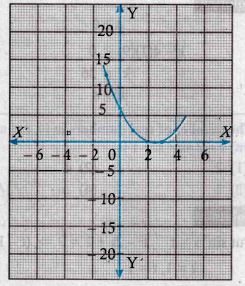
(1, 2), (0, 6), (-1, 12)
P(x) = (x2-5x + 6) (x2-5x+16)
= x4- 5x3+16x2-5x+25x2- 80x + 6x2- 30x + 96 = 0
x4-10x3+ 47x2 -110x + 96 = 0
It has two sign changes
\(\therefore\) it has two positive real roots
P(-x) = x4-10x3+ 47x2 -110x + 96
It has no sign changes, no negative real roots
y = x2- 5x + 16
| x | 0 | 1 | -1 | 2 | 4 |
| y | 16 | 12 | 23 | 10 | 12 |
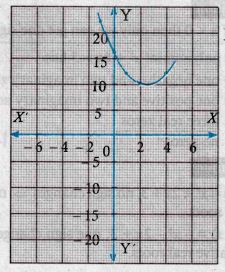
16.
Let the amount of 50% acid be x and the amount of 25% acid be y litre
By the given data, x + y = 10 ..............(1)
and \(x\left( \frac { 50 }{ 100 } \right) +y\left( \frac { 25 }{ 100 } \right) =10\left( \frac { 40 }{ 100 } \right) \)
⇒ 50x + 25y = 400 ⇒ 2x + y = 16 ...............(2)
The matrix from of the equation is \(\left[ \begin{matrix} 1 & 1 \\ 2 & 1 \end{matrix} \right] \left[ \begin{matrix} x \\ y \end{matrix} \right] =\left[ \begin{matrix} 10 \\ 16 \end{matrix} \right] \)
⇒ AX = B where A =\(\left[ \begin{matrix} 1 & 1 \\ 2 & 1 \end{matrix} \right] \)
\(X=\left[ \begin{matrix} x \\ y \end{matrix} \right] ,B=\left[ \begin{matrix} 10 \\ 16 \end{matrix} \right] \)
⇒ X = A-1N |A| = \(\left| \begin{matrix} 1 & 1 \\ 2 & 1 \end{matrix} \right| \) = 1 - 2 = -1
⇒ X = \(\frac { 1 }{ |A| } \)adj A.B
⇒ X= \(-1\left[ \begin{matrix} 1 & -1 \\ -2 & 1 \end{matrix} \right] \left[ \begin{matrix} 10 \\ 16 \end{matrix} \right] \)
= -\(\left[ \begin{matrix} 10-16 \\ -20+16 \end{matrix} \right] \)
⇒ X = -\(\left[ \begin{matrix} -6 \\ -4 \end{matrix} \right] =\left[ \begin{matrix} 6 \\ 4 \end{matrix} \right] \)
Thus, the amount of 50% acid is 6 litre and the amount of 25% acid is 4 litre = 10 litres of 40% acid solution.
17.
Since the sum of the co-efficients = 2 - 1- 1 = 0
x = 1 is a root.
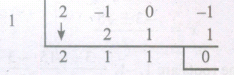
∴ x = 1 is a root and the remaining factor is
2x2+x+1
\(\Rightarrow x=\frac {-1\pm \sqrt { { 1 }^{ 2 }-4(2)(1) } }{ 2 } \)
\(\Rightarrow x=\frac { -1\pm \sqrt { -7 } }{ 2 } \) Which is a complex root.
\(\Rightarrow x=\frac { -1\pm \sqrt { -7 } }{ 2 } \)
∴ x = 1 is the rational root.
18.
\(\left[ \begin{matrix} 2 & -1 \\ 5 & -2 \end{matrix} \right] \)
Let A =\(\left[ \begin{matrix} 2 & -1 \\ 5 & -2 \end{matrix} \right] \)
Applying Gauss - Jordan method, we get
[A|I2] =\(\left[ \begin{matrix} 2 & -1 \\ 5 & -2 \end{matrix}|\begin{matrix} 1 & 0 \\ 0 & 1 \end{matrix} \right] \)
\(\overset { { R }_{ 1 }\rightarrow { R }_{ 1 }\div 2 }{ \longrightarrow } \left[ \begin{matrix} 1 & -\frac { 1 }{ 2 } \\ 5 & -2 \end{matrix}|\begin{matrix} \frac { 1 }{ 2 } & 0 \\ 0 & 1 \end{matrix} \right] \)
\(\overset { { R }_{ 2 }\rightarrow { R }_{ 2 }-5{ R }_{ 1 } }{ \longrightarrow } \left[ \begin{matrix} 1 & -\frac { 1 }{ 2 } \\ 5 & -2 \end{matrix}|\begin{matrix} \frac { 1 }{ 2 } & 0 \\ -\frac { 5 }{ 2 } & 1 \end{matrix} \right] \)
\(\overset { { R }_{ 2 }\rightarrow { R }_{ 2 }\times 2 }{ \longrightarrow } \left[ \begin{matrix} 1 & -\frac { 1 }{ 2 } \\ 0 & 1 \end{matrix}|\begin{matrix} \frac { 1 }{ 2 } & 0 \\ -5 & 2 \end{matrix} \right] \)
\(\overset { { R }_{ 1 }\rightarrow { R }_{ 1 }+\frac { 1 }{ 2 } { R }_{ 2 } }{ \longrightarrow } \left[ \begin{matrix} 1 & 0 \\ 0 & 1 \end{matrix}|\begin{matrix} -2 & 1 \\ -5 & 2 \end{matrix} \right] \)
∴ We get A-1=\(\left[ \begin{matrix} -2 & 1 \\ -5 & 2 \end{matrix} \right] \)
19.
Since the sum of the co-efficients is
2 - 9 + 10 - 3 = 12 - 12 = 0
⇒ x = 1 is a root of (x)
∴ (x - 1) is a factor of (x)
To find the other factor, let us divide f(x) by x-1
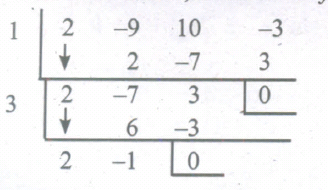
[Using synthetic division]
f(x) = (x-1)(x - 3)(2x - 1) = 0
⇒x - 1 = 0, x - 3 = 0 or 2x - 1 = 0
⇒ x = 1, x = 3x, x = \(\frac{1}{2}\)
Hence the roots are 1, 3, \(\frac{1}{2}\).
20.
Given A =\(\left[ \begin{matrix} 0 & 1 & 1 \\ 1 & 0 & 1 \\ 1 & 1 & 0 \end{matrix} \right] \)
|A| = 0-1\(\left| \begin{matrix} 1 & 1 \\ 1 & 0 \end{matrix} \right| +1\left| \begin{matrix} 1 & 0 \\ 1 & 1 \end{matrix} \right| \)
= -1(0-1) + 1(1-0) = 1 + 1 = 2
adj A =\(\left[ \begin{matrix} +\left| \begin{matrix} 0 & 1 \\ 1 & 0 \end{matrix} \right| & -\left| \begin{matrix} 1 & 1 \\ 1 & 0 \end{matrix} \right| & +\left| \begin{matrix} 1 & 0 \\ 1 & 1 \end{matrix} \right| \\ -\left| \begin{matrix} 1 & 1 \\ 1 & 0 \end{matrix} \right| & +\left| \begin{matrix} 0 & 1 \\ 1 & 0 \end{matrix} \right| & -\left| \begin{matrix} 0 & 1 \\ 1 & 1 \end{matrix} \right| \\ +\left| \begin{matrix} 1 & 1 \\ 0 & 1 \end{matrix} \right| & -\left| \begin{matrix} 0 & 1 \\ 1 & 1 \end{matrix} \right| & +\left| \begin{matrix} 0 & 1 \\ 1 & 0 \end{matrix} \right| \end{matrix} \right] ^{ T }\)
=\(\left[ \begin{matrix} (0-1) & -(0-1) & +(1-0) \\ -(0-1) & +(0-1) & -(0-1) \\ +(1+0) & -(0-1) & +(0-1) \end{matrix} \right] ^{ T }\)
=\(\left[ \begin{matrix} -1 & 1 & 1 \\ 1 & -1 & 1 \\ 1 & 1 & -1 \end{matrix} \right] ^{ T }=\left[ \begin{matrix} -1 & 1 & 1 \\ 1 & -1 & 1 \\ 1 & 1 & -1 \end{matrix} \right] \)
∴ A-1 = \(\frac { 1 }{ 2 } \left[ \begin{matrix} -1 & 1 & 1 \\ 1 & -1 & 1 \\ 1 & 1 & -1 \end{matrix} \right] \) ................(1)
Now A2 =\(\left[ \begin{matrix} 0 & 1 & 1 \\ 1 & 0 & 1 \\ 1 & 1 & 0 \end{matrix} \right] \left[ \begin{matrix} 0 & 1 & 1 \\ 1 & 0 & 1 \\ 1 & 1 & 0 \end{matrix} \right] \)
=\(\left[ \begin{matrix} 0+1+1 & 0+0+1 & 0+1+0 \\ 0+0+1 & 1+0+1 & 1+0+0 \\ 0+1+0 & 1+0+0 & 1+1+0 \end{matrix} \right] =\left[ \begin{matrix} 2 & 1 & 1 \\ 1 & 2 & 1 \\ 1 & 1 & 2 \end{matrix} \right] \)
A2- 3I =\(\left[ \begin{matrix} 2 & 1 & 1 \\ 1 & 2 & 1 \\ 1 & 1 & 2 \end{matrix} \right] -3\left[ \begin{matrix} 1 & 0 & 0 \\ 0 & 1 & 0 \\ 0 & 0 & 1 \end{matrix} \right] \)
=\(\left[ \begin{matrix} 2-3 & 1-0 & 1-0 \\ 1-0 & 2-3 & 1-0 \\ 1-0 & 1-0 & 2-3 \end{matrix} \right] =\left[ \begin{matrix} -1 & 1 & 1 \\ 1 & -1 & 1 \\ 1 & 1 & -1 \end{matrix} \right] \) .............(2)
From (1) and (2), it is proved that A-1 = \(\frac{1}{2}\) [A2 - 3I]
21.
Let ∝, β, ૪ be the roots of the equation
Given \(\frac { \alpha }{ \beta } =\frac { 3 }{ 2 } \Rightarrow 2\alpha =3\beta \Rightarrow \alpha =\frac { 3 }{ 2 } \beta \)
\(\therefore \frac { 3 }{ 2 } \beta ,\beta ,\gamma \) are the roots of the given equation
Then by Vieta's formula,
\(\frac { 3 }{ 2 } \beta +\beta +\gamma =\frac { -b }{ a } =\frac { -(-9) }{ 1 } =9\)
\(\frac { 5 }{ 2 } \beta +\gamma =9\Rightarrow \gamma =9-\frac { 5 }{ 2 } \beta \)
\(\Rightarrow \gamma =\frac { 18-5\beta }{ 2 } ...(2)\)
Also \(\frac { 3 }{ 2 } \beta (\beta )+\beta \gamma +\left( \frac { 3 }{ 2 } \beta \right) \gamma =\frac { c }{ a } =\frac { 14 }{ 1 } =14\)
\(\Rightarrow \frac { 3 }{ 2 } { \beta }^{ 2 }+\frac { 5 }{ 2 } \beta \left( \frac { 18-5\beta }{ 2 } \right) =14\ [using\ (2)]\)
\(\Rightarrow \frac { 3 }{ 2 } { \beta }^{ 2 }+\frac { 90\beta }{ 4 } -\frac { 25{ \beta }^{ 2 } }{ 4 } =14\)
Multiplying by \(4,6{ \beta }^{ 2 }+90{ \beta }-25{ \beta }^{ 2 }=56\)
\(19{ \beta }^{ 2 }-90{ \beta }+56=0\)
\(\Rightarrow ({ \beta }-4)(19{ \beta }-14)=0\)
\(\Rightarrow { \beta }=4\)
\({ \beta }=\frac { 14 }{ 19 } \)
When \(\beta\) = 4, the other roots are \(\frac { 3 }{ 2 } (4),4,\frac { 18-5 }{ 2 } (4)\)
\(\Rightarrow 6,4,-1\)
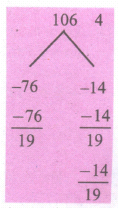
When \(\\ \beta =\frac { 14 }{ 19 } ,\) the other roots are \(\frac { 3 }{ 2 } \beta ,\beta \frac { 18-5\beta }{ 2 } [by(2)]\)
\(\Rightarrow \frac { 3 }{ 2 } \left( \frac { 14 }{ 19 } \right) ,\frac { 14 }{ 19 } ,\frac { 18-5\left( \frac { 14 }{ 19 } \right) }{ 2 } \Rightarrow \frac { 21 }{ 19 } ,\frac { 14 }{ 19 } ,\frac { 136 }{ 19 } \)
22.
Given equation is 2x4- 8x + 6x2- 3 = 0
Here a = 2, b = -8, c = 6, d = 0, e = -3
Let ∝, β, ૪ and \(\delta \) be the roots of equation (1)
Then by Vieta's formula,
\(\sum { _{ 1 }= } \alpha +\beta +\gamma +\delta =\frac { -b }{ a } =\frac { -(-8) }{ 2 } =4\)
\(\sum { _{ 2 } } =\alpha \beta +\alpha \gamma +\alpha \delta +\beta \gamma +\beta \delta +\gamma \delta =\frac { c }{ a } =\frac { 6 }{ 2 } =3\)
\(\sum { _{ 3 } } =\alpha \beta \gamma +\alpha \beta \delta +\alpha \gamma \delta +\beta \gamma \delta =\frac { -d }{ a } =\frac { 0 }{ a } \)
\(\sum { _{ 4 } } =\alpha \beta \gamma \delta =\frac { e }{ a } =\frac { -3 }{ 2 } \)
Now, (a+b+c+d)2 = a2+b2+c2+d2+2(ab+ac+ad+bc+cd)
⇒ n∝2+β2+૪2+\(\delta\)2 = (∝ + β + ૪ + \(\delta\))2-2(\(\alpha \beta +\alpha \gamma +\alpha \delta +\beta \gamma +\beta \delta +\gamma \delta \))
∝2 + β2 + ૪2 = 42-2(3) = 16 - 6 = 10

12th Standard Syllabus & Materials
12th Standard
TN 12th Computer Applications களப்பெயர் முறைமை (DNS) Sample Question Papers Study Material - QB365 Set A
NEW12th Standard
TN 12th Computer Applications வலையமைப்பு எடுத்துக்காட்டுகள் மற்றும் நெறிமுறைகள் Sample Question Papers Study Material - QB365 Set A
NEW12th Standard
TN 12th Computer Applications கணினி வலையமைப்பு ஓர் அறிமுகம் Sample Question Papers Study Material - QB365 Set A
NEW12th Standard
TN 12th Computer Applications PHP-உடன் MySQL-ஐ இணைத்தல் Sample Question Papers Study Material - QB365 Set A



Tamilnadu Stateboard 12th Standard Subjects
Maths

Chemistry

Physics

Biology

Computer Science

Business Maths and Statistics

Economics

Commerce

Accountancy

History

Computer Applications
Biology
Computer Technology
Computer Applications
Computer Science
Business Maths and Statistics
Commerce
Economics
Maths
Chemistry
Physics
Computer Technology
History
Accountancy

Tamil

English

French
Tamilnadu Stateboard Standards


