
 100% FREE ACCESS
12th Standard Syllabus & Materials
12th Standard
TN 12th Computer Applications மின்னணு தரவு பரிமாற்றம் Sample Question Papers Study Material - QB365 Set A
NEW12th Standard
TN 12th Computer Applications மின் - வணிக பாதுகாப்பு அமைப்புகள் Sample Question Papers Study Material - QB365 Set A
NEW12th Standard
TN 12th Computer Applications மின்னணு செலுத்தல் முறைகள் Sample Question Papers Study Material - QB365 Set A
NEW12th Standard
TN 12th Computer Applications மின் - வணிகம் Sample Question Papers Study Material - QB365 Set A
NEW12th Standard
TN 12th Computer Applications திறந்த மூல கருத்துருக்கள் Sample Question Papers Study Material - QB365 Set A
NEW12th Standard
TN 12th Computer Applications வலையமைப்பு வடமிடல் Sample Question Papers Study Material - QB365 Set A

Published on: 28/11/2025
Download Tamil Nadu 12th Standard Maths question papers, model tests, one-mark questions, important questions, and public exam papers in PDF format. Free study materials and answer keys for TN State Board students.
Questions + Answers key
Take MCQ Maths Test
1.
Let \(*\) be defined on R by (a \(*\) b) = a + b + ab - 7. Is \(*\) binary on R? If so, find 3 \(*\)\(\left( \frac { -7 }{ 15 } \right) \).
2.
3.
Compute P(X = k) for the binomial distribution, B(n, p) where
n = 6, \(p=\frac { 1 }{ 3 } \), k = 3
4.
Evaluate the following
\(\int _{ 0 }^{ \pi /2 }{ { sin }^{ 10 }x\quad dx } \)
5.
Find the value of \({ sin }^{ -1 }\left( sin\left( \frac { 5\pi }{ 4 } \right) \right) \)
6.
Find the distance of a point (2, 5, −3) from the plane \(\vec { r } .(6\hat { i } -3\hat { j } +2\hat { k } )\) = 5
7.
8.
Prove that \(\left[ \begin{matrix} \cos { \theta } & -\sin { \theta } \\ \sin { \theta } & \cos { \theta } \end{matrix} \right] \) is orthogonal.
9.
Find the general equation of a circle with centre (-3, -4) and radius 3 units.
10.
If α and β are the roots of the quadratic equation 2x2−7x+13 = 0 , construct a quadratic equation whose roots are α2 and β2.
11.
Show that ¬( p ∧ q) ≡ ¬p V ¬q
12.
The probability density function of X is given by \(f(x)=\begin{cases} \begin{matrix} kxe^{ -2x } & forx>0 \end{matrix} \\ \begin{matrix} 0 & for\quad x\le 0 \end{matrix} \end{cases}\) Find the value of k.
13.
Suppose f(x) is a differentiable function for all x with f'(x) ≤ 29 and f(2) = 17. What is the maximum value of f(7)?
14.
Show that y = ax + \(\frac { b }{ x } \), x ≠ 0 is a solution of the differential equation x2 y" + xy' - y = 0.
15.
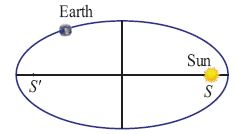
The maximum and minimum distances of the Earth from the Sun respectively are 152 × 106 km and 94.5 × 10⁶ km. The Sun is at one focus of the elliptical orbit. Find the distance from the Sun to the other focus.
16.
17.
Solve the following system of linear equations by matrix inversion method:
2x + 5y = −2, x + 2y = −3
18.
If |z| = 2 show that \(3\le \left| z+3+4i \right| \le 7\)
19.
Find a polynomial equation of minimum degree with rational coefficients, having 2i+3 as a root.
20.
For what value of x, the inequality \(\frac { \pi }{ 2 } <{ cos }^{ -1 }(3x-1)<\pi \) holds?
21.
Prove p⟶(q⟶r) ☰ (p ∧ q)⟶r without using truth table.
22.
If u = sin-1 \(\left( \frac { x+y }{ \sqrt { x } +\sqrt { y } } \right) \), Show that \(x\frac { \partial u }{ \partial x } +y\frac { \partial u }{ \partial y } =\frac { 1 }{ 2 } tanu\)
23.
Two balls are chosen randomly from an urn containing 8 white and 4 black balls. Suppose that we win Rs. 20 for each black ball selected and we lose Rs. 10 for each white ball selected. Find the expected winning amount and variance
24.
25.
Show that \(\int ^{1}_{0} (tan ^{-1} x + tan ^{-1}(1-x))\) dx = \(\frac {\pi}{2}\) - loge2
26.
In a murder investigation, a corpse was found by a detective at exactly 8 p.m. Being alert, the detective also measured the body temperature and found it to be 70oF. Two hours later, the detective measured the body temperature again and found it to be 60oF. If the room temperature is 50oF, and assuming that the body temperature of the person before death was 98.6oF, at what time did the murder occur? [log(2.43) = 0.88789; log(0.5)=-0.69315]
27.
Prove that the ellipse x2 + 4y2 = 8 and the hyperbola x2-2y2 = 4 intersect orthogonally.
28.
A camera is accidentally knocked off an edge of a cliff 400 ft high. The camera falls a distance of s = 16t2 in t seconds.
(i) How long does the camera fall before it hits the ground?
(ii) What is the average velocity with which the camera falls during the last 2 seconds?
(iii) What is the instantaneous velocity of the camera when it hits the ground?
29.
Solve the equation z3+ 8i = 0, where \(z \in \mathbb{C}\)
30.
31.
A boy is walking along the path y = ax2 + bx + c through the points (−6, 8), (−2, −12) and (3, 8). He wants to meet his friend at P(7, 60). Will he meet his friend? (Use Gaussian elimination method.)
32.
If cos−1 x + cos−1 y + cos−1 z = \(\pi \) and 0 < x, y, z < 1, show that x2
33.
34.
35.
36.
\(\text { The value of } \int_{0}^{\frac{2}{3}} \frac{d x}{\sqrt{4-9 x^{2}}} \text { is }\)
\(\frac{\pi}{6}\)
\(\frac{\pi}{2}\)
\(\frac{\pi}{4}\)
\({\pi}\)
37.
38.
The value of \(\int _{ 0 }^{ \pi }{ \frac { dx }{ 1+{ 5 }^{ cos\ x } } } \) is
\(\frac{\pi}{2}\)
\(\pi\)
\(\frac{3\pi}{2}\)
\(2\pi\)
39.
The approximate change in the volume V of a cube of side x metres caused by increasing the side by 1% is
0.3xdx m3
0.03x m3
0.03x2 m3
0.03x3 m3
40.
If X is a binomial random variable with expected value 6 and variance 2.4, then P(X = 5) is
\(\left( \frac { 10 }{ 5 } \right) \left( \frac { 3 }{ 5 } \right) ^{ 6 }\left( \frac { 2 }{ 5 } \right) ^{ 4 }\)
\(\left( \frac { 10 }{ 5 } \right) \left( \frac { 3 }{ 5 } \right) ^{ 10 }\)
\(\left( \frac { 10 }{ 5 } \right) { \left( \frac { 3 }{ 5 } \right) }^{ 4 }\left( \frac { 2 }{ 5 } \right) ^{ 6 }\)
\(\left( \frac { 10 }{ 5 } \right) \left( \frac { 3 }{ 5 } \right) ^{ 5 }\left( \frac { 2 }{ 5 } \right) ^{ 5 }\)
41.
The solution of the differential equation \(\frac { dy }{ dx } =2xy\) is
y = Cex2
y = 2x2 + C
y = Ce−x2 + C
y = x2 + C
42.
The order and degree of the differential equation \(\sqrt { sinx } (dx+dy)=\sqrt { cos x } (dx-dy)\) is
1, 2
2, 2
1, 1
2, 1
43.
The number given by the Mean value theorem for the function \(\frac { 1 }{ x } \), x ∈ [1, 9] is
2
2.5
3
3.5
44.
The position of a particle moving along a horizontal line of any time t is given by s(t) = 3t2 -2t- 8. The time at which the particle is at rest is
t = 0
\(\\ \\ \\ t=\cfrac { 1 }{ 3 } \)
t =1
t = 3
45.
If \(\rho\) (A) = \(\rho\)([A| B]), then the system AX = B of linear equations is
consistent and has a unique solution
consistent
consistent and has infinitely many solution
inconsistent
46.
47.
The vector equation \(\vec { r } =(\hat { i } -2\hat { j } -\hat { k } )+t(6\hat { j } -\hat { k) } \) represents a straight line passing through the points
(0, 6, −1) and (1, −2, −1)
(0, 6, −1) and (-1, −4, −2)
(1, -2, -1) and (1, 4, -2)
(1, -2, -1) and (0, -6, 1)
48.
49.
If the coordinates at one end of a diameter of the circle x2 + y2 − 8x − 4y + c = 0 are (11, 2), the coordinates of the other end are
(-5, 2)
(-3, 2)
(5, -2)
(-2, 5)
50.
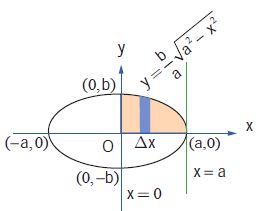
Area of the greatest rectangle inscribed in the ellipse \(\frac{x^{2}}{a^{2}}+\frac{y^{2}}{b^{2}}=1\) is
2ab
ab
\( \sqrt{ ab}\)
\(\frac { a }{ b } \)
51.
52.
If \(\alpha \) and \(\beta \) are the roots of x2+x+1 = 0, then \({ \alpha }^{ 2020 }+{ \beta }^{ 2020 }\) is
-2
-1
1
2
53.
If α, β and γ are the zeros of x3 + px2 + qx + r, then \(\Sigma \frac { 1 }{ \alpha } \) is
\(-\frac { q }{ r } \)
\(-\frac { p }{ r } \)
\(\frac { q }{ r } \)
\(-\frac { q }{ p } \)
54.
If |z - 2 + i | ≤ 2, then the greatest value of |z| is
\(\sqrt { 3 } -2\)
\(\sqrt { 3 } +2\)
\(\sqrt { 5 } -2\)
\(\sqrt { 5 } +2\)
1.
Given a*b = a + b + ab -7, ∀ a,b ∈R
If a ∈R, b∈R then ab ∈ R
(a*b) = a +b+ ab - 7 ∈R
For example, let 1, 2 ∈ R
(1*2) = 1+2+(1)(2)-7
= 2 ∈ R
* a binary operation on R
\(3 *\left(\frac{-7}{15}\right)=3-\frac{7}{15}+\gamma^1\left(\frac{-7}{15_5}\right)-7\)
[Here a = 3, b = \(\frac{-7}{15}\)]
\(=3-\frac { 7 }{ 15 } -\frac { 21 }{ 15 } -7\)
\(\therefore 3*\left( \frac { -7 }{ 15 } \right) =\frac { -88 }{ 15 }\)
2.
3.
Given n = 6, \(p=\frac { 1 }{ 3 }\), k = 3
\(P(X=k)=\left( \begin{matrix} n \\ k \end{matrix} \right) { p }^{ k }\left( 1-p \right) ^{ n-k },\)
n = 0,1,2, ... n
\(\therefore P(X=k)=\left( \begin{matrix} n \\ k \end{matrix} \right) { p }^{ k }(1-p)^{ n-k }\)
n = 0,1,2, ... n
\(P(X=3)=\left( \begin{matrix} 6 \\ 3 \end{matrix} \right) \left( \cfrac { 1 }{ 3 } \right) ^{ 3 }\left( 1-p \right) ^{ 6-3 }\)
= \(\left( \begin{matrix} 6 \\ 3 \end{matrix} \right) \left( \cfrac { 1 }{ 3 } \right) ^{ 3 }\left( \cfrac { 2 }{ 3 } \right) ^{ 2 }\)
\(=\frac{6 \times 5 \times 4}{8 \times 2 \times 1} \times \frac{1}{27} \times \frac{8}{27}\)
\(P(X=3)=\frac { 160 }{ 729 }\)
4.
\({ I }_{ n }=\int _{ 0 }^{ \pi /2 }{ { sin }^{ n }x } =\frac { n-1 }{ n } { I }_{ n-2 },n\ge 2\)
\(Let\quad { I }_{ 10 }=\int _{ 0 }^{ \pi /2 }{ { sin }^{ 10 }xdx=\frac { 9 }{ 10 } { I }_{ 8 } } \)
\(=\frac { 9 }{ 10 } \times \frac { 7 }{ 8 } \times { I }_{ 6 }=\frac { 9 }{ 10 } \times \frac { 7 }{ 8 } \times \frac { 5 }{ 6 } \times { I }_{ 4 }\)
\(\\ =\frac { 9 }{ 10 } \times \frac { 7 }{ 8 } \times \frac { 5 }{ 6 } \times \frac { 3 }{ 4 } { I }_{ 2 }\)
\(=\frac { 9 }{ 10 } \times \frac { 7 }{ 8 } \times \frac { 5 }{ 6 } \times \frac { 3 }{ 4 } \times \frac { 1 }{ 2 } \times \frac { \pi }{ 2 } \)
\(=\frac { 315 }{ 1280 } \times \frac { \pi }{ 2 } =\frac { 63\pi }{ 256(2) } =\frac { 63\pi }{ 512 } \)
5.
\({ sin }^{ -1 }\left( sin\left( \frac { 5\pi }{ 4 } \right) \right) \)
= \({ sin }^{ -1 }\left( sin\left( \pi +\frac { \pi }{ 4 } \right) \right) \) \(\because \frac { 5\pi }{ 4 } \notin \left[ \frac { -\pi }{ 2 } ,\frac { \pi }{ 2 } \right] \)
= \({ sin }^{ -1 }\left( sin\left( -\frac { \pi }{ 4 } \right) \right) \)
= \( \frac {- \pi }{ 4 } \epsilon \left[ \frac { -\pi }{ 2 } ,\frac { \pi }{ 2 } \right] \)
6.
Comparing the given equation of the plane with \(\vec { r } .\vec { n } \) = p, we have \(\vec { n } =6\hat { i } -3\hat { j } +2\hat { k } \).
We know that the perpendicular distance from the given point with position vector u to the plane \(\vec { r } .\vec { n } \)= p is given by \(\delta =\frac { |\vec { u } .\vec { n } -p| }{ |\vec { n } | } \). Therefore, substi \(\vec { u } \)= (2, 5, -3) = \(2\hat { i } +5\hat { j } -3\hat { k } \) and \(\ \vec { n } =6\hat { i } -3\hat { j } +2\hat { k } \) in the formula, we get
\(\delta =\frac { |\vec { u } .\vec { n } -p| }{ |\vec { n } | } =\frac { |(2\hat { i } +5\hat { j } -3\hat { k } ).(6\hat { i } -3\hat { j } +2\hat { k } )-5| }{ |6\hat { i } -3\hat { j } +2\hat { k } | } \) = 2 unit.
7.
8.
Let A = \(\left[ \begin{matrix} \cos { \theta } & -\sin { \theta } \\ \sin { \theta } & \cos { \theta } \end{matrix} \right] \). Then, AT = \({ \left[ \begin{matrix} \cos { \theta } & -\sin { \theta } \\ \sin { \theta } & \cos { \theta } \end{matrix} \right] }^{ T }=\left[ \begin{matrix} \cos { \theta } & \sin { \theta } \\ -\sin { \theta } & \cos { \theta } \end{matrix} \right] \)
So, we get
AAT = \({ \left[ \begin{matrix} \cos { \theta } & -\sin { \theta } \\ \sin { \theta } & \cos { \theta } \end{matrix} \right] }\left[ \begin{matrix} \cos { \theta } & \sin { \theta } \\ -\sin { \theta } & \cos { \theta } \end{matrix} \right] \)
= \(\left[ \begin{matrix} \cos ^{ 2 }{ \theta +\sin ^{ 2 }{ \theta } } & \cos { \theta \sin { \theta } } -\sin { \theta \cos { \theta } } \\ \sin { \theta \cos { \theta -\cos { \theta \sin { \theta } } } } & \sin ^{ 2 }{ \theta } +\cos ^{ 2 }{ \theta } \end{matrix} \right] =\left[ \begin{matrix} 1 & 0 \\ 0 & 1 \end{matrix} \right] \) = I2
Similarly, we get ATA = I2. Hence AAT = ATA = I2 ⇒ A is orthogonal.
9.
Equation of the circle in standard form is (xr − h)2 + (y − k)2 = r2
\( \Rightarrow (x-(-3))^{2}+(y-(-4))^{2} =3^{2} \)
\( \Rightarrow (x+3)^{2}+(y+4)^{2} =3^{2} \)
\( \Rightarrow x^{2}+y^{2}+6 x+8 y+16 =0 .\)
10.
Since α and β are the roots of the quadratic equation, we have α + β =\(\frac { 7 }{ 2 } \) and αβ = \(\frac { 13 }{ 2 } \).
Thus, to construct a new quadratic equation,
Sum of the roots = α2+β2 = (α+β)2-2αβ =\(\frac { -3 }{ 4 } \)
Product of the roots = α2β2 = (αβ)2 = \(\frac { 169 }{ 4 }\)
Thus a required quadratic equation is x2+\(\frac { 3 }{ 4 } x+\frac { 169 }{ 4 } \)= 0.
From this we see that 4x2+3x+169 = 0 is a quadratic equation with roots α2 and β2.
11.
~( p ∧ q) ≡ ~p V ~q
| p | q | p ∧ q | ~(p ∧ q) | ~p | ~p | ~p V ~q |
| T | T | T | F | F | F | F |
| T | F | F | T | F | T | T |
| F | T | F | T | T | F | T |
| F | F | F | T | T | T | T |
From column (4) and column (7), the entries are Identical.
ஃ ~( p ∧ q) ≡ ~p V ~q are identical and hence they are equivalent.
12.
Given \(f(x)=\begin{cases} \begin{matrix} kxe^{ -2x } & forx>0 \end{matrix} \\ \begin{matrix} 0 & for\quad x\le 0 \end{matrix} \end{cases}\)
Since the given function is a probability density function
\(\int _{ -\infty }^{ \infty }{ f(x)dx } \) = 1
\(\Rightarrow k\int _{ 0 }^{ \infty }{ { xe }^{ -2x }dx=1 } \)
\(\Rightarrow k \frac { 1! }{ \left( 2 \right) ^{ 2 } } =1\)
[\(\int _{ 0 }^{ \infty }{ { x }^{ n }e^{ -ax } } =\frac { n! }{ { a }^{ +1 } } \), Here a = 2, n = 1]
\(\Rightarrow \frac { k }{ 4 } =1\\ \Rightarrow k=4\)
13.
By the mean value theorem we have, there exists 'c'∈(2, 7) such that,
\(\frac { f(7)-f(2) }{ 7-2 } \) = f'(c) ≤ 29
Hence, f(7) ≤ 5× 29 +17 = 162
Therefore, the maximum value of f (7) is 162.
14.
Given y = ax + \(\frac { b }{ x } \) .......(1)
Differentiating with respect to x
y' = ax - \(\frac { b }{ x ^2} \) ......(2)
Differentiating again with respect to x
\(y'' = \frac{-b(-2)}{x^3}= \frac{2b}{x^3}
\)
\(Now, x^2y'' + xy'-y
\)
\( = x^2 \times \frac{2b}{x^3}+x(a- \frac{b}{x^2})-(ax+\frac{b}{x})
\)
\(= 2\times (\frac{b}{x})+ax-(\frac{b}{x})-ax-(\frac{b}{x})\)
= 0
Hence, y = ax + b is the solution of the differential equation x2y"+xy'-y = 0.
15.
AS = 94.5 × 10⁶ km,
SA' = 152 × 106 km
a+c = 152 × 106
a-c = 94.5 × 10⁶
Subtracting 2c = 57.5 × 106 = 575 × 105 km
Distance of the Sun from the other focus is SS' = 575 × 105 km.
16.
17.
2x+5y = -2, x+2y = -3
The matrix form of the system is
\(\left( \begin{matrix} 2 & 5 \\ 1 & 2 \end{matrix} \right) \left( \begin{matrix} x \\ y \end{matrix} \right) =\left( \begin{matrix} -2 \\ -3 \end{matrix} \right) \)
⇒ AX = B where
A =\(\left( \begin{matrix} 2 & 5 \\ 1 & 2 \end{matrix} \right) ,B=\left( \begin{matrix} -2 \\ -3 \end{matrix} \right) \)
X =\(\left( \begin{matrix} x \\ y \end{matrix} \right) \)
⇒ = A-1B
|A| = \(\left| \begin{matrix} 2 & 5 \\ 1 & 2 \end{matrix} \right| \)= 4 - 5 = -1 ≠ 0
∴ A-1 =\(\frac { 1 }{ |A| } adjA=\frac { 1 }{ -1 } \left[ \begin{matrix} 2 & -5 \\ -1 & 2 \end{matrix} \right] \)
=\(\left[ \begin{matrix} -2 & 5 \\ 1 & -2 \end{matrix} \right] \)
∴ X = A-1B =\(\left[ \begin{matrix} -2 & 5 \\ 1 & -2 \end{matrix} \right] \left[ \begin{matrix} -2 \\ -3 \end{matrix} \right] \)
= \(\left[ \begin{matrix} 4-15 \\ -2+6 \end{matrix} \right] =\left[ \begin{matrix} -11 \\ 4 \end{matrix} \right] \)
∴ Solution set is x = -11, y = 4
18.

\(\left| z+3+4i \right| \le \left| z \right| +\left| 3+4i \right| =2+5=7\)
\(\left| z+3+4i \right| \le 7\) .............. (1)
\(\left| z+3+4i \right| \ge \left| \left| z \right| -\left| 3+4i \right| \right| =\left| 2-5 \right| =3\)
\(\left| z+3+4i \right| \ge 3\) ............ (2)
From (1) and (2) we get, \(3\le \left| z+3+4i \right| \le 7\)
19.
Given 2i + 3 is a root
∴ Its conjugate 3 - 2i is also a root of the polynomial equation.
∴ Sum of the roots 3 + 2i + 3 - 2i = 6
Product of the roots = (3 + 2i) (3 - 2i)
= 32 + 22 = 9+ 4 = 13
∴ The polynomial equation of minimum degree with rational co-efficients is
x2 - x (sum of the roots) + product of the roots = 0
⇒x2 -x (6) + 13 = 0
⇒ x2- 6x + 13 = 0
20.
Given \(\frac { \pi }{ 2 } <{ cos }^{ -1 }(3x-1)<\pi \)
\((cos2\frac { \pi }{ 2 } <3x-1\))
\(\Rightarrow 0<3x-1<-1\)
\(0+1<3x<-1+1\)
\(1<3x<0\)
21.
Prove that p⟶(q⟶r) = (p ∧ q)⟶r without using truth table. From example we know that p⟶ q = ~p V q
Consider LHS = p⟶(q⟶r)
= p ⟶ (~q V r) [Implication Law]
= ~p V (~q V r) [Implication Law]
= (~p V ~q) V r [associative property]
= ~(p ∧ q) V r [using Demorgan's law]
= (p ∧ q) ⟶ r [Implication Law]
Hence proved.
22.
Note that the function u is not homogeneous. So we cannot apply Euler’s Theorem for u.
However, note that f(x,y) = \(\frac { x+y }{ \sqrt { x } +\sqrt { y } }\) = sin u is homogeneous; because
f(tx,ty) = \(\frac { tx+ty }{ \sqrt { tx } +\sqrt { ty } } \) = t1/2 f(x, y), \(\forall \) x, y, t\(\ge \)0
Thus f is homogeneous with degree \(\frac { 1 }{ 2 } \) and so by Euler’s Theorem we have
\(x\frac { \partial f }{ \partial x } +y\frac { \partial f }{ \partial y } =\frac { 1 }{ 2 } f(x,y)\).
Now substituting f = sin u in the above equation, we obtain
\(x\frac { \partial (sinu) }{ \partial x } +y\frac { \partial (sinu) }{ \partial y } =\frac { 1 }{ 2 } sin \ u\)
\(x\quad cosu\frac { \partial u }{ \partial x } +y\quad cosu\frac { \partial u }{ \partial x } =\frac { 1 }{ 2 } sin \ u\) ...(19)
Dividing both sides by cosu we obtain
\(x\frac { \partial u }{ \partial x } +y\frac { \partial u }{ \partial y } =\frac { 1 }{ 2 } tan \ u\)
Note:
Solving this problem by direct calculation will be possible; but will involve lengthy calculations.
23.
Let X denote the winning amount. The possible events of selection are
(i) both balls are black, or
(ii) one white and one black or
(iii) both are white
Therefore X is a random variable that can be defined as
X (both are black balls) = Rs. 2(20) = Rs. 40
X (one black and one white ball) = Rs. 20 − Rs. 10 = Rs. 10
X (both are white balls) = (Rs. 20) = - Rs. 20
Therefore X takes on the values 40,10 and −20
Total number of balls n = 12
Total number of ways of selecting 2 balls = \(\left( \begin{matrix} 12 \\ 2 \end{matrix} \right) =\frac { 12\times 11 }{ 1\times 2 } =66\)
Number of ways of selecting 2 black balls = \(\left( \begin{matrix} 4 \\ 2 \end{matrix} \right) =6\)
Number of ways of selecting one black ball and one white ball = \(\left( \begin{matrix} 8 \\ 1 \end{matrix} \right) \left( \begin{matrix} 4 \\ 1 \end{matrix} \right) =32\)
Number of ways of selecting 2 white balls = \(\left( \begin{matrix} 8 \\ 2 \end{matrix} \right) =28\)
| Values of Random Variable X | 40 | 10 | -20 | Total |
| Number of elements in inverse images | 6 | 32 | 28 | 66 |
Probability mass function is
| X | 40 | 10 | -20 | Total |
| f (x) | \(\cfrac { 6 }{ 66 } \) | \(\cfrac { 32 }{ 66 } \) | \(\cfrac { 28 }{ 66 } \) | 1 |
Mean :
\(E(X)\Sigma xf(x)=40.\left( \frac { 6 }{ 66 } \right) +10.\left( \frac { 32 }{ 66 } \right) +\left( -20 \right) .\left( \frac { 28 }{ 66 } \right) =\frac { 4000 }{ 11 } \)
That is expected winning amount is 0
Variance :
\(\Sigma x^{ 2 }=\Sigma { x }^{ 2 }f(x)=40^{ 2 }.\left( \frac { 6 }{ 66 } \right) +10^{ 2 }.\left( \frac { 32 }{ 66 } \right) +\left( -20 \right) ^{ 2 }.\left( \frac { 28 }{ 66 } \right) =\frac { 4000 }{ 11 } \)
(E(X )2 = 02 = 0
This gives \(V(X)=E({ X }^{ 2 })-\left( E(X))^{ 2 } \right) =\frac { 4000 }{ 11 } -0=\frac { 4000 }{ 11 } \)
Therefore E(X ) = 0 and \(V(x)=\frac { 4000 }{ 11 } \)
24.
25.
I =\(\int ^{1}_{0} (tan ^{-1} x + tan ^{-1}(1-x))\) dx
=\(\int ^{1}_{0} (tan ^{-1} x dx + \int ^{1}_{0} tan ^{-1}(1-x)) dx\)
= \(\int ^{1}_{0} (tan ^{-1} x dx + \int ^{1}_{0} tan ^{-1}(1-(1-x)) dx\), Since\(\int ^{a}_{0} f (x) dx = \int ^{a}_{0} f(a-x) dx \)
=\(\int ^{1}_{0} tan ^{-1} x dx + \int ^{1}_{0} tan ^{-1} x dx\)
= 2\(\int ^{1}_{0} tan^{-1} x dx\)
= \([2 \int udv]^1_0\) , Where u = tan-1 x and dν = dx
= 2\([uν - \int udv]^1_0,\) applying integration by parts
= 2\((x tan^{-1} x - \int x \frac{dx}{1+x^2})^{1}_{0}\)
= 2\((x tan^{-1} x - \frac {1}{2} log (1+x^2))^{1}_{0}\)
= \(\frac{\pi}{2} \)- log 2
26.
Let T be the temperature of the body at any time t and with time 0 taken to be 8 p.m. By Newton’s law of cooling \(\frac { dT }{ dt } =k(T-50)or\frac { dT }{ T-50 } =dt\).
Integrating on both sides, we get log |50 −T| = kt + logC or 50 −T = Cekt.
When t = 0, T = 70, and so C = −20
When t = 2,T = 60, we have −10 = −20 ek2.
Thus, \(k=\frac { 1 }{ 2 } log\left( \frac { 1 }{ 2 } \right) \)
Hence, the solution is 50-T = -20e\(\frac{1}{2}\)tlog\((\frac{1}{2})\) or T = 50 + 20\((\frac{1}{2})^\frac{t}{2}\)
Now, we would like to find the value of t, for which T(t) = 98.6 , and t = 2\(\left( \frac { log\left( \frac { 48.6 }{ 20 } \right) }{ log\left( \frac { 1 }{ 2 } \right) } \right) \approx -2.56\)
It appears that the person was murdered at about 5.30 p.m.
27.
Let the point of intersection of the two curves be (a,b) . Hence,
\(a^{2}+4b^{2}=8\) and \(a^{2}-2b^{2}=4\) ...(4)
It is enough if we show that the product of the slopes of the two curves evaluated at (a, b) is −1.
Differentiation of \(x^{2}+4y^{2}=8\) with respect x, gives
\(2x+8y=\frac{dy}{dx}=0\).
Therefore \(\frac{dy}{dx}= -\frac{-x}{4y}\),
\((\frac{dy}{dx})_{(a,b)}=m_{1}= -\frac{a}{4b}\)
Differentiation of x2-2y2 = 4 with respect to x, gives
\(2x-4y\frac{dy}{dx}=0\)
Therefore, \(\frac{dy}{dx}=\frac{x}{2y}\),
at \((a,b)(\frac{dy}{dx})=m_{2}= \frac{a}{4b}\).
Therefore, \(m_{1}\times m_{2}=(-\frac{a}{4b})\times (\frac{a}{2b})= -\frac{a^{2}}{8b^{2}}\) ...(5)
Applying the ratio of proportions in (4), we get
\(\frac{a^{2}}{-16-16}=\frac{b^{2}}{-8+4}=\frac{1}{-2-4}\)
Therefore, \(\frac{a^{2}}{b^{2}}=\frac{32}{4}=8\) Substituting in (5), we get \(m_{1}\times m_{2}=-1\) Hence, the curves cut orthogonally.
28.
Given s (t) = 16t2, height = 400 ft.
⇒ t2 = \(\frac { 400 }{ 16 } =\frac { 100 }{ 4 } \)
t2 = 25
t = 5 sec
(ii) Average velocity = \(\frac { ds }{ dt } \) = 32 t
When t = 2 sec
Average in the last
2 sec = \(\frac { V \ at \ t=3+V \ at \ t=5 }{ 2 } \)
= \(\frac { 32(3)+32(5) }{ 2 } \)
= \(\frac { 96+160 }{ 2 } =\frac { 256 }{ 2 } \)
= 128 f/sec
(iii) Instantaneous Velocity
=\(\frac { ds }{ dt } \) = 32t
When t = 5 sec
Velocity = \(\frac { ds }{ dt } \) = 32(5)
= 160 ft/sec
29.
Let \({ z }^{ 3 }+8i=0\)
\(\Rightarrow\) z3 = -8i
= \(8(-i)=8\left( cos\left( -\frac { \pi }{ 2 } +2k\pi \right) isin\left( -\frac { \pi }{ 2 } +2k\pi \right) \right) \),k\(\in Z\)
\(z=\sqrt [ 3 ]{ 8 } \left( cos\left( \frac { -\pi +4k\pi }{ 6 } \right) +isin\left( \frac { -\pi +4k\pi }{ 6 } \right) \right) \)
Taking k = 0, 1, 2 we get,
k = 0, \(z=2\left( cos\left( -\frac { \pi }{ 6 } \right) +isin\left( -\frac { \pi }{ 6 } \right) \right) =2\left( -\frac { 1 }{ 2 } -i\frac { \sqrt { 3 } }{ 2 } \right) =2\left( \frac { \sqrt { 3 } }{ 2 } -i\frac { 1 }{ 2 } \right) \)
k = 1, \(z=2\left( cos\left( \frac { \pi }{ 2 } \right) +isin\left( \frac { \pi }{ 2 } \right) \right) =2=\left( 0+i \right) =0+2i=2i\)
k = 2,\(z=2\left( xcos\left( \frac { 7\pi }{ 6 } \right) +isim\left( \frac { 7\pi }{ 6 } \right) \right) =2\left( cos\left( \pi +\frac { \pi }{ 6 } \right) \right) +isin\left( \pi +\frac { \pi }{ 6 } \right) \)
= \(2\left( -cos\left( \frac { \pi }{ 6 } \right) -isin\left( \frac { \pi }{ 6 } \right) \right) =2\left( -\frac { \sqrt { 3 } }{ 2 } -i\frac { 1 }{ 2 } \right) =-\sqrt { 3 } -i\)
The values of z are \(\sqrt { 3 } -i,2i\) and \(-\sqrt { 3 } -i\)
30.
31.
Giveny = ax2 + bx + c .............(1)
(-6, 8) lies on (1)
⇒ 8 = a(-6)2+b(-6)+c
⇒ 8 = 36z-6b+c ..........(2)
(-2,12) lies on (1)
⇒ -12 = a(-2)2+b(-2)+c
⇒ -12 = 4a-2b+c ...........(3)
Also (3, 8) lies on (1)
⇒ 8 = a(3)2+b(3)+c
⇒ 8 = 9a+3b+c ............(4)
Reducing the augment matrix to an equivalent row-echelon form by using elementary. row operations, we get,
\(\left[ \begin{matrix} 36 & -6 & 1 \\ 4 & -2 & 1 \\ 0 & 3 & 1 \end{matrix}|\begin{matrix} 8 \\ -12 \\ 8 \end{matrix} \right] \overset { { R }_{ 2 }\rightarrow { 9R }_{ 2 }-{ R }_{ 1 }\\ { R }_{ 3 }\rightarrow 4{ R }_{ 3 }-{ R }_{ 1 } }{ \longrightarrow } \left[ \begin{matrix} 36 & -6 & 1 \\ 0 & -12 & 8 \\ 0 & 18 & 3 \end{matrix}|\begin{matrix} 8 \\ -116 \\ 24 \end{matrix} \right] \)
\(\overset { { R }_{ 2 }\rightarrow { R }_{ 2 }\div 4\\ { R }_{ 3 }\rightarrow { R }_{ 3 }\div 3 }{ \longrightarrow } \left[ \begin{matrix} 36 & -6 & 1 \\ 0 & -3 & 2 \\ 0 & 0 & 5 \end{matrix}|\begin{matrix} -8 \\ -29 \\ -8 \end{matrix} \right] \)
\(\overset { { R }_{ 3 }\rightarrow { R }_{ 3 }+2{ R }_{ 2 } }{ \longrightarrow } \left[ \begin{matrix} 36 & -6 & 1 \\ 0 & -3 & 2 \\ 0 & 0 & 5 \end{matrix}|\begin{matrix} -8 \\ -29 \\ -50 \end{matrix} \right] \)
Writing the equivalent equation from the row echelon matrix, we get
36a - 6b + c = 8 ........(1)
-3b+2c = -29 ....(2)
5c = -50
⇒ c = \(\frac{-50}{5}\) = -10
Substituting c = -10 in (2) we get,
-3b+2(-10)= -29
⇒ -3b+2(-10) = -29
⇒ -3b-20 = -29
⇒ -3b = -9
⇒ b = \(\frac{-9}{-3}\) = 3
Substituting b = 3 and c = -10 in (1) we get,
36a-6(3)-10 = 8
⇒ 36a-18-10 = 8
⇒ 36a-28 = 8
⇒ 6a = 8+28 = 36
⇒ a = \(\frac{36}{36}\) = 1
∴ a = 1, b = 3, c = -10
Hence the path of the boy is
y = 1(x2)+3(x)-10
⇒ y = x2+3x-10
Since his friend is at P(7, 60),
60 = (7)2+3(7)-10
⇒ 60 = 49+21-10
⇒ 60 = 70-10 = 60
⇒ 60 = 60
Since (7, 60) satisfies his path, he can meet his friend who is at P(7, 60)
32.
Let cos−1x = \(\alpha\) and cos-1 y = \(\beta\).
Then, x = cos\(\alpha\) and y cos =\(\beta\)
cos-1x + x + cos-1 y + cos-1x = \(\pi\) gives \(\alpha\)+\(\beta\) = \(\pi\) -cos-1z.
Now, cos(\(\alpha\)+\(\beta\)) = cos\(\alpha\)cos\(\beta\)-sin\(\alpha\)sin\(\beta\) = xy-\(\sqrt { 1-{ x }^{ 2 } } \sqrt { 1-{ y }^{ 2 } } \)
-cos(cos-1 z) = xy\(\sqrt { 1-{ x }^{ 2 } } \sqrt { 1-{ y }^{ 2 } } \)
so, \(-z=xy-\sqrt { 1-{ x }^{ 2 } } \sqrt { 1-{ y }^{ 2 } } \), Which gives -xy - z = -\(\sqrt { 1-{ x }^{ 2 } } \sqrt { 1-{ y }^{ 2 } } \)
Squaring on both sides and simplifying, we get x2 + y2 + z2 + 2xyz = 1.
33.
34.
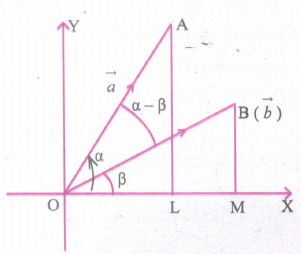
35.
(b)
36.
(a)
\(\frac{\pi}{6}\)
37.
(b)
38.
(a)
\(\frac{\pi}{2}\)
39.
\({ f }_{ y }=\frac { 1 }{ 1+\frac { { x }^{ 2 } }{ { y }^{ 2 } } } \left( \frac { -x }{ { y }^{ 2 } } \right) =\frac { -\frac { x }{ { y }^{ 2 } } }{ \frac { { x }^{ 2 }+{ y }^{ 2 } }{ { { x }{ x }^{ 2 } } } } \)
= \(\frac { -x }{ { x }^{ 2 }+{ y }^{ 2 } } \)
\({ f }_{ x }=\frac { 1 }{ 1+\frac { { x }^{ 2 } }{ { { y }^{ 2 } } } } \left( \frac { 1 }{ y } \right) =\frac { \frac { 1 }{ y } }{ \frac { { x }^{ 2 }+{ y }^{ 2 } }{ { { y }^{ 2 } } } } \)
\(=\frac { y }{ { { x }^{ 2 }+{ y }^{ 2 } } } \)
\({ f }_{ xy }=\frac { \partial }{ \partial x } ({ f }_{ y })\)
\({ f }_{ xy }=-\left[ \frac { { (x }^{ 2 }+{ y }^{ 2 })(1)-x{ (2x) } }{ { ({ x }^{ 2 }+{ y }^{ 2 }) }^{ 2 } } \right] \)
\(=-\left[ \frac { { x }^{ 2 }+{ y }^{ 2 }-2{ x }^{ 2 } }{ { ({ x }^{ 2 }+{ y }^{ 2 }) }^{ 2 } } \right] \)
\(=-\left[ \frac { { y }^{ 2 }-{ x }^{ 2 } }{ { ({ x }^{ 2 }+{ y }^{ 2 }) }^{ 2 } } \right] \)
\(=\frac { x^{ 2 }-{ y }^{ 2 } }{ { ({ x }^{ 2 }+{ y }^{ 2 }) }^{ 2 } } \) ...(1)
\({ f }_{ xy }=\frac { \partial }{ \partial y } ({ f }_{ x })\)
\({ f }_{ xy }=\frac { ({ x }^{ 2 }+{ y }^{ 2 })(1)-y(2y) }{ ({ x }^{ 2 }+{ { y }^{ 2 }) }^{ 2 } } \)
\(=\frac { { x }^{ 2 }+{ y }^{ 2 }-2{ y }^{ 2 } }{ ({ x }^{ 2 }+{ { y }^{ 2 }) }^{ 2 } } \)
\(=\frac { { x }^{ 2 }-{ y }^{ 2 } }{ ({ x }^{ 2 }+{ { y }^{ 2 }) }^{ 2 } } \) ...(2)
∴ From (1) and (2), fxy = fyz
40.
(d)
\(\left( \frac { 10 }{ 5 } \right) \left( \frac { 3 }{ 5 } \right) ^{ 5 }\left( \frac { 2 }{ 5 } \right) ^{ 5 }\)
41.
(a)
y = Cex2
42.
\({ I }_{ n }=\int _{ 0 }^{ \pi /2 }{ { cos }^{ 7 }xdx=\frac { n-1 }{ n } { I }_{ n-2 },n\ge 2 } \)
\(\therefore { I }_{ 7 }=\int _{ 0 }^{ \pi /2 }{ { cos }^{ 7 }xdx=\frac { 6 }{ 7 } \times \frac { 4 }{ 5 } \times \frac { 2 }{ 3 } \times 1 } =\frac { 16 }{ 35 } \)
43.
(c)
3
44.
(b)
\(\\ \\ \\ t=\cfrac { 1 }{ 3 } \)
45.
(b)
consistent
46.
(a)
47.
(c)
(1, -2, -1) and (1, 4, -2)
48.
(d)
49.
(b)
(-3, 2)
50.
(a)
2ab
51.
(a)
52.
(b)
-1
53.
(a)
\(-\frac { q }{ r } \)
54.
(d)
\(\sqrt { 5 } +2\)

12th Standard Syllabus & Materials
12th Standard
TN 12th Computer Applications களப்பெயர் முறைமை (DNS) Sample Question Papers Study Material - QB365 Set A
NEW12th Standard
TN 12th Computer Applications வலையமைப்பு எடுத்துக்காட்டுகள் மற்றும் நெறிமுறைகள் Sample Question Papers Study Material - QB365 Set A
NEW12th Standard
TN 12th Computer Applications கணினி வலையமைப்பு ஓர் அறிமுகம் Sample Question Papers Study Material - QB365 Set A
NEW12th Standard
TN 12th Computer Applications PHP-உடன் MySQL-ஐ இணைத்தல் Sample Question Papers Study Material - QB365 Set A



Tamilnadu Stateboard 12th Standard Subjects
Maths

Chemistry

Physics

Biology

Computer Science

Business Maths and Statistics

Economics

Commerce

Accountancy

History

Computer Applications
Biology
Computer Technology
Computer Applications
Computer Science
Business Maths and Statistics
Commerce
Economics
Maths
Chemistry
Physics
Computer Technology
History
Accountancy

Tamil

English

French
Tamilnadu Stateboard Standards


