
 100% FREE ACCESS
12th Standard Syllabus & Materials
12th Standard
TN 12th Maths Applications of Matrices and Determinants Sample Question Papers Study Material - QB365 Set A
NEW12th Standard
TN 12th Computer Applications மின்னணு தரவு பரிமாற்றம் Sample Question Papers Study Material - QB365 Set A
NEW12th Standard
TN 12th Computer Applications மின் - வணிக பாதுகாப்பு அமைப்புகள் Sample Question Papers Study Material - QB365 Set A
NEW12th Standard
TN 12th Computer Applications மின்னணு செலுத்தல் முறைகள் Sample Question Papers Study Material - QB365 Set A
NEW12th Standard
TN 12th Computer Applications மின் - வணிகம் Sample Question Papers Study Material - QB365 Set A
NEW12th Standard
TN 12th Computer Applications திறந்த மூல கருத்துருக்கள் Sample Question Papers Study Material - QB365 Set A

Published on: 22/08/2026
Download Tamil Nadu 12th Standard Maths question papers, model tests, one-mark questions, important questions, and public exam papers in PDF format. Free study materials and answer keys for TN State Board students.
Questions + Answers key
Take MCQ Maths Test
1.
Find the order and degree of \(y+\frac { dy }{ dx } =\frac { 1 }{ 4 } \int { ydx } \)
2.
Determine the order and degree (if exists) of the following differential equations:
\({ \left( \frac { { d }^{ 4 }y }{ { dx }^{ 4 } } \right) }^{ 3 }+4{ \left( \frac { dy }{ dx } \right) }^{ 7 }+6y=5cos3x\)
3.
For each of the following differential equations, determine its order, degree (if exists)
\(\frac { { d }^{ 2 }y }{ d{ x }^{ 2 } } =xy+cos\left( \frac { dy }{ dx } \right) \)
4.
For each of the following differential equations, determine its order, degree (if exists)
\({ \left( \frac { { d }^{ 3 }y }{ d{ x }^{ 3 } } \right) }^{ \frac { 2 }{ 3 } }-3\frac { { d }^{ 2 }y }{ d{ x }^{ 2 } } +5\frac { dy }{ dx } +4=0\)
5.
Find the locus of a point which divides so that the sum of its distances from (-4, 0) and (4, 0) is 10 units.
6.
Find the number of positive and negative roots of the equation x7 - 6x6 + 7x5 + 5x2+2x+2
7.
Identify the type of conic section for each of the equations.
y2+4x+3y+4 = 0
8.
If x2+2(k+2)x+9k = 0 has equal roots, find k.
9.
Find the general equation of the circle whose diameter is the line segment joining the points (−4, −2) and (1, 1) is x2+y2+5x+3y+6=0
10.
If α and β are the roots of the quadratic equation 17x2+43x−73 = 0 , construct a quadratic equation whose roots are α + 2 and β + 2.
11.
An equation relating to the stability of an aircraft is given by \(\frac{d v}{d t}=g \cos \alpha-k v\) where g, \(\alpha\), k are constants and v is the velocity. Obtain an expression in terms of v if v = 0 when t = 0.
12.
Find the centre, foci and eccentricity of the hyperbola \(12 x^{2}-4 y^{2}-24 x+32 y-124=0\)
13.
In a murder investigation, a corpse was found by a detective at exactly 8 p.m. Being alert, the detective also measured the body temperature and found it to be 70oF. Two hours later, the detective measured the body temperature again and found it to be 60oF. If the room temperature is 50oF, and assuming that the body temperature of the person before death was 98.6oF, at what time did the murder occur? [log(2.43) = 0.88789; log(0.5)=-0.69315]
14.
Solve the Linear differential equation:
\(\frac { dy }{ dx } =\frac { { sin }^{ 2 }x }{ 1+{ x }^{ 3 } } -\frac { { 3x }^{ 2 } }{ 1+{ x }^{ 3 } } y\)
15.
Solve (2x + 3y)dx + (y − x)dy = 0.
16.
Solve the following differential equations:
(ydx-xdy)cot\(\left( \frac { x }{ y } \right) \) = ny2 dx
17.
Identify the type of conic and find centre, foci, vertices, and directrices of each of the following :
\(\frac { { \left( y-2 \right) }^{ 2 } }{ 25 } \frac { { \left( x+1 \right) }^{ 2 } }{ 16 } =1\)
18.
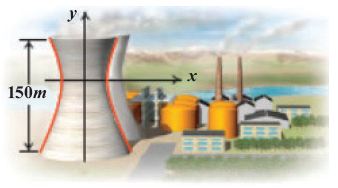
Cross section of a Nuclear cooling tower is in the shape of a hyperbola with equation\(\frac { { x }^{ 2 } }{ { 30 }^{ 2 } } -\frac { { y }^{ 2 } }{ { 44 }^{ 2 } } =1\). The tower is 150 m tall and the distance from the top of the tower to the centre of the hyperbola is half the distance from the base of the tower to the centre of the hyperbola. Find the diameter of the top and base of the tower.
19.
Find the equations of the tangent and normal to hyperbola 12x2−9y2 = 108 at \(\theta =\frac { \pi }{ 3 } \) (Hint: use parametric form)
20.
21.
Solve: \(8x^{ \frac { 3 }{ 2x } }-8x^{ \frac { -3 }{ 2x } }\) = 63
22.
Solve the following equation: x4-10x3+ 26x2-10x + 1 = 0
23.
Find the equation of the circle passing through the points (1, 1 ), (2, -1 ) and (3, 2) .
24.
If p is real, discuss the nature of the roots of the equation 4x2+ 4px + p + 2 = 0 in terms of p.
25.
Examine the no.of rational roots of 2x³ – x² – 1 = 0
26.
Find the equation of the hyperbola in each of the cases given below:
foci(±2, 0), eccentricity = \(\frac { 3 }{ 2 } \)
27.
Find the equation of the ellipse in each of the cases given below:
length of latus rectum 8, eccentricity = \(\frac { 3 }{ 5 } \), centre (0, 0) and major axis on x -axis.
28.
Solve: \(\frac{dy}{dx}+y=cos x\)
29.
Find the differential equation of the family of parabolas with vertex at (0, −1) and having axis along the y-axis.
30.
Find the differential equation of the family of circles passing through the origin and having their centres on the x -axis.
31.
Find the value of c if y = x + c is a tangent to the hyperbola 9x2 - 16y2 = 144.
32.
If α, β and γ are the roots of the cubic equation x3+ 2x2+ 3x + 4 = 0, form a cubic equation whose roots are \(\frac { 1 }{ \alpha } ,\frac { 1 }{ \beta } ,\frac { 1 }{ \gamma } \)
33.
Find solution, if any, of the equation 2cos2x - 9cosx + 4 = 0
34.
Find the equation of circles that touch both the axes and pass through (-4, -2) in general form.
35.
If the product of the roots of 3x4 - 4x3 + 2x2 + x + a = 0 is 21, then the value of a is _____________
7
-7
-63
63
36.
The solution of the differential equation \(\frac{d y}{d x}=e^{x}+2 \text { is }\)__________
\(y=e^{x}+C\)
\(y=2 x+e^{x}+C\)
\(y=2 x e^{x}+C\)
\(y=e^{x}+2 C x\)
37.
38.
39.
The solution of the differential equation \(\frac { dy }{ dx } =2xy\) is
y = Cex2
y = 2x2 + C
y = Ce−x2 + C
y = x2 + C
40.
The integrating factor of the differential equation \(\frac{d y}{d x}+P(x) y=Q(x)\) is x, then P(x)
x
\(\frac { { x }^{ 2 } }{ 2 } \)
\(\frac{1}{x}\)
\(\frac{1}{x^2}\)
41.
The differential equation representing the family of curves y = Acos(x + B), where A and B are parameters,is
\(\frac { { d }^{ 2 }y }{ { dx }^{ 2 } } -y=0\)
\(\frac { { d }^{ 2 }y }{ { dx }^{ 2 } }+y=0\)
\(\frac { { d }^{ 2 }y }{ { dx }^{ 2 } }=0\)
\(\frac { { d }^{ 2 }x }{ { dy }^{ 2 } }=0\)
42.
The order and degree of the differential equation \(\frac { { d }^{ 2 }y }{ { dx }^{ 2 } } +{ \left( \frac { dy }{ dx } \right) }^{ 1/3 }+{ x }^{ 1/4 }=0\) are respectively
2, 3
3, 3
2, 6
2, 4
43.
44.
lf the root of the equation x3 + bx2+ cx - 1 = 0 form an lncreasing G.P, then ___________
one of the roots is 2
one of the roots is 1
one of the roots is -1
one of the roots is -2
45.
If x + y = k is a normal to the parabola y2 = 12x, then the value of k is
3
-1
1
9
46.
The area of quadrilateral formed with foci of the hyperbolas \(\frac{x^{2}}{a^{2}}-\frac{y^{2}}{b^{2}}=1 \text { and } \frac{x^{2}}{a^{2}}-\frac{y^{2}}{b^{2}}=-1\)
4(a2+b2)
2(a2+b2)
a2 +b2
\(\frac { 1 }{ 2 } \)(a2+b2)
47.
The radius of the circle passing through the point(6, 2) two of whose diameter are x + y = 6 and x + 2y = 4 is
10
\( {2} \sqrt {5}\)
6
4
48.
49.
The eccentricity of the hyperbola whose latus rectum is 8 and conjugate axis is equal to half the distance between the foci is
\(\frac { 4 }{ 3 } \)
\(\frac { 4 }{ \sqrt { 3 } } \)
\(\frac { 2 }{ \sqrt { 3 } } \)
\(\frac { 3 }{ 2 } \)
50.
The polynomial x3 + 2x + 3 has
one negative and two imaginary zeros
one positive and two imaginary zeros
three real zeros
no zeros
51.
52.
According to the rational root theorem, which number is not possible rational zero of 4x7 + 2x4 - 10x3 - 5?
-1
\(\frac { 5 }{ 4 } \)
\(\frac { 4 }{ 5 } \)
5
53.
A polynomial equation in x of degree n always has
n distinct roots
n real roots
n complex roots
at most one root
54.
A zero of x3 + 64 is
0
4
4i
-4
1.
order 2 ; degree 1
2.
Here, the highest order derivative is \(\frac { { d }^{ 4 }y }{ { dx }^{ 4 } } \) whose power is 3.
Therefore, the given differential equation is of order 4 and degree 3.
3.
\(\frac { { d }^{ 2 }y }{ d{ x }^{ 2 } } =xy+cos\left( \frac { dy }{ dx } \right) \)
The given differential equation is
\(\frac { { d }^{ 2 }y }{ d{ x }^{ 2 } } =xy+cos\left( \frac { dy }{ dx } \right) \)
The highest derivative is 2
∴ Order 2.
The given differential equation is not a polynomial equations in its derivatives and so its degree is not defined.
4.
\({ \left( \frac { { d }^{ 3 }y }{ d{ x }^{ 3 } } \right) }^{ \frac { 2 }{ 3 } }-3\frac { { d }^{ 2 }y }{ d{ x }^{ 2 } } +5\frac { dy }{ dx } +4=0\)
Given differential equation is
\({ \left( \frac { { d }^{ 3 }y }{ d{ x }^{ 3 } } \right) }^{ \frac { 2 }{ 3 } }-3\left( \frac { { d }^{ 2 }y }{ d{ x }^{ 2 } } \right) +5\frac { dy }{ dx } +4=0\)
\(\Rightarrow { \left( \frac { { d }^{ 3 }y }{ d{ x }^{ 3 } } \right) }^{ \frac { 2 }{ 3 } }=3\left( \frac { { d }^{ 2 }y }{ d{ x }^{ 2 } } \right) -5\left( \frac { dy }{ dx } \right) -4\)
Taking power 3 both sides,
\(\Rightarrow { \left( \frac { { d }^{ 3 }y }{ d{ x }^{ 3 } } \right) }^{ 2 }={ \left( 3\left( \frac { { d }^{ 2 }y }{ d{ x }^{ 2 } } \right) -5\left( \frac { dy }{ dx } \right) -4 \right) }^{ 3 }\)
The highest derivative is 3 and its power is 2.
∴ Order 3, degree 2.
5.
Let P(x, y) be the movable point.
By focal property of ellipse, PA + PB = 2a
∴ 2a = 10 ⇒ a = 5
Since focus is (4, 0), ae = 4 ⇒ 5e = 4 ⇒ e = \(\frac45\)
Also b2 = a2(1 - e2) = 25\(\left( 1-\frac { 16 }{ 25 } \right) =25\left( \frac { 9 }{ 25 } \right) \) = 9
Equation of ellipse is \(\frac { { x }^{ 2 } }{ { a }^{ 2 } } +\frac { { y }^{ 2 } }{ { b }^{ 2 } } =1\)
\(\frac { { x }^{ 2 } }{ 25 } +\frac { { y }^{ 2 } }{ 9 } =1\)
6.
Let p(x) = x7-6x6+7x5+5x2+2x+2
It has only one change of sign. Now,
p(-x) = (-x)7 -6(-x)6 +7(-x)5 +5(-x)2 +2(-x)+2
= -x7 -6x6 -7x5 + 5x2 - 2x + 2
It has two, change of sign.
Hence, p(x) has one positive root and has at least two negative roots.
7.
Here A = 0, B = 0, C = 1, D = 4, E = 3, F = 4
B = 0, A = 0 either A or C is 0.
Hence, the given equation represents a parabola.
8.
Here Δ = b2−4ac = 0 for equal roots. This implies 4(k + 2)2 = 4(9)k. This implies k = 4 or 1.
9.
Equation of the circle with end points of the diameter as (x1, y1) and (x2, y2) given in theorem is
(x−x1)(x−x2)+(y−y1)(y−y2) = 0
(x+4)(x−1)+(y+2)(y−1) = 0
x2 + y2 + 3x + y − 6 = 0 which is the required equation of the circle.
10.
Since α and β are the roots of 17x2+ 43x −73 = 0 , we have α + β =\(\frac { -43 }{ 17 } \) and αβ =\(\frac { -73 }{ 17 } \).
We wish to construct a quadratic equation with roots α + 2 and β + 2. Thus, to construct such a quadratic equation, calculate
the sum of the roots = α + β + 4 = \(\frac { -4 }{ 17 } +4=\frac { 25 }{ 17 } \) and
the product of the roots = αβ + 2(α+β)+4 = \(\frac { -73 }{ 17 } +2\left( \frac { -43 }{ 17 } \right) +4=\frac { -91 }{ 17 } \)
Hence a quadratic equation with required roots is x2-\(\frac { 25 }{ 17 } x-\frac { 91 }{ 17 } \) = 0
Multiplying this equation by 17, gives 17x2−25x−91 = 0
which is also a quadratic equation having roots α + 2 and β + 2
11.
\(
\frac{d v}{d t} =g \cos \alpha-k v
\)
\(\frac{d v}{d t}+\mathrm{k} v =g \cos \alpha
\)
Which is of the form
\(
\frac{d v}{d t}+\mathrm{p} v =\mathrm{Q}
\)
Where \(\mathrm{P} =\mathrm{k}_{1} \mathrm{Q}=\mathrm{g} \cos \alpha
\)
\(\mathrm{I} \cdot \mathrm{F} =\mathrm{e}^{\mathrm{P} d t}
\)
\( =\mathrm{e}^{\int \mathrm{kdt}}\)
The general solution
\(
\mathrm{y}(\mathrm{I} . \mathrm{F}) =\int \mathrm{Q}(\mathrm{I} . \mathrm{F}) \mathrm{dx}+\mathrm{c}
\)
\(\mathrm{v}(\mathrm{I} . \mathrm{F}) =\int \mathrm{Q}(\mathrm{I} . \mathrm{F}) \mathrm{dt}+\mathrm{c}
\)
\(\mathrm{Ve}^{\mathrm{kt}} =\int \mathrm{g} \cos \alpha \mathrm{e}^{\mathrm{kt}} \mathrm{dt}+\mathrm{c}
\)
\(\mathrm{Ve}^{\mathrm{kt}} =\int \mathrm{g} \cos \alpha\left(\frac{\mathrm{e}^{\mathrm{kt}}}{\mathrm{k}}\right)+\mathrm{c}
\)
put v = 0, t = 0
\(0 =g \cos \alpha\left(\frac{\mathrm{e}^{0}}{\mathrm{k}}\right)+\mathrm{c}
\)
\(\mathrm{c} =-\frac{\mathrm{g} \cos \alpha}{\mathrm{k}}
\)
\(\mathrm{Ve}^{\mathrm{kt}} =\mathrm{g} \cos \alpha\left(\frac{\mathrm{e}^{\mathrm{kt}}}{\mathrm{k}}\right)-\frac{g \cos \alpha}{\mathrm{k}}
\)
\(\mathrm{Ve}^{\mathrm{kt}} =\frac{\mathrm{g} \cos \alpha}{\mathrm{k}}\left(\mathrm{e}^{\mathrm{kt}}-1\right)
\)
\(\mathrm{V} =\frac{\mathrm{g} \cos \alpha}{\mathrm{k}}\left(1-\mathrm{e}^{-\mathrm{kt}}\right)
\)
12.
Rearranging terms in the equation of hyperbola to bring it to standard form,
We have,
\(
12\left(x^{2}-2 x\right)-4\left(y^{2}-8 y\right)-124 =0
\)
\(12(x-1)^{2}-4(y-4)^{2} =124+12-64
\)
\(12(x-1)^{2}-4(y-4)^{2} =72
\)
\(\frac{(x-1)^{2}}{6}-\frac{(y-4)^{2}}{18} =1\)
Centre (1, 4); a2 = 6;
\(
b^{2} =18
\)
\(c^{2} =a^{2}+b^{2}
\)
\( =6+18
\)
\(c^{2} =24
\)
\(c =\pm 2 \sqrt{6}
\)
\(e =\frac{c}{a}=\frac{2 \sqrt{6}}{6}\)
eccentricity, \(e=\frac{\sqrt{6}}{3}\)
centre (h, k) = (1, 4)
foci \(
=(h, \pm c+k)
\)
\(=(1, \pm 2 \sqrt{6}+4)
\)
\( =(1,2 \sqrt{6}+4) 8(1,-2 \sqrt{6}+4)\)
13.
Let T be the temperature of the body at any time t and with time 0 taken to be 8 p.m. By Newton’s law of cooling \(\frac { dT }{ dt } =k(T-50)or\frac { dT }{ T-50 } =dt\).
Integrating on both sides, we get log |50 −T| = kt + logC or 50 −T = Cekt.
When t = 0, T = 70, and so C = −20
When t = 2,T = 60, we have −10 = −20 ek2.
Thus, \(k=\frac { 1 }{ 2 } log\left( \frac { 1 }{ 2 } \right) \)
Hence, the solution is 50-T = -20e\(\frac{1}{2}\)tlog\((\frac{1}{2})\) or T = 50 + 20\((\frac{1}{2})^\frac{t}{2}\)
Now, we would like to find the value of t, for which T(t) = 98.6 , and t = 2\(\left( \frac { log\left( \frac { 48.6 }{ 20 } \right) }{ log\left( \frac { 1 }{ 2 } \right) } \right) \approx -2.56\)
It appears that the person was murdered at about 5.30 p.m.
14.
\(\frac { dy }{ dx } +\frac { { 3x }^{ 2 }y }{ 1+{ x }^{ 3 } } =\frac { { sin }^{ 2 }x }{ 1+{ x }^{ 3 } } \)
This is a linear differential equation
\(\therefore P=\frac { { 3x }^{ 2 } }{ 1+{ x }^{ 3 } } ;Q=\frac { { sin }^{ 2 }x }{ 1+{ x }^{ 3 } } \)
\(\therefore \int { pdx } =\int { \frac { { 3x }^{ 2 } }{ 1+{ x }^{ 3 } } dx } =log(1+{ x }^{ 3 })\)
\(\therefore I.F.={ e }^{ \int { pdx } }={ e }^{ log(1+{ x }^{ 3 }) }=(1+{ x }^{ 3 })\)
\(\therefore\)The solution is \({ ye }^{ \int { pdx } }=\int { Q{ e }^{ \int { pdx } }dx+c } \)
\(\Rightarrow y(1+{ x }^{ 3 })=\int { \frac { { sin }^{ 2 }x }{ 1+{ x }^{ 3 } } (1+{ x }^{ 3 })dx+c } \)
\(cos2x=1-2{ sin }^{ 2 }x\)
\(sin2x=\frac { 1-cos2x }{ 2 } =\int { { sin }^{ 2 }xdx+c } \)
\(\Rightarrow y(1+{ x }^{ 3 })=\int { \frac { 1-cos2x }{ 2 } } dx+c\)
\(\Rightarrow y(1+{ x }^{ 3 })=\frac { x }{ 2 } -\frac { sin2x }{ 4 } +c\)
15.
The given equation can be written as \(\frac { dy }{ dx } =\frac { 2x+3y }{ x-y } \)
This is a homogeneous equation.
Let y = vx . Then we have \(v+x\frac { dv }{ dx } =\frac { 2+3v }{ 1-v } \)
Thus, \(x\frac { dv }{ dx } =\frac { 2+2v+{ v }^{ 2 } }{ 1-v } or\frac { 1-v }{ { (1+v) }^{ 2 }+1 } dv=\frac { dx }{ x } or\frac { 1 }{ 2 } \left[ \frac { 2v+2 }{ { v }^{ 2 }+2v+2 } -\frac { 4 }{ { (v+1) }^{ 2 }+1 } \right] dv=\frac { dx }{ x } \)
Integrating both sides, we get -\(\frac{1}{2}\)log |v2+2v+2|+2tan-1(v+1) = log |x| + log |C|
or log |v2+2v+2| -4tan-1(v+1) = -2log |x| -2 log |C|
or log |v2+2v+2| +log |x|2 - 4tan-1(v+1) = -2 log |C|
or log |(v2+2v+2)x2| -4 tan-1(v+1) = -2 log |C|
Now replacing v by\(\frac{y}{x},\) we get, log |y2+2xy+2x2|-4tan-1\(\left( \frac { x+y }{ x } \right) =k\), where k = -2 log |C| gives the required solution.
16.
\(\Rightarrow \frac { y\quad dx-x\quad dy }{ { y }^{ 2 } } .cot\left( \frac { x }{ y } \right) =xdx\)
put \(\frac { x }{ y } =t\)
\(\Rightarrow \frac { y\quad dx-x\quad dy }{ { y }^{ 2 } } =dt\)
Substituting these values in equation (1), we get
dt cot(t) = x dx
cot t dt = ndx
Taking integration on both sides, we get
\(\Rightarrow \int { cot(t)dt=n\int { dx } } \)
\(
\int \cot t \mathrm{dt} =n \int d x
\)
\(\log (\sin \mathrm{t}) =\mathrm{n} x+\mathrm{C}_1
\)
\(\sin \mathrm{t} =\mathrm{e}^{\mathrm{nx}+\mathrm{c}_1}
\)
\(\sin \left(\frac{x}{y}\right) =\mathrm{e}^{n x} \mathrm{e}^{\mathrm{C}_r}
\)
\(\sin \left(\frac{x}{y}\right) =\mathrm{C}^{\mathrm{nx}}\)
\(\\ \Rightarrow sin\left( \frac { x }{ y } \right) ={ e }^{ nx+c }\left[ \because t=\frac { x }{ y } \right] \)
17.
\(\frac { { (y-2) }^{ 2 } }{ 25 } -\frac { ({ x+1) }^{ 2 } }{ 16 } =1\)
Given equatlon is \(\frac { { (y-2) }^{ 2 } }{ 25 } -\frac { ({ x+1) }^{ 2 } }{ 16 } =1\)
Thi is an equation of the hyperbola where transverse axis is parallel to y-axis.
∴ a2 = 25, b2 = 16
⇒ c2 - a2 + b2 = 25 +16 = 41
⇒ c = \(\sqrt { 41 } \)
\(e =\sqrt { 1-\frac { { b }^{ 2 } }{ { a }^{ 2 } } } =\sqrt { 1+\frac { 16 }{ 25 } } =\sqrt { \frac { 41 }{ 25 } } =\frac { \sqrt { 41 } }{ 5 } \)
(a) Center is (-1, 2) ⇒ h = -1, k = 2
(b) Foci are (h, k + c), (h, k- c)
⇒ (-1, 2 + \(\sqrt { 41 } \)), (-1, 2 - \(\sqrt { 41 } \))
(c) Vertices are (h, k + a), (h, k-a)
⇒ (-1, 2 + 5), (-1, 2 - 5)
= (-1, 7), (-1, -3)
(d) Equation of directrices are
\(y-2=\pm \frac { 5 }{ \frac { \sqrt { 41 } }{ 5 } } \)
\(\Rightarrow y-2=\pm \frac { 25 }{ \sqrt { 41 } } \)
\(\Rightarrow y=2+\frac { 25 }{ \sqrt { 41 } } \) and
\( y=2-\frac { 25 }{ \sqrt { 41 } } \)
18.
The cross section of a nuclear cooling tower is in the shape of a hyperbola.
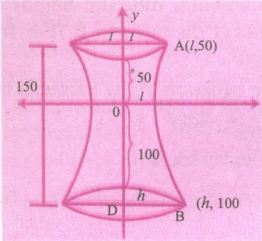
GIven OC = \(\frac12\) OD and CD = 150 m
Its equation is OC = 50 m & OD = 100 m
\(\frac { { x }^{ 2 } }{ { 30 }^{ 2 } } -\frac { { y }^{ 2 } }{ { 44 }^{ 2 } } =1\) ......(1)
Let I be the radius of the top of the tower
∴ A(l, 50) is a point on the hyperbola
∴ \(\frac { { l }^{ 2 } }{ { 30 }^{ 2 } } \frac { { 50 }^{ 2 } }{ { 44 }^{ 2 } } =1\)
⇒ \(\frac { { l }^{ 2 } }{ { 30 }^{ 2 } } =1+\frac { { 50 }^{ 2 } }{ { 44 }^{ 2 } } =\frac { { 44 }^{ 2 }+{ 50 }^{ 2 } }{ { 44 }^{ 2 } } \)
⇒ \({ l }^{ 2 }=\frac { { 30 }^{ 2 } }{ { 44 }^{ 2 } } \) (1936 + 2500)
⇒ l2 = \(\frac { 30 }{ 40 } \sqrt { 4436 } =\frac { 30 }{ 44 } \)(66.60)
⇒ \(\frac { 30 }{ 40 } \sqrt { 4436 } =\frac { 30 }{ 44 } \) = 45.41 m
Radius of the top of the tower is 45.41 m.
Let h be the radius of the base of the tower.
∴ B(h, 100) is a point on the hyperbola
∴ (1) becomes
\(\frac { { h }^{ 2 } }{ { 30 }^{ 2 } } -\frac { { 100 }^{ 2 } }{ { 44 }^{ 2 } } =1\Rightarrow \frac { h^{ 2 } }{ { 30 }^{ 2 } } =1+\frac { { 100 }^{ 2 } }{ { 44 }^{ 2 } } =\frac { { 44 }^{ 2 }+{ 100 }^{ 2 } }{ { 44 }^{ 2 } } \)
⇒ \({ h }^{ 2 }=\frac { { 30 }^{ 2 } }{ { 44 }^{ 2 } } \) (1936 + 10000)
⇒ \({ h }^{ 2 }=\frac { 30 }{ 44 } \sqrt { 11936 } =\frac { 30 }{ 44 } \)(109.25)
⇒ \(h=\frac { 3277.5 }{ 44 } \) = 74.48 m.
Radius of the base of the tower is 74.48 m.
Diameter of the base = 148.96 m
Diameter of the top and base of the tower are 90.82 m and 148.96 m.
19.
Equation of the hyperbola is 12x2- 9y2 = 108
\(\div 108\) we get, \(\frac { { 12x }^{ 2 } }{ 108 } -\frac { 9{ y }^{ 2 } }{ 108 } =1\)
⇒ \(\frac { { x }^{ 2 } }{ 9 } -\frac { { y }^{ 2 } }{ 12 } =1\)
∴ a2 = 9, b2 = 12
Parametric equation of tangent to the hyperbola is \(\frac { x \ sec\ \theta }{ a } -\frac { y \ tan \ \theta }{ b } =1\)
When \(\theta =\frac { \pi }{ 3 } \), the equation is
\(\frac { xsec\frac { \pi }{ 3 } }{ 3 } -\frac { ytan\frac { \pi }{ 3 } }{ 2\sqrt { 3 } } =1\)
.JPG)
⇒ \(\frac { 4x-3y }{ 6 } =1\) ⇒ 4x - 3y - 6 = 0 is the required equation of tangent.
Parametric equation of normal to the hyperbola is
\(\frac { ax }{ sec\theta } +\frac { by }{ tan\theta } ={ a }^{ 2 }+{ b }^{ 2 }\)
At \(\theta =\frac { \pi }{ 3 } ,\frac { 3x }{ sec\frac { \pi }{ 3 } } +\frac { 2\sqrt { 3 } }{ tan\frac { \pi }{ 3 } } =9+12\)
\(\Rightarrow \frac{3 x}{2}+\frac{2 \sqrt{\not 3} y}{\sqrt{\not 3}}=21\)
⇒ \(\frac { 3x }{ 2 } \) + 2y = 21 ⇒ 3x + 4y = 42
⇒ 3x + 4y - 42 = 0 is the required equation of normal.
20.
21.
\(8x^{ \frac { 3 }{ 2x } }-8x^{ \frac { -3 }{ 2x } }\) = 63
\(\Rightarrow 8\left[ { \left( { x }^{ \frac { 1 }{ 2n } } \right) }^{ 3 }-{ \left( { x }^{ \frac { -1 }{ 2n } } \right) }^{ 3 } \right] =63\)
Put \({ x }^{ \frac { 1 }{ 2n } }=y\)
\(\Rightarrow 8\left( { y }^{ 2 }-\frac { 1 }{ { y }^{ 3 } } \right) =63\)
\(\Rightarrow { y }^{ 3 }-\frac { 1 }{ { y }^{ 3 } } =\frac { 63 }{ 8 } \Rightarrow \frac { { y }^{ 6 }-1 }{ { y }^{ 3 } } =\frac { 63 }{ 8 } \)
\(\Rightarrow { 8y }^{ 6 }-8=63{ y }^{ 3 }\)
\(\Rightarrow { 8y }^{ 6 }-{ 63y }^{ 3 }-8=0\)
\(\Rightarrow { 8t }^{ 2 }-63t-8=0\ [where\quad t={ y }^{ 3 }]\)
\(\Rightarrow (8t-1)(t-8)=0\)
\(\Rightarrow t=\frac { 1 }{ 8 } ,8\)
Case (i): when \(t=8,\Rightarrow { y }^{ 3 }=8\Rightarrow { y }^{ 2 }={ 2 }^{ 3 }\)
\(\Rightarrow y=2\)
Case (ii): when \(t=\frac { 1 }{ 8 } ,{ y }^{ 3 }=\frac { 1 }{ 8 } \Rightarrow y=\frac { 1 }{ 2 } \)
When \(y=2,{ x }^{ \frac { 1 }{ 2n } }=2\)
\(\Rightarrow x={ (2 })^{ 2n }\quad \Rightarrow x={ ({ 2 }^{ 2 }) }^{ n }\)
\(\Rightarrow x={ 4 }^{ n }\)
When \(y=\frac { 1 }{ 2 } ,{ x }^{ \frac { 1 }{ 2n } }=\frac { 1 }{ 2 } \Rightarrow x={ \left( \frac { 1 }{ 2 } \right) }^{ 2n }\)
\(\Rightarrow x={ \left( \frac { 1 }{ { 2 }^{ 2 } } \right) }^{ n }=\frac { 1 }{ { 4 }^{ n } } \)
Hence the roots are 4n.
22.
This equation is Type I even degree reciprocal equation. Hence it can be rewritten as
x2\(\left[ \left( { x }^{ 2 }+\frac { 1 }{ { x }^{ 2 } } \right) -10 \left( x+\frac { 1 }{ x } \right) +26 \right] \)= 0 Since x \(\neq\) 0, we get \(\left(x^{2}+\frac{1}{x^{2}}\right)-10\left(x+\frac{1}{x}\right)+26=0\)
Let y = \(\left( x+\frac { 1 }{ x } \right) \)
[(y2-2)-10y+26] = 0 ⇒ (y2-10y+24) = 0 ⇒ (y-6)(y-4) = 0 ⇒ y = 6 or y = 4
Case (i)
y = 6 ⇒ x +\(\frac{1}{x}\) = 6 ⇒ x = 3+2\(\sqrt{2}\), x = 3 - 2\(\sqrt{2}\)
Case (ii)
y = 4 ⇒ x = 2+\(\sqrt{3}\), x = 2-\(\sqrt{3}\).
Hence, the roots are \(3 \pm 2 \sqrt{2}, 2 \pm \sqrt{3}\)
23.
Let the general equation of the circle be
x2 +y2 +2gx + 2fy + c = 0 ........ (1)
It passes through points (1, 1), (2, -1) and(3, 2) .
Therefore,
2g+2f+c = -2 ........ (2)
4g−2f+c = -5 ........(3)
6g+4f+c = -13 ...... (4)
(2) – (3) gives −2g + 4f = 3 ... (5)
(4) – (3) gives 2g + 6f = -8 ....(6)
(5) + (6) gives f = \(-\frac { 1 }{ 2 } \)
Substituting f = \(-\frac { 1 }{ 2 } \) in (6), g = -\(\frac { 5 }{ 2 } \)
Substituting f = \(-\frac { 1 }{ 2 } \) and g = - \(\frac { 5 }{ 2 } \) in (2), c = 4 .
Therefore the required equation of the circle is
x2+ y2+ 2\(\left( -\frac { 5 }{ 2 } \right) x+2\left( -\frac { 1 }{ 2 } \right) \)y+4 = 0 and x2 + y2 − 5x − y + 4 = 0.
24.
The discriminant Δ =((4p)2 - 4(4)(p+2) = 16(p2-p-2) = 16(p+1)(p-2). So we get
Δ < 0 if -1
Δ = 0 if p = -1 or p = 2
Δ >0 if \(\infty\).
imaginary roots if -1 < p < 2
equal real roots if p = −1 or p = 2;
distinct real roots if -\(\infty\) < p < -1 or 2 < p < \(\infty\)
25.
x = 1
26.
\(a\left( \frac { 3 }{ 2 } \right) =2\Rightarrow a\frac { 4 }{ 3 } \)
b2 = a2(e2 - 1)
\(\Rightarrow b^{2}=\frac{16}{9}\left(\frac{9}{4}-1\right)=\frac{16}{9}\left(\frac{9-4}{4}\right)=\frac{\not 16}{9} \times \frac{5}{4}\)
⇒ \({ b }^{ 2 }=\frac { 4\times 5 }{ 9 } =\frac { 20 }{ 9 } \)
∴ Equation of the hyperbola is \(\frac { { x }^{ 2 } }{ { a }^{ 2 } } -\frac { { y }^{ 2 } }{ { b }^{ 2 } } =1\)
⇒ \(\frac { { x }^{ 2 } }{ \frac { 16 }{ 9 } } -\frac { { y }^{ 2 } }{ \frac { 20 }{ 9 } } =1\)
⇒ \(\frac { { 9x }^{ 2 } }{ 16 } -\frac { 9{ y }^{ 2 } }{ 20 } =1\)
.JPG)
27.
Length of latus rectrum = 8, e = \(\frac35\) and major axis on x-axis
Given \(\frac { { 2b }^{ 2 } }{ a } =8,e=\frac { 3 }{ 5 } \)
b2 = 4a
b2 = a2(1- e2)
\(4a={ a }^{ 2 }\left( 1-\frac { 9 }{ 25 } \right) \)
\(4=a\left( \frac { 25-9 }{ 25 } \right) \)
100 = a(16)
a = \(\frac { 100 }{ 16 } =\frac { 25 }{ 4 } \Rightarrow { a }^{ 2 }=\frac { 625 }{ 16 } \)
\({ b }^{ 2 }=4\times \frac { 25 }{ 4 } =25\)
Since major axis is on x-axis, equation of the ellipse is
⇒ \(\frac { { \left( x-0 \right) }^{ 2 } }{ { a }^{ 2 } } +\frac { { \left( y-0 \right) }^{ 2 } }{ { b }^{ 2 } } =1\)
⇒ \(\frac { { x }^{ 2 } }{ \frac { 625 }{ 16 } } +\frac { { y }^{ 2 } }{ 25 } =1\)
⇒ \(\frac { 16{ x }^{ 2 } }{ 625 } +\frac { { y }^{ 2 } }{ 25 } =1\)
28.
Given \(\frac { dy }{ dx } +y=cosx\)
This is a linear differential equation
Here p = 1, Q = cos x
\(\therefore \int { p\ dx } =\int { dx } =x\)
\(I.F={ e }^{ \int { p\ dx } }={ e }^{ x }\)
The solution is
\({ y }^{ \int { p\ dx } }=\int { Q{ e }^{ \int { p\ dx } }dx+c } \)
\(\Rightarrow { ye }^{ x }=\int { cosx.{ e }^{ x }dx+c } \)
\(\Rightarrow { ye }^{ x }=\frac { { e }^{ x } }{ 2 } \left( cosx+sinx \right) +c\)
\(\Rightarrow y=\frac { 1 }{ 2 } \left( cosx+sinx \right) +{ ce }^{ x }\)
\(\therefore \int { { e }^{ ax }cos\ bx\ dx=\frac { { e }^{ ax } }{ { a }^{ 2 }+{ b }^{ 2 } } \left[ acos\ bx+sin\ ax \right] } \)
29.
Equation of family of parabolas with axis as y axis is given by,
(x-0) = 4a(y-k) .... (1)
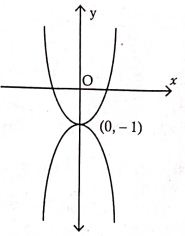
Given: Vertex at (0, - 1).
Putting k = -1 in (1), we get
⇒ x2 = \(\pm\)4a(y + 1) ....(2)
Differentiating with respect to 'x'
2x = \(\pm\)4a\(\left( \frac { dy }{ dx } \right) \) ....(3)
⇒ 4a = \(\frac { 2x }{ \frac { dy }{ dx } } \)
\(\frac{x^2}{2x} = \frac{y+1}{\frac{dt}{dx}}\)
ie) \(x \frac{dy}{dx}-2(y+1) =0\)
This is the required differential equation.
30.
Given the circles centre on r-axis & the circle is passing through the origin.
Let it be (r, 0) & its radius r.
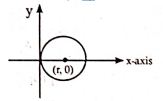
Equation of the circle is
(x - a)2 + (y - b)2 = r2
(x - r)2 + (y - 0)2 = r2
⇒ x2 - 2xr + r2 + y2 = r2
⇒ x2 - 2xr + y2 = 0 ...(1)
defferentiating equation (1) with respect to 'x' we get
⇒ 2x - 2r + 2y \(\frac { dy }{ dx } =0\)
⇒ 2x + 2y \(\frac { dy }{ dx } =2r\)
⇒ x + y \(\frac { dy }{ dx } =r\) ...(2)
Substituting r value in equation (1), we get
x2 - 2x \(\left( x+y\frac { dy }{ dx } \right) +{ y }^{ 2 }=0\)
\(\Rightarrow \ { x }^{ 2 }-{ 2x }^{ 2 }-2xy\frac { dy }{ dx } +{ y }^{ 2 }=0\)
\(\Rightarrow \ { -x }^{ 2 }{ -2x }y\left( \frac { dy }{ dx } \right) { +y }^{ 2 }\)
Multiply by '-', we get
\(\Rightarrow \ { x }^{ 2 }{ +2x }y\left( \frac { dy }{ dx } \right) { -y }^{ 2 }\) which is the required differential equation.
31.
Given line is y = x + c
m = 1, c = c
Equation of the hyperbola is 9x2 - 16y2 = 144
\(\div \)144 we get \(\frac { { x }^{ 2 } }{ 16 } +\frac { { y }^{ 2 } }{ 9 } \) = 1
a2 = 16, b2 = 9
The condition for the line y = mx + c to be a tangent to the hyperbola is c2 = a2m2 - b2
∴ c2 = 16(1)2 - 9 = 16 - 9 = 7
∴ c = ±\(\sqrt7\)
32.
The roots of x3+2x2+3x+4 = 0 are ∝, β, ૪
∴ ∝ + β + ૪ = -co-efficient of x2 = -2 .........(1)
∝β + β૪ + ૪∝ = co-effficient of x = 3 ..........(2)
-∝β૪ = +4 ⇒ ∝β૪ = -4 .......(3)
From the cubic equation whose roots are \(\frac { 1 }{ \alpha } ,\frac { 1 }{ \beta } ,\frac { 1 }{ \gamma } \)
\(\frac { 1 }{ \alpha } +\frac { 1 }{ \beta } +\frac { 1 }{ \gamma } =\frac { \beta \gamma +\gamma \alpha +\alpha \beta }{ \alpha \beta \gamma } =\frac { 3 }{ -4 } =\frac { -3 }{ 4 } \)
\(\frac { 1 }{ \alpha \beta } +\frac { 1 }{ \beta \gamma } +\frac { 1 }{ \gamma \alpha } =\frac { \gamma +\alpha +\beta }{ \alpha \beta \gamma } =\frac { -2 }{ -4 } =\frac { 1 }{ 2 } \)
\(\left( \frac { 1 }{ \alpha } \right) \left( \frac { 1 }{ \beta } \right) \left( \frac { 1 }{ \gamma } \right) =\frac { 1 }{ \alpha \beta \gamma } =\frac { 1 }{ -4 } =-\frac { 1 }{ 4 } \)
∴ The required cubic equation is
\({ x }^{ 3 }-\left( \frac { 1 }{ \alpha } +\frac { 1 }{ \beta } +\frac { 1 }{ \gamma } \right) { x }^{ 2 }+\left( \frac { 1 }{ \alpha \beta } +\frac { 1 }{ \beta \gamma } +\frac { 1 }{ \gamma \alpha } \right) x-\left( \frac { 1 }{ \alpha } ,\frac { 1 }{ \beta } ,\frac { 1 }{ \gamma } \right) \)
\(\Rightarrow { x }^{ 3 }+\frac { 3 }{ 4 } { x }^{ 2 }+\frac { 1 }{ 2 } x+\frac { 1 }{ 4 } =0\)
Multiplying by 4 we get,
4x3 + 3x2 + 2x + 1 = 0
33.
2cos2x - 9cosx + 4 = 0 ............ (1)
The left hand side of this equation is not a polynomial in x. But it looks like a polynomial. In fact, we can say that this is a polynomial in cos x. However, we can solve the equation (1) by using our knowledge on polynomial equations. If we replace cos x by y, then we get the polynomial equation 2y2- 9y + 4 = 0 for which 4 and \(\frac{1}{2}\) are solutions.
From this we conclude that x must satisfy cos x = 4 or cos x = \(\frac{1}{2}\).
But cos x = 4 is never possible, if we take cos x = \(\frac{1}{2}\), then we get infinitely many real numbers x satisfying cos x = \(\frac{1}{2}\); in fact, for all n\(\in \)Z, x = 2nπ ±\(\frac { \pi }{ 3 } \) are solutions for the given equation (1).
If we repeat the steps by taking the equation cos2x - 9 cosx + 20 = 0, we observe that this equation has no solution.
34.
Since the circles touch both the axes. Its equation will be
(x + a)2 + (y + a)2 = a2 ...............(1)
It passes through (-4, -2)
∴ (-4 + a)2 + (-2 + a)2 = a2
\(16+\not a^{2}+8 a+4+a^{2}+4 a=\not a^{2}\)
⇒ a2 + 12a + 20 = 0
⇒ (a + 10)(a + 2) = 0
a = -10 or -2
.JPG)
Case (i):
When a = -10, (1) becomes
(x + 10)2 + (y + 10)2 = 102
\(\Rightarrow x^{2}+\not 100+20 x+y^{2}+\not 100+20 y=160\)
⇒ x2 + y2+ 20x + 20y + 100 = 0
Case (ii):
When a = -2, (1) becomes
⇒ (x + 2)2 + (y + 2)2 = 22
\(x^{2}+4 x+4+y^{2}+4 y+\not 4 = \not 4\)
x2 + y2+ 4x + 4y + 4 = 0
Hence, equation of the circles are
x2 + y2+ 4x + 4y + 4 = 0
or x2 + y2+ 20x + 20y + 100 = 0
35.
(d)
63
36.
(b)
\(y=2 x+e^{x}+C\)
37.
(d)
38.
(a)
39.
(a)
y = Cex2
40.
(c)
\(\frac{1}{x}\)
41.
(b)
\(\frac { { d }^{ 2 }y }{ { dx }^{ 2 } }+y=0\)
42.
(a)
2, 3
43.
(c)
44.
(b)
one of the roots is 1
45.
(d)
9
46.
(b)
2(a2+b2)
47.
(b)
\( {2} \sqrt {5}\)
48.
(b)
49.
(c)
\(\frac { 2 }{ \sqrt { 3 } } \)
50.
(a)
one negative and two imaginary zeros
51.
(d)
52.
(c)
\(\frac { 4 }{ 5 } \)
53.
(c)
n complex roots
54.
(d)
-4

12th Standard Syllabus & Materials
12th Standard
TN 12th Computer Applications வலையமைப்பு வடமிடல் Sample Question Papers Study Material - QB365 Set A
NEW12th Standard
TN 12th Computer Applications களப்பெயர் முறைமை (DNS) Sample Question Papers Study Material - QB365 Set A
NEW12th Standard
TN 12th Computer Applications வலையமைப்பு எடுத்துக்காட்டுகள் மற்றும் நெறிமுறைகள் Sample Question Papers Study Material - QB365 Set A
NEW12th Standard
TN 12th Computer Applications கணினி வலையமைப்பு ஓர் அறிமுகம் Sample Question Papers Study Material - QB365 Set A



Tamilnadu Stateboard 12th Standard Subjects
Maths

Chemistry

Physics

Biology

Computer Science

Business Maths and Statistics

Economics

Commerce

Accountancy

History

Computer Applications
Biology
Computer Technology
Computer Applications
Computer Science
Business Maths and Statistics
Commerce
Economics
Maths
Chemistry
Physics
Computer Technology
History
Accountancy

Tamil

English

French
Tamilnadu Stateboard Standards


