
 100% FREE ACCESS
12th Standard Syllabus & Materials
12th Standard
TN 12th Maths Applications of Matrices and Determinants Sample Question Papers Study Material - QB365 Set A
NEW12th Standard
TN 12th Computer Applications மின்னணு தரவு பரிமாற்றம் Sample Question Papers Study Material - QB365 Set A
NEW12th Standard
TN 12th Computer Applications மின் - வணிக பாதுகாப்பு அமைப்புகள் Sample Question Papers Study Material - QB365 Set A
NEW12th Standard
TN 12th Computer Applications மின்னணு செலுத்தல் முறைகள் Sample Question Papers Study Material - QB365 Set A
NEW12th Standard
TN 12th Computer Applications மின் - வணிகம் Sample Question Papers Study Material - QB365 Set A
NEW12th Standard
TN 12th Computer Applications திறந்த மூல கருத்துருக்கள் Sample Question Papers Study Material - QB365 Set A

Published on: 28/11/2025
Download Tamil Nadu 12th Standard Physics question papers, model tests, one-mark questions, important questions, and public exam papers in PDF format. Free study materials and answer keys for TN State Board students.
Questions + Answers key
Take MCQ Physics Test
1.
Discuss the properties of neutrino and its role in beta decay.
2.
Discuss the gamma emission process with example.
3.
Explain the variation of average binding energy with the mass number using graph and discuss about its features.
4.
Derive the energy expression for an electron is the hydrogen atom using Bohr atom model.
5.
Write down the postulates of Bohr atom model.
6.
Write the properties of cathode rays.
7.
Calculate the amount of energy released when 1 kg of \(_{ 92 }^{ 235 }{ U }\) undergoes fission reaction.
8.
Calculate the number of nuclei of carbon-14 undecayed after 22,920 years if the initial number of carbon-14 atoms is 10,000. The half-life of carbon-14 is 5730 years.
9.
Calculate the density of the nucleus with mass number A.
10.
Calculate the radius of \(_{ 79 }^{ 197 }{ Au }\) Au nucleus.
11.
Show that the mass of radium \((_{ 88 }^{ 226 }{ Ra })\) with an activity of 1 curie is almost a gram. Given T1/2 = 1600 years.
12.
What are the constituent particles of neutron and proton?
13.
Define curie.
14.
What is half-life of a radio active nucleus? Give the expression.
15.
What is mean life of a radio active nucleus? Give the expression.
16.
What is meant by radioactivity?
17.
What is binding energy of a nucleus? Give its expression.
18.
19.
Define atomic mass unit u.
20.
What is isotope? Give an example.
21.
Define impact parameter.
22.
Define the ionization energy and ionization potential.
23.
Obtain the law of radioactivity.
24.
Discuss the spectral series of hydrogen atom.
1.
The neutrino has the following properties:
(i) It has zero charge
(ii) It has an antiparticle called anti-neutrino
(iii) Recent experiments showed that the nutrino has very small mass.
(iv) It interacts very weakly with the matter therefore, it is very difficult to detect it.
(v) In every second trillion of neutrino coming from the sun are passing through our body without any interaction.
Initially, it was thought that during beta decay, a neutron in the parent nucleus is converted to the daughter nuclei by emitting only electron as given by
\({ }_{\mathrm{Z}}^{\mathrm{A}} \mathbf{X} \rightarrow \underset{\mathrm{Z}+1}{\mathrm{~A}} \mathbf{Y}+\mathrm{e}^{-}\)
(i) But the kinetic energy of electron coming out of the nucleus did not match with the experimental results.
(ii) In beta decay, the beta particle (i.e, electron) have a continuous range of energies. But the conservation of energy and momentum gives specific single values for electron energy and the recoiling nucleus Y It seems that the conservation of energy, momentum is violated and could not be explained. So beta decay remained as a puzzle for several years.
(iii) But later w. Pauli proposed a third particle which must be present in beta decay to carry away missing energy and momentum.
(iv) Fermi later named this particle the neutrino.
(v) Finally, the neutrino was detected experimentally in 1956 by Fredrick Reines and Clyde Cowan.
2.
(i) In \(\alpha \text { and } \beta \) decay, most of the daughter nucleus is in the excited state.
(ii) The life time of excited state is approximately 10-11 s.
(iii) This excited state nucleus immediately returns to the ground state or lower energy state by emitting highly energetic photons called rays of energy in order of MeV.
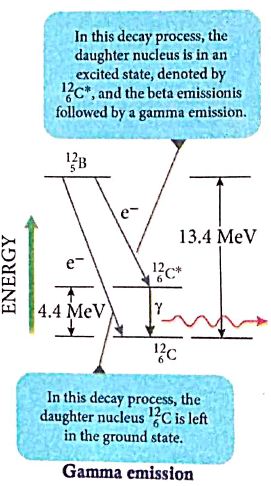
The gamma decay is given by,
\({ }_{\mathrm{Z}}^{\mathrm{A}} \mathrm{X}^{*} \rightarrow{ }_{\mathrm{Z}}^{\mathrm{A}} \mathrm{X}+\gamma-\text { ray }\)
(iv) Here the asterisk(*) means excited state nucleus.
(a) In gamma decay, there is no change in the mass number or atomic number of the nucleus. when \({ }_{5}^{12} \mathrm{~B}\) undergoes beta decay directly into ground state carbon (\(_{ 6 }^{ 12 }{ C})\) by emitting an electron of maximum of energy 13.4 MeV.
(b) If \({ }_{5}^{12} \mathrm{~B}\) undergoes beta decay to an excited state of carbon \(({ _{ 6 }^{ 12 }{ C } }^{ * })\) by emitting an electron of maximum energy 9.0 MeV followed by gamma decay to ground state by emitting a photon of energy 4.4 MeV. It is represented by,
\(_{ 5 }^{ 12 }{ B }\rightarrow _{ 6 }^{ 12 }{ C+ }{ e }^{ - }+\overline { v } \)
\(_{ 6 }^{ 12 }{ C^* }\rightarrow _{ 6 }^{ 12 }{ C }+\gamma -rays\)
3.
The average binding energy per nucleon is the energy required to separate single nucleon from the particular nucleus.
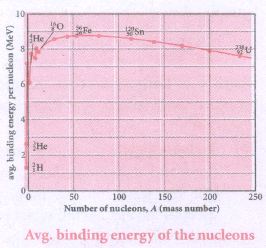
\(\overline{\mathrm{BE}}=\frac{\left[\mathrm{Zm}_{\mathrm{H}}+\mathrm{Nm} _{\mathrm{n}}-\mathrm{M}_{\mathrm{A}}\right] \mathrm{c}^{2}}{\mathrm{~A}}\)
\(\overline { BE } \) is plotted against A of all known nuclei.
Important inferences from the average binding energy curve:
(i) The value of \(\overline { BE } \) rises as the mass number increases until it reaches a maximum value of 8.8 MeV for A = 56 (iron) and then it slowly decreases.
(ii) The average binding energy per nucleon is about 8.5 MeV for nuclei having mass number between A = 40 and 120. These elements are comparatively more stable and not radioactive.
(iii) For higher mass numbers, the curve reduces slowly and \(\overline { BE } \) for uranium is about 7.6 MeV. They are unstable and radioactive.
(iv) From Figure, If two light nuclei with A<28 combine with a nucleus with A<56, the binding energy per nucleon is more for final nucleus than initial nuclei. Thus, if the lighter elements combine to produce a nucleus of medium value A, a large amount of energy will be released. This is the basis of nuclear fusion and is the principle of the hydrogen bomb.
(v) If a nucleus of heavy element is split (fission) into two or more nuclei of medium value A, the energy released would again be large. The atom bomb is based on this principle and huge energy of atom bombs comes from this fission when it is uncontrolled.
4.
The electrostatic force is a conservative force, the potential energy for the electron in nth orbit is
\(U_{n} =\frac{1}{4 \pi \varepsilon_{0}} \frac{(+Z e)(-e)}{r_{n}}=-\frac{1}{4 \pi \varepsilon_{0}} \frac{Z^{2}}{r_{n}} \) \(\left[ \because r_n=\frac{\varepsilon_{0} h^{2} n^{2}}{\pi m Z e^{2}}\right]\)
\(U_{n} =-\frac{1}{4\varepsilon_{0}} -\frac{Z^{2} \mathrm{me}^{4}}{h^{2} n^{2}} \)
The kinetic energy of electron in nth orbit is
\(\mathrm{KE}_{\mathrm{n}}=\frac{1}{2} \mathrm{mv}_{\mathrm{n}}^{2}=\frac{\mathrm{Z}^{2} m \mathrm{e}^{4}}{8 \varepsilon_{0}^{2} \mathrm{~h}^{2} \mathrm{n}^{2}}\)
This implies that Un = -2KEn
Total energy of electron in the nth orbit is
\(E_{n}=K E_{n}+U_{n}=K E_{n}-2 K E_{n}=-K E_{n} \)
\(E_{n}=-\frac{Z^{2} m e^{4}}{8 \varepsilon_{0}^{2} h^{2} n^{2}} \)
For Hydrogen atom Z = 1
\(E_{n}=-\frac{m e^{4}}{8 \varepsilon_{0}^{2} h^{2} n^{2}} \text { joule }\)
n - principal quantum number
The negative sign indicates that the electron is bound to the nucleus.
Substituting the values of mass and charge of an electron (m and e), permittivity of free space \(\varepsilon^{0}\) and Planck's constant h and expressing in terms of (+(eV)), we get
\(E_{n}=-13.6\left(\frac{1}{n^{2}}\right) e V\)
(i) For the first orbit (ground state), the total energy of electron is E1 = - 13.6 eV.
(ii) For the second orbit (first excited state), the total energy of electron is E2 = -3.4 eV.
(iii) For the third orbit (second excited state), the total energy of electron is E3 = -1.51 eV and so on.
5.
(i) The electron in an atom moves around nucleus in circular orbits under the influence of Coulomb electrostatic force of attraction. This Coulomb force gives necessary centripetal force for the electron to undergo circular motion.
(ii) Electrons in an atom revolve around the nucleus only in certain discrete orbits called stationary orbits where it does not radiate electromagnetic energy. Only those discrete orbits allowed are stable orbits.
(iii) The angular momentum of the electron in these stationary orbits are quantized (ie) L = \(\frac{nh}{2\pi}\) This is known as Bohr quantization condition.
(iv) The energy of the orbits are not continuous but only discrete. This is called quantization of energy.
(v) An electron can jump from one orbit to another orbit by absorbing or emitting a photon whose energy is equal to the difference in energy between the two orbital levels.
6.
(i) Cathode rays possess energy and momentum and travel in a straight line with high speed of the order of 107m s-1or \({ \left( \frac { 1 }{ 10 } \right) }^{ th }\) of the speed of light.
(ii) It can be deflected by application of electric and magnetic fields. The direction of deflection indicates that they are negatively charged particles.
(ii) When the cathode rays are allowed to fall on matter, they produce heat. They affect the photographic plates and also produce fluorescence when they fall on certain crystals and minerals.
(iii) When the cathode rays fall on a material of high atomic weight, x-rays are produced.
(iv) Cathode rays ionize the gas through which they pass.
7.
235 g of \(_{ 92 }^{ 235 }{ U }\) has 6.02 x 10²³ atoms. In one gram of \(_{ 92 }^{ 235 }{ U }\), the number of atoms is equal to \(\frac { 6.02\times { 10 }^{ 23 } }{ 235 } =2.56\times { 10 }^{ 21 }\)
So the number of atoms in 1 kg of \(_{ 92 }^{ 235 }{ U }\) = 2.56 x 1021 x 1000 = 2.56 x 1024
Each \(_{ 92 }^{ 235 }{ U }\) nucleus releases 200 MeV of energy during the fission. The total energy released by 1kg of \(_{ 92 }^{ 235 }{ U }\) is
Q = 2.56 x 1024 x 200MeV = 5.12 x 1026 MeV
In terms of joules,
Q = 5.12 x 1026 x 1.6 x 10-13 J = 8.192 x 10¹³ J
In terms of Kilowatt hour,
Q = \(\frac { 8.192\times { 10 }^{ 13 } }{ 3.6\times { 10 }^{ 6 } } =2.27\times { 10 }^{ 7 }\) kWh
8.
To get the time interval in terms of half life, \(n=\frac { t }{ { T }_{ 1/2 } } =\frac { 22,920 \ yr }{ 5730 \ yr } =4\)
The number of nuclei remaining undecayed after 22,920 years,
\(N={ \left( \frac { 1 }{ 2 } \right) }^{ n }{ N }_{ 0 }={ \left( \frac { 1 }{ 2 } \right) }^{ 4 }\times 10,000\)
N = 625
9.
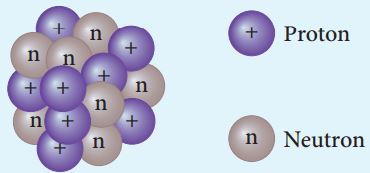
From equation (9.19), the radius of the nuclecus, R = R0 \(A^\frac13\). Then the volume of the nucleus
\(V=\frac { 4 }{ 3 } \pi { R }^{ 3 }=\frac { 4 }{ 3 } { \pi { R }_{ 0 } }^{ 3 }A\)
By ignoring the mass difference between the proton and neutron, the total mass of the nucleus having mass number A is equal to A.m where m is mass of the proton and is equal to 1.6726 x 10⁻²⁷ kg.
Nuclear density.
10.
R = R0A\(\frac13\)
R = 1.2 x 10−15 x (197)\(\frac13\) = 6.97 x 10⁻¹⁵ m
Or R = 6.97 F
11.
\(T_{1 / 2}=1600 \text { years }=1600 \times 365 \times 24 \times 60 \times 60 s\)
R = 1 curie = 3.7 x 10¹⁰ Bq, Show that m = 1g
R = λN
Number of atoms Present, N = \(\frac{\mathrm{R}}{\lambda}=\frac{\mathrm{R}}{0.6931} \mathrm{~T}_{1 / 2}\)
Mass of 6.023 x 10²³ atoms of \({ }_{88}^{226} R a=226 g\)
Mass of 1 atom of \({ }_{88}^{226} \mathrm{Ra}=\frac{226}{6.023 \times 10^{23}} \mathrm{~g}\)
Mass of N atoms of \({ }_{88}^{{ }{266}} \mathrm{Ra}=\frac{226}{6.023 \times 10^{23}} \times \mathrm{Ng}\)
Mass of N atoms of \({ }_{88}^{226} \mathrm{Ra}(\mathrm{m})=\frac{226}{6.023 \times 10^{23}} \times \frac{\mathrm{R}}{0.6931} \mathrm{~T}_{1 / 2} \mathrm{~g}\)
\(\mathrm{m}=\frac{226}{6.023 \times 10^{23}} \times \frac{3.7 \times 10^{10}}{0.6931} \times 1600 \times 365 \times 24 \times 60 \times 60 \mathrm{~g}\)
m = 1.01 g
12.
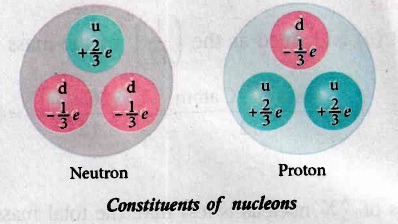
According to quark model,
(i) Proton is made up of two up quarks and one down quark.
(ii) Neutron is made up of one up quark and two down quarks.
13.
One curie was defined as number of decays per second in 1 gram of radium. 1 1 curie = 3.7 X 10¹⁰ decays/s.
14.
Half-life T1/2 of nucleus is the time required for the number of atoms initially present to reduce to one half of the initial amount.
\(\mathrm{T}_{1 / 2}=\frac{0.6931}{\lambda}\)
\(\lambda\) is the decay constant.
15.
The mean life time of the nucleus is the ratio of sum or integration of life times of all nuclei to the total number nuclei present initially.
\(\tau =\frac { 1 }{ \lambda } \)
16.
The phenomenon of spontaneous emission of highly penetrating radiations such as α, β and ⋎ rays by an element is called radioactivity and the substances which emit these radiations are called radioactive elements.
17.
While forming a nucleus, the mass disappear is converted into energy. This energy is called binding energy of a nucleus.
\(\therefore \mathrm{BE}=\left(\mathrm{Zm}_{\mathrm{P}}+\mathrm{Nm}_{\mathrm{n}}-\mathrm{M}\right) \times \mathrm{c}^{2}\)
where, c - velocity of light
18.
19.
One atomic mass unit (u) is defined as the (1/12)th of the mass of the isotope of carbon \(_{ 6 }^{ 12 }{ C }\)
\(\mathrm{lu}=\frac{\text { mass of }_{6}^{12} \mathrm{C} \text { atom }}{12}=\frac{1.9926 \times 10^{-26}}{12}=1.660 \times 10^{-27} \mathrm{~kg}\)
20.
Isotopes are atoms of the same element having same atomic number Z, but different mass number A.
(Ex: Hydrogen, \(_{ 1 }^{ 1 }{ H }\) ((hydrogen), \(_{ 1 }^{ 2 }{ H }\) (deuterium),and \(_{ 1 }^{ 3 }{ H }\) (tritium))
21.
The impact parameter is defined as the perpendicular distance between the centre of the gold nucleus and the direction of velocity vector of alpha particle when it is at a large distance in the Rutherford's alpha particles scattering experiment.
22.
(i) Minimum energy required to remove an electron from an atom in the ground state is known as binding energy or ionization energy.
(ii) Ionization potential is defined as ionization energy per unit charge.
23.
(i) At any instant t, the number of decays per unit time, called rate of decay \(\left( \frac { dN }{ dt } \right) \) is proportional to the number of nuclei (N) at the same instant.
\(\left( \frac { dN }{ dt } \right) \propto N\)
\(\frac { dN }{ dt } =-\lambda N\) ...(1)
(ii) Here, proportionality constant \( \lambda\) is called decay constant which is different for different radioactive sample and the negative sign in the equation implies that the N is decreasing with time. From (1)
\(\frac{\mathrm{dN}}{\mathrm{N}}=-\lambda \mathrm{dt}\) ...(2)
(iii) Here, dN represents number of nuclei decaying in the time interval dt.
(iv) Let us assume that at time t = 0 s, the number of nuclei present in the radioactive sample is No.
(v) By integrating the equation (2), we can calculate the number of undecayed nuclei N at any time t.
\(\int_{N_{0}}^{N} \frac{d N}{N}=-\int_{0}^{t} \lambda d t \)
\({[\ln N]_{N_{0}}^{N}=-\lambda t} \)
\(\ln \left[\frac{N}{N_{0}}\right]=-\lambda t \)
Taking exponential on both sides, we get
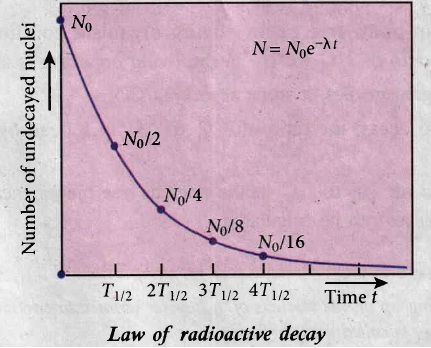
\(\mathrm{N}=\mathrm{N}_{0} \mathrm{e}^{-\lambda t}\) .....(3)
(vi) Equation (3) is called the law of radioactive decay.
(vii) Here N denotes the number of undecayed nuclei present at any time t and No denotes the number of nuclei present initially time t = 0.
(viii) From equation (3) the number of atoms is decreasing exponentially over the time. This implies that the time taken for all the radioactive nuclei to decay will be infinite.
24.
When electron jumps from higher energy stationary orbit (m) to lower energy stationary orbit (n), emit radiation.
Wave number (or) Wave length of the emitted radiation is given by,
\(\frac{1}{\lambda}=R\left[\frac{1}{n^{2}}-\frac{1}{m^{2}}\right]=\bar{v}\)
V - Ware number; R- Rydberg constant = 1.09737 x 10⁷ m-1
m > n (where m, n are integers)
(a) Lyman series:
When electron jumps from any outer orbit to first orbit, (n = 1 and m = 2,3,4.......) the wave number or wavelength of spectral lines lies in ultra-violet region is
\(\bar{v}=\frac{1}{\lambda}=\mathrm{R}\left[\frac{1}{1^{2}}-\frac{1}{\mathrm{~m}^{2}}\right]\)
(b) Balmer series:
Wher electron jumps from any outer orbit to second orbit, (n = 2 and m = 3, 4, 5.......) the wave number or wavelength of spectral lines lies in visible region is,
\(\bar{v}=\frac{1}{\lambda}=R\left[\frac{1}{2^{2}}-\frac{1}{m^{2}}\right]\)
(c) Paschen series:
When electron jumps from any outer orbit to third orbit, (n = 3 and m = 4, 5, 6.......) the wave number or wavelength of spectral lines lies in infra red (Near IR) region is
\(\bar{v}=\frac{1}{\lambda}=R\left[\frac{1}{3^{2}}-\frac{1}{m^{2}}\right]\)
(d) Bracket series:
When electron jumps from any outer orbit to fourth orbit, (n = 4 and m = 5, 6, 7.......) the wave number or wavelength of spectral lines lies in infra red (Middle IR) region is
\(\bar{v}=\frac{1}{\lambda}=R\left[\frac{1}{4^{2}}-\frac{1}{m^{2}}\right]\)
(e) Pfund series:
When electron jumps from any outer orbit to fifth orbit, (n - 5 and m = 6, 7, 8.......) the wave number or wavelength of spectral lines lies in infra red (far IR) region is
\(\bar{v}=\frac{1}{\lambda}=R\left[\frac{1}{5^{2}}-\frac{1}{m^{2}}\right]\)

12th Standard Syllabus & Materials
12th Standard
TN 12th Computer Applications வலையமைப்பு வடமிடல் Sample Question Papers Study Material - QB365 Set A
NEW12th Standard
TN 12th Computer Applications களப்பெயர் முறைமை (DNS) Sample Question Papers Study Material - QB365 Set A
NEW12th Standard
TN 12th Computer Applications வலையமைப்பு எடுத்துக்காட்டுகள் மற்றும் நெறிமுறைகள் Sample Question Papers Study Material - QB365 Set A
NEW12th Standard
TN 12th Computer Applications கணினி வலையமைப்பு ஓர் அறிமுகம் Sample Question Papers Study Material - QB365 Set A



Tamilnadu Stateboard 12th Standard Subjects

Maths

Chemistry
Physics

Biology

Computer Science

Business Maths and Statistics

Economics

Commerce

Accountancy

History

Computer Applications
Biology
Computer Technology
Computer Applications
Computer Science
Business Maths and Statistics
Commerce
Economics
Maths
Chemistry
Physics
Computer Technology
History
Accountancy

Tamil

English

French
Tamilnadu Stateboard Standards


