
 100% FREE ACCESS
12th Standard Syllabus & Materials
12th Standard
TN 12th Computer Applications மின்னணு தரவு பரிமாற்றம் Sample Question Papers Study Material - QB365 Set A
NEW12th Standard
TN 12th Computer Applications மின் - வணிக பாதுகாப்பு அமைப்புகள் Sample Question Papers Study Material - QB365 Set A
NEW12th Standard
TN 12th Computer Applications மின்னணு செலுத்தல் முறைகள் Sample Question Papers Study Material - QB365 Set A
NEW12th Standard
TN 12th Computer Applications மின் - வணிகம் Sample Question Papers Study Material - QB365 Set A
NEW12th Standard
TN 12th Computer Applications திறந்த மூல கருத்துருக்கள் Sample Question Papers Study Material - QB365 Set A
NEW12th Standard
TN 12th Computer Applications வலையமைப்பு வடமிடல் Sample Question Papers Study Material - QB365 Set A

Published on: 28/11/2025
Download Tamil Nadu 12th Standard Physics question papers, model tests, one-mark questions, important questions, and public exam papers in PDF format. Free study materials and answer keys for TN State Board students.
Questions + Answers key
Take MCQ Physics Test
1.
Calculate the amount of energy released when 1 kg of \(_{ 92 }^{ 235 }{ U }\) undergoes fission reaction.
2.
Calculate the number of nuclei of carbon-14 undecayed after 22,920 years if the initial number of carbon-14 atoms is 10,000. The half-life of carbon-14 is 5730 years.
3.
Compute the binding energy per nucleon of \(_{ 2 }^{ 4 }{ He }\) nucleus.
4.
Compute the binding energy of \(_{ 2 }^{ 4 }{ He }\) nucleus using the following data: Atomic mass of Helium atom MA(He) = 4.00260u and that of hydrogen atom, mH = 1.00785u.
5.
Calculate the density of the nucleus with mass number A.
6.
Calculate the radius of \(_{ 79 }^{ 197 }{ Au }\) Au nucleus.
7.
Calculate the average atomic mass of chlorine if no distinction is made between its different isotopes?
8.
The radius of the 5th orbit of hydrogen atom is 13.25 Å. Calculate the de Broglie wavelength of the electron orbitting in the 5th orbit.
9.
Characol pieces of tree is found from an archeological site. The carbon-14 content of this characol is only 17.5% that of equivalent sample of carbon from a living tree. What is the age of tree?
10.
Show that the mass of radium \((_{ 88 }^{ 226 }{ Ra })\) with an activity of 1 curie is almost a gram. Given T1/2 = 1600 years.
11.
Assuming that energy released by the fission of a single \(_{ 92 }^{ 235 }{ U }\) nucleus is 200MeV, calculate the number of fissions per second required to produce 1-watt power.
12.
In the Bohr atom model, the frequency of transitions is given by the following expression \(v=Rc\left( \frac { 1 }{ { n }^{ 2 } } -\frac { 1 }{ { m }^{ 2 } } \right) \), where n < m, Consider the following transitions:
| Transitions | m➝n |
| 1 | 3➝2 |
| 2 | 2➝1 |
| 3 | 3➝1 |
Show that the frequency of these transitions obey sum rule (which is known as Ritz combination principle)
13.
Consider two hydrogen atoms HA and HB in ground state. Assume that hydrogen atom HA is at rest and hydrogen atom HB is moving with a speed and make head-on collision with the stationary hydrogen atom HA. After the collision, both of them move together. What is minimum value of the kinetic energy of the moving hydrogen atom HB, such that any one of the hydrogen atoms reaches first excitation state.
14.
What are the constituent particles of neutron and proton?
15.
Define curie.
16.
What is meant by activity or decay rate? Give its unit.
17.
What is half-life of a radio active nucleus? Give the expression.
18.
What is mean life of a radio active nucleus? Give the expression.
19.
In alpha decay, why the unstable nucleus emits \(_{ 2 }^{ 4 }{ He }\) nucleus? Why it does not emit four separate nucleons?
20.
Give the symbolic representation of alpha decay, beta decay and gamma decay.
21.
What is meant by radioactivity?
22.
Give the physical meaning of binding energy per nucleon.
23.
What is binding energy of a nucleus? Give its expression.
24.
25.
Show that nuclear density is almost constant for nuclei with Z > 10.
26.
Define atomic mass unit u.
27.
What is isobar? Give an example.
28.
What is isotone? Give an example.
29.
What is isotope? Give an example.
30.
Write a general notation of nucleus of element X. What does each term denote?
31.
Define impact parameter.
32.
What is distance of closest approach?
33.
Define the ionization energy and ionization potential.
34.
What is meant by excitation energy?
35.
Give the results of Rutherford alpha scattering experiment.
36.
What are cathode rays?
1.
235 g of \(_{ 92 }^{ 235 }{ U }\) has 6.02 x 10²³ atoms. In one gram of \(_{ 92 }^{ 235 }{ U }\), the number of atoms is equal to \(\frac { 6.02\times { 10 }^{ 23 } }{ 235 } =2.56\times { 10 }^{ 21 }\)
So the number of atoms in 1 kg of \(_{ 92 }^{ 235 }{ U }\) = 2.56 x 1021 x 1000 = 2.56 x 1024
Each \(_{ 92 }^{ 235 }{ U }\) nucleus releases 200 MeV of energy during the fission. The total energy released by 1kg of \(_{ 92 }^{ 235 }{ U }\) is
Q = 2.56 x 1024 x 200MeV = 5.12 x 1026 MeV
In terms of joules,
Q = 5.12 x 1026 x 1.6 x 10-13 J = 8.192 x 10¹³ J
In terms of Kilowatt hour,
Q = \(\frac { 8.192\times { 10 }^{ 13 } }{ 3.6\times { 10 }^{ 6 } } =2.27\times { 10 }^{ 7 }\) kWh
2.
To get the time interval in terms of half life, \(n=\frac { t }{ { T }_{ 1/2 } } =\frac { 22,920 \ yr }{ 5730 \ yr } =4\)
The number of nuclei remaining undecayed after 22,920 years,
\(N={ \left( \frac { 1 }{ 2 } \right) }^{ n }{ N }_{ 0 }={ \left( \frac { 1 }{ 2 } \right) }^{ 4 }\times 10,000\)
N = 625
3.
From example, we found that the BE of \(_{ 2 }^{ 4 }{ He }\) = 28.33 Mev
Binding energy per nucleon = \(\overline{B \cdot E}\) = \(28.33 \mathrm{MeV} / 4 \simeq 7 \mathrm{MeV}\).
4.
Binding energy BE = [ZmH + Nmn - MA]c2
For helium nucleus, Z = 2, N = A–Z = 4–2 = 2
Mass defect
Δm = [(2 x 1.00785u) + (2 x 1.008665 u) -4.00260u] Δm = 0.03043 u
B.E = 0.03043u x c2
B.E = 0.03043 x 931 MeV = 28.33 MeV
[∵ luc2 = 931 MeV]
The binding energy of the \(_{ 2 }^{ 4 }{ He }\) nucleus is 28.33 MeV.
5.
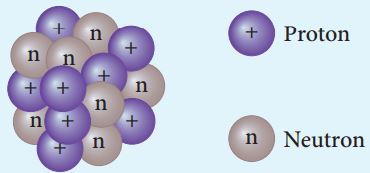
From equation (9.19), the radius of the nuclecus, R = R0 \(A^\frac13\). Then the volume of the nucleus
\(V=\frac { 4 }{ 3 } \pi { R }^{ 3 }=\frac { 4 }{ 3 } { \pi { R }_{ 0 } }^{ 3 }A\)
By ignoring the mass difference between the proton and neutron, the total mass of the nucleus having mass number A is equal to A.m where m is mass of the proton and is equal to 1.6726 x 10⁻²⁷ kg.
Nuclear density.
6.
R = R0A\(\frac13\)
R = 1.2 x 10−15 x (197)\(\frac13\) = 6.97 x 10⁻¹⁵ m
Or R = 6.97 F
7.
The element chlorine is a mixture of 75.77% of \(_{ 17 }^{ 35 }{ Cl }\) and 24.23% of \(_{ 17 }^{ 37 }{ Cl }\). So the average atomic mass will be
\(\frac { 75.77 }{ 100 } \times 34.96885u+\frac { 24.23 }{ 100 } \times 36.96593u\)
= 35.453 u
In fact, the chemist uses the average atomic mass or simply called chemical atomic weight (35.453 u for chlorine) of an element. So it must be remembered that the atomic mass which is mentioned in the periodic table is basically averaged atomic mass.
8.
2πr = nλ
2 x 3.14 x 13.25Å = 5 x λ
∴ λ = 16.64 Å
9.
\(\frac{\mathrm{N}}{\mathrm{N}_{0}}=\frac{17.5}{100} \),\(\mathrm{~T}_{1 / 2}=5730 \text { Years } \)
Age of the sample (t) = ?
Age of sample, \(t=\frac{2.303 \times \log \left(\frac{\mathrm{N}_{0}}{\mathrm{~N}}\right) \times \mathrm{T}_{1 / 2}}{0.6931}\)
\(t=\frac{2.303 \times \log \left(\frac{100}{17.5}\right) \times 5730}{0.6931} \)
\(t=\frac{2.303 \times \log (5.714) \times 5730}{0.6931} \)
\(t=\frac{2.303 \times 0.7570 \times 5730}{0.6931} \)
t = 14410 years
t = 1.44 x 10⁴ years
10.
\(T_{1 / 2}=1600 \text { years }=1600 \times 365 \times 24 \times 60 \times 60 s\)
R = 1 curie = 3.7 x 10¹⁰ Bq, Show that m = 1g
R = λN
Number of atoms Present, N = \(\frac{\mathrm{R}}{\lambda}=\frac{\mathrm{R}}{0.6931} \mathrm{~T}_{1 / 2}\)
Mass of 6.023 x 10²³ atoms of \({ }_{88}^{226} R a=226 g\)
Mass of 1 atom of \({ }_{88}^{226} \mathrm{Ra}=\frac{226}{6.023 \times 10^{23}} \mathrm{~g}\)
Mass of N atoms of \({ }_{88}^{{ }{266}} \mathrm{Ra}=\frac{226}{6.023 \times 10^{23}} \times \mathrm{Ng}\)
Mass of N atoms of \({ }_{88}^{226} \mathrm{Ra}(\mathrm{m})=\frac{226}{6.023 \times 10^{23}} \times \frac{\mathrm{R}}{0.6931} \mathrm{~T}_{1 / 2} \mathrm{~g}\)
\(\mathrm{m}=\frac{226}{6.023 \times 10^{23}} \times \frac{3.7 \times 10^{10}}{0.6931} \times 1600 \times 365 \times 24 \times 60 \times 60 \mathrm{~g}\)
m = 1.01 g
11.
Energy produced per second in reactor = 1 W = 1 J/s
Energy produced per fission = 200 MeV = 200 x 106 x 1.6 x 10-19 J
= 3.2 x 10¹¹ J
Number of fissions per second required \(=\frac{\text { Energy produced per second in reactor }}{\text { Energy produced per fission }} \)
\(=\frac{1}{3.2 \times 10^{11}}=\frac{10 \times 10^{10}}{3.2}=3.125 \times 10^{10} \)
Number of fissions per second = 3.125 x 10¹⁰
12.
\(v_{3 \rightarrow 2}=R C\left(\frac{1}{4}-\frac{1}{9}\right)=\frac{5}{36} R C \)
\(v_{2 \rightarrow 1}=R C\left(\frac{1}{1}-\frac{1}{4}\right)=\frac{3}{4} R C \)
\(v_{3 \rightarrow 1}=R C\left(\frac{1}{1}-\frac{1}{9}\right)=\frac{8}{9} R C \)
\(v_{3 \rightarrow 2}+v_{2 \rightarrow 1}=\frac{5}{36} R C+\frac{3}{4} R C =R C\left(\frac{5}{36}+\frac{3}{4}\right)=R C\left(\frac{5+27}{36}\right) \)
\(v_{3 \rightarrow 2}+v_{2 \rightarrow 1}= R C\left(\frac{32}{36}\right)=\frac{8}{9} R C=v_{3 \rightarrow 1} \)
13.
Kinetic energies,
KEAi = 0
KEAf = KEBt
It should obey law of conservation of energy
Total Initial KE = Total final KE
\(\mathrm{KE}_{\mathrm{A}_{i}}+\mathrm{KE}_{\mathrm{B}_{i}}=\mathrm{KE}_{\mathrm{A}_{\mathrm{t}}}+\mathrm{KE}_{\mathrm{B}_{\mathrm{t}}} \)
\(0+\mathrm{KE}_{\mathrm{B}_{i}}=\mathrm{KE}_{\mathrm{A}_{\mathrm{f}}}+\mathrm{KE}_{\mathrm{A}_{t}} \)
\(\mathrm{KE}_{\mathrm{B}_{\mathrm{i}}}=2 \mathrm{KE}_{\mathrm{A}_{\mathrm{f}}} \)
Minimum energy required for excite the hydrogen atom is 10.2eV
Hence minimum Kinetic energy of HB is
\(\mathrm{KE}_{\mathrm{B}_{1}}=2 \times 10.2 \mathrm{eV}=20.4 \mathrm{eV}\)
14.
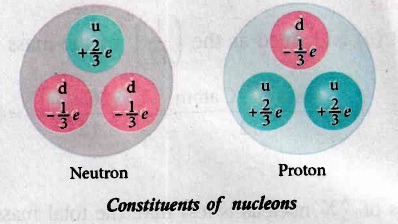
According to quark model,
(i) Proton is made up of two up quarks and one down quark.
(ii) Neutron is made up of one up quark and two down quarks.
15.
One curie was defined as number of decays per second in 1 gram of radium. 1 1 curie = 3.7 X 10¹⁰ decays/s.
16.
Activity (R) or decay rate which is the number of nuclei decayed per second and it is denoted as,
R = \(\left| \frac { dN }{ dt } \right| \)
17.
Half-life T1/2 of nucleus is the time required for the number of atoms initially present to reduce to one half of the initial amount.
\(\mathrm{T}_{1 / 2}=\frac{0.6931}{\lambda}\)
\(\lambda\) is the decay constant.
18.
The mean life time of the nucleus is the ratio of sum or integration of life times of all nuclei to the total number nuclei present initially.
\(\tau =\frac { 1 }{ \lambda } \)
19.
If \({ }_{92}^{238} \mathrm{U}\) nucleus decays into \({ }_{90}^{234} \mathrm{Th}\) by emitting four separate nucleons (two protons and two neutrons), then the disintegration energy Q is negative. It implies that the total mass of products is greater than that of parent \(\left({ }_{92}^{238} \bigcup\right)\) nucleus. This kind of process cannot occur in nature because it would violate conservation of energy. In any decay process, it must obey the law of conservation of energy, law of conservation of linear momentum and law of conservation of angular momentum.
20.
(i) α - decay :
\(_{ Z }^{ A }{ X\rightarrow }_{ Z-2 }^{ A-4 }{ Y+ }_{ 2 }^{ 4 }{ He }\)
(ii) β- decay :
\(_{ Z }^{ A }{ X\rightarrow }_{ Z+1 }^{ A }{ Y+ }{ e }^{ - }+\overset { - }{ v } \)
(iii) β+ decay :
\({ }_{\mathrm{Z}}^{\mathrm{A}} \mathrm{X} \rightarrow{ }_{\mathrm{Z}-1}^{\mathrm{A}} \mathrm{Y}+\mathrm{e}^{+}+\mathrm{v} \)
(iv) Gamma emission :
\({ }_{\mathrm{Z}}^{\mathrm{A}} \mathrm{X}^{*} \rightarrow{ }_{\mathrm{z}}^{\mathrm{A}} \mathrm{X}+\gamma \text { ray } \)
21.
The phenomenon of spontaneous emission of highly penetrating radiations such as α, β and ⋎ rays by an element is called radioactivity and the substances which emit these radiations are called radioactive elements.
22.
Binding energy per nucleon is defined as minimum energy required to take out either a proton or a neutron from nucleus.
\(\overline {BE}=\frac{BE}{A}\)
23.
While forming a nucleus, the mass disappear is converted into energy. This energy is called binding energy of a nucleus.
\(\therefore \mathrm{BE}=\left(\mathrm{Zm}_{\mathrm{P}}+\mathrm{Nm}_{\mathrm{n}}-\mathrm{M}\right) \times \mathrm{c}^{2}\)
where, c - velocity of light
24.
25.
\(\rho=\frac{\text { mass of the nuclei }}{\text { Volume of the nuclei }}=\frac{\mathrm{Am}}{\frac{4}{3} \pi \mathrm{R}_{0}^{3} \mathrm{~A}}=\frac{\mathrm{m}}{\frac{4}{3} \pi \mathrm{R}_{0}^{3}} \)
\(\rho=\frac{1.67 \times 10^{-27}}{\frac{4}{3} \pi\left(1.2 \times 10^{-15}\right)^{3}}=2.3 \times 10^{17} \mathrm{kgm}^{-3} \)
26.
One atomic mass unit (u) is defined as the (1/12)th of the mass of the isotope of carbon \(_{ 6 }^{ 12 }{ C }\)
\(\mathrm{lu}=\frac{\text { mass of }_{6}^{12} \mathrm{C} \text { atom }}{12}=\frac{1.9926 \times 10^{-26}}{12}=1.660 \times 10^{-27} \mathrm{~kg}\)
27.
Isobars are the atoms of different elements having the same mass number A, but different atomic number Z.
Example: \({ }_{16}^{40} \mathrm{~S},{ }_{17}^{40} \mathrm{Cl},{ }_{18}^{40} \mathrm{Ar}\)
28.
Isotones are the atoms of different elements having same number of neutrons.
Example: \({ }_{5}^{12} \mathrm{~B},{ }_{6}^{12} \mathrm{C}\)
29.
Isotopes are atoms of the same element having same atomic number Z, but different mass number A.
(Ex: Hydrogen, \(_{ 1 }^{ 1 }{ H }\) ((hydrogen), \(_{ 1 }^{ 2 }{ H }\) (deuterium),and \(_{ 1 }^{ 3 }{ H }\) (tritium))
30.
General Notation -\(_{ Z }^{ A }{ X }\)
A - Mass number of nucleus - the total number of neutrons and protons in the nucleus
Z - atomic number of nucleus - the total number of protons in the nucleus
X - chemical symbol of the element.
31.
The impact parameter is defined as the perpendicular distance between the centre of the gold nucleus and the direction of velocity vector of alpha particle when it is at a large distance in the Rutherford's alpha particles scattering experiment.
32.
The minimum distance between the centre of the nucleus and the alpha particle just before it gets reflected back through 1800 is defined as the distance of closest approach ro (also known as contact distance).
33.
(i) Minimum energy required to remove an electron from an atom in the ground state is known as binding energy or ionization energy.
(ii) Ionization potential is defined as ionization energy per unit charge.
34.
The energy required to excite an electron from lower energy state to any higher energy state is known as excitation energy.
35.
(i) Most of the alpha particles are un-deflected through the gold foil and went straight.
(ii) Some of the alpha particles are deflected through a small angle.
(iii) A few alpha particles (one in thousand) are deflected through the angle more than 90o.
(iv) Very few alpha particles returned back (ie) deflected back by 180o.
36.
(i) When the pressure of the gas in discharge tube is reduced to around 0.01 mm of Hg, positive column disappears.
(ii) At this time, a dark space is formed between anode and cathode which is called Crooke's dark space.
(iii) The walls of the tube appear with green colour.
(iv) At this stage, some invisible rays emanate from cathode called cathode rays, which are beam of electrons.

12th Standard Syllabus & Materials
12th Standard
TN 12th Computer Applications களப்பெயர் முறைமை (DNS) Sample Question Papers Study Material - QB365 Set A
NEW12th Standard
TN 12th Computer Applications வலையமைப்பு எடுத்துக்காட்டுகள் மற்றும் நெறிமுறைகள் Sample Question Papers Study Material - QB365 Set A
NEW12th Standard
TN 12th Computer Applications கணினி வலையமைப்பு ஓர் அறிமுகம் Sample Question Papers Study Material - QB365 Set A
NEW12th Standard
TN 12th Computer Applications PHP-உடன் MySQL-ஐ இணைத்தல் Sample Question Papers Study Material - QB365 Set A



Tamilnadu Stateboard 12th Standard Subjects

Maths

Chemistry
Physics

Biology

Computer Science

Business Maths and Statistics

Economics

Commerce

Accountancy

History

Computer Applications
Biology
Computer Technology
Computer Applications
Computer Science
Business Maths and Statistics
Commerce
Economics
Maths
Chemistry
Physics
Computer Technology
History
Accountancy

Tamil

English

French
Tamilnadu Stateboard Standards


