
 100% FREE ACCESS
12th Standard Syllabus & Materials
12th Standard
TN 12th Maths Applications of Matrices and Determinants Sample Question Papers Study Material - QB365 Set A
NEW12th Standard
TN 12th Computer Applications மின்னணு தரவு பரிமாற்றம் Sample Question Papers Study Material - QB365 Set A
NEW12th Standard
TN 12th Computer Applications மின் - வணிக பாதுகாப்பு அமைப்புகள் Sample Question Papers Study Material - QB365 Set A
NEW12th Standard
TN 12th Computer Applications மின்னணு செலுத்தல் முறைகள் Sample Question Papers Study Material - QB365 Set A
NEW12th Standard
TN 12th Computer Applications மின் - வணிகம் Sample Question Papers Study Material - QB365 Set A
NEW12th Standard
TN 12th Computer Applications திறந்த மூல கருத்துருக்கள் Sample Question Papers Study Material - QB365 Set A

Published on: 28/11/2025
Download Tamil Nadu 12th Standard Physics question papers, model tests, one-mark questions, important questions, and public exam papers in PDF format. Free study materials and answer keys for TN State Board students.
Questions + Answers key
Take MCQ Physics Test
1.
32 cells, each of emf 3 V are connected in Scrics and kept in a box. If externally the combination shows an emf of 84 V, then how many number of cells reversed in the combination?+
2.
What is called 'Angular dispersion'?
3.
What are the conditions of Total internal reflection?
4.
Prove that a concave lens can only form a virtual, erect and diminished image.
5.
Derive the relation between f and R for a spherical mirror.
6.
What are carbon resistors? What does the colour indicates?
7.
State and explain Kirchhoff ’s rules
8.
From the given circuit,
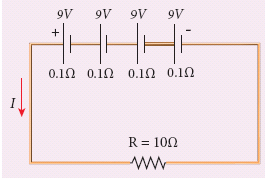
Find
i) Equivalent emf of the combination
ii) Equivalent internal resistance
iii) Total current
iv) Potential difference across external resistance
v) Potential difference across each cell
9.
What is power of a lens?
10.
What is Snell’s window?
11.
What are mirage and looming?
12.
What are critical angle and total internal reflection?
13.
Why nickel is used as heating element?
14.
State Joule’s law of heating.
15.
State the principle of potentiometer.
16.
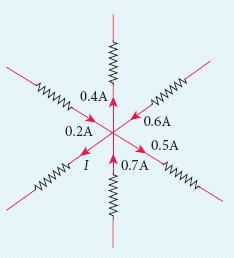
For the given circuit find the value of I.
17.
A ray of light travelling in a transparent medium of refractive index n falls, on a surface separating the medium from air at an angle of incidents of 45o . The ray can undergo total internal reflection for the following n, ______.
n = 1.25
n = 1.33
n = 1.4
n = 1.5
18.
An air bubble in glass slab of refractive index 1.5 (near normal incidence) is 5 cm deep when viewed from one surface and 3 cm deep when viewed from the opposite face. The thickness of the slab is ______.
8 cm
10 cm
12 cm
16 cm
19.
The radius of curvature of curved surface at a thin planoconvex lens is 10 cm and the refractive index is 1.5. If the plane surface is silvered, then the focal length will be, ______.
5 cm
10 cm
15 cm
20 cm
20.
When a biconvex lens of glass having refractive index 1.47 is dipped in a liquid, it acts as plane sheet of glass. This implies that the liquid must have refractive index, ______.
less than one
less than that of glass
greater than that of glass
equal to that of glass
21.
Stars twinkle due to, ______.
reflection
total internal reflection
refraction
polarisation
22.
A rod of length 10 cm lies along the principal axis of a concave mirror of focal length 10 cm in such a way that its end closer to the pole is 20 cm away from the mirror. The length of the image is, ______.
2.5 cm
5cm
10 cm
15cm
23.
The speed of light in an isotropic medium depends on, ______.
its intensity
its wavelength
the nature of propagation
the motion of the source w.r.t medium
24.
Resistance increases with increases in temperature for _________________.
conductor
semiconductors
insulators
superconductor
25.
A piece of copper and another of germanium are cooled from room temperature to 80 K. The resistance of ______.
each of them increases
each of them decreases
copper increases and germanium decreases
copper decreases and germanium increases
26.
The internal resistance of a 2.1 V cell which gives a current of 0.2 A through a resistance of 10 Ω is ______.
0.2 Ω
0.5 Ω
0.8 Ω
1.0 Ω
27.
The temperature coefficient of resistance of a wire is 0.00125 per °C. At 20°C, its resistance is 1 Ω. The resistance of the wire will be 2 Ω at ______.
800 °C
700 °C
850 °C
820 °C
28.
In India electricity is supplied for domestic use at 220 V. It is supplied at 110 V in USA. If the resistance of a 60 W bulb for use in India is R, the resistance of a 60 W bulb for use in USA will be ______.
R
2R
\(\frac{R}{4}\)
\(\frac{R}{2}\)
29.
A wire connected to a power supply of 230 V has power dissipation P1. Suppose the wire is cut into two equal pieces and connected parallel to the same power supply. In this case power dissipation is P2. The ratio \(\frac{P_2}{P_1}\) is ______.
1
2
3
4
30.
A carbon resistor of (47 ± 4.7 ) k Ω to be marked with rings of different colours for its identification. The colour code sequence will be ______.
Yellow – Green – Violet – Gold
Yellow – Violet – Orange – Silver
Violet – Yellow – Orange – Silver
Green – Orange – Violet - Gold
31.
A toaster operating at 240 V has a resistance of 120 Ω. The power is ______.
400 W
2 W
480 W
240 W
32.
Obtain lens maker’s formula and mention its significance.
33.
Obtain the equation for radius of illumination (or) Snell’s window.
34.
Derive the mirror equation and the equation for lateral magnification.
35.
Obtain the condition for bridge balance in Wheatstone’s bridge.
36.
Explain the equivalent resistance of a series and parallel resistor network.
37.
Describe the microscopic model of current and obtain general form of Ohm’s law.
1.
Number of cells = 32
Total emf = 32 x 3 = 96 V
External emf = 84 V
Total emf - 2nE = Effective emf
96 - 2n x 3 = 84
- 6n = 84 - 96
- 6n = - 12
\(n=\frac{12}{6}=2\)
Number of cells = 2
2.
\(\delta_{v}-\delta_{R}=\left(n_{v}-n_{R}\right) A\)
\(\delta_{v}-\delta_{R}\) is the angular separation between two extreme colours (violet and Red) in the spectrum is called the angular dispersion.
3.
(i) The ray should come from denser medium to rarer medium.
(ii) The angle of incidence should be greater than the critical angle.
4.
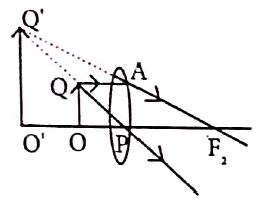
To obtain the image of Q, consider two rays QP and QA. The ray QP passing through the optical centre P goes undeviated. The ray QA parallel to principal axis must pass through F2. Thus, the emergent ray is along AF2Q' (Fig: b). The image is formed where QPQ' and AF2Q' intersect. A perpendicular form Q' is dropped on the principal axis. This perpendicular O'Q' is the image of OQ.
As the ray QA diverges at A on the convex lens an erect diminished virtual image is obtained. The size of the image is always smaller.
5.
Relation between f and R:
C ⇒ Center of curvature
F ⇒ Principal focus
i ⇒ Angle of incidence
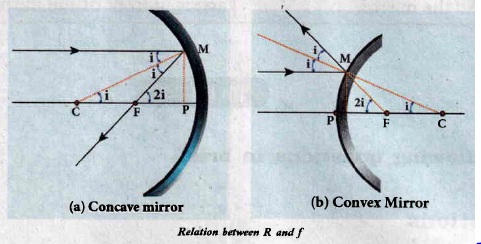
The angles
\(\tan i=\frac{P M}{P C} \text { and } \tan 2 i=\frac{P M}{P F}\)
As the angles are small, tan i = i and tan 2i = 2i.
\(\mathrm{i}=\frac{\mathrm{PM}}{\mathrm{PC}} \text { and } 2 \mathrm{i}=\frac{\mathrm{PM}}{\mathrm{PF}}\)
Simplifying further,
\(2 \frac{\mathrm{PM}}{\mathrm{PC}}=\frac{\mathrm{PM}}{\mathrm{PF}} ; 2 \mathrm{PF}=\mathrm{PC}, \mathrm{R}=2 \mathrm{f}\)
PF is focal length f and PC is the radius of curvature R.
R = 2f (or) f = R/2
6.
(i) Carbon resistors consists of a ceramic core, on which a thin layer of crystalline Carbon is deposited. These resistors are inexpensive, stable and compact in size. Color rings are used to indicate the value of the resistance.
(ii) Three coloured rings are used to indicate the values of a resistor: the first two rings are significant figures of resistances, the third ring indicates the decimal multiplier after them. The fourth color, silver or gold shows the tolerance of the resistor.
| Color | Number | Multiplier | Tolerance |
|---|---|---|---|
| Black | 0 | 1 | - |
| Brown | 1 | 101 | - |
| Red | 2 | 102 | - |
| Orange | 3 | 103 | - |
| Yellow | 4 | 104 | - |
| Green | 5 | 105 | - |
| Blue | 6 | 105 | - |
| Violet | 7 | 107 | - |
| Gray | 8 | 107 | - |
| White | 9 | 109 | - |
| Gold | - | 10-1 | 5% |
| Slive | - | 10-2 | 10% |
| Colorless | - | - | 20% |
7.
Kirchhoff's First rule: (current rule)
(i) It states that the algebraic sum of the currents at any junction of a circuit is zero. It is a statement of law of conservation of electric charge.
(ii) All charges that enter a given junction in a circuit must leave that junction since charge cannot build up or disappear at a junction. By convention current entering the junction is taken as positive and current leaving the junction is taken as negative.
Applying law to the junction A in Figure.
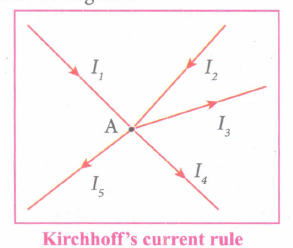
\({ I }_{ 1 }+{ I }_{ 2 }-{ I }_{ 3 }-{ I }_{ 4 }-{ I }_{ 5 }=0\)
(or)
\({ I }_{ 1 }+{ I }_{ 2 }=I_{ 3 }+{ I }_{ 4 }+{ I }_{ 5 }\)
Kirchhoff's Second rule (Voltage rule or Loop rule)
(i) It states that in a closed circuit the algebraic sum of the products of the current and resistance of each part of the circuit is equal to the total emf included in the circuit.
(ii) This rule follows from the law of conservation of energy for an isolated system (The energy supplied by the emf sources is equal to the sum of the energy delivered to all resistors).
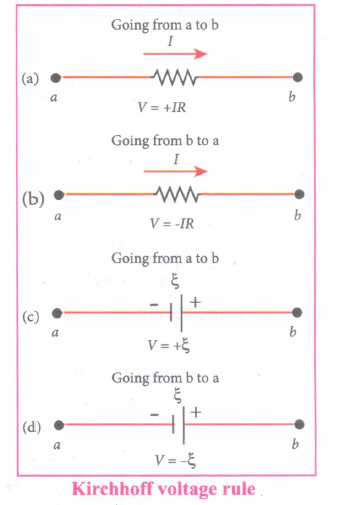
(iii) Kirchhof's voltage rule has to be applied only when all currents in the circuit reach a steady state condition.
(iv) The current in the various branches are constant. The product of current and resistance is taken as positive when the direction of the current is followed.
(v) Suppose if the direction of current is opposite to the direction of the loop, then product of current and voltage across the resistor is negative. It is shown in Figure (a) and (b).
(vi) The emf is considered positive when proceeding from the negative to the positive terminal of the cell.
8.
Equivalent emf of the combination
ξeq = nξ = 4 x 9 = 36 V
ii) Equivalent internal resistance req = nr = 4 x 0.1 = 0.4 Ω
iii) Total current \(I=\frac { n\xi }{ R+nr } \)
\(=\frac { 4\times 9 }{ 10+(4\times 0.1) } \)
\(=\frac { 4\times 9 }{ 10+0.4 } =\frac { 36 }{ 10.4 } \)
I = 3.46 A
iv) Potential difference across external resistance V = IR = 3.46 x 10 = 34.6 V. The remaining 1.4 V is dropped across the internal resistance of cells.
v) Potential difference across each cell \(\frac { V }{ n } =\frac { 34.6 }{ 4 } =8.65V\)
9.
The power of a lens P is defined as the reciprocal of its focal length (in metre).
\(P=\frac{1}{f}\)
10.
When light entering the water from outside is seen from inside the water, the view is restricted to a particular angle equal to the critical angle ic. The restricted illuminated circular area is called Snell's window
11.
Mirage:
Mirage is an optical illusion caused by atmospheric conditions especially the appearance of sheet of water in a desert caused by total internal reflection (or) refraction of light from the sky by heated air.
Looming:
Looming is an optical illusion caused by bending of light which appear an object floating high above its actual position specially in polar region.
12.
Critical angle:
The angle of incidence in the denser medium for which the angle reflection is 90o or the reflected ray graces the boundary between the two media is called critical angle.
Total Internal reflection:
For any angle of incidence greater than the critical angle, the center light is reflected back into the denser medium itself. This phenomenon is called Total internal reflection.
13.
The heating elements are made of nichrome, an alloy of nickel and chromium. Nichrome has a high specific resistance and can be heated to very high temperatures without oxidation.
14.
It states that the heat developed in an electrical circuit due to the flow of current varies directly as
(i) the square of the current
(ii) the resistance of the circuit and
(iii) the time of flow.
15.
The emf of the cell is directly proportional to the balancing length.
16.
Applying Kirchoff’s rule to the point P in the circuit,
The arrows pointing towards P are positive and away from P are negative.
Therefore, 0.2A - 0.4A + 0.6A - 0.5A + 0.7A - I = 0
0.7 A - I = 0
1.5A - 0.9A – I = 0
0.6A - I = 0
I = 0.6 A
17.
For total internal reflection,
sin i > sin c
\(n=\frac{1}{sin \ c}\)
\(sin \ c=\frac{1}{n}\)
\(sin \ i>\frac{1}{n}\)
\(n>\frac{1}{sin \ i}\)
n >\(\sqrt{2}\)
n >1.414 = 1.5
18.
Apparent depth = 3 + 5 = 8 cm
Real depth = thickness of the slab = t
n = 1.5
\(n=\frac{Real \ depth}{Apparent \ depth}\)
\(\therefore 1.5=\frac{t}{8}\)
t = 1.5 x 8
t = 12 cm
19.
\(\frac{1}{f} =(n-1)\left(\frac{1}{R_1}-\frac{1}{R_2}\right) \)
\(=(1.5-1)\left(\frac{1}{\infty}-\frac{1}{(-10)}\right)\)
(Since plano convex lens)
\(=0.5\left[\frac{1}{10}\right]=\frac{1}{20} \)
\(\mathrm{f}_t =20 \mathrm{~cm}\)
Formula for silvered lenses
\(\frac{1}{\mathrm{~F}} =\frac{2}{\mathrm{f}_1}+\frac{1}{\mathrm{f}_m} \)
\(\frac{1}{\mathrm{~F}} =\frac{2}{20}+\frac{1}{\infty} \)
\(\therefore \mathrm{F} =\frac{20}{2}=10 \mathrm{~cm}\)
20.
\(\frac{I}{f}=\left(\frac{\mu_{\mathrm{L}}}{\mu_L}-1\right)\left(\frac{1}{R_1}-\frac{1}{R_2}\right)\)
When the biconvex lens of glass dipped in liquid, it acts as a plane sheet of glass.
\(\therefore \mathrm{f}=\infty, \frac{1}{\mathrm{f}}=0 \quad \frac{\mu_g}{\mu_{\mathrm{L}}}-1=0 ; \frac{\mu_{\mathrm{s}}}{\mu_{\mathrm{L}}}=1, \mu_{\mathrm{s}}=\mu_{\mathrm{L}}\)
21.
(c)
refraction
22.
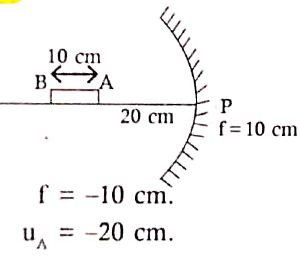
At end A,
\(\frac{1}{f} =\frac{1}{u_A}+\frac{1}{v_A} \)
\(\therefore \frac{1}{v_A} =\frac{1}{-10}-\frac{1}{-20} \)
\(\frac{1}{v_A} =-\frac{1}{10}+\frac{1}{20}=\frac{-2+1}{20}=-\frac{1}{20} \)
\(v_A =-20 \mathrm{~cm} \)
\(\left|v_{\wedge}\right|=20 \mathrm{~cm}\)
At end B,
\(\frac{1}{f} =\frac{1}{u_B}+\frac{1}{v_B} \)
\(\frac{1}{v_B} =\frac{1}{f}-\frac{1}{u_B}, \)
\(u_B =-30 \mathrm{~cm} \)
\(\frac{1}{v_B} =-\frac{1}{10}+\frac{1}{30} \)
\(=\frac{-3+1}{30}=\frac{-2}{30}=\frac{-1}{15} \)
\(v_B =-15 \mathrm{~cm} \)
\(\left|v_B\right| =15 \mathrm{~cm} \)
\(\therefore \quad\left|\mathrm{v}_{\mathrm{A}}\right|-\left|\mathrm{v}_{\mathrm{B}}\right| \) is the length of the image
= 20 - 15 = 5 cm
23.
v = nג
In an isotropic medium, there is no change in the frequency of the light. So, the speed of light depends on wavelength of light.
24.
(a)
conductor
25.
Resistivity ∝ temperature for conductor. so, copper → decreases
Resistivity ∝\(\frac{1}{\text {temperature for semiconductor}}\)
so, germanium → increases.
26.
I = 0.2 A, R = 10 Ω, E = 2.1 V
\(I=\frac{ɛ}{R+r}\)
\(0.2=\frac{2.1}{10+r}\)
0.2 x (10 + r) = 2.1
2 + 0.2 r = 2.1
0.2 r = 2.1 - 2 = 0.1
Internal resistance, \(r=\frac{0.1}{0.2}=\frac{1}{2}\)
r = 0.5 Ω
27.
Rt = Ro [1 + α(T2 - T1)
2 = 1[1 + 0.00125(T2 - 293)
I = 5/4 x 10-3 (T2 - 293)
T2 = 1093 K
T2 = 820 oC
28.
\(\mathrm{V}_1 =220 \mathrm{~V}, \quad \mathrm{P}_1=60 \mathrm{~W} \)
\(\mathrm{~V}_{\mathrm{U}} =110 \mathrm{~V}, \mathrm{P}_{\mathrm{U}}=60 \mathrm{~W} \)
\(P =\frac{V^2}{R} \Rightarrow R=\frac{V^2}{P} \)
\(\therefore R_l =\frac{V_I^2}{P_l} \text { Similarly, } \quad \mathrm{R}_U=\frac{V_U^2}{P_U} \)
\(R_l =\frac{220 \times 220}{60} \quad \mathrm{R}_{\mathrm{U}}=\frac{110 \times 110}{60} \)
\(R_I =\frac{48400}{60} \quad R_U=\frac{12100}{60} \)
\(\frac{R_U}{R_l} =\frac{12100}{60} \times \frac{60}{48400}=\frac{1}{4} \)
\(R_U =\frac{R_l}{4}=\frac{R}{4}\)
29.
\(\mathrm{V}=230 \mathrm{~V} \)
\(P=\frac{V^2}{R} \text { since } \mathrm{V} \text { is same } \mathrm{P} \propto \frac{1}{R} \)
\(\frac{1}{R_2}=\frac{1}{\frac{R_1}{2}}+\frac{1}{\frac{R_1}{2}}=\frac{2}{R_1}+\frac{2}{R_1}=\frac{2+2}{R_1} \)
\(\frac{1}{R_2}=\frac{4}{R_1} \)
\(\therefore R_2=\frac{R_1}{4} \)
\(R_1=4 R_2 \)
\(\therefore \frac{P_2}{P_1}=\frac{R_1}{R_2}=\frac{4 R_2}{R_2}=4\)
30.
Yellow - 4
Violet - 7
Orange - 103
Silver - Tolerance - 10%
31.
\(P=\frac{V^2}{R}=\frac{240 \times 240}{120}=480 \ W\)
32.
(i) Let us consider a thin lens made up of a medium of refractive index n2 is placed in a medium of refractive index n1. Let R1 and R2 be the radii of curvature of two spherical surfaces (1) and (2) respectively and P be the pole.
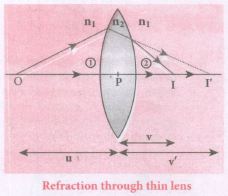
(ii) Consider a point object 'O' on the principal axis. A paraxial ray from 'O' which falls very close to P, after refraction at the surface (1) forms image at 1'.
(iii) Before it does so, it is again refracted by the surface (2). Therefore the final image is formed at I.
(iv) The general equation for the refraction at a single spherical surface is given from Equation,
\(\cfrac { { n }_{ 2 } }{ v } -\cfrac { { n }_{ 1 } }{ v} =\cfrac { \left( { n }_{ 2 }-{ n }_{ 1 } \right) }{ { R } } \)
For the refracting surface (1), the light goes from n1 to n2
\(\cfrac { { n }_{ 2 } }{ v' } -\cfrac { { n }_{ 1 } }{ u } =\cfrac { \left( { n }_{ 2 }-{ n }_{ 1 } \right) }{ { R }_{ 1 } } \) .....(1)
For the refracting surface (2), the light goes from n2 to n1
\(\frac{n_{1}}{v}+\frac{n_{2}}{v^{\prime}}=\frac{\left(n_{1}-n_{2}\right)}{R_{2}}\) ......(2)
For surface (2) I' acts as virtual object.
Adding the above two equations (1) and (2)
\(\cfrac { { n }_{ 1 } }{ v } -\cfrac { { n }_{ 1 } }{ u } =\left( { n }_{ 2 }-{ n }_{ 1 } \right) \left( \cfrac { 1 }{ { R }_{ 1 } } -\cfrac { 1 }{ { R }_{ 2 } } \right) \)
on further simplifying and rearranging,
\(\cfrac { 1 }{ v } -\cfrac { 1 }{ u } =\left( \cfrac { { n }_{ 2 }-{ n }_{ 1 } }{ { n }_{ 1 } } \right) \left( \cfrac { 1 }{ { R }_{ 1 } } -\cfrac { 1 }{ { R }_{ 2 } } \right) \)
\(\cfrac { 1 }{ v } -\cfrac { 1 }{ u } =\left( \cfrac { { n }_{ 2 } }{ n_{ 1 } } -1 \right) \left( \cfrac { 1 }{ { R }_{ 1 } } -\cfrac { 1 }{ { R }_{ 2 } } \right) \) ....(3)
If the object is at infinity, the image is formed at the focus of the lens. Thus, for u = \(\infty\), v = f. Then the equation becomes.
\(\cfrac { 1 }{ f } -\cfrac { 1 }{ \infty } =\left( \cfrac { { n }_{ 2 } }{ { { n }_{ 1 } } } -1 \right) \left( \cfrac { 1 }{ { R }_{ 1 } } -\cfrac { 1 }{ { R }_{ 2 } } \right) \)
\(\cfrac { 1 }{ f } =\left( \cfrac { { n }_{ 2 } }{ { n }_{ 1 } } -1 \right) \left( \cfrac { 1 }{ { R }_{ 1 } } -\cfrac { 1 }{ { R }_{ 2 } } \right) \) ......(4)
If the lens is kept in air, then we can take n2 = n and n1 = 1. So the equation (4) becomes,
\(\\ \cfrac { 1 }{ f } =\left( n-1 \right) \left( \cfrac { 1 }{ { R }_{ 1 } } -\cfrac { 1 }{ { R }_{ 2 } } \right) \) ..(5)
The above equation is called the lens maker's formula.
Significance:
It tells the lens manufacturers what curvature is needed to make a lens of desired focal length with a material of particular refractive index to make a lens of desired focal length. This formula holds good also for a concave lens.
33.
(i) The angle of view for water animals is restricted to twice the critical angle 2ic. The critical angle for water is 48.6°. Thus the angle of view is 97.2°.
(ii) The radius R of the circular area depends on the depth d from which it is seen and also the refractive indices of the media.
(iii) The radius R of Snell's window can be deduced with the illustration as shown in Figure.
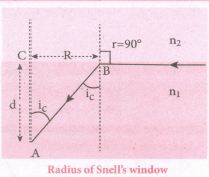
(iv) Light is seen from a point A at a depth 'd'.
(v) From the Snell's law in product form, n1 sini = n2 sinr
(vi) The equation for the refraction happening at the point B on the boundary between the two media is,
n1 sin ic = n2 sin90o ..(1)
n1sinic = n2 (∵ sin90o = 1)
\(sin{ i }_{ c }=\cfrac { { n }_{ 2 } }{ { n }_{ 1 } } \) ...(2)
From the right angle triangle ΔABC,
\({ sini }_{ c }=\cfrac { CB }{ AB } =\cfrac { R }{ \sqrt { { d }^{ 2 }+{ R }^{ 2 } } } \) ....(3)
Equating the above two equation
\(\cfrac { R }{ \sqrt { { d }^{ 2 }+{ R }_{ 2 } } } =\cfrac { { n }_{ 2 } }{ { n }_{ 1 } } \)
Squaring on both sides
\(\cfrac { { R }^{ 2 } }{ { R }^{ 2 }+d^{ 2 } } \left( \cfrac { { n }_{ 2 } }{ { n }_{ 1 } } \right) ^{ 2 }\)
Taking reciprocal,
\(\cfrac { { R }^{ 2 }+{ d }^{ 2 } }{ { R }^{ 2 } } =\left( \cfrac { { n }_{ 1 } }{ { n }_{ 2 } } \right) ^{ 2 }\)
On further simplifying
\(1+\cfrac { { d }^{ 2 } }{ { R }^{ 2 } } =\left( \cfrac { { n }_{ 1 } }{ { n }_{ 2 } } \right) ^{ 2 };\cfrac { { d }^{ 2 } }{ { R }^{ 2 } } =\left( \cfrac { { n }_{ 1 } }{ { n }_{ 2 } } \right) ^{ 2 }-1;\)
\(\cfrac { { d }^{ 2 } }{ { R }^{ 2 } } =\cfrac { { n }_{ 1 }^{ 2 } }{ { n }_{ 1 }^{ 2 } } -1=\cfrac { { n }_{ 1 }^{ 2 }-{ n }_{ 2 }^{ 2 } }{ { n }_{ 2 }^{ 2 } } \)
Again taking reciprocal and rearranging
\(\cfrac { { R }^{ 2 } }{ { d }^{ 2 } } =\cfrac { { { n }_{ 2 }^{ 2 } } }{ { n }_{ 1 }^{ 2 }-{ n }_{ 2 }^{ 2 } } { R }^{ 2 }={ d }^{ 2 }\left( \cfrac { { n }_{ 2 }^{ 2 } }{ { n }_{ 1 }^{ 2 }-{ n }_{ 2 }^{ 2 } } \right) \)
∴ The radius of illumination is,
\(R=d\sqrt { \cfrac { { n }_{ 2 }^{ 2 } }{ \left( n_{ 1 }^{ 2 }-{ n }_{ 2 }^{ 2 } \right) } } \) ...(4)
If the rarer medium outside is air, then, n2 = 1, and we can take n1 = n
\(R=d\left( \cfrac { 1 }{ \sqrt { { n }^{ 2 }-1 } } \right) \) or \(R=\cfrac { d }{ \sqrt { { n }^{ 2 }-1 } } \) ....(5)
34.
Mirror Equation :
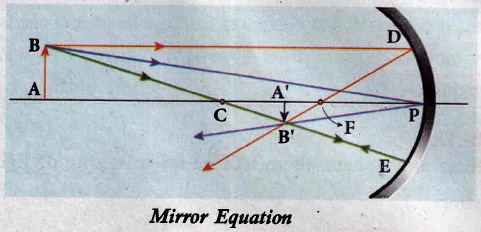
(i) AB is an object which is placed on the principal axis of a concave mirror beyond the center of curvature C. A' B' is an image which is formed between the point pole P, and the centre of curvature.
(ii) From the figure As per law of reflection, the angle of incidence ∠BPA is equal to the angle of reflection ∠B'PA'.
(iii) The triangles ∠BPA and ∠B'PA' are similar. Thus, from the rule of similar triangles,
\(\cfrac { { A }^{ ' }{ B }^{ ' } }{ AB } =\cfrac { { PA }^{ ' } }{ PA } \) ................(1)
(iv) The other set of similar triangles are, ΔDPF and ΔB'A'F. (PD is almost a straight vertical line)
\(\cfrac { { A }^{ ' }B' }{ PD } =\cfrac { A'F }{ PF } \)
(v) As, PD = AB the above equation becomes,
\(\cfrac { A'B' }{ AB } =\cfrac { A'F }{ PF } \) ......(2)
(vi) From equations (1) and (2) we can write,
\(\cfrac { PA' }{ PA } =\cfrac { A'F }{ PF } \)
(vii) As, A'F = PA' - PF, the above equation becomes,
\(\cfrac { PA' }{ PA } =\cfrac { PA'-PF }{ PF } \) .....(3)
(viii) We can apply the sign conventions for the various distances in the above equation
PA = - u, PA' = -v, PF = - f
(ix) All the three distances are negative as per sign convention, because they are measured to the left of the pole. Now, the equation (3) becomes,
\(\cfrac { -v }{ -u } =\cfrac { -v-\left( -f \right) }{ -f } \)
On further simplification,
\(\cfrac { v }{ u } =\cfrac { v-f }{ f } ;\cfrac { v }{ u } =\cfrac { v }{ f } -1 \)
Dividing either side with v,
\(\cfrac { 1 }{ u } =\cfrac { 1 }{ f } -\cfrac { 1 }{ v } \)
After rearranging,
\(\cfrac { 1 }{ v } +\cfrac { 1 }{ u } =\cfrac { 1 }{ f } \)
The above equation is called mirror equation.
Lateral magnification:
The lateral or transverse magnification is defined as the ratio of the height of the image to the height of the object. The height of the object and image are measured perpendicular to the principal axis.
Magnification (m) \(=\frac{\text { height of the image }\left(h^{\prime}\right)}{\text { height of the image }(h)} \)
\(m=\frac{h^{\prime}}{h} \) ....(1)
Applying proper sign conventions for equation,
\(\frac{A^{\prime} B^{\prime}}{A B}=\frac{P A^{\prime}}{P A} \)
\(A^{\prime} B^{\prime}=-h^{\prime}, A B=h, P A^{\prime}=-v, P A=-u \)
\(-\frac{h}{h}=\frac{-v}{-u} \)
On simplifying we get,
\(\mathrm{m}=\frac{\mathrm{h}^{\prime}}{\mathrm{h}}=-\frac{\mathrm{v}}{\mathrm{u}}\) ...(2)
Using mirror equation, we can further write the magnification as,
\(m=\frac{h^{\prime}}{h}=\frac{f-v}{f}=\frac{f}{f-u}\) ..(3)
35.
Wheatstone's bridge:
i) An important application of Kirchhoff's rule is Wheatstone's bridge. It is used to compare Resistances and also helps in determining the unknown resistance in electrical network. The bridge consists of four resistances P, Q, R and S connected as shown in Figure.
ii) A galvanometer G is connected between the points B and D. The battery is connected between the points A and C. The current through the galvanometer is IG and its resistance is G.
Applying Kirchhoff's current rule to junction B
I1 - IG - I3 = 0 ..(1)
Applying Kirchhoff's current rule to junction D,
I2 + IG - I4 = 0 ...(2)
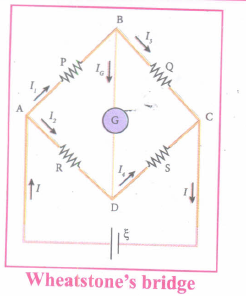
Applying Kirchhoff's voltage rule to loop ABDA,
I1P + IGG - I2R = 0 ...(3)
Applying Kirchhoff's voltage rule to loop ABCDA,
I1P + I3Q - I4S - I2R = 0 ...(4)
(iii) When the points B and D are at the same potential, the bridge is said to be balanced. As there is no potential difference between B and D, no current flows through galvanometer (IG = 0). Substituting IG = 0 in equation (1), (2) and (3), we get
I1 = I3 ..(5)
I2 = I4 ..(6)
I1P = I2R ..(7)
Substituting the equation (7) in equation (4),
I3Q = I4S .....(8)
Dividing equation (7) by equation (8), we get
\(\cfrac { P }{ Q } =\cfrac { R }{ S } \) .....(9)
(iv) This is the bridge balance condition. Only under this condition, galvanometer shows null deflection.
36.
Resistors in series:
(i) When two or more resistors are connected end to end, they are said to be in series. The resistors could be simple resistors or bulbs or heating elements or other devices. Figure (a) shows three resistors R1, R2 and R3 connected in series.
(ii) The amount of charge passing through resistor R1 must also pass through resistors R2 and R3 since the charges cannot accumulate anywhere in the circuit. Due to this reason, the current I passing through all the three resistors are the same.
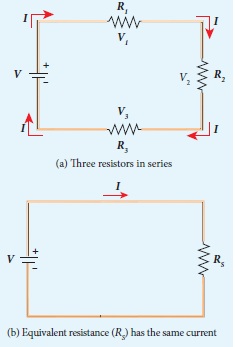
(iii) According to Ohm's law, if same current pass through different resistors of different values, then the potential difference across each resistor must be different. Let V1, V2 and V3 be the potential difference (voltage)across each of the resistors R1, R2 and R3 respectively, then we can write V1 = IR1, V2= RI2 and V3 = IR3. But the total voltage V is equal to the sum of voltages across each resistor.
V = V1 + V2 + V3 = IR1+ IR2 + IR3
V = I (R1 + R2 + R3)
V = IRS
where Rs is the equivalent resistance,
RS = R1 + R2 + R3
(iv) When several resistances are connected in series, the total or equivalent resistance is the sum of the individual resistances.
Note: The value of equivalent resistance in series connection will be greater than each individual resistance.
Resistors in parallel:
(i) Resistors are in parallel when they are connected across the same potential difference as shown in figure (a).
(ii) In this case, the total current I that leave the battery split into three separate components.
Let I1, I2 and I3 be the current through the resistors R1, R2, and R3 respectively. Due to the conservation of charge, total current in the circuit I is equal to sum of the currents through each of the three resistors.
I = I1 + I2 + I3 .....(1)
(iii) Since the voltage across each resistor is the same, applying Ohm's law to each resistor, we have
\({ I }_{ 1 }=\cfrac { V }{ { R }_{ 1 } } ,{ I }_{ 2 }=\cfrac { V }{ { R }_{ 2 } } ,{ I }_{ 3 }=\cfrac { V }{ { R }_{ 3 } } \)
Substituting these values in equation (1), we get,
\({ I }_{ 1 }=\cfrac { V }{ { R }_{ 1 } } +\cfrac { V }{ { R }_{ 2 } } +\cfrac { V }{ { R }_{ 3 } } =V\left[ \cfrac { 1 }{ { R }_{ 1 } } +\cfrac { 1 }{ { R }_{ 2 } } +\cfrac { 1 }{ { R }_{ 3 } } \right] \)
\(I=\cfrac { V }{ { R }_{ p } } \)
\(\cfrac { 1 }{ R_{ P } } =\cfrac { 1 }{ { R }_{ 1 } } +\cfrac { 1 }{ { R_{ 2 } } } +\cfrac { 1 }{ R_{ 3 } } \)
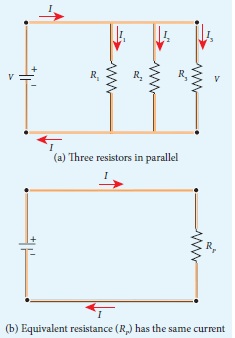
Here RP is the equivalent resistance of the parallel combination of the resistors. Thus, when a number of resistors are connected in parallel, the sum of the reciprocal of the values of resistance of the individual resistor is equal to the reciprocal of the effective resistance of the combination.
Note: The value of equivalent resistance in parallel connection will be lesser than each individual resistance.
37.
(i) XY is a conductor of area cross section A. \(\vec { E } \)is the applied electric field. n is the number of electrons per unit volume with same drift velocity (Vd) .
(ii) Let electrons move through a distance dx in time interval dt.
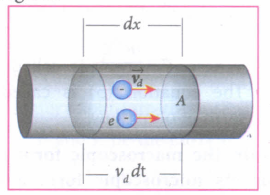
(iii) The drift velocity of the electrons = vd
(iv) If the electrons move through a distance dx within a small interval of time dt,
\({ v }_{ d }=\cfrac { dx }{ dt } ;dx={ v }_{ d }dt\) ..(i)
(v) Since A is the area of cross section of the conductor, the electrons available in the volume of length dx is
= volume x number of electrons per unit volume = A dx x n ...(2)
(vi) Substituting for dx from equation (1) in (2)
= (A vd dt) n
(vii) Total charge in volume element dQ =(charge) x (number of electrons in the volume element)
dQ = (e) (Avddt)n
Hence the current \(I=\cfrac { dQ }{ dt } =\cfrac { ne{ Av }_{ d }dt }{ dt } \)
\(I=ne{ Av }_d\) ..........(3)
Current density (J):
(viii) The current density (J) is defined as the current per unit area of cross section of the conductor.
\(J=\cfrac { I }{ A } \)
(ix) The S.I unit of current density is \({ Am }^{ -2 }\)
\(J=\cfrac { neAv_{ d } }{ A } \) (∵I = nAeVd)
\(J={ nev }_{ d }\) .........(4)
(x) The above expression holds only when the direction of the current is perpendicular to the area A.
In general, the current density is a vector quantity and it is given by,
\(\vec { J } =ne\vec { v_{ d } } \)
Substituting \(\vec { v_{ d } } \) from equation
\(\vec { v_{ d } } =\cfrac { e\tau }{ m } \vec { E } \)
\(\vec { J } =\cfrac { n.{ e }^{ 2 }\tau }{ m } \vec { E } \) ...(5)
\(\vec { J } =\sigma \vec { E } \) ....(6)
(xi) But conventionally, we take the direction of (conventional) current density as the direction of electric field. So, the above equation becomes,
\(\vec { J } =\sigma \vec { E } \) .....(7)
(xii) Where, \(\sigma =\cfrac { { ne }^{ 2 }\tau }{ m } \) is called conductivity. The equation (7) is called microscopic form of ohm's law.

12th Standard Syllabus & Materials
12th Standard
TN 12th Computer Applications வலையமைப்பு வடமிடல் Sample Question Papers Study Material - QB365 Set A
NEW12th Standard
TN 12th Computer Applications களப்பெயர் முறைமை (DNS) Sample Question Papers Study Material - QB365 Set A
NEW12th Standard
TN 12th Computer Applications வலையமைப்பு எடுத்துக்காட்டுகள் மற்றும் நெறிமுறைகள் Sample Question Papers Study Material - QB365 Set A
NEW12th Standard
TN 12th Computer Applications கணினி வலையமைப்பு ஓர் அறிமுகம் Sample Question Papers Study Material - QB365 Set A



Tamilnadu Stateboard 12th Standard Subjects

Maths

Chemistry
Physics

Biology

Computer Science

Business Maths and Statistics

Economics

Commerce

Accountancy

History

Computer Applications
Biology
Computer Technology
Computer Applications
Computer Science
Business Maths and Statistics
Commerce
Economics
Maths
Chemistry
Physics
Computer Technology
History
Accountancy

Tamil

English

French
Tamilnadu Stateboard Standards


