
 100% FREE ACCESS
12th Standard Syllabus & Materials
12th Standard
TN 12th Maths Applications of Matrices and Determinants Sample Question Papers Study Material - QB365 Set A
NEW12th Standard
TN 12th Computer Applications மின்னணு தரவு பரிமாற்றம் Sample Question Papers Study Material - QB365 Set A
NEW12th Standard
TN 12th Computer Applications மின் - வணிக பாதுகாப்பு அமைப்புகள் Sample Question Papers Study Material - QB365 Set A
NEW12th Standard
TN 12th Computer Applications மின்னணு செலுத்தல் முறைகள் Sample Question Papers Study Material - QB365 Set A
NEW12th Standard
TN 12th Computer Applications மின் - வணிகம் Sample Question Papers Study Material - QB365 Set A
NEW12th Standard
TN 12th Computer Applications திறந்த மூல கருத்துருக்கள் Sample Question Papers Study Material - QB365 Set A

Published on: 28/11/2025
Download Tamil Nadu 12th Standard Physics question papers, model tests, one-mark questions, important questions, and public exam papers in PDF format. Free study materials and answer keys for TN State Board students.
Questions + Answers key
Take MCQ Physics Test
1.
What are Fraunhofer lines? How are they useful in the identification of elements present in the Sun?
2.
Discuss the Hertz experiment.
3.
Define ‘Electric field’ and discuss its various aspects.
4.
Explain in detail Coulomb’s law and its various aspects.
5.
Calculate the electrostatic force and gravitational force between the proton and the electron in a hydrogen atom. They are separated by a distance of 5.3 x 10⁻¹¹ m. The magnitude of charges on the electron and proton are 1.6 x 10⁻¹⁹ C. Mass of the electron is me = 9.1 x 10⁻³¹ kg and mass of proton is mp = 1.6 x 10⁻²⁷ kg.
6.
Fraunhofer lines are an example of ______ spectrum.
line emission
line absorption
band emission
band absorption
7.
Which one of them is used to produce a propagating electromagnetic wave?
an accelerating charge
a charge moving at constant velocity
a stationary charge
an uncharged particle
8.
Which of the following is an electromagnetic wave?
α - rays
β - rays
\(\gamma\) - rays
all of them
9.
Which of the following is false for electromagnetic waves
transverse
non-mechanical waves
longitudinal
produced by accelerating charges
10.
11.
Two metallic spheres of radii 1 cm and 3 cm are given charges of -1 \(\times\) 10-2 C and 5 \(\times\) 10-2 C respectively. If these are connected by a conducting wire, the final charge on the bigger sphere is
3 \(\times\) 10-2 C
4 \(\times\) 10-2 C
1 \(\times\) 10-2 C
2 \(\times\) 10-2 C
12.
If voltage applied on a capacitor is increased from V to 2V, choose the correct conclusion.
Q remains the same, C is doubled
Q is doubled, C doubled
C remains same, Q doubled
Both Q and C remain same
13.
An electric field \(\vec { E } =10x\hat { i } \) exists in a certain region of space. Then the potential difference V = Vo – VA, where Vo is the potential at the origin and VA is the potential at x = 2 m is _____.
10 V
-20 V
+20 V
-10 V
14.
Two identical conducting balls having positive charges q1 and q2 are separated by a centre to centre distance r. If they are made to touch each other and then separated to the same distance, the force between them will be _____.
less than before
same as before
more than before
zero
15.
Which charge configuration produces a uniform electric field?
point charge
uniformly charged infinite line
uniformly charged infinite plane
uniformly charged spherical shell
16.
Write notes on Gauss' law in magnetism.
17.
What is displacement current?
18.
When two objects are rubbed with each other, approximately a charge of 50 nC can be produced in each object. Calculate the number of electrons that must be transferred to produce this charge.
19.
Write a short note on superposition principle.
20.
What is meant by quantisation of charges?
21.
Explain the importance of Maxwell’s correction.
22.
Explain the Maxwell’s modification of Ampere’s circuital law.
23.
Explain in detail the construction and working of a Van de Graaff generator.
24.
Explain the process of electrostatic induction.
1.
(i) When the spectrum obtained from the Sun is examined, it consists of large number of dark lines . These dark lines in the solar spectrum are called Fraunhofer lines.
(ii) The Absorption spectra for various materials are compared with the Fraunhofer lines in the solar spectrum, which helps in identifying elements present in the Sun's atmosphere.
2.
(i) The experimental set up it consists of two metal electrodes which are made of small spherical metals. These are connected to larger spheres and the ends of them are connected to induction coil with very large number of turns.
(ii) This is to produce very high electromotive force (emf). Since the coil is maintained at very high potential, air between the electrodes gets ionized and spark (spark means discharge of electricity) is produced.
(iii) This discharge of electricity affects another electrode (ring type - not completely closed) which is kept at far distance. This implies that the energy is transmitted from electrode to the receiver (ring electrode) in the form of waves, known as electromagnetic waves. If the receiver is rotated by 90o then no spark is observed by the receiver.
(iv) This confirms that electromagnetic waves are transverse waves as predicted by Maxwell. Hertz detected radio waves and also computed the speed of radio waves which is equal to the speed of light (3 x 10⁸ ms-1).
3.
The electric field at the point P at a distance r from the point charge q is defined as the force that would be experienced by a unit positive charge placed at that point and is given by,
\(\vec{E}=\frac{\vec{F}}{q_{0}}=\frac{k q}{r^{2}} \hat{r}=\frac{1}{4 \pi \varepsilon_{0}} \frac{q}{r^{2}} \hat{r}\) ....(1)
where \(\hat{r}\) is the unit vector pointing from q to the point of interest P.
Important aspect of the Electric field:
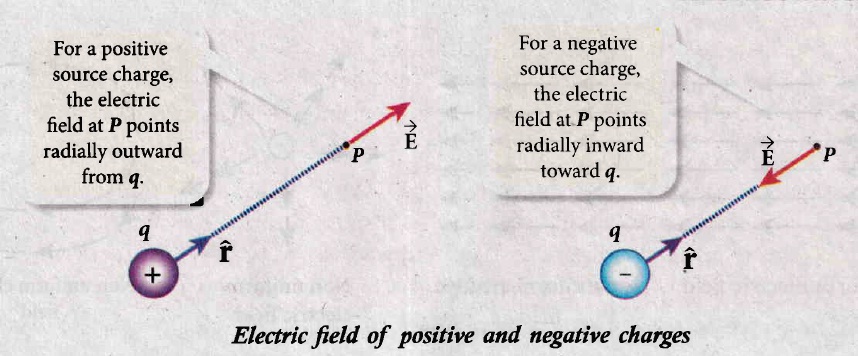
(i) If the charge q is positive then the electric field points away from the source charge and if q is negative, the electric field points towards the source charge q. This is shown in the Figure
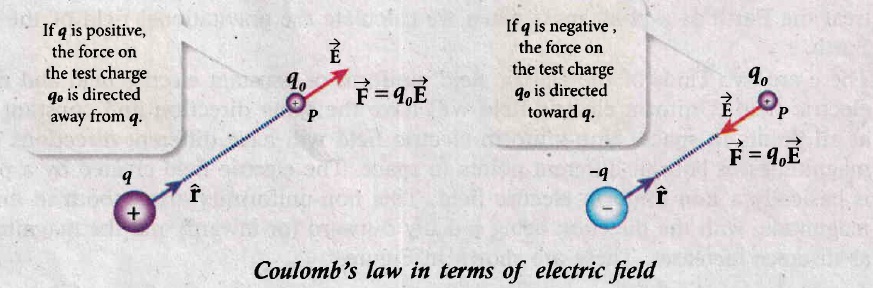
(ii) If the electric field at a point P is \(\vec{E},\) then the force experienced by the test charge qo placed at the point P is \(\vec { F } ={ q }_{ 0 }\vec { E } \)
This is Coulomb's law in terms of electric field. This is shown in Figure
(iii) The equation (1) implies that the electric field is independent of the test charge qo and it depends only on the source charge q.
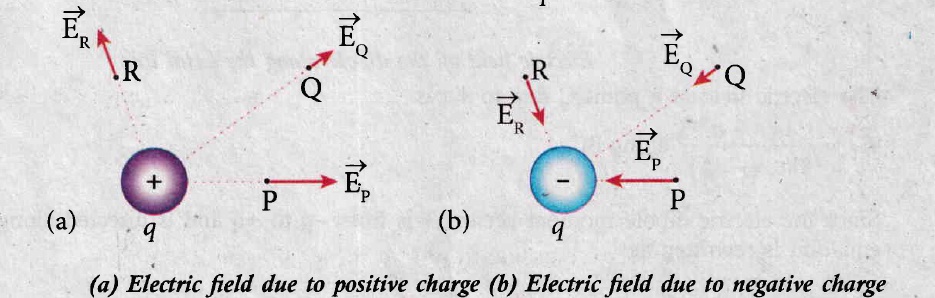
(iv) Since the electric field is a vector quantity, at every point in space, this field has unique direction and magnitude, as shown in Figures (a) and (b). From equation (1), we can infer that as distance increases, the electric field decreases in magnitude. Note that in Figures (a) and (b) the length of the electric field vector is shown for three different points. The strength or magnitude of the electric field at point P is stronger than at the points Q and R because the point P is closer to the source charge.
(v) In the definition of electric field, it is assumed that the test charge (q0) is taken sufficiently small, so that bringing this test charge will not move the source charge. In other words, the test charge is made sufficiently small such that it will not modify the electric field of the source charge.
(vi) The expression (1) is valid only for point charges. For continuous and finite size charge distributions, integration techniques must be used. These will be explained later in the same section. However, this expression can be used as an approximation for a finite-sized charge if the test point is very far away from the finite sized source charge. Note that we similarly treat the Earth as a point mass when we calculate the gravitational field of the Sun on the Earth.
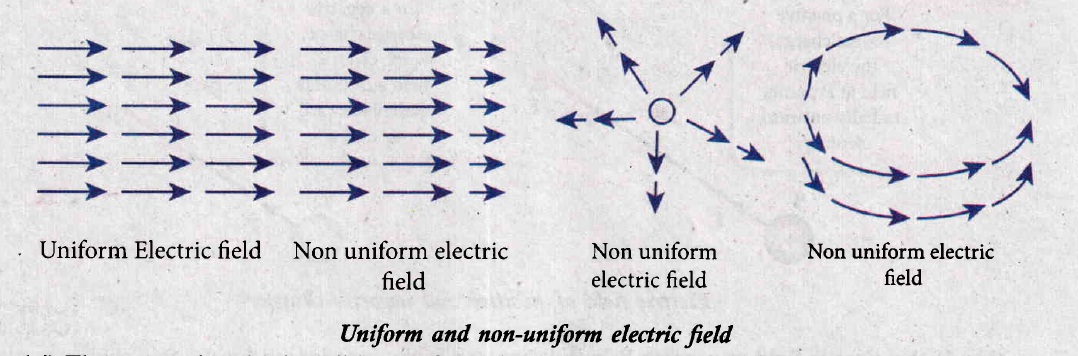
(vii) There are two kinds of the electric field : uniform or constant electric field and non-uniform electric field. Uniform electric field will have the same direction and constant magnitude at all points in space. Non-uniform electric field will have different directions or different magnitudes or both at different points in space. The electric field created by a point charge is basically a non uniform electric field. This non-uniformity arises, both in direction and magnitude, with the direction being radially outward (or inward) and the magnitude changes as distance increases. These are shown in Figure.
4.
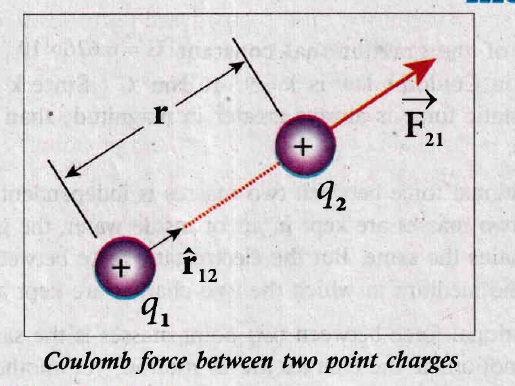
(i) Consider two point charges q1 and q2 at rest in vacuum, and separated by a distance of r, as shown in the figure.
(ii) According to Coulomb, the force on the point charge q2 exerted by another point charge q1 is \(\overrightarrow{F_{21}}=k \frac{q_{1} q_{2}}{r^{2}} \hat{r}_{12}\)
(iii) where \(\hat{r}_{12}\) is the unit vector directed from charge q1 to charge q2 and k is the proportionality constant.
Important aspects of Coulomb’s law
(i) Coulomb’s law states that the electrostatic force is directly proportional to the product of the magnitude of the two point charges and is inversely proportional to the square of the distance between the two point charges.
(ii) The force on the charge q2 exerted by the charge q1 always lies along the line joining the two charges. \({ \hat { r } }_{ 12 }\) is the unit vector pointing from charge q1 to q2. It is shown in the Figure. Likewise, the force on the charge q1 exerted by q2 is along \(-{ \hat { r } }_{ 12 }\)(i.e., in the direction opposite to \({ \hat { r } }_{ 12 })\).
(iii) In SI units, \(k=\frac { 1 }{ 4\pi { \varepsilon }_{ 0 } } \) and its value is k = 9 x 10⁹ Nm2C-2. Here \({ \varepsilon }_{ 0 }\) is the permittivity of free space or vacuum and the value of \({ \varepsilon }_{ 0 }=\frac { 1 }{ 4\pi k } =8.85\times { 10 }^{ -12 }{ C }^{ 2 }{ N }^{ -1 }{ m }^{ -2 }\).
(iv) The magnitude of the electrostatic force between two charges each of one coulomb and separated by a distance of 1 m is calculated as follows: \(|F|=\frac { 9\times { 10 }^{ 9 }\times 1\times 1 }{ { 1 }^{ 2 } } =9\times { 10 }^{ 9 }N\).
(v) In SI units, Coulomb's law in vacuum takes the form \({ \vec { F } }_{ 21 }=\frac { 1 }{ { 4\pi \varepsilon }_{ 0 } } \frac { { q }_{ 1 }{ q }_{ 2 } }{ { r }^{ 2 } } { \hat { r } }_{ 12 }.\) In a medium of permittivity \(\varepsilon \), the force between two point charges is given by\({ \vec { F } }_{ 21 }=\frac { 1 }{ 4\pi \varepsilon } \frac { { q }_{ 1 }{ q }_{ 2 } }{ { r }^{ 2 } } { \hat { r } }_{ 12 }\). Since \(\varepsilon \)>\(\varepsilon \)0, the force between two point charges in a medium other than vacuum is always less than that in vacuum. The relative permittivity for a given medium as \({ \varepsilon }_{ r }=\frac { \varepsilon }{ { \varepsilon }_{ 0 } } \) For vacuum or air, \(\varepsilon \)r = 1 and for all other media \(\varepsilon \)r > 1.
(vi) (a) Coulomb's law has same structure as Newton's law of gravitation. Both are inversely proportional to the square of the distance between the particles.
(b) The electrostatic force is directly proportional to the product of the magnitude of two point charges.
(c) Coulomb force between two charges can be attractive or repulsive, depending on the nature of charges and nature of the medium in which the two charges are kept at rest.
(vii) The force on a charge q1 exerted by a point charge q2 is given by
\({ \vec { F } }_{ 12 }=\frac { 1 }{ { 4\pi \varepsilon }_{ 0 } } \frac { { q }_{ 1 }{ q }_{ 2 } }{ { r }^{ 2 } } { \hat { r } }_{ 21 }\)
Here \({ \hat { r } }_{ 21 }\) is the unit vector from charge q2 to q1.
But \({ \hat { r } }_{ 21 }=-{ \hat { r } }_{ 12 },\)
\({ \vec { F } }_{ 12 }=\frac { 1 }{ { 4\pi \varepsilon }_{ 0 } } \frac { { q }_{ 1 }{ q }_{ 2 } }{ { r }^{ 2 } } \left( -{ \hat { r } }_{ 21 } \right) =\frac {- 1 }{ { 4\pi \varepsilon }_{ 0 } } \frac { { q }_{ 1 }{ q }_{ 2 } }{ { r }^{ 2 } } \left( { \hat { r } }_{ 12 } \right) \)
or \({ \vec { F } }_{ 12 }=-{ \vec { F } }_{ 21 }\)
Therefore, the electrostatic force obeys Newton's third law.
(viii) Coulomb force is true only for point charges. In fact, Coulomb discovered his law by considering the charged spheres in the torsion balance as point charges.
Point charge : If the distance between the two charged spheres (or objects) is much greater than the radii (or sizes) of the spheres (or objects).
5.
The proton and the electron attract each other. The magnitude of the electrostatic force between these two particles is given by
\(F_e=\frac { ke^{ 2 } }{ { r }^{ 2 } } =\frac { 9\times 10^{ 9 }\times (1.6\times 10^{ -19 })^{ 2 } }{ (5.3\times 10^{ -11 })^{ 2 } } \)
=\(\frac { 9\times 2.56 }{ 28.09 } \) x 10-7 = 8.2 x 10⁻⁸ N
The gravitational force between the proton and the electron is attractive. The magnitude of the gravitational force between these particles is
FG = \(\frac { G{ m }_{ e }{ m }_{ p } }{ { r }^{ 2 } } \)
= \(\frac { 6.67\times 10^{ -11 }\times 9.1\times 10^{ -31 }\times 1.6\times 10^{ -27 } }{ (5.3\times 10^{ -11 })^{ 2 } } \)
= \(\frac { 97.11 }{ 28.09 } \) x 10-47 = 3.4 x 10-47N
The ratio of the two forces \(\frac { { F }_{ e } }{ F_{ G } } =\frac { 8.2\times 10^{ -8 } }{ 3.4\times 10^{ -47 } } \)
= 2.41 x 1039
Note that Fe ≈ 1039 FG
The electrostatic force between a proton and an electron is enormously greater than the gravitational force between them. Thus the gravitational force is negligible when compared with the electrostatic force in many situations such as for small size objects and in the atomic domain. This is the reason why a charged comb attracts an uncharged piece of paper with greater force even though the piece of paper is attracted downward by the Earth. This given figure is shown in below.
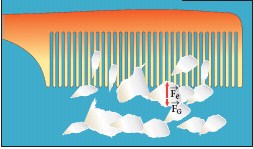
Electrostatic attraction between a comb and pieces of papers
6.
(b)
line absorption
7.
(a)
an accelerating charge
8.
(c)
\(\gamma\) - rays
9.
(c)
longitudinal
10.
(b)
11.
Q = q1 + q2 = 4 x 10⁻²C
\(q_{2f}=Q[\frac{r_2}{r_1+r_2}]\)
= 4 x 10⁻² \([\frac{3}{4}]\)
q2f = 3 x 10⁻² C
12.
If voltage is increased from V to 2 V
Then Q1 = CV
Q2 = C(2 V) = 2 CV
∴ Q is doubled and C remains same
13.
\(\vec {E}\) = 10x\(\hat{i},\) when x = 2 m
\(\vec {E}\) = 10 x 2 x \(\hat{i}\) = 20\(\hat{i}\)
Since, \(E=\frac{-dV}{dx}\therefore V=+20 V\)
14.
Force ∝ charge
After the separation, the magnitude of charge will be increased. So the force will be more than before.
15.
(c)
uniformly charged infinite plane
16.
i) The surface integral of magnetic field over a closed surface is zero. Mathematically, \(\oint \vec{B} \cdot d\vec{A}=0\) (Gauss's law for magnetism) where \(\vec{B}\) is the magnetic field.
ii) This equation implies that the magnetic lines of force form a continuous closed path. In other words, it means that no isolated magnetic monopole exists.
17.
The displacement current can be defined as the current which comes into play in the region in which the electric field or the electric flux is changing with time.
18.
Charge q = 50 nC = 50 x 10-9 C , e = 1.6 x 10⁻¹⁹ C
No. of electrons \(n=\frac{q}{e}\)
\(\frac { q }{ e } =\frac { 50\times { 10 }^{ -9 } }{ 1.6\times { 10 }^{ -19 } } \)
= 31.25 x 10¹⁰ electrons
To produce 50 nC charge, number of electrons transferred = 31.25 x 10¹⁰ electrons
19.
It there are more than two charges, the total force acting on a given charge is equal to the vector sum of forces exerted on it by all the other charges.
Consider a system of n charges namely q1, q2, q3 ...qn. The force on q1 exerted by the charge q2 is \(\overrightarrow{F_{12}}=k \frac{q_{1} q_{2}}{r_{21}^{2}} \hat{r}_{21}\) .
The force on q1 exerted by the charge q3 is \(\overrightarrow{F_{13}}=k \frac{q_{1} q_{3}}{r_{31}^{2}} \hat{r}_{31}\)
By continuing this, the total force acting on the charge q1 due to all other charges is given by
\( \vec{F}_{1}^{\text { tot }}=\overrightarrow{F_{12}}+\overrightarrow{F_{13}}+\overrightarrow{F_{14}}+\ldots+\vec{F}_{1 n} \)
\(\vec{F}_{1} ^{\text { tot }}=k\left\{\frac{q_{1} q_{2}}{r_{21}^{2}} \hat{r}_{21}+\frac{q_{1} q_{3}}{r_{31}^{2}} \hat{r}_{31}+\frac{q_{1} q_{4}}{r_{41}^{2}} \hat{r}_{41}+\ldots+\frac{q_{1} q_{n}}{r_{n 1}^{2}} \hat{r}_{n 1}\right\}\)
20.
The charge of an electron is the elementary charge in nature. Therefore, charge on any body is the integral multiple of an electron. The charge on any body can be expressed by the formula,
q = ne; where, n is the number of electrons, e is the charge on one electron.
n = 0, ±1, ±2, ±3, ±4, ...
This is called quantization of charge.
21.
Importance of Maxwell's correction:
(i) Earth receives radiation from Sun and other stars. These radiations travel through empty space where there are no electric charges and hence no electric current. Ampere's law says that only electric current can produce a magnetic field. If Ampere's law alone is true, there will not be any radiation.
(ii) Maxwell's correction term \(\left(\mu_{0} \varepsilon_{0} \frac{d \phi_{E}}{d t}\right)\)in Ampere's law ensures that time-varying electric field or displacement current can also produce a magnetic field. Though conduction current is zero in an empty space displacement current does exist.
\(\oint_{l} \vec{B} \cdot \overrightarrow{d l}=\mu_{0} \varepsilon_{0} \frac{d \phi_{E}}{d t} \)
(iii) In stars, due to thermal excitation of atoms, time-varying electric field is produced which in turn, produces time-varying magnetic field. According to Faraday's law, this time-varying magnetic field produces again time-varying electric field and so on. The coupled time-varying electric and magnetic fields travel through empty space with the speed of light and is called electromagnetic wave.
(iv) Even though Maxwell initially started with purely symmetry argument, his correction term explains one of the important aspects of the universe, namely the existence of electromagnetic waves.
22.
(i) We have stated Ampere's law as \(\oint \vec{B} \cdot \overrightarrow{d l}=\mu_oi\)
(ii) Where, i is the electric current crossing a surface bounded by a closed curve and the line integral of \(\vec{B}\) is calculated along that closed curve. This equation is valid only when the electric field at the surface does not change with time.
(iii) Maxwell strongly believed that when the time varying magnetic field produces an electric field, the time varying electric field must produce a magnetic field.
(iv) To understand how a varying electric field produces magnetic field, let us consider a situation of charging a parallel plate capacitor.
.JPG)
(v) Let ic be the conduction current. To calculate the magnetic field at P (fig. 1 ) an amperian loop. S1 is drawn. Applying Ampere circuital law for the surface S1, we get
\(\oint \vec{B} \cdot \overrightarrow{d l}=\mu_0 i_c\) Where, \(\mu_0\) is permeability of free space.
(vi) Applying the same for the surface S2, we get \(\oint \vec{B} \cdot \overrightarrow{d l}=0.\)
Because the surface S2 nowhere touches the wire carrying conduction current. Therefore for the point P at one surface (S1) it has some value and at another surface (S2) it has zero value.
(vii) So, Maxwell believed that there must be a current associated with the changing electric field in between the capacitor and he called that current as displacement current.
(viii) Applying Gauss law to the electric flux between the plates of the capacitor \(\phi_E=\oint \vec{E} \cdot \overrightarrow{\mathrm{dA}}=E A=\frac{q}{\varepsilon_0}\) where, A is the area of the plate.
The change in electric flux is \(\frac{d \phi_F}{d t}=\frac{1}{\varepsilon_0} \frac{d q}{d t} (or) \frac{\mathrm{dq}}{\mathrm{dt}}=\mathrm{i}_{\mathrm{d}}=\varepsilon_0 \frac{\mathrm{d} \phi_{\mathrm{E}}}{\mathrm{dt}}\), where id is the displacement current.
(ix) The displacement current can be defined as the current which comes into play in the region in which the electric field and electric flux are changing with time.
(x) So, Maxwell modified Ampere's law \(\oint_{l} \vec{B} \cdot d \vec{l}=\mu_{0} i_c+\mu_{0}-i_d\) which means the total current enclosed by the surface is sum of conduction current and displacement current.
23.
In the year 1929, Robert Van de Graaff designed a machine which produces a large amount of electrostatic potential difference, up to several million volts (107 V).
Principle:
Electrostatic induction and Action at points.
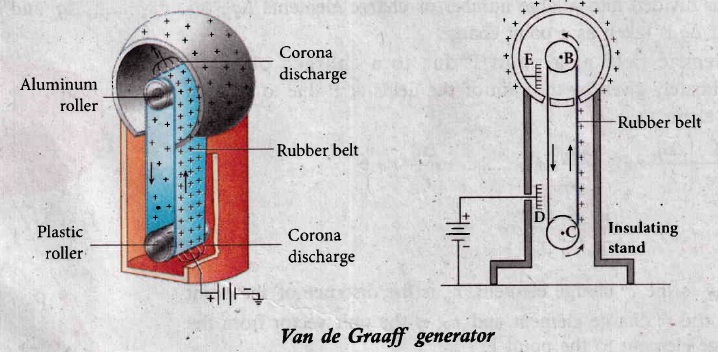
Construction:
(i) A large hollow spherical conductor is fixed on the insulating stand as shown in Figure. A pulley B is mounted at the center of the hollow sphere and another pulley C is fixed at the bottom. A belt made up of insulating materials like silk or rubber runs over both pulleys. The pulley C is driven continuously by the electric motor. Two comb-shaped metallic conductors E and D are fixed near the pulleys.
(ii) The comb D is maintained at a positive potential of 104 V by a power supply. The upper comb E is connected to the inner side of the hollow metal sphere
Working:
(i) Because of the high electric field near comb D, air between the belt and comb D gets ionized. The positive charges are pushed towards the belt and negative charges are attracted towards the comb D.
(ii) The positive charges stick to the belt and move up. When the positive charges reach the comb E, a large amount of negative and positive charges are induced on either side of comb E due to electrostatic induction.
(iii) As a result, the positive charges are pushed away from the comb E and they reach the outer surface of the sphere. Since the sphere is a conductor, the positive charges are distributed uniformly. on the outer surface of the hollow sphere.
(iv) At the same time the negative charges nullify the positive Charges in the belt due to corona discharge before it passes over the pulley.
(v) When the belt descends, it has almost no net charge. At the bottom, it again gains a large positive charge. The belt goes up and delivers the positive charges to the outer surface of the sphere.
(vi) This process continues until the outer surface produces the potential difference of the order of 107 which is the limiting value. We cannot store charges beyond this limit since the extra charge starts leaking to the surroundings due to ionization of air. The leakage of charges can be reduced by enclosing the machine in a gas filled steel chamber at very high pressure.
(vii) The high voltage produced in this Van de Graaff generator is used to accelerate positive ions (protons and deuterons) for nuclear disintegrations and other applications.
24.
Electrostatic induction:
(i) Let us Consider an uncharged (neutral) conducting sphere at rest on an insulating stand. Suppose a negatively charged rod is brought near the conductor without touching it, as shown in Figure (a).
The negative charge of the rod repels the electrons in the conductor to the opposite side. As a result, positive charges are induced near the region of the charged rod while negative charges on the farther side.
Before introducing the charged rod, the free electrons were distributed uniformly on the surface of the conductor and the net charge is zero. Once the charged rod is brought near the conductor, the distribution is no longer uniform with more electrons located on the farther side of the rod and positive charges are located closer to the rod. But the total charge is zero.
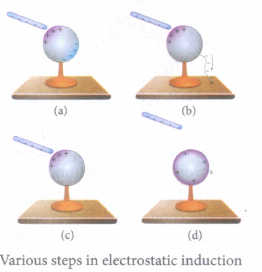
(ii) Now the conducting sphere is connected to the ground through a conducting wire. This is called grounding. Since the ground can always receive any amount of electrons, grounding removes the electron from the conducting sphere. Note that positive charges will not flow to the ground because they are attracted by the negative charges of the rod Figure (b).
(iii) When the grounding wire is removed from the conductor, the positive charges remain near the charged rod Figure (c).
(iv) Now the charged rod is taken away from the conductor. As soon as the charged rod is removed, the positive charge gets distributed uniformly on the surface of the conductor Figure (d). By this process, the neutral conducting sphere becomes positively charged.

12th Standard Syllabus & Materials
12th Standard
TN 12th Computer Applications வலையமைப்பு வடமிடல் Sample Question Papers Study Material - QB365 Set A
NEW12th Standard
TN 12th Computer Applications களப்பெயர் முறைமை (DNS) Sample Question Papers Study Material - QB365 Set A
NEW12th Standard
TN 12th Computer Applications வலையமைப்பு எடுத்துக்காட்டுகள் மற்றும் நெறிமுறைகள் Sample Question Papers Study Material - QB365 Set A
NEW12th Standard
TN 12th Computer Applications கணினி வலையமைப்பு ஓர் அறிமுகம் Sample Question Papers Study Material - QB365 Set A



Tamilnadu Stateboard 12th Standard Subjects

Maths

Chemistry
Physics

Biology

Computer Science

Business Maths and Statistics

Economics

Commerce

Accountancy

History

Computer Applications
Biology
Computer Technology
Computer Applications
Computer Science
Business Maths and Statistics
Commerce
Economics
Maths
Chemistry
Physics
Computer Technology
History
Accountancy

Tamil

English

French
Tamilnadu Stateboard Standards


