
 100% FREE ACCESS
12th Standard Syllabus & Materials
12th Standard
TN 12th Maths Applications of Matrices and Determinants Sample Question Papers Study Material - QB365 Set A
NEW12th Standard
TN 12th Computer Applications மின்னணு தரவு பரிமாற்றம் Sample Question Papers Study Material - QB365 Set A
NEW12th Standard
TN 12th Computer Applications மின் - வணிக பாதுகாப்பு அமைப்புகள் Sample Question Papers Study Material - QB365 Set A
NEW12th Standard
TN 12th Computer Applications மின்னணு செலுத்தல் முறைகள் Sample Question Papers Study Material - QB365 Set A
NEW12th Standard
TN 12th Computer Applications மின் - வணிகம் Sample Question Papers Study Material - QB365 Set A
NEW12th Standard
TN 12th Computer Applications திறந்த மூல கருத்துருக்கள் Sample Question Papers Study Material - QB365 Set A

Published on: 28/11/2025
Download Tamil Nadu 12th Standard Physics question papers, model tests, one-mark questions, important questions, and public exam papers in PDF format. Free study materials and answer keys for TN State Board students.
Questions + Answers key
Take MCQ Physics Test
1.
Write down the integral form of modified Ampere’s circuital law.
2.
What is displacement current?
3.
4.
A water molecule has an electric dipole moment of 6.3 x 10⁻³⁰ Cm. A sample contains 1022 water molecules, with all the dipole moments aligned parallel to the external electric field of magnitude 3 x 10⁵ NC-1. How much work is required to rotate all the water molecules from θ = 0° to 90°?
5.
Calculate the number of electrons in one coulomb of negative charge.
6.
An e.m. wave is propagating in a medium with a velocity \(\vec{v}=v \hat{i}\). The instantaneous oscillating electric field of this e.m. wave is along + y-axis, then the direction of oscillating magnetic field of the e.m. wave will be along _____.
–y direction
–x direction
+z direction
–z direction
7.
Which of the following is NOT true for electromagnetic waves?
it transport energy
it transport momentum
it transport angular momentum
in vacuum, it travels with different speeds which depend on their frequency
8.
If the magnetic monopole exists, then which of the Maxwell’s equation to be modified?
\(\oint { \vec { E } .d\vec { A } } =\frac { { Q }_{ enclosed } }{ { \in }_{ 0 } } \)
\(\oint { \vec { B } .d\vec { A } } \) = 0
\(\oint { \vec { B } .d\vec { l } } ={ \mu }_{ 0 }{ i }_{ c}+{ \mu }_{ 0 }{ \in }_{ 0 }\frac { d }{ dt } \oint_s { \vec { E } .d\vec { A } } \)
\(\oint { \vec { E } .d\vec { l } } =-\frac { d }{ dt } { \Phi }_{ B }\)
9.
The electric and the magnetic fields, associated with an electromagnetic wave, propagating along negative X axis can be represented by _____.
\(\vec { E } ={ E }_{ 0 }\hat { i } \) and \(\vec { B } ={ B }_{ 0 }\hat { k } \)
\(\vec { E } ={ E }_{ 0 }\hat { k } \) and \(\vec { B } ={ B }_{ 0 }\hat { j } \)
\(\vec { E } ={ E }_{ 0 }\hat { i } \) and \(\vec { B } ={ B }_{ 0 }\hat { j } \)
\(\vec { E } ={ E }_{ 0 }\hat { j } \) and \(\vec { B } ={ B }_{ 0 }\hat { i } \)
10.
Which of the following electromagnetic radiations is used for viewing objects through fog
microwave
gamma rays
X- rays
infrared
11.
Two metallic spheres of radii 1 cm and 3 cm are given charges of -1 \(\times\) 10-2 C and 5 \(\times\) 10-2 C respectively. If these are connected by a conducting wire, the final charge on the bigger sphere is
3 \(\times\) 10-2 C
4 \(\times\) 10-2 C
1 \(\times\) 10-2 C
2 \(\times\) 10-2 C
12.
If voltage applied on a capacitor is increased from V to 2V, choose the correct conclusion.
Q remains the same, C is doubled
Q is doubled, C doubled
C remains same, Q doubled
Both Q and C remain same
13.
Four Gaussian surfaces are given below with charges inside each Gaussian surface. Rank the electric flux through each Gaussian surface in increasing order.
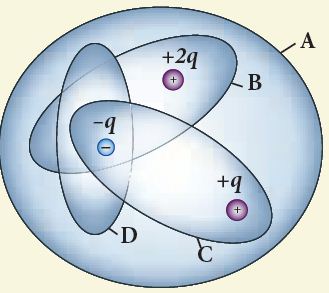
D < C < B < A
A < B = C < D
C < A = B < D
D > C > B > A
14.
15.
Which charge configuration produces a uniform electric field?
point charge
uniformly charged infinite line
uniformly charged infinite plane
uniformly charged spherical shell
16.
What are Fraunhofer lines? How are they useful in the identification of elements present in the Sun?
17.
Discuss the Hertz experiment.
18.
Consider a parallel plate capacitor which is connected to an 230 V RMS value and 50 Hz frequency. If the separation distance between the plates of the capacitor and area of the plates are 1 mm and 20 cm2 respectively. Calculate the displacement current at t = 1 s.
19.
Obtain Gauss law from Coulomb’s law.
20.
Discuss the basic properties of electric charges.
21.
Explain the importance of Maxwell’s correction.
22.
Write down Maxwell equations in integral form.
23.
Explain the process of electrostatic induction.
24.
Derive an expression for electrostatic potential due to an electric dipole.
1.
\(\oint _l\vec{B} \cdot \overrightarrow{d l}=\mu_{o} i_{\text {c }}+\mu_{o} \varepsilon_{o} \frac{d}{d t} \oint _s \vec{E} \cdot \overrightarrow{d A}\)
2.
The displacement current can be defined as the current which comes into play in the region in which the electric field or the electric flux is changing with time.
3.
4.
When the water molecules are aligned in the direction of the electric field, it has minimum potential energy. The work done to rotate the dipole from θ = 0° to 90° is equal to the potential energy difference between these two configurations.
W = ΔU = U(90°) - U(0°)
From the equation U =−pE cosθ = −\(\hat p.\hat E\) ,
we write U = − pE cosθ, Next, we calculate the work done to rotate one water molecule from θ = 0° to 90°.
For one water molecule
W = - pE cos90o + pE cos0o = pE
W= 6.3 x 10-30 x 3 x 105 = 18.9 x 10⁻²⁵J
For 1022 water molecules, the total work done is
Wtot = 18.9 x 10-25 x 1022 = 18.9 x 10⁻³J
5.
According to the quantisation of charge
q = ne
Here q = 1C. So the number of electrons in 1 coulomb of charge is
n = \(\frac { q }{ e } =\frac { 1C }{ 1.6\times 10^{ -19 } } \) = 6.25 x 10¹⁸ electrons
6.
(c)
+z direction
7.
(d)
in vacuum, it travels with different speeds which depend on their frequency
8.
(b)
\(\oint { \vec { B } .d\vec { A } } \) = 0
9.
\( { E } ={ E }_{ 0 }\hat { k } \) and \({ B } ={ B }_{ 0 }\hat { j } \)
10.
(d)
infrared
11.
Q = q1 + q2 = 4 x 10⁻²C
\(q_{2f}=Q[\frac{r_2}{r_1+r_2}]\)
= 4 x 10⁻² \([\frac{3}{4}]\)
q2f = 3 x 10⁻² C
12.
If voltage is increased from V to 2 V
Then Q1 = CV
Q2 = C(2 V) = 2 CV
∴ Q is doubled and C remains same
13.
The electric flux of D is less than that of C
The electric flux of C is less than that of B
The electric flux of B is less than that of A
14.
(b)
15.
(c)
uniformly charged infinite plane
16.
(i) When the spectrum obtained from the Sun is examined, it consists of large number of dark lines . These dark lines in the solar spectrum are called Fraunhofer lines.
(ii) The Absorption spectra for various materials are compared with the Fraunhofer lines in the solar spectrum, which helps in identifying elements present in the Sun's atmosphere.
17.
(i) The experimental set up it consists of two metal electrodes which are made of small spherical metals. These are connected to larger spheres and the ends of them are connected to induction coil with very large number of turns.
(ii) This is to produce very high electromotive force (emf). Since the coil is maintained at very high potential, air between the electrodes gets ionized and spark (spark means discharge of electricity) is produced.
(iii) This discharge of electricity affects another electrode (ring type - not completely closed) which is kept at far distance. This implies that the energy is transmitted from electrode to the receiver (ring electrode) in the form of waves, known as electromagnetic waves. If the receiver is rotated by 90o then no spark is observed by the receiver.
(iv) This confirms that electromagnetic waves are transverse waves as predicted by Maxwell. Hertz detected radio waves and also computed the speed of radio waves which is equal to the speed of light (3 x 10⁸ ms-1).
18.
Potential difference between the plates of the capacitor,
\(V=V_{\max } \sin 2 \pi f t\)
\(=230 \sqrt{2} \sin (2 \pi \times 50 t)\)
\(\therefore V=325 \sin 100 \pi t\)
d = 1 mm = 1 x 10⁻³ m
A = 20 cm2 = 20 x 10–4 m2
Displacement current, \(i_{d}=\epsilon_{0} \frac{d \Phi_{E}}{d t}=\epsilon_{\circ} \frac{d(\mathrm{EA})}{d t}\)
\(\therefore i_{d}=\frac{\epsilon_{0} A}{d}\left[\frac{d V}{d t}\right] \quad\left[\because E=\frac{V}{d}\right]\)
\(=\frac{\epsilon_{0} A}{d}(325)(100 \pi) \cos 100 \pi t\)
\(=\left(\begin{array}{l} 8.85 \times 10^{-12} \times 20 \times 10^{-4} \times 325 \\ \times 100 \times 3.14 \times \cos (100 \pi \times 1) \end{array}\right) /\left(1 \times 10^{-3}\right)\)
\(\begin{aligned}=1.81 \times 10^{-6} \mathrm{~A}=1.81 \mu \mathrm{A}[\because \cos (100 \pi \times 1)=1] \end{aligned}\)
19.
Gauss law:
(i) A positive point charge Q is surrounded by an imaginary sphere of radius r as shown in Figure. then the total electric flux through the closed surface of the sphere is
\(\Phi_E =\oint { \vec { E } .d\vec { A } =\oint { Ed } Acos\theta } \) .....(1)
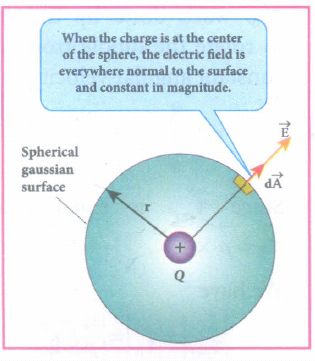
(ii) The electric field of the point charge is directed radially outward at all points on the surface of the sphere. Therefore, the direction of the area element \(d\vec { A } \) is along the electric field \(\vec { E } \) and θ = 0o.
\(\\ \Phi_E =\oint { EdA } \) Since cos0o = 1 ......(2)
iii) E is uniform on the surface of the sphere,
\(\\ \Phi_E=E\oint { dA } \) .......(3)
Substituting for \(\oint { dA=4{ \pi r }^{ 2 } } \) and \(E=\frac { 1 }{ 4\pi { \varepsilon }_{ 0 } } \frac { Q }{ { r }^{ 2 } } \) in eqn (3), we get
\(\therefore \phi E=4{ \pi r }^{ 2 }E\)
\({ \phi }_{ E }=\frac { 1 }{ 4\pi { \varepsilon }_{ 0 } } \frac { Q }{ { r }^{ 2 } } \times { 4\pi r }^{ 2 }=4\pi \frac { 1 }{ 4\pi { \varepsilon }_{ 0 } } Q\)
\({ \phi }_{ E }=\frac { Q }{ { \varepsilon }_{ 0 } } \) .....(4)
The equation (4) is called as Gauss's law.
20.
Basic properties of charges:
(i) Electric charge:
(a) Most objects in the universe are made up of atoms, which in turn are made up of protons, neutrons and electrons.
(b) These particles have mass, an inherent property of particles. Similarly, the electric charge is another intrinsic and fundamental property of particles.
(ii) Conservation of charges:
Total electric charge is conserved. Charge can neither be created nor be destroyed. In any physical process, the net change in charge will be zero.
(iii) Quantisation of charges:
(a) The charge q on any object is equal to an integral multiple of this fundamental unit of charge.
(b) q = ne
(c) Here, n is any integer \((0, \pm 1, \pm 2, \pm 3, \pm 4 \ldots)\) This is called Quantisation of electric charge.
21.
Importance of Maxwell's correction:
(i) Earth receives radiation from Sun and other stars. These radiations travel through empty space where there are no electric charges and hence no electric current. Ampere's law says that only electric current can produce a magnetic field. If Ampere's law alone is true, there will not be any radiation.
(ii) Maxwell's correction term \(\left(\mu_{0} \varepsilon_{0} \frac{d \phi_{E}}{d t}\right)\)in Ampere's law ensures that time-varying electric field or displacement current can also produce a magnetic field. Though conduction current is zero in an empty space displacement current does exist.
\(\oint_{l} \vec{B} \cdot \overrightarrow{d l}=\mu_{0} \varepsilon_{0} \frac{d \phi_{E}}{d t} \)
(iii) In stars, due to thermal excitation of atoms, time-varying electric field is produced which in turn, produces time-varying magnetic field. According to Faraday's law, this time-varying magnetic field produces again time-varying electric field and so on. The coupled time-varying electric and magnetic fields travel through empty space with the speed of light and is called electromagnetic wave.
(iv) Even though Maxwell initially started with purely symmetry argument, his correction term explains one of the important aspects of the universe, namely the existence of electromagnetic waves.
22.
MaxWell's equations in integral form
i) Gauss law in electricity, \(\oint _s\vec{E} \vec{d} A=\frac{Q_{\text {enclosed }}}{\varepsilon_{o}}\)
ii) Gauss law in magnetism \(\oint _s \vec{B} \cdot \vec{d} A=0\)
iii) Faraday's law \(\oint_l \vec E. \vec {d l}=-\frac{d \phi _B}{d t}\)
iv) Ampere-Maxwell's law \(\oint_l \vec {B}. \vec {d l}=\mu_{o} i_c+\mu_{o} \varepsilon_{o} \frac{d}{d t} \oint_s \vec{E} \cdot {d} \vec A\)
23.
Electrostatic induction:
(i) Let us Consider an uncharged (neutral) conducting sphere at rest on an insulating stand. Suppose a negatively charged rod is brought near the conductor without touching it, as shown in Figure (a).
The negative charge of the rod repels the electrons in the conductor to the opposite side. As a result, positive charges are induced near the region of the charged rod while negative charges on the farther side.
Before introducing the charged rod, the free electrons were distributed uniformly on the surface of the conductor and the net charge is zero. Once the charged rod is brought near the conductor, the distribution is no longer uniform with more electrons located on the farther side of the rod and positive charges are located closer to the rod. But the total charge is zero.
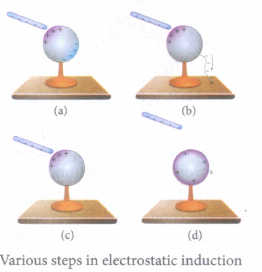
(ii) Now the conducting sphere is connected to the ground through a conducting wire. This is called grounding. Since the ground can always receive any amount of electrons, grounding removes the electron from the conducting sphere. Note that positive charges will not flow to the ground because they are attracted by the negative charges of the rod Figure (b).
(iii) When the grounding wire is removed from the conductor, the positive charges remain near the charged rod Figure (c).
(iv) Now the charged rod is taken away from the conductor. As soon as the charged rod is removed, the positive charge gets distributed uniformly on the surface of the conductor Figure (d). By this process, the neutral conducting sphere becomes positively charged.
24.
Electrostatic potential at a point due to an electric dipole :
(i) Consider two equal and opposite charges separated by a small distance 2a as shown in Figure. The point P is located at a distance r from the midpoint 'O' of the dipole. Let θ be the angle between the line OP and dipole axis AB.

(ii) Let r1 be the distance of point P from +q and r2 be the distance of point P from -q.
Potential at P due to charge +q\(=\frac { 1 }{ 4\pi { \varepsilon }_{ 0 } } \frac { q }{ { r }_{ 1 } } \)
Potential at P due to charge -q \(=-\frac { 1 }{ 4\pi { \varepsilon }_{ 0 } } \frac { q }{ { r }_{ 2 } } \)
Total potential at the point P,
\(V=\frac { 1 }{ 4\pi { \varepsilon }_{ 0 } } q\left( \frac { 1 }{ { r }_{ 1 } } -\frac { 1 }{ { r }_{ 2 } } \right) \) ....(1)
(iii) Suppose if the point P is far away from the dipole, such that (r >> a), then equation (1) can be expressed in terms of r.
By the cosine law for triangle BOP,
\({ r }_{ 1 }^{ 2 }={ r }^{ 2 }+{ a }^{ 2 }-2ra cos\theta \)
\({ r }_{ 1 }^{ 2 }={ r }^{ 2 }\left( 1+\frac { { a }^{ 2 } }{ { r }^{ 2 } } -\frac { 2a }{ r } cos\theta \right) \)
Since the point P is very far from dipole, then(r >> a). Then term \(\frac{a^{2}}{r^{2}}\)
\({ r }_{ 1 }^{ 2 }={ r }^{ 2 }\left( 1-2a\frac { cos\theta }{ r } \right) \)
\((or){ r }_{ 1 }=r{ \left( 1-\frac { 2a }{ r } cos\theta \right) }^{ \frac { 1 }{ 2 } }\)
\(\frac { 1 }{ { r }_{ 1 } } =\frac { 1 }{ r } { \left( 1-\frac { 2a }{ r } cos\theta \right) }^{ -\frac { 1 }{ 2 } }\)
iv) Since \(\frac{a}{r}\) << 1, we can use binomial theorem and retain the terms up to first order.
\(\frac { 1 }{ { r }_{ 1 } } =\frac { 1 }{ r } \left( 1+\frac { a }{ r } cos\theta \right) ...(2)\)
Similarly applying the cosine law for triangle AOP,
r22 = r2 + a2 - 2ra cos (180-θ)
Since cos(180 - θ) = - cos θ we get
r22= r2 + a2 + 2ra cos θ
Neglecting the term \(\frac { { a }^{ 2 } }{ { r }^{ 2 } } \) because (r >> a)
\({ r }_{ 2 }^{ 2 }={ r }^{ 2 }\left( 1+\frac { 2acos\theta }{ r } \right) \)
\({ r }_{ 2 }=r{ \left( 1+\frac { 2acos\theta }{ r } \right) }^{ \frac { 1 }{ 2 } }\)
Using Binomial theorem, we get
\(\frac { 1 }{ { r }_{ 2 } } =\frac { 1 }{ r } \left( 1-a\frac { cos\theta }{ r } \right) \quad \quad ...(3)\)
Substituting equation (3) and (2) in equation (1),
\(V=\frac { 1 }{ 4\pi { \varepsilon }_{ 0 } } q\left( \frac { 1 }{ r } \left( 1+a\frac { cos\theta }{ r } \right) -\frac { 1 }{ r } \left( 1-a\frac { cos\theta }{ r } \right) \right) \)
\(V=\frac { q }{ 4\pi { \varepsilon }_{ 0 } } \left( \frac { 1 }{ r } \left( 1+a\frac { cos\theta }{ r } -1+a\frac { cos\theta }{ r } \right) \right) \)
\(V=\frac { 1 }{ 4\pi { \varepsilon }_{ 0 } } \frac { 2aq }{ { r }^{ 2 } } cos\theta \)
v)
\(V=\frac { 1 }{ 4\pi { \varepsilon }_{ 0 } } \left( \frac { pcos\theta }{ { r }^{ 2 } } \right) \)
Now we can write p cos\(\theta =\vec { p } .\hat { r } \) where \(\hat { r } \) is the unit vector from the point O to point P. Hence the electric potential at a point P due to an electric dipole is given by
\(V=\frac { 1 }{ 4\pi { \varepsilon }_{ 0 } } \frac { \vec { p } .\hat { r } }{ { r }^{ 2 } } (r>>a)\quad ...(4)\)
Equation (4) is valid for distances very large compared to the size of the dipole. But for a point dipole, the equation (4) is valid for any distance.
Special cases:
Case (i) : If the point P lies on the axial line of the dipole on the side of +q, then θ = 0. Then the electric potential becomes
\(V=\frac { 1 }{ 4\pi { \varepsilon }_{ 0 } } \frac { p }{ { r }^{ 2 } } \quad \quad ...(5)\)
Case (ii) : If the point P lies on the axial line of the dipole on the side of -q, then θ = 180°, then
\(V=-\frac { 1 }{ 4\pi { \varepsilon }_{ 0 } } \frac { p }{ { r }^{ 2 } } \quad \quad ...(6)\)
Case (iii) : If the point P lies on the equatorial line of the dipole, then θ = 90°. Hence,
V = 0 .....(7)

12th Standard Syllabus & Materials
12th Standard
TN 12th Computer Applications வலையமைப்பு வடமிடல் Sample Question Papers Study Material - QB365 Set A
NEW12th Standard
TN 12th Computer Applications களப்பெயர் முறைமை (DNS) Sample Question Papers Study Material - QB365 Set A
NEW12th Standard
TN 12th Computer Applications வலையமைப்பு எடுத்துக்காட்டுகள் மற்றும் நெறிமுறைகள் Sample Question Papers Study Material - QB365 Set A
NEW12th Standard
TN 12th Computer Applications கணினி வலையமைப்பு ஓர் அறிமுகம் Sample Question Papers Study Material - QB365 Set A



Tamilnadu Stateboard 12th Standard Subjects

Maths

Chemistry
Physics

Biology

Computer Science

Business Maths and Statistics

Economics

Commerce

Accountancy

History

Computer Applications
Biology
Computer Technology
Computer Applications
Computer Science
Business Maths and Statistics
Commerce
Economics
Maths
Chemistry
Physics
Computer Technology
History
Accountancy

Tamil

English

French
Tamilnadu Stateboard Standards


