
 100% FREE ACCESS
12th Standard Syllabus & Materials
12th Standard
TN 12th Computer Applications மின்னணு தரவு பரிமாற்றம் Sample Question Papers Study Material - QB365 Set A
NEW12th Standard
TN 12th Computer Applications மின் - வணிக பாதுகாப்பு அமைப்புகள் Sample Question Papers Study Material - QB365 Set A
NEW12th Standard
TN 12th Computer Applications மின்னணு செலுத்தல் முறைகள் Sample Question Papers Study Material - QB365 Set A
NEW12th Standard
TN 12th Computer Applications மின் - வணிகம் Sample Question Papers Study Material - QB365 Set A
NEW12th Standard
TN 12th Computer Applications திறந்த மூல கருத்துருக்கள் Sample Question Papers Study Material - QB365 Set A
NEW12th Standard
TN 12th Computer Applications வலையமைப்பு வடமிடல் Sample Question Papers Study Material - QB365 Set A

Published on: 28/11/2025
Download Tamil Nadu 12th Standard Physics question papers, model tests, one-mark questions, important questions, and public exam papers in PDF format. Free study materials and answer keys for TN State Board students.
Questions + Answers key
Take MCQ Physics Test
1.
Suppose a cyclotron is operated to accelerate protons with a magnetic field of strength 1 T. Calculate the frequency in which the electric field between two Dees could be reversed.
2.
Compute the magnitude of the magnetic field of a long, straight wire carrying a current of 1 A at distance of 1m from it. Compare it with Earth’s magnetic field.
3.
Compute the speed of the electromagnetic wave in a medium if the amplitude of electric and magnetic fields are 3 x 10⁴ N C–1 and 2 x 10⁻⁴ T, respectively.
4.
The relative magnetic permeability of the medium is 2.5 and the relative electrical permittivity of the medium is 2.25. Compute the refractive index of the medium.
5.
The current flowing in the first coil changes from 2 A to 10 A in 0.4 s. Find the mutual inductance between two coils if an emf of 60 mV is induced in the second coil. Also determine the magnitude of induced emf in the second coil if the current in the first coil is changed from 4 A to 16 A in 0.03 s. Consider only the magnitude of induced emf.
6.
A closed coil of 40 turns and of area 200 cm2, is rotated in a magnetic field of flux density 2 Wb m–2. It rotates from a position where its plane makes an angle of 30o with the field to a position perpendicular to the field in a time 0.2 s. Find the magnitude of the emf induced in the coil due to its rotation.
7.
Dielectric strength of air is 3 x 10⁶ V m-1. Suppose the radius of a hollow sphere in the Van de Graff generator is R = 0.5 m, calculate the maximum potential difference created by this Van de Graaff generator.
8.
Find the heat energy produced in a resistance of 10 Ω when 5 A current flows through it for 5 minutes.
9.
If the resistance of coil is 3 Ω at 20oC and α = 0.004/oC then determine its resistance at 100oC.
10.
If an electric field of magnitude 570 N C–1, is applied in the copper wire, find the acceleration experienced by the electron.
11.
The barrier potential of a silicon diode is approximately, ______.
0.7 V
0.3 V
2.0 V
2.2 V
12.
Mp denotes the mass of the proton and Mn denotes mass of a neutron. A given nucleus of binding energy B, contains Z protons and N neutrons. The mass M(N, Z) of the nucleus is given by _____.(where c is the speed of light)
M (N,Z) = NMn + ZMp - Bc2
M (N,Z) = NMn + ZMp + Bc2
M (N,Z) = NMn + ZMp - B/c2
M (N,Z) = NMn + ZMp + B/c2
13.
In a hydrogen atom, the electron revolving in the fourth orbit, has angular momentum equal to _____.
h
\(\frac{h}{\pi}\)
\(\frac{4h}{\pi}\)
\(\frac{2h}{\pi}\)
14.
15.
Two coherent monochromatic light beams of intensities I and 4I are superposed. The maximum and minimum possible intensities in the resulting beam are _____.
5I and I
5I and 3I
9I and I
9I and 3I
16.
An air bubble in glass slab of refractive index 1.5 (near normal incidence) is 5 cm deep when viewed from one surface and 3 cm deep when viewed from the opposite face. The thickness of the slab is ______.
8 cm
10 cm
12 cm
16 cm
17.
18.
A circular coil of radius 5 cm and 50 turns carries a current of 3 ampere. The magnetic dipole moment of the coil is nearly ____.
1.0 A m2
1.2 A m2
0.5 A m2
0.8 A m2
19.
The flux linked with a coil at any instant t is given by \(\Phi\)B = 10t2 − 50t + 250. The induced emf at t = 3s is
−190 V
−10 V
10 V
190 V
20.
Which of the following is false for electromagnetic waves
transverse
non-mechanical waves
longitudinal
produced by accelerating charges
21.
Which charge configuration produces a uniform electric field?
point charge
uniformly charged infinite line
uniformly charged infinite plane
uniformly charged spherical shell
22.
In a large building, there are 15 bulbs of 40 W, 5 bulbs of 100 W, 5 fans of 80 W and 1 heater of 1 kW are connected. The voltage of electric mains is 220 V. The maximum capacity of the main fuse of the building will be ______.
14 A
8 A
10 A
12 A
23.
Explain the equivalent resistance of a parallel resistor network.
24.
Discuss the conversion of galvanometer into an ammeter.
25.
26.
Assuming that the length of the solenoid is large when compared to its diameter, find the equation for its inductance.
27.
Obtain an expression for motional emf from Lorentz force.
28.
An electron moving perpendicular to a uniform magnetic field 0.500 T undergoes circular motion of radius 2.50 mm. What is the speed of electron?
29.
Obtain the expression for capacitance for a parallel plate capacitor.
30.
Obtain Gauss law from Coulomb’s law.
31.
Derive an expression for electrostatic potential due to a point charge.
32.
Derive an expression for the torque experienced by a dipole due to a uniform electric field.
1.
Magnetic field B = 1 T
Mass of the proton, mp = 1.67 x 10⁻²⁷kg
Charge of the proton, q = 1.60 x 10⁻¹⁹C
\(f=\frac { qB }{ { { 2\pi m }_{ p } } } =\frac { \left( 1.60\times { 10 }^{ -19 } \right) \left( 1 \right) }{ 2\left( 3.14 \right) \left( 1.67\times { 10 }^{ -27 } \right) } \)
= 15.3 x 10⁶ Hz = 15.3 MHz
2.
Given that I = 1 A and radius r = 1 m
Bstraightwire = \(=\frac { { \mu }_{ ° }I }{ 2\pi r } =\frac { 4\pi \times { 10 }^{ -7 }\times 1 }{ 2\pi \times 1 } =2\times { 10 }^{ -7 }T\)
But the Earth’s magnetic field is Bearth \(\sim { 10 }^{ -5 }T\)
So, Bstraightwire is one hundred times smaller than BEarth.
3.
The amplitude of the electric field, E0 = 3 x 10⁴ NC-1
The amplitude of the magnetic field, B0 = 2 x 10⁻⁴ T. Therefore, speed of the electromagnetic wave in a medium is
v = \(\frac { 3\times { 10 }^{ 4 } }{ 2\times { 10 }^{ -4 } } \) = 1.5 x 10⁸ ms-1.
4.
Dielectric constant (relative permittivity of the medium) is εr = 2.25
Magnetic permeability is μr = 2.5
Refractive index of the medium,
n = \(\sqrt { { \varepsilon }_{ r }{ \mu }_{ r } } =\sqrt { 2.25\times 2.5 } \) = 2.37
5.
Case (i):
di1 = 10 – 2 = 8 A; dt = 0.4 s;
ε2 = 60 x 10-3V
Case(ii):
di1 = 16 – 4 = 12 A; dt = 0.03 s
(i) Mutual inductance between the coils.
\({ M }=\frac { { \epsilon }_{ 2 } }{ \frac { { di }_{ 1 } }{ dt } } \)
\(=\frac { 60\times { 10 }^{ -3 }\times 0.4 }{ 8 } \)
\({ M }=3\times { 10 }^{ -3 }H\)
(ii) Induced emf in the second coil due to the rate of change of current in the first coil is
\({ \epsilon }_{ 2 }={ M }=\frac { { di }_{ 1 } }{ dt } \)
\(=\frac { 3\times { 10 }^{ -3 }\times 12 }{ 0.03 } \)
ε2 = 1.2V
6.
N = 40 turns; B = 2 Wb m-2
A = 200 cm2 = 200 x 10-4 m2;
Initial flux, \(\Phi_i\) = BA cos\(\theta\)
= 2 x 200 x 10-4 x cos60o
since θ = 90°− 30°= 60°
\(\Phi_i\)= 2 x 10⁻² Wb
Final flux, \(\Phi_f\) = BA cos\(\theta\)
= 2 x 200 x 10-4 x cos0o since \(\theta\) = 0o
\(\Phi_f\) = 4 x 10⁻²Wb
Magnitude of the induced emf is
\(ε =N\frac { d{ \Phi }_{ B } }{ dt } \)
\(=\frac { 40\times (4\times { 10 }^{ -2 }-2\times { 10 }^{ -2 }) }{ 0.2 } =4V\)
7.
The electric field on the surface of the sphere(by Gauss law) is given by
E = \(\frac { 1 }{ 4\pi { \varepsilon }_{ 0 } } \frac { Q }{ { R }^{ 2 } } \)
The potential on the surface of the hollow metallic sphere is given by
V = \(\frac { 1 }{ 4\pi { \varepsilon }_{ 0 } } \frac { Q }{ { R } } \) = ER
Since Vmax = EmaxR
Here Emax = 3 x 10⁶ Vm-1. So the maximum potential difference created is given by
Vmax = 3 x 106 x 0.5
= 1.5 x 10⁶V (or) 1.5 million volt.
8.
R = 10 Ω, I = 5 A, t = 5 minutes = 5 x 60 s
H = I2 R t
= 52 x 10 x 5 x 60
= 25 x 10 x 300
= 25 x 3000
= 75000 J (or) 75 kJ
9.
R0 = 3 Ω, T = 100oC, T0 = 20oC
α = 0.004/oC, RT = ?
RT = R0(1 + α(T - T0))
R100 = 3(1 + 0.004 x 80)
R100 = 3.96 Ω
10.
E = 570 N C-1, e = 1.6 x 10⁻¹⁹ C,
m = 9.11 x 10⁻³¹ kg and a = ?
F = ma = eE
\(a=\frac { eE }{ m } =\frac { 570\times 1.6 \times { 10 }^{ -19 } }{ 9.11\times { 10 }^{ -31 } } \)
\(=\frac { 912\times { 10 }^{- 19 }\times { 10 }^{ 31 } }{ 9.11 } \)
= 1.001 x 10¹⁴ ms-2
11.
(a)
0.7 V
12.
B = ∆m x c2
∆m = \(\frac{B}{c^2}\)
N Mn + Z Mp - M(N,Z) = \(\frac{B}{c^2}\)
N (N,Z) = N Mn + ZMp - \(\frac{B}{c^2}\)
13.
\(L=\frac{nh}{2\pi}=\frac{4h}{2\pi}=\frac{2h}{\pi}\)
14.
(b)
15.
I = l1 + l2 + 2\(\sqrt{I_1I_2}\)cos θ
If cos θ = cos 0 = l, I is max
= I+ 4I + 2\(\sqrt{41^2}\) cos 0
= 5I + 4I = 91
If cos π = -1, I is min
Imin = I + 4I + 2\(\sqrt{41^2}\) cos π
= 5I + 4I(-1)
= 5I + 4I = I
(Imax, Imin)= (9I, I)
16.
Apparent depth = 3 + 5 = 8 cm
Real depth = thickness of the slab = t
n = 1.5
\(n=\frac{Real \ depth}{Apparent \ depth}\)
\(\therefore 1.5=\frac{t}{8}\)
t = 1.5 x 8
t = 12 cm
17.
(a)
18.
Dipole moment, \(\vec{p}_m=n\times I\times\vec{A}\)
\(\vec{p}_m\) = 50 x 3 x 3.14 x 25 x 10-4 ≈ 1.2 A m2
19.
\(\phi_B =10 t^2-50 t+250 \)
\(e =\frac{-d \phi_B}{d t} \)
\(=\frac{-d}{d t}\left(10 t^2-50 t+250\right) \)
=-(20 t - 50)
=-20 t + 50
When, t = 3 s, e =-20(3) + 50 = -60 + 50
e = -10V
20.
(c)
longitudinal
21.
(c)
uniformly charged infinite plane
22.
Total power = 15 x 40 + 5 x 100 + 5 x 80 + 1000
= 600 + 500 + 400 + 1000
= 2500 W
P = VI, V = 220 V
\(I=\frac{P}{V}=\frac{2500}{220}=11.363 \ A\)
≃ 12 A
23.
Resistors in parallel:
(i) Resistors are in parallel when they are connected across the same potential difference as shown in figure (a).
(ii) In this case, the total current I that leave the battery split into three separate components.
Let I1, I2 and I3 be the current through the resistors R1, R2, and R3 respectively. Due to the conservation of charge, total current in the circuit I is equal to sum of the currents through each of the three resistors.
I = I1 + I2 + I3 .....(1)
(iii) Since the voltage across each resistor is the same, applying Ohm's law to each resistor, we have
\({ I }_{ 1 }=\cfrac { V }{ { R }_{ 1 } } ,{ I }_{ 2 }=\cfrac { V }{ { R }_{ 2 } } ,{ I }_{ 3 }=\cfrac { V }{ { R }_{ 3 } } \)
Substituting these values in equation (1), we get,
\({ I }_{ 1 }=\cfrac { V }{ { R }_{ 1 } } +\cfrac { V }{ { R }_{ 2 } } +\cfrac { V }{ { R }_{ 3 } } =V\left[ \cfrac { 1 }{ { R }_{ 1 } } +\cfrac { 1 }{ { R }_{ 2 } } +\cfrac { 1 }{ { R }_{ 3 } } \right] \)
\(I=\cfrac { V }{ { R }_{ p } } \)
\(\cfrac { 1 }{ R_{ P } } =\cfrac { 1 }{ { R }_{ 1 } } +\cfrac { 1 }{ { R_{ 2 } } } +\cfrac { 1 }{ R_{ 3 } } \)
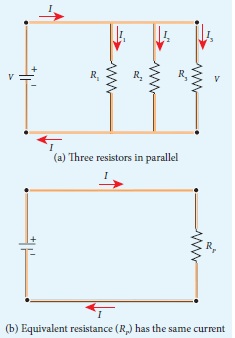
Here RP is the equivalent resistance of the parallel combination of the resistors. Thus, when a number of resistors are connected in parallel, the sum of the reciprocal of the values of resistance of the individual resistor is equal to the reciprocal of the effective resistance of the combination.
Note: The value of equivalent resistance in parallel connection will be lesser than each individual resistance.
24.
Biot-Savart's law states that the magnitude of magnetic field \(d\vec { B } \) at a point P at a distance r from the small elemental length taken on a conductor carrying current varies
(i) directly as the strength of the current I
(ii) directly as the magnitude of the length of element \(\vec { dl } \)
(iii) directly as the sine of the angle (say,θ) between \(\vec { dl } \) and \(\hat { r } \).
(iv) inversely as the square of the distance between the point P and length element \(\vec { dl } \).
\(d\vec { B } =\frac { { \mu }_{ 0 } }{ 4\pi } \frac { I\vec { dl } \times \hat { r } }{ { r }^{ 2 } } \)
25.
26.
Consider a long solenoid of length Iand cross-sectional area A. Let n be the number of turns per unit length (or turn density) of the solenoid. When an electric current i is passed through the solenoid, a magnetic field is produced by inside is almost uniform and is directed along the axis of the solenoid as shown in Figure. The magnetic field at any point inside the solenoid is given by,
B = μ0ni
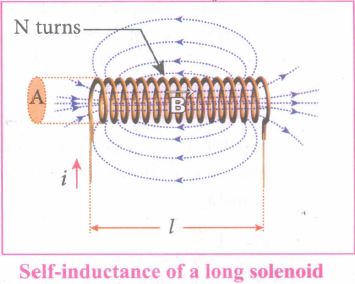
As this magnetic field passes through the solenoid, the windings of the solenoid are linked by the field lines. The magnetic flux passing through each turn is
\({ \phi }_{B }=\int _{ A }^{ }{\vec B.d } \vec { A } =BAcos\theta =BA(since\theta=0^o\)
= (μ0ni)A ....(1)
The total magnetic flux linked or flux linkage of the solenoid with N turns (the total number of turns N is given by N= n l) is
\({ N\Phi }_{ B }\) = (nl)(μ0ni)A
\({ N\Phi }_{ B }\) = (μon2Al)i ...(2)
The equation (1) is,
\({ N\Phi }_{ B }\) = Li
Comparing equation (1) and (2), we have
L =μn2Al ...(3)
From the above equation (3), it is clear that inductance depends on the geometry of the solenoid (turn density n, cross-sectional area A, length l) and the medium present inside the solenoid. If the solenoid is filled with a dielectric medium of relative permeability μr, then
L =μn2Al or L = μ0 μr n2 Al.
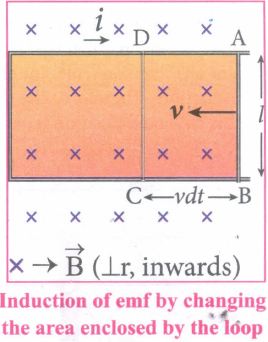
27.
(i) Consider a straight conducting rod AB of length I in a uniform magnetic field \(\vec { B } \) which is directed perpendicularly into the plane of the paper.
(ii) The length of the rod is normal to the magnetic field. Let the rod move with a constant velocity \(\vec { v } \) towards right side
(iii) When the rod moves, the free electrons present in it also move with same velocity \(\vec { v } \) in \(\vec { B } \). As a result, the Lorentz force acts on free electrons in the direction from B to A and is given by the relation
.JPG)
\({ \vec { F } }_{ B }=-e(\vec v\times \vec { B } )\)
(iv) The action of this Lorentz force is to accumulate the free electrons at the end A. This accumulation of free electrons produces a potential difference across the rod which in turn establishes an electric field \(\vec { E } \) directed along BA
(v) Due to the electric field \(\vec { E } \), the coulomb force starts acting on the free electrons along AB and is given by
\({ \vec { F } }_{ E }=-e\vec { F } \)
(vi) The magnitude of the electric field \(\vec { E } \) keeps on increasing as long as accumulation of electrons at the end A continues. The force \({ \vec { F } }_{ E }\) also increases until equilibrium is reached.
(vii) At equilibrium, the magnetic Lorentz force \({ \vec { F } }_{ B }\) and the coulomb force \({ \vec { F } }_{ E }\) balance each other and no further accumulation of free electrons at the end A takes place.
| \(\left| { \vec { F } }_{ B } \right| =\left| { \vec { F } }_{ E } \right| \) \(\left| -e(\vec { v } \times \vec { B } ) \right| =\left| -e\vec { E } \right| \) vB Sin 900 = E ⇒vB = E |
The potential difference between two ends of the rod is
V = El
V = vBl
Thus, the Lorentz force on the free electrons is responsible to maintain this potential difference and hence produces an emf
ε = Blv
As this emf is produced due to the movement of the rod, it is often called as motional emf. If the ends A and B are connected by an external circuit or total resistance R, then current \(i=\frac {ε}{R}=\frac{Blv}{R}\)flows in it. The direction of the current is found from right-hand thumb rule.
28.
Charge of an electron q = –1.60 × 10⁻¹⁹ C ⇒ |q| = 1 60 x 10-19 C
Magnitude of magnetic field B = 0.500 T
Mass of the electron, m = 9.11 × 10⁻³¹ kg
Radius of the orbit, r = 2.50 mm = 2.50 × 10⁻³ m
Speed of the electron, V = \(q \frac{\mathrm{rB}}{\mathrm{m}}\)
\( v = 1.60 \times 10^{-19} \times\frac{ 2.50 \times 10^{-3} \times 0.500}{9.11 \times 10^{-31}}\)
\(v=2.195 \times 10^8 \mathrm{~m} \mathrm{s} ^{-1}\)
29.
Capacitance of a parallel plate capacitor:
(i) Consider a capacitor with two parallel plates each of cross-sectional area A and separated by a distance d as shown in Figure.
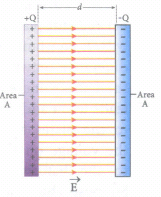
(ii) The electric field between two infinite parallel plates is uniform and is given by \(E=\frac { \sigma }{ { \varepsilon }_{ o} } \) where σ is the surface charge density on the plates \(\left( \sigma =\frac { Q }{ A } \right) \).
iii) If the separation distance d is very much smaller than the size of the plate (d2 < < A), then the above result is used even for finite-sized parallel plate capacitor.
The electric field between the plates is
\(E=\frac { Q }{ A{ \varepsilon }_{ 0 } } ...(1)\)
iv) Since the electric field is uniform, the electric potential between the plates having separation d is given by
\(V=Ed=\frac { Qd }{ A{ \varepsilon }_{ 0 } } \quad \quad \quad ...(2)\)
Therefore the capacitance of the capacitor is given by
\(C=\frac { Q }{ V } =\frac { Q }{ \left( \frac { Qd }{ A{ \varepsilon }_{ 0 } } \right) } =\frac { { \varepsilon }_{ 0 }A }{ d } \quad \quad ....(3)\)
(v) From equation (3), it is evident that capacitance is directly proportional to the area of cross section and is inversely proportional to the distance between the plates.
30.
Gauss law:
(i) A positive point charge Q is surrounded by an imaginary sphere of radius r as shown in Figure. then the total electric flux through the closed surface of the sphere is
\(\Phi_E =\oint { \vec { E } .d\vec { A } =\oint { Ed } Acos\theta } \) .....(1)
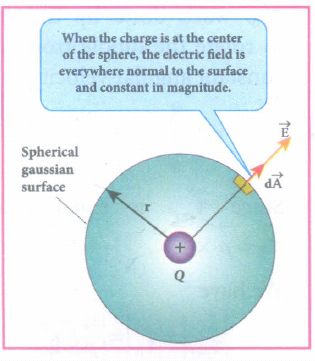
(ii) The electric field of the point charge is directed radially outward at all points on the surface of the sphere. Therefore, the direction of the area element \(d\vec { A } \) is along the electric field \(\vec { E } \) and θ = 0o.
\(\\ \Phi_E =\oint { EdA } \) Since cos0o = 1 ......(2)
iii) E is uniform on the surface of the sphere,
\(\\ \Phi_E=E\oint { dA } \) .......(3)
Substituting for \(\oint { dA=4{ \pi r }^{ 2 } } \) and \(E=\frac { 1 }{ 4\pi { \varepsilon }_{ 0 } } \frac { Q }{ { r }^{ 2 } } \) in eqn (3), we get
\(\therefore \phi E=4{ \pi r }^{ 2 }E\)
\({ \phi }_{ E }=\frac { 1 }{ 4\pi { \varepsilon }_{ 0 } } \frac { Q }{ { r }^{ 2 } } \times { 4\pi r }^{ 2 }=4\pi \frac { 1 }{ 4\pi { \varepsilon }_{ 0 } } Q\)
\({ \phi }_{ E }=\frac { Q }{ { \varepsilon }_{ 0 } } \) .....(4)
The equation (4) is called as Gauss's law.
31.
Electric potential due to a point charge:
Consider a positive charge q kept fixed at the origin. Let P be a point at distance r from the charge q. This is shown in Figure.
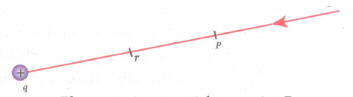
Electrostatic potential at a point P
The electric potential at the point P is
\(V=\int _{ \infty }^{ r }{ \left( -\vec { E } \right) d\vec { r } } =-\int _{ \infty }^{ r }{ \vec { E } } .d\vec { r } \) ...(1)
Electric field due to positive point charge q is
\(\vec { E } =\frac { 1 }{ 4\pi { \varepsilon }_{ 0 } } \frac { q }{ { r }^{ 2 } } \hat { r } \)
\(V=\frac { -1 }{ 4\pi { \varepsilon }_{ 0 } } \int _{ \infty }^{ r }{ \frac { q }{ { r }^{ 2 } } \hat { r } .d\vec { r } } \)
The infinitesimal displacement vector, \(d\vec { r } =dr\hat { r } \) and using \(\hat { r } \).\(\hat { r } \) = 1, we have
\(V=\frac { 1 }{ 4\pi { \varepsilon }_{ 0 } } \int _{ \infty }^{ r }{ \frac { q }{ { r }^{ 2 } } \hat { r } .dr\hat { r } =\frac { 1 }{ 4\pi { \varepsilon }_{ 0 } } \int _{ \infty }^{ r }{ \frac { q }{ { r }^{ 2 } } dr } } \)
After the integration,
\(V=-\frac { 1 }{ 4\pi { \varepsilon }_{ 0 } } q{ \left\{ -\frac { 1 }{ r } \right\} }_{ \infty }^{ r }=\frac { 1 }{ 4\pi { \varepsilon }_{ 0 } } \frac { q }{ r } \)
Hence, the electric potential due to a point charge q at a distance r is
\(V=\frac { 1 }{ 4\pi { \varepsilon }_{ 0 } } \frac { q }{ r } \) ....(2)
32.
Torque experienced by an electric dipole in the uniform electric field:
Consider an electric dipole of dipole moment \(\vec { p } \) placed in a uniform electric field \(\vec { E } \) whose field lines are equally spaced and point in the same direction. The charge +q will experience a force \(q\vec { E } \) in the direction of the field and charge -q will experience a force \(-q\vec { E } \) in a direction opposite to the field. Since the external field \(\vec { E } \) is uniform, the total force acting on the dipole is zero. These two forces acting at different points will constitute a couple and the dipole experience a torque. This torque tends to rotate the dipole.
The total torque on the dipole about the point O
\(\vec{\tau}=\overrightarrow{O A} \times(-q \vec{E})+\overrightarrow{O B} \times q \vec{E}\) ......(1)
Using right-hand corkscrew rule, it is found that total torque is perpendicular to the plane of the paper and is directed into it.
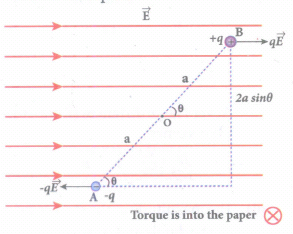
The magnitude of the total torque
\(\tau =|\vec { OA } |\left( -q\vec { E } \right) |sin\theta +|\vec { OB } ||\vec { E } |sin\theta \)
\(\tau =qE.2a\quad sin\theta \) ....(2)
where θ is the angle made by \(\vec { p } \) with \(\vec { E } \) since p = 2aq, the torque is written in terms of the vector product as
\(\vec { \tau } =\vec { p } \times \vec { E } \) ...(3)
The magnitude of this torque is \(\tau \) = pEsin \(\theta \) and is maximum when θ = 90o.
This torque tends to rotate the dipole and align it with the electric field \(\vec{E}\). Once \(\vec{p}\) is aligned with \(\vec{E}\), the total torque on the dipole becomes zero.

12th Standard Syllabus & Materials
12th Standard
TN 12th Computer Applications களப்பெயர் முறைமை (DNS) Sample Question Papers Study Material - QB365 Set A
NEW12th Standard
TN 12th Computer Applications வலையமைப்பு எடுத்துக்காட்டுகள் மற்றும் நெறிமுறைகள் Sample Question Papers Study Material - QB365 Set A
NEW12th Standard
TN 12th Computer Applications கணினி வலையமைப்பு ஓர் அறிமுகம் Sample Question Papers Study Material - QB365 Set A
NEW12th Standard
TN 12th Computer Applications PHP-உடன் MySQL-ஐ இணைத்தல் Sample Question Papers Study Material - QB365 Set A



Tamilnadu Stateboard 12th Standard Subjects

Maths

Chemistry
Physics

Biology

Computer Science

Business Maths and Statistics

Economics

Commerce

Accountancy

History

Computer Applications
Biology
Computer Technology
Computer Applications
Computer Science
Business Maths and Statistics
Commerce
Economics
Maths
Chemistry
Physics
Computer Technology
History
Accountancy

Tamil

English

French
Tamilnadu Stateboard Standards


