
 100% FREE ACCESS
12th Standard Syllabus & Materials
12th Standard
TN 12th Computer Applications மின்னணு தரவு பரிமாற்றம் Sample Question Papers Study Material - QB365 Set A
NEW12th Standard
TN 12th Computer Applications மின் - வணிக பாதுகாப்பு அமைப்புகள் Sample Question Papers Study Material - QB365 Set A
NEW12th Standard
TN 12th Computer Applications மின்னணு செலுத்தல் முறைகள் Sample Question Papers Study Material - QB365 Set A
NEW12th Standard
TN 12th Computer Applications மின் - வணிகம் Sample Question Papers Study Material - QB365 Set A
NEW12th Standard
TN 12th Computer Applications திறந்த மூல கருத்துருக்கள் Sample Question Papers Study Material - QB365 Set A
NEW12th Standard
TN 12th Computer Applications வலையமைப்பு வடமிடல் Sample Question Papers Study Material - QB365 Set A

Published on: 28/11/2025
Download Tamil Nadu 12th Standard Physics question papers, model tests, one-mark questions, important questions, and public exam papers in PDF format. Free study materials and answer keys for TN State Board students.
Questions + Answers key
Take MCQ Physics Test
1.
What is rectification?
2.
How will you define threshold frequency?
3.
What is half-life of a radio active nucleus? Give the expression.
4.
State Ampere’s circuital law.
5.
What are electromagnetic waves?
6.
What is corona discharge?
7.
Write down Coulomb’s law in vector form and mention what each term represents.
8.
Define current density.
9.
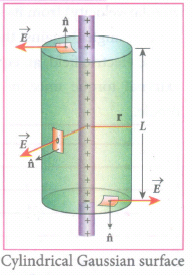
Distinguish between drift velocity and mobility.
10.
Fraunhofer lines are an example of ______ spectrum.
line emission
line absorption
band emission
band absorption
11.
If the input to the NOT gate is A = 1011, its output is ______.
0100
1000
1100
0011
12.
The principle based on which a solar cell operates is______.
Diffusion
Recombination
Photovoltaic action
Carrier flow
13.
The barrier potential of a silicon diode is approximately, ______.
0.7 V
0.3 V
2.0 V
2.2 V
14.
The ratio of the wavelengths radiation emitted for the transition from n = 2 to n = 1 in Li++, He+ and H is _____.
1:2:3
1:4:9
3:2:1
4:9:36
15.
Atomic number of H-like atom with ionization potential 122.4 V for n = 1 is _____.
1
2
3
4
16.
The threshold wavelength for a metal surface whose photoelectric work function is 3.313 eV is _____.
4125 \(\mathring { A } \)
3750\(\mathring { A } \)
6000\(\mathring { A } \)
2062.5\(\mathring { A } \)
17.
The unit for electric flux is
C2N-1m-2
Nm2C-2
Nm2C-1
Nm-2C-1
18.
The vertical component of Earth’s magnetic field at a place is equal to the horizontal component. What is the value of angle of dip at this place?
30°
45°
60°
90°
19.
A circular coil of radius 5 cm and 50 turns carries a current of 3 ampere. The magnetic dipole moment of the coil is nearly ____.
1.0 A m2
1.2 A m2
0.5 A m2
0.8 A m2
20.
Which of the following is an electromagnetic wave?
α - rays
β - rays
\(\gamma\) - rays
all of them
21.
If the amplitude of the magnetic field is 3 x 10⁻⁶ T, then amplitude of the electric field for a electromagnetic waves is _____.
100 V m−1
300 V m-1
600 V m-1
900 V m-1
22.
A parallel plate capacitor stores a charge Q at a voltage V. Suppose the area of the parallel plate capacitor and the distance between the plates are each doubled then which is the quantity that will change?
Capacitance
Charge
Voltage
Energy density
23.
24.
The temperature coefficient of resistance of a wire is 0.00125 per °C. At 20°C, its resistance is 1 Ω. The resistance of the wire will be 2 Ω at ______.
800 °C
700 °C
850 °C
820 °C
25.
What are Fraunhofer lines? How are they useful in the identification of elements present in the Sun?
26.
List out the laws of photoelectric effect. (or) Write any three Laws of Photoelectric Effect
27.
Write the properties of cathode rays.
28.
State and explain Kirchhoff ’s rules
29.
Obtain Einstein’s photoelectric equation with necessary explanation.
30.
State and prove De Morgan’s first and second theorem.
31.
Explain the construction and working of a full wave rectifier
32.
Explain the J.J. Thomson experiment to determine the specific charge of electron.
33.
Calculate the magnetic field at a point on the axial line of a bar magnet.
34.
Explain the types of emission spectrum.
35.
36.
Obtain the condition for bridge balance in Wheatstone’s bridge.
1.
The process in which alternating voltage or alternating current is converted direct voltage or direct current is called rectification.
2.
For a given metallic Surface, the emission of photo electrons takes place only if the frequency of incident light is greater than a certain minimum frequency called the threshold frequency.
3.
Half-life T1/2 of nucleus is the time required for the number of atoms initially present to reduce to one half of the initial amount.
\(\mathrm{T}_{1 / 2}=\frac{0.6931}{\lambda}\)
\(\lambda\) is the decay constant.
4.
Ampere's circuital law states that the line integral of magnetic field over a closed loop is μ0, times net current enclosed by the loop.
\(\oint _{ c }^{ }{ \vec { B } \vec { dl } } \) = μ0I enclosed.
5.
An electromagnetic waves are the waves that are radiated by an accelerated charge which propagates through space as coupled electric and magnetic fields, oscillating perpendicular to each other and to the direction of propagation of the wave.
6.
When an irregular shaped conductor is given positive charge, the electric field near the sharp end is very high and it ionizes the surrounding air. The positive ions are repelled at the sharp edge and negative ions are attracted towards the sharper edge. This reduces the total charge of the conductor near the sharp edge. This is called corona discharge.
7.
Coulomb's law \(\overrightarrow{F_{21}}=\frac{k q_{1} q_{2}}{r^{2}} \hat{r}_{12}\)
where, q1 - charge; q2 - charge
r - distance between the charges
\(\hat{r}_{12}\)- the unit vector directed from charge q1 to charge q2
k = Proportionality constant
8.
Current density is J in a conductor is defined as the current flowing per unit area of cross-section of the conductor
\(\therefore J=\cfrac { I }{ A } \)
Where I - current
A - area of cross section
9.
| S.No | Drift velocity | Mobility |
| (i) | Drift velocity is the average velocity acquired by the electrons inside the conductor when it is subjected to an electric field. | Mobility is defined as the magnitude of the drift velocity per unit electric field. |
| (ii) | Vd = a\(\tau\) (or) Vd = μE. | μ =e\(\tau\)/m (or) u = vd/E. |
| (iii) | Its unit is m / s. | Its unit is m2/ Vs. |
10.
(b)
line absorption
11.
\(y=\overline{A}=\overline{1011}=0100\)
The Boolean expression for NOT gate, \(y=\bar{A}\)
12.
(c)
Photovoltaic action
13.
(a)
0.7 V
14.
\(\frac{1}{\lambda}=\mathrm{RZ}^2\left[\frac{1}{\mathrm{n}_1^2}-\frac{1}{\mathrm{n}_2^2}\right] \)
\(\frac{1}{\lambda}=\mathrm{RZ} ^2\left[\frac{1}{1}-\frac{1}{4}\right]=\frac{3}{4} \mathrm{RZ}^2 \)
\(\lambda \propto \frac{1}{Z^2} \)
\(\lambda_{\mathrm{Li}}: \lambda_{\mathrm{H} c}: \lambda_{\mathrm{H}}=\frac{1}{9}: \frac{1}{4}: \frac{1}{1}=4: 9: 36\)
15.
\(V_{ionisation}=\frac{13.6}{n^2}Z^2 volt\)
\(Z=\sqrt\frac{V\times n^2}{13.6}=\sqrt\frac{122.4 \times I^2}{13.6}=\sqrt{9}=3\)
16.
\(\lambda_0 =\frac{h c}{\phi} \)
\(=\frac{6.626 \times 10^{-34} \times 3 \times 10^8}{3.313 \times 1.6 \times 10^{-19}} \)
\( =\frac{19.8782400}{5.3} \times 10^{-7} \)
\(\lambda_0 =3.750 \times 10^{-7} \simeq 3750 \stackrel{o}A\)
17.
(c)
Nm2C-1
18.
\(tan \ I=\frac{B_V}{B_H}=1\)
∴ I = 45o
19.
Dipole moment, \(\vec{p}_m=n\times I\times\vec{A}\)
\(\vec{p}_m\) = 50 x 3 x 3.14 x 25 x 10-4 ≈ 1.2 A m2
20.
(c)
\(\gamma\) - rays
21.
Bo = 3 x 10⁻⁶T
Amplitude of electric field, Eo = Boc
Eo = 3 x 10-6 x 3 x 108 = 900V m -1
22.
Energy density uE \(=\frac{U}{volume}\)
If A' = 2A d ' = 2d
Then V ' = 2A x 2d = 4Ad = 4V
Then volume would be increased. So, energy density will change.
23.
(a)
24.
Rt = Ro [1 + α(T2 - T1)
2 = 1[1 + 0.00125(T2 - 293)
I = 5/4 x 10-3 (T2 - 293)
T2 = 1093 K
T2 = 820 oC
25.
(i) When the spectrum obtained from the Sun is examined, it consists of large number of dark lines . These dark lines in the solar spectrum are called Fraunhofer lines.
(ii) The Absorption spectra for various materials are compared with the Fraunhofer lines in the solar spectrum, which helps in identifying elements present in the Sun's atmosphere.
26.
Laws of photoelectric effect:
(i) For a given surface, the emission of photoelectrons takes place only if the frequency of incident light is greater than a certain minimum frequency called the threshold frequency.
(ii) For a given frequency of incident light, the number of photoelectrons emitted is directly proportional to the intensity of the incident light. The saturation current is also directly proportional to the intensity of incident light.
(iii) Maximum kinetic energy of the photoelectrons is independent of the intensity of the incident light.
(iv) Maximum kinetic energy of the photoelectrons from a given metal is directly proportional to the frequency of incident light.
(v) There is no time lag between the incidence of light and the ejection of photoelectrons.
27.
(i) Cathode rays possess energy and momentum and travel in a straight line with high speed of the order of 107m s-1or \({ \left( \frac { 1 }{ 10 } \right) }^{ th }\) of the speed of light.
(ii) It can be deflected by application of electric and magnetic fields. The direction of deflection indicates that they are negatively charged particles.
(ii) When the cathode rays are allowed to fall on matter, they produce heat. They affect the photographic plates and also produce fluorescence when they fall on certain crystals and minerals.
(iii) When the cathode rays fall on a material of high atomic weight, x-rays are produced.
(iv) Cathode rays ionize the gas through which they pass.
28.
Kirchhoff's First rule: (current rule)
(i) It states that the algebraic sum of the currents at any junction of a circuit is zero. It is a statement of law of conservation of electric charge.
(ii) All charges that enter a given junction in a circuit must leave that junction since charge cannot build up or disappear at a junction. By convention current entering the junction is taken as positive and current leaving the junction is taken as negative.
Applying law to the junction A in Figure.
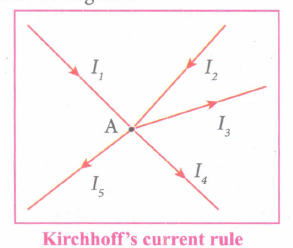
\({ I }_{ 1 }+{ I }_{ 2 }-{ I }_{ 3 }-{ I }_{ 4 }-{ I }_{ 5 }=0\)
(or)
\({ I }_{ 1 }+{ I }_{ 2 }=I_{ 3 }+{ I }_{ 4 }+{ I }_{ 5 }\)
Kirchhoff's Second rule (Voltage rule or Loop rule)
(i) It states that in a closed circuit the algebraic sum of the products of the current and resistance of each part of the circuit is equal to the total emf included in the circuit.
(ii) This rule follows from the law of conservation of energy for an isolated system (The energy supplied by the emf sources is equal to the sum of the energy delivered to all resistors).
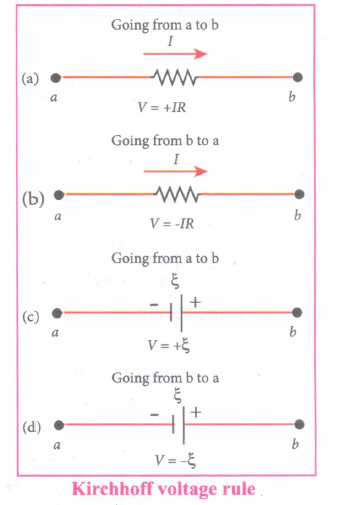
(iii) Kirchhof's voltage rule has to be applied only when all currents in the circuit reach a steady state condition.
(iv) The current in the various branches are constant. The product of current and resistance is taken as positive when the direction of the current is followed.
(v) Suppose if the direction of current is opposite to the direction of the loop, then product of current and voltage across the resistor is negative. It is shown in Figure (a) and (b).
(vi) The emf is considered positive when proceeding from the negative to the positive terminal of the cell.
29.
(i) When a photon of energy hv is incident on a metal surface, it is completely absorbed by a single electron and the electron is ejected.
(ii) In this process, a part of the photon energy is used for the ejection of the electrons from the metal surface (photoelectric work function Φ0) and the remaining energy as the kinetic energy of the ejected electron. From the law of conservation of energy,
\(\\ \\ \\ hv=\phi { _{ 0 }+\cfrac { 1 }{ 2 } { mv }^{ 2 } }\) ......(1)
(iii) where m is the mass of the electron and v its velocity.
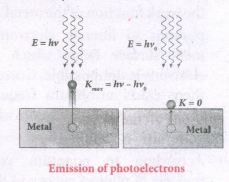
(iv) If we reduce the frequency of the incident light is reduced, the speed or kinetic energy of photo electrons is also reduced. At some frequency v0 of incident radiation, the photo electrons are ejected with almost zero kinetic energy.
Then the equation becomes.
\({ hv }_{ 0 }=\phi _{ 0 }\) ......(2)
(v) Where v0 is the threshold frequency. B rewriting the equation, we get
\(hv={ hv }_{ o }+\cfrac { 1 }{ 2 } { { mv }^{ 2 } }\) ......(3)
The equation is known as einstein's photoelectric equation.
(vi) If the electron does not lose energy by internal collisions, then it is emitted with maximum kinetic energy Kmax. Then
\({ K }_{ max }=\cfrac { 1 }{ 2 } { mv }^{ 2 }_{ max }\) ......(4)
(vii) where vmaxis the maximum velocity of max the electron ejected. The equation (1) is rearranged as follows:
\({ K }_{ max }=hv-{ \phi }_{ 0 }\)
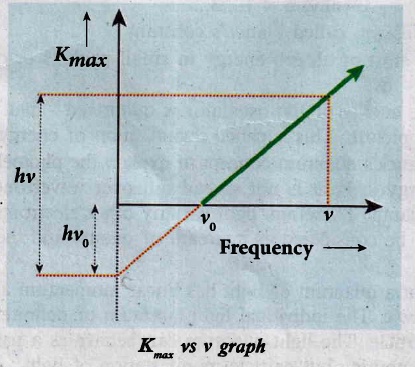
A graph between maximum kinetic energy Kmax of the photoelectron and frequency v of the incident light is a straight line.
30.
First Theorem :
The complement of the sum of two logical inputs is equal to the product of its complements.
\(\overline { A+B } \) = \(\bar { A } .\bar { B } \)
Proof:
(i) The Boolean equation for NOR gate is Y = \(\overline { A+B } \)
(ii) The Boolean equation for a bubbled AND gate is Y =\(\bar { A } .\bar { B } \)
(iii) Both cases generate same outputs for same inputs. It can be verified using the following truth
| A | B | A+B | \(\overline { A+B } \) | Ā | \(\bar { B } \) | \(\bar { A } .\bar { B } \) |
| 0 | 0 | 0 | 1 | 1 | 1 | 1 |
| 0 | 1 | 1 | 0 | 1 | 0 | 0 |
| 1 | 0 | 1 | 0 | 1 | 0 | 0 |
| 1 | 1 | 1 | 0 | 0 | 0 | 0 |
(i) From the above truth table, we can conclude \(\overline { A+B } \) = \(\bar { A } .\bar { B } \)
(ii) Thus De Morgan's first theorem is proved.
(iii) Hence, a NOR gate is equal to a bubbled AND gate
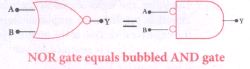
Second theorem :
The complement of the product of two is equal to the sum of its complements
\(\overline { A.B } \) = \(\bar { A } +\bar { B } \)
Proof:
(i) The Boolean equation for NAND gate is Y = \(\overline { A.B } \)
(ii) The Boolean equation for bubbled OR gate is Y = \(\bar { A } +\bar { B } \)
(iii) A and B are the inputs and Y is the output. The above two equations produces the same output for the same inputs. It can be verified by using the truth table.
| A | B | A+B | \(\overline{\mathrm{A}. \mathrm{B}}\) | Ā | \(\bar { B } \) | \(\overline{\mathrm{A}}+\overline{\mathrm{B}}\) |
| 0 | 0 | 0 | 1 | 1 | 1 | 1 |
| 0 | 1 | 0 | 1 | 1 | 0 | 1 |
| 1 | 0 | 0 | 1 | 0 | 1 | 1 |
| 1 | 1 | 1 | 0 | 0 | 0 | 0 |
(i) From the above truth table, we can conclude \(\overline { A.B } \) = \(\bar { A } +\bar { B } \)
(ii) Thus, De Morgan's second therom is proved.
(iii) Hence, a NAND gate is equal to a bubbled OR gate.
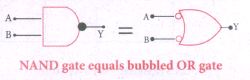
31.
FuIl wave rectifier :
The positive and negative half cycles of the AC input signal pass through the full wave rectifier circuit and hence it is called the full wave rectifier
Construction:
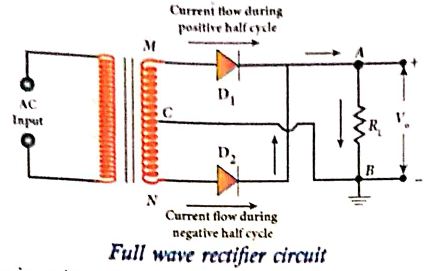
(i) It consists of two p-n junction diodes, a center-tapped transformer, and a load resistor (R1)
(ii) The centre is usually taken as the ground or zero voltage reference point.
(iii) Due to the centre tap transformer, the output voltage rectified by each diode is only one-half of the total secondary voltage.
Working:
During positive half cycle :
(i) When the positive half cycle of the ac input signal passes through the circuit, terminal M is positive, G is at zero potential and N is at negative potential.
(ii) This forward biases diode D1 and reverse biases diode D2.
(iii) Hence, being forward biased, diode D1 conducts and current flows along the path MD1AGC.
During negative half cycle:
(i) When the negative half cycle of the AC input signal passes through the circuit, terminal N becomes positive, C is at zero potential and M is at negative potential.
(ii) This forward biases diode D2 and reverse biases diode D1.
(iii) Hence, being forward biased, diode D2 conducts and current flows along the path ND2BGC.
(iii) During both positive and negative half cycles of the input signal, the current flows through the load in same direction.
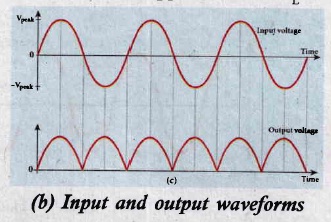
(iv) The output signal corresponding to the input signal is shown in Figure. Though both half cycles of AC input are rectified, the output is still pulsating in nature.
(v) The efficiency (η) of full wave rectifier is twice that of a half wave rectifier and is found to be 81.2 %.
32.
Principle:
Cathode rays are deflected in electric and magnetic fields.
By the variation of electric and magnetic fields, mass normalized charge or the specific charge (charge per unit mass) of the cathode rays is measured.
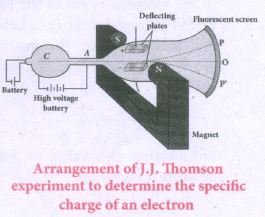
Construction and Working:
(i) Cathode rays (electron beam) produced at cathode of a highly evacuated discharge tube. Cathode rays are attracted towards anode disc A.
(ii) Pin hole in the anode disc allows only a narrow beam of cathode rays.
(iii) These cathode rays are now allowed to pass through the parallel metal plates, maintained at high voltage.
(iv) Further, discharge tube is kept in between pole pieces of magnet.
(v) Electric and magnetic fields are perpendicular to each other.
(vi) When the cathode rays strike the zinc sulphide coated screen (O), produces scintillation and hence bright spot is observed.
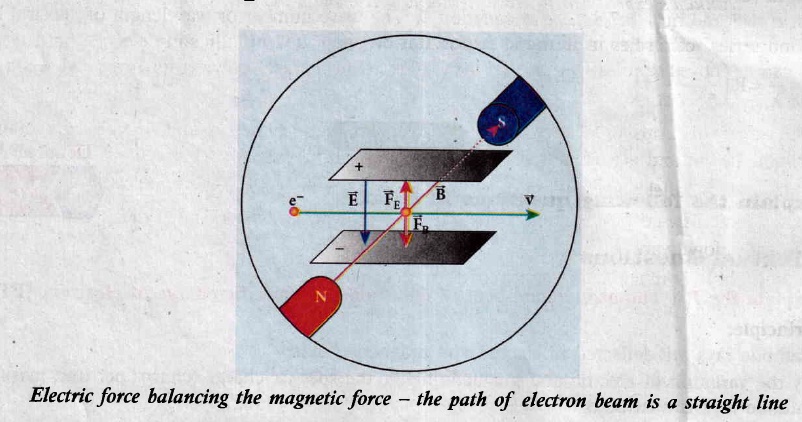
(i) Determination of velocity of cathode rays:
(a) For a fixed electric field between the plates, the magnetic field is adjusted such that the cathode rays (electron beam) strike at the original position O.
(b) This means that the magnitude of electric force is balanced by the magnitude of force due to magnetic field.
(ie) Ee = Bev
\(\Rightarrow v=\frac { E }{ B } \) ...(1)
(ii) Determination of specific charge:
(a) Since accelerated from cathode to anode, the potential energy of the electron beam at the cathode is converted into kinetic energy of the electron beam at the anode.
(b) Let V be the potential difference between anode and cathode, then the potential energy is eV.
Then from law of conservation of energy,
\(eV=\frac { 1 }{ 2 } { mv }^{ 2 } \)
\(\frac { e }{ m } =\frac { { v }^{ 2 } }{ 2V } \) ....(2)
Substituting (1) in (2),
\(\frac { e }{ m } =\frac { 1 }{ 2V } \frac { { E }^{ 2 } }{ { B }^{ 2 } } \)
By substituting known values, we get
\(\frac { e }{ m } =1.7\times { 10 }^{ 11 }{ CKg }^{ -1 }\)
The specific charge \(\frac{\mathrm{e}}{\mathrm{m}}\) is independent of (a) gas used (b) nature of the electrodes
33.
(i) Consider a bar magnet NS whose pole strength is qm and length is 2l.
(ii) Let C be the point along axis of maget.
(iii) The magnetic field at a point C (lies along the axis of the magnet) at a distance r from the geometrical center O of the bar magnet can be computed by keeping unit north pole (qmc = 1 A m) at C.
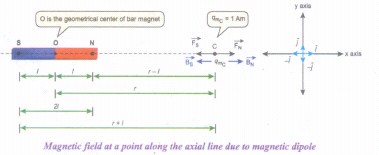
The magnetie field at C due to the north pole is,
\(\vec { { B }_{ N } } =\frac { { \mu }_{ 0 } }{ 4\pi } \frac { { q }_{ m } }{ (r-l)^{ 2 } } \hat { i } \)
where (r - I) is the distance between north pole of the bar magnet and unit north pole at C. The magnetic field at C due to the south pole is,
\(\vec { { B }_{ S } } =-\frac { { \mu }_{ 0 } }{ 4\pi } \frac { { q }_{ m } }{ (r+l)^{ 2 } } \hat { i } \)
where (r + I) is the distance between south pole of the bar magnet and unit north pole at C. The net magnetic field due to magnetic dipole at a point C
\(\vec { B } =\vec { { B }_{ N } } +\vec { B_{ S } } \)
\(\vec { B } =\frac { { \mu }_{ 0 } }{ 4\pi } \frac { { q }_{ m } }{ (r-l)^{ 2 } } \hat { i } +\left(- \frac { { \mu }_{ 0 } }{ 4\pi } \frac { { q }_{ m } }{ (r+l)^{ 2 } } \hat { i } \right) \)
\(\vec { B } =\frac { { \mu }_{ 0 }{ q }_{ m } }{ 4\pi } \left( \frac { 1 }{ (r-l)^{ 2 } } -\frac { 1 }{ (r+l)^{ 2 } } \right) \hat { i } \)
\(\vec { B } =\frac { { \mu }_{ 0 }2r }{ 4\pi } \left( \frac { { q }_{ m }.(2l) }{ ({ r }^{ 2 }-{ l }^{ 2 })^{ 2 } } \right) \hat { i } \)
Since, magnitude of magnetic dipole moment is \(|\vec { { p }_{ m } } |\) = pm = qm. 2l the magnetic field at a point C can be written as,
\(\vec { { B }_{ axial } } =\frac { { \mu }_{ 0 } }{ 4\pi } \left( \frac { 2rp_{ m } }{ { (r^2-l^2)}^{ 2 } } \right) \hat { i } \)
If r >> I then, (r2 - l2)2 ≈ r4
\( { { \vec B }_{ axial } } =\frac { { \mu }_{ 0 } 2r}{ 4\pi } \left( \frac { p_{ m } }{ { r }^{ 4 } } \right) \hat { i } =\frac { { \mu }_{ 0 } }{ 4\pi }[ \frac { 2 \vec p_{ m } }{ { r }^{ 3 }}] \)
∵ \(\vec { { p }_{ m } } =p_{ m }\hat { i } \).
34.
Emission spectra:
When the spectrum of self luminous source is taken, we get emission spectrum. Each source has its own characteristic emission spectrum. The emission spectrum can be divided into three types:
(i) Continuous emission spectra (or continuous spectra) :
(a) If the light from incandescent lamp (filament bulb) is allowed to pass through prism (simplest spectroscope), it splits into seven colours.
(b) Thus, it consists of wavelengths containing all the visible colours ranging from violet to red (in the figure). Examples: spectrum obtained from carbon arc, incandescent solids.
(ii) Line emission spectrum (or line spectrum) :
(a) Suppose light from hot gas is allowed to pass through a prism, line spectrum is observed. Line spectra are also known as discontinuous spectra. The line spectra consists of sharp lines of definite wavelengths or frequencies.
(b) Such spectra arise due to excited atoms of elements. These lines are the characteristics of the element and are different for different elements. Examples: spectra of atomic hydrogen, helium, etc.
(iii) Band emission spectrum (or band spectrum) :
(a) Band spectrum consists of several number of very closely spaced spectral lines which overlapped together forming specific bands which are separated by dark spaces.
(b) This spectrum has a sharp edge at one end and fades out at the other end. Such spectra arise when the molecules are excited.
(c) Band spectrum is the characteristic of the molecule hence, the structure of the molecules can be studied using their band spectra. Examples, spectra of hydrogen gas, ammonia gas in the discharge tube, etc.
35.
36.
Wheatstone's bridge:
i) An important application of Kirchhoff's rule is Wheatstone's bridge. It is used to compare Resistances and also helps in determining the unknown resistance in electrical network. The bridge consists of four resistances P, Q, R and S connected as shown in Figure.
ii) A galvanometer G is connected between the points B and D. The battery is connected between the points A and C. The current through the galvanometer is IG and its resistance is G.
Applying Kirchhoff's current rule to junction B
I1 - IG - I3 = 0 ..(1)
Applying Kirchhoff's current rule to junction D,
I2 + IG - I4 = 0 ...(2)
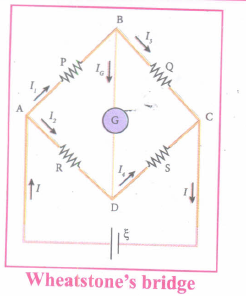
Applying Kirchhoff's voltage rule to loop ABDA,
I1P + IGG - I2R = 0 ...(3)
Applying Kirchhoff's voltage rule to loop ABCDA,
I1P + I3Q - I4S - I2R = 0 ...(4)
(iii) When the points B and D are at the same potential, the bridge is said to be balanced. As there is no potential difference between B and D, no current flows through galvanometer (IG = 0). Substituting IG = 0 in equation (1), (2) and (3), we get
I1 = I3 ..(5)
I2 = I4 ..(6)
I1P = I2R ..(7)
Substituting the equation (7) in equation (4),
I3Q = I4S .....(8)
Dividing equation (7) by equation (8), we get
\(\cfrac { P }{ Q } =\cfrac { R }{ S } \) .....(9)
(iv) This is the bridge balance condition. Only under this condition, galvanometer shows null deflection.

12th Standard Syllabus & Materials
12th Standard
TN 12th Computer Applications களப்பெயர் முறைமை (DNS) Sample Question Papers Study Material - QB365 Set A
NEW12th Standard
TN 12th Computer Applications வலையமைப்பு எடுத்துக்காட்டுகள் மற்றும் நெறிமுறைகள் Sample Question Papers Study Material - QB365 Set A
NEW12th Standard
TN 12th Computer Applications கணினி வலையமைப்பு ஓர் அறிமுகம் Sample Question Papers Study Material - QB365 Set A
NEW12th Standard
TN 12th Computer Applications PHP-உடன் MySQL-ஐ இணைத்தல் Sample Question Papers Study Material - QB365 Set A



Tamilnadu Stateboard 12th Standard Subjects

Maths

Chemistry
Physics

Biology

Computer Science

Business Maths and Statistics

Economics

Commerce

Accountancy

History

Computer Applications
Biology
Computer Technology
Computer Applications
Computer Science
Business Maths and Statistics
Commerce
Economics
Maths
Chemistry
Physics
Computer Technology
History
Accountancy

Tamil

English

French
Tamilnadu Stateboard Standards


