
 100% FREE ACCESS
12th Standard Syllabus & Materials
12th Standard
TN 12th Computer Applications மின்னணு தரவு பரிமாற்றம் Sample Question Papers Study Material - QB365 Set A
NEW12th Standard
TN 12th Computer Applications மின் - வணிக பாதுகாப்பு அமைப்புகள் Sample Question Papers Study Material - QB365 Set A
NEW12th Standard
TN 12th Computer Applications மின்னணு செலுத்தல் முறைகள் Sample Question Papers Study Material - QB365 Set A
NEW12th Standard
TN 12th Computer Applications மின் - வணிகம் Sample Question Papers Study Material - QB365 Set A
NEW12th Standard
TN 12th Computer Applications திறந்த மூல கருத்துருக்கள் Sample Question Papers Study Material - QB365 Set A
NEW12th Standard
TN 12th Computer Applications வலையமைப்பு வடமிடல் Sample Question Papers Study Material - QB365 Set A

Published on: 28/11/2025
Download Tamil Nadu 12th Standard Physics question papers, model tests, one-mark questions, important questions, and public exam papers in PDF format. Free study materials and answer keys for TN State Board students.
Questions + Answers key
Take MCQ Physics Test
1.
Prove the following Boolean expressions using the laws and theorems of Boolean algebra.
(i) \((A+B)(A+\bar{B})=A\)
(ii) \(A(\bar{A}+B)=A B\)
(iii) (A + B) (A + C) = A + BC
2.
Work function of aluminium is 4.2 eV. If two photons, each of energy 2.5 eV, are incident on It surtace, will the emission of electrons take place? Justify your answer
3.
When light of wavelength 2200 Å falls on Cu, photo electrons are emitted from it. Find
(i) the threshold wavelength and
(ii) the stopping potential.
Given: the work function for Cu is ϕ0 = 4.65 eV.
4.
A radiation of wavelength 300 nm is incident on a silver surface. Will photoelectrons be observed? [work function of silver = 4.7 eV]
5.
Find the polarizing angles for
(i) glass of refractive index 1.5 and
(ii) water of refractive index 1.33.
6.
Prove the Boolean identity AC + ABC = AC and give its circuit description.
7.
In a transistor connected in the common base configuration, \(\alpha\) = 0 95, IE = 1 mA. Calculate the values of IC and IB.
8.
The wavelength of light from sodium source in vacuum is 5893Å. What are its
(a) wavelength,
(b) speed and
(c) frequency when this light travels in water which has a refractive index of 1.33.
9.
Calculate the amount of energy released when 1 kg of \(_{ 92 }^{ 235 }{ U }\) undergoes fission reaction.
10.
Calculate the number of nuclei of carbon-14 undecayed after 22,920 years if the initial number of carbon-14 atoms is 10,000. The half-life of carbon-14 is 5730 years.
11.
Compute the binding energy per nucleon of \(_{ 2 }^{ 4 }{ He }\) nucleus.
12.
Calculate the radius of \(_{ 79 }^{ 197 }{ Au }\) Au nucleus.
13.
Show that the mass of radium \((_{ 88 }^{ 226 }{ Ra })\) with an activity of 1 curie is almost a gram. Given T1/2 = 1600 years.
14.
Assuming that energy released by the fission of a single \(_{ 92 }^{ 235 }{ U }\) nucleus is 200MeV, calculate the number of fissions per second required to produce 1-watt power.
15.
A transmitting antenna has a height of 40 m and the height of the receiving antenna is 30 m. What is the maximum distance between them for line-of-sight communication? The radius of the earth is 6.4 × 10⁶ m.
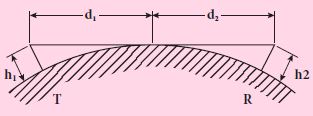
16.
Write the output (Y) Boolean expression for the following circuit with inputs A, B and C.
.jpg)
17.
\({ }_{92} U^{235}\) nucleus emits \(2 \alpha\) particles, \(3\beta\) particle and \(2 \gamma\) particles. What is the resulting atomic number and mass number?
18.
Find the de Broglie wavelength associated with an alpha particle which is accelerated through a potential difference of 400 V. Given that the mass of the proton is 1.67 x 10⁻²⁷ kg.
19.
When a 6000Å light falls on the cathode of a photo cell, photoemission takes place. If a potential of 0.8 V is required to stop emission of electron, then determine the
(i) frequency of the light
(ii) energy of the incident photon
(iii) work function of the cathode material
(iv) threshold frequency and
(v) net energy of the electron after it leaves the surface.
20.
When a light of frequency 9 x 10¹⁴ Hz is incident on a metal surface, photoelectrons are emitted with a maximum speed of 8 x 10⁵ m/s. Determine the threshold frequency of the surface.
21.
How many photons of frequency 1014 Hz will make up 19.86 J of energy?
22.
A thin rod of length f /3 is placed along the optical axis of a concave mirror of focal length f such that one end of image which is real and elongated just touches the respective end of the rod. Calculate the longitudinal magnification.
23.
A thin converging lens of refractive index 1.5 has a power of + 5.0 D. When this lens is immersed in a liquid of refractive index n, it acts as a divergent lens of focal length 100 cm. What must be the value of n?
24.
Calculate the time required for 60% of a sample of radon undergo decay. Given T1/2 of radon = 3.8 days.
25.
What is the frequency of a photon whose energy 66.3 eV? Given: h = 6.63 X 10⁻³⁴ Js.
1.
(i) \((A+B)(A+B)=AA+AB+BA+BB\) \((\because AA=A)\)
\(=A+AB+B\)
= A+ AB +B = A(1 + B) + B \((\because AB+AB=AB)\)
= A + B \((\because 1+B=1)\)
(ii) \(A(\bar{A}+B)\)\(=A \bar{A}+A B=AB\) \((\because A\bar{A}=0)\)
(iii) (A + B) (A + C) = AA + AC + BA + BC
= A + AC + BA + BC
= A (1 + C) + BA + BC
= A + BA + BC
= A(1 + B) + BC \((\because 1+C=1)\)
= A + BC \((\because 1+B=1)\)
2.
In photoelectric effect, a single photon interacts with a single electron. As individual photo has energy (2.5 eV) which is less than work function, hence emission of electron will not take place.
3.
i) The threshold wavelength is given by
\({ \lambda }=\frac { hc }{ { \phi }_{ 0 } } =\frac { 6.626\times { 10 }^{ -34 }\times 3\times { 10 }^{ 8 } }{ 4.65\times 1.6\times 10^{ -19 } } \)
= 2672 \(\mathring { A }\)
ii) Energy of the photon of wavelength 2200 \(\mathring { A }\) is
E = \(\frac { hc }{ \lambda } =\frac { 6.626\times { 10 }^{ -34 }\times 3\times { 10 }^{ 8 } }{ 2200\times 10^{ -10 } } \)
= 9.035 x 10⁻¹⁹ J = 5.65 eV
We know that kinetic energy of fastest photo electron is
Kmax = hv - ϕ0 = 5.65 - 4.65
= 1 eV
From equation (7.3), Kmax = eV0
V0 = \(\frac { { K }_{ max } }{ e } =\frac { 1\times 1.6\times { 10 }^{ -19 } }{ 1.6\times { 10 }^{ -19 } } \)
Therefore, stopping potential = 1 V
4.
Energy of the incident photon is
E = hv = \(\frac { hc }{ \lambda } \) (in joules)
E = \(\frac { hc }{ \lambda e } \) (in eV)
Substituting the known values, we get
E = \(\frac { 6.626\times { 10 }^{ -34 }\times 3\times 10^{ 8 } }{ 300\times { 10 }^{ -9 }\times 1.6\times { 10 }^{ -19 } } \)
E = 4.14 eV
The work function of silver = 4.7 eV. Since the energy of the incident photon is less than the work function of silver, photoelectrons are not observed in this case.
5.
Brewster’s law, tan ip = n
For glass, tanip = 1.5 ; ip = tan-11.5 ; ip= 56.3o
For water, tanip= 1.33; ip= tan-1 = tan-1 1.33; ip = 53.1o
6.
Step 1: AC (1 + B) = AC.1 [OR law-2]
Step 2: AC . 1 = AC [AND law – 2]
Therefore, AC + ABC = AC
Thus the Boolean identity is proved.
Circuit Description
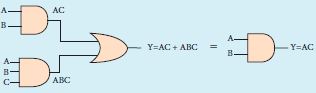
7.
α = \(\frac{I_C}{I_E}\)
IC = α IE = 0.95 x 1 = 0.95 mA
IE = IB + IC
∴ IB = IE - IC = 1 - 0.95 = 0.05 mA
8.
The refractive index of vacuum, n1 = 1
The wavelength in vacuum, λ1 = 5893 Å.
The speed in vacuum, c = v1 = 3 x 10⁸ m s–1
The refractive index of water, n2 = 1.33
The wavelength of light in water, λ2
The speed of light in water, v2
(a) The equation relating the wavelength and refractive index is,
\(\cfrac { { \lambda }_{ 1 } }{ \lambda _{ 2 } } =\cfrac { { n }_{ 2 } }{ { n }_{ 1 } } \)
Rewriting, \({ \lambda }_{ 2 }=\cfrac { { n }_{ 1 } }{ { n }_{ 2 } } \times { \lambda }_{ 1 }\)
Substituting the values,
\({ \lambda }_{ 2 }=\cfrac { 1 }{ 1.33 } \times 5893\overset { o }{ A } =4431\overset { o }{ A } \)
\({ \lambda }_{ 2 }=4431\overset { o }{ A } \)
(b) The equation relating the speed and refractive index is,
\(\cfrac { { v }_{ 1 } }{ { v }_{ 2 } } =\cfrac { { n }_{ 2 } }{ { n }_{ 1 } } \)
Rewriting, \({ v }_{ 2 }=\cfrac { { n }_{ 1 } }{ { n }_{ 2 } } \times { v }_{ 1 }\)
Substituting the values,
\({ v }_{ 2 }=\cfrac { 1 }{ 1.33 } \times 3\times { 10 }^{ 8 }=2.256\times { 10 }^{ 8 }\)
v2 = 2.256 x 10⁸ ms-1
(c) Frequency of light in vacuum is,
\({ v }_{ 1 }=\cfrac { c }{ { \lambda }_{ 1 } } \)
Substituting the values,
\({ v }_{ 1 }=\cfrac { 3\times { 10 }^{ 8 } }{ 5893\times { 10 }^{ -10 } } =5.091\times { 10 }^{ 14 }Hz\)
Frequency of light in water is, \({ v }_{ 2 }=\cfrac { v }{ { \lambda }_{ 2 } } \)
Substituting the values,
\(\\ { v }_{ 2 }=\cfrac { 2.256\times { 10 }^{ 8 }{ ms }^{ -1 } }{ 4431\times { 10 }^{ -10 } } =5.091\times { 10 }^{ 14 }Hz\)
The results show that the frequency remains same in all media.
9.
235 g of \(_{ 92 }^{ 235 }{ U }\) has 6.02 x 10²³ atoms. In one gram of \(_{ 92 }^{ 235 }{ U }\), the number of atoms is equal to \(\frac { 6.02\times { 10 }^{ 23 } }{ 235 } =2.56\times { 10 }^{ 21 }\)
So the number of atoms in 1 kg of \(_{ 92 }^{ 235 }{ U }\) = 2.56 x 1021 x 1000 = 2.56 x 1024
Each \(_{ 92 }^{ 235 }{ U }\) nucleus releases 200 MeV of energy during the fission. The total energy released by 1kg of \(_{ 92 }^{ 235 }{ U }\) is
Q = 2.56 x 1024 x 200MeV = 5.12 x 1026 MeV
In terms of joules,
Q = 5.12 x 1026 x 1.6 x 10-13 J = 8.192 x 10¹³ J
In terms of Kilowatt hour,
Q = \(\frac { 8.192\times { 10 }^{ 13 } }{ 3.6\times { 10 }^{ 6 } } =2.27\times { 10 }^{ 7 }\) kWh
10.
To get the time interval in terms of half life, \(n=\frac { t }{ { T }_{ 1/2 } } =\frac { 22,920 \ yr }{ 5730 \ yr } =4\)
The number of nuclei remaining undecayed after 22,920 years,
\(N={ \left( \frac { 1 }{ 2 } \right) }^{ n }{ N }_{ 0 }={ \left( \frac { 1 }{ 2 } \right) }^{ 4 }\times 10,000\)
N = 625
11.
From example, we found that the BE of \(_{ 2 }^{ 4 }{ He }\) = 28.33 Mev
Binding energy per nucleon = \(\overline{B \cdot E}\) = \(28.33 \mathrm{MeV} / 4 \simeq 7 \mathrm{MeV}\).
12.
R = R0A\(\frac13\)
R = 1.2 x 10−15 x (197)\(\frac13\) = 6.97 x 10⁻¹⁵ m
Or R = 6.97 F
13.
\(T_{1 / 2}=1600 \text { years }=1600 \times 365 \times 24 \times 60 \times 60 s\)
R = 1 curie = 3.7 x 10¹⁰ Bq, Show that m = 1g
R = λN
Number of atoms Present, N = \(\frac{\mathrm{R}}{\lambda}=\frac{\mathrm{R}}{0.6931} \mathrm{~T}_{1 / 2}\)
Mass of 6.023 x 10²³ atoms of \({ }_{88}^{226} R a=226 g\)
Mass of 1 atom of \({ }_{88}^{226} \mathrm{Ra}=\frac{226}{6.023 \times 10^{23}} \mathrm{~g}\)
Mass of N atoms of \({ }_{88}^{{ }{266}} \mathrm{Ra}=\frac{226}{6.023 \times 10^{23}} \times \mathrm{Ng}\)
Mass of N atoms of \({ }_{88}^{226} \mathrm{Ra}(\mathrm{m})=\frac{226}{6.023 \times 10^{23}} \times \frac{\mathrm{R}}{0.6931} \mathrm{~T}_{1 / 2} \mathrm{~g}\)
\(\mathrm{m}=\frac{226}{6.023 \times 10^{23}} \times \frac{3.7 \times 10^{10}}{0.6931} \times 1600 \times 365 \times 24 \times 60 \times 60 \mathrm{~g}\)
m = 1.01 g
14.
Energy produced per second in reactor = 1 W = 1 J/s
Energy produced per fission = 200 MeV = 200 x 106 x 1.6 x 10-19 J
= 3.2 x 10¹¹ J
Number of fissions per second required \(=\frac{\text { Energy produced per second in reactor }}{\text { Energy produced per fission }} \)
\(=\frac{1}{3.2 \times 10^{11}}=\frac{10 \times 10^{10}}{3.2}=3.125 \times 10^{10} \)
Number of fissions per second = 3.125 x 10¹⁰
15.
The total distance d between the transmitting and receiving antennas will be the sum of the individual distances of coverage.
d = d1 + d2
\(=\sqrt { 2R{ h }_{ 1 } } +\sqrt { 2{ Rh }_{ 2 } } \)
\(=\sqrt { 2R } \left( \sqrt { { h }_{ 1 } } +\sqrt { { h }_{ 2 } } \right) \)
\(=\sqrt { 2\times 6.4\times { 10 }^{ 6 } } \times (\sqrt { 40 } +\sqrt { 30 } )\)
\(=16\times { 10 }^{ 2 }\sqrt { 5 } \times (6.32+5.48)\)
= 42217 m = 42.217 km
16.
.jpg)
\(\begin{array}{l} Y=(\bar{A}+\bar{B}) \cdot C \\ Y=(\bar{A} \cdot \bar{B}) \cdot C \end{array}\) (Using De-Morgan's 1" theorem)
Y = ABC
17.
After the Emission of \(2\alpha\) particles,
\({ }_{92} \mathrm{U}^{235} \rightarrow{ }_{\mathrm{88} } \mathrm{Ra}^{227}+2_2 \mathrm{He}^4\)
After the Emission of \(3\beta\) particles,
\({ }_{88} \mathrm{Ra}^{227} \rightarrow{ }_{91} \mathrm{~Pa}^{227^*}+3_{-1} \mathrm{e}^0\)
After the Emission of \(2\gamma\) particles,
\({ }_{91} \mathrm{~Pa}^{227^*} \rightarrow{ }_{91} \mathrm{~Pa}^{227}+2 \gamma\)
Therefore, the resulting
Atomic Number = 91
Mass Number = 227 and the Radio active Element is Protactinium
18.
An alpha particle contains 2 protons and 2 neutrons. Therefore, the mass M of the alpha particle is 4 times that of a proton (mp) (or a neutron) and its charge q is twice that of a proton (+e).
The de Broglie wavelength associated with it is
\(\lambda=\frac { h }{ \sqrt { 2MqV } } =\frac { h }{ \sqrt { 2\times (4m_{ p })\times (2e)\times V } } \)
\(=\frac { 6.626\times { 10 }^{ -34 } }{ \sqrt { 2\times 4\times 1.67\times 10^{ -27 }\times 2\times 1.6\times { 10 }^{ -19 }\times 400 } } \)
\(=\frac { 6.626\times 10^{ -34 } }{ 4\times 20\times { 10 }^{ -23 }\sqrt { 1.67\times 1.6 } } \) = 0.00507 \(\mathring { A }\)
19.
\(\lambda=6000Å=6000 \times 10^{-10} \mathrm{~m} ; \mathrm{V}=0.8 \mathrm{v} \)
\(\mathrm{k} \cdot \mathrm{E}=\mathrm{hv}-\phi \)
\(\mathrm{eV}_o=\mathrm{hv}-\phi=\frac{\mathrm{hc}}{\lambda}-\phi \)
\((i) v=\frac{c}{\lambda}=\frac{3 \times 10^{8}}{6000 \times 10^{-10}}=5 \times 10^{14} \mathrm{~Hz} \)
\((ii)\ \mathrm{E}=\frac{\mathrm{hc}}{\lambda}=\frac{6.626 \times 10^{-34} \times 3 \times 10^{8}}{6000 \times 10^{-10}}=3.313 \times 10^{-19} J\)
\(\mathrm{E}=\frac{3.313 \times 10^{-19}}{1.6 \times 10^{-19}}=2.07 \mathrm{eV} \)
\((iii) \ \mathrm{E}=\mathrm{hv}-\mathrm{W}\Rightarrow\mathrm{W}=\mathrm{h} v-\mathrm{E} \)
\(\mathrm{E}=\mathrm{eV_o}=1.6 \times 10^{-19} \times 0.8=1.2 8 \times10^{-19}J\)
\(\mathrm{hv}=6.626 \times 10^{-34} \times 5 \times 10^{14}=3.313 \times 10^{-19}J \)
\(\mathrm{~W}=\frac{(3.313-1.28) \times 10^{-19}}{1.6 \times 10^{-19}}=1.270 \mathrm{eV} \)
W = 1.27 eV
\((iv) \ \mathrm{W}=\mathrm{h} \mathrm{v}_{0} \)
\(v_{0}=\frac{W}{h}=\frac{2.033 \times 10^{-19}}{6.626 \times 10^{-34}}=3.07 \times 10^{14} \mathrm{~Hz} \)
\((v)\ \mathrm{E}=\mathrm{eV}_o=\frac{0.8 \times 1.6 \times 10^{-19}}{1.6 \times 10^{-19}}=\mathbf{0 . 8} \mathrm{eV}\)
20.
\(v= 9 \times 10^{14} \mathrm{~Hz} ; \mathrm{V}=8 \times 10^{5} \mathrm{~m} / \mathrm{s} \)
\(\mathrm{E}= \mathrm{h}-\mathrm{h} v_{o} \Rightarrow v_{o}=\frac{\mathrm{h}v-\mathrm{E}}{\mathrm{h}}=\mathrm{V}-\frac{\mathrm{E}}{\mathrm{h}}=\mathrm{V}-\frac{\frac{1}{2} \mathrm{mv}^{2} }{h}\)
\(v_s={9 \times 10^{14}-\frac{\left[\frac{1}{2} \times 9.1 \times 10^{-31} \times\left(8 \times 10^{5}\right)^{2}\right]}{6.626 \times 10^{-34}}}=4.605 \times 10^{14} \)
\( v_{o} \simeq 4.6 \times 10^{14} \mathrm{~Hz} \)
21.
\(v=10^{14} \mathrm{~Hz} ; \mathrm{E}=19.86 \mathrm{~J} \)
\(E=nhv \Rightarrow n=\frac{E}{hv}\)
\(=\frac{19.86}{6.626 \times 10^{-34} \times 10^{14}}=2.99 \times 10^{20} \)
\(\mathrm{n} \simeq 3 \times 10^{20} \)
22.
\(\text{ longitudinal magnifcation}(m_l)=\frac { length\ of\ image\left( l' \right) }{ length\ of\ object\left( l \right) } \)
Given: length of object, \(l=\cfrac { f }{ 3 } \)
For the given condition, the image formation is shown in the figure.
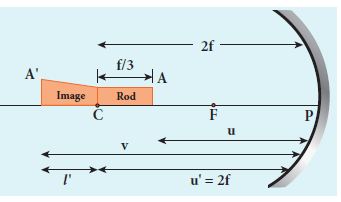
Let, l' be the length of the image, then
\(m=\cfrac { l' }{ l } =\cfrac { l' }{ f/3 } \) (or) \(l=\cfrac { m_lf }{ 3 } \)
Image of one end coincides with the object. Thus, the coinciding end must be at center of curvature.
\(u_B=u_A-\cfrac { f }{ 3 } =2f-\cfrac { f }{ 3 } =\cfrac { 5f }{ 3 } \)
\(v_B=u_B+l+l'\)
\(v_b =\cfrac { 5f }{ 3 } +\cfrac { f }{ 3 } +\cfrac { mf }{ 3 } =\cfrac { f(6+m) }{ 3 } \)
Mirror equation,\(\cfrac { 1 }{ v } +\cfrac { 1 }{ u } =\cfrac { 1 }{ f } \)
\(\cfrac { 1 }{ -\left( \cfrac { f(6+m_l) }{ 3 } \right) } +\cfrac { 1 }{ -\left( \cfrac { 5f }{ 3 } \right) } =\cfrac { 1 }{ -f } \)
After simplifying,
\(\cfrac { 3 }{ f(6+m_l) } +\cfrac { 3 }{ 5f } =\cfrac { 1 }{ f } ;\cfrac { 3 }{ (6+m_l) } =\cfrac { 2 }{ 5 } \)
\(6+m_l=\cfrac { 15 }{ 2 } ;m_l=\cfrac { 15 }{ 2 } -6\)
\(m_l=\cfrac { 3 }{ 2 } =1.5\)
23.
\(P_{a}=\frac{1}{f_{a}}=\left(\frac{\mu_{g}}{\mu_{a}}-1\right)\left(\frac{1}{R_{1}}-\frac{1}{R_{2}}\right) \) ..(1)
\(P_{w}=\frac{1}{f_{w}}=\left(\frac{\mu_{g}}{\mu_{w}}-1\right)\left(\frac{1}{R_{1}}-\frac{1}{R_{2}}\right) \) ...(2)
\(p_{a}=5 D, f_{w}=-100 \text { (Diverging lens) } \)
\(\mu_{\mathrm{g}}=1.5, \mu_{\mathrm{a}}=1 \)
\(5=(1.5-1)\left(\frac{1}{R_{1}}-\frac{1}{R_{2}}\right) \) ...(3)
\(\left(\frac{1}{R_{1}}-\frac{1}{R_{2}}\right)=\frac{5}{0.5}=\frac{50}{5}=10 \)
\(\frac{1}{f_{w}}=\left(\frac{1.5}{n_{w}}-1\right)\left(\frac{1}{R_{1}}-\frac{1}{R_{2}}\right) \) ...(4)
\(\frac{-1}{100 \times 10^{-2}}=\left(\frac{1.5}{n_{w}}-1\right)\left(\frac{1}{R_{1}}-\frac{1}{R_{2}}\right) \)
\(-1=\left(\frac{1.5}{n_{w}}-1\right)(10) \Rightarrow \frac{-1}{10}=\frac{1.5}{n_{w}}-1 \)
\(\frac{1.5}{n_{w}}=\frac{-1}{10}+1 \)
\(\frac{1.5}{n_{w}}=\frac{9}{10} \)
\(n_{w}=\frac{1.5 \times 10}{9}=\frac{15}{9}=\frac{5}{3} \)
\(n_{w}=\frac{5}{3} \)
24.
Decayed = 60 %
Left undecayed = 40 %(ie) \(\frac{\mathrm{N}}{\mathrm{N}_{0}}=\frac{40}{100} \)
\(\mathrm{~T}_{\frac{1}{2}}=3.8 \text { days } \)
\(\mathbf{N}=\mathrm{N}_{0} \mathrm{e}^{-\lambda t} \)
\(\frac{\mathrm{N}}{\mathrm{N}_{0}}=\mathrm{e}^{-\lambda t} \)
\(\frac{40}{100}=\mathrm{e}^{-\lambda t} \Rightarrow \frac{100}{40}=2.5=\mathrm{e}^{\lambda t} \)
\(\therefore \mathrm{e}^{\lambda t} \) = 2.5
Taking log on both sides
\(\lambda t=\ln [2.5]=2.3026 \times \log (2.5)=2.3026 \times 0.3974 \)
\(t=\frac{0.9163}{\lambda}=\frac{0.9163}{0.6931} \times T_{1 / 2} \)
\(t=1.322 \times 3.8=5.022 \text { days } \)
25.
\(E=hv,v=\frac { E }{ h } =\frac { 66.3\times 1.6\times { 10 }^{ -19 } }{ 6.63\times { 10 }^{ -34 } } \)
= 16 x 1015 hHz = 1.6 x 10¹⁶

12th Standard Syllabus & Materials
12th Standard
TN 12th Computer Applications களப்பெயர் முறைமை (DNS) Sample Question Papers Study Material - QB365 Set A
NEW12th Standard
TN 12th Computer Applications வலையமைப்பு எடுத்துக்காட்டுகள் மற்றும் நெறிமுறைகள் Sample Question Papers Study Material - QB365 Set A
NEW12th Standard
TN 12th Computer Applications கணினி வலையமைப்பு ஓர் அறிமுகம் Sample Question Papers Study Material - QB365 Set A
NEW12th Standard
TN 12th Computer Applications PHP-உடன் MySQL-ஐ இணைத்தல் Sample Question Papers Study Material - QB365 Set A



Tamilnadu Stateboard 12th Standard Subjects

Maths

Chemistry
Physics

Biology

Computer Science

Business Maths and Statistics

Economics

Commerce

Accountancy

History

Computer Applications
Biology
Computer Technology
Computer Applications
Computer Science
Business Maths and Statistics
Commerce
Economics
Maths
Chemistry
Physics
Computer Technology
History
Accountancy

Tamil

English

French
Tamilnadu Stateboard Standards


