
 100% FREE ACCESS
12th Standard Syllabus & Materials
12th Standard
TN 12th Maths Applications of Matrices and Determinants Sample Question Papers Study Material - QB365 Set A
NEW12th Standard
TN 12th Computer Applications மின்னணு தரவு பரிமாற்றம் Sample Question Papers Study Material - QB365 Set A
NEW12th Standard
TN 12th Computer Applications மின் - வணிக பாதுகாப்பு அமைப்புகள் Sample Question Papers Study Material - QB365 Set A
NEW12th Standard
TN 12th Computer Applications மின்னணு செலுத்தல் முறைகள் Sample Question Papers Study Material - QB365 Set A
NEW12th Standard
TN 12th Computer Applications மின் - வணிகம் Sample Question Papers Study Material - QB365 Set A
NEW12th Standard
TN 12th Computer Applications திறந்த மூல கருத்துருக்கள் Sample Question Papers Study Material - QB365 Set A

Published on: 28/11/2025
Download Tamil Nadu 12th Standard Physics question papers, model tests, one-mark questions, important questions, and public exam papers in PDF format. Free study materials and answer keys for TN State Board students.
Questions + Answers key
Take MCQ Physics Test
1.
Pure water has refractive index 1.33. What is the speed of light through it?
2.
What is Snell’s window?
3.
Explain the reason for the glittering of diamond.
4.
Give a comparison of electrical and gravitional forces?
5.
Define ‘capacitance’. Give its unit.
6.
Write a short note on superposition principle.
7.
Calculate the number of electrons in one coulomb of negative charge.
8.
The unit of focal power of a lens is ______________.
Watt
Horse Power
Dioptre
Lux
9.
An electric dipole placed in a uniform electric field has minimum potential energy. The angle of inclination of the dipole moment with the field is __________________.
\(2 \pi\)
\(\pi\)
Zero
\(\frac{\pi}{4}\)
10.
The radius of curvature of curved surface at a thin planoconvex lens is 10 cm and the refractive index is 1.5. If the plane surface is silvered, then the focal length will be, ______.
5 cm
10 cm
15 cm
20 cm
11.
12.
A rod of length 10 cm lies along the principal axis of a concave mirror of focal length 10 cm in such a way that its end closer to the pole is 20 cm away from the mirror. The length of the image is, ______.
2.5 cm
5cm
10 cm
15cm
13.
A condenser is charged to a potential of 200V and has a charge of 0.1C. The energy stored in it is _____________
1 J
2 J
10 J
20 J
14.
Two points A and B are maintained at a potential of 7 V and -4 V respectively. The work done in moving 50 electrons from A to B is _______.
8.80 x 10⁻¹⁷ J
-8.80 x 10⁻¹⁷ J
4.40 x 10⁻¹⁷ J
5.80 x 10⁻¹⁷ J
15.
Four Gaussian surfaces are given below with charges inside each Gaussian surface. Rank the electric flux through each Gaussian surface in increasing order.
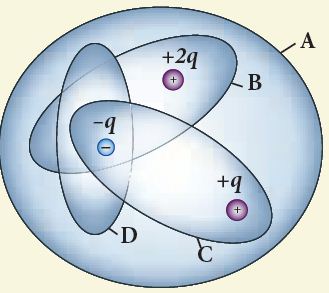
D < C < B < A
A < B = C < D
C < A = B < D
D > C > B > A
16.
Which charge configuration produces a uniform electric field?
point charge
uniformly charged infinite line
uniformly charged infinite plane
uniformly charged spherical shell
17.
Two identical point charges of magnitude –q are fixed as shown in the figure below. A third charge +q is placed midway between the two charges at the point P. Suppose this charge +q is displaced a small distance from the point P in the directions indicated by the arrows, in which direction(s) will +q be stable with respect to the displacement?
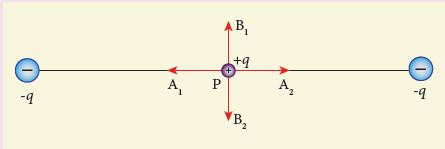
A1 and A2
B1 and B2
both directions
No stable
18.
Obtain the lens maker’s formula for a lens of refractive index n2 which is separating two media of refractive indices n1 and n3 on the left and right respectively.
19.
Derive the equation for effective focal length for lenses in contact.
20.
Obtain the equation for apparent depth.
21.
Obtain Gauss law from Coulomb’s law.
22.
Derive an expression for electrostatic potential due to a point charge.
23.
Derive an expression for the torque experienced by a dipole due to a uniform electric field.
24.
Derive the equation for refraction at single spherical surface.
25.
Obtain the equation for radius of illumination (or) Snell’s window.
26.
27.
Explain in detail the construction and working of a Van de Graaff generator.
28.
Explain in detail the effect of a dielectric placed in a parallel plate capacitor.
29.
1.
\(n=\cfrac { c }{ v } ;\quad v=\cfrac { c }{ n } \)
\(v=\cfrac { 3\times { 10 }^{ 8 } }{ 1.33 } =2.26\times { 10 }^{ 8 }{ ms }^{ -1 }\)
Light travels with a speed of 2.26 x 10⁸ m s-1 through pure water.
2.
When light entering the water from outside is seen from inside the water, the view is restricted to a particular angle equal to the critical angle ic. The restricted illuminated circular area is called Snell's window
3.
Diamond appears glittering because the total internal reflection of light.
Inside the diamond the refractive index of diamond is about 2.417 which is greater than the refractive index of glass. (μg =1.5). The critical angle of diamond is 24.4d which is much less than that of glass (gcrown = 40.5°, gflint 31.9°).
So, when the light enters the diamond, the total internal reflection of light happens inside the diamond before getting out. This gives a sparkling effect for diamond.
4.
(i) Both forces obey inverse square law, F∝\(\frac{1}{r^2}\)
(ii) Both forces are proportional to product of masses or charges.
(iii) Both forces are conservative forces.
(iv) Both forces can operate in vacuum.
5.
The capacitance C of a capacitor is defined as the ratio of the magnitude of charge on either of the conductor plates to the potential difference existing between the conductors. \(C=\frac{Q}{V}\)
Its unit is Coulomb per volt or farad (F).
6.
It there are more than two charges, the total force acting on a given charge is equal to the vector sum of forces exerted on it by all the other charges.
Consider a system of n charges namely q1, q2, q3 ...qn. The force on q1 exerted by the charge q2 is \(\overrightarrow{F_{12}}=k \frac{q_{1} q_{2}}{r_{21}^{2}} \hat{r}_{21}\) .
The force on q1 exerted by the charge q3 is \(\overrightarrow{F_{13}}=k \frac{q_{1} q_{3}}{r_{31}^{2}} \hat{r}_{31}\)
By continuing this, the total force acting on the charge q1 due to all other charges is given by
\( \vec{F}_{1}^{\text { tot }}=\overrightarrow{F_{12}}+\overrightarrow{F_{13}}+\overrightarrow{F_{14}}+\ldots+\vec{F}_{1 n} \)
\(\vec{F}_{1} ^{\text { tot }}=k\left\{\frac{q_{1} q_{2}}{r_{21}^{2}} \hat{r}_{21}+\frac{q_{1} q_{3}}{r_{31}^{2}} \hat{r}_{31}+\frac{q_{1} q_{4}}{r_{41}^{2}} \hat{r}_{41}+\ldots+\frac{q_{1} q_{n}}{r_{n 1}^{2}} \hat{r}_{n 1}\right\}\)
7.
According to the quantisation of charge
q = ne
Here q = 1C. So the number of electrons in 1 coulomb of charge is
n = \(\frac { q }{ e } =\frac { 1C }{ 1.6\times 10^{ -19 } } \) = 6.25 x 10¹⁸ electrons
8.
(c)
Dioptre
9.
(c)
Zero
10.
\(\frac{1}{f} =(n-1)\left(\frac{1}{R_1}-\frac{1}{R_2}\right) \)
\(=(1.5-1)\left(\frac{1}{\infty}-\frac{1}{(-10)}\right)\)
(Since plano convex lens)
\(=0.5\left[\frac{1}{10}\right]=\frac{1}{20} \)
\(\mathrm{f}_t =20 \mathrm{~cm}\)
Formula for silvered lenses
\(\frac{1}{\mathrm{~F}} =\frac{2}{\mathrm{f}_1}+\frac{1}{\mathrm{f}_m} \)
\(\frac{1}{\mathrm{~F}} =\frac{2}{20}+\frac{1}{\infty} \)
\(\therefore \mathrm{F} =\frac{20}{2}=10 \mathrm{~cm}\)
11.
(a)
12.
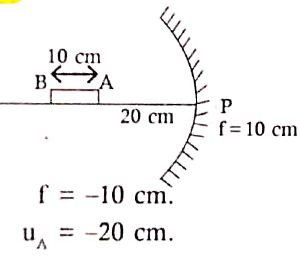
At end A,
\(\frac{1}{f} =\frac{1}{u_A}+\frac{1}{v_A} \)
\(\therefore \frac{1}{v_A} =\frac{1}{-10}-\frac{1}{-20} \)
\(\frac{1}{v_A} =-\frac{1}{10}+\frac{1}{20}=\frac{-2+1}{20}=-\frac{1}{20} \)
\(v_A =-20 \mathrm{~cm} \)
\(\left|v_{\wedge}\right|=20 \mathrm{~cm}\)
At end B,
\(\frac{1}{f} =\frac{1}{u_B}+\frac{1}{v_B} \)
\(\frac{1}{v_B} =\frac{1}{f}-\frac{1}{u_B}, \)
\(u_B =-30 \mathrm{~cm} \)
\(\frac{1}{v_B} =-\frac{1}{10}+\frac{1}{30} \)
\(=\frac{-3+1}{30}=\frac{-2}{30}=\frac{-1}{15} \)
\(v_B =-15 \mathrm{~cm} \)
\(\left|v_B\right| =15 \mathrm{~cm} \)
\(\therefore \quad\left|\mathrm{v}_{\mathrm{A}}\right|-\left|\mathrm{v}_{\mathrm{B}}\right| \) is the length of the image
= 20 - 15 = 5 cm
13.
(c)
10 J
14.
W = qV
V = 7 - (-4) = 11 V
q = ne = 50 x 1.6 x 10-19 = 8 x 10-18C
W = 8 x 10-18 x 11 = 88 x 10-18 = 8.8 x 10⁻¹⁷]
15.
The electric flux of D is less than that of C
The electric flux of C is less than that of B
The electric flux of B is less than that of A
16.
(c)
uniformly charged infinite plane
17.
The charge + q will be stable between B1 and B2 with respect to the displacement.
18.
(i) Consider a thin lens made up of a medium of refractive index n2 placed in a medium of refractive. index n1 on its left and medium of refractive index n3 on its right. Let R1 and R2 be the radii of curvature of two spherical surfaces (1) and (2) respectively and P be the pole.
(ii) A paraxial ray from O forms image at I' after refraction at surface (1). Before that it is again refracted by the surface (2) due to which final image is formed at I.
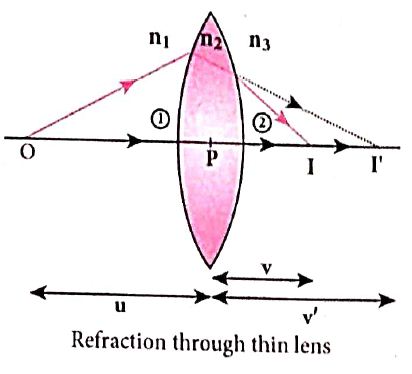
For the refracting surface (1), the light goes from n1 to n2.
\(\frac{\mathrm{n}_{2}}{\mathrm{v}^{\prime}}-\frac{\mathrm{n}_{1}}{\mathrm{u}}=\frac{\mathrm{n}_{2}-\mathrm{n}_{1}}{\mathrm{R}_{1}}\) ...(1)
For the refracting surface (2), the light goes from n2 to n3.
Then, \(\frac{\mathrm{n}_{3}}{\mathrm{v}}-\frac{\mathrm{n}_{2}}{\mathrm{v}^{\prime}}=\frac{\mathrm{n}_{3}-\mathrm{n}_{2}}{\mathrm{R}_{2}}\) ......(2)
Add equations (1) and (2)
\(\frac{n_{3}}{v}-\frac{n_{1}}{u}=\frac{n_{2}-n_{1}}{R_{1}}+\frac{n_{3}-n_{2}}{R_{2}}\) ....(3)
19.
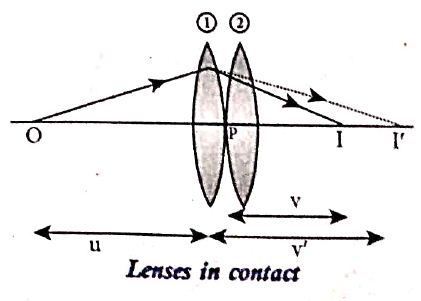
Consider two lenses 1 and 2 of focal length f1 and f2 are placed coaxially in contact with each other so that they have a common principal axis.
O be the object which is placed beyond the focus of the first lens on the principal axis. I' is the image of object O which is formed beyond the lens 2. Then, I' acts as an object for the lens 'P' is the common optical centre of the two lenses.
From the figure, PO =u, PI' = v' for lens I
PI' = v' (object distance) PI = v (image distance) for lens 2
For lens 1,
\(\cfrac { 1 }{ v' } -\cfrac { 1 }{ u } =\cfrac { 1 }{ { f }_{ 1 } } \) .........(1)
For lens 2,
\(\cfrac { 1 }{ v } -\cfrac { 1 }{ u' } =\cfrac { 1 }{ { f }_{ 2 } } \) .........(2)
Adding (1) of (2)
\(\cfrac { 1 }{ v } -\cfrac { 1 }{ u } =\cfrac { 1 }{ f_1 }+\cfrac{1}{f_2} \) .........(3)
(vi) If the combination acts as a single lens of focal length f so that for an object at the position O it forms the image at I,
Then,
\(\cfrac { 1 }{ v } -\cfrac { 1 }{ u } =\cfrac { 1 }{ f } \) .........(4)
Comparing equations (3) and (4) we can write,
\(\cfrac { 1 }{ F } =\cfrac { 1 }{ { f }_{ 1 } } +\cfrac { 1 }{ { f }_{ 2 } } \) .........(5)
The above equation can be extended for any number of lenses in contact as,
\(\cfrac { 1 }{ f } =\cfrac { 1 }{ { f }_{ 1 } } +\cfrac { 1 }{ { f }_{ 2 } } +\cfrac { 1 }{ { f }_{ 3 } }+\cfrac { 1 }{ { f }_{ 4 } } +..........\)
20.
(i) Light from the object O at the bottom of the tank passes from denser medium (water) to rarer medium (air) to reach our eyes for viewing the object.
(ii) It deviates away from the normal in the rarer medium at the point of incidence B as shown in Figure.
(iii) The refractive index of the denser medium is n1 and that of rarer medium is n2. Here, n1 > n2.
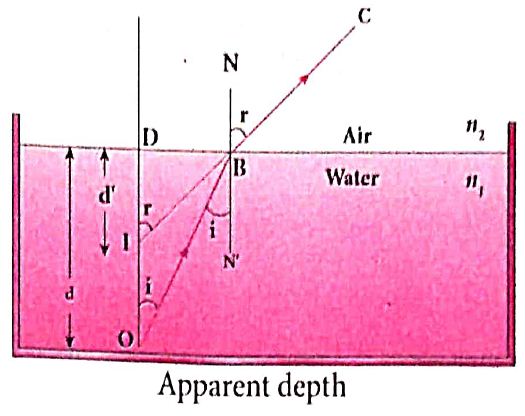
The angle of incidence in the denser medium is i and the angle of refraction in the rarer medium is r. The lines NN'and OD are parallel. Thus, the angle ∠DIB is also r. The angles i and r are very small as the diverging light from O entering the eye is very narrow. The Snell's law in product form for this refraction from equation is,
n1 sin i = n2 sin r
As the angles i and r are small, we can approximate, sin i = tan i and sin r tan r.
n1 tan i = n2 tan r
In triangles ∆DOB and ∆DIB,
\(tan \ i=\frac{DB}{DO}and \ tan \ r=\frac{DB}{DI}\)
\(n_1\frac{DB}{DO}=n_2\frac{DB}{DI}\)
DB is cancelled both sides. Now, DO is the actual depth d and DI is the apparent depth d'.
\(n_1\frac{1}{d}=n_2\frac{1}{d'}\)
After rearranging, \(\frac{d'}{d}=\frac{n_2}{n_1}\)
Rewriting the above equation for the apparent depth d', d' = \(=\frac{n_2}{n_1}d\)
As the rarer medium is air, its refractive index n, can be taken as 1, (n2 = 1) and the refractive index n1 of denser medium could then be taken as n itself, (n1 = n). Now, the equation for apparent depth becomes,
\(d'=\frac{d}{n}\)
The bottom appears to be elevated by d-d',
\(d-d'=d-\frac{d}{n}(or)d-d'=d(1-\frac{1}{n})\)
21.
Gauss law:
(i) A positive point charge Q is surrounded by an imaginary sphere of radius r as shown in Figure. then the total electric flux through the closed surface of the sphere is
\(\Phi_E =\oint { \vec { E } .d\vec { A } =\oint { Ed } Acos\theta } \) .....(1)
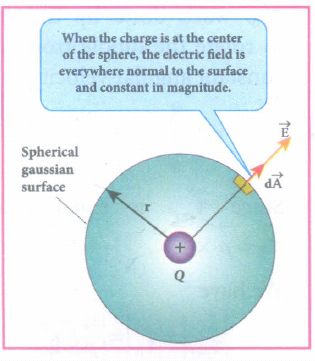
(ii) The electric field of the point charge is directed radially outward at all points on the surface of the sphere. Therefore, the direction of the area element \(d\vec { A } \) is along the electric field \(\vec { E } \) and θ = 0o.
\(\\ \Phi_E =\oint { EdA } \) Since cos0o = 1 ......(2)
iii) E is uniform on the surface of the sphere,
\(\\ \Phi_E=E\oint { dA } \) .......(3)
Substituting for \(\oint { dA=4{ \pi r }^{ 2 } } \) and \(E=\frac { 1 }{ 4\pi { \varepsilon }_{ 0 } } \frac { Q }{ { r }^{ 2 } } \) in eqn (3), we get
\(\therefore \phi E=4{ \pi r }^{ 2 }E\)
\({ \phi }_{ E }=\frac { 1 }{ 4\pi { \varepsilon }_{ 0 } } \frac { Q }{ { r }^{ 2 } } \times { 4\pi r }^{ 2 }=4\pi \frac { 1 }{ 4\pi { \varepsilon }_{ 0 } } Q\)
\({ \phi }_{ E }=\frac { Q }{ { \varepsilon }_{ 0 } } \) .....(4)
The equation (4) is called as Gauss's law.
22.
Electric potential due to a point charge:
Consider a positive charge q kept fixed at the origin. Let P be a point at distance r from the charge q. This is shown in Figure.
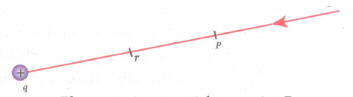
Electrostatic potential at a point P
The electric potential at the point P is
\(V=\int _{ \infty }^{ r }{ \left( -\vec { E } \right) d\vec { r } } =-\int _{ \infty }^{ r }{ \vec { E } } .d\vec { r } \) ...(1)
Electric field due to positive point charge q is
\(\vec { E } =\frac { 1 }{ 4\pi { \varepsilon }_{ 0 } } \frac { q }{ { r }^{ 2 } } \hat { r } \)
\(V=\frac { -1 }{ 4\pi { \varepsilon }_{ 0 } } \int _{ \infty }^{ r }{ \frac { q }{ { r }^{ 2 } } \hat { r } .d\vec { r } } \)
The infinitesimal displacement vector, \(d\vec { r } =dr\hat { r } \) and using \(\hat { r } \).\(\hat { r } \) = 1, we have
\(V=\frac { 1 }{ 4\pi { \varepsilon }_{ 0 } } \int _{ \infty }^{ r }{ \frac { q }{ { r }^{ 2 } } \hat { r } .dr\hat { r } =\frac { 1 }{ 4\pi { \varepsilon }_{ 0 } } \int _{ \infty }^{ r }{ \frac { q }{ { r }^{ 2 } } dr } } \)
After the integration,
\(V=-\frac { 1 }{ 4\pi { \varepsilon }_{ 0 } } q{ \left\{ -\frac { 1 }{ r } \right\} }_{ \infty }^{ r }=\frac { 1 }{ 4\pi { \varepsilon }_{ 0 } } \frac { q }{ r } \)
Hence, the electric potential due to a point charge q at a distance r is
\(V=\frac { 1 }{ 4\pi { \varepsilon }_{ 0 } } \frac { q }{ r } \) ....(2)
23.
Torque experienced by an electric dipole in the uniform electric field:
Consider an electric dipole of dipole moment \(\vec { p } \) placed in a uniform electric field \(\vec { E } \) whose field lines are equally spaced and point in the same direction. The charge +q will experience a force \(q\vec { E } \) in the direction of the field and charge -q will experience a force \(-q\vec { E } \) in a direction opposite to the field. Since the external field \(\vec { E } \) is uniform, the total force acting on the dipole is zero. These two forces acting at different points will constitute a couple and the dipole experience a torque. This torque tends to rotate the dipole.
The total torque on the dipole about the point O
\(\vec{\tau}=\overrightarrow{O A} \times(-q \vec{E})+\overrightarrow{O B} \times q \vec{E}\) ......(1)
Using right-hand corkscrew rule, it is found that total torque is perpendicular to the plane of the paper and is directed into it.
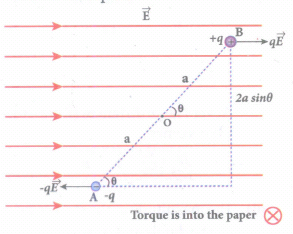
The magnitude of the total torque
\(\tau =|\vec { OA } |\left( -q\vec { E } \right) |sin\theta +|\vec { OB } ||\vec { E } |sin\theta \)
\(\tau =qE.2a\quad sin\theta \) ....(2)
where θ is the angle made by \(\vec { p } \) with \(\vec { E } \) since p = 2aq, the torque is written in terms of the vector product as
\(\vec { \tau } =\vec { p } \times \vec { E } \) ...(3)
The magnitude of this torque is \(\tau \) = pEsin \(\theta \) and is maximum when θ = 90o.
This torque tends to rotate the dipole and align it with the electric field \(\vec{E}\). Once \(\vec{p}\) is aligned with \(\vec{E}\), the total torque on the dipole becomes zero.
24.
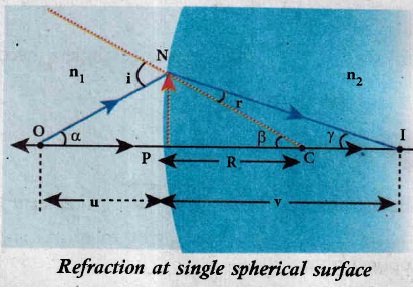
(i) Let us consider two transparent media with refractive indices n, and n, which are separated by a spherical surface. Let C be the centre of curvature of the spherical surface. Let a point object O be in the medium n.
(ii) The line OC cuts the spherical surface at the pole P of the surface. As the rays considered are paraxial rays, the perpendicular dropped for the point of incidence to the principal axis is very close to the pole (or) passes through the pole itself.
(iii) Light from O falls on the refracting surface at N. The normal drawn at the point of incidence passes through the centre of curvature C.
(iv) As n2 > n1 light in the denser medium deviates towards the normal and meets the principal axis at I where the image is formed.
(v) Snell's law in product form for the refraction at the point N can be written from the cquation,
n1 sin i = n2 sin r ...(1)
(vi) As the angles are small, sine of the angle could be approximated to the angle itself,
n1 i = n2r .........(2)
Let the angles be,
\(\angle NOP=\alpha ,\angle NCP=\beta ,\angle NIP=\gamma \)
From the right angle triangles, ∆NOP, ∆NCP and ∆NIP
\(tan\alpha =\cfrac { PN }{ PO } ;tan\beta =\cfrac { PN }{ PC } ;tan\gamma =\cfrac { PN }{ PI } \)
As these angles are small, tan of the angle could be approximated to the angle itself.
\(\alpha =\cfrac { PN }{ PO } ;\beta =\cfrac { PN }{ PC } ;\gamma =\cfrac { PN }{ PI } \) ................(3)
For the triangle, ΔONC,
\(i=\alpha +\beta \) ......(4)
For the triangle, ΔINC,
\(\beta =r+\gamma (or)r=\beta -\gamma \) ...............(5)
Substituting for i and r from equations (4) and (5) in equation (2),
\({ n }_{ 1 }(\alpha +\beta )={ n }_{ 2 }\left( { \beta -\gamma } \right) \)
After rearranging,
\({ n }_{ 1 }a+{ n }_{ 2 }\gamma =\left( { n }_{ 2 }-{ n }_{ 1 } \right) \beta \)
Substituting for α, β and y from equation
\({ n }_{ 1 }\left( \cfrac { PN }{ PO } \right) +{ n }_{ 2 }\left( \cfrac { PN }{ PI } \right) ={ (n }_{ 2 }-{ n }_{ 1 })\left( \cfrac { PN }{ PC } \right) \)
Further simplifying by cancelling PN,
\(\cfrac { { n }_{ 1 } }{ PO } +\cfrac { { n }_{ 2 } }{ PI } =\cfrac { { n }_{ 2 }-{ n }_{ 1 } }{ PC } \) .............(6)
Following sign conventions, PO = -u, PI = +v and PC = +R in equation (6)
\(\cfrac { { n }_{ 1 } }{ -u } +\cfrac { { n }_{ 2 } }{ v } =\cfrac { \left( { n }_{ 2 }-{ { n }_{ 1 } } \right) }{ R } \)
After rearranging, finally we get,
\(\cfrac { { n }_{ 1 } }{ -u } +\cfrac { { n }_{ 2 } }{ v } =\cfrac { \left( { n }_{ 2 }-{ { n }_{ 1 } } \right) }{ R } \) ..................(7)
(vii) If the first medium is air then, n1 = 1 and the second medium is taken just as n2 = n, then the equation (7) is reduced to,
\(\cfrac { n }{ v } -\cfrac { 1 }{ u } =\cfrac { \left( n-1 \right) }{ R } \) ....(8)
25.
(i) The angle of view for water animals is restricted to twice the critical angle 2ic. The critical angle for water is 48.6°. Thus the angle of view is 97.2°.
(ii) The radius R of the circular area depends on the depth d from which it is seen and also the refractive indices of the media.
(iii) The radius R of Snell's window can be deduced with the illustration as shown in Figure.
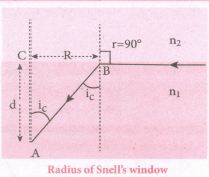
(iv) Light is seen from a point A at a depth 'd'.
(v) From the Snell's law in product form, n1 sini = n2 sinr
(vi) The equation for the refraction happening at the point B on the boundary between the two media is,
n1 sin ic = n2 sin90o ..(1)
n1sinic = n2 (∵ sin90o = 1)
\(sin{ i }_{ c }=\cfrac { { n }_{ 2 } }{ { n }_{ 1 } } \) ...(2)
From the right angle triangle ΔABC,
\({ sini }_{ c }=\cfrac { CB }{ AB } =\cfrac { R }{ \sqrt { { d }^{ 2 }+{ R }^{ 2 } } } \) ....(3)
Equating the above two equation
\(\cfrac { R }{ \sqrt { { d }^{ 2 }+{ R }_{ 2 } } } =\cfrac { { n }_{ 2 } }{ { n }_{ 1 } } \)
Squaring on both sides
\(\cfrac { { R }^{ 2 } }{ { R }^{ 2 }+d^{ 2 } } \left( \cfrac { { n }_{ 2 } }{ { n }_{ 1 } } \right) ^{ 2 }\)
Taking reciprocal,
\(\cfrac { { R }^{ 2 }+{ d }^{ 2 } }{ { R }^{ 2 } } =\left( \cfrac { { n }_{ 1 } }{ { n }_{ 2 } } \right) ^{ 2 }\)
On further simplifying
\(1+\cfrac { { d }^{ 2 } }{ { R }^{ 2 } } =\left( \cfrac { { n }_{ 1 } }{ { n }_{ 2 } } \right) ^{ 2 };\cfrac { { d }^{ 2 } }{ { R }^{ 2 } } =\left( \cfrac { { n }_{ 1 } }{ { n }_{ 2 } } \right) ^{ 2 }-1;\)
\(\cfrac { { d }^{ 2 } }{ { R }^{ 2 } } =\cfrac { { n }_{ 1 }^{ 2 } }{ { n }_{ 1 }^{ 2 } } -1=\cfrac { { n }_{ 1 }^{ 2 }-{ n }_{ 2 }^{ 2 } }{ { n }_{ 2 }^{ 2 } } \)
Again taking reciprocal and rearranging
\(\cfrac { { R }^{ 2 } }{ { d }^{ 2 } } =\cfrac { { { n }_{ 2 }^{ 2 } } }{ { n }_{ 1 }^{ 2 }-{ n }_{ 2 }^{ 2 } } { R }^{ 2 }={ d }^{ 2 }\left( \cfrac { { n }_{ 2 }^{ 2 } }{ { n }_{ 1 }^{ 2 }-{ n }_{ 2 }^{ 2 } } \right) \)
∴ The radius of illumination is,
\(R=d\sqrt { \cfrac { { n }_{ 2 }^{ 2 } }{ \left( n_{ 1 }^{ 2 }-{ n }_{ 2 }^{ 2 } \right) } } \) ...(4)
If the rarer medium outside is air, then, n2 = 1, and we can take n1 = n
\(R=d\left( \cfrac { 1 }{ \sqrt { { n }^{ 2 }-1 } } \right) \) or \(R=\cfrac { d }{ \sqrt { { n }^{ 2 }-1 } } \) ....(5)
26.
27.
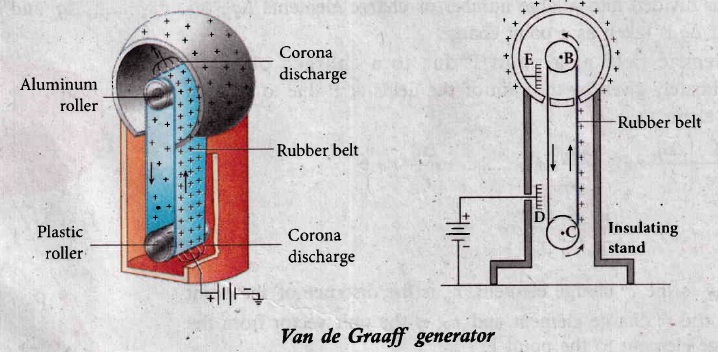
In the year 1929, Robert Van de Graaff designed a machine which produces a large amount of electrostatic potential difference, up to several million volts (107 V).
Principle:
Electrostatic induction and Action at points.
Construction:
(i) A large hollow spherical conductor is fixed on the insulating stand as shown in Figure. A pulley B is mounted at the center of the hollow sphere and another pulley C is fixed at the bottom. A belt made up of insulating materials like silk or rubber runs over both pulleys. The pulley C is driven continuously by the electric motor. Two comb-shaped metallic conductors E and D are fixed near the pulleys.
(ii) The comb D is maintained at a positive potential of 104 V by a power supply. The upper comb E is connected to the inner side of the hollow metal sphere
Working:
(i) Because of the high electric field near comb D, air between the belt and comb D gets ionized. The positive charges are pushed towards the belt and negative charges are attracted towards the comb D.
(ii) The positive charges stick to the belt and move up. When the positive charges reach the comb E, a large amount of negative and positive charges are induced on either side of comb E due to electrostatic induction.
(iii) As a result, the positive charges are pushed away from the comb E and they reach the outer surface of the sphere. Since the sphere is a conductor, the positive charges are distributed uniformly. on the outer surface of the hollow sphere.
(iv) At the same time the negative charges nullify the positive Charges in the belt due to corona discharge before it passes over the pulley.
(v) When the belt descends, it has almost no net charge. At the bottom, it again gains a large positive charge. The belt goes up and delivers the positive charges to the outer surface of the sphere.
(vi) This process continues until the outer surface produces the potential difference of the order of 107 which is the limiting value. We cannot store charges beyond this limit since the extra charge starts leaking to the surroundings due to ionization of air. The leakage of charges can be reduced by enclosing the machine in a gas filled steel chamber at very high pressure.
(vii) The high voltage produced in this Van de Graaff generator is used to accelerate positive ions (protons and deuterons) for nuclear disintegrations and other applications.
28.
Effect of dielectrics in capacitors:
Suppose dielectrics like mica, glass or paper are introduced between the plates, then the capacitance of the capacitor is altered. The dielectric can be inserted into the plates in two different ways.
(i) when the capacitor is disconnected from the battery.
(ii) when the capacitor is connected to the battery.
(i) When the capacitor is disconnected from the battery
Consider a capacitor with two parallel plates each of cross-sectional area A and are separated by a distance d. The capacitor is charged by a battery of voltage Vo and the charge stored is Qo. The capacitance of the capacitor without the dielectric is,
\(C_{0}=\frac{Q_{0}}{V_{0}}\) ....(i)
The battery is then disconnected from the capacitor and the dielectric is inserted between the plates. This is shown in Figure.
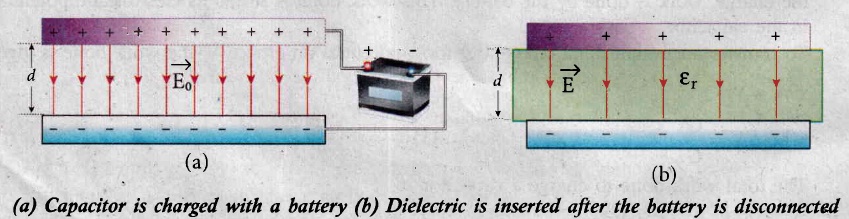
The introduction of dielectric between the plates will decrease the electric field. Experimentally it is found that the modified electric field is given by,
\(E=\frac{E_{0}}{\varepsilon_{r}}\) ....(2)
Here Eo is the electric field inside the capacitors when there is no dielectric and \(\varepsilon_{\mathrm{r}}\) is the relative permittivity of the dielectric or simply known as the dielectric constant. Since \(\varepsilon_{\mathrm{r}}\) > 1, the electric field E < Eo.
As a result, the electrostatic potential difference between the plates (V = Ed) is also reduced. But at the same time, the charge Qo will remain constant once the battery is disconnected.
Hence the new potential difference is
\(V=E d=\frac{E_{0}}{\varepsilon_{r}} d=\frac{V_{0}}{\varepsilon_{r}}\) .......(3)
We know that capacitance is inversely proportional to the potential difference. Therefore as V decreases, C increases.
Thus new capacitance in the presence of a dielectric is
\(C=\frac{Q_{0}}{V}=\varepsilon_{r} \frac{Q_{0}}{V_{0}}=\varepsilon_{r} C_{0}\) ......(4)
Since \(\varepsilon_{\mathrm{r}}\) > 1, we have C > Co. Thus insertion of the dielectric increases the capacitance.
We know that, Co =\(\frac{\varepsilon_{\mathrm{o}} A}{d}\) ...........(5)
Equation (4) ⇒ \(C=\frac{\varepsilon_{r} \varepsilon_{0} A}{d}=\frac{\varepsilon A}{d} \) ..........(6)
where \(\varepsilon=\varepsilon_{\mathrm{r}} \varepsilon_{\mathrm{o}}\) is the permittivity of the dielectric medium.
The energy stored in the capacitor before the insertion of a dielectric is given by,
\(U_{0}=\frac{1}{2} \frac{Q_{0}^{2}}{C_{0}}\) .......(7)
After the dielectric is inserted, the charge Qo remains constant but the capacitance is increased. As a result, the stored energy is decreased.
\(U=\frac{1}{2} \frac{Q_{0}^{2}}{C}=\frac{1}{2} \frac{Q_{0}^{2}}{\varepsilon_{r} C_{0}}=\frac{U_{0}}{\varepsilon_{r}}\) ..........(8)
Since \(\varepsilon_{\mathrm{r}}\) > 1we get U < Uo. There is a decrease in energy because, when the dielectric is inserted, the capacitor spends some energy in pulling the dielectric inside.
(ii) When the battery remains connected to the capacitor:
When the battery of voltage vo remains connected to the capacitor and the dielectric is inserted into the capacitor, then
(a) The potential difference vo across the plates remains constant.
(b) The charge stored in the capacitor is increased by a factor \(\varepsilon_{\mathrm{r}}\). (Experimentally found).
.jpg)
\({Q}=\varepsilon_{r} Q_{0}\) .......(1)
Due to this increased charge, the capacitance is also increased. The new capacitance is,
\(C=\frac{Q}{V_{0}}=\varepsilon_{r} \frac{Q_{0}}{V_{0}}=\varepsilon_{r} C_{0}\) ......(2)
However the reason for the increase in capacitance in this case where the battery remains connected is different from the case when the battery is disconnected before introducing the dielectric.
The energy stored in the capacitor before the insertion of a dielectric is given by,
\(U_{0}=\frac{1}{2} C_{0} V_{0}^{2}\) ....(4)
After the dielectric is inserted, the capacitance is increased; hence the stored energy is also increased.
\( U=\frac{1}{2} C V_{0}^{2}=\frac{1}{2} \varepsilon_{r} C_{0} V_{0}^{2}=\varepsilon_{r} U_{0} \) .....(5)
\(Since \ \varepsilon_{r}>1\ we \ have \ U>U_{o}.\)
Note: Here we have not used the expression \(U_o=\frac{1}{2}\frac{Q_0^2}{C_0}\)because here, both charge and capacitance are changed, whereas in equation (4), Vo remains constant.
Since voltage between the capacitor Vo is constant, the electric field between the plates also remains constant .The energy density is given by,
\(u=\frac{1}{2} \varepsilon E_{0}^{2}\) ..(6)
where ε is the permittivity of the given dielectric material.
29.

12th Standard Syllabus & Materials
12th Standard
TN 12th Computer Applications வலையமைப்பு வடமிடல் Sample Question Papers Study Material - QB365 Set A
NEW12th Standard
TN 12th Computer Applications களப்பெயர் முறைமை (DNS) Sample Question Papers Study Material - QB365 Set A
NEW12th Standard
TN 12th Computer Applications வலையமைப்பு எடுத்துக்காட்டுகள் மற்றும் நெறிமுறைகள் Sample Question Papers Study Material - QB365 Set A
NEW12th Standard
TN 12th Computer Applications கணினி வலையமைப்பு ஓர் அறிமுகம் Sample Question Papers Study Material - QB365 Set A



Tamilnadu Stateboard 12th Standard Subjects

Maths

Chemistry
Physics

Biology

Computer Science

Business Maths and Statistics

Economics

Commerce

Accountancy

History

Computer Applications
Biology
Computer Technology
Computer Applications
Computer Science
Business Maths and Statistics
Commerce
Economics
Maths
Chemistry
Physics
Computer Technology
History
Accountancy

Tamil

English

French
Tamilnadu Stateboard Standards


