
 100% FREE ACCESS
12th Standard Syllabus & Materials
12th Standard
TN 12th Maths Applications of Matrices and Determinants Sample Question Papers Study Material - QB365 Set A
NEW12th Standard
TN 12th Computer Applications மின்னணு தரவு பரிமாற்றம் Sample Question Papers Study Material - QB365 Set A
NEW12th Standard
TN 12th Computer Applications மின் - வணிக பாதுகாப்பு அமைப்புகள் Sample Question Papers Study Material - QB365 Set A
NEW12th Standard
TN 12th Computer Applications மின்னணு செலுத்தல் முறைகள் Sample Question Papers Study Material - QB365 Set A
NEW12th Standard
TN 12th Computer Applications மின் - வணிகம் Sample Question Papers Study Material - QB365 Set A
NEW12th Standard
TN 12th Computer Applications திறந்த மூல கருத்துருக்கள் Sample Question Papers Study Material - QB365 Set A

Published on: 22/08/2026
Download Tamil Nadu 12th Standard Physics question papers, model tests, one-mark questions, important questions, and public exam papers in PDF format. Free study materials and answer keys for TN State Board students.
Questions + Answers key
Take MCQ Physics Test
1.
Stars twinkle due to, ______.
reflection
total internal reflection
refraction
polarisation
2.
An object is placed in front of a convex mirror of focal length off and the maximum and minimum distance of an object from the mirror such that the image formed is real and magnified.
2f and c
c and \(\infty\)
f and O
None of these
3.
A rod of length 10 cm lies along the principal axis of a concave mirror of focal length 10 cm in such a way that its end closer to the pole is 20 cm away from the mirror. The length of the image is, ______.
2.5 cm
5cm
10 cm
15cm
4.
Pure water has refractive index 1.33. What is the speed of light through it?
5.
What are critical angle and total internal reflection?
6.
Why do stars twinkle?
7.
What is principle of reversibility?
8.
Light travels from air into a glass slab of thickness 50 cm and refractive index 1.5.
(i) What is the speed of light in the glass?
(ii) What is the time taken by the light to travel through the glass slab?
(iii) What is the optical path of the glass slab?
9.
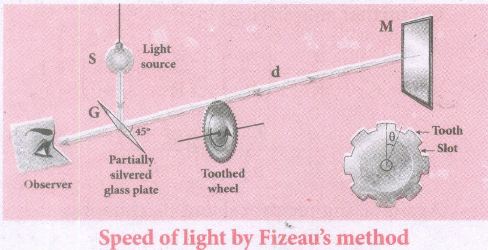
Derive the relation between f and R for a spherical mirror.
10.
Obtain the equation for apparent depth.
11.
12.
Derive the mirror equation and the equation for lateral magnification.
1.
(c)
refraction
2.
Convex Mirror is diverging in nature and for all positions of objects, convex mirror forms virtual and erect image.
3.
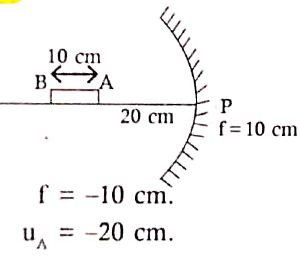
At end A,
\(\frac{1}{f} =\frac{1}{u_A}+\frac{1}{v_A} \)
\(\therefore \frac{1}{v_A} =\frac{1}{-10}-\frac{1}{-20} \)
\(\frac{1}{v_A} =-\frac{1}{10}+\frac{1}{20}=\frac{-2+1}{20}=-\frac{1}{20} \)
\(v_A =-20 \mathrm{~cm} \)
\(\left|v_{\wedge}\right|=20 \mathrm{~cm}\)
At end B,
\(\frac{1}{f} =\frac{1}{u_B}+\frac{1}{v_B} \)
\(\frac{1}{v_B} =\frac{1}{f}-\frac{1}{u_B}, \)
\(u_B =-30 \mathrm{~cm} \)
\(\frac{1}{v_B} =-\frac{1}{10}+\frac{1}{30} \)
\(=\frac{-3+1}{30}=\frac{-2}{30}=\frac{-1}{15} \)
\(v_B =-15 \mathrm{~cm} \)
\(\left|v_B\right| =15 \mathrm{~cm} \)
\(\therefore \quad\left|\mathrm{v}_{\mathrm{A}}\right|-\left|\mathrm{v}_{\mathrm{B}}\right| \) is the length of the image
= 20 - 15 = 5 cm
4.
\(n=\cfrac { c }{ v } ;\quad v=\cfrac { c }{ n } \)
\(v=\cfrac { 3\times { 10 }^{ 8 } }{ 1.33 } =2.26\times { 10 }^{ 8 }{ ms }^{ -1 }\)
Light travels with a speed of 2.26 x 10⁸ m s-1 through pure water.
5.
Critical angle:
The angle of incidence in the denser medium for which the angle reflection is 90o or the reflected ray graces the boundary between the two media is called critical angle.
Total Internal reflection:
For any angle of incidence greater than the critical angle, the center light is reflected back into the denser medium itself. This phenomenon is called Total internal reflection.
6.
Stars appear twinkling because of the movement of the atmospheric layer with varying refractive indices due to refraction.
7.
The principle of reversibility states that light will follow exactly the same path if its direction of travel is reversed.
8.
Given, thickness of glass slab, d = 50 cm = 0.5 m, refractive index, n = 1.5
refractive index, \(n=\cfrac { c }{ v } \)
(a) speed of light in the glass slab is,
\(v=\cfrac { c }{ n } =\cfrac { 3\times { 10 }^{ 8 } }{ 1.5 } =2\times { 10 }^{ 8 }{ ms }^{ -1 }\)
(b) time taken by light to travel through the glass slab is,
\(t=\cfrac { d }{ v } =\cfrac { 0.5 }{ 2\times { 10 }^{ 8 } } =2.5\times { 10 }^{ -9 }{ s }\)
(c) optical path,
d' = nd = 1.5 x 0.5 = 0.75 m = 75 cm
Light would have traveled an additional 25 cm (75 cm – 50 cm) in vacuum at the same time had there been no glass slab in its path.
9.
Relation between f and R:
C ⇒ Center of curvature
F ⇒ Principal focus
i ⇒ Angle of incidence
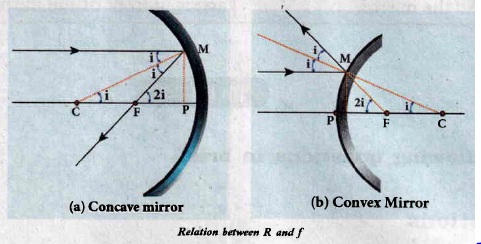
The angles
\(\tan i=\frac{P M}{P C} \text { and } \tan 2 i=\frac{P M}{P F}\)
As the angles are small, tan i = i and tan 2i = 2i.
\(\mathrm{i}=\frac{\mathrm{PM}}{\mathrm{PC}} \text { and } 2 \mathrm{i}=\frac{\mathrm{PM}}{\mathrm{PF}}\)
Simplifying further,
\(2 \frac{\mathrm{PM}}{\mathrm{PC}}=\frac{\mathrm{PM}}{\mathrm{PF}} ; 2 \mathrm{PF}=\mathrm{PC}, \mathrm{R}=2 \mathrm{f}\)
PF is focal length f and PC is the radius of curvature R.
R = 2f (or) f = R/2
10.
(i) Light from the object O at the bottom of the tank passes from denser medium (water) to rarer medium (air) to reach our eyes for viewing the object.
(ii) It deviates away from the normal in the rarer medium at the point of incidence B as shown in Figure.
(iii) The refractive index of the denser medium is n1 and that of rarer medium is n2. Here, n1 > n2.
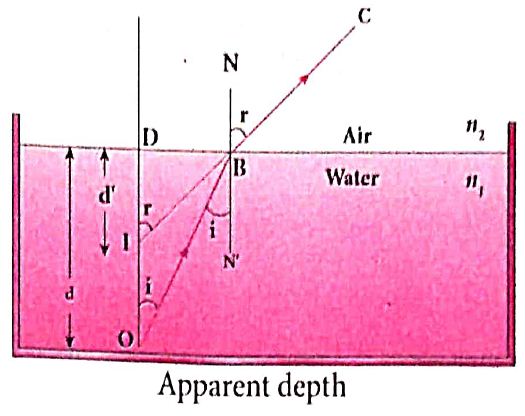
The angle of incidence in the denser medium is i and the angle of refraction in the rarer medium is r. The lines NN'and OD are parallel. Thus, the angle ∠DIB is also r. The angles i and r are very small as the diverging light from O entering the eye is very narrow. The Snell's law in product form for this refraction from equation is,
n1 sin i = n2 sin r
As the angles i and r are small, we can approximate, sin i = tan i and sin r tan r.
n1 tan i = n2 tan r
In triangles ∆DOB and ∆DIB,
\(tan \ i=\frac{DB}{DO}and \ tan \ r=\frac{DB}{DI}\)
\(n_1\frac{DB}{DO}=n_2\frac{DB}{DI}\)
DB is cancelled both sides. Now, DO is the actual depth d and DI is the apparent depth d'.
\(n_1\frac{1}{d}=n_2\frac{1}{d'}\)
After rearranging, \(\frac{d'}{d}=\frac{n_2}{n_1}\)
Rewriting the above equation for the apparent depth d', d' = \(=\frac{n_2}{n_1}d\)
As the rarer medium is air, its refractive index n, can be taken as 1, (n2 = 1) and the refractive index n1 of denser medium could then be taken as n itself, (n1 = n). Now, the equation for apparent depth becomes,
\(d'=\frac{d}{n}\)
The bottom appears to be elevated by d-d',
\(d-d'=d-\frac{d}{n}(or)d-d'=d(1-\frac{1}{n})\)
11.
12.
Mirror Equation :
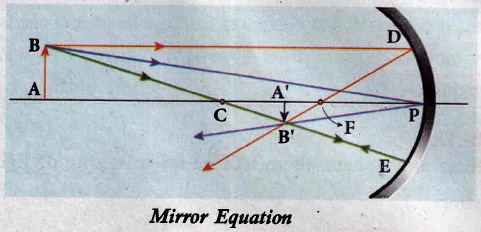
(i) AB is an object which is placed on the principal axis of a concave mirror beyond the center of curvature C. A' B' is an image which is formed between the point pole P, and the centre of curvature.
(ii) From the figure As per law of reflection, the angle of incidence ∠BPA is equal to the angle of reflection ∠B'PA'.
(iii) The triangles ∠BPA and ∠B'PA' are similar. Thus, from the rule of similar triangles,
\(\cfrac { { A }^{ ' }{ B }^{ ' } }{ AB } =\cfrac { { PA }^{ ' } }{ PA } \) ................(1)
(iv) The other set of similar triangles are, ΔDPF and ΔB'A'F. (PD is almost a straight vertical line)
\(\cfrac { { A }^{ ' }B' }{ PD } =\cfrac { A'F }{ PF } \)
(v) As, PD = AB the above equation becomes,
\(\cfrac { A'B' }{ AB } =\cfrac { A'F }{ PF } \) ......(2)
(vi) From equations (1) and (2) we can write,
\(\cfrac { PA' }{ PA } =\cfrac { A'F }{ PF } \)
(vii) As, A'F = PA' - PF, the above equation becomes,
\(\cfrac { PA' }{ PA } =\cfrac { PA'-PF }{ PF } \) .....(3)
(viii) We can apply the sign conventions for the various distances in the above equation
PA = - u, PA' = -v, PF = - f
(ix) All the three distances are negative as per sign convention, because they are measured to the left of the pole. Now, the equation (3) becomes,
\(\cfrac { -v }{ -u } =\cfrac { -v-\left( -f \right) }{ -f } \)
On further simplification,
\(\cfrac { v }{ u } =\cfrac { v-f }{ f } ;\cfrac { v }{ u } =\cfrac { v }{ f } -1 \)
Dividing either side with v,
\(\cfrac { 1 }{ u } =\cfrac { 1 }{ f } -\cfrac { 1 }{ v } \)
After rearranging,
\(\cfrac { 1 }{ v } +\cfrac { 1 }{ u } =\cfrac { 1 }{ f } \)
The above equation is called mirror equation.
Lateral magnification:
The lateral or transverse magnification is defined as the ratio of the height of the image to the height of the object. The height of the object and image are measured perpendicular to the principal axis.
Magnification (m) \(=\frac{\text { height of the image }\left(h^{\prime}\right)}{\text { height of the image }(h)} \)
\(m=\frac{h^{\prime}}{h} \) ....(1)
Applying proper sign conventions for equation,
\(\frac{A^{\prime} B^{\prime}}{A B}=\frac{P A^{\prime}}{P A} \)
\(A^{\prime} B^{\prime}=-h^{\prime}, A B=h, P A^{\prime}=-v, P A=-u \)
\(-\frac{h}{h}=\frac{-v}{-u} \)
On simplifying we get,
\(\mathrm{m}=\frac{\mathrm{h}^{\prime}}{\mathrm{h}}=-\frac{\mathrm{v}}{\mathrm{u}}\) ...(2)
Using mirror equation, we can further write the magnification as,
\(m=\frac{h^{\prime}}{h}=\frac{f-v}{f}=\frac{f}{f-u}\) ..(3)

12th Standard Syllabus & Materials
12th Standard
TN 12th Computer Applications வலையமைப்பு வடமிடல் Sample Question Papers Study Material - QB365 Set A
NEW12th Standard
TN 12th Computer Applications களப்பெயர் முறைமை (DNS) Sample Question Papers Study Material - QB365 Set A
NEW12th Standard
TN 12th Computer Applications வலையமைப்பு எடுத்துக்காட்டுகள் மற்றும் நெறிமுறைகள் Sample Question Papers Study Material - QB365 Set A
NEW12th Standard
TN 12th Computer Applications கணினி வலையமைப்பு ஓர் அறிமுகம் Sample Question Papers Study Material - QB365 Set A



Tamilnadu Stateboard 12th Standard Subjects

Maths

Chemistry
Physics

Biology

Computer Science

Business Maths and Statistics

Economics

Commerce

Accountancy

History

Computer Applications
Biology
Computer Technology
Computer Applications
Computer Science
Business Maths and Statistics
Commerce
Economics
Maths
Chemistry
Physics
Computer Technology
History
Accountancy

Tamil

English

French
Tamilnadu Stateboard Standards


