
8th Standard Syllabus & Materials
8th Standard
TN 8th Tamil இயல் 3 - கல்வி கரையில - வினைமுற்று Important Questions And Answers Study Material - QB365 Set A
NEW8th Standard
TN 8th Tamil இயல் 2 - ஈடில்லா இயற்கை - மயங்கொலிகள் Important Questions And Answers Study Material - QB365 Set A
NEW8th Standard
TN 8th Tamil இயல் 2 - ஈடில்லா இயற்கை -பட்டமரம் Important Questions And Answers Study Material - QB365 Set A
NEW8th Standard
TN 8th Tamil இயல் 2 - ஈடில்லா இயற்கை - இயற்கையை போற்றுவோம் Important Questions And Answers Study Material - QB365 Set A
NEW8th Standard
TN 8th Tamil இயல் 1 - தமிழ் இன்பம் - ஆழிக்கு இணை Important Questions And Answers Study Material - QB365 Set A
NEW8th Standard
TN 8th Tamil இயல் 2-ஈடில்லா இயற்கை - திருக்குறள் Important Questions And Answers Study Material - QB365 Set A

Published on: 02/09/2026
Download Tamil Nadu 8th Standard Science question papers, model tests, one-mark questions, important questions, and public exam papers in PDF format. Free study materials and answer keys for TN State Board students.
Questions + Answers key
Take MCQ Science Test
1.
Aerated water contains
air
oxygen
carbon dioxide
nitrogen
2.
If you apply some heat energy to a substance, which of the following can take place in it?
Expansion
Increase in temperature
Change of state
All the above
3.
In the absence of oxygen, glucose is broken down in to ________.
Lactic acid
Citric acid
Acetic acid
Nitric acid
4.
Penicillin is an antibiotic, which is extracted from
Algae
Fungi
Bryophytes
Pteridophytes
5.
If the image and object distance is same, then the object is placed at
infinity
at F
between f and P
at C
6.
________ is used as a fertilizer.
7.
_______ is defined as the amount of heat required to raise the temperature of 1kg of a substance by 1°C.
8.
Monocotyledon seeds bear only _______cotyledon.
9.
The book “Genera Plantarum” was written by _________
10.
Geometric centre of the spherical mirror is ________.
11.
Why the human eye is compared with camera?
12.
Tabulate the difference between aerobic and anaerobic respiration.
13.
Define Prokaryotic cell?
14.
Write any four characters of pteridophytes.
15.
Write any three economic importance of algae.
16.
Give two applications of a concave and convex mirror.
17.
What are the effects of acid rain? How can we prevent them?
18.
Name the compounds produced when the following substances burn in oxygen.
a) Carbon
b) Sulphur
c) Phosphorous
d) Magnesium
e) Iron
f) Sodium
19.
Explain the mechanism of breathing.
20.
Draw the structure of human eye and label its parts.
21.
Write any five differences between monocot and dicot plants.
22.
Explain the working of a periscope.
23.
Convection is the process by which the thermal energy flows in solids.
24.
Aqueous humour plays an important role in maintaining the shape of the eye.
25.
Diffusion is the movement of particles from an area of lower concentration to higher concentration.
26.
Cell wall of fungi is made up of chitin.
27.
In polypetalae, the petals are free.
28.
Mention the physical properties of oxygen.
29.
Define specific heat capacity
30.
What are the effects of heat?
31.
Name the processes by which air enters and comes out of our lungs?
32.
Mention the function of ‘Alveoli’?
33.
State different types of tissues.
34.
Seeds of gymnosperm plants are naked. Why?
35.
Define Thallus.
1.
(c)
carbon dioxide
2.
(d)
All the above
3.
(a)
Lactic acid
4.
(b)
Fungi
5.
(d)
at C
6.
()
Nitrogen (Ammonia)
7.
()
specific heat capacity
8.
()
one
9.
()
Bentham and Hooker
10.
()
Pole
11.
The human eye can be compared to a camera as both functions by gathering, focusing and transmitting the light through the lens for creating an image of an object.
12.
| S.No | Aerobic | Anaerobic |
|---|---|---|
| 1. | Aerobic respiration takes Place in the presence of oxygen | 6139robic respiration takes place in the absence of oxygen |
| 2. | The end products of aerobic respiration are CO2 and H2O | The end products of anerobic respiration are CO2 ethanol and lactice acid |
| 3. | Common in all higher Plants and animals | Common in certain micro organisms and human muscle cell |
13.
Prokaryotic cell lacks a distinct nucleus and membrane bound organelles
eg: bacteria.
14.
Characters of Pteridophytes:
1 Pteridophytes are the first true land plants with xylem and phloem. Hence it is called vascular cryptogams.
2 Pteridophytes exhibit alternation of generation. The diploid sporophytic phase alternates with the haploid gametophytic phase.
3 The main plant body is sporophytes, which is the dominant phase, differentiated into true root, stem and leaves.
4. Sporophytes reproduce by means of spores. Spores are produced in sporangium.
15.
Agar Agar:
1. Agar Agar is extracted from some red algae namely Gelidium, Gracillaria etc
2. which is used to prepare growth medium in laboratories.
Algae in space travel:
1. Chlorella pyrenoidosa is used in space travel to get rid of Co, and decompose human wastes
Single cell protein (SCP):
1. Some of the single cell algae and blue green algae are used to produce protein.
2. Eg: Chlorella, spirulina
16.
Applications of a concave mirror:
i) Used as shaving mirror as they provides magnified image
ii) Used in torches, search lights as they direct the light to a long distance.
Applications of a convex mirror:
i) Used in vehicles as rear view mirror
ii) Used on roads where there are sharp curves and turns
17.
Effects of Acid rain
(i) It irritates eyes and skin of human beings
(ii) It inhibits germination and growth of seedlings
(iii) It changes the fertility of the soil, destroys plants and aquatic life.
(iv) It causes corrosion of many buildings, bridges etc.
Preventive measures
(i) Minimising the usage of fossil fuels such as petrol, diesel etc.
(ii) Using CNG (Compressed Natural Gas)
(iii) Using non-conventional source of energy
(iv) Proper disposal of the industrial wastes.
18.
a) Carbon - Carbondioxide CO2
b) Sulphur - Sulphur dioxide SO2
c) Phosphorous - Phosphorous trioxide P2O3
Phosphorous pentoxide P2O5
d) Magnesium - Magnesium Oxide MgO
e) Iron - Iron oxide Fe3O4
f) Sodium - Sodium Oxide Na2O
19.
Inspiration (Inhalation)
► The process of taking air into the lungs is called inspiration,
► During inspiration, the sternum is pushed up and outward and the diaphragm is pulled down
► This increases the volume of the thoracic cavity the pressure decreases.
► The air outside the body flows into the lungs.
► Here the exchange of gases takes place between the air and blood.
Expiration (Exhalation)
► The process of expelling air from the lungs is called expiration or exhalation.
► Upon exhalation, the lungs recoil to force the air out of the lungs
► The intercostal muscles relax, returning the chest wall to its original position.
► During exhalation, the diaphragm also relaxes, moving higher into the thoracic cavity.
► This increases the pressure within the thoracic cavity relative to the environment.
► Air rushes out of the lungs due to the pressure gradient.
► This movement of air out of the lungs is a passive event.
Exchange of gases in the Alveoli:
► The content of oxygen in the inhaled air in alveoli is more than the blood flowing through the capillaries
► So, the oxygen moves into the blood by simple diffusion.
► Haemoglobin in the blood combines with oxygen to form oxyhaemoglobin.
► The blood carrying oxygen reaches the heart through blood vessels.
► The heart pumps it to all the tissue in the body.
► The tissue releases carbon-dioxide which is carried back to alveoli by the blood.
► Carbon dioxide diffuses from the blood to the air in the alveoli and it sent out of the body when the air is exhaled.
20.
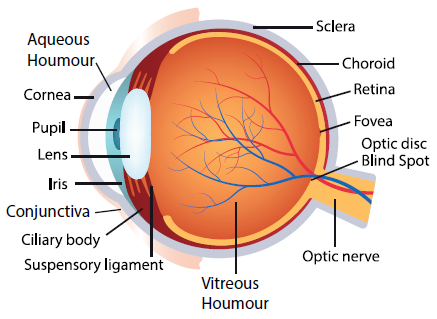
21.
| S.No | Monocot | Dicot |
| 1 | Seed has one cotyledon | Seed has two cotyledon |
| 2 | Leaves have parallel venation | Leaves have reticulate venation |
| 3 | Plants have fibrous root system | Plants have tap root system |
| 4 | Flowers are trimerous and not differentiated into calyx and corolla |
Flowers are tetramerous or pentamerous. Calyx and corolla are well differentiated |
| 5 | Pollination occurs mostly by wind Eg: Grass, Paddy |
Pollination occurs mostly by insects Eg: Bean, Mango |
22.
Periscope:-
(i) Periscope is an instrument used for viewing bodies or ships, which are over and around another body or a submarine.
Working:-
(i) It is based on the principle of the law of reflection of light
(ii) It consists of a long outer case and inside this case mirrors or prisms are kept at each end, inclined at an angle of 45o.
(iii) Light coming from the distant body falls on the mirror at the top end of the periscope and gets reflected vertically downward.
(iv) This light is reflected again by the second mirror kept at the bottom so as to travel horizontally and reach the eye of the observer.
(v) In some complex periscopes, optic fibre is used instead of mirrors for obtaining a higher resolution.
(vi) The distance between the mirrors also varies depending on the purpose of using the periscope.
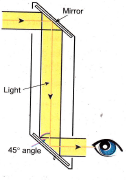
23.
(b)
24.
False
25.
False
26.
(a)
27.
(a)
28.
Physical properties of Oxygen
(i) Oxygen is a colourless, odorless and tasteless gas
(ii) It is a poor conductor heat and electricity
(iii) Oxygen dissolves readily in cold water
(iv) It is denser than air
(v) It can made into liquid at high pressure and low temperature
(v) It supports combustion.
29.
Specific heat capacity of a substance is defined as the amount of heat energy required to raise the temperature of 1 kilogram of a substance by 1oC the symbol C. It's SI unit is Jkg-1K-1.
30.
Effects of heat:
When heat energy is supplied to any substance, it brings about many changes.
The three important changes are:
(i) Expansion
(ii) Increase in temperature
(ii) Change in state.
31.
► Air enters in Inspiration
► Air comes out Expiration
32.
► Alveoli are the workhouses of respiratory system.
► The exchange of oxygen and carbondioxide takes place in alveoli.
► It takes up oxygen and gives out carbondioxide.
33.
There are 4 types of tissues.
i) Epithelial tissue
ii) Muscular tissue
iii) Connective tissue
iv) Nervous tissue
34.
Seeds of gymnosperm plants are naked because the ovule is not enclosed by ovary.
35.
The plant body of algae are called thallus. It means the plant body is not differentiated into root, stem and leaf.

8th Standard Syllabus & Materials
8th Standard
TN 8th Tamil இயல் 3 - கல்வி கரையில - பாடறிந்து ஒழுகுதல் Important Questions And Answers Study Material - QB365 Set A
NEW8th Standard
TN 8th Tamil இயல் 3-கல்வி கரையில - பல்துறைக் கல்வி Important Questions And Answers Study Material - QB365 Set A
NEW8th Standard
TN 8th Tamil இயல் 3-கல்வி கரையில - புத்தியைத் தீட்டு Important Questions And Answers Study Material - QB365 Set A
NEW8th Standard
TN 8th Tamil இயல் 2 - ஈடில்லா இயற்கை - தமிழர் மருத்துவம் ( நேர்காணல்) Important Questions And Answers Study Material - QB365 Set A



Tamilnadu Stateboard 8th Standard Subjects
Tamilnadu Stateboard Standards



