
8th Standard Syllabus & Materials
8th Standard
TN 8th Tamil இயல் 3 - கல்வி கரையில - வினைமுற்று Important Questions And Answers Study Material - QB365 Set A
NEW8th Standard
TN 8th Tamil இயல் 2 - ஈடில்லா இயற்கை - மயங்கொலிகள் Important Questions And Answers Study Material - QB365 Set A
NEW8th Standard
TN 8th Tamil இயல் 2 - ஈடில்லா இயற்கை -பட்டமரம் Important Questions And Answers Study Material - QB365 Set A
NEW8th Standard
TN 8th Tamil இயல் 2 - ஈடில்லா இயற்கை - இயற்கையை போற்றுவோம் Important Questions And Answers Study Material - QB365 Set A
NEW8th Standard
TN 8th Tamil இயல் 1 - தமிழ் இன்பம் - ஆழிக்கு இணை Important Questions And Answers Study Material - QB365 Set A
NEW8th Standard
TN 8th Tamil இயல் 2-ஈடில்லா இயற்கை - திருக்குறள் Important Questions And Answers Study Material - QB365 Set A

Published on: 02/09/2026
Download Tamil Nadu 8th Standard Science question papers, model tests, one-mark questions, important questions, and public exam papers in PDF format. Free study materials and answer keys for TN State Board students.
Questions + Answers key
Take MCQ Science Test
1.
Based on shape, the bacteria are classified into _______ types.
2
3
4
5
2.
Burning of paper is a______ change.
Physical
chemical
physical & chemical
neutral
3.
The non-metal which conduct current is
carbon
oxygen
aluminium
sulphur
4.
Which of the following liquids has more viscosity?
Grease
Water
Coconut oil
Ghee
5.
SI unit of temperature is __________
celsius
fahrenheit
kelvin
ampere
6.
Micro organism can be seen with the help of a _______.
7.
______ is the basic material to manufacture urea.
8.
The element which possess character of both metals and non metals are called_______.
9.
The pressure of a liquid column _____ with the depth of the column.
10.
The uncertainty in measurement is called as _______.
11.
Citrus canker is transmitted by insects.
12.
Female anopheles mosquito is a carrier of dengue virus.
13.
CFC is a pollutant.
14.
A chemical reaction is a temporary reaction.
15.
Force acting on a given area is called pressure.
16.
Temperature is a measure of total kinetic energy of the particles in a system.
17.
What is a symbol?
18.
What type of oscillations are used in atomic clocks?
19.
Write the names of any three protozoans.
20.
Define catalysis
21.
Write the symbols for these elements
a) Oxygen b) Gold
c) calcium d) cadmium e) Iron
22.
Give two examples to verify that a force tends to change the static condition of a body.
23.
What is the value of Avogadro’s number?
24.
What is the SI unit of Luminous Intensity?
25.
Define solid angle
26.
Write the four types of bacteria, based on their shape.
27.
Define a Alchemy.
28.
Tabulate four points of difference between metals and non-metals.
29.
Define friction. Give two examples of the utility of friction in day to day life.
30.
Define - mole.
31.
Define - ampere.
32.
Explain the physical properties of non metals
33.
Write a short note on Probiotics.
34.
Write a short note on bacteria and its structure.
35.
Explain how food items are spoiled by chemical reactions?
36.
Describe an experiment to prove that friction depends on the nature of a surface.
37.
Write a short note on different types of clocks.
1.
(c)
4
2.
(b)
chemical
3.
(a)
carbon
4.
(a)
Grease
5.
(c)
kelvin
6.
()
Microscope
7.
()
Ammonia
8.
()
metalloids
9.
()
Increases
10.
()
Errors
11.
(b)
12.
(b)
13.
(a)
14.
(b)
15.
(b)
16.
(b)
17.
A syrnbol is an image, object etc that stands for some meaning.
Ex (+) denotes addition
18.
Periodic vibrations occuring with in the atom are used in atomic clocks.
19.
i) Plasmodium
ii) Paramecium
iii) Euglena
20.
Chemical substance used to alter the speed of the reaction is called a catalyst and the process is called catalysis.
21.
| Element | Symbol | |
|---|---|---|
| a | Oxygen | O |
| b | Gold | Au |
| c | Calcium | Ca |
| d | Cadmium | Cd |
| e | Iron | Fe |
22.
i) When a kicking force is exerted on a football at rest, it raises.
ii) When a pushing force is applied on a box at rest it moves.
23.
6.023 x 10²³
24.
The SI unit of Luminous Intensity is Candela.
25.
Solid angle is the angle formed by three or more planes intersecting at a common point. SI unit is steradian.
26.
i) Bacilli - Rod shaped bacteria.
Eg. Bacillus anthracis
ii) Spirilla - Spiral shaped bacteria.
Eg. Helicobacter pylori.
iii) Cocci - Spherical or ball shaped bacteria
Eg. Streptococus pneumoniae
iv) Vibrio - Comma shaped bacteria
Eg. Vibrio cholera
27.
The process of changing less valuable metal into gold is called alchemy.
28.
| S.No | Property | Metal | Non - metal |
| 1 | Malleability | Good | Poor - usually soft or brittle |
| 2 | Ductility | Good | Poor - usually soft or brittle |
| 3 | Melting point | usually high | usually low |
| 4 | Conductivity (Thermal and electrical) | Good | Very poor |
29.
Frictional force arises when two or more bodies in contact move or tend to move, relative to each other. It acts always in the opposite direction of the moving body.
Examples:
(i) To light a matchstick.
(ii) To stitch a cloth in a sewing machine.
30.
Mole is defined as The amount of substance which contains 6.023 x 10²³ entities.
31.
ampere:
One ampere is defined as one coulomb of charge moving in a conductor in one second.
32.
| S.No | Property | Non-metals | Exceptions |
|---|---|---|---|
| 1 | Physical State | Solids, liquids or gases | - |
| 2 | Hardness | not hard | diamond |
| 3 | Lustre | not shiny | graphite, iodine |
| 4 | 4 Density | Soft, have low density | diamond |
| 5 | Melting point & boiling point | low | Carbon,Silicon boron |
| 6. | Tensile strength | do not have tensile strength | Carbon fibre |
| 7 | Malleability | Non-malleable | - |
| 8 | Ductility | Non-ductile | Carbon fibre |
| 9 | .Conductivity | bad conductors | graphite |
| 10 | Sonorous | do not give ringing | - |
33.
Probiotics are live food supplements used in yoghurt and other fermented milk products. Eg. Lactobacillus acidophilus and Bifidobacterium bifidum. These bacteria improve the microbial spectrum in the gut and thus contribute to the following effects.
1. Decrease the risk of colon cancer.
2. Decrease cholesterol absorption.
3. Prevent diarrhoeal diseases by increasing the immunity power.
34.
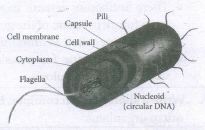
Bacteria are single-celled prokaryotes (cells without nuclei). They are considered to be the first living organisms on earth. Bacteria are grouped under the Kingdom Monera. The study of bacteria is called Bacteriology. The size of bacteria range from 1 μm to 5 μm (micrometer). Bacteria are of two types based on respiration
i) Aerobic bacteria (requires oxygen)
ii) Anaerobic bacteria (Does not requires oxygen)
Cell Structure:
A bacterium has on outer covering known as the cell wall. Nuclear material is represented by a nucleoid without nudear membrane. An extra chromosomal DNA called plasmid is present in the cytoplasm. Protein synthesis is carried out by 70 S ribosomes. Other cell organelles (mitochondria, golgi body, endoplasmic reticulum etc.) are absent flagella aid in locomotion.
35.
(i) Spoilage of food and vegetables:
Food spoilage may be defined as any change that causes food unfit for human consumption
The chemical reactions catalyzed by the enzymes result in the degradation of food quality such as development of bad tastes and odour, detorioration and loss of nutrients.
Eg: Rotten eggs develop a bad smell due to the formation of hydrogen sulphide gas.
Decaying of vegetables and fruits due to microbes.
(ii) Rancidity of fishes and meat:
Fishes and meat contains high levels of polyunsaturated fatty acids.
These fatty acids undergo oxidation when exposed to air or light.
It results in bad odour. This process is called rancidity.
(iii) Apples and fruits turn brown when cut:
It is due to chemical reaction with oxygen in air.
The cells of apples contain an enzyme called tyrosinase that when in contact with oxygen catalyses a biochemical reaction of plant's phenolic compounds to brown pigments known as melanins.
36.
Experiment:
i) Arrange some notebooks one over the other to form a platform on a table.
ii) Keep a wide scale, as a slide, such that one of its ends rests on the pile of books:
iii) Take different kinds of materials like cotton cloth, plastic paper, newspaper, writing pad etc.
iv) Place some glass marbles in a bowl placed on the table.
v) First, keep a rectangular piece of paper near the end of the scale which is in contact with the table.
vi) Now release a glass marble from the top end of the scale such that it rolls down the scale.
vii) Allow the marble to roll over the piece of paper and finally, come to rest.
viii) Measure the distance travelled by the marble over the paper using the meter scale.
ix) Replace the rolling surface by placing the plastic sheet, wooden plank, cotton cloth etc.
x) In each trial measure the distance travelled by the glass marble.
xi) Tabulate the distance covered by the marble over each surface.
| S.No | Rolling surface placed on the table | Distance covered by the glass marble after sliding down (in centimetre) |
| 1. | Paper | 8 cm |
| 2. | Glass | 10 cm |
| 3. | Cotten cloth | 5 cm |
| 4. | wood | 6 cm |
Inference:
The marble covers a lesser distance over the cotton cloth in comparison with the distance it covers over the glass plate.
Reason:
i) A rough surface like the cotton cloth offers more frictional force. So the marble moves slowly and cover a minimum distance.
ii) The smooth surface of glass, offers lesser friction. So, the glass marble travels a greater distance over it.
Result:
i) The effect of the force of friction increases as the roughness of the surface increases.
ii) Thus friction depends on the nature of a surface.
37.
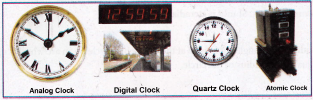
Types of clocks:
I. Types of clocks based on display
(i) Analog clocks:
1. It looks like a classic clock.
2. It has three hands such as hours hand, minutes hand and seconds hand to show the time
3. Analog clocks can be driven either mechanically or electronically.
(ii) Digital clocks:
1. A digital clock displays the time directly
2. It shows the time in numerals or other symbols.
3. It may have a 12 hours or 24 hours display,
II. Types of clocks based on working mechanism
(i) Quartz clock:
1. These clocks are activated by electronic oscillations which are controlled by a 'quartz crystal'.
2. The quartz clock is more accurate than the mechanical clock.
3. Accuracy - One second in every 109 seconds.
(ii) Atomic clock:
1. These clocks are making use of periodic vibrations occurring within the atom
2. Accuracy - One second in every 10 seconds.
3. Atomic clocks are used in Global positioning System, Global Navigation Satellite System and International time distribution services.

8th Standard Syllabus & Materials
8th Standard
TN 8th Tamil இயல் 3 - கல்வி கரையில - பாடறிந்து ஒழுகுதல் Important Questions And Answers Study Material - QB365 Set A
NEW8th Standard
TN 8th Tamil இயல் 3-கல்வி கரையில - பல்துறைக் கல்வி Important Questions And Answers Study Material - QB365 Set A
NEW8th Standard
TN 8th Tamil இயல் 3-கல்வி கரையில - புத்தியைத் தீட்டு Important Questions And Answers Study Material - QB365 Set A
NEW8th Standard
TN 8th Tamil இயல் 2 - ஈடில்லா இயற்கை - தமிழர் மருத்துவம் ( நேர்காணல்) Important Questions And Answers Study Material - QB365 Set A



Tamilnadu Stateboard 8th Standard Subjects
Tamilnadu Stateboard Standards



