
8th Standard Syllabus & Materials
8th Standard
TN 8th Tamil இயல் 3 - கல்வி கரையில - வினைமுற்று Important Questions And Answers Study Material - QB365 Set A
NEW8th Standard
TN 8th Tamil இயல் 2 - ஈடில்லா இயற்கை - மயங்கொலிகள் Important Questions And Answers Study Material - QB365 Set A
NEW8th Standard
TN 8th Tamil இயல் 2 - ஈடில்லா இயற்கை -பட்டமரம் Important Questions And Answers Study Material - QB365 Set A
NEW8th Standard
TN 8th Tamil இயல் 2 - ஈடில்லா இயற்கை - இயற்கையை போற்றுவோம் Important Questions And Answers Study Material - QB365 Set A
NEW8th Standard
TN 8th Tamil இயல் 1 - தமிழ் இன்பம் - ஆழிக்கு இணை Important Questions And Answers Study Material - QB365 Set A
NEW8th Standard
TN 8th Tamil இயல் 2-ஈடில்லா இயற்கை - திருக்குறள் Important Questions And Answers Study Material - QB365 Set A

Published on: 02/09/2026
Download Tamil Nadu 8th Standard Social Science question papers, model tests, one-mark questions, important questions, and public exam papers in PDF format. Free study materials and answer keys for TN State Board students.
Questions + Answers key
Take MCQ Social Science Test
1.
________ of a state enjoy full civil and political rights.
2.
The degree of water vapour present in the atmosphere is known as__________.
3.
The scientific study of weather is called __________.
4.
_________ soil is highly suitable for millets cultivation.
5.
Scientific study of rocks is called ________.
6.
There is state religion in India
7.
Mass migration is absent in the modern period
8.
Citizen of India can enjoy Fundamental Rights guaranteed by our constitution.
9.
The Scientific study of weather is called Climatology.
10.
Slate is formed from shale.
11.
What does secularism mean?
12.
Name some of the Indians who contributed to spread of secularism.
13.
List out any four most populous cities in the world.
14.
What is Urbanisation?
15.
What are the causes of rural to urban migration?
16.
Define “Migration”.
17.
Give any three suggestions to reduce global warming.
1. ______________.
2. ______________.
3. ______________.
18.
Name the five ways of acquiring citizenship?
19.
Mention any three qualities of a good citizen.
20.
Name the types of citizens?
21.
Define “ hydrological cycle”.
22.
Write a short note on aquifer.
23.
State the types of soils.
24.
How are igneous rocks formed?
25.
Why we need secular education?
26.
On what grounds that the citizenship of a person is cancelled?
27.
Distinguish between evaporation and transpiration.
28.
Write about the wind and its types.
29.
How is temperature measured?
30.
Classify and explain the rocks.
31.
Explain the process of soil formation.
32.
What are “Isolines”?
33.
What is meant by atmospheric pressure?
34.
Define ‘weather’.
35.
On the outline map of the world mark the following places
1. Tokyo
2. New Delhi
3. Mexico city
4. Shanghai
5. Sao Paulo
6. Oceania
7. Latin America
8. Paris
9. London
10. Cairo
1.
()
The citizens
2.
()
Humidity
3.
()
meteorology
4.
()
Red
5.
()
petrology
6.
(b)
7.
(a)
8.
(a)
9.
(b)
10.
(b)
11.
i) Secularism means an attitude of tolerance towards other religions and peaceful co-existence of citizens belonging to different faiths.
ii) It is a policy of neutrality and equality by the states towards all religious communities.
12.
i) Rajaram Mohan Roy
ii) Rabindranath Tagore
iii) B.R. Ambedkar
iv) Sir Syed Ahmad Khan and
v) Mahatma Gandhi
13.
i) Tokyo - (Japan)
ii) Delhi - (India)
iii) Shanghai - (China)
iv) Mexico City - (Mexico)
14.
Urbanisation refers to the process in which there is an increase in the proportion of population living in towns and cities.
15.
i) Natural population growth
ii) Rural to urban migration and the reclassification of rural areas into urban areas.
16.
Migration is defined as the permanent semi permanent change of residence of an individual or group of people over a significant distance.
17.
(i) Reduce tropical deforestation and its associated global warming emissions. Plant more frees
(ii) Reduce waste by choosing reusable products instead of disposables. Recycle paper plastic, glass and aluminium cans.
(iii) Expand the use of renewable energy and transform our energy system to one that is cleaner and less dependent on coal and other fossil fuels
(iv) Increase vehicle fuel efficiency and support other solutions that reduce U.S oil use.
(v) Build a clean energy economy by investing in efficient energy technologies, industries and approaches.
(vi) Use energy-efficient lights, heating, ventilation, A.C. set them to energy conservation levels.
18.
i) Acquiring citizenship by birth.
ii) Acquiring citizenship by descent.
iii) Acquiring citizenship by Registration.
iv) Acquiring citizenship by Naturalisation.
v) Acquiring citizenship by incorporation of Territory
19.
a) Loyalty to the constitution.
b) Obeys laws
c) Respecting diversity
20.
i) Natural Citizens: They are the citizens by birth
ii) Naturalised citizens: They are the one who acquires citizenship.
21.
(i) Hydrological cycle is a global sun. driven process where water is transported from oceans to atmosphere, from atmosphere to land and from land back to oceans.
(ii) The water cycle can be considered as a closed system for the earth, as the quantity of water involved in the cycle is invariable.
22.
i) An aquifer is an underground layer of water - bearing permeable rock, rock fractures or unconsolidated materials (gravel, sand or silt).
ii) Ground water can be extracted using a water well.
iii) The study of water flow in aquifers and the characterization of aquifers is called hydrogeology.
23.
Soils are classified on the basis of their formation colour, physical and chemical properties. Soil is classified into six major types. They are
1. Alluvial soil
2. Black soil
3. Red soil
4. Laterite soil
5. Mountain soil
6. Desert soil
24.
1. The igneous rocks are formed by the solidification of molten magma.
2. These rocks are also called as the 'Primary Rocks' or 'Parent Rocks' as all other rocks are formed from these rocks.
25.
i) To remove narrow mindedness and make dynamic and enlightened view.
ii) To develop moral and humanistic outlook.
iii) To train the youth to be good citizen.
iv) To strengthen democratic values like liberty, equality and fraternity and co-operative living
v) To give wider vision towards life.
vi) To develop an attitude of appreciation and understanding of others point of view.
vii) To develop the spirit of love, tolerance, co-operation, equality and sympathy.
viii) To synthesise materialism and spiritualism.
26.
Renunciation : (a voluntary act)
when a person after acquiring the citizenship of another country gives up his/ her Indian citizenship.
Termination : (by operation of Law)
When an Indian citizen voluntarily acquires the citizenship of another country he/ she automatically ceases to be an Indian citizen.
Deprivation : (Compulsary Termination)
The citizenship is deprived on the basis of an order of the government of India in case involving acquisition of India citizenship by fraud, false representation or being disloyal to the constitution.
27.
| Transpiration | Evaporation | |
| 1. | It refers to the process by which the water content in the plants are released into the atmosphere in the form of water vapour. |
It refers to the process in which the liquid form of water changes into gaseous form. |
| 2. | Transpiration is a physiological process and occurs in plants. | Evaporation is a surface level process and occurs on any free surface. |
| 3. | It helps only from living bodies | It happens from any surface either living or non-living. |
| 4. | It mainly Occurs during day time. | It occurs throughout day and night. |
| 5. | The nature of the plant parts including barks and leaves also determine the transpiration rate. |
Temperature is the prime element which affects the rate of evaporation. |
| 6. | The rate of transpiration is also affected by the temperature, wind and humidity. |
Areal extent of surface water, wind and the atmospheric humidity are the other variables which affect the rate of evaporation. |
| 7. | It keeps the surface wet | It leads to dryness of surface |
28.
The horizontal movement of air is called wind.
The winds move from high pressure to low pressure.
Winds get their name from the direction from which they blow i.e, wind blows from south west is called southwest monsoon.
The wind systems are broadly categorized into three as follows.
i) Planetary winds
ii) Seasonal winds
iii) Local winds
Planetary winds:
These Winds are the ones which blow almost in the same direction throughout the year. So, they are called as Permanent or planetary winds.
Eg: Trade winds, Westerlies and polar easterlies.
Seasonal winds:
Seasonal winds are those which change their direction according to season in a year.
They are called as monsoon winds.
These winds blow from sea to land during summer and land to sea during winter.
Local winds:
These winds are the winds blow over a small area only during a particular time of a day or a short period of a year.
Eg: Land breeze and sea breeze.
29.
1. The temperature of a unit volume of air at a given time is measured in scales like Celsius, Fahrenheit,
2. Meteorologist measures the temperature by the Thermometer, Stevenson screen and minimum and maximum Thermometer.
3. Atmosphere is mainly heated by outgoing radiation from 2 to 4 pm.
4. So the maximum temperature is recorded between 2 and 4 pm regularly and minimum temperature is recorded around 4 am before sunrise.
30.
According to the mode of formation the rocks are classified into three as follows
1. Igneous Rocks
2. Sedimentary Rocks
3. Metamorphic Rocks
Igneous Rocks:
1. The igneous rocks are formed by the solidification of molten magma.
2. These rocks are also called as the 'Primary Rocks' or 'Parent Rocks' as all other rocks are formed from these rocks.
3. Igneous rocks are of two types. They are
Extrusive Igneous Rocks.
Intrusive Igneous Rocks.
Sedimentary Rocks:
1. The sedimentary rocks are formed by the sediments derived and deposited by various agents.
2.Due to high temperature and pressure, the undistrubed sediments of long period cements to form sedimentary rocks.
3. These rocks consist of many layers which were formed by the sediments deposited at different periods. As it consists of many strata, it is also known as 'stratified rocks.
4. The three types of sedimentary rocks are
i) Organic Sedimentary Rocks
ii) Mechanical Sedimentary Rocks
iii) Chemical Sedimentary rocks
Metamorphic Rocks:
When Igneous and sedimentary rocks are subjected to high temperature and pressure, the original rocks get altered to form a new kind of rock called metamorphic rocks.
Metamorphism is of two types
1. Thermal Metamorphism
2. Dynamic Metamorphism
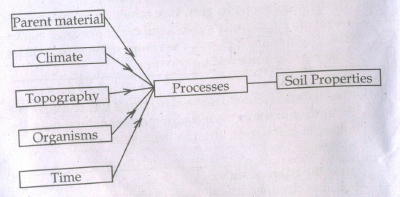
31.
(i) Soil is a mixture of organic matter, mineral, gases, liquids and organisms that together support life. Soil minerals form the basis of soil. It forms on surface of the earth. It is known as skin of earth.
(ii) Soils are produced form rocks through the processes of weathering and soil erosion.
(iii) Water, wind, temperature change, gravity, chemical interaction, living organisms and pressure differences all help break down parent material.
(iv) It leads to the formation of loose material
(v) In course of time they further break down into fine particles.
(vi) This process release the minerals locked in the rock fragments.
(vii) Later on the vegetative cover which develops in that region forms humus content in the soil. This way the soil gets matured gradually.
32.
i) Isolines are those which join the places of equal values.
ii) Isolines are given different names based on the weather element they represent.
33.
i) The weight of air above a given area on the earth's surface is called atmospheric pressure or air pressure.
ii) The air pressure is measured by Barometer.
iii) The standard air pressure at sea level is 1013.25 mb.
34.
1. Weather is the day today conditions of the atmosphere at any place as regards sunshine, temperature, cloud cover, Wind fog condition, air pressure, humidity, precipitation and such other elements.
2. It refers to short periods like a day, a week, a month or a little longer.
3. Weather changes from time to time in a day and one period to the other in a year.
4. The weather is cool in winter and hot in summer.
35.

8th Standard Syllabus & Materials
8th Standard
TN 8th Tamil இயல் 3 - கல்வி கரையில - பாடறிந்து ஒழுகுதல் Important Questions And Answers Study Material - QB365 Set A
NEW8th Standard
TN 8th Tamil இயல் 3-கல்வி கரையில - பல்துறைக் கல்வி Important Questions And Answers Study Material - QB365 Set A
NEW8th Standard
TN 8th Tamil இயல் 3-கல்வி கரையில - புத்தியைத் தீட்டு Important Questions And Answers Study Material - QB365 Set A
NEW8th Standard
TN 8th Tamil இயல் 2 - ஈடில்லா இயற்கை - தமிழர் மருத்துவம் ( நேர்காணல்) Important Questions And Answers Study Material - QB365 Set A



Tamilnadu Stateboard 8th Standard Subjects
Tamilnadu Stateboard Standards



