
 100% FREE ACCESS
8th Standard CBSE Syllabus & Materials
8th Standard CBSE
CBSE 8th Social Science Theme D - Factors of Production - New Model Questions Papers Study Material - QB365 Set A
NEW8th Standard CBSE
CBSE 8th Social Science Theme C - Universal Franchise and India's Electoral System - New Model Questions Papers Study Material - QB365 Set A
NEW8th Standard CBSE
CBSE 8th Social Science Theme B - The Rise of the Marathas - New Model Questions Papers Study Material - QB365 Set A
NEW8th Standard CBSE
CBSE 8th Social Science Theme B - Reshaping India's Political Map - New Model Questions Papers Study Material - QB365 Set A
NEW8th Standard CBSE
CBSE 8th Social Science Theme A - Natural Resources and Their Use - New Model Questions Papers Study Material - QB365 Set A
NEW8th Standard CBSE
CBSE 8th Science Keeping Time with Skies - New Model Questions Papers Study Material - QB365 Set A

Published on: 31/07/2018
Based on the current academic syllabus, some of the important questions are prepared from the chapter Understanding Quadrilaterals.
Students, subscribe and get plenty of question paper with answer key. For subscription please click here.
Download CBSE Class 8th Standard CBSE Mathematics question papers, sample papers, important questions, and previous year solved papers in PDF format. Get free study materials, NCERT solutions, and exam preparation resources for Class 8th Standard CBSE Mathematics
Questions + Answers key
Take MCQ Mathematics Test
1.
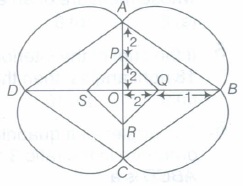
A rangoli has been drawn on the floor of a school's main gate. Participatent of Class VllI th girls for making rangoli, all bring different types of color from market to colour the rangoli (as shown below), where, ABCD and PORS both are in the shape of a rhombus. Find the radius of semi circle drawn on each side of rhombus ABCD. What type of value depict here?
2.
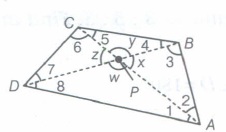
As before, consider quadrilateral ABCD in adjoining figure. Let P be any point in its interior. Join P to vertices A, B, C and D. In the given figure, consider ΔPAB. From this, we see x= 180°- mㄥ2 - mㄥ3; similarly from ΔPBC, y = 1800- mㄥ4 - mㄥ5; from ΔPCD, z = 180° - mㄥ6 - mㄥ7 and from ΔPDA, w= 180°- mㄥB - mㄥ1. Use this to find the total measure mㄥ1 + mㄥ2 + ... + mㄥ8. Does it help you to arrive at the result?
3.
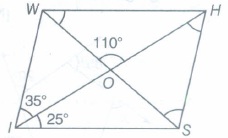
In a parallelogram WISH, find ㄥSWH, ㄥOSH and ㄥSHO.
4.
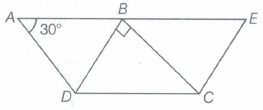
In the given figure, ABCD and BDCE are parallelograms with common base DC. If
BC ⏊ BD, then find ㄥBEC.
5.
Can a quadrilateral ABCD be a parallelogram, if
(i) ㄥD + ㄥB = 180 °?
(ii) AB= DC = 8 cm, AD = 4 cm and BC = 4.4 cm?
(iii) ㄥA = 70° and ㄥC = 65°?
6.
Take identical cut-outs of congruent triangles of sides 3 cm, 4 cm and 5 cm. Arrange them as shown in the figure.
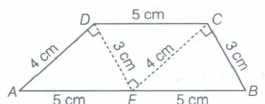
You get a trapezium. (Check it!) Which are the parallel sides here? Should the non-parallel sides be equal. You can get two more trapeziums using the same set of triangles. Find out them and discuss their shapes.
7.
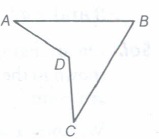
These quadrilaterals were convex. What would happen, if the quadrilateral is not convex? Consider quadrilateral ABCD. Split it into two triangles and find the sum of the interior angles in adjoining figure.
8.
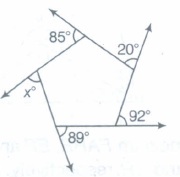
In the following figure, find the value of x.
9.
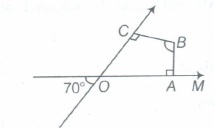
In the following figure, find the measure of ㄥABC.
10.
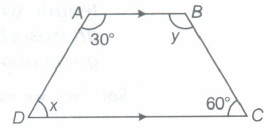
Find the values of x and y from the figure given below,
11.
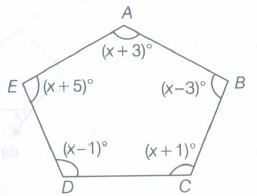
Find the value of x and measure of each interior angles of the polygon shown below
12.
How many diagonals does each of the following have?
(a) A convex quadrilateral
(b) A regular hexagon
(c) A triangle
13.
Which one has all the properties of a kite and a parallelogram?
Trapezium
Rhombus
Rectangle
Parallelogram
14.
For which of the following quadrilaterals, diagonals are perpendicular to each other?
Parallelogram
Trapezium
Rectangle
Kite
15.
The angles of a quadrilateral ABCD taken in an order are in the ratio 3 : 7 : 6 : 4. Then, the ABCD is a
kite
rhombus
trapezium
parallelogram
16.
The number of sides of a regular polygon, whose measure of an exterior angle is 24°, is
6
8
10
15
17.
Which of the following is not true for an exterior angle of a regular polygon with n sides?
Each exterior angle = \(\frac { { 360 }^{ 0 } }{ n } \)
Exterior angle = 180° - Interior angle
n = \(\frac { { 360 }^{ 0 } }{ Exterior\quad angle } \).
Each exterior angle = \(\frac { (n-2)\times 180^{ 0 } }{ n } \)
18.
All rhombuses are parallelograms.
19.
PQRS is a trapezium, in which PQ II RS and ㄥP = 130°, ㄥQ = 110°, then ㄥR is equal to 70°.
20.
The sum of adjacent angles of a parallelogram is 180°.
21.
The sum of adjacent angles of a parallelogram is 180°.
22.
Diagonals of rhombus intersects at right angle.
23.
If one diagonal of a rectangle is 8 cm long, length of the other diagonal is _______
24.
If the diagonals of a quadrilateral bisect each other, it is a ______
25.
_______ is a regular quadrilateral.
26.
The diagonals of the quadrilateral HOPE are _____ and ____
27.
If PQRS is a parallelogram, then ㄥQ - ㄥS is equal to _____
1.
In rhombus ABCD,
AO = OP + PA = 2 + 2 ⇒ AO = 4
and OB = OQ + QB = 2 + 1 ⇒ OB = 3
In ΔOAB,
(AB)2 =(OA)2 + (OB)2
[by Pythagoras theorem]
⇒ (AB)2 =(4)2 + (3)2 = 25
⇒ AB=5
Since, AB is diameter of semi-circle.
∴ Radius = \(\frac { 5 }{ 2 } \)=2.5
Hence, radius of the semi-circle is 2.5. The value depict here is participation unity and creativity.
2.
We know ,that, the sum of all angles of a triangle is 180°. Therefore
In ΔAPB, we have
ㄥx + ㄥ2 + ㄥ3 =180° ⇒ ㄥx=1800 - ㄥ2- ㄥ3 ... (i)
In ΔBPC, we have
ㄥy + ㄥ4 + ㄥ5 = 180° ⇒ ㄥy = 180°- ㄥ4 - ㄥ5 ... (ii)
In ΔCPD, we have
ㄥz + ㄥ6 + ㄥ7 = 180° ⇒ ㄥz = 180°- ㄥ6 - ㄥ7 ... (iii)
In ΔDPA, we have
ㄥw + ㄥ8 + ㄥ1=180° ⇒ w=1800 - ㄥ8 - ㄥ1 ... (iv)
On adding Eqs. (i), (ii), (iii) and (iv), we get
ㄥx+ ㄥy+ ㄥz + ㄥw
=720° - (ㄥ1 + ㄥ2 + ㄥ3 + ㄥ4+ ㄥ5 + ㄥ6 + ㄥ7 + ㄥ8)
But, at point P, ㄥx + ㄥy + ㄥz + ㄥw = 360°
∴ 360°= 720° - [(ㄥ1 + ㄥ2) + (ㄥ3 + ㄥ4)+(ㄥ5 + ㄥ6) + (ㄥ7 + ㄥ8)]
⇒ 360°-720° = -(ㄥA + ㄥB + ㄥC + ㄥD)
⇒ -360° = -(ㄥA + ㄥB + ㄥC + ㄥD)
or ㄥA + ㄥB + ㄥC + ㄥD = 360°
Thus, this helps us to arrive at the result that the sum of all angles of a quadrilateral is 360°.
3.
We have, a parallelogram WISH.
Here, WH Il lS and IW II HS
∴ ㄥWIH = ㄥIHS = 35° [alternate angle]
Similarly, ㄥHIS = ㄥIHW = 25° [alternate angle]
Now, by using angle sum property of a triangle in ΔWOH, we get
ㄥWOH + ㄥOWH + ㄥOHW = 180°
⇒ 110° + ㄥOWH + 25° =180°
[∵ ㄥOHW = ㄥIHW]
⇒ ㄥOWH =180° - (110° + 25°)
= 180° -135° = 45° = ㄥSWH
In ΔOHS, we have
ㄥHOS = 180° -110° = 70°
ㄥOHS = 35° [proved]
∴ 70° + 35° + ㄥOSH =180°
⇒ ㄥOSH =180° -105° =75°.
4.
Wehave, parallelograms ABCD and BDCE and BC丄 BD
ㄥABC =180° - 30° = 150°
[since, ㄥDAB and ㄥABC are adjacent angles of parallelogram ABCD]
∴ ㄥCBE = 180° - ㄥABC = 180° - 150° = 30°
Also, it is given that,
ㄥDBC=90°
∴ ㄥDBE = 90° + 30° = 120°
ㄥDBE = ㄥDCE = 120°
∴ ㄥBEC = 180° -120° = 60°
[since ㄥBEC and ㄥDCE are adjacent angles of parallelogram DCEB].
5.
(i) In a quadrilateral ABCD,
ㄥD + ㄥB = 180° = Sum of two adjacent angles So, the quadrilateral may be parallelogram, but not always.
(ii) In a quadrilateral ABCD,
AB = DC = 8 cm, AD = 4 cm and BC = 4.4 cm
Here, opposite sides AD and BC are not equal, but in a parallelogram opposite sides are of equal length. So, quadrilateral ABCD cannot be a parallelogram.
(iii) In a quadrilateral ABCD,
ㄥA = 70° and ㄥC = 65°
Here, ㄥA ≠ㄥC
But in a parallelogram, opposite angles are of equal measure.
So, quadrilateral ABCD cannot be a parallelogram
6.
Given, three cut-outs of congruent triangles of sides 3 cm, 4 cm and 5 cm. On arranging them, we get a trapezium from the given figure, we have
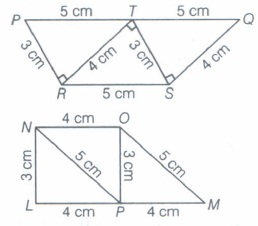
ㄥDEC = ㄥECB = 90° [alternate angles]
∴ DEIIBC
and DE = BC =3 cm
Also, EB = DC = 5 cm
So, EBCD is a parallelogram.
∴ EBIIDC
Also, AEB is a straight line, so AEB II DC. Therefore, in trapezium ABCD, sides AB and DC are parallel and non-parallel sides AD and BC are unequal. Also, non-parallel sides of a trapezium mayor may not be equd By using the same set of triangles, we can get two more trapeziums.
7.
If a quadrilateral is not convex, then it will be concave. In the quadrilateral ABCD, join BD. Then, quadrilateral split into two triangles.
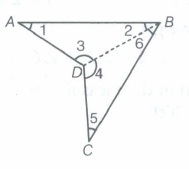
In ΔADB, we have
mㄥ1 + mㄥ2 + mㄥ3 = 180°
[using angle sum property of a traingle] ... (i)
In ΔBDC, we have
mㄥ4 + mㄥ5 + mㄥ6 = 180°
[using angle sum property of a triangle] ... (ii)
On adding Eqs. (i) and (ii), we get
mㄥ1 + mㄥ2 + mㄥ3 + mㄥ4 + mㄥ5 +mㄥ6 = 180°+180°
⇒ mㄥ1 + mㄥ2 + mㄥ6+ mㄥ5 + (mㄥ3 + mㄥ4) = 360°
∴ mㄥA + mㄥB + mㄥC + mㄥD = 360°
Hence, the sum of the interior angles of a quadrilateral is 360°.
8.
We know that, sum of all the exterior angles of a pentagon is 360°.
∴ 92° + 20° + 85° + x0 + 89° = 360°
⇒ 286° + x0 = 360°
⇒ x0=3600-2860=740
9.
ㄥABC = 110°
10.
Since, ABCD is a trapezium as AB II CD,
∴ 300 + x = 1800 and y +600 = 1800 ⇒ x = 1800 - 300 = 1500 and y = 1800 - 600 = 1200.
11.
x =107°, ㄥA=110°, ㄥB=104°, ㄥC=108°, ㄥD=106° and ㄥE=112°
12.
We know that, a diagonal is a line segment connecting two non-consecutive vertices of a polygon.
(a) A convex quadrilateral has two diagonals.
(b) A regular hexagon has nine diagonals.
(c) A triangle has no diagonals.
13.
14.
(d)
Kite
15.
(c)
trapezium
16.
(d)
15
17.
(d)
Each exterior angle = \(\frac { (n-2)\times 180^{ 0 } }{ n } \)
18.
(a)
19.
(a)
20.
(a)
21.
(a)
22.
(a)
23.
8 cm; [∵ in a rectangle, diagonals are of equal length]
24.
Parallelogram; since, in a parallelogram, diagonals bisect each other.
25.
Square; since, in a square all the sides and angles are equal.
26.
The diagonals of the quadrilateral HOPE are HP and OE.
27.
since, in a parallelogram PORS, opposite angles are equal.
Here, ㄥP, ㄥR and ㄥQ, ㄥS are opposite angles.
ㄥQ = ㄥS ⇒ ㄥQ - ㄥS = 0

8th Standard CBSE Syllabus & Materials
8th Standard CBSE
CBSE 8th Science Particulate Nature of Matter - New Model Questions Papers Study Material - QB365 Set A
NEW8th Standard CBSE
CBSE 8th Science Pressure, Winds, Stroms and Cyclones - New Model Questions Papers Study Material - QB365 Set A
NEW8th Standard CBSE
CBSE 8th Mathematics Quadrilaterals - New Model Questions Papers Study Material - QB365 Set A
NEW8th Standard CBSE
CBSE 8th Mathematics A story of Numbers - New Model Questions Papers Study Material - QB365 Set A



CBSE 8th Standard CBSE Subjects
CBSE Standards




