
 100% FREE ACCESS
12th Standard Syllabus & Materials
12th Standard
TN 12th Computer Applications மின்னணு தரவு பரிமாற்றம் Sample Question Papers Study Material - QB365 Set A
NEW12th Standard
TN 12th Computer Applications மின் - வணிக பாதுகாப்பு அமைப்புகள் Sample Question Papers Study Material - QB365 Set A
NEW12th Standard
TN 12th Computer Applications மின்னணு செலுத்தல் முறைகள் Sample Question Papers Study Material - QB365 Set A
NEW12th Standard
TN 12th Computer Applications மின் - வணிகம் Sample Question Papers Study Material - QB365 Set A
NEW12th Standard
TN 12th Computer Applications திறந்த மூல கருத்துருக்கள் Sample Question Papers Study Material - QB365 Set A
NEW12th Standard
TN 12th Computer Applications வலையமைப்பு வடமிடல் Sample Question Papers Study Material - QB365 Set A

Published on: 12/07/2019
Download Tamil Nadu 12th Standard Chemistry question papers, model tests, one-mark questions, important questions, and public exam papers in PDF format. Free study materials and answer keys for TN State Board students.
Questions + Answers key
Take MCQ Chemistry Test1.
The general electronic configuration of d-block elements can be written as ________.
[Noble gas]n - 1d1-10 ns1-2
[Noble gas]n - 1d-10 n1-6
[Noble gas]n - 2 d10 ns1-2
[Noble gas]n - 2 d10 ns1-6
2.
Coinage metals are _______.
normal metals
transition metals
active metals
alkali metals
3.
The colour of K2Cr2O7 and Fe2+ ions are respectively due to_______.
Crystal defects and charge transfer spectra
d-d transition and charge transfer spectra
Charge transfer spectra and crystal defects
Charge transfer spectra and d-d transition
4.
Which one of the following exhibits highest oxidation state?
Ni
Mn
V
Zr
5.
Identify the paramagnetic species.
Cu+
Cr+
MnO4
Zn2+
6.
Most of the transition metal ions are coloured, because of the ________.
presence of unpaired electrons
energy gap between two energy levels is very small
both (a) and (b)
neither (a) nor (b)
7.
The catalytic activity of transition metals is due to ________.
the formation of a variety of oxidation states
the formation of intermediate products
the capability of forming interstitial compounds.
all the above
8.
The catalytic behaviour of transition metals and their compounds is ascribed mainly due to _______.
their magnetic behaviour
their unfilled d orbitals
their ability to adopt variable oxidation states
their chemical reactivity
9.
Which of the following compounds is colourless?
Fe3+
Ti4+
Co2+
Ni2+
10.
The magnetic moment of Mn2+ ion is _______.
5.92BM
2.80BM
8.95BM
3.90BM
11.
Which one of the following ions has the same number of unpaired electrons as present in V3+?
Ti3+
Fe3+
Ni2+
Cr3+
12.
Among the transition metals of 3d series, the one that has highest negative \(\left( \frac { M^{ 2+ } }{ M } \right) \) standard electrode potential is _______.
Ti
Cu
Mn
Zn
13.
Which of the following d block element has half filled penultimate d sub shell as well as half filled valence sub shell?
Cr
Pd
Pt
none of these
14.
Sc (Z = 21) is a transition element but Zinc (z = 30) is not because _______.
both Sc3+ and Zn2+ ions are colourless and form white compounds
In case of Sc, 3d orbital are partially filled but in Zn these are completely filled
last electron as assumed to be added to 4s level in case of zinc
both Sc and Zn do not exhibit variable oxidation states
15.
What are the uses of potassium dichromate?
16.
What is chromyl chloride test? Give equations.
17.
Do transition elements form complex co-ordinate compounds?
18.
Which is more stable? Fe3+ or Fe2+? Why ?
19.
What are transition metals? Give four examples.
20.
What are the conditions for alloy formation?
21.
What is Zeigler - Natta catalyst?
22.
Define standard electrode potential.
23.
Transition metals show high melting points. Why?
24.
Write the electronic configuration of Ce4+ and Co2+.
25.
What are interstitial compounds?
26.
Explain why compounds of Cu2+ are coloured but those of Zn2+ are colourless.
27.
Explain the oxidation states of 4d series elements.
28.
Complete the following reactions
(i) Cr2O72- ⟶
(ii) Cr2O72- + 6I-+ 14H+ ⟶
(iii) Cr2O72-+ 3S2-+ 14H+ ⟶
(iv) Cr2O72- + 3SO2 + 2H+ ⟶
(v) Cr2O72- + 3Sn2+ + 14H+ ⟶
(vi) K2Cr2O7 + 8H2SO4 + 3CH3CH2OH ⟶
(vii) 2MnO4- + 5(COO)2- + 6H+ ⟶
(viii) 2MnO4- + 10I- + 16H+ ⟶
(ix) 2MnO4- + 5S2-+ 16H+ ⟶
(x) 2MnO4- + 5NO2- + 6H+ ⟶
(xi) 2KMnO4 + 3H2SO4 + 5CH3CH2OH ⟶
(xii) 2MnO4- + 5SO32- + 6H+ ⟶
29.
Predict which of the following will be coloured in aqueous solution Ti2+, V3+, Sc4+, Cu+, Sc3+, Fe3+, Ni2+ and Co3+
30.
I. First transition metal scandium exhibits +3 oxidation state.
II. Mn has 3 different oxidation states.
III. No. of oxidation state decreased with the no of electrons.
IV. No. of oxidation state increases as the no of paired electrons increases.
a) I, III and IV only
b) I, II, IV and III only
c) I, II and III only
d) I, II and III
1.
(a)
[Noble gas]n - 1d1-10 ns1-2
2.
(b)
transition metals
3.
(d)
Charge transfer spectra and d-d transition
4.
(b)
Mn
5.
(b)
Cr+
6.
(c)
both (a) and (b)
7.
(d)
all the above
8.
(c)
their ability to adopt variable oxidation states
9.
(b)
Ti4+
10.
Mn2+ ⇒ 3d5 contains 5 unpaired electrons
n = 5,
\( \sqrt{n(n+ 2)} \) BM
\(= \sqrt{5(5+ 2)} = \sqrt{35} = 5.92 BM\)
11.
(c)
Ni2+
12.
(a)
Ti
13.
Cr ⇒ [Ar]3d54s1
14.
(b)
In case of Sc, 3d orbital are partially filled but in Zn these are completely filled
15.
(i) It is used as a strong oxidizing agent
(ii) It is used in dyeing and printing.
(iii) It used in leather tanneries for chrome tanning.
(iv) It is used in quantitative analysis for the estimation of iron compounds and iodides.
16.
(i) When potassium dichromate is heated with any chloride salt in the presence of Conc. H2SO4, orange red vapours of chromyl chloride (CrO2CI2) is evolved.
(ii) This reaction is used to confirm the presence of chloride ion in inorganic qualitative analysis
.JPG)
(iii) The chromyl chloride vapours are dissolved in sodium hydroxide solution and then acidified with acetic acid and treated with lead acetate. A yellow precipitate of lead chromate is obtained
.JPG)
17.
(i) Transition elements have a tendency to form coordination compounds with a species that has an ability to donate an electron pair to form a co-ordinate covalent bond.
(ii) Transition metal ions are small and highly charged and they have vacant low energy orbitals to accept an electron pair donated by other groups. Due to these properties, transition metals form large number of complex.
(iii) Examples: [Fe(CN)6]4-, [Co(NH3)6]3+, etc.
18.
(i) Fe3+ - electronic configuration - [Ar] 3d5
(ii) It has exactly half-filled stable electronic configuration.
(iii) Fe2+ - electronic configuration -[Ar]3d6
(iv) It has only partially filled d-orbitals.
Hence Fe3+ is more stable than Fe2+.
19.
IUPAC defines transition metal as an element whose atom has an incomplete d-sub shell or which can give rise to cations with an incomplete d-sub shell. They occupy the central position of the periodic table, between s and p-block elements.
Examples: Fe, Cu, Ag, Au
20.
(i) According to Hume-Rothery rule to, form a substitute alloy the difference between the atomic radii of solvent and solute is less than 15%.
(ii) Both the solvent and solute must have the same crystal structure and valence and their electro negativity difference must be close to zero.
21.
A mixture of TiCl4 and trialkyl aluminium is used for polymerization.
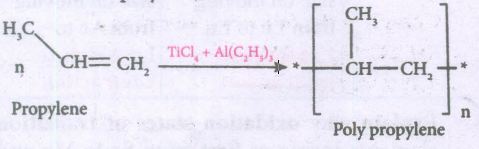
22.
Standard electrode potential is the value of the standard emf of a cell in which molecular hydrogen under standard pressure (1 atm) and temperature (273K) is oxidised to solvate protons at the electrode.
23.
(i) Transition metals have number of unpaired electron. They are involved in metallic bonding. Hence they show high melting point.
(ii) As we move from left to right along the transition metal series melting point first increases reach a maximum value and then decreases as the d-electrons pair up and become less available for bonding.
24.
Electronic configuration of Ce4+ = [Xe] 4f05d06s0
Electronic configuration of Co2+ = [Ar]3d7
25.
An interstitial compound or alloy is a compound that is formed when small atoms like hydrogen, boron, carbon or nitrogen are trapped in the interstitial holes in a metal lattice. They are usually non-stoichiometric compounds. Transition metals form a number of interstitial compounds such as TiC, ZrH1.92, Mn4N etc.
Properties of interstitial compound
(i) They are hard and show electrical and thermal conductivity.
(ii) They have high melting points higher than those of pure metals.
(iii) Transition metal hydrides are used as powerful reducing agents
(iv) Metallic carbides are chemically inert.
26.
(i) The compounds of Cu2+ are coloured as it has one free electron its valence shell which absorb I radiation of visible region and get excited to emit its complementary colour.
(ii) Zn has no free electron it has fully filled shells. Due to extra stable orbitals electron can't be excited by radiations of visible light, hence its compounds are colourless.
27.
The oxidation states of 4d metals vary from +3 for Y to +8 for Ru and Os.
The highest oxidation state of 4d elements are found in their compounds with the higher electronegative elements like O, F & Cl.
Example: In RuO4, OsO4 & WCl6
The oxidation state of Ru and Os is +8.
The oxidation state of W is +6.
Generally in going down a group, a stability of higher oxidation state increases while that of lower oxidation state decreases.
4d series (5th period) - Yttrium to Cadmium (10 elements)
| Elements | Oxidation states |
|---|---|
| Y | +3 |
| Zr | +3, +4 |
| Nb | +2, +3, +4, +5 |
| Mo | +2, +3, +4, +5, +6 |
| Tc | +2, +4, +5, +7 |
| Ru | +2, +3, +4, +5, +6, +7 +8 |
| Rh | +2, +3, +4, +6 |
| Pd | +2, +3, +4 |
| Ag | +1, +2, +3 |
| Cd | +2 |
28.
(i) It oxidises ferrous salts to ferric salts.
Cr2O72- + 6Fe2++ 14H+ ⟶ 2Cr3+ + 6Fe3+ + 7H2O
(ii) It oxidises iodide ions to iodine
Cr2O72- + 6I-+ 14H+ ⟶ 2Cr3+ + 3I2 + 7H2O
(iii) It oxidises sulphide ion to sulphur
Cr2O72- + 3S2-+ 14H+ ⟶ 2Cr3+ + 3S + 7H2O
(iv) It oxidises sulphur dioxide to sulphate ion
Cr2O72- + 3SO2+ 2H+ ⟶ 2Cr3+ + 3SO42- + H2O
(v) It oxidises stannous salts to stannic salt
Cr2O72- + 3Sn2+ + 14H+ ⟶ 2Cr3+ + 3Sn4+ + 7H2O
(vi) It oxidises alcohols to acids
2K2Cr2O7 + 8H2SO4 + 3CH3CH2OH ⟶ 2K2SO4 +2Cr2(SO4)3+ 3CH3COOH + 11H2O
(vii) It oxidises oxalic acid to CO2
2MnO4- + 5(COO)2- + 6H+ ⟶ 2Mn2++ 10CO2 + 8H2O
(viii) It oxidises iodide ions to iodine
2MnO4- + 10I- + 16H+ ⟶ 2Mn2++ 5I2+ 8H2O
(ix) It oxidises sulphide ion to sulphur
2MnO4- + 5S2-+ 16H+ ⟶ 2Mn2++ 5S + 8H2O
(x) It oxidises nitrites to nitrates
2MnO4- + 5NO2- + 6H+ ⟶ 2Mn2++ 5NO3- + 3H2O
(xi) It oxidises alcohols to aldehydes.
2KMnO4 + 3H2SO4 + 5CH3CH2OH ⟶ 2K2SO4 + 2MnSO4 + 5CH3CHO + 8H2O
(xii) It oxidises sulphite to sulphate
2MnO4- + 5SO32- + 6H+ ⟶ 2Mn2+ + 5SO42- + 3H2O
29.
(i) Only the ions that have unpaired electrons in d- orbital and in which d - d transition is possible will be coloured.
(ii) The ions in which d - orbitals are empty or completely filled will be colourless as no d -d transition is possible in those configurations.
(iii) From the above ions, it can be easily observed that only Sc3+ has an empty d - orbital and Cu+ has completely filled d-orbitals.
(vi) All other ions, except Sc3+ and Cu+, will be coloured in aqueous solution because of d - d transition.
30.
()
a) I, III and IV only

12th Standard Syllabus & Materials
12th Standard
TN 12th Computer Applications களப்பெயர் முறைமை (DNS) Sample Question Papers Study Material - QB365 Set A
NEW12th Standard
TN 12th Computer Applications வலையமைப்பு எடுத்துக்காட்டுகள் மற்றும் நெறிமுறைகள் Sample Question Papers Study Material - QB365 Set A
NEW12th Standard
TN 12th Computer Applications கணினி வலையமைப்பு ஓர் அறிமுகம் Sample Question Papers Study Material - QB365 Set A
NEW12th Standard
TN 12th Computer Applications PHP-உடன் MySQL-ஐ இணைத்தல் Sample Question Papers Study Material - QB365 Set A



Tamilnadu Stateboard 12th Standard Subjects

Maths
Chemistry

Physics

Biology

Computer Science

Business Maths and Statistics

Economics

Commerce

Accountancy

History

Computer Applications
Biology
Computer Technology
Computer Applications
Computer Science
Business Maths and Statistics
Commerce
Economics
Maths
Chemistry
Physics
Computer Technology
History
Accountancy

Tamil

English

French
Tamilnadu Stateboard Standards

