
 100% FREE ACCESS
12th Standard Syllabus & Materials
12th Standard
TN 12th Computer Applications மின்னணு தரவு பரிமாற்றம் Sample Question Papers Study Material - QB365 Set A
NEW12th Standard
TN 12th Computer Applications மின் - வணிக பாதுகாப்பு அமைப்புகள் Sample Question Papers Study Material - QB365 Set A
NEW12th Standard
TN 12th Computer Applications மின்னணு செலுத்தல் முறைகள் Sample Question Papers Study Material - QB365 Set A
NEW12th Standard
TN 12th Computer Applications மின் - வணிகம் Sample Question Papers Study Material - QB365 Set A
NEW12th Standard
TN 12th Computer Applications திறந்த மூல கருத்துருக்கள் Sample Question Papers Study Material - QB365 Set A
NEW12th Standard
TN 12th Computer Applications வலையமைப்பு வடமிடல் Sample Question Papers Study Material - QB365 Set A

Published on: 17/10/2019
Download Tamil Nadu 12th Standard Maths question papers, model tests, one-mark questions, important questions, and public exam papers in PDF format. Free study materials and answer keys for TN State Board students.
Questions + Answers key
Take MCQ Maths Test1.
Let \(\overset { \rightarrow }{ a } ,\overset { \rightarrow }{ b } ,\overset { \rightarrow }{ c } \) be unit vectors such \(\overset { \rightarrow }{ a } .\overset { \rightarrow }{ b } =\overset { \rightarrow }{ a } .\overset { \rightarrow }{ c } =0\) and the angle between \(\overset { \rightarrow }{ b } \) and \(\overset { \rightarrow }{ c } \) is \(\frac { \pi }{ 6 } \). Prove that \(\overset { \rightarrow }{ a } =\pm 2\left( \overset { \rightarrow }{ b } \times \overset { \rightarrow }{ c } \right) \)
2.
Find the acute angle between the following lines
\(\frac { x+4 }{ 3 } =\frac { y-7 }{ 4 } =\frac { z+5 }{ 5 } \), \(\vec { r } =4\hat { k } +t(2\hat { i } +\hat { j } +\hat { k } )\)
3.
Find centre and radius of the following circles.
2x2+2y2−6x+4y+2 = 0
4.
Find the principal value of \({sin }^{ -1 }\left( sin\left( \frac { 5\pi }{ 6 } \right) \right) \)
5.
Show that the lines \(\frac { x-1 }{ 4 } =\frac { 2-y }{ 6 } =\frac { z-4 }{ 12 } \) and \(\frac { x-3 }{ -2 } =\frac { y-3 }{ 3 } =\frac { 5-z }{ 6 } \) are parallel.
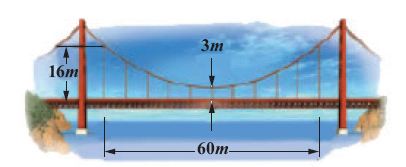
6.
Find the vertices, foci for the hyperbola 9x2−16y2 = 144.
7.
Find the value of \({ tan }^{ -1 }\left( \sqrt { 3 } \right) -{ sec }^{ -1 }(-2)\)
8.
Determine whether the points (-2, 1), (0, 0) and (-4, -3) lie outside, on or inside the circle x2+y2−5x+2y−5 = 0 .
9.
Find the period and amplitude of y = sin 7x
10.
Find the angle between the line \(\frac { x-2 }{ 3 } =\frac { y-1 }{ -1 } =\frac { z-3 }{ 2 } \) and the plane 3x + 4y + z + 5 = 0
11.
Find the value of
\(tan\left( { sin }^{ -1 }\frac { 3 }{ 5 } +{ cot }^{ -1 }\frac { 3 }{ 2 } \right) \)
12.
Find the point of intersection of the lines \(\frac { x-1 }{ 2 } =\frac { y-2 }{ 3 } =\frac { z-3 }{ 4 } \) and \(\frac { x-4 }{ 5 } =\frac { y-1 }{ 2 } =z\)
13.
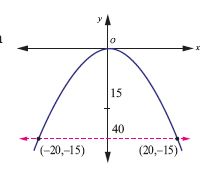
A concrete bridge is designed as a parabolic arch. The road over bridge is 40 m long and the maximum height of the arch is 15 m. Write the equation of the parabolic arch.
14.
Prove that \([\vec { a } \times \vec { b } ,\vec { b } \times \vec { c } ,\vec { c } \times \vec { a } ]\) = \([{ \vec { a } ,\vec { b } ,\vec { c } }]^{ 2 }\)
15.
Simplify: \({ tan }^{ -1 }\frac { x }{ y } -{ tan }^{ -1 }\frac { x-y }{ x+y } \)
16.
17.
Prove that the length of the latus rectum of the hyperbola \(\frac { { x }^{ 2 } }{ { a }^{ 2 } } -\frac { { y }^{ 2 } }{ { b }^{ 2 } } \) = 1 is \(\frac { { 2b }^{ 2 } }{ a } \).
18.
With usual notations, in any triangle ABC, prove by vector method that \(\frac { a }{ sinA } =\frac { b }{ sinB }=\frac { c }{ sinc }\)
19.
If y = 4x + c is a tangent to the circle x2 + y2 = 9, find c
20.
Find the equations of the tangent and normal to the circle x2 + y2 = 25 at P(-3, 4).
21.
Find the domain of the following
\(f\left( x \right) { =sin }^{ -1 }\left( \frac { { x }^{ 2 }+1 }{ 2x } \right) \)
22.
Identify the type of conic and find centre, foci, vertices, and directrices of each of the following :
9x2−y2−36x−6y+18 = 0
23.
Find the shortest distance between the following pairs of lines \(\frac { x-3 }{ 3 } =\frac { y-8 }{ -1 } =\frac { z-3 }{ 1 } \)and \(\frac { x+3 }{ -3 } =\frac { y+7 }{ 2 } =\frac { z-6 }{ 4 } \)
24.
If \({ tan }^{ -1 }\left( \frac { \sqrt { 1+{ x }^{ 2 } } -\sqrt { 1-{ x }^{ 2 } } }{ \sqrt { 1+{ x }^{ 2 } } +\sqrt { 1-{ x }^{ 2 } } } \right) =a\) than prove that x2 = sin 2a
25.
Find the non-parametric form of vector equation of the plane passing through the point (1, −2, 4) and perpendicular to the plane x + 2y −3z = 11 and parallel to the line \(\frac { x+7 }{ 3 } =\frac { y+3 }{ -1 } =\frac { z }{ 1 } \)
26.
Find the non-parametric form of vector equation, and Cartesian equations of the plane passing through the points (2, 2, 1), (9, 3, 6) and perpendicular to the plane 2x + 6y + 6z = 9
27.
Show that the straight lines x + 1= 2y = −12z and x = y + 2 = 6z − 6 are skew and hence find the shortest distance between them.
28.
If \(\vec { a } =\vec { i } -\vec { j } ,\vec { b } =\hat { i } -\hat { j } -4\hat { k } ,\vec { c } =3\hat { j } -\hat { k } \) and \(\vec { d } =2\hat { i } +5\hat { j } +\hat { k } \)
(i) \((\vec { a } \times \vec { b } )\times (\vec { c } \times \vec { d } )=[\vec { a } ,\vec { b } ,\vec { d } ]\vec { c } -[\vec { a } ,\vec { b } ,\vec { c } ]\vec { d } \)
29.
Parabolic cable of a 60m portion of the roadbed of a suspension bridge are positioned as shown below. Vertical Cables are to be spaced every 6m along this portion of the roadbed. Calculate the lengths of first two of these vertical cables from the vertex.
30.
Prove that the point of intersection of the tangents at ‘t1’ and ‘t2’ on the parabola y2 = 4ax is \(\left[ at_{ 1 }t_{ 2 },a({ t }_{ 1 }+{ t }_{ 2 }) \right] .\)
31.
Show that the line x−y+4 = 0 is a tangent to the ellipse x2+3y2 = 12 . Also find the coordinates of the point of contact.
32.
Solve \(cos\left( sin^{ -1 }\left( \frac { x }{ \sqrt { 1+{ x }^{ 2 } } } \right) \right) =sin\left\{ cot^{ -1 }\left( \frac { 3 }{ 4 } \right) \right\} \)
33.
Solve \(tan^{ -1 }\left( \frac { x-1 }{ x-2 } \right) +tan^{ -1 }\left( \frac { x+1 }{ x+2 } \right) =\frac { \pi }{ 4 } \)
34.
Find the equation of the circle through the points (1, 0),(-1, 0) , and (0, 1)
35.
36.
The value of \({ \left| \overset { \rightarrow }{ a } +\overset { \rightarrow }{ b } \right| }^{ 2 }+{ \left| \overset { \rightarrow }{ a } -\overset { \rightarrow }{ b } \right| }^{ 2 }\) is _____________
\(2\left( { \left| \overset { \rightarrow }{ a } \right| }^{ 2 }+{ \left| \overset { \rightarrow }{ b } \right| }^{ 2 } \right) \)
4 \(\overset { \rightarrow }{ a } .\overset { \rightarrow }{ b } \)
\(2\left( { \left| \overset { \rightarrow }{ a } \right| }^{ 2 }-{ \left| \overset { \rightarrow }{ b } \right| }^{ 2 } \right) \)
4 \({ \left| \overset { \rightarrow }{ a } \right| }^{ 2 }{ \left| \overset { \rightarrow }{ b } \right| }^{ 2 }\)
37.
If a parabolic reflector is 20 cm in diameter and 5 cm in diameter and 5 cm deep, then its focus is ____________
(0, 5)
(5, 0)
(10, 0)
(0, 10)
38.
If the distance of the point (1, 1, 1) from the origin is half of its distance from the plane x + y + z + k = 0, then the values of k are
\(\pm 3\)
\(\pm 6\)
-3, 9
3, -9
39.
If the direction cosines of a line are \(\frac { 1 }{ c } ,\frac { 1 }{ c } ,\frac { 1 }{ c } \), then
\(c=\pm 3\)
\(c=\pm \sqrt { 3 } \)
c > 0
0 < c < 1
40.
41.
If \(\vec { a } \times (\vec { b } \times \vec { c } )=(\vec { a } \times \vec { b } )\times \vec { c } \) where \(\vec { a } ,\vec { b } ,\vec { c } \) are any three vectors such that \(\vec{b} \cdot \vec{c} \neq 0 \text { and } \vec{a} \cdot \vec{b} \neq 0\), then \(\vec { a } \) and \(\vec { c } \) are
perpendicular
parallel
inclined at an angle \(\frac{\pi}{3}\)
inclined at an angle \(\frac{\pi}{6}\)
42.
If \(\vec { a } ,\vec { b } ,\vec { c } \) are three non-coplanar vectors such that \(\vec { a } \times (\vec { b } \times \vec { c } )=\frac { \vec { b } +\vec { c } }{ \sqrt { 2 } } \), then the angle between \(\vec { a } \ and \ \vec { b } \) is
\(\frac { \pi }{ 2 } \)
\(\frac { 3\pi }{ 4 } \)
\(\frac { \pi }{ 4 } \)
\( { \pi }\)
43.
If \(\vec { a } .\vec { b } =\vec { b } .\vec { c } =\vec { c } .\vec { a } =0\) , then the value of \([\vec { a } ,\vec { b } ,\vec { c } ]\) is
\(\left| \vec { a } \right| \left| \vec { b } \right| \left| \vec { c } \right| \)
\(\frac{1}{3}\)\(\left| \vec { a } \right| \left| \vec { b } \right| \left| \vec { c } \right| \)
1
-1
44.
The locus of a point whose distance from (-2,0) is \(\frac { 2 }{ 3 } \) times its distance from the line x = \(\frac { -9 }{ 2 } \) is
a parabola
a hyperbola
an ellipse
a circle
45.
46.
Area of the greatest rectangle inscribed in the ellipse \(\frac{x^{2}}{a^{2}}+\frac{y^{2}}{b^{2}}=1\) is
2ab
ab
\( \sqrt{ ab}\)
\(\frac { a }{ b } \)
47.
Tangents are drawn to the hyperbola \(\frac { { x }^{ 2 } }{ 9 } -\frac { { y }^{ 2 } }{ 4 } =1\) parallel to the straight line 2x − y = 1. One of the points of contact of tangents on the hyperbola is
\(\left(\frac{9}{2 \sqrt{2}}, \frac{-1}{\sqrt{2}}\right)\)
\(\left(\frac{-9}{2 \sqrt{2}}, \frac{1}{\sqrt{2}}\right)\)
\(\left(\frac{9}{2 \sqrt{2}}, \frac{1}{\sqrt{2}}\right)\)
\((3 \sqrt{3},-2 \sqrt{2})\)
48.
The centre of the circle inscribed in a square formed by the lines x2 − 8x − 12 = 0 and y2 − 14y + 45 = 0 is
(4, 7)
(7, 4)
(9, 4)
(4, 9)
49.
The eccentricity of the hyperbola whose latus rectum is 8 and conjugate axis is equal to half the distance between the foci is
\(\frac { 4 }{ 3 } \)
\(\frac { 4 }{ \sqrt { 3 } } \)
\(\frac { 2 }{ \sqrt { 3 } } \)
\(\frac { 3 }{ 2 } \)
50.
The equation \(\tan ^{-1} x-\cot ^{-1} x=\tan ^{-1}\left(\frac{1}{\sqrt{3}}\right)\)has
no solution
unique solution
two solutions
infinite number of solutions
51.
\(\sin ^{-1}\left(\tan \frac{\pi}{4}\right)-\sin ^{-1}\left(\sqrt{\frac{3}{x}}\right)=\frac{\pi}{6}\). Then x is a root of the equation
x2−x−6 = 0
x2−x−12 = 0
x2+x−12 = 0
x2+x−6 = 0
52.
53.
\(\sin ^{-1} \frac{3}{5}-\cos ^{-1} \frac{12}{13}+\sec ^{-1} \frac{5}{3}-\operatorname{cosec}^{-1} \frac{13}{12}\) is equal to
2\(\pi\)
\(\pi\)
0
tan-1\(\frac{12}{65}\)
54.
If \(\sin ^{-1} x+\sin ^{-1} y=\frac{2 \pi}{3}\); then cos-1 x + cos-1 y is equal to
\(\frac{2\pi}{3}\)
\(\frac{\pi}{3}\)
\(\frac{\pi}{6}\)
\(\pi\)
1.
Given \(\overset { \rightarrow }{ a } .\overset { \rightarrow }{ b } =\overset { \rightarrow }{ a } .\overset { \rightarrow }{ c } =0\)] ⇒ \(\overset { \rightarrow }{ a } \) 丄 \(\overset { \rightarrow }{ b } \)and \(\overset { \rightarrow }{ a } \)丄 \(\overset { \rightarrow }{ c } \)
⇒ \(\overset { \rightarrow }{ a } \) 丄r to the plane containing \(\overset { \rightarrow }{ b } \)and \(\overset { \rightarrow }{ c } \)
Also, \(\overset { \rightarrow }{ b } \times \overset { \rightarrow }{ c } =\left| \overset { \rightarrow }{ b } \right| \left| \overset { \rightarrow }{ c } \right| \) Since \(\overset { \wedge }{ n } \) [where θ is the angle between \(\overset { \rightarrow }{ b } \)and \(\overset { \rightarrow }{ c } \)]
= 1 \(\times\) 1. sin \(\frac { \pi }{ 6 } \).\(\overset { \rightarrow }{ a } \)
[Since \(\overset { \rightarrow }{ b } \) and \(\overset { \rightarrow }{ c } \) are unit vectors \(\overset { \rightarrow }{ a } \) 丄 both \(\overset { \rightarrow }{ b } \)and \(\overset { \rightarrow }{ c } \) \(\overset { \rightarrow }{ { n } } \) = \(\overset { \rightarrow }{ a } \)]
\(=\frac { 1 }{ 2 } \overset { \rightarrow }{ a } \)
\( \overset { \rightarrow }{ b } \times \overset { \rightarrow }{ c } =\frac { 1 }{ 2 } \overset { \rightarrow }{ a } \)
\(\Rightarrow \overset { \rightarrow }{ a } =\pm 2\left( \overset { \rightarrow }{ b } \times \overset { \rightarrow }{ c } \right) \)
2.
Given lines are \(\frac { x+4 }{ 3 } =\frac { y-7 }{ 4 } =\frac { z+5 }{ 5 } \)
⇒ \(\vec { b } =3\hat { i } +4\hat { j } +5\hat { k } \)
and \(\vec { r } =4\hat { k } +t(2\hat { i } +\hat { j } +\hat { k } )\)
⇒ \(\vec { d } =2\hat { i } +\hat { j } +\hat { k } \)
\(
|\vec{b}| =\sqrt{9+16+25}=\sqrt{50} \\
=5 \sqrt{2}
\)
∴ cos θ =\(\frac { \vec { b } .\vec { d } }{ |\vec { b } ||\vec { d } | } \)=\(\frac { (3\hat { i } +4\hat { j } +5\hat { k } ).(2\hat { i } +\hat { j } +\hat { k } ) }{ \sqrt { { 3 }^{ 2 }+{ 4 }^{ 2 }+{ 5 }^{ 2 } } .\sqrt { { 2 }^{ 2 }+{ 1 }^{ 2 }+{ 1 }^{ 2 } } } \)
\(
= \frac{15}{5 \sqrt{2} \times \sqrt{6}}=\frac{3}{\sqrt{2} \cdot \sqrt{2} \sqrt{3}}=\frac{3}{2 \sqrt{3}}=\frac{\sqrt{3}}{2} \\
\theta=\frac{\pi}{6}
\)
3.
Equation of the circle is
2x2 + 2y2 - 6x + 4y + 2 = 0
Dividing by 2, we get
x2 + y2 - 3x + 2y + 1 = 0
Here 2g = -3 ⇒ g = \(\frac { -3 }{ 2 } \)
2f = 2 ⇒ f = 1
and c = 1
∴ Centre is (-g, -f) = \(\left( \frac { 3 }{ 2 } ,-1 \right) \)
and r = \(\sqrt { { g }^{ 2 }+{ f }^{ 2 }-c } \) = \(\sqrt { { \left( \frac { 3 }{ 2 } \right) }^{ 2 }+{ 1 }^{ 2 }-1 } \)
= \(\sqrt { \frac { 9 }{ 4 } } =\frac { 3 }{ 2 } \) units.
4.
We know that sin-1: [-1, 1] \(\rightarrow \left[ -\frac { \pi }{ 2 } ,\frac { \pi }{ 2 } \right] \)is given by
sin−1x = y if and only if x = sin y for −1\(\le x\le \) and -\(\frac { \pi }{ 2 } \le y \le \frac { \pi }{ 2 } \). Thus
\({ sin }^{ -1 }\left( sin\left( \frac { 5\pi }{ 6 } \right) \right) \)= \({ sin }^{ -1 }\left( sin\left( \frac { \pi }{ 6 } \right) \right) \) = \({ sin }^{ -1 }\left( sin\frac { \pi }{ 6 } \right) \), since \(\frac{\pi}{6}\)\(\in \left[ -\frac { \pi }{ 2 } ,\frac { \pi }{ 2 } \right] \)
5.
We observe that the straight line \(\frac { x-1 }{ 4 } =\frac { 2-y }{ 6 } =\frac { z-4 }{ 12 } \) is parallel to the vector \(4\hat { i } -6\hat { j } +12\hat { k } \) and the straight line \(\frac { x-3 }{ -2 } =\frac { y-3 }{ 3 } =\frac { 5-z }{ 6 } \) is parallel to the vector \(2\hat { i } +3\hat { j } -6\hat { k } \)
Since \(4\hat { i } -6\hat { j } +12\hat { k } =-2(-2\hat { i } +3\hat { j } -6\hat { k } )\), two vectors are parallel, and hence the two straight lines are parallel.
6.
Reducing 9x2-16y2 = 144 to the standard form,
we have, \(\frac { { x }^{ 2 } }{ 16 }- \frac { { y }^{ 2 } }{ 9 } =1\)
With the transverse axis is along x-axis vertices are (−4, 0) and (4, 0); and c2 = a2+b2 = 16 + 9 = 25, c = 5
Hence the foci are (−5, 0) and (5, 0)
7.
\({ tan }^{ -1 }\left( \sqrt { 3 } \right) -{ sec }^{ -1 }(-2)\)
Let \({ tan }^{ 1 }\left( \sqrt { 3 } \right) =x\Rightarrow \sqrt { 3 } =tanx\)
\(\Rightarrow tanx=tan\frac { \pi }{ 3 } \)
\(\Rightarrow x=\frac { \pi }{ 3 } \)
Let sec-1(-2) = y
\(\Rightarrow -2=sec\ y\Rightarrow cos\ y=\frac { -1 }{ 2 } \Rightarrow cos\ y=-cos\left( \frac { \pi }{ 3 } \right) \)
\(\Rightarrow cos\ y=cos\left( \pi -\frac { \pi }{ 3 } \right) \)
\(\Rightarrow cos\ y=cos\left( \frac { 2\pi }{ 3 } \right) \Rightarrow y=3\frac { 2\pi }{ 3 } \)
\(\therefore { tan }^{ -1 }\left( \sqrt { 3 } \right) -{ sec }^{ -1 }\left( -2 \right) \)
= \(\frac { \pi }{ 3 } -\frac { 2\pi }{ 3 } \)
= \(\frac { \pi -2\pi }{ 3 } =-\frac { \pi }{ 3 } \)
\(\therefore\) \({ tan }^{ -1 }\left( \sqrt { 3 } \right) -{ sec }^{ -1 }(-2)\)= \(-\frac { \pi }{ 3 } \)
8.
Given equation of the circle is
x2 + y2 - 5x + 2y - 5 = 0
(i) At (-2, 1), (1) becomes
(-2)2 + 12- 5(-2) + 2(1) - 5
= 4 + 1 + 10 + 2 - 5
= 17 - 5 = 12 > 0
∴ (-2, 1) lies outside the circle.
(ii) At (0, 0), (1) becomes -5 < 0
∴ (0, 0) lies inside the circle.
(iii) At (-4, -3), (1) becomes
(-4)2 + (-3)2 - 5(-4) + 2(-3) - 5
= 16 + 9 + 20 - 6 - 5
= 45 - 11 = 34 > 0
∴ (-4, -3) lies outside the circle.
9.
The amplitude of sin x is 1 [Max of sin x curve is 1]
\(\Rightarrow \) amplitude of sin 7x is also 1
If p is the period of the function,
then f(x+p) = f(x)
Since the period of sine function is \(2\pi \)
The period of sin is \(\frac { 2\pi }{ 7 } \)
amplitude = 1
10.
The given line is parallel to the vector \(\overset { \rightarrow }{ b } =3\overset { \wedge }{ i } -\overset { \wedge }{ j } +2\overset { \wedge }{ k } \) and the given plane is normal to the vector \(\overset { \rightarrow }{ n } =3\overset { \wedge }{ i } +4\overset { \wedge }{ j } +\overset { \wedge }{ k } \)
Let θ be the angle between the line and the plane, then
\(\sin { \theta } =\frac { \overset { \rightarrow }{ b } .\overset { \rightarrow }{ n } }{ \left| \overset { \rightarrow }{ b } \right| \left| \overset { \rightarrow }{ n } \right| } =\frac { 9-4+2 }{ \sqrt { 9+1+4 } .\sqrt { 9+16+1 } } \)
\(=\frac { 7 }{ \sqrt { 14 } .\sqrt { 26 } } =\frac { 7 }{ \sqrt { 2 } \times \sqrt { 7 } \times \sqrt { 26 } } =\frac { \sqrt { 7 } }{ \sqrt { 52 } } \)
\(\therefore \theta ={ sin }^{ -1 }\left( \frac { \sqrt { 7 } }{ \sqrt { 52 } } \right) \)
11.
\(tan\left( { sin }^{ -1 }\frac { 3 }{ 5 } +{ cot }^{ -1 }\frac { 3 }{ 2 } \right) \)
Let \(sin^{ -1 }\left( \frac { 3 }{ 5 } \right) =x\)
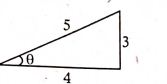
\(\Rightarrow \frac { 3 }{ 5 } =sinx\)
\(\therefore tanx=\frac { opp }{ adj } =\frac { 3 }{ 4 } \)
\({ cot }^{ -1 }\left( \frac { 3 }{ 2 } \right) =y\)
\(\Rightarrow \frac { 3 }{ 2 } =coty\Rightarrow tany=\frac { 2 }{ 3 } \)
\(\therefore tan\left( { sin }^{ -1 }\frac { 3 }{ 5 } +{ cot }^{ -1 }\frac { 3 }{ 2 } \right) =tan(x+y)\)
\(\frac { tanx+tany }{ 1-tanxtany } \)
\(\frac { \frac { 3 }{ 2 } +\frac { 2 }{ 3 } }{ 1-\left( \frac { 3 }{ 4 } \right) \left( \frac { 2 }{ 3 } \right) } =\frac { \frac { 9+6 }{ 12 } }{ 1-\frac { 6 }{ 12 } } \)
\(\frac { \frac { 3 }{ 2 } +\frac { 2 }{ 3 } }{ 1-\left( \frac { 3 }{ 4 } \right) \left( \frac { 2 }{ 3 } \right) } =\frac { \frac { 9+6 }{ 12 } }{ 1-\frac { 6 }{ 12 } } \)
\(\therefore tan\left( { sin }^{ -1 }\frac { 3 }{ 5 } +{ cot }^{ -1 }\frac { 3 }{ 2 } \right) =\frac { 17 }{ 6 } \)
12.
Every point on the line \(\frac { x-1 }{ 2 } =\frac { y-2 }{ 3 } =\frac { z-3 }{ 4 } \) = s (say) is of the form (2s + 1, 3s + 2, 4s + 3) and every point on the line \(\frac { x-4 }{ 5 } =\frac { y-1 }{ 2 } =z=t\) (say) is of the form (5t + 4, 2t + 1, t).
So, at the point of intersection, for some values of s and t, we have
(2s + 1, 3s + 2, 4s + 3) = (5t + 4, 2t + 1, t)
Therefore, 2s - 5t = 3, 3s - 2t = -1 and 4s - t = -3. Solving the first two equations we get t = -1, s = -1.
These values of s and t satisfy the third equation. Therefore, the given lines intersect.
Substituting, these values of t or s in the respective points, the point of intersection is (-1,- 1, -1)
13.
From the graph the vertex is at (0, 0) and the parabola is open down
Equation of the parabola is x2 = -4ay
(-20, -15) and (20, -15) lie on the parabola
202 = -4a(-15)
\(4a=\frac { 400 }{ 15 } \)
x2 =\(\frac { -80 }{ 3 } \) x y
Therefore equation is 3x2 = -80y
14.
Using the definition of the scalar triple product, we get
\([\vec { a } \times \vec { b } ,\vec { b } \times \vec { c } ,\vec { c } \times \vec { a } ]\) = \((\vec { a } \times \vec { b } ).[(\vec { b } \times \vec { c } )\times (\vec { c } \times \vec { a } )]\) ....(1)
By treating \((\vec { b } \times \vec { c } )\) as the first vector in the vector triple product, we find
\((\vec { b } \times \vec { c } )\times (\vec { c } \times \vec { a } )\) = \(((\vec { b } \times \vec { c } ).\vec { a } )\vec { c } \) - \(((\vec { b } \times \vec { c } ).\vec { c } )\vec { a } )\) = \([{ \vec { a } ,\vec { b } ,\vec { c } }]\vec { c } \)
Using this value in (1), we get
\([\vec { a } \times \vec { b } ,\vec { b } \times \vec { c } ,\vec { c } \times \vec { a } ]\) = \((\vec { a } \times \vec { b } ).([\vec { a } ,\vec { b } ,\vec { c } ]\vec { c } )=[\vec { a } ,\vec { b } ,\vec { c } ](\vec { a } \times \vec { b } ).\vec { c } ={ [\vec { a } ,\vec { b } ,\vec { c } ] }^{ 2 }\)
15.
\({ tan }^{ -1 }\left( \frac { x }{ y } \right) -{ { tan }^{ -1 }\left( \frac { x-y }{ x+y } \right) }\)
= \(tan^{ -1 }\left( \frac { \frac { x }{ y } -\frac { x-y }{ x+y } }{ 1+\frac { x }{ y } \left( \frac { x-y }{ x+y } \right) } \right)\)
\(\left[ \because { tan }^{ -1 }x-{ tan }^{ -1 }y={ tan }^{ -1 }\left( \frac { x-y }{ 1+xy } \right) \right]\)
= \({ tan }^{ -1 }\left( \frac { \frac { x(x+y)-y(x-y) }{ y(x+y) } }{ \frac { y(x+y)+x(x-y) }{ y(x+y) } } \right)\)
\(\begin{aligned}
& =\tan ^{-1}\left(\frac{\frac{x^2+y y-y y+y^2}{y(x+y)}}{\frac{y y+y^2+x^2-y y}{y(x+y)}}\right) \\
& =\tan ^{-1}\left(\frac{x^2+y^2}{y(x+y)} \times \frac{y(x+y)}{x^2+y^2}\right)
\end{aligned}\)
= tan-1(1)
= \(\frac { \pi }{ 4 }\)
16.
17.
The latus rectum LL' of the hyperbola passes through S(ae, 0)
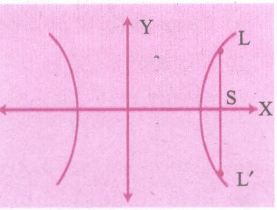
∴ L is (ae, y1)
Substituting L in \(\frac { { x }^{ 2 } }{ { a }^{ 2 } } -\frac { { y }^{ 2 } }{ { b }^{ 2 } } \) = 1 we get,
Substituting L in \(\frac { { x }^{ 2 } }{ { a }^{ 2 } } -\frac { { y }^{ 2 } }{ { b }^{ 2 } } =1\)
\(\frac { { a }^{ 2 }{ e }^{ 2 } }{ { a }^{ 2 } } -\frac { { { y }_{ 1 } }^{ 2 } }{ { b }^{ 2 } } =1\Rightarrow { e }^{ 2 }-\frac { { { y }_{ 1 } }^{ 2 } }{ { b }^{ 2 } } =1\)
\(\Rightarrow { e }^{ 2 }-1=\frac { { { y }_{ 1 } }^{ 2 } }{ { b }^{ 2 } } \) \([{ b }^{ 2 }={ a }^{ 2 }({ e }^{ 2 }-1)\)
\(\Rightarrow { { y }_{ 1 } }^{ 2 }={ b }^{ 2 }({ e }^{ 2 }-1)\) \(\Rightarrow \frac { { b }^{ 2 } }{ { a }^{ 2 } } ={ e }^{ 2 }-1]\)
\(\Rightarrow { { y }_{ 1 } }^{ 2 }={ b }^{ 2 }\left( \frac { { b }^{ 2 } }{ { a }^{ 2 } } \right) \) \(\Rightarrow { { y }_{ 1 } }^{ 2 }=\frac { { b }^{ 4 } }{ { a }^{ 2 } } \)
\(\Rightarrow { y }_{ 1 }=\pm \frac { { b }^{ 2 } }{ a } \)
∴ End points oflatus rectum Land L' are
\(\left( ae,\frac { { b }^{ 2 } }{ a } \right) \) and \(\left( ae,-\frac { { b }^{ 2 } }{ a } \right) \)
Hence, the length of latus rectum LL' = \(\frac { { b }^{ 2 } }{ a } +\frac { { b }^{ 2 } }{ a } =\frac { 2{ b }^{ 2 } }{ a } \) units.
Hence proved.
18.
With usual notations in triangle, ABC let \(\vec { BC } =\vec { a } \), \(\vec { CA } =\vec { b } \) and \(\vec { AB } =\vec { c} \). Then \(|\vec { BC }| =\vec { a } \), \(|\vec { CA } |=\vec { b } \) and \(|\vec { AB }| =\vec { c } \)
Since in ΔABC, \(\vec { BC }+\vec { CA }+\vec { AB}=0\) we have \(\vec { BC }\times(\vec { BC }+\vec { CA }+\vec { AB })=\vec { 0 }\)
Simplifying, we get,
\(\vec { BC }\times\vec { CA }=\vec { AB }\times\vec { BC }\) ....(1)
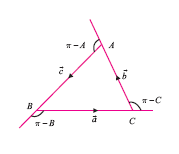
Similarly, since \(\vec { BC }+\vec { CA }+\vec { AB}=\vec 0\), we have
\(\vec {CA} \times (\vec { BC }+\vec { CA }+\vec { AB})=\vec 0\) .... (2)
On Simplification, we obtain \(\vec { BC }\times\vec { CA }=\vec {CA }\times\vec {AB }\)
From equations (1) and (2), we get
\(\vec { AB }\times\vec {BC }\) = \(\vec { CA }\times\vec {AB }\)=\(\vec { BC}\times\vec {CA}\)
So, \(\left| \overrightarrow { AB} \times \overrightarrow { BC } \right| =\left| \overrightarrow { CA } \times \overrightarrow { AB } \right| =\left| \overrightarrow { BC } \times \overrightarrow { CA } \right| \). Then, we get
ca sin(π − B) = bc sin(π - A) = ab sin (π - C)
That is, ca sin B = bc sin A = absinC . Dividing by abc, we get
\(\frac { sinA }{ A } =\frac { sinB }{ b } =\frac { sinC }{ c } \) or \(\frac { a }{ sinA }= \frac { b }{ sinB } =\frac { c }{ sinC } \)
19.
The condition for the line y = mx + c to be a tangent to the circle x2 + y2 = a2 is c2 = a2(1 + m2) from
Then \(c=\pm \sqrt { 9\left( 1+16 \right) } \)
\(c=\pm 3\sqrt { 17 } \)
20.
Equation of tangent to the circle at P(x1, y1 ) is xx1 yy1 = a2
That is, x(−3) + y(4) = 25
−3x + 4y = 25
Equation of normal is xy1 - yx1 = 0
That is, 4x + 3y = 0
21.
Given \(f(x)=sin^{ -1 }\left( \frac { x^{ 2 }+1 }{ 2x } \right) \le 1\)
We know that the domain of sin-1(x) is [-1, 1]
\(\Rightarrow -1\le \frac { { x }^{ 2 }+1 }{ 2x } \le 1\)
Consider \(\Rightarrow -1\le \frac { { x }^{ 2 }+1 }{ 2x } \)
\(\Rightarrow 0\le \frac { { x }^{ 2 }+1 }{ 2x } +1\)
\(\Rightarrow \frac { { x }^{ 2 }+1+2x }{ 2x } \ge 0\)
\(\Rightarrow \frac { \left( x+1 \right) ^{ 2 } }{ 2x } \ge 0\)
\(\Rightarrow \) x = -1 and x < 0
Consider \(\cfrac { { x }^{ 2 }+1 }{ 2x } \le 1\)
\(\Rightarrow \frac { { x }^{ 2 }+1 }{ 2x } -1\le 0\)
\(\Rightarrow \frac { { x }^{ 2 }-2x+1 }{ 2x } \le 0\)
\(\Rightarrow \frac { \left( x-1 \right) ^{ 2 } }{ 2x } \le 0\)
From (1) and (2) Domain {-1, 1}
22.
9x2- y2- 36x - 6y + 18 = 0
Given equation is 9x2- y2- 36x - 6y + 18 = 0
⇒ 9x2 - 36x - (y2 + 6y) = -18
⇒ 9(x2-4x)-(y2+6y) =-18
⇒ 9(x2 - 4x + 4 - 4) - (y2 + 6y + 9 - 9) = -18
⇒ 9(x-2)2-36-(y+3)2+9 =-18
⇒ 9(x-2)2 - (y+3)2 = -18+36-9
⇒ 9(x - 2)2 - (y + 3)2 = 9
Dividing by 9 we get, \(\frac { { (x-2) }^{ 2 } }{ 1 } -\frac { ({ y+3) }^{ 2 } }{ 9 } =1\)
This is an equation of the hyperbola whose transverse axis is parallel to x-axis.
a2 = 1, b2 = 9
∴ c2 = a2 + b2 = 1 + 9 = 10 ⇒ c = \(\sqrt { 10 } \)
\(e=\sqrt {1-\frac { { b }^{ 2 } }{ { a }^{ 2 } }} =\sqrt { 1-\frac { 9 }{ 1 } } =\sqrt { 10 } \)
a) Center is (2, -3)
⇒ h = 2, k = -3
(b) Foci are (h + c, k), (17 - c, k)
⇒ (2 +\(\sqrt { 10 } \), -3), (2 - \(\sqrt { 10 } \), -3)
(c) Vertic ar (h + a, k) (h - a, k)
⇒ (2+ 1,-3), (2-1,-3)
⇒ (3, -3) (1, -3)
(d) Equation of directrices are x - 2 = \(\pm \frac { a }{ e } \)
⇒ \(x-2=\pm \frac { 1 }{ \sqrt { 10 } } \)
\(x=2\pm \frac { 1 }{ \sqrt { 10 } } \)
⇒ \(x=2+\frac { 1 }{ \sqrt { 10 } } \) and \(x=2-\frac { 1 }{ \sqrt { 10 } } \)
23.
From the line \(\frac { x-3 }{ 3 } =\frac { y-8 }{ -1 } =\frac { z-3 }{ 1 } \), we get
\(\overset { \rightarrow }{ a } =3\overset { \wedge }{ i } +8\overset { \wedge }{ j } +3\overset { \wedge }{ k } \), \(\overset { \rightarrow }{ b } =3\overset { \wedge }{ i } -\overset { \wedge }{ j } +\overset { \wedge }{ k } \)
From the line \(\frac { x+3 }{ -3 } =\frac { y+7 }{ 2 } =\frac { z-6 }{ 4 } \) we get
\(\overset { \rightarrow }{ c } =-3\overset { \wedge }{ i } -7\overset { \wedge }{ j } +6\overset { \wedge }{ k } \) and \(\overset { \rightarrow }{ d } =-3\overset { \wedge }{ i } +2\overset { \wedge }{ j } +4\overset { \wedge }{ k } \)
Since the given lines are not parallel, the shortest distance between the line is
\(d=\left| \frac { \left( \overset { \rightarrow }{ c } -\overset { \rightarrow }{ a } \right) .\left( \overset { \rightarrow }{ b } \times \overset { \rightarrow }{ d } \right) }{ \left| \overset { \rightarrow }{ b } \times \overset { \rightarrow }{ d } \right| } \right| \)
\(\overset { \rightarrow }{ c } -\overset { \rightarrow }{ a } =-6\overset { \wedge }{ i } -15\overset { \wedge }{ j } +3\overset { \wedge }{ k } \)
\(\overset { \rightarrow }{ b } \times \overset { \rightarrow }{ d } =\left| \begin{matrix} \overset { \wedge }{ i } \\ 3 \\ -3 \end{matrix}\begin{matrix} \overset { \wedge }{ j } \\ -1 \\ 2 \end{matrix}\begin{matrix} \overset { \wedge }{ k } \\ 1 \\ 4 \end{matrix} \right| \)
\(=\overset { \wedge }{ i } (-4-2)-\overset { \wedge }{ j } (12+3)+\overset { \wedge }{ k } (6-3)\\ \)
\(=-6\overset { \wedge }{ i } -15\overset { \wedge }{ j } +3\overset { \wedge }{ k } \)
\(\therefore \left| \overset { \rightarrow }{ b } \times \overset { \rightarrow }{ d } \right| =\sqrt { 36+225+9 } \)
\(=\sqrt { 270 } \)
\(\therefore \left( \overset { \rightarrow }{ c } -\overset { \rightarrow }{ a } \right) .\left( \overset { \rightarrow }{ b } \times \overset { \rightarrow }{ d } \right) =\left( -6\overset { \wedge }{ i } -15\overset { \wedge }{ j } +3\overset { \wedge }{ k } \right) .\left( -6\overset { \wedge }{ i } -15\overset { \wedge }{ j } +3\overset { \wedge }{ k } \right) \)
= -6 (-6) + 15 _(15) + 3(3)
= 270 ≠ 0
Since the given lines are neither intersecting, nor parallel they are skew lines
\(\therefore d=\frac { 270 }{ \sqrt { 270 } } =\sqrt { 270 } units\)
24.
Given \({ tan }^{ -1 }\left( \frac { \sqrt { 1+{ x }^{ 2 } } -\sqrt { 1-{ x }^{ 2 } } }{ \sqrt { 1+{ x }^{ 2 } } +\sqrt { 1-{ x }^{ 2 } } } \right) =a\)
\(\Rightarrow \frac { \left( \sqrt { 1+{ x }^{ 2 } } -\sqrt { 1-{ x }^{ 2 } } \right) \left( \sqrt { 1+{ x }^{ 2 } } +\sqrt { 1-{ x }^{ 2 } } \right) }{ \left( \sqrt { 1+{ x }^{ 3 } } -\sqrt { 1-{ x }^{ 2 } } \right) \left( \sqrt { 1+{ x }^{ 2 } } +\sqrt { 1-{ x }^{ 2 } } \right) } \)
= \(\frac { tan\alpha +1 }{ tan\alpha -1 } \)
\(\Rightarrow \frac { 2\sqrt { 1+{ x }^{ 2 } } }{ -2\sqrt { 1-{ x }^{ 2 } } } =\frac { tan\alpha +1 }{ tan\alpha -1 } \)
\(\Rightarrow \sqrt { \frac { 1-{ x }^{ 2 } }{ 1+{ x }^{ 2 } } } =\frac { 1-tan\alpha }{ 1+tan\alpha } \)
\(\Rightarrow \sqrt { \frac { 1-{ x }^{ 2 } }{ 1+{ x }^{ 2 } } } =\frac { cos\alpha -sin\alpha }{ cos\alpha +sin\alpha } \)
\(\Rightarrow \frac { 1-{ x }^{ 2 } }{ 1+{ x }^{ 2 } } \left( \frac { cos\alpha -sin\alpha }{ cos\alpha +sin\alpha } \right) ^{ 2 }\)
\(\Rightarrow \frac { 1-{ x }^{ 2 } }{ 1+{ x }^{ 2 } } =\frac { 1-sin2\alpha }{ 1+sin2\alpha } \Rightarrow { x }^{ 2 }=sin2\alpha \)
25.
Equation of the plane passing through the point
\(=\vec { a } =\hat { i } -2\hat { j } +4 \) .......(1)
Equation of the given plane is x + 2y - 3z = 11
\(\Rightarrow \vec { r } .(\hat { i } +2\hat { j } -3\hat { k } )=11\)
The given plane is perpendicular to the vector \(\hat { i } +2\hat { j } -3\hat { k } \)
∴ The required plane is parallel to the vector
\(\vec { b } =\hat { i } +2\hat { j } -3\hat { k } \).......(2)
The given plane is parallel to the line
\(\frac { x+7 }{ 3 } =\frac { y+3 }{ -1 } =\frac { z }{ 1 } \) Whose direction ratios are 3,-1,1
The required plane is parallel to the vector
\(\vec { c } =3\hat { i } -\hat { j } +\hat { k } \) (3)
∴ The non-parametric vector equation of the plane passing through a point (\(\vec { a } \)) and parallel to two vectors \(\vec { b } \) and \(\vec { c } \) is
\((\vec { r } -\vec { a } ).(\vec { b } \times \vec { c } )=0\)
\(\vec { b } \times \vec { c } =\left| \begin{matrix} \hat { i } & \hat { j } & \hat { k } \\ 1 & 2 & -3 \\ 3 & -1 & 1 \end{matrix} \right| \)
\(=\hat { i } (2-3)-\hat { j } (1+9)+\hat { k } (-1-6)\)
\(=-\hat { i } -10\hat { j } -7\hat { k } \)
\(\therefore (\vec { r } -(\hat { i } -2\hat { j } +4\hat { k } )).(-\hat { i } -10\hat { j } -7\hat { k } )=0\)
\([\vec { r } -(-\hat { i } -10\hat { j } -7\hat { k } )]-[(\hat { i } -2\hat { j } +4\hat { k } ).(-\hat { i } -10\hat { j } -7\hat { k } )]=0\)
\(\Rightarrow \vec { r } .(-\hat { i } -10\hat { j } -7\hat { k } )-[-1+20-28]=0\)
\(\Rightarrow \vec { r } .(-\hat { i } -10\hat { j } -7\hat { k } )\times 9=0\)
\(\Rightarrow \vec { r } .(\hat { i } +10\hat { j } +7\hat { k } )-9=0\)
\(\Rightarrow \vec { r } .(\hat { i } +10\hat { j } +7\hat { k } )=9\)
Let \(\Rightarrow \vec { r } =x\hat { i } +y\hat { j } +z\hat { k } \)
\(\therefore (x\hat { i } +y\hat { j } +z\hat { k } ).(\hat { i } +10\hat { j } +7\hat { k } )=9\)
⇒ x+10y+7z = 9 which is the required Cartesian equation of the plane.
26.
Given plane is passing through the points
\(\vec { a } =2\hat { i } +2\hat { j } +2\hat { k }, \vec { b } =9\hat { i } +3\hat { j } +6\hat { k } \)
Equation of the given plane is 2x + 6y + 6z = 9. It can be written as \(\vec { r } .(2\hat { i } +6\hat { j } +6\hat { k } )=9\)
Since the given plane is perpendicular to \(2\hat { i } +6\hat { j } +6\hat { k } \), the required plane is parallel to \(\vec { c } =2\hat { i } +6\hat { j } +6\hat { k } \). Hence, parametric form of vector equation of plane passing through two points and parallel to a vector is
\(\vec { r } =\vec { a } +s(\vec { b } -\vec { a } )+t\vec { c } ,s,t\in R\)
\(\vec { r } =2\hat { i } +2\hat { j } +\hat { k } +s(7\hat { i } +\hat { j } +5\hat { k } )+t(2\hat { i } +6\hat { j } +6\hat { k } ),s,t\in R\)
Cartesian equation of the plane is
\(\left| \begin{matrix} x-{ x }_{ 1 } & y-{ y }_{ 1 } & z-{ z }_{ 1 } \\ { x }_{ 2 }-{ x }_{ 1 } & { y }_{ 2 }-{ y }_{ 1 } & { z }_{ 2 }-{ z }_{ 1 } \\ { c }_{ 1 } & { c }_{ 2 } & { c }_{ 3 } \end{matrix} \right| =0\)
\(\Rightarrow \left| \begin{matrix} x-2 & y-2 & z-1 \\ 7 & 1 & 5 \\ 2 & 6 & 6 \end{matrix} \right| =0\)
⇒ (x-2)(6-30) - (y-2)(42-10) + (z-1)(42-2) = 0
⇒ (x - 2)(-24) - (y - 2)(32) + (z - 1)(40) = 0
⇒ 24x + 48 - 32y + 64 + 40z - 40 = 0
⇒ -24x - 32y + 40z + 72 = 0
\(\div\) - 8 we get
3x+ 4y - 5z - 9 = 0 is the Cartesian form.
∴ The parametric form of vector equation is
\(\vec { r } =\vec { r } (3\vec { i } +4\vec { j } -5\vec { k } )=9\)
27.
Given lines are x+1 = 2y = -12z
\(\Rightarrow \frac { x+1 }{ 1 } =\frac { y-0 }{ 1 } =\frac { z-0 }{ \frac { -1 }{ 12 } } \)
and x = y + 2 = 6z - 6
\(\Rightarrow \frac { x-0 }{ 1 } =\frac { y+2 }{ 1 } =\frac { z-1 }{ \frac { 1 }{ 6 } } \)
\(\therefore \vec { a } =-\hat { i } ,\vec { b } =\hat { i } +\frac { 1 }{ 2 } \vec { j } -\frac { 1 }{ 12 } \hat { k } \)
\(\vec { c } =-2\hat { j } +\hat { k } \ and\ \vec { d } =\hat { i } +\hat { j } +\frac { 1 }{ 6 } \hat { k } \)
\(\vec { c } -\vec { a } =2\hat { j } +\hat { k } -(-\hat { i } )=\hat { i } -2\hat { j } +\hat { k } \)
\(\vec { b } \times \vec { d } =\left| \begin{matrix} \hat { i } & \hat { j } & \hat { k } \\ 2 & \frac { 1 }{ 2 } & -\frac { 1 }{ 12 } \\ 1 & 1 & \frac { 1 }{ 6 } \end{matrix} \right| \)
\(=\hat { i } \left( \frac { 1 }{ 12 } +\frac { 1 }{ 12 } \right) -\hat { j } \left( \frac { 1 }{ 6 } +\frac { 1 }{ 12 } \right) +\hat { k } \left( 1-\frac { 1 }{ 12 } \right) \)
\(=\frac { 1 }{ 6 } \hat { i } -\frac { 1 }{ 4 } \hat { j } +\frac { 1 }{ 2 } \hat { k } \)
Now \((\vec { c } -\vec { a } ).(\vec { b } \times \vec { d } )\)
\(=\left( \hat { i } -2\hat { j } +\hat { k } \right) .\left( \frac { 1 }{ 6 } \hat { i } -\frac { 1 }{ 4 } \hat { j } +\frac { 1 }{ 2 } \hat { k } \right) \)
\(=\frac { 1 }{ 6 } +\frac { 2 }{ 4 } +\frac { 1 }{ 2 } =\frac { 1 }{ 6 } +\frac { 1 }{ 2 } +\frac { 1 }{ 2 } \)
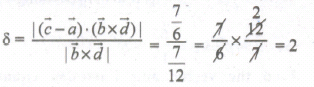
\(=\frac { 1 }{ 6 } +1=\frac { 7 }{ 6 } \)
Since \((\vec { c } -\vec { a } ).(\vec { b } \times \vec { d } )\)0, the given lines are skew lines.
\(\therefore |\vec { b } \times \vec { d } |=\sqrt { \frac { 1 }{ 36 } +\frac { 1 }{ 16 } +\frac { 1 }{ 4 } } \)
\(\sqrt { \frac { 4+9+36 }{ 144 } } =\sqrt { \frac { 49 }{ 144 } } =\frac { 7 }{ 12 } \)
Shortest distances between the skew lines
28.
By definition,
\(\vec { a } \times \vec { b } =\left| \begin{matrix} \hat { i } & \hat { j } & \hat { k } \\ 1 & -1 & 0 \\ 1 & -1 & -4 \end{matrix} \right| =4\hat { i } +4\hat { j } ,\vec { c } \times \vec { d } =\left| \begin{matrix} \hat { i } & \hat { j } & \hat { k } \\ 0 & 3 & -1 \\ 2 & 5 & 1 \end{matrix} \right| =8\hat { i } -2\hat { j } -6\hat { k } \)
\((\vec { a } \times \vec { b } )(\vec { c } \times \vec { d } )=\left| \begin{matrix} \hat { i } & \hat { j } & \hat { k } \\ 4 & 4 & 0 \\ 8 & -2 & -6 \end{matrix} \right| =-24\hat { i } +24\hat { j } -40\hat { k } \) ..............(1)
On the other hand, we have
\([\vec { a }, \vec { b }, \vec { d } ]\vec { c } -[\vec { a } ,\vec { b } ,\vec { c } ]\vec { d } =28(3\vec { j } -\vec { k } )-12(2\hat { i } +5\hat { j } +\hat { k } )=-24\hat { i } +24\hat { j } -40\hat { k } \) ..............(2)
Therefore, from equations (1) and (2), identity (i) is verified.
The verification of identity (ii) is left as an exercise to the reader
29.
Let the of the parbola be x2 = 4ay (1)
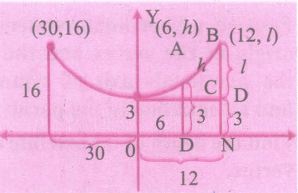
Since (30, 16) is a point on (1),
we get 302 = 4 \(\times\) a \(\times\) 16
⇒ a = \(\frac { 30\times 30 }{ 4\times 16 } =\frac { 225 }{ 16 } \)
∴ becomes, x2 = \({ x }^{ 2 }=\frac { 4\times 225 }{ 16 } y=\frac { 225 }{ 4 } y\)
Let AC = h m and BD = lm
∴ A(6, h) is a point on the parabola [∵ OD = 6]
∴ \({ 6 }^{ 2 }=\frac { 225 }{ 4 } \times h\)
⇒ \(h=\frac { 36\times 4 }{ 225 } \Rightarrow h=0.52\)
∴ AD = 3 + h = 3 + 0.52 = 3.52 m
Also (12, 1) is a point on the parabola
[∵ ON = 6 + 6 = 12]
∴ \({ 12 }^{ 2 }=\frac { 225 }{ 4 } \times l\)
⇒ l = \(\frac { 12\times 12\times 4 }{ 225 } =\frac { 576 }{ 225 } =2.08\) = 5.08 m
Hence the length of first two vertical cables are 3.52 m and 5.08 m.
30.
The parametric equation of tangent at 't1' to the parabola y2 = 4ax is yt1 = x + at12 ...(1)
Also, the parametric equation of tangent at 't2' to the parabola y = 4ax is yt2 = x+ at22 ...(2)
(1) ➝ yt1 = x + at12
(2) ➝ yt2 = x + at22
(1) - (2) y(t1 -t2) = a(t12 - t22)
.JPG)
⇒ y = a(t1 + t2)
Substitutingy = a(t1 + t2) in (1) we get,
a(t1 + t2)t1 = x + at12
.JPG)
⇒ x = at1t2
Hence, the point of intersection of two lengths is
[at1t2, a(t1 + t2)]
31.
x2+3y2 = 12
\(\div 12\) we get, \(\frac { { x }^{ 2 } }{ 12 } +\frac { { y }^{ 2 } }{ 4 } =1\)
∴ a2 = 12, b2 = 4
The line x-y+ 4 = 0 can be rewritten as y = x+4.
∴ m = 1, c = 4
The condition for y = mx + 4 to be a tangent to the ellipse is c2 = a2m2 + b2
∴ (4)2 = 12(1)2 + 4
⇒ 16 = 12+4
⇒ 16 = 16
Since the condition is satisfied, the line x - y + 4 = 0 is a tangent to the ellipse x2 + 3y2 = 12.
Also, the point of contact is \(\left( -\frac { { a }^{ 2 }m }{ c } ,\frac { { b }^{ 2 } }{ c } \right) \)
\(\Rightarrow \left( -\frac { 12(1) }{ 4 } ,\frac { 4 }{ 4 } \right) \Rightarrow (-3,1)\)
∴The point of contact is (-3, 1).
32.
We know that \(sin^{ -1 }\left( \frac { x }{ \sqrt { 1+{ x }^{ 2 } } } \right) =cos^{ -1 }\left( \frac { x }{ \sqrt { 1+{ x }^{ 2 } } } \right) \)
Thus, \(cos\left( sin^{ -1 }\left( \frac { x }{ \sqrt { 1+{ x }^{ 2 } } } \right) \right) =\frac { 1 }{ \sqrt { 1+x^{ 2 } } } \) ...(1)
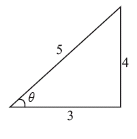
Let \(\cot ^{-1}\left(\frac{3}{4}\right)=\theta\). Then \(\cot \theta=\frac{3}{4}\) and so \(\theta\) is cute.
From the diagram, we get,
Hence \(\sin \left\{\cot ^{-1}\left(\frac{3}{4}\right)\right\}=\sin \theta=\frac{4}{5}\) ................ (2)
Using (1) and (2) in the given equation, we \(\frac { 1 }{ \sqrt { 1+x^{ 2 } } } =\frac { 4 }{ 5 } \) \(\sqrt{1+x^2}=\frac{5}{4}\)
Thus, x = \(\pm\frac{3}{4}\)
33.
Now, \(tan^{ -1 }\left( \frac { x-1 }{ x-2 } \right) +tan^{ -1 }\left( \frac { x+1 }{ x+2 } \right) =tan^{ -1 }\left[ \frac { \frac { x-1 }{ x-2 } +\frac { x+1 }{ x+2 } }{ 1-\frac { x-1 }{ x-2 } \left( \frac { x+1 }{ x+2 } \right) } \right] =\frac { \pi }{ 4 } \)
Thus, \(\frac { \frac { x-1 }{ x-2 } +\frac { x+1 }{ x+2 } }{ 1-\frac { x-1 }{ x-2 } \left( \frac { x+1 }{ x+2 } \right) } \) = 1, which on simplification gives 2x2−4 = −3
Thus, x2 = \(\frac{1}{2}\)gives x = \(\pm \frac { 1 }{ \sqrt { 2 } } \)
34.
Let the equation of the circle be
x2 + y2 + 2gx + 2fy + c = 0 ........... (1)
(1) passes through (1, 0)
⇒ 1 + 0 + 2g(1) + 2f(0) + c = 0
⇒ 2g + c = -1 ................(2)
(1) passes through (-1, 0)
⇒ (-1)2 + 0 + 2g(-1) + 2f(0)+ c = 0
⇒ -2g + c = -1 ..............(3)
Also (1) passes through (0, 1)
⇒ 0 + 12+ 2g(0) +2f(1) + c = 0
⇒ 2f + c = -1 .................(4)
(2) + (3) ⇒ 2c = -2
⇒ c = -1
Substituting c = -1 in (2), we get
2g-1 = -1
⇒ 2g = 0
⇒ g = 0
Substituting c = -1 in (4) we get,
2f -1 = -1
⇒ 2f = 0
⇒ f = 0
∴ The required equation of the circle
x2 + y2 - 1 = 0
35.
(d)
36.
(a)
\(2\left( { \left| \overset { \rightarrow }{ a } \right| }^{ 2 }+{ \left| \overset { \rightarrow }{ b } \right| }^{ 2 } \right) \)
37.
(b)
(5, 0)
38.
(d)
3, -9
39.
(b)
\(c=\pm \sqrt { 3 } \)
40.
(d)
41.
(b)
parallel
42.
(b)
\(\frac { 3\pi }{ 4 } \)
43.
(a)
\(\left| \vec { a } \right| \left| \vec { b } \right| \left| \vec { c } \right| \)
44.
(c)
an ellipse
45.
(a)
46.
(a)
2ab
47.
(c)
\(\left(\frac{9}{2 \sqrt{2}}, \frac{1}{\sqrt{2}}\right)\)
48.
(a)
(4, 7)
49.
(c)
\(\frac { 2 }{ \sqrt { 3 } } \)
50.
(b)
unique solution
51.
(b)
x2−x−12 = 0
52.
(a)
53.
(c)
0
54.
(b)
\(\frac{\pi}{3}\)

12th Standard Syllabus & Materials
12th Standard
TN 12th Computer Applications களப்பெயர் முறைமை (DNS) Sample Question Papers Study Material - QB365 Set A
NEW12th Standard
TN 12th Computer Applications வலையமைப்பு எடுத்துக்காட்டுகள் மற்றும் நெறிமுறைகள் Sample Question Papers Study Material - QB365 Set A
NEW12th Standard
TN 12th Computer Applications கணினி வலையமைப்பு ஓர் அறிமுகம் Sample Question Papers Study Material - QB365 Set A
NEW12th Standard
TN 12th Computer Applications PHP-உடன் MySQL-ஐ இணைத்தல் Sample Question Papers Study Material - QB365 Set A



Tamilnadu Stateboard 12th Standard Subjects
Maths

Chemistry

Physics

Biology

Computer Science

Business Maths and Statistics

Economics

Commerce

Accountancy

History

Computer Applications
Biology
Computer Technology
Computer Applications
Computer Science
Business Maths and Statistics
Commerce
Economics
Maths
Chemistry
Physics
Computer Technology
History
Accountancy

Tamil

English

French
Tamilnadu Stateboard Standards

