
 100% FREE ACCESS
6th Standard Syllabus & Materials
6th Standard
TN 6th Tamil பருவம் 1 - இயல் 1 - மொழி -தமிழ்த்தேன் - இன்பத்தமிழ் Sample Question Papers Study Material - QB365 Set A
NEW6th Standard
TN 6th English T1 - Supplementary - The Apple Tree and The Farmer Sample Question Papers Study Material - QB365 Set A
NEW6th Standard
TN 6th English T1 - Prose - When The Trees Walked Sample Question Papers Study Material - QB365 Set A
NEW6th Standard
TN 6th Social Science T3 - CIV - Road Safety Sample Question Papers Study Material - QB365 Set A
NEW6th Standard
TN 6th Social Science T3 - CIV - Local Bodies - Rural and Urban Sample Question Papers Study Material - QB365 Set A
NEW6th Standard
TN 6th Social Science T3 - CIV - Democracy Sample Question Papers Study Material - QB365 Set A

Published on: 17/01/2019
VI Civics Full Study Material
Download Tamil Nadu 6th Standard Social Science question papers, model tests, one-mark questions, important questions, and public exam papers in PDF format. Free study materials and answer keys for TN State Board students.
Questions + Answers key
Take MCQ Social Science Test
1.
The head of a corporation is called a_______-
Mayor
Commissioner
Chair Person
President
2.
The oldest urban local body in India is________
Delhi
Chennai
Kolkata
Mumbai
3.
_________is set up with several village panchayats
Panchayat Union
District Panchayat
Taluk
Revenue village
4.
Who has the right to work in a direct Democracy?
Men
Women
Representatives
All eligible voters
5.
Early man settled near ________ and practiced agriculture.
plains
bank of rivers
mountains
hills
6.
What is the importance of Grama Sabha?
7.
What are the special features of Panchayat Raj system?
8.
When are Grama Sabha meetings convened? What are the special on those days?
9.
List out a few means of revenue of village Panchayats.
10.
List out a few functions of corporations
11.
Who are the representatives elected in a Village Panchayat
12.
What are the divisions of a Urban local body?
13.
What are the divisions of a rural local body?
14.
What is the need for local bodies?
15.
Is there any corporation in your district? Name it.
16.
What are the salient features of our constitution that you have understood?
17.
Define: Representative Democracy
18.
Define: Direct Democracy
19.
What is Democracy
20.
Draw posters related to road safety
21.
Debate: Is wearing helmet necessary?
22.
Discuss about the statistics of 2017 accidents data
23.
Prepare slogans for road safety.
24.
Find out the number of local bodies in your district and list them.
25.
If I were a local body representative, I would.....
26.
Discuss; If there is a contribution to the improvement of your school by local body representatives
27.
Prepare a questionaire to interview a local body representative
28.
Local bodies play an important role in the development of villages and cities. How?
29.
Discuss about the merits and demerits of democracy.
30.
Find out your area's representative’s names and write down
a. MP b. MLA 3. Local body member
31.
Compare and contrast direct democracy and representative democracy.
1.
(a)
Mayor
2.
(b)
Chennai
3.
(a)
Panchayat Union
4.
(d)
All eligible voters
5.
(b)
bank of rivers
6.
(i) It is the only permanent unit in the panchayat Raj system
(ii) The Grama Sabha is the grass root level democratic institution in a Village Panchayat.
(iii) Grama Sabha meetings are conducted four times in a year. Officers like District collector, the block development officer, teachers, etc. also participate in this meeting.
(iv) The people can freely express their needs and grievances.
7.
(i) Grama Sabha
(ii) Three tier local body governance
(iii) Reservations
(iv) Panchayat Elections
(v) Tenure
(vi) Finance Commission
(v) Account and Audit, etc
8.
(i) January 26 - Republic Day
(ii) August 15 - Independence Day
(iii) May 1 - Labour Day
(iv) October 2 - Gandhi Jeyanthi
9.
(i) House tax
(ii) Professional tax
(iii) Tax on shops
(iv) Water charges
(v) Specific fees for property tax
(vi) Specific fees for transfer of immovable property
(vii) Funds from Central and State Governments, etc.
10.
(i) Drinking water supply
(ii) Street Lighting
(iii) Maintenance of Clean Environment
(iv) Primary Health Facilities
(v) Laying of Roads
(vi) Building flyovers
(vii) Space for markets
11.
(i) Panchayat President
(ii) Ward members
(iii) Councillor
(iv) District Panchayat Ward Councillor
12.
The urban local bodies are categorized into City Municipal Corporations, Municipalities and Town Panchayats.
13.
The rural local bodies are categorised into Village Panchayats, Panchayat Unions and District Panchyats.
14.
(i) The services provided can be divided as obligatory functions and discretionary functions.
(ii) These are provided by the local bodies.
15.
Yes, Tirunelveli.
16.
(i) The structure of the government institutions and methods the rules and regulations to be followed and the powers and responsibilities.
(ii) It fixes the Rights and Duties and the Directive Principles of the citizens.
17.
(i) When the people express their will on public affairs, through their elected representatives, the type of government is called representative democracy.
(ii) Ex: India, USA.
18.
(i) When the people themselves directly express their will on public affairs the type of government is called pure or direct democracy.
(ii) Ex: Switzerland.
19.
The citizens of a country select their representatives through elections. Thus, they take part in the direct governance of a country. This is termed Democracy.
20.
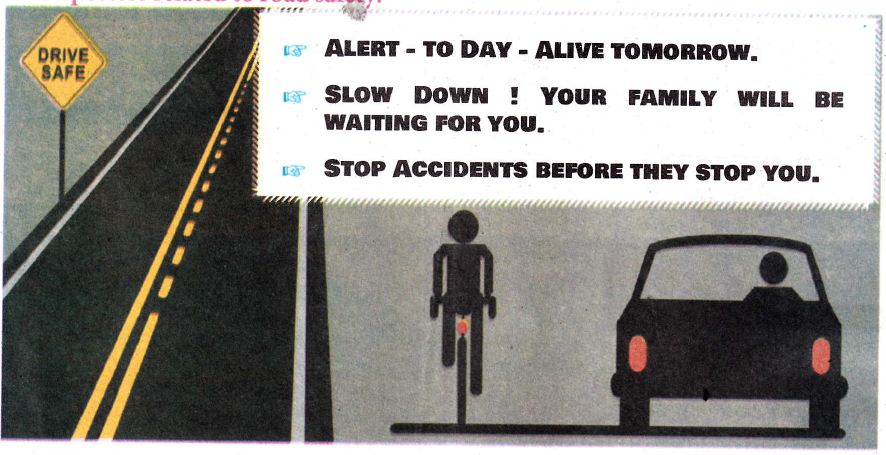
21.
Moderator: I welcome all of you for the debate on wearing helmet. First I call upon Mr. Mani to talk about the necessities of helmet.
Mani: Good Morning. Helmet wearing is very important for the motor cycle riders. It protects us from any head injury incase of accidents. Even the pillion riders also should wear helmet.
Moderator: Thank you. Now I call upon Mr. Rajesh to tell about the inconveniences of wearing the helmet.
Rajesh: Good Morning. Helmet is too heavy to wear. It increases the sweating. Some times we maynot hear the horn sounds behind.
Moderator: Thank you all. Though there are some inconveniences in wearing helmet we must wear helmet while driving. Ofcourse our life is more precious.
22.
(i) As per the report by the Ministry of Road Transport and Highways (MRTH) as many us 1.47 lakhs people died on Indian Roads in 4.64 lakh accidents.
(ii) Fatal road accidents victims largely constitute young people in the productive age groups. Young adults in the age group of 18-45 years accounted for 72.1% of victims.
(iii) People in working age group of 18-60 years accounted for a share of 87.2% in the total road accident fatalities.
23.
(i) Safety ever; Accident never.
(ii) Start early, Drive slowly, Reach safely.
(iii) Be a safety hero; score an accident zero.
(iv) East or west safety is first.
24.
| Name of the District | Village Panchayat | Panchyat Union | District Panchayat | Town Panchayat | Municipality | Corporation |
| Kanchipuram | 648 | 13 | 0 | 24 | 10 | 0 |
25.
26.
27.
28.
Local bodies play an important role in the development of villages and cities, because there are many services provided by local bodies to the people like drinking water supply, street lighting, Drainage and sewage pipe system, Laying down roads and maintenance, laying public parks, libraries, play grounds, etc. The main work of local bodies is activation of central and state government schemes to the common people.
29.
Merits of democracy
(i) In democracy the final decision rest in hand of the ruler elected by people.
(ii) There, is free and fair election held in democracy.
(iii) Democracy enhances dignity of citizen.
(iv) It allows us to correct our mistakes.
(v) It is the form of govenment in which rulers are elected by people.
Demerits:
(i) Leaders keeps on changing this leads to instability
(ii) Democracy is all about political competition and power play there is no scope for morality
(iii) So many people have to be consulted in a democracy that it leads to delays
(iv) Democracy leads to corruption for it is based on electoral competition
(v) Ordinary people don't know what is good for them, they should not decide anything.
30.
31.
| S.No | DIRECT DEMOCRACY | REPRESENTATIVE DEMOCRACY |
| 1. | In a direct democracy, only the citizens can make laws. | Elected members only can make laws. |
| 2. | All changes have to be approved by the citizen. |
Council of legislative changes the laws. |
| 3. | The politicians only rule over parliamentary procedure. |
Members of parliament rule the country. |

6th Standard Syllabus & Materials
6th Standard
TN 6th Social Science T3 - GEO - Understanding Disaster Sample Question Papers Study Material - QB365 Set A
NEW6th Standard
TN 6th Social Science T3 - GEO - Globe Sample Question Papers Study Material - QB365 Set A
NEW6th Standard
TN 6th Social Science T3 - GEO - Asia and Europe Sample Question Papers Study Material - QB365 Set A
NEW6th Standard
TN 6th Social Science T3 - HIS - South Indian Kingdoms Sample Question Papers Study Material - QB365 Set A



Tamilnadu Stateboard 6th Standard Subjects
Tamilnadu Stateboard Standards



