
 100% FREE ACCESS
10th Standard CBSE Syllabus & Materials
10th Standard CBSE
CBSE 10th Social Science ECO - Globalisation and the Indian Economy - New Model Questions Papers Study Material - QB365 Set A
NEW10th Standard CBSE
CBSE 10th Social Science ECO - Money and Credit - New Model Questions Papers Study Material - QB365 Set A
NEW10th Standard CBSE
CBSE 10th Social Science ECO - Sectors of the Indian Economy - New Model Questions Papers Study Material - QB365 Set A
NEW10th Standard CBSE
CBSE 10th Social Science ECO - Development - New Model Questions Papers Study Material - QB365 Set A
NEW10th Standard CBSE
CBSE 10th Social Science PS - Outcomes of Democracy - New Model Questions Papers Study Material - QB365 Set A
NEW10th Standard CBSE
CBSE 10th Social Science PS - Gender, Religion and Caste - New Model Questions Papers Study Material - QB365 Set A

Published on: 31/07/2018
In this question paper, some of the important one mark, two and five marks questions from the chapter Magnetic Effects of Electric Current are covered. The questions are prepared from the book back and previous year questions.
Download CBSE Class 10th Standard CBSE Science question papers, sample papers, important questions, and previous year solved papers in PDF format. Get free study materials, NCERT solutions, and exam preparation resources for Class 10th Standard CBSE Science
Questions + Answers key
Take MCQ Science Test
1.
List the properties of magnetic lines of force.
2.
A uniform magnetic field exists in the plane of paper pointing from left to right as shown in Figure. In the field an electron and a proton move as shown in the figure. The electron and the proton experience
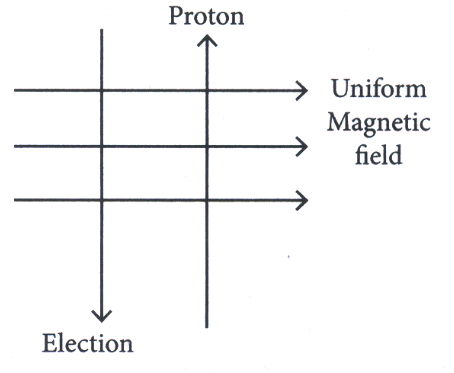
Forces both pointing into the plane of paper
Forces both pointing out of the plane of paper
Forces pointing into the plane of paper and out of the plane of paper, respectively.
Force pointing opposite and along the direction of the uniform magnetic field respectively.
3.
To convert an AC generator into DC generator
Split-ring type commutator must be used
Slip rings and brushes must be used
A stronger magnetic field has to be used
A rectangular wire has to be used.
4.
For a current in a long straight solenoid N- and S- poles are created at the two ends. Among the following statements, the incorrect statement is
The field lines inside the solenoid are in the form of straight lines which indicates that the magnetic field is the same at all points inside the solenoid
The strong magnetic field produced inside the solenoid can be used to magnetise a piece of magnetic material like soft iron, when placed inside the coil.
The pattern of the magnetic field associated with the solenoid is different from the pattern of the magnetic field around a bar magnet.
The N- and S- Poles exchange position when the direction of current through the solenoid is reversed
5.
The device used for producing electric current is called a
generator
galvanometer
ammeter
motor
6.
Which of the following property of a proton can change while it moves freely in a magnetic field ?
mass
speed
velocity
momentum
7.
(a) What is an electromagnet? What does it consist of?
(b) Name one material in each case which is used to make a
(i) Permanent magnet
(ii) Temporary magnet
(c) Describe an activity to show how you can make an electromagnet in your school laboratory.
8.
Explain the phenomenon of electromagnetic induction. Describe an experiment to show that a current is set up in a closed loop when an external magnetic field passing through the loop increases or decreases.
9.
Describe the activity that shows that a current-carrying conductor experiences a force perpendicular to its length and the external magnetic field. How does Fleming's left-hand rule help us to find the direction of the force acting on the current carrying conductor?
10.
With the help of a labelled circuit diagram illustrate the pattern of field lines of the magnetic field around a current carrying straight long conducting wire. How is the right hand thumb rule useful to find direction of magnetic field associated with a current carrying conductor?
11.
How does a solenoid behave like a magnet? Can you determine the north and South poles of a current-carrying solenoid with the help of a bar magnet? Explain.
12.
(a) Give two uses of electromagnets.
(b) Name any two devices which use permanent magnets.
13.
What will be the frequency of an alternating current, if its direction changes after every 0.05 s?
14.
Name the factors on which force produced due to magnetic field depends.
15.
What are the salient feature of domestic electric wiring?
16.
What is meant by the term, 'magnetic field'? Why does a compass needle show deflection when brought near a bar magnet?
17.
What is a compass needle?
18.
How is solenoid different from a coil?
19.
What is similar between solenoid and bar magnet?
20.
Where do we connect a fuse with the live wire or with neutral wire?
21.
Distinguish between DC and AC.
22.
How will the magnetic field intensity at the centre of a circular coil carrying current change, if the current through the coil is doubled and the radius of the coil is halved?
23.
Name some devices in which electric motors are used .
1.
Properties of magnetic field lines:
The magnetic field lines have the following properties:
(i) They originate from North pole of a magnet and end at its South pole, by convention.
(ii) These lines are closed and continuous curves.
(iii) They are crowded near the poles, where the magnetic field is strong and separated far from the poles, where the magnetic field is weak.
(iv) Field lines never intersect with each other. If they do, that would mean that there are two directions of the magnetic field at the point of intersection, which is impossible.
2.
(c)
Forces pointing into the plane of paper and out of the plane of paper, respectively.
3.
(a)
Split-ring type commutator must be used
4.
(c)
The pattern of the magnetic field associated with the solenoid is different from the pattern of the magnetic field around a bar magnet.
5.
(a)
generator
6.
(d)
momentum
7.
(a) When we magnetise a piece of magnetic material such as soft iron by keeping it inside a coil and then passing current through it, the magnet so formed is called electromagnet.
(b) (i) Steel is used to make permanent magnet.
(ii) Soft iron is used to make temporary magnets.
(c) Take a coil of wire having N number of turns and then wound it around a soft iron core. Connect the end of the wire with a battery and plug key and then let current pass through the coil. While current is passing through the coil, bring a compass near the coil. It will be observed that compass needle shows deflection. This shows that the coil will have a magnetic field of its own. The magnet so formed is called an electromagnet.
8.
Electromagnetic Induction: When a conductor is set to move inside a magnetic field or a magnetic field is set to be changing around a conductor, electric current is induced in the conductor. This is just opposite to the exertion of force by a current carrying conductor inside a magnetic field. In other words, when a conductor is brought in relative motion vis-a-vis a magnetic field, a potential difference is induced in it. This is known as electromagnetic induction.
Activity:
- To demonstrate electromagnetic induction Materials Required:
- A galvanometer, coil, bar magnet and some wires.
Procedure:
- The coil is inserted over a hollow tube of cardboard.
- With the help of wires, the two ends of the coil are attached to the galvanometer.
- The north pole of the bar magnet is moved towards the end 'B' of the coil.
- It is observed that the galvanometer needle shows deflection to right.
- When the magnet is moved away from the coil, the galvanometer needle shows deflection towards left.
- When the magnet is in static position, no deflection is seen in galvanometer needle.
- Induction of electric current in the coil is the cause of deflection in galvanometer needle.
- If the magnet is kept stationary and coil is moved, then also the galvanometer needle shows deflection.
Conclusion:
- When the coil and the bar magnet are in relative motion, a current is induced in the coil.
9.
Activity:
To show the effect of magnetic field on current -carrying conductor
Materials Required:
A small aluminium rod, a horse-shoe magnet, battery, plug key, wires and a stand.
Procedure:
The aluminium rod is suspended horizontally from the stand and tied to two wires at its ends. The wires are attached to rheostat, battery and a plug key to make the circuit.
The horse-shoe magnet is positioned in a way that the aluminium rod lies between the two poles of the magnet. If the South Pole is above the aluminium rod and the North Pole is below it. The plug key is inserted to initiate current supply to the rod.
It is observed that the aluminium rod deflects towards left.
When the direction of the current is reversed the aluminium rod deflects towards right.
Conclusion:
When a current carrying conductor is placed within a magnetic field, the conductor experiences deflection. Fleming's Left Hand Rule explains the direction of displacement in this case. Let us assume that the current is moving in anti-clockwise direction in the loop. In that case, the magnetic field would be in clockwise direction; at the top of the loop. Moreover, it would be in anticlockwise direction at the bottom of the loop.
10.
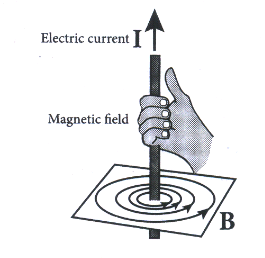
The following diagram depicts the pattern and direction of magnetic field lines around a straight current-carrying conductor.
Right Hand Thumb Rule: If a current carrying conductor is held by right hand, keeping the thumb straight and if the direction of electric current is in the direction of thumb, then the direction of wrapping of other fingers will show the direction of magnetic field.
11.
A solenoid behaves like a magnet when electric current flows through it. Any current carrying conductor creates a magnetic field around it. For determining the different poles of a solenoid, we can use a bar magnet and look for interaction between different poles of a solenoid, we can use a bar magnet and look for interaction between different poles of two magnets. If the north pole of the bar magnet gets repulsed by a particular pole of the electromagnet (solenoid) then it gets confirmed that the bar by a particular pole of the electromagnet (solenoid) then it gets confirmed that the bar magnet was brought near the north pole of the electromagnet.
12.
(a) (i) It is used in cranes for lifting heavy loads.
(ii) used in electric bells.
(b) Loudspeakers, Galvanometer, voltmeter.
13.
The time period (T) of one cycle would be =
2 X (0.05 s) = 0.1 s.
Frequency, f = 1/t.
Hence, f= (1/0.1) = 10 Hz.
14.
The factors on which force produced due to magnetic field depends are:
(i) length of the conductor.
(ii) the amount of current flowing.
(iii) The strength of magnetic field.
(iv) direction of current and magnetic field.
If are at right angles, then maximum amount of force will be produced.
15.
(i) Circuit is parallel to each other.
(ii) Each circuit consists of an on-off switch.
(iii) Two separate circuits are used, one of 15 A and another of 5 A. (iv) Electric fuse is connected to each circuit.
16.
Magnetic field is the region around a magnet in which a magnetic material experiences a force because of that magnet. The needle of a compass is actually a small bar magnet. So, when a compass is brought near a bar magnet, the compass needle enters the magnetic field of the bar magnet. Therefore, the needle experiences a force because of the bar magnet and gets deflected.
17.
A compass needle is a small bar magnet.
18.
Solenoid is different from a circular coil in the sense that the length of the solenoid is much greater than its diameter.
19.
The magnetic field produced by a solenoid is similar to the bar magnet.
20.
It should be connected with live wire.
21.
| DC | AC |
| 1. Unidirectional flow of current. | Current changes its direction in a cycle. |
| 2. Cells and batteries produce DC. | Dynamo produces AC. |
22.
Magnetic field at centre of coil \(B\propto \frac { 1 }{ R } \) when current I is doubled and radius R is halved, the magnetic field becomes four times the original field.
23.
Electric fan, mixer grinder, tape recorder, CD player, hard disk drive, washing machine, cooler, toy car, vacuum cleaner, etc.

10th Standard CBSE Syllabus & Materials
10th Standard CBSE
CBSE 10th Social Science PS - Federalism - New Model Questions Papers Study Material - QB365 Set A
NEW10th Standard CBSE
CBSE 10th Social Science PS - Power Sharing - New Model Questions Papers Study Material - QB365 Set A
NEW10th Standard CBSE
CBSE 10th Social Science GEO - Manufacturing Industries - New Model Questions Papers Study Material - QB365 Set A
NEW10th Standard CBSE
CBSE 10th Social Science GEO - Minerals and Energy Resources - New Model Questions Papers Study Material - QB365 Set A



CBSE 10th Standard CBSE Subjects
CBSE Standards





