
 100% FREE ACCESS
10th Standard CBSE Syllabus & Materials
10th Standard CBSE
CBSE 10th Social Science ECO - Globalisation and the Indian Economy - New Model Questions Papers Study Material - QB365 Set A
NEW10th Standard CBSE
CBSE 10th Social Science ECO - Money and Credit - New Model Questions Papers Study Material - QB365 Set A
NEW10th Standard CBSE
CBSE 10th Social Science ECO - Sectors of the Indian Economy - New Model Questions Papers Study Material - QB365 Set A
NEW10th Standard CBSE
CBSE 10th Social Science ECO - Development - New Model Questions Papers Study Material - QB365 Set A
NEW10th Standard CBSE
CBSE 10th Social Science PS - Outcomes of Democracy - New Model Questions Papers Study Material - QB365 Set A
NEW10th Standard CBSE
CBSE 10th Social Science PS - Gender, Religion and Caste - New Model Questions Papers Study Material - QB365 Set A

Published on: 28/09/2019
Coordinate Geometry
Download CBSE Class 10th Standard CBSE Maths question papers, sample papers, important questions, and previous year solved papers in PDF format. Get free study materials, NCERT solutions, and exam preparation resources for Class 10th Standard CBSE Maths
Questions + Answers key
Take MCQ Maths Test
1.
If the points (7,-2), (5,1) and (3,k) are collinear, then find the value of k
2.
Show that the points (4,2), (7,5) and (9,7) do not form a triangle.
3.
The vertices of \(\Delta \)ABC are A (-2,0). B(2,0) and C (0,2) and that of \(\Delta \)PQR are P (-4,0). Q (4,0)and R (0,4).Verify that the ratio of the areas of the two triangles is equal to the square of the ratio of their corresponding sides.
4.
Find the area of the triangle ABC with A(1,-4) and the mid-points of sides through A being (2,-1) and (0,-1).
5.
If P(x,y) is any point on the line segment joining the points A(a,0) and B(0,b), then show that \(\frac { x }{ a } +\frac { y }{ b } =1\)
6.
Prove that the points A(2,3), B(-2,2), C(-1,-2) and D(3,-1) are the vertices of a square ABCD.
7.
Find the area of the triangle formed by the points P(-1.5,3), Q(6,-2) and R(-3,4).
8.
If the points P(0,k), Q(8,3), R(6,7) and S(-2,3) are the vertices of a rectangle, taken in order, find the value of k.
9.
Find the points of trisection of the line segment determined by (7,5) and (16,-1).
10.
Prove that the area of a triangle with vertices (t,t-2), (t+2,t+2) and (t+3,t) is independent of t.
11.
Find the values of k so that the area of the triangle with vertices (1,-1), (-4,2k) and (-k,-5) in 24sq.units.
12.
If A(-3,5), B(-2,-7), C(1,-8) and D(6,3) are the vertices of a quadrilateral ABCD, find its area.
13.
A(0,3), B(-1,-2) and C(4,2) are vertices of a \(\Delta ABC\). D is a point on the side BC such that \({BD\over DC}={1\over2}\). P is a point on AD such that \(AP={2\sqrt5\over3}\)units. Find coordinates of P.
14.
In \(\Delta PAB, \) PA=PB and area of \(\Delta PAB=10\)sq.units. Find the coordinates of P if coordinates of A and B are (1,2) and (3,8) respectively.
15.
The three vertices of a parallelogram ABCD are A(3,-4), B(-1,-3) and C(-6,2). Find the coordinates of vertex D and find the area of ABCD.
1.
K = 4
2.
To form a triangle, sum of any two sides of a triangle must be greater than its third side.
3.
Given vertices of a \(\Delta \)ABC are A(-2,0), B(2,0) and C(0,2).
\(\therefore \) Area of \(\Delta \)ABC = \(\frac { 1 }{ 2 } \)[x1(y2-y3)+x2(y3-y1)+x3(y1-y2)]
=\(\frac { 1 }{ 2 } \)[4+4] = \(\frac { 8 }{ 2 } \) = 4 sq uints.
Also, given vertices of a ll.PQR are P( -4,0), Q( 4,0) and R(0,4).
\(\therefore \)Area of \(\Delta \)PQR = \(\frac { 1 }{ 2 } \)[x1(y2-y3)+x2(y3-y1)+x3(y1-y2)]
=\(\frac { 1 }{ 2 } \)[-4(0-4)+4(4-0)+0(0-0)]
=\(\frac { 1 }{ 2 } \)[16+16] =\(\frac { 32 }{ 2 } \) = 16 sq units
Now, AB = \(\sqrt { { \left( 2+2 \right) }^{ 2 }+{ \left( 0-0 \right) }^{ 2 } } =\sqrt { { 4 }^{ 2 } } \) = 4 sq units
and PQ = \(\sqrt { { \left( 4+4 \right) }^{ 2 }+{ \left( 0-0 \right) }^{ 2 } } =\sqrt { { 8 }^{ 2 } } \) = 8 sq units
We have to verify that, \(\frac { \Delta ABC }{ \Delta PQR } =\quad \frac { { \left( AB \right) }^{ 2 } }{ { \left( PQ \right) }^{ 2 } } \)
Now, LHS = \(\frac { \Delta ABC }{ \Delta PQR } =\frac { 4 }{ 16 } =\frac { 1 }{ 4 } \) ....(i)
and RHS = \(\frac { { \left( AB \right) }^{ 2 } }{ { \left( PQ \right) }^{ 2 } } =\frac { { 4 }^{ 2 } }{ { 8 }^{ 2 } } =\frac { 16 }{ 64 } =\frac { 1 }{ 4 } \) ....(ii)
From Eqs. (i) and (ii) we, get LHS = RHS
Hence proved.
4.
Let the coordinates of B and C be (a,b) and (x,y) respectively
Then \(\left( \frac { 1+a }{ 2 } ,\frac { -4+b }{ 2 } \right) \) =(2.-1)
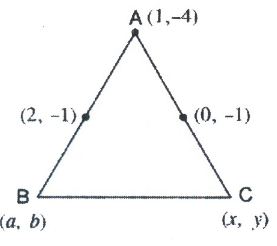
\(\Rightarrow \) \(\frac { 1+a }{ 2 } =2\quad and\quad \frac { -4+b }{ 2 } =-1\)
\(\Rightarrow \) 1+a=4 and -4+b=-2
\(\Rightarrow \) a=3 and b=2
Also \(\left( \frac { 1+x }{ 2 } ,\frac { -4+y }{ 2 } \right) \)=(0,-1)
\(\Rightarrow \) \(\frac { 1+x }{ 2 } =0\quad and\quad \frac { -4+y }{ 2 } =-1\)
\(\Rightarrow \) 1+x=0 and -4+y=-2
\(\Rightarrow \) x=-1 and y=2
Thus the coordinates of the vertices of ABC are A(1,-4),B(3,2) and C(-1,2)
Area of ABC =\(\frac { 1 }{ 2 } \) |1(2-2)+3(2+4)+(-1)(-4-2)|
= \(\frac { 1 }{ 2 } \)|0+18+6|
= \(\frac { 1 }{ 2 } \)(24)=12 sq.units
5.
P(x, y) is any point on the line segment joining the points A(a, 0) and B(0, b)
\(\Rightarrow \) P,A and B are collinear
\(\therefore \) Area of the triangle PAB formed by these ints vanishes
i.e \(\frac { 1 }{ 2 } \) {x(0-b)+a(b-y)+0(y-0)}=0
\(\Rightarrow \) -bx+ab-ay=0
\(\Rightarrow \) bx+ay=ab
Divide through by ab we have
\(\frac { bx }{ ab } +\frac { ay }{ ab } =\frac { ab }{ ab } \)
\(\Rightarrow \) \(\frac { x }{ a } +\frac { y }{ b } =1\)
6.
Here, |AB|= \(\sqrt { (-2-2)^{ 2 }+(2-3)^{ 2 } } \)
= \(\sqrt { (-4)^{ 2 }+(-1)^{ 2 } } \)
=\(\sqrt { 16+1 } =\sqrt { 17 } \) Units
|BC|= \(\sqrt { (-1+2)^{ 2 }+(-2-2)^{ 2 } } \)
= \(\sqrt { (1)^{ 2 }+(-4)^{ 2 } } \)
=\(\sqrt { 1+16 } =\sqrt { 17 } \) units
|CD|= \(\sqrt { (3+1)^{ 2 }+(-1+2)^{ 2 } } \)
=\(\sqrt { 4^{ 2 }+1^{ 2 } } \)
= \(\sqrt { 17 } \)=units
|DA|=\(\sqrt { (2-3)^{ 2 }+(3+1)^{ 2 } } \)
= \(\sqrt { (-1)^{ 2 }+4^{ 2 } } \)=\(\sqrt { 1+16 } \)
= \(\sqrt { 17 } \) units
\(\Rightarrow \) AB=BC=CD=DA= units
Now,Diagonal |AC| =\(\sqrt { (-1-2)^{ 2 }+(-2-3)^{ 2 } } \)
= \(\sqrt { (-3)^{ 2 }+(-5)^{ 2 } } \)
=\(\sqrt { 9+25 } =\sqrt { 34 } \) units
Diagonal |BD|= \(\sqrt { (3+2)^{ 2 }+(-1-2)^{ 2 } } \)
= \(\sqrt { { 5 }^{ 2 }+(-3)^{ 2 } } \)
= \(\sqrt { 25+9 } =\sqrt { 34 } \) units
\(\Rightarrow \) Diagonal AC=Diagonal BD= units
Hence ABCD is a square
7.
The area of the triangle formed by the given points is equal to
\(\frac{1}{2}[-1.5(-2-4)+6(4-3)+(-3)(3+2)]\)
\(=\frac{1}{2}(9+6-15)=0\)
Can we have a triangle of area 0 square units? What does this mean?
If the area of a triangle is 0 square units, then its vertices will be collinear.
8.
k=-1
9.
(10,3), (13,1)
10.
-s.png)
Area ABC
=\(\frac { 1 }{ 2 } \) |t(t+2-t)+(t+2)[t-(t-2)]+(t+3)[(t-2)-(t+2)]
=\(\frac { 1 }{ 2 } \) |2t+2t+4-4t-12|
= \(\frac { 1 }{ 2 } \)|-8|=4 sq.units is independent of t
11.
Area of =24 (Given)
\(\frac { 1 }{ 2 } \)|x1(y2-y3)+x2(y3-y1)+x3(y1-y2)|=24
|1(2k+5)-4(-5=1)-k(-1-2k)|=48
\(\Rightarrow \) |2k+5+16+k+2k2|=48
\(\Rightarrow \) |2k2+3k+21|=48
\(\Rightarrow \) 2k2+3k+21=\(\pm \)48
Consider, 2k2+3k+21=48
\(\Rightarrow \)2k2+3k-27=0
\(\Rightarrow \)2k2+9k-6k-27=0
\(\Rightarrow \)k(2k+9)-3(2k+9)=0
\(\Rightarrow \)(2k+9)(k-3)=0
Also 2k2+3k+21=-48
2k2+3k+69=0
D= (3)2 -4 X 2 X 69
=-ve (No solution)
\(\therefore \) k=\(\frac { -9 }{ 2 } \) or k=3
12.
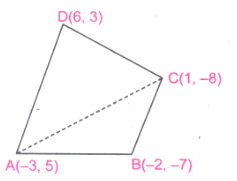
Area of quadrilateral ABCD
=Area of traingle ABC+Area of traingle ACD ...(i)
Now, ar (\(\triangle \)ABC)
=\(\frac { 1 }{ 2 } \) [-3(-7+8)-2(-8-5)+1(5+7)]
=\(\frac { 1 }{ 2 } \) [-3+26+12] = \(\frac { 35 }{ 2 } \)sq.units ...(ii)
Also, ar ( \(\triangle \)ACD)
=\(\frac { 1 }{ 2 } \) [-3(-8-3)-1(3-5)+6(5+8)]
= \(\frac { 1 }{ 2 } \)[33-2+78]=\(\frac { 109 }{ 2 } \) sq.units ...(iii)
From (i),(ii),(iii) we get
ar (ABCD)=\(\frac { 35 }{ 2 } +\frac { 109 }{ 2 } =\frac { 144 }{ 2 } \) =72 sq.units
13.
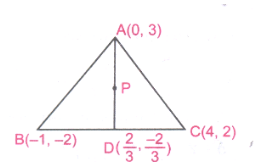
\(\because \) BD:CD =1:2
\(\therefore \) Coordinates of D are
\(\left( \frac { 1\times 4+2\times -1 }{ 1+2 } ,\frac { 1\times 2+2\times -2 }{ 1+2 } \right) \) ie \(\left( \frac { 2 }{ 3 } ,\frac { -2 }{ 3 } \right) \)
AD= \(\sqrt { \left( \frac { 2 }{ 3 } -0 \right) ^{ 2 }+\left( \frac { -2 }{ 3 } -3 \right) ^{ 2 } } \)
= \(\sqrt { \frac { 4 }{ 9 } +\frac { 121 }{ 9 } } =\sqrt { \frac { 125 }{ 9 } } =\frac { 5\sqrt { 5 } }{ 3 } \) units
DP=AD-AP = \(\frac { 5\sqrt { 5 } }{ 3 } -\frac { 2\sqrt { 5 } }{ 3 } \)
=\(\frac { 3\sqrt { 5 } }{ 3 } \) =\(\sqrt { 5 } \) units
\(\therefore \) \(\frac { AD }{ AP } =\frac { \frac { 2\sqrt { 5 } }{ 3 } }{ \sqrt { 5 } } =\frac { 2 }{ 3 } \)
P divides AD in the ratio 2 : 3.
\(\therefore \) x-coordinate of P is
x= \(\frac { 2\times \frac { 2 }{ 3 } +3\times 0 }{ 2+3 } =\frac { 4 }{ 15 } \)
Similarly ,y-coordinates of P is
y= \(\frac { 2\times \frac { -2 }{ 3 } +3\times 3 }{ 2+3 } =\frac { 23 }{ 15 } \)
\(\therefore \) x-Coordinates of P are \(\left( \frac { 4 }{ 15 } ,\frac { 23 }{ 15 } \right) \)
14.
Are of \(\triangle \)PAB =10 sq units
\(\Rightarrow \) \(\frac { 1 }{ 2 } \) |x(2-8)+1(8-y)+3(y-2)| = 10
\(\Rightarrow \) |-6x+8-y+3y-6| =20
\(\Rightarrow \) |-6x+2y+2| = 20
\(\Rightarrow \) -6x+2y+2 = 20 or -6x+2y+2 =- 20
\(\Rightarrow \) -6(17-3y)+2y+2 =20 or -6(17-3y)+2y+2=-20 ...(ii)
\(\Rightarrow \) -102+18y+2y+2=20 -102 -102+18y+2y+2=20 -20
\(\Rightarrow \) 20y=120 20y=80
y=6 y=4
When y = 6, eq. (i) becomes x = 17-18 =-1
\(\therefore \) Point is (-1,6)
When y = 4, eq. (i) becomes x = 17-12 =5
\(\therefore \) Point is (5,4)
15.
find mid point O of A and C
x=(3-6)/2
= -3/2
y=(-4+2)/2 = -1
O=(-3/2,-1)
taking O as mid point find D
-3/2=(-1+x1)/2
x1=-2
-1=(-3+y1)/2
y1=1
D=-2,1

10th Standard CBSE Syllabus & Materials
10th Standard CBSE
CBSE 10th Social Science PS - Federalism - New Model Questions Papers Study Material - QB365 Set A
NEW10th Standard CBSE
CBSE 10th Social Science PS - Power Sharing - New Model Questions Papers Study Material - QB365 Set A
NEW10th Standard CBSE
CBSE 10th Social Science GEO - Manufacturing Industries - New Model Questions Papers Study Material - QB365 Set A
NEW10th Standard CBSE
CBSE 10th Social Science GEO - Minerals and Energy Resources - New Model Questions Papers Study Material - QB365 Set A



CBSE 10th Standard CBSE Subjects
CBSE Standards





