
 100% FREE ACCESS
10th Standard CBSE Syllabus & Materials
10th Standard CBSE
CBSE 10th Social Science ECO - Globalisation and the Indian Economy - New Model Questions Papers Study Material - QB365 Set A
NEW10th Standard CBSE
CBSE 10th Social Science ECO - Money and Credit - New Model Questions Papers Study Material - QB365 Set A
NEW10th Standard CBSE
CBSE 10th Social Science ECO - Sectors of the Indian Economy - New Model Questions Papers Study Material - QB365 Set A
NEW10th Standard CBSE
CBSE 10th Social Science ECO - Development - New Model Questions Papers Study Material - QB365 Set A
NEW10th Standard CBSE
CBSE 10th Social Science PS - Outcomes of Democracy - New Model Questions Papers Study Material - QB365 Set A
NEW10th Standard CBSE
CBSE 10th Social Science PS - Gender, Religion and Caste - New Model Questions Papers Study Material - QB365 Set A

Published on: 17/10/2019
Introduction to Trigonometry
Download CBSE Class 10th Standard CBSE Maths question papers, sample papers, important questions, and previous year solved papers in PDF format. Get free study materials, NCERT solutions, and exam preparation resources for Class 10th Standard CBSE Maths
Questions + Answers key
Take MCQ Maths Test
1.
If \(cosec\theta +\cot { \theta } =p\), then prove that \(\cos { \theta } =\frac { { p }^{ 2 }-1 }{ { p }^{ 2 }+1 } \)
2.
The angle of elevation of a cloud from a point 120 m above a lake is 30° and the angle of depression of its reflection in the lake is 60°. Find the height of the cloud.
3.
If \(\sec { \theta } +\tan { \theta } =p,\) show that \(\sec { \theta } -\tan { \theta } =\frac { 1 }{ p } \). Hence, find the values of \(\cos { \theta } \) and \(\sin { \theta } \).
4.
Given that \(\left( A+B \right) =\frac { \tan { A } +\tan { B } }{ 1-\tan { A } \tan { B } } \), find the values of tan 75° and tan 90° by taking suitable values of A and B.
5.
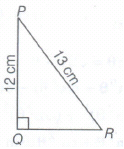
In the following figure, find tan P - cot R.
6.
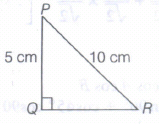
In the following figure, \(\triangle PQR\) is right angled at Q, PQ=5 cm, PR=6cm. Determine \(\angle QPR and \angle PRQ.\)
7.
If tan A = a tan B and sin A = b sin B, prove that \(\cos ^{ 2 }{ A } =\frac { { b }^{ 2 }-1 }{ { a }^{ 2 }-1 } \)
8.
Prove the following identities, where the angles involved are acute angles for which the expressions are defined.
\(\sqrt { \frac { 1+\sin { A } }{ 1-\sin { A } } } =\sec { A } +\tan { A } \)
9.
Show that \(\tan { { 48 }^{ 0 } } \tan { { 23 }^{ 0 } } \tan { { 42 }^{ 0 } } \tan { { 67 }^{ 0 } } =1.\)
10.
Prove that \(\frac { \sin { A } }{ 1+\cos { A } } +\frac { \sin { A } }{ 1-\cos { A } } =\sqrt { \frac { 1+\cos { A } }{ 1-\cos { A } } } +\sqrt { \frac { 1-\cos { A } }{ 1+\cos { A } } } \) = 2 cosec A
11.
Prove that \(\frac { \sec ^{ 2 }{ \theta } -\sin ^{ 2 }{ \theta } }{ \tan ^{ 2 }{ \theta } } =1+\cot ^{ 2 }{ \theta } -\cos ^{ 2 }{ \theta } \)
12.
Evaluate \({ \left( \frac { \sin { { 25 }^{ 0 } } }{ \cos { { 65 }^{ 0 } } } \right) }^{ 2 }+{ \left( \frac { \tan { { 65 }^{ 0 } } }{ \cot { { 25 }^{ 0 } } } \right) }^{ 2 }-2\cos ^{ 2 }{ { 45 }^{ 0 } } .\)
13.
Find the value of \((\sin { { 30 }^{ 0 } } +\cos { { 30 }^{ 0 } } )-(\sin { { 60 }^{ 0 } } +\cos { { 60 }^{ 0 } } ).\)
14.
If \(\sqrt { 3 } \sin { \theta } =\cos { \theta } \), find the value of \(\frac { \tan { \theta } (1+\cot { \theta } ) }{ \sin { \theta } +\cos { \theta } } .\)
15.
If sinA=\(\frac {12}{13}\) , what is the value of cos A?
1.
\(RHS=\frac { { p }^{ 2 }-1 }{ { p }^{ 2 }+1 } \)
\(=\frac { { \left( cosec\theta +\cot { \theta } \right) }^{ 2 }-1 }{ { \left( cosec\theta +\cot { \theta } \right) }^{ 2 }+1 } \)
\(=\frac { { cosec }^{ 2 }\theta +\cot ^{ 2 }{ \theta } +2cosec\theta \cot { \theta } -1 }{ { cosec }^{ 2 }\theta +\cot ^{ 2 }{ \theta } +2cosec\theta \cot { \theta } +1 } \)
\(=\frac { 1+\cot ^{ 2 }{ \theta } +\cot ^{ 2 }{ \theta } +2cosec\theta \cot { \theta } -1 }{ { cosec }^{ 2 }\theta +{ cosec }^{ 2 }\theta -1+2cosec\theta \cot { \theta } +1 } \)
\(=\frac { 2\cot { \theta } \left( \cot { \theta } +cosec\theta \right) }{ 2cosec\theta \left( cosec\theta +\cot { \theta } \right) } \)
\(=\frac { \cos { \theta } }{ \sin { \theta } } \times \sin { \theta } =\cos { \theta } =LHS\)
2.
In \(\Delta AOP\), tan 30°=\(\frac{H-120}{OP}\)
\(\frac { 1 }{ \sqrt { 3 } } =\)\(\frac{H-120}{OP}\)
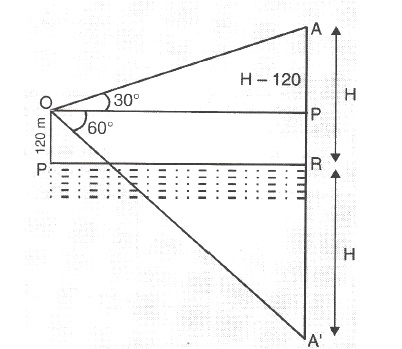
OP = (H -120)\(\sqrt{3}\) ...(i)
In \(\Delta OPA'\), tan 60°=\(\frac{H+120}{OP}\)
OP =\(\frac { H+120 }{ \sqrt { 3 } } \)...(ii)
From (i) and (ii), we get
\(\frac { H+120 }{ \sqrt { 3 } } \)=\(\sqrt{3}\)(H-120)
So height of cloud H = 240 m.
3.
\(\frac { 1 }{ p } =\frac { 1 }{ \sec { \theta } +\tan { \theta } } \times \frac { \left( \sec { \theta } -\tan { \theta } \right) }{ \sec { \theta } -\tan { \theta } } \)
\(\frac { 1 }{ p } =\frac { \sec { \theta } -\tan { \theta } }{ \sec ^{ 2 }{ \theta } -\tan ^{ 2 }{ \theta } } \times \sec { \theta } -\tan { \theta } \)
Solving \(\sec { \theta } +\tan { \theta } =p,\) and \(\sec { \theta } -\tan { \theta } =\frac { 1 }{ p } \)
we get \(\sec { \theta } =\frac { 1 }{ 2 } \left( p+\frac { 1 }{ p } \right) =\frac { { p }^{ 2 }+1 }{ 2p } \)
and \(\tan { \theta } =\frac { 1 }{ 2 } \left( p-\frac { 1 }{ p } \right) =\frac { { p }^{ 2 }-1 }{ 2p } \)
\(\therefore \quad \cos { \theta } =\frac { 2p }{ { p }^{ 2 }+1 } \) and \(\sin { \theta } =\frac { { p }^{ 2 }-1 }{ { p }^{ 2 }+1 } \)
Alternative Method :
Adding eq.(i) and eq.(ii), 2
\(\sec { \theta } +\tan { \theta } =p,\) ...(i)
\(\sec { \theta } -\tan { \theta } =\frac { 1 }{ p } \) ..(ii)
\(2\sec { \theta } =p+\frac { 1 }{ p } \)
\(\Rightarrow \quad 2\sec { \theta } =\frac { { p }^{ 2 }+1 }{ p } \)
\(\Rightarrow \quad \sec { \theta } =\frac { { p }^{ 2 }+1 }{ 2p } \)
\(\Rightarrow \quad \frac { 1 }{ \cos { \theta } } =\frac { { p }^{ 2 }+1 }{ 2p } \)
\(\Rightarrow \quad \cos { \theta } =\frac { 2p }{ { p }^{ 2 }+1 } \)
On subtracting eq.(ii) from eq.(i)
\(\sec { \theta } +\tan { \theta } =p,\)
\(\sec { \theta } -\tan { \theta } =\frac { 1 }{ p } \)
\( 2\tan { \theta } =p-\frac { 1 }{ p } \)
\(\tan { \theta } =\frac { { p }^{ 2 }-1 }{ 2p } \)
\(\tan { \theta } =\frac { \sin { \theta } }{ \cos { \theta } } \)
\(\Rightarrow \quad \sin { \theta } =\tan { \theta } .\cos { \theta } \)
\(=\frac { { p }^{ 2 }-1 }{ 2p } \times \frac { 2p }{ { p }^{ 2 }+1 } \)
\(=\frac { { p }^{ 2 }-1 }{ { p }^{ 2 }+1 } \)
4.
\(\tan { \left( A+B \right) } =\frac { \tan { A } +\tan { B } }{ 1-\tan { A } \tan { B } } \)
(i) tan 75° = tan (45° + 30°)
\(=\frac { \tan { { 45 }^{ ° } } +\tan { { 30 }^{ ° } } }{ 1.\tan { { 45 }^{ ° } } .\tan { { 30 }^{ ° } } } \)
\(=\frac { 1+\frac { 1 }{ \sqrt { 3 } } }{ 1-\frac { 1 }{ \sqrt { 3 } } } \)
\(\therefore \quad \tan { { 75 }^{ ° } } =\frac { \sqrt { 3 } +1 }{ \sqrt { 3 } -1 } \)
(ii) tan 90° = tan (60° + 30°)
\(=\frac { \tan { { 60 }^{ ° } } +\tan { { 30 }^{ ° } } }{ 1-\tan { { 60 }^{ ° } } \tan { { 30 }^{ ° } } } \)
\(=\frac { \sqrt { 3 } +\frac { 1 }{ \sqrt { 3 } } }{ 1-\sqrt { 3 } \times \frac { 1 }{ \sqrt { 3 } } } \)
\(=\frac { \frac { 3+1 }{ \sqrt { 3 } } }{ 0 } \)
\(\therefore \quad \tan { { 90 }^{ ° } } =\infty \)
5.
In right angled \(\triangle PQR,\)
PQ = 12 cm, PR = 13 cm [given]
Then, PQ2 + QR2 = PR2 [by using Pythagoras theorem]
\(\Rightarrow\) (12)2 + QR2 = (13)2
\(\Rightarrow\) 144 + QR2 = 169
\(\Rightarrow\) QR2 = 169 - 144 = 25
\(\Rightarrow\) QR = 5 [taking positive square root since, side cannot be negative]
Now, \(tanP=\frac { P }{ B } =\frac { QR }{ PQ } =\frac { 5 }{ 12 } \)
\(and\quad cot \quad R=\frac { B }{ P } =\frac { QR }{ PQ } =\frac { 5 }{ 12 } \)
\(\therefore \quad tanP-cosR=\frac { 5 }{ 12 } - \frac { 5 }{ 12 } =0\)
6.
\(\angle QPR={ 60 }^{ 0 }\quad and\quad \angle PRQ={ 30 }^{ 0 }.\)
7.
Given, \(\tan { A } =a\tan { B } \Rightarrow \tan { B } =\frac { 1 }{ a } \tan { A } \)
\(\Rightarrow \cot { A } =\frac { a }{ \tan { A } } \quad \quad ..(i)\)
and \(\sin { A } =b\sin { B } \Rightarrow \sin { B } =\frac { 1 }{ b } \sin { A } \)
\(\Rightarrow cosecB=\frac { b }{ \sin { A } } \quad \left[ \because cosec\theta =\frac { 1 }{ \sin { \theta } } \right] \quad ...(ii)\)
We know that, \({ cosec }^{ 2 }B-\cot ^{ 2 }{ B } =1\)
\(\Rightarrow \frac { { b }^{ 2 } }{ \sin ^{ 2 }{ A } } -\frac { { a }^{ 2 } }{ \tan ^{ 2 }{ A } } =1\) [from Eqs. (i) and (ii)]
\(\Rightarrow \frac { { b }^{ 2 } }{ \sin ^{ 2 }{ A } } -\frac { { a }^{ 2 }\cos ^{ 2 }{ A } }{ \sin ^{ 2 }{ A } } \quad \left[ \because \tan { A } =\frac { \sin { A } }{ \cos { A } } \right] \)
\(\Rightarrow \frac { { b }^{ 2 }-{ a }^{ 2 }\cos ^{ 2 }{ A } }{ \sin ^{ 2 }{ A } } =1\)
\(\Rightarrow { b }^{ 2 }-{ a }^{ 2 }\cos ^{ 2 }{ A } =\sin ^{ 2 }{ A } \)
\(\Rightarrow { b }^{ 2 }-{ a }^{ 2 }\cos ^{ 2 }{ A } =1-\cos ^{ 2 }{ A } \)
\(\Rightarrow \quad { b }^{ 2 }-1={ a }^{ 2 }\cos ^{ 2 }{ A } -\cos ^{ 2 }{ A } \)
\(\Rightarrow \frac { { b }^{ 2 }-1 }{ { a }^{ 2 }-1 } =\cos ^{ 2 }{ A } \)
Hence proved.
8.
LHS = \(\quad \sqrt { \frac { 1+\sin { A } }{ 1-\sin { A } } } =\sqrt { \frac { 1+\sin { A } }{ 1-\sin { A } } \times \frac { 1+\sin { A } }{ 1+\sin { A } } } \) [on multiplying numerator and denominator by \(\sqrt { (1+\sin { A } ) } \)]
\(=\sqrt { \frac { { (1+\sin { A } ) }^{ 2 } }{ 1-\sin ^{ 2 }{ A } } } =\sqrt { \frac { { (1+\sin { A } ) }^{ 2 } }{ \cos ^{ 2 }{ A } } } \) \(\left[ \because \sin ^{ 2 }{ A } +\cos ^{ 2 }{ A } =1\Rightarrow 1-\sin ^{ 2 }{ A } =\cos ^{ 2 }{ A } \right] \)
\(=\frac { 1+\sin { A } }{ \cos { A } } =\frac { \sin { A } }{ \cos { A } } +\frac { 1 }{ \cos { A } } \)
\(=\sec { A } +\tan { A } \quad \left[ \because \sec { A } =\frac { 1 }{ \cos { A } } ,\tan { A } =\frac { \sin { A } }{ \cos { A } } \right] \)
= RHS
Hence proved.
9.
LHS = \(\tan { { 48 }^{ 0 } } \tan { { 23 }^{ 0 } } \tan { { 42 }^{ 0 } } \tan { { 67 }^{ 0 } }\)
\(=\tan { { 48 }^{ 0 } } \tan { { 23 }^{ 0 } } \tan { ({ 90 }^{ 0 }-{ 48 }^{ 0 }) } \tan { ({ 90 }^{ 0 }-{ 23 }^{ 0 }) } \)
\(=\tan { { 48 }^{ 0 } } \tan { { 23 }^{ 0 } } \cot { { 48 }^{ 0 } } \cot { { 23 }^{ 0 } } \quad \left[ \because \tan { ({ 90 }^{ 0 }-\theta ) } =\cot { \theta } \right] \)
\(=\tan { { 48 }^{ 0 } } \tan { { 23 }^{ 0 } } \frac { 1 }{ \tan { { 48 }^{ 0 } } } \frac { 1 }{ \tan { { 23 }^{ 0 } } } \)
= 1 = RHS
10.
First term
\(=\sin { A } \left( \frac { 1-\cos { A } +1+\cos { A } }{ 1-\sin ^{ 2 }{ A } } \right) =\sin { A } .\frac { 2 }{ \sin ^{ 2 }{ A } } \)
\(=\frac { 2 }{ \sin { A } } =cosecA\quad \quad \left[ \therefore \frac { 1 }{ \sin { A } } =cosecA \right] \)
= Third term
Second term =\(\sqrt { \frac { 1+\cos { A } }{ 1-\cos { A } } } +\sqrt { \frac { 1-\cos { A } }{ 1+\cos { A } } } \)
\(=\sqrt { \frac { 1+\cos { A } }{ 1-\cos { A } } \times \frac { 1+\cos { A } }{ 1+\cos { A } } } +\sqrt { \frac { 1-\cos { A } }{ 1+\cos { A } } \times \frac { 1-\cos { A } }{ 1-\cos { A } } } \)
\(=\frac { 1+\cos { A } }{ \sqrt { \sin ^{ 2 }{ A } } } +\frac { 1-\cos { A } }{ \sqrt { \sin ^{ 2 }{ A } } } \quad [\because \sin ^{ 2 }{ A } +\cos ^{ 2 }{ A } =1]\)
\(=\frac { 1+\cos { A } +1-\cos { A } }{ \sin { A } } \)
= Third term \([\because \frac { 1 }{ \sin { A } } =cosecA]\)
Hence proved.
11.
LHS = \(\frac { \frac { 1 }{ \cos ^{ 2 }{ \theta } } -\sin ^{ 2 }{ \theta } }{ \frac { \sin ^{ 2 }{ \theta } }{ \cos ^{ 2 }{ \theta } } } =\frac { 1-\sin ^{ 2 }{ \theta } .\cos ^{ 2 }{ \theta } }{ \sin ^{ 2 }{ \theta } } ={ cosec }^{ 2 }\theta -\cos ^{ 2 }{ \theta } \)
\(=1+\cot ^{ 2 }{ \theta } -\cos ^{ 2 }{ \theta } \)
12.
0
13.
0
14.
As, \(\sqrt { 3 } \sin { \theta } =\cos { \theta } \Rightarrow \tan { \theta } =\frac { 1 }{ \sqrt { 3 } } \)
\(\therefore \frac { \sin { \theta } \tan { \theta } (1+\cot { \theta } ) }{ \sin { \theta } +\cos { \theta } } =\frac { \tan { \theta } \tan { \theta } (1+\cot { \theta } ) }{ \tan { \theta } +1 } \)
\(\frac { 1+\sqrt { 3 } }{ 4 } \)
15.
Use Pythagoras theorem, to find base
\(\frac {5}{13}\)

10th Standard CBSE Syllabus & Materials
10th Standard CBSE
CBSE 10th Social Science PS - Federalism - New Model Questions Papers Study Material - QB365 Set A
NEW10th Standard CBSE
CBSE 10th Social Science PS - Power Sharing - New Model Questions Papers Study Material - QB365 Set A
NEW10th Standard CBSE
CBSE 10th Social Science GEO - Manufacturing Industries - New Model Questions Papers Study Material - QB365 Set A
NEW10th Standard CBSE
CBSE 10th Social Science GEO - Minerals and Energy Resources - New Model Questions Papers Study Material - QB365 Set A



CBSE 10th Standard CBSE Subjects
CBSE Standards





