
 100% FREE ACCESS
10th Standard CBSE Syllabus & Materials
10th Standard CBSE
CBSE 10th Social Science ECO - Globalisation and the Indian Economy - New Model Questions Papers Study Material - QB365 Set A
NEW10th Standard CBSE
CBSE 10th Social Science ECO - Money and Credit - New Model Questions Papers Study Material - QB365 Set A
NEW10th Standard CBSE
CBSE 10th Social Science ECO - Sectors of the Indian Economy - New Model Questions Papers Study Material - QB365 Set A
NEW10th Standard CBSE
CBSE 10th Social Science ECO - Development - New Model Questions Papers Study Material - QB365 Set A
NEW10th Standard CBSE
CBSE 10th Social Science PS - Outcomes of Democracy - New Model Questions Papers Study Material - QB365 Set A
NEW10th Standard CBSE
CBSE 10th Social Science PS - Gender, Religion and Caste - New Model Questions Papers Study Material - QB365 Set A

Published on: 20/08/2019
Introduction to Trigonometry
Download CBSE Class 10th Standard CBSE Maths question papers, sample papers, important questions, and previous year solved papers in PDF format. Get free study materials, NCERT solutions, and exam preparation resources for Class 10th Standard CBSE Maths
Questions + Answers key
Take MCQ Maths Test
1.
If tan A = a tan B and sin A = b sin B, prove that \(\cos ^{ 2 }{ A } =\frac { { b }^{ 2 }-1 }{ { a }^{ 2 }-1 } \)
2.
Prove the following identities, where the angles involved are acute angles for which the expressions are defined.
\({ (cosec\theta -\cot { \theta } ) }^{ 2 }=\frac { 1-\cos { \theta } }{ 1+\cos { \theta } } \)
3.
If \(\sec { \theta } +\tan { \theta } =p\), show that \(\sec { \theta } -\tan { \theta } =\frac { 1 }{ p } \) . Hence fin the value of \(\cos { \theta } \) and \(\sin { \theta } \) .
4.
Evaluate \({ \left( \frac { \sin { { 25 }^{ 0 } } }{ \cos { { 65 }^{ 0 } } } \right) }^{ 2 }+{ \left( \frac { \tan { { 65 }^{ 0 } } }{ \cot { { 25 }^{ 0 } } } \right) }^{ 2 }-2\cos ^{ 2 }{ { 45 }^{ 0 } } .\)
5.
If tan\(\theta =\frac {a}{b},\) find the value of sec \(\theta.\)
6.
A statue 1.6m tall stands on the top of a pedestal. From a point on the ground the angle of elevation of the top of the statue is 60° and from the same point the angle of elevation of the top of the pedestal is 45°. Find the height of the pedestal.
7.
Prove that : \(\left( cosec\theta -\sin { \theta } \right) \left( \sec { \theta } -\cos { \theta } \right) \left( \tan { \theta } +\cot { \theta } \right) =1\)
8.
In a \(\triangle\) ABC, right angles at B, if tan A=1, verify that 2sin A cos A=1.
9.
Evaluate \(\frac { \sin { { 70 }^{ 0 } } }{ \cos { { 20 }^{ 0 } } } +\frac { cosec{ 36 }^{ 0 } }{ \sec { { 54 }^{ 0 } } } -\frac { 2\cos { { 43 }^{ 0 } } cosec{ 47 }^{ 0 } }{ \tan { { 10 }^{ 0 } } \tan { { 40 }^{ 0 } } \tan { { 50 }^{ 0 } } \tan { { 80 }^{ 0 } } } \)
10.
Find the value of \(\frac { \cos { { 60 }^{ 0 } } +\sin { { 45 }^{ 0 } } -\cot { { 30 }^{ 0 } } }{ \tan { { 60 }^{ 0 } } +\sec { { 45 }^{ 0 } } -cosec{ 30 }^{ 0 } } .\)
11.
Find the angle of elevation of the top of the tower from the point on the ground which is 30 m away from the foot of the tower of height 10 √3 rn.
12.
The top of two poles of height 16m and 10 mare connected by a wire of length I metre.If wire makes an angle of 30° with the horizontal, then find l.
13.
The ratio of the length of a rod and its shadow is \(1:{1\over \sqrt3}\).What is the angle of elevation of the source of light?
14.
If \(\theta \) be an acute angle and 5cosec \(\theta \) = 7, then evaluate \(\sin { \theta } +\cos ^{ 2 }{ \theta } -1\)
15.
A ladder, leaning against a wall, makes an angle of 60° with the horizontal. If the foot of the ladder is 2.5 m away from the wall, find the length of the ladder.
16.
If \(\sqrt { 2 } \sin { \theta } =1\), find the value of \(\sec ^{ 2 }{ \theta } -cosec^{ 2 }\theta \)
17.
If \(\sec { \theta } .\sin { \theta } =0\), then find the value of \(\theta\)
18.
If \(\sin { \alpha =\frac { 1 }{ 2 } } \) then find the value of \(3\sin { \alpha } -4\sin ^{ 3 }{ \alpha } \)
19.
If \(\sqrt { 3 } \tan { \theta } =3\sin { \theta } ,\) then find the value of \(\sin ^{ 2 }{ \theta } -\cos ^{ 2 }{ \theta } .\)
20.
Eliminate \(\theta\) from the following equation. \(x=a\sec { \theta } ,y=b\tan { \theta } \)
1.
Given, \(\tan { A } =a\tan { B } \Rightarrow \tan { B } =\frac { 1 }{ a } \tan { A } \)
\(\Rightarrow \cot { A } =\frac { a }{ \tan { A } } \quad \quad ..(i)\)
and \(\sin { A } =b\sin { B } \Rightarrow \sin { B } =\frac { 1 }{ b } \sin { A } \)
\(\Rightarrow cosecB=\frac { b }{ \sin { A } } \quad \left[ \because cosec\theta =\frac { 1 }{ \sin { \theta } } \right] \quad ...(ii)\)
We know that, \({ cosec }^{ 2 }B-\cot ^{ 2 }{ B } =1\)
\(\Rightarrow \frac { { b }^{ 2 } }{ \sin ^{ 2 }{ A } } -\frac { { a }^{ 2 } }{ \tan ^{ 2 }{ A } } =1\) [from Eqs. (i) and (ii)]
\(\Rightarrow \frac { { b }^{ 2 } }{ \sin ^{ 2 }{ A } } -\frac { { a }^{ 2 }\cos ^{ 2 }{ A } }{ \sin ^{ 2 }{ A } } \quad \left[ \because \tan { A } =\frac { \sin { A } }{ \cos { A } } \right] \)
\(\Rightarrow \frac { { b }^{ 2 }-{ a }^{ 2 }\cos ^{ 2 }{ A } }{ \sin ^{ 2 }{ A } } =1\)
\(\Rightarrow { b }^{ 2 }-{ a }^{ 2 }\cos ^{ 2 }{ A } =\sin ^{ 2 }{ A } \)
\(\Rightarrow { b }^{ 2 }-{ a }^{ 2 }\cos ^{ 2 }{ A } =1-\cos ^{ 2 }{ A } \)
\(\Rightarrow \quad { b }^{ 2 }-1={ a }^{ 2 }\cos ^{ 2 }{ A } -\cos ^{ 2 }{ A } \)
\(\Rightarrow \frac { { b }^{ 2 }-1 }{ { a }^{ 2 }-1 } =\cos ^{ 2 }{ A } \)
Hence proved.
2.
LHS=\({ (cosec\theta -\cot { \theta } ) }^{ 2 }={ \left( \frac { 1 }{ \sin { \theta } } -\frac { \cos { \theta } }{ \sin { \theta } } \right) }^{ 2 }\) \(\left[ \because cosec \quad A =\frac { 1 }{ \sin { A } } ,\cot { A } =\frac { \cos { A } }{ \sin { A } } \right] \)
\(={ \left( \frac { 1-\cos { \theta } }{ \sin { \theta } } \right) }^{ 2 }=\frac { { (1-\cos { \theta } ) }^{ 2 } }{ \sin ^{ 2 }{ \theta } } =\frac { { (1-\cos { \theta } ) }^{ 2 } }{ 1-\cos ^{ 2 }{ \theta } } \left[ \because \sin ^{ 2 }{ A } =1-\cos ^{ 2 }{ A} \right] \)
\(=\frac { (1-\cos { \theta } )(1-\cos { \theta } ) }{ (1+\cos { \theta } )(1-\cos { \theta } ) } \left[ \because \quad { a }^{ 2 }-{ b }^{ 2 }=(a+b)(a-b) \right] \)
\(=\frac { 1-\cos { \theta } }{ 1+\cos { \theta } } =RHS\)
Hence proved.
3.
\(\therefore \sec { \theta } +\tan { \theta } =p\) . ..(i)
LHS = \(\sec { \theta } -\tan { \theta } \times \frac { \sec { \theta } +\tan { \theta } }{ \sec { \theta } +\tan { \theta } } \)
\(=\frac { 1 }{ \sec { \theta } +\tan { \theta } } =\frac { 1 }{ p } \quad \quad \quad ....(i)\)
On adding Eqs. (i) and (ii), we get
\(2\sec { \theta } =p+\frac { 1 }{ p } \Rightarrow \frac { 2p }{ { p }^{ 2 }+1 } \)
\(\therefore \quad \sin { \theta } =\sqrt { 1-{ \left( \frac { 2p }{ { p }^{ 2 }+1 } \right) }^{ 2 } } =\frac { { p }^{ 2 }-1 }{ { p }^{ 2 }+1 } \)
4.
0
5.
Use Pythagoras theorem, to find hypotenuse.
\(\frac { \sqrt { { a }^{ 2 }+{ b }^{ 2 } } }{ a } \)
6.
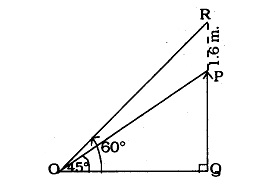
Statue=CD = 1.6 m
h = height of pedestal=BC
A is point on earth
In \(\triangle\)ABD, \(\cot { { 60 }^{ 0 } } =\frac { AB }{ BD } \)
\(\Rightarrow \quad \frac { 1 }{ \sqrt { 3 } } =\frac { AB }{ h+1.6 } \)
\(\Rightarrow \quad AB=\frac { h+1.6 }{ \sqrt { 3 } } \quad ...(i)\)
\(\triangle\)ABC, \(\frac { AB }{ BC } =\cot { { 45 }^{ 0 } } \)
\(\Rightarrow \quad \frac { 1 }{ \sqrt { 3 } } =\frac { AB }{ h+1.6 } \)
\(\Rightarrow \quad \frac { 1 }{ \sqrt { 3 } } =\frac { AB }{ h+1.6 } \)
\(\Rightarrow \quad AB=h\)
From (i) and (ii), we get
\(\Rightarrow \quad h=\frac { h+1.6 }{ \sqrt { 3 } } \)
Height of pedestal = h =2.2m.
7.
\(LHS=\left( cosec\theta -\sin { \theta } \right) \left( \sec { \theta } -\cos { \theta } \right) \left( \tan { \theta } +\cot { \theta } \right) \)
\(=\left( \frac { 1 }{ \sin { \theta } } -\sin { \theta } \right) \left( \frac { 1 }{ \cos { \theta } } -\cos { \theta } \right) \left( \frac { \sin { \theta } }{ \cos { \theta } } +\frac { \cos { \theta } }{ \sin { \theta } } \right) \)
\(=\left( \frac { 1-\sin ^{ 2 }{ \theta } }{ \sin { \theta } } \right) \left( \frac { 1-\cos ^{ 2 }{ \theta } }{ \cos { \theta } } \right) \left( \frac { \sin ^{ 2 }{ \theta } +\cos ^{ 2 }{ \theta } }{ \sin { \theta } .\cos { \theta } } \right) \)
\(=\frac { \cos ^{ 2 }{ \theta } }{ \sin { \theta } } \times \frac { \sin ^{ 2 }{ \theta } }{ \cos { \theta } } \times \left( \frac { 1 }{ \sin { \theta } .\cos { \theta } } \right) \)
\(\left[ \because \quad \sin ^{ 2 }{ \theta } +\cos ^{ 2 }{ \theta } =1 \right] \)
= 1
= RHS
8.
Given, a \(\triangle\) ABC, in which B=900
In a \(\triangle\) ABC, \(tanA=\frac { Perpendicular }{ base } \)
\(=\frac { BC }{ AB } =1\)
BC=AB
Let AB=BC=k, where k is a positive number.
Now, \(AC=\sqrt { { AB }^{ 2 }+{ BC }^{ 2 } } \) [by unsing Pythagoras theorem]
\(=\sqrt { { (k) }^{ 2 }+{ (k) }^{ 2 } } =k\sqrt { 2 } \)
\(\therefore \quad sinA=\frac { Perpendicular }{ Hypotenuse } =\frac { BC }{ AC } =\frac { k }{ \sqrt { 2 } k } =\frac { 1 }{ \sqrt { 2 } } \)
\(cosA=\frac { Base }{ Hypotenuse } =\frac { AB }{ AC } =\frac { k }{ \sqrt { 2 } k } =\frac { 1 }{ \sqrt { 2 } } \)
Now, LHS=2sin A cos A=\(2\left( \frac { 1 }{ \sqrt { 2 } } \right) \left( \frac { 1 }{ \sqrt { 2 } } \right) =1=RHS\)
Hence proved.
9.
\(\frac { \sin { { 70 }^{ 0 } } }{ \cos { { 20 }^{ 0 } } } +\frac { cosec{ 36 }^{ 0 } }{ \sec { { 54 }^{ 0 } } } -\frac { 2\cos { { 43 }^{ 0 } } cosec{ 47 }^{ 0 } }{ \tan { { 10 }^{ 0 } } \tan { { 40 }^{ 0 } } \tan { { 50 }^{ 0 } } \tan { { 80 }^{ 0 } } } \)
\(=\frac { \sin { { ({ 90 }^{ 0 }-20 }^{ 0 }) } }{ \cos { { 20 }^{ 0 } } } +\frac { cosec{ ({ 90 }^{ 0 }-54 }^{ 0 }) }{ \sec { { 54 }^{ 0 } } } -\frac { 2\cos { { 43 }^{ 0 } } cosec{ ({ 90 }^{ 0 }-43 }^{ 0 }) }{ \tan { { ({ 90 }^{ 0 }-80 }^{ 0 }) } \tan { { ({ 90 }^{ 0 }-50 }^{ 0 }) } \tan { { 50 }^{ 0 } } \tan { { 80 }^{ 0 } } } \)
\(=\frac { \cos { { 20 }^{ 0 } } }{ \cos { { 20 }^{ 0 } } } +\frac { \sec { { 54 }^{ 0 } } }{ \sec { { 54 }^{ 0 } } } -\frac { 2\cos { { 43 }^{ 0 } } \sec { { 43 }^{ 0 } } }{ \cot { { 80 }^{ 0 } } \cot { { 50 }^{ 0 } } \tan { { 50 }^{ 0 } } \tan { { 80 }^{ 0 } } } \)
\(\left[ \because \sin { ({ 90 }^{ 0 }-\theta ) } =\cos { \theta } ,cosec({ 90 }^{ 0 }-\theta )=\sec { \theta } ,\tan { ({ 90 }^{ 0 }-\theta ) } =\cot { \theta } \right] \)
\(=2-\frac { 2.1 }{ 2.1 } =2-2=0\)
10.
We have, \(\frac { \cos { { 60 }^{ 0 } } +\sin { { 45 }^{ 0 } } -\cot { { 30 }^{ 0 } } }{ \tan { { 60 }^{ 0 } } +\sec { { 45 }^{ 0 } } -cosec{ 30 }^{ 0 } } \)
\(=\frac { \frac { 1 }{ 2 } +\frac { 1 }{ \sqrt { 2 } } -\sqrt { 3 } }{ \sqrt { 3 } +\sqrt { 2 } -2 } =\frac { \frac { \sqrt { 2 } +2-2\sqrt { 2 } \times \sqrt { 3 } }{ 2\sqrt { 2 } } }{ \sqrt { 3 } +\sqrt { 2 } -2 } \)
\([ \because \cos { { 60 }^{ 0 } } =1/2,\sin { { 45 }^{ 0 } } =1/\sqrt { 2 } ,\cot { { 30 }^{ 0 } } =\sqrt { 3 }\)
\( \tan { { 60 }^{ 0 } } =\sqrt { 3 } ,\sec { { 45 }^{ 0 } } =\sqrt { 2 } \quad and\quad cosec{ 30 }^{ 0 }=2 ] \)
\(=\frac { \sqrt { 2 } +2-2\sqrt { 6 } }{ 2\sqrt { 2 } (\sqrt { 3 } +\sqrt { 2 } -2) } \)
\(=\frac { \sqrt { 2 } +2-2\sqrt { 6 } }{ 2\sqrt { 6 } +2\sqrt { 2 } \times \sqrt { 2 } -2\sqrt { 2 } \times 2 } =\frac { \sqrt { 2 } +2-2\sqrt { 6 } }{ 2\sqrt { 6 } +4-4\sqrt { 2 } } \)
11.
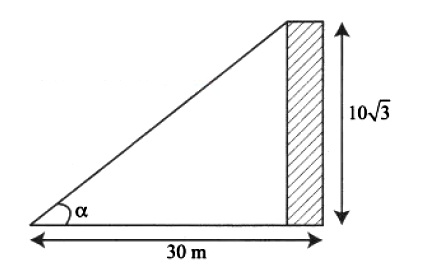
Let the angle of elevation of top of the tower be θ.
From ΔABC,
\({AB\over BC}=tan\theta\)
\(\Rightarrow\ {10\sqrt3\over 30}=tan\theta\)
\(\Rightarrow\ tan\theta={1\over\sqrt3}\)
θ=30°
Hence angle of elevation is θ.
12.
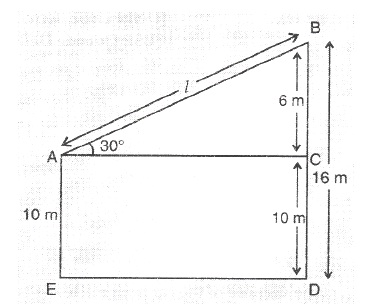
Let BD and AE be two poles
Where BD = 16 m, AE = 10m
Length BC = BD - CD
= BD-AE
= 16-10 = 6m
From ∆ABC
\({BC\over l}={sin30^0}\)
\({6\over l}={1\over 2}\)
1 = 6 x 2 = 12 m.
13.
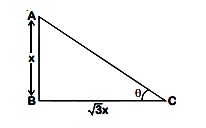
\({Length\ of\ rod\over Length\ of\ shadow}={1\over 1/\sqrt3}\)
\({p\over b}=tan\theta={1\over 1/\sqrt3}\)
\(tan\theta=\sqrt3=tan60^0\)
\(\theta=60^0\)
14.
Given, 5cosec \(\theta \) = 7
\(\Rightarrow \quad cosec\theta =\frac { 7 }{ 5 } \)
\(\Rightarrow \quad \sin { \theta } =\frac { 5 }{ 7 } \quad \left[ \because \quad cosec\theta =\frac { 1 }{ \sin { \theta } } \right] \)
\(\sin { \theta } +\cos ^{ 2 }{ \theta } -1=\sin { \theta } -\left( 1-\cos ^{ 2 }{ \theta } \right) \)
\(\left[ \because \sin ^{ 2 }{ \theta } +\cos ^{ 2 }{ \theta } =1 \right] \)
\(=\frac { 5 }{ 7 } -{ \left( \frac { 5 }{ 7 } \right) }^{ 2 }=\frac { 35-25 }{ 49 } =\frac { 10 }{ 49 } \)
15.
In right triangle ABC
\(cos\ 60^0={BC\over AC}\)
\({1\over 2}={2.5\over AC}\)
\(AC=5.0m\)
Length of the ladder is 5.0 m.
16.
Given, \(\sqrt { 2 } \sin { \theta } =1\)
\(\sin { \theta } =\frac { 1 }{ \sqrt { 2 } } =\sin { { 45 }^{ ° } } \)
\(\therefore \quad \theta ={ 45 }^{ ° }\)
Now \(\sec ^{ 2 }{ \theta } -cosec^{ 2 }\theta \) = \(\sec ^{ 2 }{ { 45 }^{ ° } } -cosec^{ 2 }{ 45 }^{ ° }\)
\(={ \left( \sqrt { 2 } \right) }^{ 2 }-{ \left( \sqrt { 2 } \right) }^{ 2 }\)
= 2 - 2
= 0
17.
Given \(\sec { \theta } .\sin { \theta } =0\)
\(\Rightarrow \quad \frac { \sin { \theta } }{ \cos { \theta } } =0\)
\(\Rightarrow \quad \tan { \theta } =0=\tan { { 0 }^{ ° } } \)
\(\therefore \quad \theta ={ 0 }^{ ° }\)
18.
Given, \(\sin { \alpha =\frac { 1 }{ 2 } } \)
then \(3\sin { \alpha } -4\sin ^{ 3 }{ \alpha } =3\times \frac { 1 }{ 2 } -4\times { \left( \frac { 1 }{ 2 } \right) }^{ 3 }\)
\(=\frac { 3 }{ 2 } -\frac { 4 }{ 8 } =1\)
19.
\(\frac {1}{3}\)
20.
Given, \(x=a\sec { \theta } and\quad y=b\tan { \theta } \)
\(\Rightarrow \quad \frac { x }{ a } =\sec { \theta } \quad and\quad \frac { y }{ b } =\tan { \theta } \quad \quad ..(i)\)
We know that, \(\quad \sec ^{ 2 }{ \theta } =1+\tan ^{ 2 }{ \theta } \)
\(\therefore \quad { \left( \frac { x }{ a } \right) }^{ 2 }=1+{ \left( \frac { y }{ b } \right) }^{ 2 }\) [from Eq. (i)]
\(\Rightarrow \quad \frac { { x }^{ 2 } }{ { a }^{ 2 } } -\frac { { y }^{ 2 } }{ { b }^{ 2 } } =1\)

10th Standard CBSE Syllabus & Materials
10th Standard CBSE
CBSE 10th Social Science PS - Federalism - New Model Questions Papers Study Material - QB365 Set A
NEW10th Standard CBSE
CBSE 10th Social Science PS - Power Sharing - New Model Questions Papers Study Material - QB365 Set A
NEW10th Standard CBSE
CBSE 10th Social Science GEO - Manufacturing Industries - New Model Questions Papers Study Material - QB365 Set A
NEW10th Standard CBSE
CBSE 10th Social Science GEO - Minerals and Energy Resources - New Model Questions Papers Study Material - QB365 Set A



CBSE 10th Standard CBSE Subjects
CBSE Standards





