
 100% FREE ACCESS
10th Standard CBSE Syllabus & Materials
10th Standard CBSE
CBSE 10th Social Science ECO - Globalisation and the Indian Economy - New Model Questions Papers Study Material - QB365 Set A
NEW10th Standard CBSE
CBSE 10th Social Science ECO - Money and Credit - New Model Questions Papers Study Material - QB365 Set A
NEW10th Standard CBSE
CBSE 10th Social Science ECO - Sectors of the Indian Economy - New Model Questions Papers Study Material - QB365 Set A
NEW10th Standard CBSE
CBSE 10th Social Science ECO - Development - New Model Questions Papers Study Material - QB365 Set A
NEW10th Standard CBSE
CBSE 10th Social Science PS - Outcomes of Democracy - New Model Questions Papers Study Material - QB365 Set A
NEW10th Standard CBSE
CBSE 10th Social Science PS - Gender, Religion and Caste - New Model Questions Papers Study Material - QB365 Set A

Published on: 24/09/2019
Surface Areas and Volumes
Download CBSE Class 10th Standard CBSE Maths question papers, sample papers, important questions, and previous year solved papers in PDF format. Get free study materials, NCERT solutions, and exam preparation resources for Class 10th Standard CBSE Maths
Questions + Answers key
Take MCQ Maths Test
1.
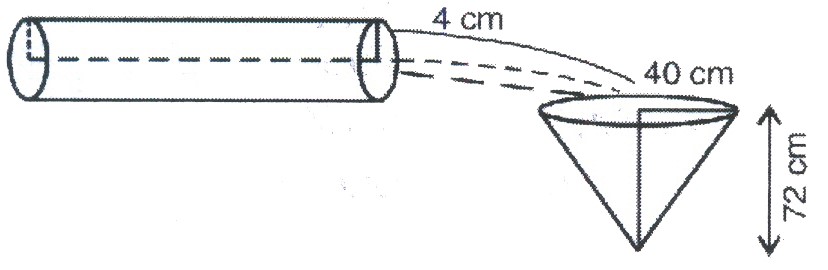
A cylindrical pipe has inner diameter of 4 cm and water flows through it at the rate of 20 m per minute. How long would it take to fill a conical tank, with diameter of base as 80 cm and depth 72 cm ?
2.
Water running in a cylindrical pipe of inner diameter 7 cm, is collected in a container at the rate of 192.5 litres per minute. Find the rate of flow of water in the pipe in km/h. \(\left[ Use\quad \pi =\frac { 22 }{ 7 } \right] \)
3.
A storage oil tanker consists of a cylindrical portion 7 m in diameter with two hemispherical ends of the same diameter. The oil tanker lying horizontally. If the total length of the tanker is 20 m, then find the capacity of the container.
4.
An iron pillar has some part in the form of a right circular cylinder and the remaining in the form of a right circular cone. The radius of the base of each of the cone and the cylinder is 8 cm. The cylindrical part is 240 cm high and conical part is 36 cm high. Find the weight of the pillar if 1 cu. cm of iron weights 7.5 grams.
5.
From a solid cylinder of height 7 cm and base diameter 12 cm, a conical cavity of same height and same base diameter is hollowed out. Find the total surface area of the remaining solid. \(\left[ Use\ \pi =\frac { 22 }{ 7 } \right] \)
6.
A right circular cone of radius 3 cm, has a curved surface area of 47.1 cm2 . Find the volume of the cone. \(\left[ Use\quad \pi =3.14 \right] \)
7.
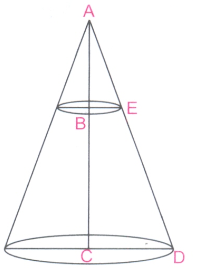
In the give figure from the top of a solid cone of a height 12 cm and base radius 6 cm, a cone of height 4 cm is removed by a plane parallel to the base. Find the total surface area of the remaining solid.(Use \(\pi=\frac{22}{7}\)and \(\sqrt{5}\) = 2.236)
8.
A solid wooden toy is in the form of a hemisphere surmounted by a cone of same radius. The radius of hemisphere is 3.5 cm and the total wood used in the making of toy is 166\(\frac{5}{6}\) cm3. Find the height of the toy. also, find the cost of painting the hemispherical part of the toy at the rate of Rs.10 per cm2.[Use \(\pi=\frac{22}{7}\)]
9.
Water in a canal, 6 m wide and 1.5 m deep, is flowing at a speed of 4 km/h. How much area will it irrigate in 10 minutes, if 8 cm of standing water is needed for irrigation?
10.
The size of the base of a cane full of kerosene is 20 cm x 20 cm and its height is 45 cm. The kerosene of this cane is poured into another cane having base of size 25 cm x 15 cm and height 50 cm. Determine the height of the kerosene in the second cane.
11.
Water flows in a tank 150 m x 100 m at the base through a pipe whose cross-section is 2 dm by 1.5 dm at the speed of 15 km/h. In what time will the water be 3 m deep?
12.
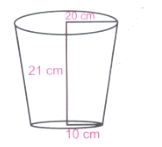
An open metal bucket is in the shape of a frustum of a cone of height 21 cm with radii of its lower and upper ends as 10 cm and 20 cm respectively. Find the cost of milk which can completely fill the bucket at Rs.30 per litre. [ \(\pi=\frac{22}{7}\)]
13.
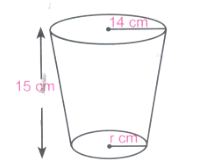
The radii of the circular ends of a bucket of height 15 cm are 14 cm and r cm (r < 14 cm). If the volume of bucket is 5390 cm3, then find the value of r Use \(\pi=\frac{22}{7}\)
14.
A rectangular reservoir is 120 m long and 75 m wide. At what speed per hour must water flow into it through a square pipe of 20 cm wide so that the water rises by 2.4 m in 18 hours?
15.
A teak wood log is cut first in the form of a cuboid of length 2.3 m, width 0.75 m and of a certain thickness. Its volume is 1.104 m3. How many rectangular planks of size 2.3 m x 0.75 m x 0.04 m can be cut from the cuboid?
1.
Let the time to fill the conical flask be x minutes.
In 1 minute 20 m water flows.
So in x minutes 20x m will flow.
\(\therefore\) Volume of water flowed through cylindrical pipe
= \(\pi r^2\) (20x) x 100 cm
= \(\pi\) (2)2 (20x) x 100 cm
Volume of water filled in conical tank
= \(\frac{1}{3}\pi\) (40)2 x 72 cm
Volume of water through pipe = Volume of water filled in conical tank
\(\Rightarrow\) \(\pi\)(2)2 (20x) 100 = \(\frac{\pi}{3}\) (40)2 x 72
\(\Rightarrow\) x = \(\frac{24}{5}\) minutes = 4\(\frac{4}{5}\) minutes
Hence, conical tank filled in 4\(\frac{4}{5}\) minutes
2.
We have,
Volume of water that flows per hour
= (192.50 x 60) litres
= (192.50 x 60 x 1000) cm3 ........(i)
Inner diameter of the pipe = 7 cm
Inner radius of the pipe \(\frac{7}{2}\) cm = 3.5 cm
Let h cm be the length of the column of water that flows in one hour.
Clearly, water column forms a cylinder of radius 3.5 cm and length h cm.
Volume of water that flows in one hour = Volume of the cylinder of radius 3.5 cm and length h cm.
3.
Radius of hemisphere portion = Radius of cylindrical portion = \(\frac{7}{2}m\)
Total length of the tanker = 20 m
\(\therefore\) Length of cylindrical portion = 20 - 7 = 13 m
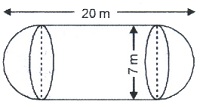
Now, Capacity (volume) of the oil tanker
= Volume of cylinder + 2 x Volume of hemisphere
= \(\pi r^2h+2\times\frac{2}{3}\pi r^3\)
= \(\frac{22}{7}\times\frac{7}{2}\times\frac{7}{2}\times13+2\times\frac{2}{3}\times\frac{22}{7}\times\frac{7}{2}\times\frac{7}{2}\times\frac{7}{2}\)
= 500.5 + 179.67 = 680.17 m3
4.
Radius of base of each of the cone and the cylinder (r) = 8 cm
Height of cylindrical part (h1) = 240 cm
Heigth of conical part (h2) = 36 cm
Colume of the iron pillar = Volume of cylinder + Volume of cone
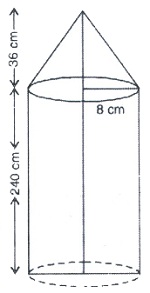
= \(\pi (8)^2\times240+\frac{1}{3}\pi (8)^2\times36\)
= 64\(\pi\) (240 + 12)
= 64 x \(\frac{22}{7}\) x 252 = 50688 cm3
\(\therefore\) Weight of the piller = 7.5 x 50688 g
= 380160g = 380.16 kg.
5.
Here, radius of cone and cylinder = 6 cm
Height of cone and cylinder = 7 cm
Slant height of cone = \(\sqrt { { \left( 6 \right) }^{ 2 }+{ \left( 7 \right) }^{ 2 } } \)
= \(\sqrt{36+46}\)
= \(\sqrt{85}\)
= 9.22 cm
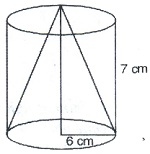
Now, total surface area of the remaining solid = C.S.A. of cylinder + C.S.A. of cone + area of base of cylinder= \(2\pi rh+\pi rl+\pi r^2\)
= \(\pi r\)(2h + l + r)
= \(\frac{22}{7}\) x 6(2 x 7 + 9.22 + 6)
= \(\frac{22}{7}\) x 6 x 29.22 = 551 cm2
6.
Here, radius of light circular cone (r) = 3cm.
Let h and l be the height and slant height of the right circular cone respectively.
Now, \(\pi rl\) = 47.1 cm2 [given]
\(\Rightarrow\) 3.14 x 3 x l = 47.1
\(\Rightarrow\) l = \(\frac{47.1}{3.14\times3}\) = 5 cm
Also, r2 + h2 = l2
\(\Rightarrow\) 32 + h2 = 52
\(\Rightarrow\) h2 = 25 - 9 = 16
\(\Rightarrow\) h = 4 cm
\(\therefore\) Volume of the cone = \(\frac{1}{3}\pi r^2h\)
= \(\frac{1}{3}\) x 3.14 x 3 x 3 x 4
= 37.68 cm3
7.
Let radius of the upper face = BE = x
\(\triangle\)ABE ~ \(\triangle\)ACD
\(\Rightarrow\) \({{AB}\over{AC}}={{BE}\over{CD}}\)
\(\Rightarrow\) \({{4}\over{12}}={{x}\over{6}}\Rightarrow x=2\) cm
-S.jpg)
Remaining solid is a frustum with height
= 12 - 4 = 8 cm
r1 - 2 cm, r2 = 6 cm
Let Slant height be
l = \(\sqrt{{h}^{2}+{({r}_{2}-{r}_{1})}^{2}}\)
l = \(\sqrt{64+16}\)
l = \(\sqrt{80}\)
l = \(4\sqrt 5\) cm
Now, total surface area
= \(\pi l({r}_{1}+{r}_{2})+{ \pi r }_{ 1 }^{ 2 }+{ \pi r }_{ 2 }^{ 2 }\)
= \(\pi[l({r}_{1}+{r}_{2})+{ r }_{ 1 }^{ 2 }+{ r }_{ 2 }^{ 2 }]\)
= \({{22}\over{7}}[4\sqrt{5}(2+6)+4+36]\)
= \({{22}\over{7}}\times[32\sqrt{5}+40]\)
= \({{22}\over{7}}(32\times2.236+40]\)
= 350.592 cm2
8.
Let height of the cone be x cm
Radius of the cone = 3.5 cm = radius of hemisphere
-S.jpg)
Volume of the toy = \({{1}\over{3}}{\pi r}^{2}h+{{2}\over{3}}{\pi r}^{3}\)
\(166{{5}\over{6}}={{1}\over{3}}\times{{22}\over{7}}{(3.5)}^{2}\times x+{{2}\over{3}}\times{{22}\over{7}}\times{(3.5)}^{3}\)
\({{1001}\over{6}}={{269.5}\over{21}}x+{{1886.5}\over{21}}\)
\(\Rightarrow\) \({{1001}\over{6}}-{{1886.5}\over{21}}={{269.5}\over{21}}x\)
\(\Rightarrow\) \({{3234\times21}\over{42\times269.5}}=x\Rightarrow 6\) cm2
\(\therefore\) Height of toy = 6 cm + 3.5 cm = 9.5 cm
Surface area of hemicspherical part = \({2\pi r}^{2}\)
= \(2\times{{22}\over{7}}\times3.5\times3.5=77\) cm2
Cost to paint at a rate of Rs 10 per cm2
= 77 x 10 = Rs 770
9.
-S.jpg)
Consider an area of cross-section of canal as ABCD.
Area of cross-section = 6 × 1.5 = 9 m2
Speed of water = 10 km/h = 10000/60 metre/min
Volume of water that flows in 1 minute from canal = 9 x 10000/60 =1500 m3
Volume of water that flows in 30 minutes from canal = 30 × 1500 = 45000 m3
Let the irrigated area be A. Volume of water irrigating the required area will be equal to the volume of water that flowed in 30 minutes from the canal.
Vol. of water flowing in 30 minutes from canal = Vol. of water irrigating the reqd. area
4500 = (Ax8)/100
A = 562500 m2
Therefore, area irrigated in 30 minutes is 562500 m2.
10.
Volume of kerosene in case
= 20 x 20 x 45 = 25 x 15 x h (Volume in second cane)
\(\Rightarrow\) h = \(\frac{20\times20\times45}{25\times15}\) = 48 cm
11.
Suppose in x hours water will be 3 metres deep in the tank.
Volume of water in the tank = (150 x 100 x 3) m3 = 45000 m3
Area of cross-section of the pipe = \((\frac{2}{10}\times\frac{1.5}{10})m^2=\frac{3}{100}m^2\)
Volume of water that flows in the tank in x hours
= (area of cross-section of the pipe) x (speed of water) x (time)
= \((\frac{3}{100}\times15000\times x)\) m3 = 450 x m3
[\(\therefore\) Speed = 15 km/h = 15000 m/h]
Since the volume of water in the tank is equal to the volume of water that flows in the tank in x hours.
\(\therefore\) 450 x = 45000 \(\Rightarrow\) x = 100 hours.
12.
R= 20cm, r= 10 cm h=21 cm
Capacity of bucket = \(\frac { 1 }{ 3 } \pi h\left( R^{ 2 }+r^{ 2 }+Rr \right) \)
= \(\frac { 1 }{ 3 } \times \frac { 22 }{ 7 } \times 21\times \left( 20 \right) ^{ 2 }+\left( 10 \right) ^{ 2 }+20\times 10\)
= 22 (400 +100 + 200)
= 22 x 700 = 15400 cm3 = \(\frac { 15400 }{ 1000 } l=15.4l\)
Total cost of milk at the rate of Rs 30 per litre = Rs 30 X 15.4 = Rs 462.00
13.
Radii of bucket are 14 cm and r cm
h = 15cm
Volume of the bucket = \(\frac { 1 }{ 3 } \pi h(R^{ 2 }+R\times r+r^{ 2 })\)
\(\Rightarrow 5390=\frac { 1 }{ 3 } \times \frac { 22 }{ 7 } \times 15(196+14r+r^{ 2 })\)
\(\Rightarrow \frac { 5390\times 7 }{ 22\times 5 } =196+14r+r^{ 2 }\)
\(\Rightarrow 343-196=14r^{ 2 }+r^{ 2 }\Rightarrow r^{ 2 }+14r-147=0\)
\(\Rightarrow r^{ 2 }+21r-7r-147=0\Rightarrow r(r+21)-7(r+21)=0\)
\(\Rightarrow (r-7)(r+2)=0\Rightarrow r=7,-21\) (Rejected)
\(\therefore \) r= 7cm
14.
Length of reservoir = 120m and width = 75m
Height of water = 2.4 m
Volume of water flow in 18 hrs = 120 x 75 x 2.4 = 21600 m3
Hence volume of water that should flow in 1 hr = \(\frac { 21600 }{ 18 } =1200\quad m^{ 2 }\)
Area of cross-section of pipe = \(\frac { 20 }{ 100 } \times \frac { 20 }{ 100 } =.04m^{ 2 }\)
\(\therefore \) Length of water column in 1 hour = \(\frac { volume }{ area } =\frac { 1200 }{ 04 } =30000m\)
Speed of water = 30000 m/h = 30 km/h
15.
Thickness of the log = \(\frac{volume}{l\times b}=\frac{1.104}{2.3\times0.75}\)m = 0.64 m
Number of planks = \(\frac{thickness \ \ of \ \ the \ \ log}{thickness \ \ of \ \ one \ \ plank}=\frac{0.64}{0.04}\) = 16

10th Standard CBSE Syllabus & Materials
10th Standard CBSE
CBSE 10th Social Science PS - Federalism - New Model Questions Papers Study Material - QB365 Set A
NEW10th Standard CBSE
CBSE 10th Social Science PS - Power Sharing - New Model Questions Papers Study Material - QB365 Set A
NEW10th Standard CBSE
CBSE 10th Social Science GEO - Manufacturing Industries - New Model Questions Papers Study Material - QB365 Set A
NEW10th Standard CBSE
CBSE 10th Social Science GEO - Minerals and Energy Resources - New Model Questions Papers Study Material - QB365 Set A



CBSE 10th Standard CBSE Subjects
CBSE Standards





