
 100% FREE ACCESS
10th Standard CBSE Syllabus & Materials
10th Standard CBSE
CBSE 10th Social Science ECO - Globalisation and the Indian Economy - New Model Questions Papers Study Material - QB365 Set A
NEW10th Standard CBSE
CBSE 10th Social Science ECO - Money and Credit - New Model Questions Papers Study Material - QB365 Set A
NEW10th Standard CBSE
CBSE 10th Social Science ECO - Sectors of the Indian Economy - New Model Questions Papers Study Material - QB365 Set A
NEW10th Standard CBSE
CBSE 10th Social Science ECO - Development - New Model Questions Papers Study Material - QB365 Set A
NEW10th Standard CBSE
CBSE 10th Social Science PS - Outcomes of Democracy - New Model Questions Papers Study Material - QB365 Set A
NEW10th Standard CBSE
CBSE 10th Social Science PS - Gender, Religion and Caste - New Model Questions Papers Study Material - QB365 Set A

Published on: 03/12/2018
From the chapterTrianlges Important Question Paper are covered in this question paper.
Questions are prepared from the creative as well as previous year question paper.
Download CBSE Class 10th Standard CBSE Maths question papers, sample papers, important questions, and previous year solved papers in PDF format. Get free study materials, NCERT solutions, and exam preparation resources for Class 10th Standard CBSE Maths
Questions + Answers key
Take MCQ Maths Test
1.
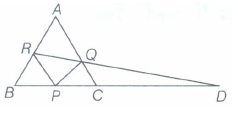
In the given figure, \(PQ\parallel BA\) and \(PR\parallel CA\) . If PD = 12 cm, then find BD x CD.
2.
Equilateral triangles are drawn on the sides of a right angled triangle. Show that the area of the triangle on the hypotenuse is equal to the sum of the areas of triangles on the other two sides.
3.
If \(\triangle ABC\sim \triangle QRP\), \(\frac { ar\left( \triangle ABC \right) }{ ar\left( \triangle QRP \right) } =\frac { 9 }{ 4 } \), AB = 18 cm and BC = 15 cm, then find PR.
4.
In \(\triangle ABC\) , D and E are points on the sides AB and AC respectively, such that \(DE\parallel BC\) . If AD = 4x - 3, AE = 8x - 7, BD = 3x - 1 and CE = 5x - 3, find the value of x.
5.
It is given that \(\triangle ABC\sim \triangle EDF\) such that AB = 5 cm, AC = 7 cm, DF = 15 cm and DE = 12 cm. Find the lengths of the remaining sides of the triangles.
6.
A street light bulb is fixed on a pole 6 m above the level of the street. If a woman of height 1.5 m casts a shadow of 3 m, find how far is she away from the base of the pole?
7.
Give two examples of pair of similar and non-similar figures.
8.
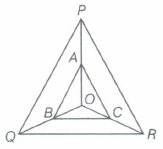
In the given figure, A, B and C are points on OP, OQ and OR respectively, such that \(AB\parallel PQ\) and \(AC\parallel PR\). Show that \(BC\parallel QR\).
9.
In a \(\triangle ABC\), P and Q are points in AB and AC, respectively and \(PQ\parallel BC\). Prove that the median bisects PQ.
10.
Two trees of heights x and y are d m apart.
(i)Prove that the height of the point of intersection of the line joining the top of each tree to the foot of the opposite trees is given by \(\frac { xy }{ x+y } m\)
(ii) Which mathematical concept is used in this problem?
(iii) What are the values depicted here?
11.
In the given figure, G is the mid-point of the side PQ of \(\triangle\)PQR and GH || QR. Prove that H is the mid-point of the side PR of the triangle PQR.
12.
If triangle ABC is similar to triangle DEF such that 2AB = DE and BC = 8 cm, then find EF.
13.
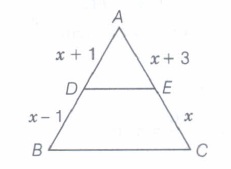
In \(\triangle\)ABC, DE || BC, find the value of x.
14.
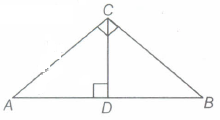
In the given figure, \(\triangle ACB\) = 90° and \(CD\bot AB\) . Prove that \(\frac { { { BC }^{ 2 } } }{ { AC }^{ 2 } } =\frac { BD }{ AD } \) .
15.
In a right angled triangle, if hypotenuse is 20 cm and the ratio of other two sides is 4 : 3, find the other sides.
1.
144
2.
Since, \(\triangle ABN\sim \triangle ACM\) [given]
\(\frac { ar\left( \triangle ABN \right) }{ ar\left( \triangle ACM \right) } =\frac { { AB }^{ 2 } }{ { AC }^{ 2 } } \) ... (i)
Similarity, \(\frac { ar\left( \triangle BCL \right) }{ ar\left( \triangle ACM \right) } =\frac { { BC }^{ 2 } }{ { AC }^{ 2 } } \) ... (ii)
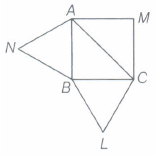
On adding Eqs.(i) and (ii), we get
\(\frac { ar\left( \triangle ABN \right) +ar\left( \triangle BCL \right) }{ ar\left( \triangle ACM \right) } =1\)
3.
Given, \(\triangle ABC\sim \triangle QRP\), AB = 18 cm, BC = 15 cm
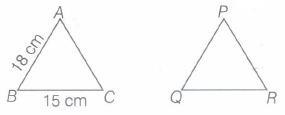
We know that, the ratio of areas of two similar triangles is equal to the ratio of squares of their corresponding sides.
\(\therefore \frac { ar\left( \triangle ABC \right) }{ ar\left( \triangle QRP \right) } =\frac { { \left( BC \right) }^{ 2 } }{ { \left( RP \right) }^{ 2 } } \)
But \(\frac { ar\left( \triangle ABC \right) }{ ar\left( \triangle QRP \right) } =\frac { 9 }{ 4 } \) given]
\(\Rightarrow \frac { { \left( 15 \right) }^{ 2 } }{ { \left( RP \right) }^{ 2 } } =\frac { 9 }{ 4 } \) [\(\because \) BC = 15 cm]
\(\Rightarrow { \left( RP \right) }^{ 2 }=\frac { 225\times 4 }{ 9 } =100\)
\(\therefore \) RP = 10 cm
[taking positive square root]
4.
Given, in \(\triangle ABC\), \(DE\parallel BC\)
By Thales theorem, we get
\(\frac { AD }{ DB } =\frac { AE }{ EC } \)
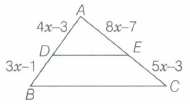
\(\Rightarrow \frac { 4x-3 }{ 3x-1 } =\frac { 8x-7 }{ 5x-3 } \)
[\(\because \) AD = 4x - 3, DB = 3x - 1, AE = 8x - 7, EC = 5x - 3]
\(\Rightarrow \) (4x - 3)(5x - 3) = (8x - 7)(3x - 1)
\(\Rightarrow \) 20x2 - 12x + 9 - 15x = 24x2 - 21x - 8x + 7
\(\Rightarrow \) 4x2 - 2x - 2 = 0
\(\Rightarrow \) 2x2 - x - 1 = 0 [dividing both sides by 2]
\(\Rightarrow \) 2x2 - 2x + x - 1 = 0 [by splitting the middle term]
\(\Rightarrow \) 2x(x - 1) + 1 (x - 1) = 0
\(\Rightarrow \) (2x + 1) (x - 1) = 0 \(\therefore x=-\frac { 1 }{ 2 } \) or x = 1
If \(x=-\frac { 1 }{ 2 } \), then AD = \(4\times -\frac { 1 }{ 2 } -3=-5<0\) [not possible]
Hence, x = 1 is the required value.
5.
Given, \(\triangle ABC\sim \triangle EDF\)
Also, AB = 5 cm, AC = 7 cm, DF = 15 cm
and DE = 12 cm .... (i)
Since, \(\triangle ABC\sim \triangle EDF\)
\(\therefore \frac { AB }{ ED } =\frac { AC }{ EF } =\frac { BC }{ DF } \)
[ ∵ Corresponding sides of similar triangles are proportions]
\(\Rightarrow \frac { 5 }{ 12 } =\frac { 7 }{ EF } =\frac { BC }{ 15 } \) [from Eq. (i)]
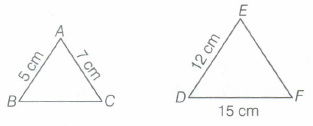
On taking first and second terms, we get
\(\frac { 5 }{ 12 } =\frac { 7 }{ EF } \Rightarrow EF=\frac { 7\times 12 }{ 5 } \) = 16.8 cm
On taking first and third terms, we get
\(\frac { 5 }{ 12 } =\frac { BC }{ 15 } \Rightarrow BC=\frac { 5\times 15 }{ 12 } \) = 6.25 cm
Hence, lengths of the remaining sides of the triangles are EF = 16.8 cm and BC = 6.25 cm.
6.
Draw the figure according to the question and get two triangles. Then, show both triangles are similar by AAA similarity criterion and then calculate the required distance.
She is at 9 m from the base of the pole.
7.
(i) Examples of similar figures:
(a) All squared
(b) All regular hexagons
(ii) Examples of non-similar figures:
(a) Two isosceles triangles of different angle measures
(b) Two rhombus of different angle measures.
8.
In \(\triangle OPQ\), \(AB\parallel PQ\) [given]
\(\therefore \quad \frac { OA }{ AP } =\frac { OB }{ BQ } \) ... (i)
[by basic proportionality theorem]
Also, in \(\triangle OPR\), \(AC\parallel PR\) [given]
\(\therefore \quad \frac { OA }{ AP } =\frac { OC }{ CR } \) ... (ii)
From Eqs. (i) and (ii),
\(\frac { OB }{ BQ } =\frac { OC }{ CR } \Rightarrow \quad BC\parallel QR\)
[by converse of basic proportionality theorem]
Hence proved.
9.
In \(\triangle APR\) and \(\triangle ABD\),
\(\angle APR\) = \(\angle ABD\)
\(\angle ARP\) = \(\angle ADB\)
\(\therefore \triangle ABC\sim \triangle ABD\)
[by AA criteria of similarity]
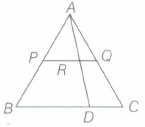
\(\frac{PR}{BD}=\frac{AR}{BD}\) ... (i)
Similarity, we can prove
\(\frac{AR}{AD}=\frac{RQ}{DC}\) ... (ii)
From Eqs.(i) and (ii),
\(\frac{PR}{BD}=\frac{RQ}{DC}\) [\(\because\) AD is median]
PR = RQ
So, median AD bisects PQ.
10.
(ii) Similarity of triangles
(iii) Trees are helpful to maintain the balance in the environment. They should be saved at any cost.
11.
Since G is the mid-point of PQ,
\(\therefore\) PG=PQ
\(\Rightarrow \frac { PG }{ GQ } =1\)
According to the question,
GH || QR
\(\therefore \frac { PG }{ GQ } =\frac { PH }{ HR } \)
\(\Rightarrow 1=\frac { PH }{ HR } \)
\(\therefore\) PH=HR.
Hence, H is the mid-point of PR.
12.
Given 2AB = DE and BC = 8 cm
\(\triangle\)ABC ~ \(\triangle\)DEF
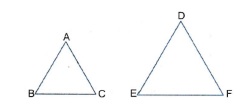
So \(\frac { AB }{ BC } =\frac { DE }{ EF } \)
\(\Rightarrow d \frac { AB }{ 8 } =\frac { 2AB }{ EF } \)
\(\therefore EF=2\times 8=16 cm.\)
13.
As DE || BC
\(\therefore \frac { AD }{ DB } =\frac { AE }{ EC } \)
\(\Rightarrow \frac { x }{ x+1 } =\frac { x+3 }{ x+5 } \)
\(\Rightarrow \)x2+5x=x2+4x+3
\(\Rightarrow \)x=3
14.
In \(\triangle ADC\) and \(\triangle ACB\),
\(\angle ADC=\angle ACB\) [each angle 90°]
\(\angle DAC= \angle CAB\) [common angle]
So, \(\triangle ADC\sim \triangle ACB\)
[by AAA similarity criterion]
Then, \(\frac{AD}{AC}=\frac{AC}{BA}\)
[since, corresponding sides of similar triangles are proportional]
\(\Rightarrow\) AC2 = AB x AD ... (i)
Similarly, \(\triangle BDC\sim \triangle BCA\)
\(\frac{BD}{BC}=\frac{BC}{AB}\)
[since, corresponding sides of similar triangles are proportional]
\(\Rightarrow\) BC2 = AB x AD ... (ii)
On dividing Eq.(i) by Eq.(ii), we get
\(\frac { { { BC }^{ 2 } } }{ { AC }^{ 2 } } =\frac { BD }{ AD } \)
15.
12 cm, 16 cm

10th Standard CBSE Syllabus & Materials
10th Standard CBSE
CBSE 10th Social Science PS - Federalism - New Model Questions Papers Study Material - QB365 Set A
NEW10th Standard CBSE
CBSE 10th Social Science PS - Power Sharing - New Model Questions Papers Study Material - QB365 Set A
NEW10th Standard CBSE
CBSE 10th Social Science GEO - Manufacturing Industries - New Model Questions Papers Study Material - QB365 Set A
NEW10th Standard CBSE
CBSE 10th Social Science GEO - Minerals and Energy Resources - New Model Questions Papers Study Material - QB365 Set A



CBSE 10th Standard CBSE Subjects
CBSE Standards





