
 100% FREE ACCESS
10th Standard CBSE Syllabus & Materials
10th Standard CBSE
CBSE 10th Social Science ECO - Globalisation and the Indian Economy - New Model Questions Papers Study Material - QB365 Set A
NEW10th Standard CBSE
CBSE 10th Social Science ECO - Money and Credit - New Model Questions Papers Study Material - QB365 Set A
NEW10th Standard CBSE
CBSE 10th Social Science ECO - Sectors of the Indian Economy - New Model Questions Papers Study Material - QB365 Set A
NEW10th Standard CBSE
CBSE 10th Social Science ECO - Development - New Model Questions Papers Study Material - QB365 Set A
NEW10th Standard CBSE
CBSE 10th Social Science PS - Outcomes of Democracy - New Model Questions Papers Study Material - QB365 Set A
NEW10th Standard CBSE
CBSE 10th Social Science PS - Gender, Religion and Caste - New Model Questions Papers Study Material - QB365 Set A

Published on: 18/09/2019
Triangles
Download CBSE Class 10th Standard CBSE Maths question papers, sample papers, important questions, and previous year solved papers in PDF format. Get free study materials, NCERT solutions, and exam preparation resources for Class 10th Standard CBSE Maths
Questions + Answers key
Take MCQ Maths Test
1.
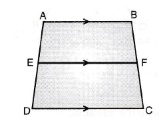
In the given figure, if ABCD is a trapezium in which AB || CD || EF, then prove that \(\frac { AE }{ ED } =\frac { BF }{ FC } .\)
2.
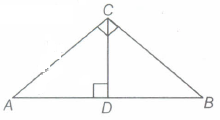
In the given figure, \(\triangle ACB={ 90 }^{ ° }\) and \(CD\bot AB\) . Prove that \(\frac { { BC }^{ 2 } }{ { AC }^{ 2 } } =\frac { BD }{ AD } \)
3.
In the given figure, CB II QR and CA II PR. If AQ = 12 cm, AR = 20 cm, PB = CQ = 15 cm, calculate PC and BR.
4.
In the given figure, if AB II DC, find the value of x.
5.
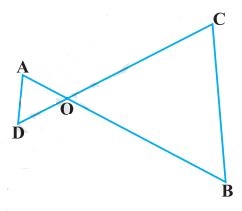
In the given figure, OA . OB = OC . OD. Show that \(\angle\)A = \(\angle\)C and \(\angle\)B = \(\angle\)D.
6.
In the given figure, PQR is a triangle right angled at Q and XY || QR. If PQ=6 cm, PY=4 cm and PX : XQ=1 : 2. Calculate the lengths of PR and QR.
7.
ABCD is a trapezium in which AB || DC and its diagonals intersect each other at the point O. Show that \(\frac { AO }{ BO } =\frac { CO }{ DO } .\)
8.
In the given figure, find the measure of \(\angle\)X.
9.
In the given figure, in a triangle PQR, ST || QR and \(\frac { PS }{ SQ } =\frac { 3 }{ 5 } \) and PR=28 cm, find PT.
10.
In the given triangle PQR, \(\angle\)OPR = 90\(\unicode{xb0} \), PQ = 24 cm and QR = 26 cm and in PKR, \(\angle\)PKR = 90\(\unicode{xb0} \) and KR = 8 cm, find PK.
11.
In the given figure, DE || BC. If AD=1.5 cm, BD=2AD, then find \(\frac { ar(\triangle ABC) }{ ar(trapeziumBCED) } .\)
12.
In an equilateral triangle of side 24 cm, find the length of the altitude.
13.
In the given figure, OA = 3 cm, OB = 4 cm, \(\angle\)AOB = 90\(\unicode{xb0} \), AC = 12 cm and BC = 13 cm, prove that \(\angle\)CAB = 90\(\unicode{xb0} \).
14.
In an equilateral triangle of side\(3\sqrt { 3 } cm,\) find the length of the altitude.
15.
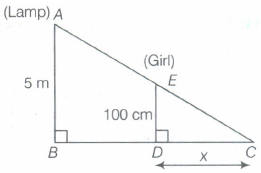
A girl of height 100 cm is walking away from the base of a lamppost at a speed of 1.9 m/s. If the lamp is 5 m above the ground, find the length of her shadow after 4s.
1.
Drac AC intersecting EF at G.
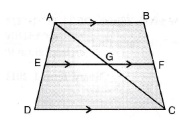
AB || DC and EF || AB (Given)
So, EF || DC (Lines parallel to the same line are parallel to each other)
Now, in D ADC,
EG || DC (As EF || DC)
So, \(\frac{\mathrm{AE}}{\mathrm{ED}}=\frac{\mathrm{AG}}{\mathrm{GC}}\) Similarly, from D CAB,
\(\frac{\mathrm{CG}}{\mathrm{AG}}=\frac{\mathrm{CF}}{\mathrm{BF}}\)
ie., \(\frac{\mathrm{AG}}{\mathrm{GC}}=\frac{\mathrm{BF}}{\mathrm{FC}}\)
Therefore, from (1) and (2),
\(\frac{\mathrm{AE}}{\mathrm{ED}}=\frac{\mathrm{BF}}{\mathrm{FC}}\)
2.
In \(\triangle ADC\) and \(\triangle ACB\),
\(\angle ADC=\angle ACB\) [each 90°]
\(\angle DAC=\angle CAB\) [common angle]
So, \(\triangle ADC\sim \triangle ACB\)
[by AA similarity criterion]
Then, \(\frac{AD}{AC}=\frac{AC}{BA}\)
[since, corresponding sides of similar triangles are proportional]
\(\Rightarrow \) AC2 = AB x AD ..... (i)
Similarity, \(\triangle BDC\sim \triangle BCA\)
\(\therefore \frac{BD}{BC}=\frac{BC}{AB}\)
[since, corresponding sides of similar triangles are proportional]
\(\Rightarrow \) BC2 = AB x BD ..... (ii)
On dividing Eq (ii) by Eq (i), we get
\(\frac { { BC }^{ 2 } }{ { AC }^{ 2 } } =\frac { BD }{ AD } \)
3.
In \(\triangle\) PQR, CA || PR
\(\therefore \quad \frac { PC }{ CQ } =\frac { RA }{ AQ } (By\quad BPT)\)
\(\Rightarrow \quad \frac { PC }{ 15 } =\frac { 20 }{ 12 } \)
\(\Rightarrow \quad PC=\frac { 20\times 15 }{ 12 } =25\)
\(\therefore \quad PC=25\quad cm\)
In \(\triangle\) PQR , CB || QR
\(\therefore \quad \frac { PC }{ CQ } =\frac { PB }{ BR } (By\quad BPT)\)
\(\Rightarrow \quad \frac { 25 }{ 15 } =\frac { 15 }{ BR } \)
\(\Rightarrow \quad BR=\frac { 15\times 15 }{ 25 } =9\quad cm\)
4.
Since the diagonals of a trapezium divide each other proportionally, we have
\(\therefore \frac { OA }{ OC } =\frac { BO }{ OD } \)
\(\Rightarrow \frac { x+5 }{ x+3 } =\frac { x-1 }{ x-2 } \)
\(\Rightarrow\) (x + 5)(x - 2) = (x - 1)(x + 3)
\(\Rightarrow\) x2- 2x + 5x - 10 = ~ + 3x - x - 3
\(\Rightarrow\) 3x-2x = 10-3
\(\therefore\) x = 7.
5.
OA. OB = OC . OD (Given)
So, \(\frac{\mathrm{OA}}{\mathrm{OC}}=\frac{\mathrm{OD}}{\mathrm{OB}}\) (1)
Also, we have \(\angle\)AOD = \(\angle\)COB (Vertically opposite angles) (2)
Therefore, from (1) and (2), \(\Delta\)AOD \(\sim\) \(\Delta\)COB (SAS similarity criterion)
So, \(\angle\)A = \(\angle\)C and \(\angle\)D = \(\angle\)B
(Corresponding angles of similar triangles)
6.
Since, XY || QR
\(\therefore \frac { PX }{ XQ } =\frac { PY }{ YR } \)
\(\Rightarrow \frac { 1 }{ 2 } =\frac { PY }{ PR-PY } \)
\(\Rightarrow\) PR-4=8
\(\Rightarrow\) PR=12 cm
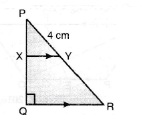
In right \(\triangle\)PQR, QR2=PR2-PQ2
= 122-62
= 144-36=108
QR = 6\(\sqrt3\)cm
7.
In \(\triangle\)AOB and \(\triangle\)COD,
AB || CD
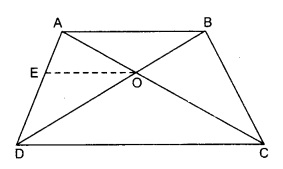
OAB = DCO and OBA = ODC (Alternate angles)
\(\triangle\)AOB ~\(\triangle\)COD (AA similarity)
\(\therefore \frac { AO }{ BO } =\frac { CO }{ DO } .\\ \) (Corresponding sides of similar triangles)
or \(\frac { AO }{ CO } =\frac { BO }{ DO } \)
8.
From given figures.
\(\frac { PQ }{ ZY } =\frac { 4.2 }{ 8.4 } =\frac { 1 }{ 2 } ;\)
\(\frac { PR }{ ZX } =\frac { 3\sqrt { 3 } }{ 6\sqrt { 3 } } =\frac { 1 }{ 2 } ;\)
\(\frac { QR }{ ZY } =\frac { 7 }{ 14 } =\frac { 1 }{ 2 } ;\)
\(\Rightarrow \quad \frac { PQ }{ ZY } =\frac { PR }{ ZX } =\frac { QR }{ ZY } \)
\(\Rightarrow \triangle PQR\)~\( \triangle ZYX\)
\(\therefore \quad \angle X=\angle R\)
\(\therefore \quad \angle X=\)1800-(600+700)=500
9.
According to the question,
ST || QR
\(\therefore \frac { PS }{ SQ } =\frac { PT }{ PR } \)
Given, \(\frac { PS }{ SQ } =\frac { 3 }{ 5 } and PR=28cm\)
\(\Rightarrow\frac { 3 }{ 5 } =\frac { PT }{ 28 } \)
\(\therefore PT=\frac { 3\times 28 }{ 5 } =16.8cm\)
10.
According to the question, (Given)
\(\angle\)OPR = 90\(\unicode{xb0} \)
\(\therefore\) QR2=QP2+PR2
\(\therefore\) PR=\(\sqrt { { 26 }^{ 2 }-{ 24 }^{ 2 } } \)
\(=\sqrt { 100 } =10\)
\(\angle\)PKR = 90\(\unicode{xb0} \)
\(PK=\sqrt { { 10 }^{ 2 }-8^{ 2 } } \\ =\sqrt { 100-64 } \\ =\sqrt { 36 } =6 cm.\)
11.
Given: AD=1.5 cm, BD=3 cm and AB=AD+BD=1.5+3.0=4.5 cm.
Given, In triangle ADE and ABC,
\(\angle\)A is common and DE || BC
\(\angle\)ADE=\(\angle\)ABC (Corresponding angles)
\(\triangle\)ADE~\(\triangle\)ABC, (AA similarity)
\(\frac { ar(\triangle ADE) }{ ar(\triangle ABC) } =\frac { { AD }^{ 2 } }{ { AB }^{ 2 } } =\frac { { (1.5) }^{ 2 } }{ { (4.5) }^{ 2 } } =\frac { 1 }{ 9 } \)
\(\Rightarrow \quad \frac { ar(\triangle ADE) }{ ar(\triangle ABC)-ar(\triangle ADE) } =\frac { 1 }{ 9-1 } \)
\(\Rightarrow \quad \frac { ar(\triangle ADE) }{ ar(trapezium\quad BCED) } =\frac { 1 }{ 8 } \)
12.
Let \(\triangle\)ABC be an equilateral triangle of side 24 cm and Ad is altitude which is also a perpendicular bisector of side BC.
Hence BD=\(\frac { BC }{ 2 } =\frac { 24 }{ 2 } =12\quad cm\)
AB=24 cm
\(\therefore \quad AD=\sqrt { { AB }^{ 2 }-{ BD }^{ 2 } } \)
\(=\sqrt { { (24) }^{ 2 }-{ (12) }^{ 2 } } \)
\(=\sqrt { 576-144 } \)
\(=\sqrt { 432 } \)
\(AD=12\sqrt { 3 } cm\)
The length of the altitude is \(12\sqrt { 3 } cm.\)
13.
AB2 = OA2 + OB2 = (3)2 + (4)2 (Pythagoras the)
AB = 5 cm
AB2 + AC2 = (5)2 + (12)2 = (13)2 = BC2
\(\angle\)CAB = 90\(\unicode{xb0} \) (Converse of Pythagoras the)
14.
\({ (3\sqrt { 3 } ) }^{ 2 }={ h }^{ 2 }+{ \left( \frac { 3\sqrt { 3 } }{ 2 } \right) }^{ 2 }\)
\(\Rightarrow 27={ h }^{ 2 }+\frac { 27 }{ 4 } \)
\(\Rightarrow { h }^{ 2 }=27-\frac { 27 }{ 4 }\)
\( \Rightarrow { h }^{ 2 }=\frac { 81 }{ 4 }\)
\(\therefore h=\frac { 9 }{ 2 } =4.5\ cm\)
15.
Let AB be the lamp-post and ED be the position of girl after 4s.
Given, height of the girl, ED = 100 cm
and height of the lamp-post, AB = 5 m = 500 cm
Distance of the girl from lamp-post after 4 s
= 1.9 x 4 = 7.6 m = 760 cm
[\(\because\) distance = speed x time]
i.e. BD = 760 cm
Let DC = x cm
In \(\triangle CDE\) and \(\triangle CBA\),
\(\angle DCE=\angle BCA\) [common angle]
\(\angle CDE=\angle CBA\) [each 90°]
\(\therefore \triangle CDE\sim \triangle CBA\) [by AA similarity criterion]
So, \(\frac { CD }{ CB } =\frac { DE }{ BA } \Rightarrow \frac { x }{ x+760 } =\frac { 100 }{ 500 } \)
\(\Rightarrow\) 5x = x + 760
\(\Rightarrow\) 4x = 760
\(\Rightarrow\) x = 190 cm
Hence, the length of her shadow 4s is 190 cm.

10th Standard CBSE Syllabus & Materials
10th Standard CBSE
CBSE 10th Social Science PS - Federalism - New Model Questions Papers Study Material - QB365 Set A
NEW10th Standard CBSE
CBSE 10th Social Science PS - Power Sharing - New Model Questions Papers Study Material - QB365 Set A
NEW10th Standard CBSE
CBSE 10th Social Science GEO - Manufacturing Industries - New Model Questions Papers Study Material - QB365 Set A
NEW10th Standard CBSE
CBSE 10th Social Science GEO - Minerals and Energy Resources - New Model Questions Papers Study Material - QB365 Set A



CBSE 10th Standard CBSE Subjects
CBSE Standards





