
 100% FREE ACCESS
10th Standard CBSE Syllabus & Materials
10th Standard CBSE
CBSE 10th Social Science ECO - Globalisation and the Indian Economy - New Model Questions Papers Study Material - QB365 Set A
NEW10th Standard CBSE
CBSE 10th Social Science ECO - Money and Credit - New Model Questions Papers Study Material - QB365 Set A
NEW10th Standard CBSE
CBSE 10th Social Science ECO - Sectors of the Indian Economy - New Model Questions Papers Study Material - QB365 Set A
NEW10th Standard CBSE
CBSE 10th Social Science ECO - Development - New Model Questions Papers Study Material - QB365 Set A
NEW10th Standard CBSE
CBSE 10th Social Science PS - Outcomes of Democracy - New Model Questions Papers Study Material - QB365 Set A
NEW10th Standard CBSE
CBSE 10th Social Science PS - Gender, Religion and Caste - New Model Questions Papers Study Material - QB365 Set A

Published on: 11/10/2019
How do Organisms Reproduce
Download CBSE Class 10th Standard CBSE Science question papers, sample papers, important questions, and previous year solved papers in PDF format. Get free study materials, NCERT solutions, and exam preparation resources for Class 10th Standard CBSE Science
Questions + Answers key
Take MCQ Science Test
1.
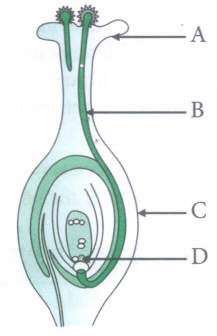
(a) Name the parts labelled as A,B,C and D in the diagram given below:
(b) What is pollination? State its significance.
(c) How does fertilisation occur in flowers? Name the parts of the floower that develop into
(i) seed, and (ii) fruit after fertilisation.
2.
Write the two causes of human population explosion. Explain with the help of suitable examples how this explosion can be checked.
3.
Describe in brief the role of (i)testis (ii)seminal vesicle, (iii)vas deferens, (iv)ureter and (v) prostate gland in human male reproductive system.
4.
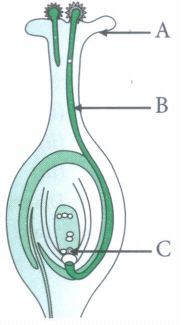
(a)Identify A, B and C in the given diagram and write their functions.
(b)Mention the role of gamete and zygote in sexually reproducing organisms.
5.
(a)Give one example each of a unisexual and a bisexual flower
(b)Mention the changes a flower undergoes after fertilisation.
(c)How does the amount of DNA remain constant though each new generation is a combination of DNA copies of two individuals?
6.
List four points of significance of reproductive health in a society. Name any two areas related to reproductive health which have improved over the past 50years in our country.
7.
(a) Name the human male reproductive organ that produces sperms and also secretes a hormone. Write the functions of the secreted hormone.
(b) Name the parts of the human female reproductive system where
(i) fertilisation takes place,
(ii) implantation of the fertilised egg occurs.
Explain how the embryo gets nourishment inside the mother's body.
8.
Reproduction is essentially a phenomenon that is not survival of an individual but for the stability of a species. Justify.
9.
What is the placenta? Mention its role during pregnancy?
10.
How does fertilisation take place? Fertilisation occurs once in a month. Comment.
11.
Distinguish between a gamete and zygote. Explain their roles in sexual reproduction.
12.
Write two points of difference between asexual and sexual types of reproduction. Describe why variations are observed in the offspring formed by sexual reproduction.
1.
(a) A - Stigma B - Pollen tube C - Ovary D - Ovule (ovum)
(b) The transfer of pollen grains from anther (male sexual part) of a flower to the stigma part of the pistil (female sexual part) is known as pollination. Signification of pollination. It may be the cause of variation in a species of a plant.
(c) Fertilisation in flower. A pollen grain contains two male gametes. When a pollen grain falls on the stigma of the carpel, it grows a pollen tube downwards into the
style. One of the male gametes reaches the ovary through pollen tube and fuses with female gamete present in the ovule. This fertilisation of the two germ cells forms a zygote. The zygote is capable of growing into a new plant. The other male gamete fuses with two polar nuclei to form endosperm nucleus. This fusion is called triple fusion. The zygote grows into an embryo and an endosperm nucleus grows into endosperm (the food storage tissue of seed).
(i) All the eggs in the ovule present in the ovary of a flower gets fertilised by male gametes from pollen grains and grow to become seeds.
(ii) The ovary of flower develops and becomes fruit.
2.
There are three main causes of human population explosion:
1. Decline in death rate from 13.8 per 1,000 in 1985 to 8 per 1,000 in 200l.
2. Increase in longevity.
3. Increase in birth rate.
The uncontrolled growth of human population causes many socio-economic problems.
To mitigate the various ill-effects of increasing population, there is a need of population control by reducing the birth rate through family planning programmes.
1. By adopting various methods of contraception:
(a) Barrier methods-Physical devices such as condoms, diaphragm and cervical caps are used.
(b) Surgical methods
(c) Chemical methods-Oral and vaginal pills used by females.
2. People in reproductive age group should be educated about the advantages of a small family with the help of mass media like radio, T.V., newspapers, etc. and educational institutions.
3. Marriage age should be increased.
4. Social organisations should be involved in family planning programmes.
5. Literacy rate, especially that of females should be increased.
3.
1. Testis: Testes are oval shaped primary reproductive organs in men. The function of testes is to produce sperms and male sex hormone testosterone. The scrotum provides optimal temperature for the formation of sperms.
2. Seminal vesicle: Seminal vesicles are a pair of thin walled muscular elongated which secrete fluid for nourishment of sperms.
3. Vas deferens: The sperms are carried by a long tube called vas deferens to organs called seminal vesicles where the sperms get nourishment and stored.
4. Ureter: It is the tube that carries urine from kidney to the urinary bladder. In humans, there are two ureters, one attached to each kidney.
5. Prostate glands: Prostate glands produce a fluid which is released in the urethra along with secretion of seminal vesicles for nourishment and transportation of sperms.
4.
(a) A - Stigma: The top part of carpel is called stigma. Stigma is for receiving the pollen grains from the anther of stamen during pollination.
B - Pollen tube: When a pollen grain falls on the stigma, it bursts open and grows a pollen tube downward through the style towards the female gamete in the ovary. A male gamete moves down the pollen tube.
C - Female gamete (ovum): It is a special reproductive female sex cell which combines with male gamete to form zygote.
(b) Sexual reproduction takes place by the combination of special reproductive cells called sex cells. These cells are of two types male sex cells and female sex cells, which are coming from two different parents a male and a female. The cells involved in sexual reproduction are called gametes. In sexual reproduction, a male gamete fuses with a female gamete to form a new cell called zygote. This zygote then grows and develops into a new organism in due course of time.
5.
(a) Unisexual Flower - Papaya Bisexual Flower - Hibiscus
(b) After fertilisation, the fertilised egg divides several times to form an embryo within the ovule. The ovule, develops a tough coat around it and is gradually converted into a seed (containing the baby plant along with food). The ovary of flower develops and becomes a fruit (with seeds inside it). The other parts of flower like sepals, petals, stamens, stigma and style dry up and fall off. Only the vary is left behind.
(c) In sexual reproduction, though the genetic material DNA from two gametes, male and female gametes, combine together to form a new cell 'zygote' but the amount of DNA in zygote does not get doubled. This is because the gametes are special type of cells which contain only half the amount of DNA as compared to the normal body cells of an organism. So the new cell zygote formed by two gametes cells will have the normal amount of DNA.
6.
The significance of reproductive health of society are:
1. regular medication and check-ups have led to development of reproductive health. Healthy mothers give birth to healthy children.
2. Reproductive health should be maintain in order to prevent sexually transmitted diseases (STDs).
3. Family planning by using various contraceptives enables a couple to decide on the number of children they want to have and when to have them. If a couple has less number of children they can provide good food, clothes and education to each child. So a small family is a happy family.
4. Having fewer children also keeps the mother in good health. This will reduce the cases of maternal mortality as well as new born mortality.
7.
(a) Testis produces sperms and secretes male hormone testosterone. Function of testosterone hormone is to control the development of male sex organs and male features such as deeper voice, moustaches, body hair, etc. All these changes caused by testosterone are associated with male puberty which the boys attains at an age of 13 to 14 years. It also controls the formation of male gamete, i.e., sperm.
(b) (i) Fertilisation takes place in fallopian tube (oviduct).
(ii) Implantation of the fertilised egg occurs in the uterus. Nourishment of embryo. After fertilisation, zygote is formed which develops into an embryo. The embryo gets nutrition from the mother's blood with the help of a special tissue called placenta. This is a disc which is embedded in the uterine wall. It contains villi on the embryo's side of the tissue. On the mother's side are blood spaces, which surround the -uu This provides a large surface area for glucose and oxygen to pass from the mother to the embryo. In this way, embryo gets its nutrition.
8.
(a) Organisms need energy for survival which they obtain from life processes such as nutrition and respiration.
(b) reproduction needs a lot of energy
(c) Genetic material is transferred from one generation to the next as a result of reproduction through DNA copying.
(d) DNA copying takes place with high constancy and considerable variations, that is, advantages to the species for stability in the changing environment.
9.
(a) Special tissue connection between embryo and uterine wall.
(b) Possesses villi that increase the surface area.
(c) Facilitate passage of nutrition and oxygen to embryo from mother through blood.
(d) Waste substances produced by embryo are removed through placenta into mother's blood.
10.
During the ovulation cycle, one egg is released by either of the ovaries. The egg reaches the fallopian tube. The sperm enters the vagina during mating. From there, it enters the uterus through cervix and reaches fallopian tube. Numerous sperms reach the fallopian tube but only one sperm is required for fertilization.
Since only one egg is released in a single ovulation cycle and ovulation cycle happens once in a month, so fertilization occurs once in a month.
11.
Gamete is formed as a result of meiosis in gametogenic cells. Zygote is formed after fusion of two different kinds of gametes. Different types of gametes are formed by different parents. Zygote is formed in the female reproductive part only.
Role of gamete in sexual reproduction: Gamete formation results in halving of number of chromosomes which is necessary to maintain the number of chromosomes in an organism which reproduces sexually.
Role of zygote in sexual reproduction: Zygote formation makes the number of chromosome equal to the somatic cells. further, it is the zygote which undergoes mitosis to develop into an embryo and subsequently into a new individual.
12.
Two points of difference between asexual and sexual reproduction are as follows:
(a) A single parent is involved in asexual reproduction, while two parents are involved in sexual reproduction.
(b) Meiosis does not happen in asexual reproduction during gamete formation.
reason of variations in offspring produced by sexual reproduction: Two sets of genes are contributed by different parents, which bring different sets of characters in the offspring.

10th Standard CBSE Syllabus & Materials
10th Standard CBSE
CBSE 10th Social Science PS - Federalism - New Model Questions Papers Study Material - QB365 Set A
NEW10th Standard CBSE
CBSE 10th Social Science PS - Power Sharing - New Model Questions Papers Study Material - QB365 Set A
NEW10th Standard CBSE
CBSE 10th Social Science GEO - Manufacturing Industries - New Model Questions Papers Study Material - QB365 Set A
NEW10th Standard CBSE
CBSE 10th Social Science GEO - Minerals and Energy Resources - New Model Questions Papers Study Material - QB365 Set A



CBSE 10th Standard CBSE Subjects
CBSE Standards





