
 100% FREE ACCESS
10th Standard CBSE Syllabus & Materials
10th Standard CBSE
CBSE 10th Social Science ECO - Globalisation and the Indian Economy - New Model Questions Papers Study Material - QB365 Set A
NEW10th Standard CBSE
CBSE 10th Social Science ECO - Money and Credit - New Model Questions Papers Study Material - QB365 Set A
NEW10th Standard CBSE
CBSE 10th Social Science ECO - Sectors of the Indian Economy - New Model Questions Papers Study Material - QB365 Set A
NEW10th Standard CBSE
CBSE 10th Social Science ECO - Development - New Model Questions Papers Study Material - QB365 Set A
NEW10th Standard CBSE
CBSE 10th Social Science PS - Outcomes of Democracy - New Model Questions Papers Study Material - QB365 Set A
NEW10th Standard CBSE
CBSE 10th Social Science PS - Gender, Religion and Caste - New Model Questions Papers Study Material - QB365 Set A

Published on: 28/09/2019
Magnetic Effects of Electric Current
Download CBSE Class 10th Standard CBSE Science question papers, sample papers, important questions, and previous year solved papers in PDF format. Get free study materials, NCERT solutions, and exam preparation resources for Class 10th Standard CBSE Science
Questions + Answers key
Take MCQ Science Test
1.
(a) What is an electromagnet? What does it consist of?
(b) Name one material in each case which is used to make a
(i) Permanent magnet
(ii) Temporary magnet
(c) Describe an activity to show how you can make an electromagnet in your school laboratory.
2.
(a) What is an electromagnet?
(b) List any of its two uses.
(c) Draw a labelled diagram to show how an electromagnet is made.
(d) What is the purpose of the soft iron core used in making an electromagnet?
3.
(a) What is meant by a magnetic field?
(b) How is the direction of magnetic field at a point determined?
(c) Describe an activity to demonstrate the direction of the magnetic field generated around a current carrying conductor.
(d) What is the direction of magnetic field at the centre of a current carrying circular loop?
4.
Draw an appropriate schematic diagram showing common domestic circuits and discuss the importance of fuse. Why is it that a burnt out fuse should be replaced by another fuse of identical rating?
5.
Explain the phenomenon of electromagnetic induction. Describe an experiment to show that a current is set up in a closed loop when an external magnetic field passing through the loop increases or decreases.
6.
Describe the activity that shows that a current-carrying conductor experiences a force perpendicular to its length and the external magnetic field. How does Fleming's left-hand rule help us to find the direction of the force acting on the current carrying conductor?
7.
Explain with the help of a labelled diagram the distribution of magnetic field due to a current through a circular loop. Why is it that if a current carrying coil has 'n' turns the field produced at any point is n times as large as that produced by a single turn?
8.
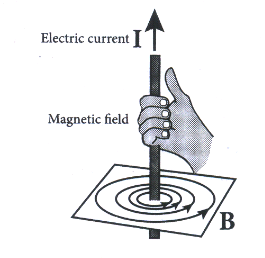
With the help of a labelled circuit diagram illustrate the pattern of field lines of the magnetic field around a current carrying straight long conducting wire. How is the right hand thumb rule useful to find direction of magnetic field associated with a current carrying conductor?
9.
(a) Give two uses of electromagnets.
(b) Name any two devices which use permanent magnets.
10.
Distinguish between an electric motor and generator?
1.
(a) When we magnetise a piece of magnetic material such as soft iron by keeping it inside a coil and then passing current through it, the magnet so formed is called electromagnet.
(b) (i) Steel is used to make permanent magnet.
(ii) Soft iron is used to make temporary magnets.
(c) Take a coil of wire having N number of turns and then wound it around a soft iron core. Connect the end of the wire with a battery and plug key and then let current pass through the coil. While current is passing through the coil, bring a compass near the coil. It will be observed that compass needle shows deflection. This shows that the coil will have a magnetic field of its own. The magnet so formed is called an electromagnet.
2.
(a) An electromagnet is a device used to produce magnetic field with the help of electricity.
(b) An electromagnet is used for lifting heavy loads. It is also used in automatic door locking systems.
(c)
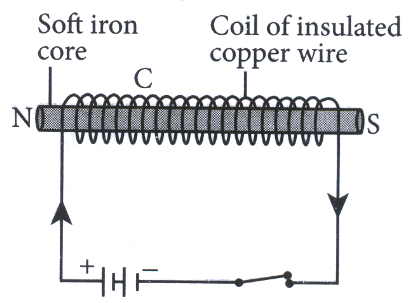
(d) A soft iron is used as a core in order to strengthen the magnetic field created by the electromagnet.
3.
(a) Magnetic field is the region around a magnet in which a magnetic material experiences a force because of that magnet.
(b) The direction of magnetic field at a point is determined by using a magnetic compass. The direction along which the needle of a magnetic compass gets aligned indicates the direction of the magnetic field.
(c) A straight thick conducting wire is inserted normally through centre of a plane paper. Now, electric current is passed through the wire. When a small magnetic compass is placed on the paper, the magnetic needle of the compass gets aligned along a particular direction. The positions of the North Pole and South Pole are marked on the paper. Now, the magnetic needle is shifted to a new position such that its South Pole occupies the position previously occupied by its North Pole. Again, the positions of the North Pole and South Pole are marked. These steps are repeated over and over again and the marked points are joined to obtain the direction of the magnetic field generated by the current-carrying straight wire.
(d) The direction of magnetic field at the centre of a current of a current carrying loop is normal to the plane formed by the loop.
4.
Importance of Fuse: The electric fuse is an important device in household wiring and also in many electrical appliances. By melting, the fuse wire breaks the circuit and thus helps in saving the wiring or the appliance from damage. A fuse wire works because of its lower melting point which is possible because of its respective rating. If a fuse with larger rating is used with an appliance, the fuse wire shall not melt and hence would fail to serve the required purpose. Due to this, a fuse with defined rating should not be replaced by one with a larger rating.
5.
Electromagnetic Induction: When a conductor is set to move inside a magnetic field or a magnetic field is set to be changing around a conductor, electric current is induced in the conductor. This is just opposite to the exertion of force by a current carrying conductor inside a magnetic field. In other words, when a conductor is brought in relative motion vis-a-vis a magnetic field, a potential difference is induced in it. This is known as electromagnetic induction.
Activity:
- To demonstrate electromagnetic induction Materials Required:
- A galvanometer, coil, bar magnet and some wires.
Procedure:
- The coil is inserted over a hollow tube of cardboard.
- With the help of wires, the two ends of the coil are attached to the galvanometer.
- The north pole of the bar magnet is moved towards the end 'B' of the coil.
- It is observed that the galvanometer needle shows deflection to right.
- When the magnet is moved away from the coil, the galvanometer needle shows deflection towards left.
- When the magnet is in static position, no deflection is seen in galvanometer needle.
- Induction of electric current in the coil is the cause of deflection in galvanometer needle.
- If the magnet is kept stationary and coil is moved, then also the galvanometer needle shows deflection.
Conclusion:
- When the coil and the bar magnet are in relative motion, a current is induced in the coil.
6.
Activity:
To show the effect of magnetic field on current -carrying conductor
Materials Required:
A small aluminium rod, a horse-shoe magnet, battery, plug key, wires and a stand.
Procedure:
The aluminium rod is suspended horizontally from the stand and tied to two wires at its ends. The wires are attached to rheostat, battery and a plug key to make the circuit.
The horse-shoe magnet is positioned in a way that the aluminium rod lies between the two poles of the magnet. If the South Pole is above the aluminium rod and the North Pole is below it. The plug key is inserted to initiate current supply to the rod.
It is observed that the aluminium rod deflects towards left.
When the direction of the current is reversed the aluminium rod deflects towards right.
Conclusion:
When a current carrying conductor is placed within a magnetic field, the conductor experiences deflection. Fleming's Left Hand Rule explains the direction of displacement in this case. Let us assume that the current is moving in anti-clockwise direction in the loop. In that case, the magnetic field would be in clockwise direction; at the top of the loop. Moreover, it would be in anticlockwise direction at the bottom of the loop.
7.
Magnetic Field Due to Circular Loop Current-Carrying Conductor:
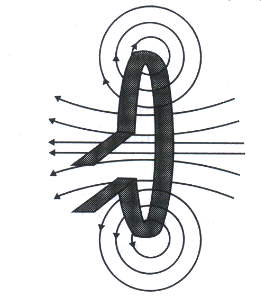
In case of a circular current carrying conductor, the magnetic field lines would be in the form of concentric circles around every part of the periphery of the conductor. Since, magnetic field lines tend to remain closer when near the conductor, so the magnetic field would be stronger near the periphery of the loop. On the other hand, the magnetic field lines would be distant from each other when we move towards the centre of the current carrying loop. Finally, at the centre, the arcs of big circles would appear as a straight lines.
Magnetic field and number of turns of coil: Magnitude of magnetic field gets summed up with increase in the number of turns of coil. If there are 'n' turns of coil, magnitude of magnetic field will be 'n' times of magnetic field in case of a single turn of coil.
8.
The following diagram depicts the pattern and direction of magnetic field lines around a straight current-carrying conductor.
Right Hand Thumb Rule: If a current carrying conductor is held by right hand, keeping the thumb straight and if the direction of electric current is in the direction of thumb, then the direction of wrapping of other fingers will show the direction of magnetic field.
9.
(a) (i) It is used in cranes for lifting heavy loads.
(ii) used in electric bells.
(b) Loudspeakers, Galvanometer, voltmeter.
10.
The major differences between an electric motor and generator are stated below:
Electric Motor:
1. It converts electrical energy into mechanical energy.
2. It needs electrical energy for its works.
3. They are used as water pumps, marble grinders etc.
Generator:
1. It converts mechanical energy into electrical energy
2. It needs mechanical energy for its working.
3. They are used as water pumps, marble grinders etc.
4. diesel generator, hydro-electric generator are the examples of it.

10th Standard CBSE Syllabus & Materials
10th Standard CBSE
CBSE 10th Social Science PS - Federalism - New Model Questions Papers Study Material - QB365 Set A
NEW10th Standard CBSE
CBSE 10th Social Science PS - Power Sharing - New Model Questions Papers Study Material - QB365 Set A
NEW10th Standard CBSE
CBSE 10th Social Science GEO - Manufacturing Industries - New Model Questions Papers Study Material - QB365 Set A
NEW10th Standard CBSE
CBSE 10th Social Science GEO - Minerals and Energy Resources - New Model Questions Papers Study Material - QB365 Set A



CBSE 10th Standard CBSE Subjects
CBSE Standards





