
 100% FREE ACCESS
10th Standard CBSE Syllabus & Materials
10th Standard CBSE
CBSE 10th Social Science ECO - Globalisation and the Indian Economy - New Model Questions Papers Study Material - QB365 Set A
NEW10th Standard CBSE
CBSE 10th Social Science ECO - Money and Credit - New Model Questions Papers Study Material - QB365 Set A
NEW10th Standard CBSE
CBSE 10th Social Science ECO - Sectors of the Indian Economy - New Model Questions Papers Study Material - QB365 Set A
NEW10th Standard CBSE
CBSE 10th Social Science ECO - Development - New Model Questions Papers Study Material - QB365 Set A
NEW10th Standard CBSE
CBSE 10th Social Science PS - Outcomes of Democracy - New Model Questions Papers Study Material - QB365 Set A
NEW10th Standard CBSE
CBSE 10th Social Science PS - Gender, Religion and Caste - New Model Questions Papers Study Material - QB365 Set A

Published on: 24/09/2019
Metals and Non-Metals
Download CBSE Class 10th Standard CBSE Science question papers, sample papers, important questions, and previous year solved papers in PDF format. Get free study materials, NCERT solutions, and exam preparation resources for Class 10th Standard CBSE Science
Questions + Answers key
Take MCQ Science Test
1.
A man went door to door posing to be a goldsmith. He promised to bring back the glitter of old and dull gold ornaments. An unsuspecting lady gave a set of gold bangles to him which he dipped in a particular solution. The bangles sparkled like new but their weight was reduced drastically. The lady was upset but after a futile argument, the man beat a hasty retreat.
(i) Can you play the detective to find out the nature of the solution he had used?
(ii) What is 24 carat gold?
2.
How is the method of extraction of metals high up in the reactivity series different from that for metals in the middle? Why the same process cannot be applied for them? Explain giving equations, the extraction of sodium.
3.
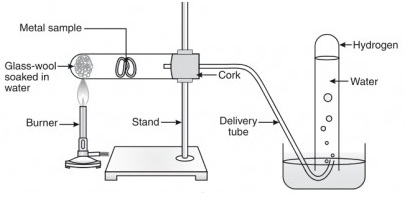
Compose an activity to arrange Ca, Mg and Fe metals in the decreasing order of reactivity with water, Write suitable balanced chemical equation and draw diagrams.
4.
(a) Name one main ore of Aluminium. Write its formula. Which two main impurities are associated with this ore?
(b) Describe with chemical equations, the method employed for the enrichment of the above named ore.
5.
(a) What is corrosion of metals? Name one metal which does not corrode and one which corrodes on being kept in atmosphere.
(b) How will you show that the rusting of iron needs oxygen and moisture at the same time?
6.
(a) Write chemical equations for the reactions involved in obtaining pure alumina from the mineral bauxite which has impurities of iron oxide and silica.
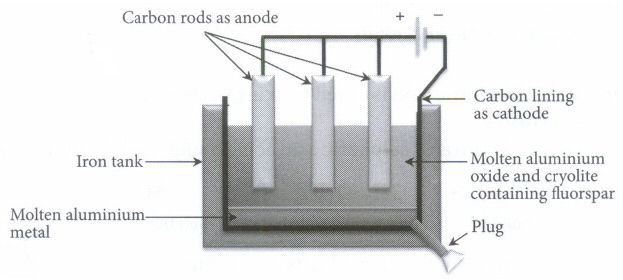
(b) Draw a labelled diagram of the electrolytic tank cell used for the extraction of aluminium from alumina.
7.
Two ores A and B were taken. On heating ore A gives CO2 whereas, ore B gives SO2 .What steps will you take to convert them into metals?
8.
An element A burns with golden flame in air. It reacts with another element B, atomic number 17 to give a product C. An aqueous solution of product C on electrolysis gives a compound D and liberates hydrogen. Identify A, B, C and D. Also write down the equations for the reactions involved.
9.
Of the three metals X, Y and Z, X reacts with cold water, Y with hot water and Z with steam only. Identify X, Y and Z and also arrange them in order of increasing reactivity.
10.
A non-metal A which is the largest costituent of air, when heated with H2 in 1 : 3 ratio in the presence of catalyst (Fe) gives a gas B. On heating with O2 it gives an oxide C. If this oxide is passed into water in the presence of air it gives an acid D which acts as a strong oxidising agent.
(a) Identify A, B, C and D
(b) To which group of periodic table does this non - metal belong?
1.
(i) The nature of the solution is acidic. It is a mixture of conc. HNO3, and conc. HCI in the ratio of 1 : 3. It can dissolve gold as it is an oxidising agent.
(ii) Pure gold is 24 carat gold which is very soft.
2.
Metals high up in reactivity series are extracted by electrolytic reduction. While those in the middle are extracted first by converting into oxide and then reducing by carbon.
Same method cannot be used because metals have more affinity for oxygen than carbon.
Molten sodium chloride is taken for electrolytic reduction. The metals are deposited at the cathode and chlorine is liberated at anode.
At cathode: Na+ + e- \(\longrightarrow \)Na
At anode: 2Cl- \(\longrightarrow \) C12 + 2e-
3.
Take some metals like Ca, Mg and Fe etc. Place separately small pieces of these metals in beakers with small amount of water in them. If the metals react with the cold water, then the reaction is vigorous. If metal does not
react with cold water, then treat it with hot water. Record the observations and arrange the metals in decreasing order of reactivity.
| Metal | Reaction | Observation | Chemical reaction |
| Fe | Steam | Fe3O4 and H2(g) | 3Fe(s) + 4H2O(g)\(\longrightarrow \)Fe3O(g) + H2(g) |
| Mg | Hot water | Mg(OH)2(aq)&H2(g) | Mg(s)+2H2O(hot)\(\longrightarrow \)Mg(OH)2(aq)+H2(g) |
| Ca | Cold water | Ca(OH)2(aq)&H2(g) | Ca(s)+2H2O(l)\(\longrightarrow \)Ca(OH)2(aq)+H2(g) |
4.
(a) The main ore of aluminium is bauxite ore. Its formula is A1203.The impurities sociated with this ore are iron oxide and sand. .
(b) The reaction involved in obtaining pure alumina from mineral bauxite having impurities of iron oxide and silica are:
(i) \(\underset { Aluminiumoxide\\ (frombauxiteore) }{ { A1 }_{ 2 }{ O }_{ 3 } } +\underset { Sodiumhydroxide\\ \quad (hot) }{ 2NaOH(aq) } \rightarrow \underset { Sodiumaluminate\\ \quad (Soluble) }{ { 2NaA1O }_{ 2 }(aq) } +\underset { Water }{ { H }_{ 2 }O(1) } \)
The iron oxide and silica (sand) present in the bauxite ore do not dissolve in sodium hydroxide solution. Therefore, they are separated by filtration.
(ii) \(\underset { Sodiumaluminate }{ { NaA1O }_{ 2 }(aq) } +\underset { Water }{ { 2H }_{ 2 }O(1) } \rightarrow \underset { Aluminiumhydroxide\\ \quad (Whiteppt) }{ { A1(OH) }_{ 3 }(s) } +\underset { Sodiumhydroxide }{ NaOH(aq) } \)
(iii) \(\underset { Aluminiumhydroxide }{ { 2A1(OH) }_{ 3 }(s) } \underrightarrow { heat } \underset { Aluminiumoxide\\ \quad (Pure) }{ { A1 }_{ 2 }{ O }_{ 3 }(s) } +\underset { Steam }{ { 3H }_{ 2 }O(g) } \)
5.
(a) The eating up of metals by the action of air and moisture on their surface is called corrosion.
(i) Metal which does not corrode on being kept in the atmosphere is gold.
(ii) Metal which corrodes on being kept in the atmosphere is iron.
(b) Take three boiling tubes and label them as A, B, and C. Place clean iron nails, free from rust, in each tube. Add water to tube A in such a manner that some parts of the nails are exposed to air and seal it with the help of a rubber cork. Add boiled water to tube B in such a way that the nails are completely submerged. Then, pour some amount of kerosene oil in the tube and seal it with the help of a rubber cork. Add anhydrous calcium chloride to tube C and then seal it. Leave the tubes undisturbed for two weeks and observe the changes.
6.
(a) The reaction involved in obtaining pure alumina from the mineral bauxite having impurities of iron oxide and silica is:
(i) \(\underset { Aluminiumoxide\\ (frombauxiteore) }{ { AI }_{ 2 }{ O }_{ 3 }(s) } +\underset { Sodiumhydroxide\\ \quad (hot) }{ 2NaOH(aq) } \rightarrow \underset { Sodiumaluminate\\ \quad (Soluble) }{ { 2NaAIO }_{ 2 }(aq) } +\underset { Water }{ { H }_{ 2 }O(I) } \)
The iron oxide and silica (sand) present in the bauxite ore do not dissolve in sodium hydroxide solution. Therefore, they are separated by filtration.
(ii) \(\underset { Sodiumaluminate }{ { NaAIO }_{ 2 }(aq) } +\underset { Water }{ { 2H }_{ 2 }O(I) } \rightarrow \underset { Aluminiumhydroxide\\ \quad (Whiteppt) }{ { AI(OH) }_{ 3 }(s) } +\underset { Sodiumhydroxide }{ NaOH(aq) } \)
(iii) \(\underset { Aluminiumhydroxide }{ { 2AI(OH) }_{ 3 }(s) } \underrightarrow { heat } \underset { Aluminiumoxide\\ \quad (Pure) }{ { AI }_{ 2 }{ O }_{ 3 }(s) } +\underset { Steam }{ { 3H }_{ 2 }O(g) } \)
(b)
7.
Ore A gives CO2 and ore B gives SO2 . Therefore, ores are MCO3 and MS.
A can be converted into metal by the following steps :
\({ MCO }_{ 3 }\underrightarrow { Calcination } MO+{ CO }_{ 2 }\\ MO+C\underrightarrow { Reduction } M+CO\)
B can be converted into metal by the following steps :
\(2MS+{ 3O }_{ 2 }\underrightarrow { Roasting } 2MO+{ 2SO }_{ 2 }\\ \quad \quad \quad MO+C\rightarrow M+CO\)
8.
Since the element B belongs to atomic number 17, it must be chlorine.
The element which burns golden flame in air is sodium. Therefore, the element A must be sodium.
When element sodium and chlorine reacts, it forms sodium chloride, the compound C. The compound C on electrolysis gives sodium hydroxide and hydrogen gas.
Thus, A = Na; B = CI2; C = NaCI; D = NaOH.
Chemical Reactions involved:
\(2Na+{ CI }_{ 2 }\rightarrow 2NaCI\)
\(2NaCI(aq)+{ 2H }_{ 2 }O(I)\rightarrow 2NaOH(aq)+{ CI }_{ 2 }(g)+{ H }_{ 2 }(g)\)
9.
Since the metal X react with cold water, it must be high in the reactivity series i.e., sodium or potassium.
X is alkali metal, Na or K.
Since the metal Y reacts with hot water, it must be middle in the reactivity series i.e., magnesium or calcium.
Y is alkaline earth metal, Mg or Ca.
Since the metal X reacts with steam only, it must be low in the reactivity series i.e., iron Z is Fe.
Increasing reactivity series : Na > Mg > Fe.
10.
Since the non-metal A is the largest costituent of air, it must be Nitrogen. When nitrogen is heated with hydrogen in the ratio of 1 : 3, it gives ammonia in presence of iron as a catalyst [Haber's process]. When nitrogen is heated with oxygen, it gives nitric oxide. When this oxide is passed through water in presence of air, it gives nitric acid which acts as a strong oxidising agent.
(a) A - N2; B - NH3; C - NO; D - HNO3
(b) Element A belongs to Group - 15 of the Periodic Table.

10th Standard CBSE Syllabus & Materials
10th Standard CBSE
CBSE 10th Social Science PS - Federalism - New Model Questions Papers Study Material - QB365 Set A
NEW10th Standard CBSE
CBSE 10th Social Science PS - Power Sharing - New Model Questions Papers Study Material - QB365 Set A
NEW10th Standard CBSE
CBSE 10th Social Science GEO - Manufacturing Industries - New Model Questions Papers Study Material - QB365 Set A
NEW10th Standard CBSE
CBSE 10th Social Science GEO - Minerals and Energy Resources - New Model Questions Papers Study Material - QB365 Set A



CBSE 10th Standard CBSE Subjects
CBSE Standards





