
 100% FREE ACCESS
10th Standard CBSE Syllabus & Materials
10th Standard CBSE
CBSE 10th Social Science ECO - Globalisation and the Indian Economy - New Model Questions Papers Study Material - QB365 Set A
NEW10th Standard CBSE
CBSE 10th Social Science ECO - Money and Credit - New Model Questions Papers Study Material - QB365 Set A
NEW10th Standard CBSE
CBSE 10th Social Science ECO - Sectors of the Indian Economy - New Model Questions Papers Study Material - QB365 Set A
NEW10th Standard CBSE
CBSE 10th Social Science ECO - Development - New Model Questions Papers Study Material - QB365 Set A
NEW10th Standard CBSE
CBSE 10th Social Science PS - Outcomes of Democracy - New Model Questions Papers Study Material - QB365 Set A
NEW10th Standard CBSE
CBSE 10th Social Science PS - Gender, Religion and Caste - New Model Questions Papers Study Material - QB365 Set A

Published on: 28/07/2019
Metals and Non-Metals
Download CBSE Class 10th Standard CBSE Science question papers, sample papers, important questions, and previous year solved papers in PDF format. Get free study materials, NCERT solutions, and exam preparation resources for Class 10th Standard CBSE Science
Questions + Answers key
Take MCQ Science Test
1.
Why do silver articles become black after sometime when exposed to air?
2.
Name the metal which reacts with a very dilute HNO3 to evolve hydrogen gas.
3.
Which gas is liberated when a metal reacts with an acid? How will you test the presence of this gas?
4.
Make a distinction between metals and nonmetals with respect to the nature of their oxide.
5.
Name three common types of ores where metal exists in nature.
6.
Name two allotropes of carbon.
7.
A metal is found in liquid state. It is widely used in instrument for measuring blood pressure. In what form does it occur in nature? How can we extract this metal from its ore?
8.
What are amphoteric oxides? Give two examples of amphoteric oxides.
9.
What are alloys?
10.
Why is sodium kept immersed in kerosene oil?
11.
Generally metals react with acids to give salt and hydrogen gas. Which of the following acids does not give hydrogen gas on reacting with metals (except Mn and Mg)?
H2SO4
HCl
HNO3
All of these
12.
Which of the following oxide(s) of iron would be obtained on prolonged reaction of iron with steam?
FeO
Fe2O3
Fe3O4
Fe2O3 and Fe3O4
13.
Aluminium is used for making cooking utensils. Which of the following properties of aluminium are responsible for the same?
(i) Good thermal conductivity
(ii) Good electrical conductivity
(iii) Ductility
(iv) High melting point
(i) and (ii)
(i) and (iii)
(ii) and (iii)
(i) and (iv)
14.
Which of the following methods is suitable for preventing an iron frying pan from rusting?
Applying grease
Applying paint
Applying a coating of zinc
All of the above
15.
Which of the following pairs will give displacement reactions?
NaCl solution and copper metal
MgCl2 solution and aluminium metal
FeSO4 solution and silver metal
AgNO3 solution and copper metal
16.
(i) Why Sulphuric acid is called the 'king of chemicals'?
(ii) Name the gas evolved when :
(a) Concentrated Sulphuric acid acts on Sulphur.
(b) Dilute Sulphuric acid acts on Sodium carbonate.
(iii) State the colour change you would observe on adding concentrated sulphuric acid to :
(a) Blue Copper sulphate crystals.
(b) Colourless cane-sugar crystals.
17.
Of the three metals X, Y and Z, X reacts with cold water, Y with hot water and Z with steam only. Identify X, Y and Z and also arrange them in order of increasing reactivity.
18.
List three properties of sodium in which it differs from the general physical properties of most metals.
19.
What are 'mineral' and 'ore'?
20.
(i) Name an important oxide ore of iron.
(ii) Describe the extraction of iron from those ore under the following heads:
(a) Reduction of the concentrated ore
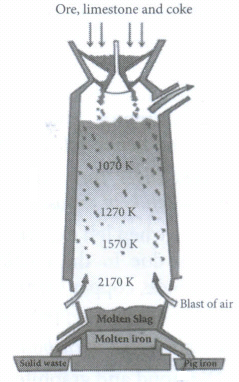
(b) Diagram of the furnace used
(c) Chemical equations for the reactions involved
1.
They get tarnished by reacting with atmospheric air to form silver sulphide.
2.
Manganese or Magnesium.
3.
Hydrogen gas is formed. Bring a burning matchstick near to it, H2 will burn explosively with 'pop' sound.
4.
Metallic oxides are basic, few are amphoteric.
Non-metallic oxides are acidic, few are neutral.
5.
Oxides ores, carbonate and sulphide ore.
6.
Diamond and graphite
7.
Mercury is the metal which is found in liquid state and is used in instruments for measuring blood pressure. It occurs in nature a sulphide in the form of Cinnabar (HgS). Mercury is obtained from purified Cinnabar by roasting in the present air.
\(HgS\quad \underrightarrow { Air/Heat } \quad Hg+{ SO }_{ 2 }\)
8.
The metallic oxides which show the properties of acids as well as bases are called amphoteric oxides. It means that they react with both bases and acids to form salt and water.
e.g. ZnO and Al2O3
ZnO(s) + 2HCl(aq) \(\rightarrow\) ZnCl2 (aq) + H2O(l)
Zinc oxide (As a base) Hydrochloric acid Zinc chloride Water
ZnO(s) + 2NaOH(aq) \(\rightarrow\) Na2ZnO2(aq) + H2O(l)
Zinc oxide (As an acid) Sodium hydroxide Sodium zincare Water
9.
An alloy is a homogeneous mixture of two or more metals or a metal and a non-metal. It is prepared by mixing the metals in molten form and then cooling the mixture. The electrical conductivity and melting point of an alloy is less than that of pure metals.
e.g.
| Alloy | Composition | Uses |
| Brass | Copper and zinc | Utensils and taps |
| Bronze | Copper and tin | Medals, statues and valves |
10.
Sodium metal being reactive highly reacts so vigorously with oxygen that it catches fire if kept in open air. Therefore, to protect it from accidental fires, sodium is kept immersed in kerosene oil.
11.
(c)
HNO3
12.
(c)
Fe3O4
13.
(d)
(i) and (iv)
14.
(c)
Applying a coating of zinc
15.
(d)
AgNO3 solution and copper metal
16.
(i) Concentrated sulphuric acid is called the king of chemicals as it is a very strong acid and is highly corrosive.
(ii) (a) When concentrated sulphuric acid acts on sulphur, sulphur dioxide gas is evolved.
\(\underset { Suphur }{ S(s) } +\underset { Suphuricacid(conc.) }{ { 2H }_{ 2 }{ SO }_{ 4 }(I) } \underrightarrow { \Delta } \underset { Sulphurdioxide }{ { 3SO }_{ 2 }(g) } +\underset { Water }{ { 2H }_{ 2 }O(I) } \)
(b) When dilute sulphuric acid acts on sodium carbonate, carbon dioxide gas is evolved.
\(\underset { Sodiumcarbonate }{ { Na }_{ 2 }{ CO }_{ 3 }(g) } +\underset { Sulphuricacid }{ { H }_{ 2 }{ SO }_{ 4 }(aq) } \rightarrow \underset { Sodiumsulphate }{ { Na }_{ 2 }{ SO }_{ 4 }(aq) } +\underset { Carbondioxide }{ { CO }_{ 2 }(g) } +\underset { Water }{ { H }_{ 2 }O(I) } \)
(iii) (a) When concentrated sulphuric acid is added to blue copper sulphate crystals, white coloured anhydrous copper sulphate is formed.
\(\underset { Copper(II)sulphatepentahydrate\\ \quad \quad (BlueCrystal) }{ { CuSO }_{ 4 }.{ 5H }_{ 2 }O } \overset { { conc.H }_{ 2 }{ SO }_{ 4 } }{ \underset { { -5H }_{ 2 }O }{ \longrightarrow } } \underset { Anhydrouscopper(II)sulphate\\ \quad \quad (Whitepowder) }{ { CuSO }_{ 4 } } \)
(b) When concentrated sulphuric acid is added to colourless cane sugar crystals, it dehydrates sugar to a black mass of carbon known as sugar charcoal.
\(\underset { Sugar\\ (White) }{ { C }_{ 12 }{ H }_{ 22 }{ O }_{ 11 } } \overset { { conc.H }_{ 2 }{ SO }_{ 4 } }{ \underset { { -11H }_{ 2 }O }{ \longrightarrow } } \underset { Carbon\\ (Black) }{ 12C } \)
17.
Since the metal X react with cold water, it must be high in the reactivity series i.e., sodium or potassium.
X is alkali metal, Na or K.
Since the metal Y reacts with hot water, it must be middle in the reactivity series i.e., magnesium or calcium.
Y is alkaline earth metal, Mg or Ca.
Since the metal X reacts with steam only, it must be low in the reactivity series i.e., iron Z is Fe.
Increasing reactivity series : Na > Mg > Fe.
18.
Three properties of sodium are:
(i) Sodium is so soft that it can be cut with a knife.
(ii) It has low density.
(iii) It has low melting point.
19.
Mineral :
It is a naturally occurring substance which contains elements or compounds.
Ores :
Those minerals which contain a very large percentage of a particular metal and the metal can be extracted economically are called ores.
20.
Haematite (Fe2O3) is an important ore of iron.
In the upper part of the blast furnace, carbon monoxide reduces iron (III) oxide to iron metal.
\(\underset { Iron(III)oxide }{ { Fe }_{ 2 }{ O }_{ 3 } } +\underset { Carbonmonoxide }{ 3CO(g) } \rightarrow \underset { Ironmetal }{ 2Fe(I) } +\underset { Carbondioxide }{ { 3CO }_{ 2 }(g) } \)
Following reactions are involved in the blast furnace:
(i) Formation of carbon monoxide
\(\underset { Carbon }{ C(s) } +\underset { Oxygen }{ { O }_{ 2 }(g) } \rightarrow \underset { Carbondioxide }{ { CO }_{ 2 }(g) } +Heat\\ \underset { Carbondioxide }{ { CO }_{ 2 }(g) } +\underset { Coke }{ C(s) } \rightarrow \underset { Carbonmonoxide }{ 2CO(g) } \)
(ii) Reduction of iron (III) oxide or haematite to iron
\(\underset { Iron(III)oxide }{ { Fe }_{ 2 }{ O }_{ 3 } } +\underset { Carbonmonoxide }{ 3CO(g) } \rightarrow \underset { Ironmetal }{ 2Fe(I) } +\underset { Carbondioxide }{ { 3CO }_{ 2 }(g) } \)

10th Standard CBSE Syllabus & Materials
10th Standard CBSE
CBSE 10th Social Science PS - Federalism - New Model Questions Papers Study Material - QB365 Set A
NEW10th Standard CBSE
CBSE 10th Social Science PS - Power Sharing - New Model Questions Papers Study Material - QB365 Set A
NEW10th Standard CBSE
CBSE 10th Social Science GEO - Manufacturing Industries - New Model Questions Papers Study Material - QB365 Set A
NEW10th Standard CBSE
CBSE 10th Social Science GEO - Minerals and Energy Resources - New Model Questions Papers Study Material - QB365 Set A



CBSE 10th Standard CBSE Subjects
CBSE Standards





