
 100% FREE ACCESS
10th Standard CBSE Syllabus & Materials
10th Standard CBSE
CBSE 10th Social Science ECO - Globalisation and the Indian Economy - New Model Questions Papers Study Material - QB365 Set A
NEW10th Standard CBSE
CBSE 10th Social Science ECO - Money and Credit - New Model Questions Papers Study Material - QB365 Set A
NEW10th Standard CBSE
CBSE 10th Social Science ECO - Sectors of the Indian Economy - New Model Questions Papers Study Material - QB365 Set A
NEW10th Standard CBSE
CBSE 10th Social Science ECO - Development - New Model Questions Papers Study Material - QB365 Set A
NEW10th Standard CBSE
CBSE 10th Social Science PS - Outcomes of Democracy - New Model Questions Papers Study Material - QB365 Set A
NEW10th Standard CBSE
CBSE 10th Social Science PS - Gender, Religion and Caste - New Model Questions Papers Study Material - QB365 Set A

Published on: 29/07/2019
Life Process
Download CBSE Class 10th Standard CBSE Science question papers, sample papers, important questions, and previous year solved papers in PDF format. Get free study materials, NCERT solutions, and exam preparation resources for Class 10th Standard CBSE Science
Questions + Answers key
Take MCQ Science Test
1.
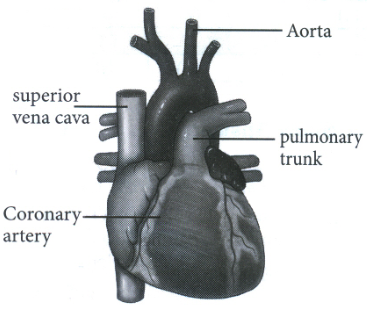
Draw the human heart and label the following on it:
(i)Aorta,
(ii)Coronary,
(iii)pulmonary trunk and
(iv)superior vena cava.
2.
List two vital functions of the human kidney.Name the procedure used in the working of artificial kidney.
3.
Which are the most common chemical reaction in a body?
4.
What is lymph?
5.
Name the type of blood vessels which carry blood from organs to the heart.
6.
What is breathing?
7.
Name the excretory unit of a kidney
8.
Where do plants get each of the raw materials required for photosynthesis?
9.
Carbohydrate in humans is stored in the form of
Glycogen
Starch
Glucose
Maltose
10.
Complete digestion of carbohydrates, proteins and fats takes place in
Stomach
Large intestine
Small intestine
Villi
11.
Select the correct statement
Heterotrophs do not synthesise their own food
Heterotrophs utilise solar energy for photosynthesis
Heterotrophs synthesise their own food
Heterotrophs are capable of converting carbon dioxide and water into carbohydrates
12.
The autotrophic mode of nutrition requires
Carbon dioxide and water
Chlorophyll
Sunlight
All of the above
13.
The kidneys in human beings are a part of the system for
Nutrition
Respiration
Excretion
Transportation
14.
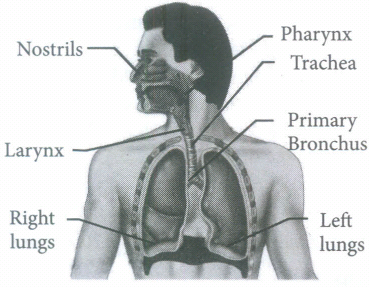
(a)Draw the respiratory system of human beings.
(b)Label the following on the diagram drawn: Larynx, Trachea, Primary Bronchus, Lungs
(c)What happens to the carbon dioxide which collects in human tissues?
15.
Describe the process of urine formation in kidneys.
16.
Give reasons for the following:
(i)The glottis is guarded by epiglottis
(ii)The lung alveoli are covered with blood capillaries.
(iii)The wall of trachea is supported by cartilage rings.
1.
2.
(i)Removal of waste products from the blood
(ii)Maintenance of the water balance of the body
The procedure used in the working of artificial kidney is haemodialysis.
3.
Oxidation-reduction reaction
4.
It is an extracellular fluid used in transportation.
5.
The blood vessels which carry blood from organs to the heart are veins.
6.
Breathing is the process of taking in oxygen (inhalation) and giving out carbon dioxide (exhalation)
7.
The uriniferous tubule, or nephron, is the kidney's excretory unit.
Excretion is the process in which an organism's hazardous waste is removed from its body.
The nephron is the fundamental unit of homeostasis, as it is controls the amount of water, ions and other substances in the blood.
Nephron's key tasks include blood filtration, reabsorption, secretion, and urine production.
8.
The raw materials for photosynthesis are carbon dioxide and water. These are taken up by the plants in the following ways
(i) CO2 is taken up through the stomata from the atmosphere in case of land plants, while the aquatic plants take up CO2 dissolved in water.
(ii) Water is taken up or is absorbed by the roots through the process of osmosis and is transported to the leaves containing photosynthetic cells by the xylem vessels.
9.
(a)
Glycogen
10.
(c)
Small intestine
11.
(a)
Heterotrophs do not synthesise their own food
12.
(d)
All of the above
13.
(c)
Excretion
14.
(a) and (b)
(c) The carbon dioxide which gets collected in the human tissues dissolves in the blood and is transported back to the lungs to be expelled out.
15.
The mechanism of urine formation includes three steps namely,
(i) Glomerular ultra-filtration
(ii) Tubular reabsorption
(iii) Tubular secretion
(i)Glomerular Ultrafiltration:
Ultrafiltration of blood takes place inthe Malphighian body which acts as a biological filter. A Malphighian body comprises of Bowman's capsule and glomeruli.
The blood from the kidney flows through the capillaries of glomerulus where the blood pressure, is comparatively high and so brings about effective filtration. The hydrostatic pressure of the blood is always greater than the opposing pressures existing in the plasma protein and renal capillaries. Thus, the available net filtering force is chiefly responsible for glomerular filtration. The fluid in the capsule which is obtained by this process is termed glomerular filtrate. In man it is about 125ml/min. In 24 hours, the total volume of glomerular filtrate is 170 to 180 litres.
(ii) Tubular Reabsorption: Reabsorption takes place in the 'uriniferous tubules. Reabsorption of useful substances is a differential or selective process. The glomerular filtrate contains many useful substances such as glucose, amino acids, mineral salts and vitamins dissolved in large amount of water. Substances such as glucose, sodium and calcium, are actively reabsorbed in large quantities. Substances like urea and uric acid etc are reabsorbed in small quantities by a simple diffusion process or passive reabsorption. Substances like creatinine are not reabsorbed. They are completely eliminated.
Proximal convoluted tubule is responsible for the reabsorption of water, glucose, sodium phosphate and bicarbonates. On entering the distal convoluted tubule, the urine becomes nearly isotonic to the surrounding tissue fluid due to the active transport of sodium and passive transport of water. As urine (isotonic) passes into the collecting tubule it becomes once again hypertonic by the osmotic reabsorption of water under the influence of the hormone ADH. Thus the urine formed contains 96% of water, 2% urea and 2% of the metabolic products.
(iii) Tubular Secretion: This is the final step in the formation of urine during which the walls of tubule actively remove additional waste substances which are harmful to the body from the blood that have escaped filtration.
16.
(i)The glottis is gaurded by epiglottis because it prevents the entry of food in wind pipe. If the food enters wind pipe, then it chokes it, leading to the death of the person.
(ii)The lung alveoli are covered with blood vessels because the oxygen that we inhale dissolves in the blood, present in these blood capillaries only, as it reaches the lungs.
(iii)The wall of trachea is supported by cartilage rings because these rings prevent the air passage from collapsing.

10th Standard CBSE Syllabus & Materials
10th Standard CBSE
CBSE 10th Social Science PS - Federalism - New Model Questions Papers Study Material - QB365 Set A
NEW10th Standard CBSE
CBSE 10th Social Science PS - Power Sharing - New Model Questions Papers Study Material - QB365 Set A
NEW10th Standard CBSE
CBSE 10th Social Science GEO - Manufacturing Industries - New Model Questions Papers Study Material - QB365 Set A
NEW10th Standard CBSE
CBSE 10th Social Science GEO - Minerals and Energy Resources - New Model Questions Papers Study Material - QB365 Set A



CBSE 10th Standard CBSE Subjects
CBSE Standards





