
 100% FREE ACCESS
10th Standard CBSE Syllabus & Materials
10th Standard CBSE
CBSE 10th Social Science ECO - Globalisation and the Indian Economy - New Model Questions Papers Study Material - QB365 Set A
NEW10th Standard CBSE
CBSE 10th Social Science ECO - Money and Credit - New Model Questions Papers Study Material - QB365 Set A
NEW10th Standard CBSE
CBSE 10th Social Science ECO - Sectors of the Indian Economy - New Model Questions Papers Study Material - QB365 Set A
NEW10th Standard CBSE
CBSE 10th Social Science ECO - Development - New Model Questions Papers Study Material - QB365 Set A
NEW10th Standard CBSE
CBSE 10th Social Science PS - Outcomes of Democracy - New Model Questions Papers Study Material - QB365 Set A
NEW10th Standard CBSE
CBSE 10th Social Science PS - Gender, Religion and Caste - New Model Questions Papers Study Material - QB365 Set A

Published on: 31/07/2019
Control and Coordination
Download CBSE Class 10th Standard CBSE Science question papers, sample papers, important questions, and previous year solved papers in PDF format. Get free study materials, NCERT solutions, and exam preparation resources for Class 10th Standard CBSE Science
Questions + Answers key
Take MCQ Science Test
1.
Give the difference between sensory and motor nerve.
2.
Name the hormones released by the following:
(a) Pancreas
(b) Pituitary
(c) Testis
(d) Ovary
3.
What health disorder may occur if the following hormones are not secreted properly?
(a) Growth hormone
(b) Insulin
(c) Thyroxine
(d) Testosterone
4.
Name the hormone secreted by thyroid gland.
5.
Name the part of hind brain which takes part in regulation of respiration.
6.
Name one endocrine gland which performs dual function.
7.
Name the stress and fear hormones.
8.
Name the components of neuron.
9.
How does our body respond when adrenaline is secreted into the blood?
10.
How do auxins promote the growth of a tendril around a support?
11.
What is the role of the brain in reflex action?
12.
How do neurons transmit information?
13.
Draw a diagram of human brain and label on it the following of its parts:
(i) Cerebrum
(ii) Meninges
(iii) Medulla Oblongata
(iv) Cerebellum
14.
How is the movement of leaves of the sensitive plant different from the movement of a shoot towards light?
15.
Junction between two neurons is called
Cell junction
Neuro muscular junction
Neural joint
Synapse
16.
Dwarfism result due to
Excess secretion of thyroxin
Less secretion of growth hormone
Less secretion of adrenaline
Excess secretion of growth hormone
17.
Which statement is not true about thyroxin?
Iron is essential for the synthesis of thyroxin
It regulates carbohydrates, protein and fat metabolism in the body
Thyroid gland require iodine to synthesise thyroxin
Thyroxin is also called thyroid hormone
18.
The substance that triggers the fall of mature leaves and fruits from plants is due to
Auxin
Gibberellin
Abscissic acid
Cytokinin
19.
The shape of guard cells change due to change in the
Protein composition of cells
Temperature of cells
Amount of water in cells
Position of nucleus in the cells
20.
The movement of shoot towards light is
Geotropism
Hydrotropism
Chemotropism
Phototropism
21.
Which of the following statements are true about the brain?
(i) The main thinking part of brain is hind brain
(ii) Centres of hearing, smell, memory, sight, etc. are located in forebrain.
(iii) Involuntary actions like salivation, vomiting, blood pressure are controlled by the medulla in the hind brain
(iv) Cerebellum does not control posture and balance of the body
(i) and (ii)
(i), (ii) and (iii)
(ii) and (iii)
(iii) and (iv)
22.
In a neuron, conversion of electrical signal to a chemical signal occurs at/in
Cell body
Axonal end
Dendritic end
Axon
23.
The brain is responsible for
Thinking
balancing the body
regulating
All of the above
24.
Which of the following is a plant hormone?
Insulin
Thyroxin
Oestrogen
Cytokinin
25.
What are reflex actions? Give two examples. Explain a reflex arc.
26.
Name various plant hormones. Also give their physiological effects on plant growth and development.
1.
| Sensory nerves | Motor nerves |
| It takes the information from receptors and transmit it to brain. |
It transmits the information for action to be taken from brain to the effector organs i.e. muscles. |
2.
(a) Pancreas - Insulin and Glucagon
(b) Pituitary - Growth hormone
(c) Testis - Testosterone
(d) Ovary - Progresterone and Oestrogen.
3.
(a) Dwarfism if less hormone; Gigantism if secreted more.
(b) Diabetes
(c) Goitre
(d) Masculine characters will not develop properly in male.
4.
Thyroxine is the hormone secreted by the thyroid gland. This hormone regulates the metabolism of carbohydrates, fats and proteins. By regulating the metabolism it helps in optimum growth and development of the body.
5.
The part of the hindbrain that takes part in the regulation of respiration is medulla oblongata.
6.
Pancreas. It secretes hormones and digestive enzymes.
7.
Adrenaline hormone.
8.
Dendrite, cell body, axon and nerve ending.
9.
Adrenaline hormone is secreted from adrenal gland into the blood and carried to different parts of the body. At the time of emergency, danger or stress, it is released in large quantities. As a result, it causes fast beating of heart, resulting in more supply of oxygen to muscles.
The blood supply to the digestive system and skin is reduced due to contraction of muscles around small arteries in these organs. The breathing rate also increases because of the contraction of diaphragm and rib muscles. All these responses together help the animal to deal with the emergency situation.
10.
Auxins promote cell elongation and are present at the shoot tip. When tendril comes in contact with a support, auxin stimulates faster growth of the cells on the opposite sides. Thus, the tendril coils around the support.
11.
Brain has limited role to play in reflex action. It is an extremely quick action, which does not involve any thinking by the brain. In this type of action, the stimulus is received by the spinal cord that sends a response,e.g. coughing, The action is registered in cercbral brain just for memory.
12.
Information passes through neuron in the form of electro-chemical signals. These signals are called impulse.
When an impulse reaches the end of the axon it sets off the release of some chemicals. These chemicals cross the gap or the synapse and start a similar electrical impulse in a dendrite of the next neuron. A similar synapse allows the delivery of impulses from the neurons to other cells, like muscle cells or glands.
13.
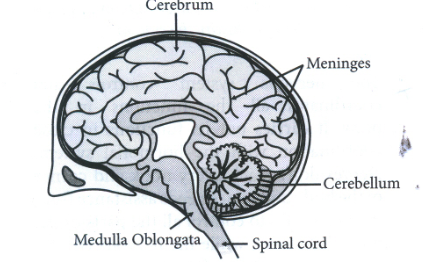
14.
Differences between movement of leaves and movement of shoot towards light are as follows:
| Movement of Leaves(Sensitive Plant) | Movement of Shoot |
| This movement is independent of growth | This movement is dependent on growth. |
| Stimulus is touch. | Stimulus is light. |
| Movement is not directional. | Movement is directional. |
| Movement is neither away nor towards the stimulus. | Movement is towards the stimulus. |
15.
(d)
Synapse
16.
(b)
Less secretion of growth hormone
17.
(a)
Iron is essential for the synthesis of thyroxin
18.
(c)
Abscissic acid
19.
(c)
Amount of water in cells
20.
(d)
Phototropism
21.
(c)
(ii) and (iii)
22.
(b)
Axonal end
23.
(d)
All of the above
24.
(d)
Cytokinin
25.
Reflex action is a special case of involuntary movement involuntary organs. When a voluntary organ is in the vicinity of a sudden danger, it is immediately pulled away from the danger to save itself. For example; when your hand touches a very hot electric iron, you move away your hand in a jerk. All of this happens in flash and your hand is saved from the imminent injury. This is an example of reflex action.
Reflex Arc: The path through which nerves signals; involved in a reflex action; travel is called the reflex arc. The following flow chart shows the flow of signal in a reflex arc. Receptor \(\rightarrow\) Sensory Neuron\(\rightarrow\) Relayneuron \(\rightarrow\) Motor neuron \(\rightarrow\) Effector (muscle) The receptor is the organ which comes in the danger zone. The sensory neurons pick signals from the receptor and send them to the relay neuron. The relay neuron is present in the spinal cord. The spinal cord sends signals to the effector via the motor neuron. The effector comes in action moves the receptor away from the danger.
26.
Various plant hormones and their effects are as follows:
(i) Auxin : Promotes cell elongation and thus promotes growth of a plant part.
(ii) Gibberellins : Promotes growth.
(iii) Cytokinin : Promotes cell division and thus promotes growth.
(iv) Abscissic acid : Inhibits growth and is responsible for shedding or older parts.

10th Standard CBSE Syllabus & Materials
10th Standard CBSE
CBSE 10th Social Science PS - Federalism - New Model Questions Papers Study Material - QB365 Set A
NEW10th Standard CBSE
CBSE 10th Social Science PS - Power Sharing - New Model Questions Papers Study Material - QB365 Set A
NEW10th Standard CBSE
CBSE 10th Social Science GEO - Manufacturing Industries - New Model Questions Papers Study Material - QB365 Set A
NEW10th Standard CBSE
CBSE 10th Social Science GEO - Minerals and Energy Resources - New Model Questions Papers Study Material - QB365 Set A



CBSE 10th Standard CBSE Subjects
CBSE Standards





