
 100% FREE ACCESS
10th Standard CBSE Syllabus & Materials
10th Standard CBSE
CBSE 10th Social Science ECO - Globalisation and the Indian Economy - New Model Questions Papers Study Material - QB365 Set A
NEW10th Standard CBSE
CBSE 10th Social Science ECO - Money and Credit - New Model Questions Papers Study Material - QB365 Set A
NEW10th Standard CBSE
CBSE 10th Social Science ECO - Sectors of the Indian Economy - New Model Questions Papers Study Material - QB365 Set A
NEW10th Standard CBSE
CBSE 10th Social Science ECO - Development - New Model Questions Papers Study Material - QB365 Set A
NEW10th Standard CBSE
CBSE 10th Social Science PS - Outcomes of Democracy - New Model Questions Papers Study Material - QB365 Set A
NEW10th Standard CBSE
CBSE 10th Social Science PS - Gender, Religion and Caste - New Model Questions Papers Study Material - QB365 Set A

Published on: 28/09/2019
Popular Struggles and Movements
Download CBSE Class 10th Standard CBSE Social Science question papers, sample papers, important questions, and previous year solved papers in PDF format. Get free study materials, NCERT solutions, and exam preparation resources for Class 10th Standard CBSE Social Science
Questions + Answers key
Take MCQ Social Science Test
1.
How do pressure groups and movements exert influence on politics? Explain any five points in this regard.
2.
How do pressure groups and movements exert influence on politics? Explain with examples.
3.
What is a single-issue movement? How does it differ from a long-term movement? Give examples.
4.
Describe the 'Second Movement for Democracy' of Nepal.
5.
What was the Second Movement of Democracy in Nepal?
6.
Distinguish between issue-specific movements and long term movements
7.
State any three causes of Bolivia's protest in 2000.
8.
Describe Bolivia's water war.
9.
Mention three points of different between pressure groups and political parties.
10.
Give the reasons, events and results of the Movent of April 2006 in Nepal.
1.
Pressure groups and movements exert influence on politics in a variety of ways.
(i) They try to gain public support and sympathy for their cause by carrying out information campaigns, organising meetings, filing petitions, etc.
(ii) By organising strikes and disruptions, they seek to make the government take note of their demands
(iii) They also influence decision-making by lobbying.
(iv) The issues raised by them often influence the policies of political parties.
(v) Formation of new political parties.
2.
Pressure groups and movements exert influence on politics in a variety of ways.
(i) They try to gain public support and sympathy for their cause by carrying out information campaigns, organising meetings, filing petitions, etc.
(ii) By organising strikes and disruptions, they seek to make the government take note of their demands
(iii) They also influence decision-making by lobbying.
(iv) The issues raised by them often influence the policies of political parties.
(v) Formation of new political parties.
3.
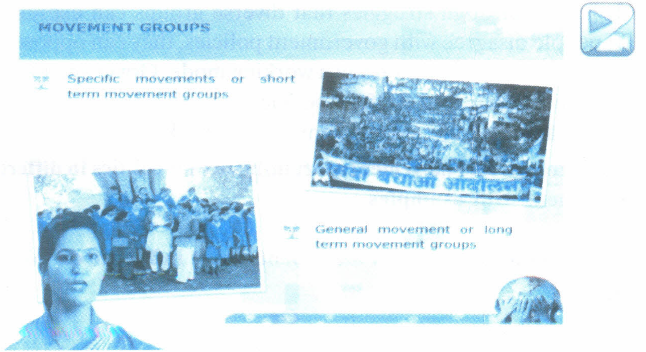
A single-issue movement is an issue-specific movement that seeks to achieve a single objective within a limited time frame. A single-issue movement differs from a long-term movement in the following ways
| Single-issue movement | Long-term movement |
| (a) It involves a specific issue. | (a) It involves more than one issue. |
| (b) It has a clear leadership. | (b) It has an independent leadership. |
| (c) It has some organisaiton controlling or guiding it. | (c) It has no single organisaiton controlling or guiding it. |
| (d) Its active life is usually short. | (d) Its active life is usually long |
| (e) Examples: Narmada Bachao Andolan. | (e) Examples: Environmental movements |
4.
(i) It was a movement started by all the major political parties in the parliament by r forming a Seven Party Alliance. It was aimed at regaining popular control over the government from the king and restoring democracy.
(ii) It started with a four-day strike in Kathmandu, the country's capital. This protest soon turned into an indefinite strike in which Maoist insurgents and various other organizations joined hands.
(iii) On 21 April, they served an ultimatum to the king. They stuck to their demand for restoration of parliament, power to an all-party government and a new constituent assembly.
(iv) On 24 April 2006, the last day of the ultimatum, the king was forced to concede all the three demands.
(v) The SPA chose Girija Prasad Koirala as the new Prime Minister of the interim government. The restored parliament met and passed laws taking away most of the powers of the king.
(vi) The SPA and the Maoists came to an understanding about pow the new Constituent
Assembly was going to be elected. This struggle came to be known as Nepal's second movement for democracy
5.
(i) It was a movement started by all the major political parties in the parliament by r forming a Seven Party Alliance. It was aimed at regaining popular control over the government from the king and restoring democracy.
(ii) It started with a four-day strike in Kathmandu, the country's capital. This protest soon turned into an indefinite strike in which Maoist insurgents and various other organizations joined hands.
(iii) On 21 April, they served an ultimatum to the king. They stuck to their demand for restoration of parliament, power to an all-party government and a new constituent assembly.
(iv) On 24 April 2006, the last day of the ultimatum, the king was forced to concede all the three demands.
(v) The SPA chose Girija Prasad Koirala as the new Prime Minister of the interim government. The restored parliament met and passed laws taking away most of the powers of the king.
(vi) The SPA and the Maoists came to an understanding about pow the new Constituent
Assembly was going to be elected. This struggle came to be known as Nepal's second movement for democracy
6.
(i) Single-issue movements are issue-specific movements that seek to achieve a single objectives within a limited frame.These movements have a clear leadership and supporting some organisations.But their active life is very short.The Nepalese movement for democracy and Narmada Bachao Andolan are good examples of single-issue movements.
(ii) Long-term movements are general or generic movement that seek to achieve a broad goal in the long terms and involve more than one issue.There is No single organisation that controls or guides such movements.The environmental movement and the women's movement are examples of such movements.All of these have separate organisations, independent leadership and often different views on policy related matters.Yet all of these share a board objective and have a similar approach.
7.
(i)The government of Bolivia sold the right of municipal water supply of the city of Cochabamba to a multinational company.
(ii)The government agreed to negotiate and the strike was called off.
(iii)Instead of resolving the issue, the police resorted to brutal repression and the government imposed martial law.
(iv)But the power of the people forced the officials of MNC to flee the city and made the government conceds to all the demands of the protestors.
(v)the contract with the MNC was canceled and water supply was restored to the municipality at old rates.This came to be known as Bolivia's water war.
8.
(i)The government of Bolivia sold the right of municipal water supply of the city of Cochabamba to a multinational company.
(ii)The government agreed to negotiate and the strike was called off.
(iii)Instead of resolving the issue, the police resorted to brutal repression and the government imposed martial law.
(iv)But the power of the people forced the officials of MNC to flee the city and made the government conceds to all the demands of the protestors.
(v)the contract with the MNC was canceled and water supply was restored to the municipality at old rates.This came to be known as Bolivia's water war.
9.
(i)A political party is a group of people who come together to contest elections and hold power in the government where as a pressure group is an organization formed when people with common occupation, interest, aspirations or opinions come together in order to achieve a common objective
(ii)Pressure groups do not aim to directly control or share political power as political parties do.
(iii)Political parties have to face the people in elections, but pressure groups are not accountable to the people.
(iv)Pressure groups and movements may not get their funds and support from the people as political parties get.
(v)A pressure group is a temporary set up where as political parties are permanent set up.
10.
Causes of Movement:
(i) King Birendra of Nepal had accepted to be the constitutional head instead of an absolute monarch.
(ii) But he was mysteriously killed in 2001 and the new king, Gyanendra, did not accept democracy.
(iii) He dissolved the Parliament and sacked the Prime Minister.
(iv) The movement of April 2006 was against the actions of King Gyanendra, and to seize power from him. Events. (v) All major political parties formed a Seven -Party Alliance and they called for a four day strike in Kathmandu (the capital of Nepal).
(vi) They were joined by Maoist insurgents and various organisations.
(vii) People poured into the streets of Kathmandu, defying the curfew and the police found it impossible to deal with more than a lakh people involved in it.
(viii) On April 24, 2006, the king finally gave in and he was forced to concede all three of their demands.
(ix) Girija Prasad Koirala was chosen as the new Prime Minister.
Results of the Movement:
(i) Most of the powers of the king were taken away.
(ii) The SPA and the Maoists agreed about the new Constituent Assembly, and how to elect it.

10th Standard CBSE Syllabus & Materials
10th Standard CBSE
CBSE 10th Social Science PS - Federalism - New Model Questions Papers Study Material - QB365 Set A
NEW10th Standard CBSE
CBSE 10th Social Science PS - Power Sharing - New Model Questions Papers Study Material - QB365 Set A
NEW10th Standard CBSE
CBSE 10th Social Science GEO - Manufacturing Industries - New Model Questions Papers Study Material - QB365 Set A
NEW10th Standard CBSE
CBSE 10th Social Science GEO - Minerals and Energy Resources - New Model Questions Papers Study Material - QB365 Set A



CBSE 10th Standard CBSE Subjects
CBSE Standards





