
 100% FREE ACCESS
10th Standard CBSE Syllabus & Materials
10th Standard CBSE
CBSE 10th Social Science ECO - Globalisation and the Indian Economy - New Model Questions Papers Study Material - QB365 Set A
NEW10th Standard CBSE
CBSE 10th Social Science ECO - Money and Credit - New Model Questions Papers Study Material - QB365 Set A
NEW10th Standard CBSE
CBSE 10th Social Science ECO - Sectors of the Indian Economy - New Model Questions Papers Study Material - QB365 Set A
NEW10th Standard CBSE
CBSE 10th Social Science ECO - Development - New Model Questions Papers Study Material - QB365 Set A
NEW10th Standard CBSE
CBSE 10th Social Science PS - Outcomes of Democracy - New Model Questions Papers Study Material - QB365 Set A
NEW10th Standard CBSE
CBSE 10th Social Science PS - Gender, Religion and Caste - New Model Questions Papers Study Material - QB365 Set A

Published on: 05/12/2018
CBSE Class 10 is a crucial grade in your secondary school education. So learning with effective preparation is a must. Our study materials for CBSE Class 10 follow the latest CBSE syllabus and are prepared by subject experts who have much experience in the academic industry. In this question paper, the questions are cover from the 10th Maths chapter Pair of Linear Equation in Two Variable. Questions are prepared as per NCERT guidelines by the help of expert teachers.
By referring to our solutions, students get a clear understanding of each concept in detail. Students who have referred to our solutions have seen a significant increase in overall marks and ease in understanding the subjects. Our study materials are not only used by students but also by educational institutes in India.
In this post, we are providing you with the most important questions of Maths exam from the chapter Pair of Linear Equation in Two Variable. You should know answers to these questions in all likelihood to score good marks in Class 10 Maths exam.
The latest sample papers have been designed as per the latest blueprints, syllabus and examination trends. Sample papers should be practiced in examination condition at home or school and also show it to your teachers for checking or compare with the answers provided.
Download CBSE Class 10th Standard CBSE Maths question papers, sample papers, important questions, and previous year solved papers in PDF format. Get free study materials, NCERT solutions, and exam preparation resources for Class 10th Standard CBSE Maths
Questions + Answers key
Take MCQ Maths Test
1.
Draw the graphs of the following equations:
2x - y = 1,x + 2y =13
Find the solution of the equations from the graph and shade the triangular region formed by the lines and the Y-axis.
2.
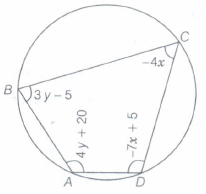
ABCD is a cyclic quadrilateral. Find the angles of the cyclic quadrilateral.
3.
Ankita travels 14 km to her home partly by rickshaw and partly by bus. She takes half an hour, if she travels 2 km by rickshaw and the remaining distance by bus.
On the other hand, if she travels 4 km by rickshaw and the remaining distance by bus, she takes 9 min longer. Find the speed of rickshaw and of the bus.
4.
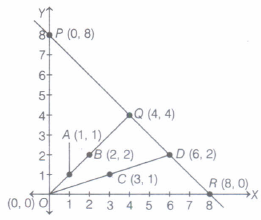
Determine graphically, the vertices of the triangle formed by the lines y=x, 3y=x, x+y=8.
5.
Use elimination method to find all possible solutions of the following pair of linear equation
2x+3y=8 (1)
4x+6y=7 (2)
6.
Solve graphically, the pair of linear equations x-y=-1 and 2x+y-10=0. Also, find the vertices of the triangle formed by these lines and X-axis.
7.
Is the system of linear equations 2x + 3y - 9 = 0 and 4x + 6y - 18 = 0 consistent? Justify your answer.
8.
If ad \(\neq \) bc, then find whether the pairs of linear equations ax + by = p and cx + dy = q has no solution, unique solution or infinitely many solutions.
9.
If am=bl, then find whether the pair of linear equations ax + by = c and lx + my = n has no solutions, unique solution or infinitely many solutions.
10.
Find whether the pair of linear equations y = 0 and y = -5 has no solution, unique solution or infinitely many solutions.
11.
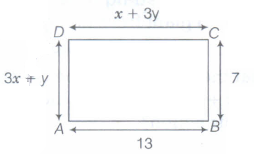
Find the values of x and y in the given rectangle.
12.
Solve the following pair of equations by elimination method.
0.4x+0.3y=1.7; 0.7x-0.2y=0.8x=2, y=3
13.
Two straight paths are represented by the lines 7x-5y=3 and 14x-10y=5. Check whether the paths cross each other.
14.
It can take 12 h to fill a swimming pool using two pipes. If the pipe of larger diameter is used for 4 h and the pipe of smaller diameter for 9 h, only half the pool can be filled. How long would it take for each pipe to fill the pool separately?
15.
Find the value of k, for which system of equations kx+3y=3 and 12x+ky=6 represent parallel lines.
16.
For what value of p will the following system of equations have no solution?
(2p-1)x + (p-1)y= 2p + 1; y + 3x-1 = 0.
17.
Draw the graph of lines x=-2 and y=3. Write the vertices of the figure formed by these lines, X-axis and Y-axis. Also, find the area of the figure.
18.
Find the values of a and b for which the following system of linear equation has infinite number of solutions.(a+b)x-2by=5a+2b+1 and 3x-y=14
1.
2x - y = 1
\(\Rightarrow\) y = 2x - 1
| x | 0 | 1 | 3 |
| y | -1 | 1 | 5 |
and x + 2y = 13
\(\Rightarrow \quad y=\frac { 13-x }{ 2 } \)
| x | 1 | 3 | 5 |
| y | 6 | 5 | 4 |
Plotting the above points and drawing the lines joining them, we get the graph of above equations. Clearly, two lines intersect at point A(3, 5). Hence, x = 3 and .y = 5 is the solution of above equations.
ABC is the triangular shaded region formed by the lines and the Y-axis.
2.
We know that, in a cyclic quadrilateral, the sum of two opposite angles is 180°.
\(\therefore \quad \angle B+\angle D={ 180 }^{ 0 } and \quad \angle A+\angle C={ 180 }^{ 0 }\)
\(\Rightarrow \) 3y-5-7x+5=180 and 4y+20-4x=180
\(\Rightarrow \) 3y-7x=180 ...(i)
and 4y-4x=160
\(\Rightarrow \) y-x=4. [dividing both sides by 4] ...(ii)
On multiplying Eq. (ii) by 7 and then subtracting from Eq. (i), we get
-4y=180-280
\(\Rightarrow \) -4y=-100 y=25
On putting y=25 in Eq. (ii), we get
25-x=40 x=-15
On putting the values of x and y, we calculate the angles as
\(\angle A=4y+20=100+20={ 120 }^{ 0 }.\)
\(\\ \angle B=3y-5=75-5={ 70 }^{ 0 }.\)
\(\\ \angle C=-4x=-4(-15)={ 60 }^{ 0 }.\)
and \( \angle D=-7x+5=105+5={ 110 }^{ 0 }.\)
Hence, the angles are \(\angle A={ 120 }^{ 0 },\angle B={ 70 }^{ 0 },\angle C={ 60 }^{ 0 }\) and \( \angle D={ 110 }^{ 0 }.\)
3.
10 km/h, 40 km/h
4.
Plot the lines as follows (0, 0), (4,4), (6,2)
5.
Step 1 : Multiply Equation (1) by 2 and Equation (2) by 1 to make the coefficients of x equal. Then we get the equations as
4x + 6y = 16 (3)
4x + 6y = 7 (4)
Step 2 : Subtracting Equation (4) from Equation (3),
(4x - 4x) + (6y - 6y) = 16 - 7
i.e., 0 = 9, which is a false statemnt.
Therefore, the pair of equations has no solution.
6.
x=3, y=4, vertices of triangle are (3,4), (-1,0) and (5,0).
7.
Yes, it is consistent. We have, for the equation
2x + 3y - 9 = 0
a1 = 2,b1 = 3 and c1= -9
and for the equation, 4x + 6y - 18 = 0
a2 = 4, b2 = 6 and C2 = - 18
Here \(\frac { { a }_{ 1 } }{ { a }_{ 2 } } =\frac { 2 }{ 4 } =\frac { 1 }{ 2 } \)
\(\frac { { b }_{ 1 } }{ { b }_{ 2 } } =\frac { 3 }{ 6 } =\frac { 1 }{ 2 } \)
and \(\frac { { c }_{ 1 } }{ { c }_{ 2 } } =\frac { -9 }{ -18 } =\frac { 1 }{ 2 } \)
It is clear that \(\frac { { a }_{ 1 } }{ { a }_{ 2 } } =\frac { { b }_{ 1 } }{ { b }_{ 2 } } =\frac { { c }_{ 1 } }{ { c }_{ 2 } } \)
Hence, system is consistent and dependent.
8.
\(ad\neq bc\Rightarrow \frac { a }{ c } \neq \frac { b }{ d } \)
Hence, the pair of given linear equations has unique solution.
9.
Since, am = bl
\(\Rightarrow \ \ \frac { a }{ l } =\frac { b }{ m } \neq \frac { c }{ n } \)
So, ax+by=c and lx + my = n has no solution.
10.
The pair of equations y = 0 and y = -5 has no solution.
11.
By property of rectangle, we know that its opposite sides are of equal lengths.
i.e. DC=AB \(\Rightarrow\) x+3y=13 ...(i)
and AD=BC \(\Rightarrow\) 3x+y=7 .....(ii)
On multiplying Eq. (ii) by 3 and then subtracting Eq. (i), we get
| 9x+3y=21 |
| x+3y=13 |
| 8x=8 |
\(\Rightarrow\) x=1
On putting x=1 in Eq. (i), we get
3y=12 \(\Rightarrow\) y=4
Hence, x=1 and y=4.
12.
x=2, y=3
13.
Given equation are 7x-5y=3 and 14x-10y=5
Here, a1=7, b1=-5, c2=-3
and a2=14, b2=-10, c2=-5
Now, \(\frac { { a }_{ 1 } }{ { a }_{ 2 } } =\frac { 7 }{ 14 } =\frac { 1 }{ 2 } ,\quad \frac { { b }_{ 1 } }{ { b }_{ 2 } } =\frac { -5 }{ -10 } =\frac { 1 }{ 2 } \) and \(\frac { { c }_{ 1 } }{ { c }_{ 2 } } =\frac { 3 }{ 5 } \)
Thus, for the given equations, we have
\(\frac { { a }_{ 1 } }{ { a }_{ 2 } } =\frac { { b }_{ 1 } }{ { b }_{ 2 } } \neq \frac { { c }_{ 1 } }{ { c }_{ 2 } } \)
So, we conclude that the two paths are parallel to each other. Hence, the paths do not cross each other.
14.
Let the time taken by larger pipe be x h and that taken by smaller pipe be y h, then
\(\frac { 4 }{ x } +\frac { 9 }{ y } =\frac { 1 }{ 2 } \quad \quad ...(i)\)
and \(\frac { 12 }{ x } +\frac { 12 }{ y } =1\quad \quad ...(ii)\)
Solve Eq. (i) and Eq. (ii) to get values of x and y.
Larger pipe alone fill the pool in 20 h and smaller pipe alone fill the pool in 30 h.
15.
For parallel lines, \(\frac { { a }_{ 1 } }{ { a }_{ 2 } } =\frac { { b }_{ 1 } }{ { b }_{ 2 } } \neq \frac { { c }_{ 1 } }{ { c }_{ 2 } } \)
k=-6
16.
For (2p- 1)x + (p - 1)y - (2p + 1) = 0
a1 = 2p -1, b1 = P -1 and c1 = - (2p + 1)
and for 3x + y - 1 = 0
a2 = 3, b2 = 1 and c2 = - 1
The condition for no solution is
\(\frac { { a }_{ 1 } }{ { a }_{ 2 } } =\frac { { b }_{ 1 } }{ { b }_{ 2 } } =\frac { { c }_{ 1 } }{ { c }_{ 2 } } \)
\(\Rightarrow \ \frac { 2p-1 }{ 3 } =\frac { p-1 }{ 1 } \neq \frac { 2p+1 }{ 1 } \)
By \(\frac { 2p-1 }{ 3 } =\frac { p-1 }{ 1 } \)
\(\Rightarrow\) 3p-3 = 2p - 1
\(\Rightarrow\) 3p - 2p = 3- 1
\(\therefore\) p = 2
from \(\frac { p-1 }{ 1 } \neq 2p+1\)
We have p - 1 \(\neq \) 2p + 1
\(\Rightarrow\) -1-1 \(\neq \) 2p - p
\(\therefore\) p \(\neq \) -2
from \(\\ \frac { 2p-1 }{ 3 } \neq \frac { 2p+1 }{ 1 } \)
\(\Rightarrow\) 2p - 1\(\neq \) 6p + 3
\(\Rightarrow\) 4p \(\neq \) -4
\(\therefore\) p \(\neq \) -1
17.
(0,0), (0,3), (-2m3), (-2,0) and area=6 sq units
18.
Given, system of equation is
(a+b)x-2by=5a+2b+1
or (a+b)x-2by-5a-2b-1=0 ...(i)
and 3x-y=14
or 3x-y-14=0 ......(ii)
a=5, b=1

10th Standard CBSE Syllabus & Materials
10th Standard CBSE
CBSE 10th Social Science PS - Federalism - New Model Questions Papers Study Material - QB365 Set A
NEW10th Standard CBSE
CBSE 10th Social Science PS - Power Sharing - New Model Questions Papers Study Material - QB365 Set A
NEW10th Standard CBSE
CBSE 10th Social Science GEO - Manufacturing Industries - New Model Questions Papers Study Material - QB365 Set A
NEW10th Standard CBSE
CBSE 10th Social Science GEO - Minerals and Energy Resources - New Model Questions Papers Study Material - QB365 Set A



CBSE 10th Standard CBSE Subjects
CBSE Standards





