
 100% FREE ACCESS
10th Standard CBSE Syllabus & Materials
10th Standard CBSE
CBSE 10th Social Science ECO - Globalisation and the Indian Economy - New Model Questions Papers Study Material - QB365 Set A
NEW10th Standard CBSE
CBSE 10th Social Science ECO - Money and Credit - New Model Questions Papers Study Material - QB365 Set A
NEW10th Standard CBSE
CBSE 10th Social Science ECO - Sectors of the Indian Economy - New Model Questions Papers Study Material - QB365 Set A
NEW10th Standard CBSE
CBSE 10th Social Science ECO - Development - New Model Questions Papers Study Material - QB365 Set A
NEW10th Standard CBSE
CBSE 10th Social Science PS - Outcomes of Democracy - New Model Questions Papers Study Material - QB365 Set A
NEW10th Standard CBSE
CBSE 10th Social Science PS - Gender, Religion and Caste - New Model Questions Papers Study Material - QB365 Set A

Published on: 22/10/2025
Download CBSE Class 10th Standard CBSE Maths question papers, sample papers, important questions, and previous year solved papers in PDF format. Get free study materials, NCERT solutions, and exam preparation resources for Class 10th Standard CBSE Maths
Questions + Answers key
Take MCQ Maths Test
1.
In the following figure, altitudes AD and CE of ΔABC intersect each other at the point P. Show that:
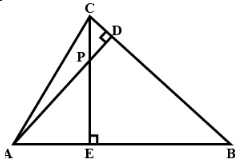
ΔAEP ∼ ΔCDP
2.
State which pair of triangles in the following figure are similar? Write the similarity criterion used by you for answering the question and also write the pairs of similar triangles in the symbolic form:
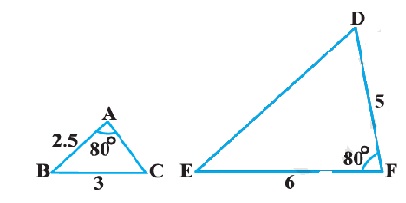
3.
State which pair of triangles in the following figure are similar? Write the similarity criterion used by you for answering the question and also write the pairs of similar triangles in the symbolic form:
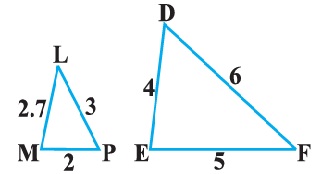
4.
In the given figure, DE || OQ and DF || OR. Show that EF || QR.
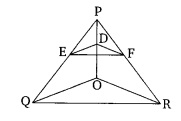
5.
E and F are points on the sides PQ and PR respectively of a ΔPQR. For the following case, state whether EF || QR
PE = 4 cm, QE = 4.5 cm, PF = 8 cm and RF = 9 cm
6.
See the given Figure. DE || BC. Find EC
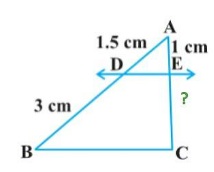
7.
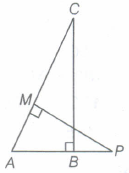
In the given figure, ABC and AMP are two right angled triangles, right angled at B and M, respectively. Prove that
\(\triangle ABC\sim \triangle AMP\)
8.
E and F are points on the sides PQ and PR respectively of a ΔPQR. For the following case, state whether EF || QR. PE = 3.9 cm, EQ = 3 cm, PF = 3.6 cm and FR = 2.4 cm
9.
Give two different examples of pair of
(i) similar figures
(ii) non-similar figures
10.
The given figure consists of two semicircles and two quarter circles. If OA = OB = OC = OD = 14 cm. Find the length of the boundary and area of the shaded region.
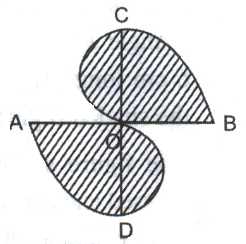
11.
Find the area of \(\Delta\)PQR such that \(\angle\)=900, PR=10cm and \(\angle\) PRQ=300.[Take \(\sqrt{3}=1.73\)]
12.
The figure shows the quadrant of a circle of radiius 4.2 cm. Find the perimeter of the quadrant.
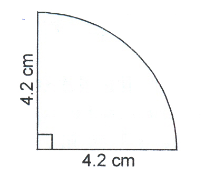
13.
If the circumference of a circle increases from \(2\pi\) to \(4\pi\), then find the change in its area.
14.
Find the perimeter of a quadrant of a circle of radius \(\frac{7}{2}\) cm.
15.
A wire is in the shape of a circle of radius 21 cm. It is bent to form a square. Find the side of the square. \(\left[ \pi =\frac { 22 }{ 7 } \right] \)
16.
Find the diameter of a circle whose area is equal to sum of areas of two circles of diameter 16 cm and 12 cm.
17.
Find the number of rounds that a wheel of diameter \(\frac{7}{11}\) m will make in going 4 km.
18.
A lighthouse throws a light forming sector of radius 16.5 cm with central angle 80°, find the area covered by it.
19.
Area enclosed between two circumferences of two concentric circles is 346.5 cm2 , if circumference of inner circle is 88 cm, find the radius of outer circle.
20.
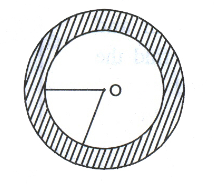
Find the area of shaded region in the given figure.
21.
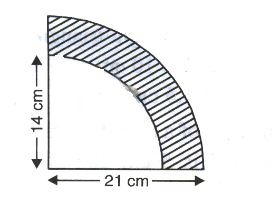
The perimeter of a sector of circle with central angle 90° is 25 cm, find the area of the minor segment.
22.
How many times will the wheel of a car rotate in a journey of 2002m, if the radius of the wheel is 49cm?
23.
The diameter of a cycle wheel is 21cm.How many revolutions will it make to travel 1.98km?
24.
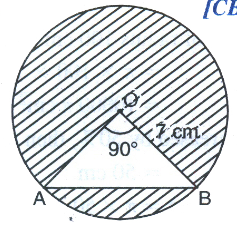
In figure, if radius of circle is 7cm and \(\angle AOB=90^0,\) then find the area of the shaded region.
25.
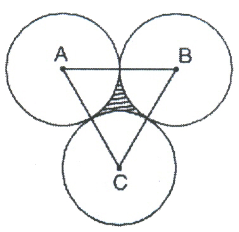
In figure, if radius of each circle is unity and ABC is an equilateral triangle, then find the area of the shaded region.
26.
In figure, find the area of shaded region.
27.
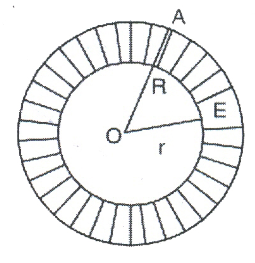
In given figure, a semicircle is drawn with O as centre and AB as diameter. Semicircles are drawn with AO and OB as diameters. If AB = 28 m, find the perimeter of the shaded region. \([Use\ \pi={22\over 7}]\)
28.
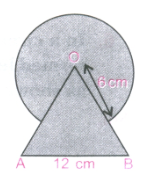
Find the area of the shaded region in the figure, where a circular arc of radius 6 cm has been drawn with vertex O of an equilateral triangle OAB of side 12 cm as centre.
29.
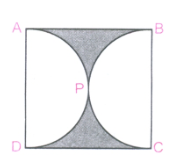
Find the area of the shaded region in the given figure, if ABCD is a square of side 14 cm and APD and BPC are semicircles.
30.
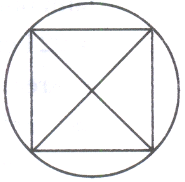
All the vertices of a rhombus lie on a circle. Find the area of the rhombus, if area of the circle is 1256 \(cm^2\) (Use \(\pi\) = 3.14).
31.
The diameter of the wheel of a bus is 140 cm. How many revolutions per minute must the wheel make in order to keep a speed of 66 km/h?
32.
What is the ratio of the areas of a circle and an equilateral triangle whose diameter and a side are respectively equal?
33.
If the perimeter of a semicircular protactor is 66 cm., find the radius of the protactor.
34.
The circumference of a circular plot is 220 m. A 15 m wide concrete track runs round outside the plot. Find the area of the track. \([\ Use\ \pi = 22/7]\)
35.
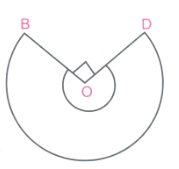
In fig., the shape of the top of a table in restaurant is that of sector of a circle with centre O and (
(i) the area of the top of the table
(ii) the perimeter of the table top. [Take \(\pi\) = 3.14]
36.
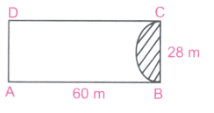
A plot is in the form of a rectangle ABCD having semicircle on BC as shown in the figure. The semicircle portion is grassy while the remaining plot is without grass. Find the area of the plot without grass where AB=60 m and BC = 28 m. \([Use\ \pi ={22\over 7}]\)
37.
The minute hand of a clock is \(\sqrt {21}\) cm long. Find the area described by the minute hand on the face of the clock between 7.00 am and 7.05 am. \([Use\ \pi={22\over 7}]\)
38.
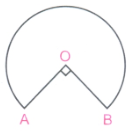
In the given figure, the shape of the top of a table is that a sector of a circle with centre O and \(< AOB = 90^o\). If AO=OB = 42 cm, then find the perimeter of the top of the table. \([Use\ \pi={22\over7}]\)
39.
An arc of a circle is of length \(5\pi\) cm and the sector it bounds has an area of \(20\pi\ cm^2\). Find the radius of the circle
40.
A pendulum swings through an angle of \(30^o\) and describes an arc 8.8 cm in length. Find the length of pendulum. ( use \(\pi ={22\over 7}\))
41.
A bicycle wheel makes 5000 revolutions in moving 11 km. Find the diameter of the wheel. (use \(\pi ={22\over 7}\))
42.
In the fig., O is the centre of a circle. The area of sector OAPB is \(5\over 18\)of the area of the circle. Find x.
-S.png)
43.
To warn ships for underwater rocks, a lighthouse spreads a red coloured light over a sector of angle \(80^o\) to a distance of 16.5 km. Find the area of the sea over which the ships are warned. \((Use\ \ \pi = 3.14)\)
44.
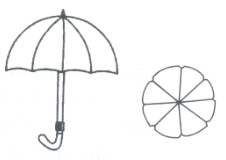
An umbrella has 8 ribs which are equally spaced (see the figure). Assuming umbrella to be a flat circle of radius 45 cm, find the area between the two consecutive ribs of the umbrella.
45.
A chord of a circle of radius 10 cm subtends a right angle at the centre. Find area of the corresponding
(i) minor segment
(ii) major sector \(( Take, \quad \pi = 3.14)\)
46.
Find the area of a quadrant of a circle whose circumference is 22cm.
1.
Given, AD and CE are altitudes which intersect each other at the point P.
In ΔAEP and ΔCDP,
∠AEP = ∠CDP [Each 90°]
and ∠APE = ∠CPD [Vertically opposite angles]
\(\therefore\) ΔAEP ∼ ΔCDP [by AA similarity criterion]
2.
No, because in \(\Delta\)ABC, \(\angle\)BAC is given but the measure of included side AC is not given.
3.
No, the two triangles are not similar.
4.
In Δ POQ, DE || OQ [given]
\(\therefore \frac{P E}{E Q}=\frac{P D}{D O}\) ...(i)
[by basic proportionality theorem]
In ΔPOR, DF || OR [given]
\(\therefore \frac{P F}{F R}=\frac{P D}{D O}\) ...(ii)
[by basic proportionality theorem]
From Eqs. (i) and (ii), we get
\(\frac{P E}{E Q}=\frac{P F}{F R}\)
In ΔPQR, we have \(\frac{P E}{E Q}=\frac{P F}{F R}\)
∴ EF || QR
[by Converse of basic proportionally theorem]
Hence proved.
5.
PE = 4 cm, QE = 4.5 cm, PF = 8 cm, RF = 9 cm
\( \frac{P E}{E Q}=\frac{4}{4.5}=\frac{8}{9} \)
\(\frac{P F}{F R}=\frac{8}{9} \)
\(\frac{P F}{F R}=\frac{P E}{E Q} \)
Therefore, EF is parallel to QR
6.
Let EC = x cm
It is given that DE || BC.
By using basic proportionality theorem, we obtain
\(\frac{A D}{D B}=\frac{A E}{E C}\)
\(\frac{1.5}{3}=\frac{1}{x}\)
\(x=\frac{3 \times 1}{1.5}\)
x = 2
∴ EC = 2 cm
7.
Given, \(\angle ABC={ 90 }^{ ° }\) and \(\angle AMP={ 90 }^{ ° }\)
In \(\triangle ABC\) and \(\triangle AMP\)
\(\angle ABC=\angle AMP\) [each 90°]
and \(\angle BAC=\angle MAP\) [common angle]
\(\therefore \triangle ABC\sim \triangle AMP\) [by AA similarity criterion]
8.
Given that, PE = 3.9 cm, EQ = 3 cm, PF = 3.6 cm, FR = 2.4 cm
\( \frac{P E}{E Q}=\frac{3.9}{3}=1.3 \)
\(\frac{P F}{F R}=\frac{3.6}{2.4}=1.5\)
Hence, \(\frac{P E}{E Q} \neq \frac{P F}{F R}\)
Therefore, EF is not parallel to QR
9.
(i) (a) Pair of the equilateral triangles are similar figures.
(b) Pair of the squares are similar figures.
(ii) (a) A triangle and a quadrilateral form a pair of non-similar figures.
(b) A square and a circle form a pair of non-similar figures.
10.
116 cm, 462 cm2
11.
Here, \({PQ\over PR}=sin30^0\)
\(⇒\ {PQ\over 10}={1\over 2}⇒\ PQ=5cm\)
And \({QR\over PR}=cos30^0\)
\(⇒\ {QR\over 10}={\sqrt3\over 2}⇒ QR=5\sqrt3cm\)
-S.png)
∴ Area of ΔPQR\(={1\over 2}\times PQ\times QR\)
\(={2\over 2}\times5\times5\sqrt3\)
\(={25\over 2}\times1.73={43.25\over 2}\)
=21.625cm2
12.
15 cm
13.
Four times
14.
12.5 cm
15.
33 cm
16.
20 cm
17.
2000
18.
190.14 m2
19.
17.5 cm
20.
192.5 cm2
21.
14 cm2
22.
Radius of the wheel = r = 49cm
Distance covered in one = 2πr
\(=2\times{22\over 7}\times49\)
2 x 22 x 7cm
Total distance covered = 2002m
∴ Number of revolutions=\(Total\ distance\ covered\over Distance\ covedred\ in\ one\ revolution\)
\(={2002\times100\over 2\times22\times7}=750\)
23.
Let r be the radius of cycle wheel
\(r={21\over2}cm\)
Distance travelled in one revolution = 2πr
\(=2\times{22\over 7}\times{21\over 2}=66cm\)
Total distance covered = 1.98km
=1.98 x 100 x 100
=198000cm
∴ Number of revolutions=\(Total\ distance\ covered\over distance\ covered\ in\ one\ revolution\)
\(={198000\over66}=3000\)
24.
Here, area of shaded region
=Area of circle-Area of \(\Delta AOB\)
\(={2\over7}\times7\times7-{1\over2}\times7\times7\)
\(=154-{49\over2}\)
=129.5 cm2
25.
Area of an equilateral ΔABC=\(\frac { \sqrt { 3 } }{ 4 } \times (2)^{ 2 }=\sqrt { 3 } \)
∵ Central angle of each sector = 60o
∴ Area of 3 sectors=\(3\times \frac { { \pi r }^{ 2 }\theta }{ { 360 }^{ o } } \)
\(=\frac { 3\times \pi \times 1\times 1\times { 60 }^{ o } }{ { 360 }^{ o } } =\frac { \pi }{ 2 } \)
∴ Area of shaded region = Area of ΔABC Area of 3 sectors
=\(\sqrt { 3 } -\frac { \pi }{ 2 } \)
26.
Area of shaded region = Area of outer circle-Area of inner circle
\(=\pi R^2-\pi r^2=\pi(R^2-r^2)\)
27.
Diameter AB=28m
Radius (r1)=\(={28\over 2}=14m\)
Diameter AO=14m
Radius (r2)=\(={14\over 2}=7m\)
radius(r3)=7m
Perimeter of the shaded region=πr1+(πr2+πr3)=π[r1+r2+r3]
\(={22\over 7}[14+7+7]={22\over 7}\times28=88m\)
28.
Area of sector OCDE \(=\frac{60^{\circ}}{360^{\circ}} \pi r^{2}\)
\(\begin{array}{l} =\frac{1}{6} \times \frac{22}{7} \times 6 \times 6 \\ =\frac{132}{7} \mathrm{~cm}^{2} \end{array}\)
Area of triangle OAB \(=\frac{\sqrt{3}}{4}(12)^{2}=\frac{\sqrt{3} \times 12 \times 12}{4}=36 \sqrt{3} \mathrm{~cm}^{2}\)
Area of circle \(=\pi r^{2}=\frac{22}{7} \times 6 \times 6=\frac{792}{7} \mathrm{~cm}^{2}\)
Area of shaded region = Area of ΔOAB + Area of circle − Area of sector OCDE
\(\begin{array}{l} =36 \sqrt{3}+\frac{792}{7}-\frac{132}{7} \\ =\left(36 \sqrt{3}+\frac{660}{7}\right) c m^{2} \end{array}\)
29.
ABCD is a square
Given: side of the square =14cm
∴ Area of the square = (side)2 (14)2 = 196 cm2
Radius of the semicircle APD=\({1\over 2}\)(side of square)=\({1\over 2}\times14=7cm\)
Area of the semicircle APD=\({1\over 2}\pi r^2={1\over 2}\times{22\over 7}\times7\times7=11\times7=77cm^2\)
Similarly, area of the semicircle BPC= 77cm2
Total area of both the semicircles=77 + 77 - 154 cm2.
Area of the shaded region = Area of square - area of both semicircles = 196 - 154 -42cm2
30.
Area of the circle=1256cm2
⇒ A=πr2
A.T.Q 1256=πr2
\({1256\over3.14}=r^2\)
\(⇒\sqrt{1256\over 3.14}=r\)
⇒ 20cm = radius
⇒ 40cm = diameter
Here, Diagonals of rhombus = diameter of the circle
∴ Area of rhombus = \({1\over 2}d_1\times d_2\)
\(={1\over 2}\times40\times40=800cm^2\)
31.
Radius of wheel=70cm
Distance covered in 1 revolution=2πr
\(=2\times{22\over 7}\times70=440cm=4.4m\)
\(Speed=66km/h={66000\over 60}m/minute\)
=1100m/minute
∴ No. of revolutions\(={1100\over 4.4}=250\)
32.
Let radius of circle be r cm
Its area = πr2 sq units
Side of an equilateral triangle = diameter of the circle = 2r
Area of the equilateral triangle
\(={\sqrt3\over 4}\times(2r)^2\)
\(={\sqrt3\over 4}\times4r^2=\sqrt3r^2\)
\({Area\ of\ the\ circle\over Area\ of\ the\ triangle }={\pi r^2\over \sqrt3 r^2}={\pi\over\sqrt3}\)
33.
Let radius of the protractor be r cm
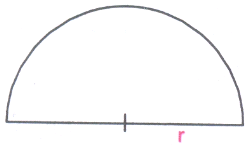
⇒ Perimeter=\(\left[{1\over2}\times2\pi r+2r\right]\)
66cm=[πr+2r]
⇒ \(66=\left({22\over 7}+2\right)r=\left(22+14\over7\right)r\)
\(=\left(36\over 7\right)r\)
\(⇒\ \ {7\times66\over 36}=r⇒ r={77\over 6}cm\)
34.
Inner radius \(= {220\times 7\over 22\times 2}=35 cm\) and Width of the track = 15 m
Outer radius = 35 + 15 = 50 m
Area of the track \(=\ \pi(50^2-35^2)={22\over 7}(50-35)(50+35)={22\over 7}\times 1585\ m^2=4007.14\ sq.m\)
35.
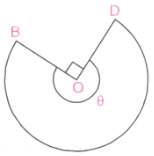
BO = OD = r = 60 cm
\(\theta\) = 360° - BOD = 360° - 90° = 270°
(i) Area of the table top (sector)
= \(\frac { \theta }{ 360° } { \pi r }^{ 2 }=\frac { 270° }{ 360° } \times 3.14\times 60\times 60\)
= \(45\times 60\times \frac { 314 }{ 100 } \times 60+120\)
= (ii) Perimeter (table top) = \(\frac { \theta }{ 360° } { 2\pi r }+2r\)
= \(\frac { 270° }{ 360° } \times 2\times \frac { 314 }{ 100 } \times 60+120\)
= \(\frac { 270° }{ 360° } \times 2\times \frac { 90\times 314 }{ 100 } +120=\frac { 2826+1200 }{ 10 } =402.6 \ cm\)
36.
Length of the rectangle AB = 60 m
Breadth of the rectangle = BC = 28 m
Diameter of the shaded portion = 28 m
⇒ Radius of the shaded portion = \(28\over2\)m = 14m
Grass portion = shaded portion
⇒ Area of the plot without grass = area of the rectangle ABCD - area of the shaded portion
= \(\left[ 60\times 28-\frac { 1 }{ 2 } \times \frac { 22 }{ 7 } \times { (14) }^{ 2 } \right] { m }^{ 2 }\) = (1680 - 308)m2 = 1372 m2
37.
Time taken by minute hand to make one circle = 60 minutes.
\(\therefore\) Angle described in 60 minutes = \(360^o\)
Angle described in 5 minutes [i.e., from 7.00 a.m. to 7.05 a.m.] = \({360^o\over 60^o}\times 5=30^o\)
Radius of circle = length of minute hand = \(\sqrt {21}cm\)
Area swept = \({\theta \over 360^o}\times r^2={30^oover 360^o}\times {22\over 7}\times \sqrt{21}\times \sqrt {21}={1\over 12}\times {22\over 7}\times 21 = {11\over 2}\ cm^2=5.5 cm^2\)
38.
Perimeter = length of major arc + 2r
\(={270^o\over 306^o} \times 2 \times + 2r= {3\over 2}\times {22\over 7}\times 42+2\times 42+2\times 42 = 198 + 84=284\ cm\)
39.
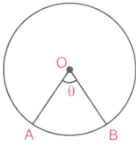
length of arc AB = 5\(\pi\) cm
Let AOB = \(\theta\)
Now i = \(\frac { \theta }{ 360° } \)x 2\(\pi\)r
5\(\pi\) = \(\frac { \theta }{ 180° } \)\(\pi\)r ⇒ \({900\over r}=\theta\)
Now, Area of sector = \(\frac { \theta }{ 360° } \)x 2\(\pi\)r2
20\(\pi\) = \(\frac { r }{ 360° } \)x 2\(\pi\)r2 ⇒ 20 = \(900°\over360°\)r ⇒ r = 8 cm
40.
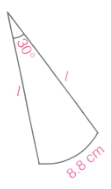
Let length of the pendulum he I cm.
Length of the arc = 8.8 cm
⇒ \(\frac { \theta \pi i }{ 180 } =8.8cm\Rightarrow \frac { 30°\times \pi \times i }{ 180° } =8.8\)
⇒ \(\pi i=8.8\times 6\Rightarrow \frac { 22 }{ 7 } \times i=52.8cm\)
⇒ \(i=\frac { 52.8\times 7 }{ 22 } cm\quad =\quad 16.8\quad cm\)
41.
Distance covered in 5000 revolutions = 11 km.
Distance covered in 1 revolution
Distance covered in 1 revolution \(={11000\over 5000}m={11\over 5}m\)
Distance covered in 1 revolution = circumference of the wheel
\(\Rightarrow\)\(2\ \pi r ={11\over 5} \Rightarrow 2\times {22\over 7}\times r = {11\over 5}\)
\(\Rightarrow\) \(r \Rightarrow {11\over 5}\times 7\times {1\over 2\times 22}={7\over 20}m\)
\(\therefore\) Diameter \(=2\times r=2\times {7\over 20}={7\over 10}\times 100 cm=70cm\)
42.
Area of sector OAPB \(={x\over 360^o}\times \pi r^2\)
According to the question,
Ares of sector \(OAPB = {5\over 18}\)of the area of the circle.
\(\Rightarrow\) \({x\over 360^o} \times \pi r^2={15\over 18}\pi r^2\Rightarrow {x\over 360^o}={5\over 18} \Rightarrow x=100^o\).
43.
Given, sector angle, \(\theta\)= 80°
and distance or radius, r = 16.5 km
\(\begin{aligned} \therefore \text { Area of sector } & =\frac{\theta}{360^{\circ}} \times \pi r^2=\frac{80^{\circ}}{360^{\circ}} \times 3.14 \times(16.5)^2 \\ \end{aligned}\)
\(\begin{aligned} =\frac{2 \times 3.14 \times 272.25}{9} \end{aligned}\)
\(\begin{aligned} =\frac{1709.73}{9} \end{aligned}\)
= 189.97 km2
which is the required area of the sea over which the ships are warned.
44.
Given, umbrella to be a flat circle. So, the central angle of an umbrella is 360°.
Since, umbrella has 8 ribs.
\(\therefore\) Angle between two ribs.
\(=\frac{360^{\circ}}{8}=45^{\circ}\)
Area between two ribs = Area of one sector of the umbrella
\(=\frac{\theta}{360^{\circ}} \times \pi r^2=\frac{45^{\circ}}{360^{\circ}} \times \frac{22}{7} \times(45)^2[\because r=45, \text { given }]\)
\(\begin{aligned} & =\frac{22}{7 \times 8}(45)^2 \\ \end{aligned}\)
\(\begin{aligned} & =\frac{22275}{28} \mathrm{~cm}^2 \end{aligned}\)
45.
Given, radius of a circle, AO = 10 cm and \(\angle\)AOC = 90°
Area of \(\triangle A O C=\frac{1}{2} \times O A \times O C=\frac{1}{2} \times 10 \times 10=50 \mathrm{~cm}^2\)
\(\begin{aligned} \text { Area of sector } O A E C O & =\frac{\theta}{360^{\circ}} \times \pi r^2 \\ \end{aligned}\)
\(\begin{aligned} =\frac{90^{\circ}}{360^{\circ}} \times 3.14 \times(10)^2 \\ \end{aligned}\)
\(\begin{aligned} =\frac{314}{4}=78.5 \mathrm{~cm}^2 \end{aligned}\)
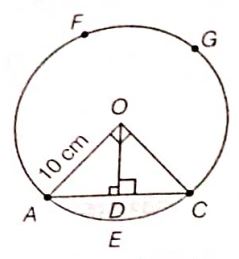
(i) Area of minor segment AECDA
= Area of sector OAECO - Area of \(\Delta\)AOC
= 78.5 - 50 = 28.5 cm2
(ii) Area of major sector OAFGCO
= Area of circle - Area of sector OAECO
= 3.14 \(\times\)(10)2 - 78.5
= 314 - 78.5 = 235.5 cm2
46.
Let, Radius of the circle = r
\(\therefore\) Circumference of the circle = \(2\pi r\)
A.T.Q \(2\pi r\) = 22 cm
\(\Rightarrow\) \(2\times {22\over 7}\times r=22\ \ \ \Rightarrow\ \ \ \ r={{22\times 7\over 2\times 22}}={7\over 2}cm\)
Area of quadrant of the circle \(={\pi r^2\theta\over 360^o}={22\over 7}\times {7\times 7\over 2\times 2}\times {90^o\over 360^o}={22\times 7\over 2\times 2\times 4}={77\over 8}cm^2\)

10th Standard CBSE Syllabus & Materials
10th Standard CBSE
CBSE 10th Social Science PS - Federalism - New Model Questions Papers Study Material - QB365 Set A
NEW10th Standard CBSE
CBSE 10th Social Science PS - Power Sharing - New Model Questions Papers Study Material - QB365 Set A
NEW10th Standard CBSE
CBSE 10th Social Science GEO - Manufacturing Industries - New Model Questions Papers Study Material - QB365 Set A
NEW10th Standard CBSE
CBSE 10th Social Science GEO - Minerals and Energy Resources - New Model Questions Papers Study Material - QB365 Set A



NCERT Books

Syllabus

Exam Pattern

Sample Question Papers

Previous year Question Papers

Important Notes

MCQ Practice test

NCERT Exemplers

Case study Questions

Image Based Questions

Passage based Questions

HOT Questions

Value Based Questions

Model Questions Papers
NCERT ( Book Back ) Questions

Assertion and Reason
Important Questions And Answers

CBSE 10th Standard CBSE Subjects
CBSE Standards



