
 100% FREE ACCESS
10th Standard CBSE Syllabus & Materials
10th Standard CBSE
CBSE 10th Social Science ECO - Globalisation and the Indian Economy - New Model Questions Papers Study Material - QB365 Set A
NEW10th Standard CBSE
CBSE 10th Social Science ECO - Money and Credit - New Model Questions Papers Study Material - QB365 Set A
NEW10th Standard CBSE
CBSE 10th Social Science ECO - Sectors of the Indian Economy - New Model Questions Papers Study Material - QB365 Set A
NEW10th Standard CBSE
CBSE 10th Social Science ECO - Development - New Model Questions Papers Study Material - QB365 Set A
NEW10th Standard CBSE
CBSE 10th Social Science PS - Outcomes of Democracy - New Model Questions Papers Study Material - QB365 Set A
NEW10th Standard CBSE
CBSE 10th Social Science PS - Gender, Religion and Caste - New Model Questions Papers Study Material - QB365 Set A

Published on: 22/10/2025
Download CBSE Class 10th Standard CBSE Maths question papers, sample papers, important questions, and previous year solved papers in PDF format. Get free study materials, NCERT solutions, and exam preparation resources for Class 10th Standard CBSE Maths
Questions + Answers key
Take MCQ Maths Test
1.
Derive the formula for the curved surface area and total surface area of the frustum of a cone, given to you in Section 13.5, using the symbols as explained.
2.
A momento is made as shown in the figure. Its base PBCR is silver plated from the front side. Find the area which is silver plated. (Use \(\pi =\frac{22}{7}\))
3.
A hollow cube of internal edge 22 cm is filled with spherical marbles of diameter 05 cm and it is assumed that \(\frac { 1 }{ 8 } \) space of the cube remains unfilled. Then, find the number of marbles that the cube can accommodate.
4.
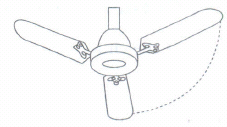
A ceiling fan has three wings as shown in the figure. Find the length of arc described between two consecutive wings, where the length of each wing is 0.98 m.
5.
AB is chorod of circle of radius 10 cm. The chorod subtends a right angle at the centre of the circle. Find the area of the minor segment. [Take \(\pi\) = 3.14 ]
6.
The total surface area of a solid cylinder is 231cm2.If the curved surface area of this solid cylinder is \(2\over3\)of its total area, find is radius and height \([Use\ \pi={22\over7}]\)
7.
A plumbline (sahul) is the combination of two geometric shapes. name the two geometric shapes.
8.
If the diameter of a protractor is 7 cm, then find its perimeter.
9.
The height of a cone is 30 m. A small cone is cut off at the top by a plane parallel to the base. If its volume be \(\frac{1}{27}\) of the volume of the given cone, at what height above the base is the section made?
10.
A human chain in the form of a circle of radius 56 m is formed at India Gate to protest against the rising prices of petrol. If each person is given metres of space to stand find how many persons can be accommodated in the chain.
11.
A toy is in the form of a hemisphere surmounted by a right circular cone of the same base radius as that of the
hemisphere.If the radius of base of the cone is 21cm and its volume is \(2\over3\) of the volume of the hemisphere, calculate the height of the cone and the surface area of the toy.[Use \(\pi={22\over7}\)]
12.
Two farmers have circular plots. The plots are watered with the same water source placed in the point common to both the plots as shown in the figure. The sum of their areas is 130\(\pi\) and the distance between their centres is 14 m. Find the radii of the circles. What value is depicted by the farmers?
13.
50 students of class X planned a visit to an old age home and to spend the whole day with its inmates.
Each one prepared a cylindrical flower vase using cardboard to gift the inmates. The radius of cylindrical is 4.2 cm and the height is 11.2 cm.
(i) What is the amount spent for purchasing the cardboard at the rate of Rs.20 per 100 m2?
(ii) Which values are depicted by the students?
14.
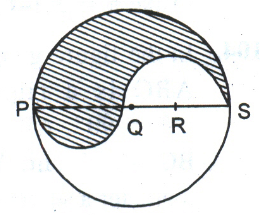
PQRS is a diameter of a circle of radius 6 cm. The lengths PQ, QR and RS are equal. Semicircles are drawn on PQ and QS as diameters as shown in the given figure. Find the perimeter of the shaded region. Also find the area of the shaded region.
15.
From each end of a solid metal cylinder, metal was scooped out in hemispherical form of same diameter. The height of the cylinder is 10 cm and its base is of radius 4.2 cm. The rest of the cylinder is melted and converted into a cylindrical wire of 1.4 cm thickness. Find the length of the wire.[Use \(\pi =22/7\)]
16.
All faces of a cuboid must be rectangular.
17.
If we double the radius of a hemisphere, its urface area will also be doubled.
18.
If circumference of a circle and perimeter of square are equal than area of circle is equal to area of sqaure.
19.
The perimeter of a semicircle is \(\pi r+2r\).
20.
A surahi is the combination of
a sphere and a cylinder
a hemisphere and a cylinder
two hemispheres
a cylinder and a cone
21.
The total surface area of an open pipe of length 50 cm, external diameter 20 cm and internal diameter 6 cm will be
4657.71 cm2
4757.71 cm2
4677.75 cm2
4557.81 cm2
22.
If H and h be the heights of two cylinders, then the ratio of curved surface areas of two cylinders with equal radii is
√H : 2√h
H : h
H2 : h2
2H : h
23.
If the curved surface area of a right circular cylinder is 1760 cm2 and its radius is 10 cm, then what is its height?
7 cm
24 cm
28 cm
14 cm
24.
A right circular cylinder of radius r cm and height h cm (h>2r) just enclosed a sphere of diameter
r cm
h cm
2h cm
2r cm
25.
What is the area of a semi–circle of radius 5 cm?
78.57 cm
71.42 cm
63.18 cm
79.86 cm
26.
A toy is in the form of a cone mounted on a hemisphere of common base radius 7 cm. The total height of the toy is 31 cm. Find the total surface area of the toy.
465
912
769
858
27.
A cylinder and a cone are of the same base radius and same height. Find the ratio of the volumes of the cylinder of that of the cone.
1 : 3
1 : 2
3 : 1
2 : 1
28.
If the side of an equilateral triangle and the radius of a circle are equal, find the ratio of their areas.
\(\pi :\sqrt { 2 } \)
\(\sqrt { 2 } :\pi \)
\(\sqrt { 3 } :4\pi \)
\(\sqrt { 3\pi } :4\)
29.
The radii of two circles are 19 cm and 9 cm respectively. The radius of the circle which has its circumference equal to the sum of the circumferences of the two circles is:
30 cm
26 cm
32 cm
28 cm
30.
The minute hand of a clock is 10 cm long. The area of the face of the clock described by the minute hand between 8 A.M and 8.25 A.M is
100 cm2
125.5 cm2
120 cm2
130.95 cm2
31.
If the circumference of a circle increases from 2π to 4π then its area is
Tripled
Doubled
Four times
Halved
32.
A circular disc of radius 6 cm is divided into three sectors with central angles 90o, 120o and 150o. The ratio of the areas of the three sectors is
4: 5: 6
1: 5: 6
3: 4: 5
2: 3: 4
33.
The area swept by the minute hand of a circular clock in 5 minutes forms a
Circle
Segment
Cone
Sector
34.
We have a circle with centre O and two radii OA and OB. If the perimeter of minor sector OAB is 55 cm, and the radius of the circle is 7cm, the value of ∠AOB is
450o
45o
180o
110o
35.
Find the circumference of the circle, whose area is 144 cm2
46 πcm
24 πcm
72 πcm
12 πcm
36.
Isha is 10 years old girl. On the result day, Isha and her father Suresh were very happy as she got first position in the class. While coming back to their home, Isha asked for a treat from her father as a reward for her success. They went to a juice shop and asked for two glasses of juice.
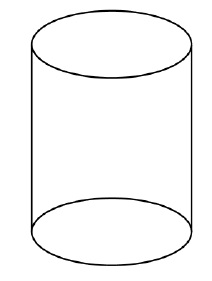
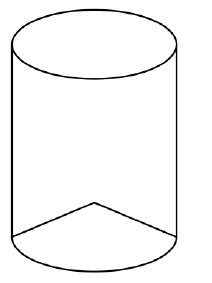
Aisha, a juice seller, was serving juice to her customers in two types of glasses. Both the glasses had inner radius 3cm. The height of both the glasses was 10 cm.
First type: A Glass with hemispherical raised bottom.
Second type: A glass with conical raised bottom of height 1.5 cm
Give answer the following questions based on above conditions :
(i) What is the capacity of first glass?
| (a) 72\(\pi\) cm2 | (b) 72\(\pi\) cm3 | (c) 85\(\pi\) cm2 | (d) 85\(\pi\) cm3 |
(ii) What is the capacity of second glass?
| (a) 85.5 \(\pi\)cm3 | (b) 85\(\pi\) cm3 | (c) 85\(\pi\) cm2 | (d) 85 \(\pi\)cm3 |
(iii) Find the ratio of the capacity of both types of glass.
| (a) 16 : 19 | (b) 17 : 19 | (c) 15 : 19 | (d) 18 : 19 |
(iv) Isha insisted to have the juice is first type of glass and her father decided to have the juice in second type of glass. Out of the two, Isha or her father Suresh, who got more quantities of juice to drink and by how much?
| (a) Isha; 72\(\pi\) cm3 | (b) Suresh; 85.5\(\pi\) cm3 | (c) Suresh; 72\(\pi\) cm3 | (d) Suresh; 13.5\(\pi\) cm3 |
(v) How much quantity of juice is purchased by Suresh from a juice seller?
| (a) 157.5\(\pi\) cm3 | (b) 1575\(\pi\) cm3 | (c) 157.5\(\pi\) cm3 | (d) none of these |
37.
Arpana is studying in X standard. While helping her mother in kitchen, she saw rolling pin made of steel and empty from inner side, with two small hemispherical ends as shown in the figure.
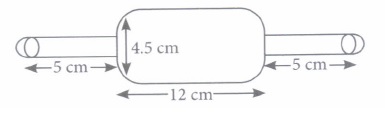
(i) Find the curved surface area of two identical cylindrical parts, if the diameter is 2.5 cm and length of each part is 5 cm.
| (a) 475 cm2 | (b) 78.57 cm2 | (c) 877 cm2 | (d) 259.19 cm2 |
(ii) Find the volume of big cylindrical part.
| (a) 190.93 cm3 | (b) 75 cm3 | (c) 77 cm3 | (d) 83.5 cm3 |
(iii) Volume of two hemispherical ends having diameter 2.5 cm, is
| (a) 4.75 cm3 | (b) 8.18 cm3 | (c) 2.76 cm3 | (d) 75 cm3 |
(iv) Curved surface area of two hemispherical ends, is
| (a) 17.5cm2 | (b) 7.9cm2 | (c) 19.64 cm2 | (d) 15.5 cm2 |
(v) Find the difference of volumes of bigger cylindrical part and total volume of the two small hemispherical ends.
| (a) 175.50 cm3 | (b) 182.75 cm3 | (c) 76.85 cm3 | (d) 96 cm3 |
38.
A farmer has a rectangular field oflength 30 m and breadth 15 m. By the farmer a pit of diameter 7 m is dug 12 m deep for rain water harvesting. The earth taken out is spread in the field.
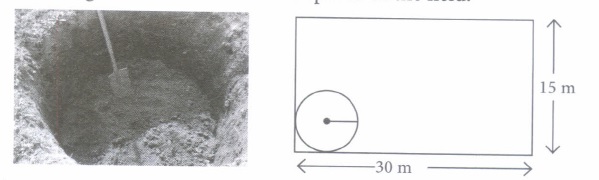
Based on the above information, answer the following questions.
(I) Find the volume of the earth taken out.
| (a) 460 m3 | (b) 462 m3 | (c) 465 m3 | (d) 468 m3 |
(ii) The area of the rectangular field is
| (a) 420 m2 | (b) 430 m2 | (c) 440 m2 | (d) 450m2 |
(iii) Find'the area of the top of the pit.
| (a) 38.5 m2 | (b) 40.5 m2 | (c) 41.5 m2 | (d) None of these |
(iv) The area of the remaining field is
| (a) 402.3 m2 | (b) 405 m2 | (c) 410 m2 | (d) 411.5 m2 |
(v) Find the level rise in the field
| (a) 0.5 m | (b) 3 m | (c) 1.12 m | (d) 2.12 m |
1.
Let ABC be a cone. A frustum DECB is cut by a plane parallel to its base. Let r1 and r2 be the radii of the ends of the frustum of the cone and h be the height of the frustum of the cone.
In ΔABG and ΔADF, DF||BG
∴ ΔABG ∼ ΔADF
DF/BG = AF/AG =AD/AB
\(\begin{array}{l} \frac{r_{2}}{r_{1}}=\frac{h_{1}-h}{h_{1}}=\frac{l_{1}-l}{l_{1}} \\ \frac{r_{2}}{r_{1}}=1-\frac{h}{h_{1}}=1-\frac{1}{l_{1}} \\ l-\frac{l}{l_{1}}=\frac{r_{2}}{r_{1}} \\ \frac{l}{l_{1}}=1-\frac{r_{2}}{r_{1}}=\frac{r_{1}-r_{2}}{r_{1}} \\ \frac{l_{1}}{l}=\frac{r_{1}}{r_{1}-r_{2}} \\ l_{1}=\frac{r_{1} l}{r_{1}-r_{2}} \end{array}\)
CSA of frustum DECB = CSA of cone ABC − CSA cone ADE
\(\begin{array}{l} =\pi r_{1} l_{1}-\pi r_{2}\left(l_{1}-l\right) \\ =\pi r_{1}\left(\frac{l r_{1}}{r_{1}-r_{2}}\right)-\pi r_{2}\left[\frac{r_{1} l}{r_{1}-r_{2}}-l\right] \\ =\frac{\pi r_{1}^{2} l}{r_{1}-r_{2}}-\pi r_{2}\left(\frac{r_{1} l-r_{1} l+r_{2} l}{r_{1}-r_{2}}\right) \\ =\frac{\pi r_{1}^{2} l}{r_{1}-r_{2}}-\frac{\pi r_{2}^{2} l}{r_{1}-r_{2}} \\ =\pi l\left[\frac{r_{1}^{2}-r_{2}^{2}}{r_{1}-r_{2}}\right] \end{array}\)
CSA of frustum = Π(r1 + r2)l
Total surface area of frustum = CSA of frustum + Area of upper circular end + Area of lower circular end
\(\begin{array}{l} =\pi\left(r_{1}+r_{2}\right) l+\pi r_{2}^{2}+\pi r_{1}^{2} \\ =\pi\left[\left(r_{1}+r_{2}\right) l+r_{1}^{2}+r_{2}^{2}\right] \end{array}\)
2.
Area of right-angled \(\Delta\)ABC = \(\frac { 1 }{ 2 } \times 10\times 10\)
= 50 cm2
Area of quadrant APR of the circle of radius 7 cm
\(\frac { 1 }{ 4 } \times \pi \times { (7) }^{ 2 }Area\quad of\quad quadrant=\frac { 1 }{ 4 } Area\quad of\quad circle\)
\(=\frac { 1 }{ 4 } \times \frac { 22 }{ 7 } \times 49=38.5{ cm }^{ 2 }\)
\(\therefore\) Area of base PBCR = Area of \(\Delta\)ABC - Area of quadrant APR
= 50 - 38.5 = 11.5 cm2
3.
Given, edge of the cube=22cm
Volume of the cube=(Edge)3=(22)3=10648cm3
Also, given that diameter of a marble=0.5cm
Radius of a marble\(=\frac { 0.5 }{ 2 } =0.25cm\) \(\left[ \because \quad radius=\frac { diameter }{ 2 } \right] \)
Volume of one spherical marble
\(=\frac { 4 }{ 3 } \times \frac { 22 }{ 7 } \times \left( 0.5 \right) ^{ 3 } \ \ \ \ \left[ \because \ volume \ of \ sphere=\frac { 4 }{ 3 } \pi r^{ 3 } \right] \\ =\frac { 88 }{ 21 } \times 0.015625=\frac { 1375 }{ 21 } =0.0655cm^{ 3 }\)
Filled space of the cube with marble
=Volume of cube\(-\frac { 1 }{ 8 } \times \)Volume of the cube
\(=10648-\frac { 1 }{ 8 } \times 10648=10648-1331\\ =9317cm^{ 3 }\)
Required number of marbles
\(=\frac { Total \ space \ filled \ by \ marbles \ in \ a \ cube }{ Volume \ of \ one \ marble } \\ =\frac { 9317 }{ 0.0655 } =142244\)
Hence, the number of marbles that the cube accommodate is 142244.
4.
Area of each sector = \(\frac{1}{3}\)\(\times\)Area of circle form by wings of fan
\(=\frac{1}{3} \times \frac{22}{7} \times(0.98)^2\) ...(i)
Area of each sector \(=\frac{1}{2} \times 0.98 \times l\) ...(ii)
From Eqs.(i) and (ii), we get
\(\frac{1}{2} \times 0.98 \times l=\frac{1}{3} \times \frac{22}{7} \times(0.98)^2\)
Ans. 2.05 m
5.
-s.png)
Area of the segment
= area of the shaded portion
= area of the sector - area of the triangle
= \(\frac { 90° }{ 360° } \times \frac { 22 }{ 7 } \times { (10) }^{ 2 }-\frac { 1 }{ 2 } \times 10\times 10\)
= \(\left( \frac { 1 }{ 4 } \times \frac { 22 }{ 7 } \times 100-50 \right) \) cm2
= (78.57 - 50) cm2
= 28.57 cm2
6.
Let radius of the base Of cylinder be r cm and height be h cm
Total surface area = \(2\pi r(r+h)=231cm^{ 2 }\)
Curved surface area = \(2\pi rh\)
According to the question
curved surface area = \(\frac { 2 }{ 3 } \) total surface area
\(\Rightarrow 2\pi rh=\frac { 2 }{ 3 } \times 2\pi r(r+h)\Rightarrow 2\pi rh=231\Rightarrow 2\pi rh=154cm^{ 2 }\)
Now \(2\pi r(r+h)=231\Rightarrow 2\pi r^{ 2 }+2\pi rh=231\)
\(\Rightarrow 2\pi r^{ 2 }+154=231\Rightarrow 2\pi r^{ 2 }=231\)
\(\Rightarrow 2\times \frac { 22 }{ 7 } \times r^{ 2 }=77\Rightarrow r^{ 2 }=\frac { 77\times 7 }{ 22\times 2 } \Rightarrow r=\frac { 7 }{ 2 } cm\)
\(2\pi rh=154\Rightarrow 2\times \frac { 22 }{ 7 } \times \frac { 7 }{ 2 } \times h=154\)
h= \(\frac { 154 }{ 22 } =7cm\)
7.
A hemisphere and a cone.
8.
18 cm
9.
20 cm
10.
176
11.
Radius of the base of cone=21 cm
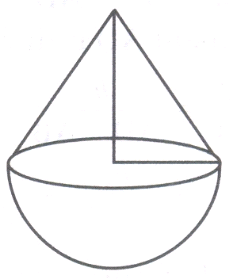
Volume of cone=\(\frac{2}{3}\)volume of hemisphere
\(\frac{1}{3}\pi{r}^{2}h=\frac{2}{3}\times{\frac{2}{3}}\pi{r}^{3}\)
⇒ h=\(\frac{4}{3}r=\frac{4}{3}\times{21}\)=28cm
l2=h2+r2=(28)2+(21)2
=784+441=1225
l=\(\sqrt{1225}\)=35cm
Surface area of the toy=πrl=2πr2
=\(\frac{22}{7}\times{21}\times{35}\)cm2+2x\(\frac{22}{7}\)x21x21 cm2
=2310 cm2+2772 cm2
=5082 cm2
12.
We known that, if two circles touch externally, then the distance between their centres is equal to the sum of their radii.
Let the radii of the two circles be r1 and r2 , respectively and C1 , C2 be the centres of the given circles.
Then r1 + r2 = 14 [distance between the centres of two circles = 14cm, given]
Given, the sum of the areas of two circles is equal to 130\(\pi\) sq cm.
\(\therefore \quad { \pi r }_{ 1 }^{ 2 }+{ \pi r }_{ 2 }^{ 2 }=130\pi \Rightarrow \pi ({ r }_{ 1 }^{ 2 }+{ r }_{ 2 }^{ 2 })=130\pi \)
\(\Rightarrow { r }_{ 1 }^{ 2 }+{ r }_{ 2 }^{ 2 }=130\)
Now, \(({ r }_{ 1 }+{ r }_{ 2 })^{ 2 }={ r }_{ 1 }^{ 2 }+{ r }_{ 2 }^{ 2 }+2{ r }_{ 1 }{ r }_{ 2 }\)
\(\Rightarrow { (14) }^{ 2 }=130+2{ r }_{ 1 }{ r }_{ 2 }\) [from Eqs. (i) and (ii)]
\(\Rightarrow 196-130=2{ r }_{ 1 }{ r }_{ 2 }\)
\(\Rightarrow 66=2{ r }_{ 1 }{ r }_{ 2 }\)
\( \Rightarrow { r }_{ 1 }{ r }_{ 2 }=\frac { 66 }{ 2 } =33\)
We know that,
\(({ r }_{ 1 }-{ r }_{ 2 })^{ 2 }={ r }_{ 1 }^{ 2 }+{ r }_{ 2 }^{ 2 }-2{ r }_{ 1 }{ r }_{ 2 }\)
\(\Rightarrow ({ r }_{ 1 }-{ r }_{ 2 })^{ 2 }=130-2\times 33\) [from Eq. (i)]
\(\Rightarrow ({ r }_{ 1 }-{ r }_{ 2 })^{ 2 }=130-66\)
\(\\ \Rightarrow ({ r }_{ 1 }-{ r }_{ 2 })^{ 2 }=64\)
\(\Rightarrow \quad \ { r }_{ 1 }-{ r }_{ 2 }=8\)
On adding Eqs. (i) and (iii), we get
\( { 2r }_{ 1 }=22\)
\(\Rightarrow \ \ { r }_{ 1 }=\frac { 22 }{ 2 } 11cm\)
On putting the value of r1 in Eq. (i), we get
\(11+{ r }_{ 2 }=14\)
\( \Rightarrow \ { r }_{ 2 }=14-11=3cm\)
Hence, the radii of the circles are 11 cm and 3 cm.
The value depicted by the farmers, are of cooperative nature and mutual understanding.
13.
(i) Rs. 3511.20
(ii) Social value, cooperation, caring for old people
14.
\(12\pi \ cm,\ 37.71{ cm }^{ 2 }\)
15.
Radius of hemisphere = 4.2 cm
Volume of hemisphere =\(\frac { 2 }{ 3 } \pi \) r3
=\(\frac { 2 }{ 3 } \pi \times (4.2)^{ 3 }{ cm }^{ 3 }\) =49.329 \(\pi \) cm3
∴ volume of 2 hemispheres
=2 X =98.392\(\pi \) cm3 = 98.784\(\pi \) cm3
Height of cylinder =10 cm
Radius =4.2 cm
∴ volume of cylinder =\(\pi \) r2h
=\(\pi \) X (4.2)2X 10=176.4 \(\pi \)
∴ volume of metal left
=176.4\(\pi \) -98.3784\(\pi \) =77.616\(\pi \) cm3
Radius of wire =0.7 cm
let length of wire be x
Volume of wire =\(\pi \) X 0.7 X 0.7 X x
=0.49\(\pi \) x cm3
⇒ 0.49\(\pi \)x =77.616 \(\pi \)
⇒ x= 158.4 cm
∴ length of wire =158.4 cm
16.
(b)
17.
(b)
18.
(b)
19.
(a)
20.
(a)
a sphere and a cylinder
21.
(a)
4657.71 cm2
22.
(b)
H : h
23.
(c)
28 cm
24.
(d)
2r cm
25.
(a)
78.57 cm
26.
(d)
858
27.
(c)
3 : 1
28.
(c)
\(\sqrt { 3 } :4\pi \)
29.
(d)
28 cm
30.
(d)
130.95 cm2
31.
(c)
Four times
32.
(c)
3: 4: 5
33.
(d)
Sector
34.
(a)
450o
35.
(b)
24 πcm
36.
(i) (b): capacity of first glass \(=\pi r^{2} h-\frac{2}{3} \pi r^{3}\)
\(=\pi r^{2}\left(h-\frac{2}{3} r\right)\)
\(=\pi(3)^{2}\left(10-\frac{2}{3} \times 3\right)\)
\(=9 \pi(10-2)\)
72\(\pi\) cm3
(ii) (a): capacity of second glass \(=\pi r^{2} \mathrm{H}-\frac{1}{3} \pi r^{2} h\)
\(=\pi r^{2}\left(\mathrm{H}-\frac{1}{3} h\right)\)
\(=\pi(3)^{2}\left(10-\frac{1}{3} \times 1.5\right)\)
\(=9 \pi(10-0.5)\)
= 85.5 \(\pi\)cm3
(iii) (a): \(\text { Ratio }=\frac{\text { Capacity of first glass }}{\text { Capacity of second glass }}=\frac{72 \pi}{85.5 \pi}=\frac{16}{19}=16: 19 .\)
(iv) (d): From part (i) and (ii)
Suresh got more quantity of juice.
\(=85.5 \pi \mathrm{cm}^{3}-72 \pi \mathrm{cm}^{3}=13.5 \pi \mathrm{cm}^{3}\)
(v) (a): Total quantity of juice is purchased by Suresh = (72 \(\pi\) + 85.5 \(\pi\) ) cm3
= 157.5\(\pi\) cm3
37.
(i) (b):Curved surface area of two identical cylindrical parts \(=2 \times 2 \pi r h=2 \times 2 \times \frac{22}{7} \times \frac{2.5}{2} \times 5\)
= 78.57 cm2
(ii) (a): Volume of big cylindrical part \(=\pi r^{2} h\)
\(=\frac{22}{7} \times \frac{4.5}{2} \times \frac{4.5}{2} \times 12=190.93 \mathrm{~cm}^{3}\)
(iii) (b) :Volume of two hemispherical ends \(=2 \times \frac{2}{3} \pi r^{3}\)
\(=\frac{2 \times 2}{3} \times \frac{22}{7} \times\left(\frac{2.5}{2}\right)^{3}=8.18 \mathrm{~cm}^{3}\)
(iv) (c) : Curved surface area of two hemispherical ends \(=2 \times 2 \pi r^{2}=2 \times 2 \times \frac{22}{7} \times \frac{2.5}{2} \times \frac{2.5}{2}=19.64 \mathrm{~cm}^{2}\)
(v) (b): Difference of volume of bigger cylinder to two small hemispherical ends = 190.93 - 8.18 = 182.75 cm3
38.
(i) (b): Volume of the earth taken out
\(=\pi\left(\frac{7}{2}\right)^{2} \times 12=\frac{22}{7} \times \frac{7}{2} \times \frac{7}{2} \times 12=462 \mathrm{~m}^{3}\)
(ii) (d): Area of the rectangular field = 30 x 15 = 450 m2
(iii) (a): Area of top of the pit = \(=\pi\left(\frac{7}{2}\right)^{2} =\frac{22}{7} \times \frac{7}{2} \times \frac{7}{2} \)
\(=\frac{77}{2}=38.5 \mathrm{~m}^{2}\)
(iv) (d): Area of the remaining field = Area of rectangular field - area of top of pit
= 450 - 38.5 = 411.5 m2
(v) (c): The rise in the level of field = \(=\frac{462}{411.5}=1.12 \mathrm{~m}\)

10th Standard CBSE Syllabus & Materials
10th Standard CBSE
CBSE 10th Social Science PS - Federalism - New Model Questions Papers Study Material - QB365 Set A
NEW10th Standard CBSE
CBSE 10th Social Science PS - Power Sharing - New Model Questions Papers Study Material - QB365 Set A
NEW10th Standard CBSE
CBSE 10th Social Science GEO - Manufacturing Industries - New Model Questions Papers Study Material - QB365 Set A
NEW10th Standard CBSE
CBSE 10th Social Science GEO - Minerals and Energy Resources - New Model Questions Papers Study Material - QB365 Set A



NCERT Books

Syllabus

Exam Pattern

Sample Question Papers

Previous year Question Papers

Important Notes

MCQ Practice test

NCERT Exemplers

Case study Questions

Image Based Questions

Passage based Questions

HOT Questions

Value Based Questions

Model Questions Papers
NCERT ( Book Back ) Questions

Assertion and Reason
Important Questions And Answers

CBSE 10th Standard CBSE Subjects
CBSE Standards



