
 100% FREE ACCESS
10th Standard CBSE Syllabus & Materials
10th Standard CBSE
CBSE 10th Social Science ECO - Globalisation and the Indian Economy - New Model Questions Papers Study Material - QB365 Set A
NEW10th Standard CBSE
CBSE 10th Social Science ECO - Money and Credit - New Model Questions Papers Study Material - QB365 Set A
NEW10th Standard CBSE
CBSE 10th Social Science ECO - Sectors of the Indian Economy - New Model Questions Papers Study Material - QB365 Set A
NEW10th Standard CBSE
CBSE 10th Social Science ECO - Development - New Model Questions Papers Study Material - QB365 Set A
NEW10th Standard CBSE
CBSE 10th Social Science PS - Outcomes of Democracy - New Model Questions Papers Study Material - QB365 Set A
NEW10th Standard CBSE
CBSE 10th Social Science PS - Gender, Religion and Caste - New Model Questions Papers Study Material - QB365 Set A

Published on: 26/10/2025
Download CBSE Class 10th Standard CBSE Maths question papers, sample papers, important questions, and previous year solved papers in PDF format. Get free study materials, NCERT solutions, and exam preparation resources for Class 10th Standard CBSE Maths
Questions + Answers key
Take MCQ Maths Test
1.
Two circles touch externally. The sum of their areas is \(130\pi { cm }^{ 2 }\) and the distance between their centres is 14 cm, Find the radii of the circles.
2.
AB is one of the direct common tangent of two circles of radii 12 cm and 4 cm respectively touching each other. Find the area of the region enclosed by the circles and the tangent.
3.
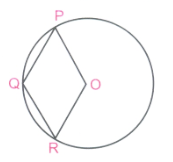
In the given figure. OPQR is a rhombus, there of whose vertices lie on a circle with centre O. If the area of the rhombus is \(32\sqrt 3\ cm^2\), find the radius of the circle.
4.
What is the angle subtended at the centre of a circle of radius 6 cm by an arc of length 6\(\pi\) cm.
5.
To warn ships for underwater rocks, a lighthouse spreads a red coloured light over a sector of angle \(80^o\) to a distance of 16.5 km. Find the area of the sea over which the ships are warned. \((Use\ \ \pi = 3.14)\)
6.
Find the area of a sector of a circle with radius 6 cm, if angle of the sector is \(60^o\)
7.
Find the area of the sector of a circle with radius 4 cm and of angle 30°. Also find the area of the corresponding major sector. (Use \(\pi\) = 3.14).
8.
The radius of a wheel of a car is 35 cm.
(i) Find the number of rotations it will make when the car travels 5.5 km.
(ii) Calculate the speed of the car if it makes 8100 revolutions in 15 minutes.
9.
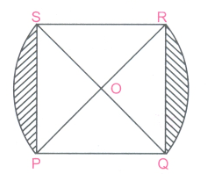
In fig., PQRS is a square lawn with side PQ = 42 metres. Two circular flower beds are there on the sides PS and QR with centre at O, the intersection of its diagonals. Find the total area of the two flowers beds (shaped parts).
10.
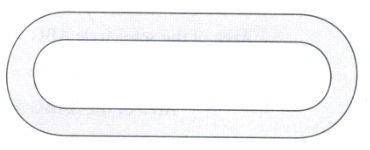
The given figure depicts a racing track whose left and right ends are semicircular. The distance between the two inner parallel line segments is 60 m and they are each 106 m long. If the track is 10 m wide, find:
(i) the distance around the track along its inner edge.
(ii) the area of the track.
11.
A horse is tied to a peg at one corner of a square shaped grass field of side 15 m by means of a 5 m long rope (see figure). Find
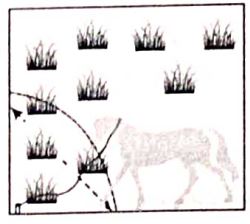
(i) the area of the part of the field in which the horse can graze.
(ii) the increase in the grazing area if the rope were 10 m long instead of 5 m. \((take, \pi\ =3.14)\)
12.
Tick the correct answer in the following:
Area of a sector of angle P (in degrees) of a circle with radius R is
\({P \over 180^o}\times 2\pi R\)
\({P \over 180^o}\times \pi R^2\)
\({P \over 360^o}\times 2\pi R\)
\({P \over 720^o}\times 2\pi R^2\)
13.
A square ABCD is inscribed in a circle of 10 units. The area of the circle not included in the square is
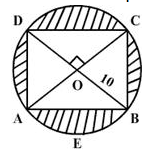
100 sq. units
250 sq. units
114 sq. units
112 sq. units
14.
ABCD is a square of side 10 cm. The area of the shaded region will be
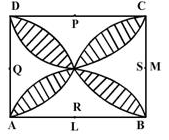
80 cm2
57 cm2
75 cm2
60 cm2
15.
A pendulum swings through an angle of 300 and describes an arc 8.8cm in length. The length of the pendulum is
17 cm
8.8 cm
15.8 cm
16.8 cm
16.
The ratio of radii of two circles is in the ratio of 1:5. Calculate the ratio of their perimeters
1:8
1:2
1:6
1:5
17.
A farmer has a rectangular field oflength 30 m and breadth 15 m. By the farmer a pit of diameter 7 m is dug 12 m deep for rain water harvesting. The earth taken out is spread in the field.
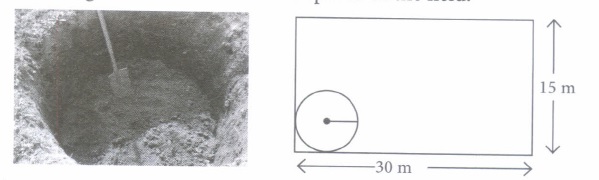
Based on the above information, answer the following questions.
(I) Find the volume of the earth taken out.
| (a) 460 m3 | (b) 462 m3 | (c) 465 m3 | (d) 468 m3 |
(ii) The area of the rectangular field is
| (a) 420 m2 | (b) 430 m2 | (c) 440 m2 | (d) 450m2 |
(iii) Find'the area of the top of the pit.
| (a) 38.5 m2 | (b) 40.5 m2 | (c) 41.5 m2 | (d) None of these |
(iv) The area of the remaining field is
| (a) 402.3 m2 | (b) 405 m2 | (c) 410 m2 | (d) 411.5 m2 |
(v) Find the level rise in the field
| (a) 0.5 m | (b) 3 m | (c) 1.12 m | (d) 2.12 m |
18.
Principle of a school decided to give badges to students who are chosen for the post of Head boy, Head girl, Prefect and Vice Prefect. Badges are circular in shape with two colour area, red and silver, as shown in figure. The diameter of the region representing red colour is 22 cm and silver colour is filled in 10.5 ern wide ring. Based on the above information, answer the following questions.
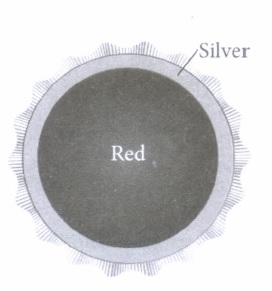
(i) The radius of circle representing the red region is
| (a) 9 cm | (b) 10 cm | (c) 11 cm | (d) 12 cm |
(ii) Find the area of the red region.
| (a) 380.28 cm2 | (b) 382.28 cm2 | (c) 384.28 cm2 | (d) 378.28 cm2 |
(iii) Find the radius of the circle formed by combining the red and silver region.
| (a) 20.5 cm | (b) 21.5 cm | (c) 22.5 cm | (d) 23.5 cm |
(iv) Find the area of the silver region.
| (a) 172.50 cm2 | (b) 1062.50 cm2 | (c) 1172.50 cm2 | (d) 1072.50 cm2 |
(v) Area of the circular path formed by two concentric circles of radii r1 and r2 (r1 > r2) =
| (a) \(\pi\)(\({r}_{1}^{2}\) + \({r}_{2}^{2}\)) sq. units | (b) \(\pi\)(\({r}_{1}^{2}\) - \({r}_{2}^{2}\)) sq. units |
| (c) 2 \(\pi\)(\({r}_{1}^{2}\) + \({r}_{2}^{2}\)) sq. units | (d) 2 \(\pi\)(\({r}_{1}^{2}\) - \({r}_{2}^{2}\)) sq. units |
1.
3 cm, 11 cm
2.
Let tangent touches the circles with centre O and O' at the points A and B respectively.
-s.png)
⇒ ㄥ1 = ㄥ2 = 900
[Tangent makes 900 angle with the radius at the point of contact]
Through O' draw O'M I I AB meeting OA in M
⇒ O'M I I AB.Thus ABO'M is a rectangle with
AM = O'B = 4cm
In ΔOMO'
OM=OA-AM
= (12 — 4) cm = 8cm
and 00' = OP+ O'P= 12+4= 16cm
⇒ OO'2 = 0M2 + (O'M)2
⇒ 162 = 82 + (O'M)2
⇒ x2 = 162-82 = (16-8) (16 + 8)
= 8 x 24 = 8 x 8 x 3
\(⇒\ x=\sqrt{8\times8\times3}=8\sqrt3cm\)
Area ABO'O = area of rectangle ABO'M + area of AOMO'
=AM x O'M+\({1\over 2}\)x OM x O'M
\(=4\times8\sqrt3+{1\over 2}\times8\times8\sqrt3\)
\(=32\sqrt3+32\sqrt3=64\sqrt3cm\)
Now ΔOMO' is a right triangle with ㄥM=900
\({O'M\over OO'}={8\sqrt3\over 16}=cos(ㄥ3)\)
\(⇒\ ㄥ3=30^0\ and\ {OM\over OO'}=cosㄥ4\)
\(⇒ {8\over 16}cos\angle4\)
⇒ ㄥ4=600 ⇒ㄥAOP=600
= angle of sector AOP
ㄥ3 = 300 ⇒ ㄥMO'O = 300 = 900 + ㄥMO'O = 900 + 300
= 1200 = angle of sector BOP
Area of the portion enclosed between the circles and the tangents is
= area of the trapezium ABO'O - 2 X area of the sectors
= 64√3 cm2 - (area of sector AOP + area of sector BO'P)
=64√3 cm2 - (area of sector AOP+area of sector BO'P)
\(=64\sqrt3cm^3-\left[{60^0\over 360^0}\times\pi\times12^2+{120^0\over 360^0}\times\pi\times 4^2\right]cm^2\)
\(=64\sqrt{3}cm^2-{\pi\over 6}\times8[18+2\times2]cm^2\)
\(=64\sqrt3cm^2-{4\pi\over 3}\times2[9+2]cm^2\)
\(=\left[64\sqrt3-{8\over 3}\times{22\over 7}\right]cm^2\)
\(=\left[64\times1.73-{88\over 3}\times{22\over 7}\right]cm^2\)
=[110.72-92.1904]=18.5296cm2
3.
Side of the rhombus = radius of the circle
OP = OQ = PQ = x = OR = QR
-s.png)
⇒ ΔORQ and ΔOPQ are equilateral triangles
Area of the equilateral triangle OPQ=\({\sqrt3\over 4}(side)^2\)
Area of the equilateral ΔOPQ=\({\sqrt3\over 4}\times (x)^2\)
Area of the rhombus=2ar(ΔOPQ)
\(=2\times{\sqrt3\over 4}x^2={\sqrt3\over 2}x^2⇒{\sqrt3\over 2}x^2=32\sqrt3\)
⇒x2=64cm2⇒x=8cm
4.
\(l=6\pi ,r=6cm,\theta =?\)
\(l=\frac { \theta \pi r }{ { 180 }^{ ° } } \Rightarrow 6\pi =\frac { \theta \times \pi \times 6 }{ { 180 }^{ ° } } \Rightarrow \theta ={ 180 }^{ ° }\)
5.
Given, sector angle, \(\theta\)= 80°
and distance or radius, r = 16.5 km
\(\begin{aligned} \therefore \text { Area of sector } & =\frac{\theta}{360^{\circ}} \times \pi r^2=\frac{80^{\circ}}{360^{\circ}} \times 3.14 \times(16.5)^2 \\ \end{aligned}\)
\(\begin{aligned} =\frac{2 \times 3.14 \times 272.25}{9} \end{aligned}\)
\(\begin{aligned} =\frac{1709.73}{9} \end{aligned}\)
= 189.97 km2
which is the required area of the sea over which the ships are warned.
6.
We know that area of sector of a circle =\(\frac{\theta}{360^{\circ}} \times \pi r^2\)
Given, radius of circle, r = 6 cm
and angle of sector, \(\theta\)= 60°
\(\therefore\) Area of sector of a circle \(=\frac{60^{\circ}}{360^{\circ}} \times \frac{22}{7} \times(6)^2=\frac{132}{7} \mathrm{~cm}^2\)
7.
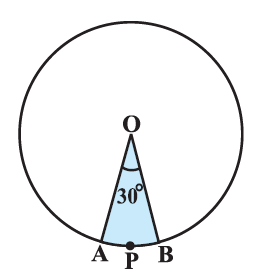
Given sector is OAPB
Area of the sector \(=\frac{\theta}{360} \times \pi r^{2}\)
\(=\frac{30}{360} \times 3.14 \times 4 \times 4 \mathrm{~cm}^{2}\)
\(=\frac{12.56}{3} \mathrm{~cm}^{2}=4.19 \mathrm{~cm}^{2}(\text { approx. })\)
Area of the corresponding major sector
\(\begin{aligned} &=\pi r^{2}-\text { area of sector } \mathrm{OAPB}\\ &=(3.14 \times 16-4.19) \mathrm{cm}^{2}\\ &=46.05 \mathrm{~cm}^{2}=46.1 \mathrm{~cm}^{2}(\text { approx. }) \end{aligned}\)
Alternatively, area of the major sector \(=\frac{(360-\theta)}{360} \times \pi r^{2}\)
\(\begin{array}{l} =\left(\frac{360-30}{360}\right) \times 3.14 \times 16 \mathrm{~cm}^{2} \\ =\frac{330}{360} \times 3.14 \times 16 \mathrm{~cm}^{2}=46.05 \mathrm{~cm}^{2} \\ =46.1 \mathrm{~cm}^{2}(\text { approx. }) \end{array}\)
8.
(i) 2500 (ii) 19.8 m/s
9.
Here PR2 = PQ2 + QR2
⇒ PR2 = (42)2 + (42)2
⇒PR=42√2m
⇒\(PO={42\sqrt2\over 2}=21\sqrt2m\)
Area of sector
\(={90^0\over 360^0}\times\pi(21\sqrt2)^2\)
\(={1\over4}\times{22\over 7}\times21\times21\times2\)
=693m2
Area of ΔPOS
\(={1\over 1}PO\times OS(∵ \ PO⊥OS)\)
\(={1\over 1}\times 21\sqrt2\times21\sqrt2=441m^2\)
∴ Area of one flower bed
=693-441=252m2
⇒ Area of two flower beds
=2 x 252 = 504m2
10.
-S.png)
Distance around the track along its inner edge = AB + arc BEC + CD + arc DFA
\(\begin{array}{l} =106+\frac{1}{2} \times 2 \pi r+106+\frac{1}{2} \times 2 \pi r \\ =212+\frac{1}{2} \times 2 \times \frac{22}{7} \times 30+\frac{1}{2} \times 2 \times \frac{22}{7} \times 30 \\ =212+2 \times \frac{22}{7} \times 30 \\ =212+\frac{1320}{7} \\ =\frac{1484+1320}{7}=\frac{2804}{7} m \end{array}\)
Area of the track = (Area of GHIJ − Area of ABCD) + (Area of semi-circle HKI − Area of semi-circle BEC) + (Area of semi-circle GLJ − Area of semi-circle AFD)
\(\begin{array}{l} =106 \times 80-106 \times 60+\frac{1}{2} \times \frac{22}{7} \times(40)^{2}-\frac{1}{2} \times \frac{22}{7} \times(30)^{2}+\frac{1}{2} \times \frac{22}{7} \times(40)^{2}-\frac{1}{2} \times \frac{22}{7} \times(30)^{2} \\ =106(80-60)+\frac{22}{7} \times(40)^{2}-\frac{22}{7} \times(30)^{2} \\ =106(20)+\frac{22}{7}\left[(40)^{2}-(30)^{2}\right] \\ =2120+\frac{22}{7}(40-30)(40+30) \\ =2120+\left(\frac{22}{7}\right)(10)(70) \end{array}\)
=2120+2200
= 4320 m2
Therefore, the area of the track is 4320 m2.
11.
Given, side of a square = 15 m
\(\therefore\) Area of square = (15)2 = 225 m2 [\(\because\)area of square = (side)2]
also given, length of rope = 5 m
\(\therefore\) Radius of arc = 5 m
(i) Area of the field graze by the horse,
\(A_1=\frac{\theta}{360^{\circ}} \times \pi r^2=\frac{90^{\circ}}{360^{\circ}} \times 3.14 \times(5)^2\)
[\(\because\) each angle of a square is 90°]
\(=\frac{3.14 \times 25}{4}=\frac{78.5}{4}=19.625 \mathrm{~cm}^2\)
(ii) If length of rope = 10 m = r1 (say)
then, area of the field graze by the horse,
\(\begin{aligned} A_2 & =\frac{\theta}{360^{\circ}} \times \pi r_1^2=\frac{90^{\circ}}{360^{\circ}} \times 3.14 \times(10)^2 \\ \end{aligned}\)
\(\begin{aligned} =\frac{3.14 \times 100}{4}=\frac{314}{4}=78.5 \mathrm{~cm}^2 \end{aligned}\)
\(\therefore\) Required increase in the grazing area
= A2 - A1
= 78.5 - 19.625 = 58.875 cm2
12.
(d)
\({P \over 720^o}\times 2\pi R^2\)
13.
(c)
114 sq. units
14.
(b)
57 cm2
15.
(d)
16.8 cm
16.
(d)
1:5
17.
(i) (b): Volume of the earth taken out
\(=\pi\left(\frac{7}{2}\right)^{2} \times 12=\frac{22}{7} \times \frac{7}{2} \times \frac{7}{2} \times 12=462 \mathrm{~m}^{3}\)
(ii) (d): Area of the rectangular field = 30 x 15 = 450 m2
(iii) (a): Area of top of the pit = \(=\pi\left(\frac{7}{2}\right)^{2} =\frac{22}{7} \times \frac{7}{2} \times \frac{7}{2} \)
\(=\frac{77}{2}=38.5 \mathrm{~m}^{2}\)
(iv) (d): Area of the remaining field = Area of rectangular field - area of top of pit
= 450 - 38.5 = 411.5 m2
(v) (c): The rise in the level of field = \(=\frac{462}{411.5}=1.12 \mathrm{~m}\)
18.
(i) (c): Radius of circle representing red region
\(=\frac{22}{2}=11 \mathrm{~cm}\) [\(\because\) Diameter = 22 cm (Given)]
(ii) (a): Area of red region = \(\pi r^{2}\)
\(=\frac{22}{7} \times 11 \times 11=380.28 \mathrm{~cm}^{2}\)
(iii) (b): Radius of circle formed by combining red and silver region = Radius of red region + width of silver sign
= (11 + 10.5) cm = 21.5 cm
(iv) (d): Area of silver region
= Area of combined region - Area of red region
\(=\frac{22}{7} \times 21.5 \times 21.5-380.28\)
= 1452.78 - 380.28 = 1072.50 crrr'
(v) (b): Area of circular path formed by two concentric circles = \(\pi\left(r_{1}^{2}-r_{2}^{2}\right)\) sq. units

10th Standard CBSE Syllabus & Materials
10th Standard CBSE
CBSE 10th Social Science PS - Federalism - New Model Questions Papers Study Material - QB365 Set A
NEW10th Standard CBSE
CBSE 10th Social Science PS - Power Sharing - New Model Questions Papers Study Material - QB365 Set A
NEW10th Standard CBSE
CBSE 10th Social Science GEO - Manufacturing Industries - New Model Questions Papers Study Material - QB365 Set A
NEW10th Standard CBSE
CBSE 10th Social Science GEO - Minerals and Energy Resources - New Model Questions Papers Study Material - QB365 Set A



NCERT Books

Syllabus

Exam Pattern

Sample Question Papers

Previous year Question Papers

Important Notes

MCQ Practice test

NCERT Exemplers

Case study Questions

Image Based Questions

Passage based Questions

HOT Questions

Value Based Questions

Model Questions Papers
NCERT ( Book Back ) Questions

Assertion and Reason
Important Questions And Answers

CBSE 10th Standard CBSE Subjects
CBSE Standards



