
 100% FREE ACCESS
10th Standard CBSE Syllabus & Materials
10th Standard CBSE
CBSE 10th Social Science ECO - Globalisation and the Indian Economy - New Model Questions Papers Study Material - QB365 Set A
NEW10th Standard CBSE
CBSE 10th Social Science ECO - Money and Credit - New Model Questions Papers Study Material - QB365 Set A
NEW10th Standard CBSE
CBSE 10th Social Science ECO - Sectors of the Indian Economy - New Model Questions Papers Study Material - QB365 Set A
NEW10th Standard CBSE
CBSE 10th Social Science ECO - Development - New Model Questions Papers Study Material - QB365 Set A
NEW10th Standard CBSE
CBSE 10th Social Science PS - Outcomes of Democracy - New Model Questions Papers Study Material - QB365 Set A
NEW10th Standard CBSE
CBSE 10th Social Science PS - Gender, Religion and Caste - New Model Questions Papers Study Material - QB365 Set A

Published on: 26/10/2025
Download CBSE Class 10th Standard CBSE Maths question papers, sample papers, important questions, and previous year solved papers in PDF format. Get free study materials, NCERT solutions, and exam preparation resources for Class 10th Standard CBSE Maths
Questions + Answers key
Take MCQ Maths Test
1.
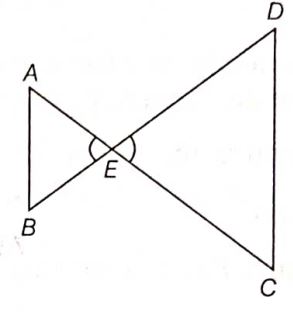
In the given figure, \(\frac{E A}{E C}=\frac{E B}{E D}\), prove that \(\triangle E A B \sim \triangle E C D\)
2.
Find p, the mean of the given data is 15.45.
| Class interval | 0-6 | 6-12 | 12-18 | 18-24 | 24-30 |
|---|---|---|---|---|---|
| Frequency | 6 | 8 | p | 9 | 7 |
3.
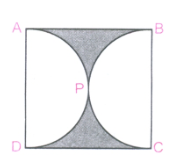
Find the area of the shaded region in the given figure, if ABCD is a square of side 14 cm and APD and BPC are semicircles.
4.
A horse is placed for grazing inside are rectangular field 70 m by 52 m and is tethered to one corner by a rope 21 m long. On how much area can it graze?
5.
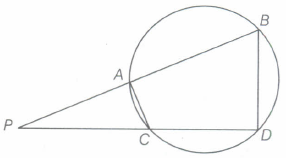
In the given figure, two chords AB and CD of a circle intersect each other at the point P (when produced) outside the circle. Prove that
PA. PB = PC . PD
6.
A life insurance agent found the following data for distribution of ages of 100 policy holders:
| Age (in years) | Number of policy holders |
|---|---|
| Below 20 | 2 |
| Below 25 | 6 |
| Below 30 | 24 |
| Below 35 | 45 |
| Below 40 | 78 |
| Below 45 | 89 |
| Below 50 | 92 |
| Below 55 | 98 |
| Below 60 | 100 |
Calculate the median age, if policies are given only to persons having age 18 yr onwards but less than 60 yr. Given benefits of insurance.
7.
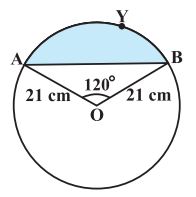
Find the area of the segment AYB shown in Figure, if radius of the circle is 21 cm and \(\angle \mathrm{AOB}=120^{\circ} .\left(\text { Use } \pi=\frac{22}{7}\right)\)
8.
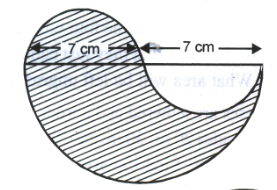
From the given figure, calculate:
(i) the area of the shaded region and
(ii) the length of the boundary
9.
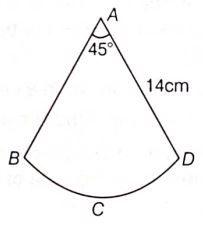
The perimeter of the sector of a circle of radius 14 cm and central angle 45° is
10.
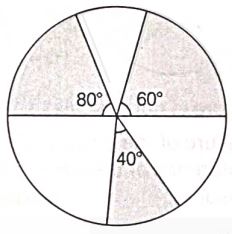
In the given figure, three sectors of a circle of radius 7 cm, making angles of 60°, 80° and 40° at the centre are shaded. Find the area of the shaded region.
11.
D is the mid-point of side BC of ∆ABC and E is the mid-point of AD. BE produced meets AC at the point M. Prove that BE = 3EM
12.
Find the mean of the following data:
| Class | Less than 20 | Less than 40 | Less than 60 | Less than 80 | Less than 90 |
| Frequency | 15 | 37 | 74 | 99 | 120 |
13.
In MBC, DE II Be. If AD = x + 2, DB = 3x + 16, AE = x and EC = 3x + 5, then find x.
14.
Find the mode of the following distribution.
| Class interval | 0-20 | 20-40 | 40-60 | 60-80 | 80-100 |
|---|---|---|---|---|---|
| Frequency | 25 | 16 | 28 | 20 | 5 |
15.
The relation connecting the measures of central tendencies is
Mode = 2 median + 3 mean
Mode = 3 median – 2 mean
Mode = 3 median + 2 mean
Mode = 2 median – 3 mean
16.
For the following distribution the differences in the upper limit of median and modal class is
| C1 | 0-10 | 10-20 | 20-30 | 30-40 | 40-50 |
| F | 2 | 5 | 7 | 5 | 2 |
40
10
0
20
17.
If ABC~QRP \(\frac { ar(\triangle ABC) }{ ar(\triangle PQR) } =\frac { 9 }{ 4 } \) ,AB = 18 cm and BC = 15 cm then PR is equal to
10 cm
12 cm
\(\frac { 20 }{ 3 } \)cm
8 cm
18.
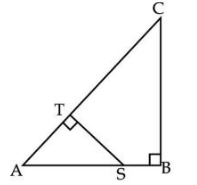
In the given figure, T and B are right angles. If the lengths of AT, BC and AS (in centimeters) are 15, 16 and 17 respectively, then the length of TC (in centimeters) is:
18
12
19
16
19.
The length of an altitude of an equilateral triangle of side a is
\(\frac { a }{ 2\sqrt { 3 } } \)
\(\frac { 2a }{ \sqrt { 3 } } \)
\(\frac { \sqrt { 3 } a }{ 2 } \)
\(\frac { \sqrt { 3 } }{ 2a } \)
20.
In given figure, a circle of radius 7.5cm is inscribed in a square, the remaining area of the square is
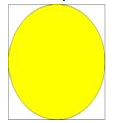
46 cm sq.
48.91 cm sq
52.32 cm sq
48.375 cm sq
21.
Find the circumference of the circle, whose area is 144 cm2
46 πcm
24 πcm
72 πcm
12 πcm
22.
The area of a sector of a circle of radius 5 cm is 5 cm2. The angle contained by the sector will be
90°
45°
72°
60°
23.
Assertion: In ΔABC, ∠B = 90° and BD ⊥ AC. If AD = 4 cm and CD = 5 cm then BD is 2\(\sqrt5\) cm.
Reason: The ratio of the areas of two similar triangles are equal to the ratio of squares of any two corresponding sides.
Codes:
(a) If both Assertion and Reason are correct and Reason is the correct explanation of Assertion.
(b) If both Assertion and Reason are correct, but Reason is not the correct explanation of Assertion.
(c) If Assertion is correct but Reason is incorrect.
(d) If Assertion is incorrect but Reason is correct.
24.
Assertion: Δ ABC ∼ Δ POR such that ar(ΔABC) = 36 cm2 and ar(ΔPOR) = 49 cm2. If AB = 6 cm, then PQ = 10 cm.
Reason: If Δ ABC - Δ DEP, then \(\frac{\operatorname{ar}(\Delta A B C)}{\operatorname{ar}(\Delta D E F)}=\frac{A B^{2}}{D E^{2}}=\frac{B C^{2}}{E F^{2}}=\frac{A C^{2}}{D F^{2}}\)
Codes:
(a) If both Assertion and Reason are correct and Reason is the correct explanation of Assertion.
(b) If both Assertion and Reason are correct, but Reason is not the correct explanation of Assertion.
(c) If Assertion is correct but Reason is incorrect.
(d) If Assertion is incorrect but Reason is correct.
25.
While doing dusting a maid found a button whose upper face is of black colour, as shown in the figure. The diameter of each of the smaller identical circles is 1/4 of the diameter of the larger circle whose radius is 16 cm.
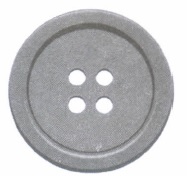
Based on the above information, answer the following questions.
(i) The area of each of the smaller circle is
| (a) 40.28 cm2 | (b) 46.39 cm2 | (c) 50.28 cm2 | (d) 52.3 cm2 |
(ii) The area of the larger circle is
| (a) 804.57 cm2 | (b) 704.57 cm2 | (c) 855.57 cm2 | (d) 990.57 cm2 |
(iii) The area of the black colour region is
| (a) 600.45 cm2 | (b) 603.45 cm2 | (c) 610.45 cm2 | (d) 623.45 cm2 |
(iv) The area of quadrant of a smaller circle is
| (a) 11.57 cm2 | (b) 13.68 cm2 | (c) 12 cm2 | (d) 12.57 cm2 |
(v) If two concentric circles are of radii 2 cm and 5 cm, then the area between them is
| (a) 60 cm2 | (b) 63 cm2 | (c) 66 cm2 | (d) 68 cm2 |
1.
In \(\Delta\)EAB and \(\Delta\)ECD
\(\frac{E A}{E C}=\frac{E B}{E D}\) [given]
\(\angle A E B=\angle C E D\) [vertically opposite angles]
\(\therefore\) By SAS rule of similarity
\(\triangle E A B \sim \triangle E C D\) Hence proved.
2.
10
3.
ABCD is a square
Given: side of the square =14cm
∴ Area of the square = (side)2 (14)2 = 196 cm2
Radius of the semicircle APD=\({1\over 2}\)(side of square)=\({1\over 2}\times14=7cm\)
Area of the semicircle APD=\({1\over 2}\pi r^2={1\over 2}\times{22\over 7}\times7\times7=11\times7=77cm^2\)
Similarly, area of the semicircle BPC= 77cm2
Total area of both the semicircles=77 + 77 - 154 cm2.
Area of the shaded region = Area of square - area of both semicircles = 196 - 154 -42cm2
4.
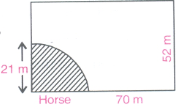
Area of portion that horse can graze area of the shaded portion.
Shaded portion is a sector of radius 21 m = length of the rope
Angle of this sector = angle of the corners of the rectangle = 90°
Area the shaded portion that horse can graze
= \(\frac { \theta }{ 360° } \times { \pi r }^{ 2 }=\frac { 90° }{ 360° } \times \frac { 22 }{ 7 } \times { (21) }^{ 2 }{ m }^{ 2 }\)
= \(\frac { 1 }{ 4 } \times \frac { 22 }{ 7 } \times 21\times 21 \ { m }^{ 2 } \ = \ \frac { 11 }{ 2 } \times 3\times 21 \ { m }^{ 2 }=346.5 \ \ { m }^{ 2 }\)
5.
We know that the corresponding sides of similar triangles are proportional.
∴ PA/PD = AC/DB = PC/PB
⇒ PA/PD = PC/PB
∴ PA.PB = PC.PD
6.
Here, class width is not the same. There is no requirement of adjusting the frequencies according to class intervals. The given frequency table is of less than type represented with upper class limits. The policies were given only to persons with age 18 years onwards but less than 60 years. Therefore, class intervals with their respective cumulative frequency can be defined as below
| Age (in years) | Number of policy holders (fi) | Cumulative frequency (cf) |
| 18 - 20 | 2 | 2 |
| 20 - 25 | 6 - 2 = 4 | 6 |
| 25 - 30 | 24 - 6 = 18 | 24 |
| 30 - 35 | 45 - 24 = 21 | 45 |
| 35 - 40 | 78 - 45 = 33 | 78 |
| 40 - 45 | 89 - 78 = 11 | 89 |
| 45 - 50 | 92 - 89 = 3 | 92 |
| 50 - 55 | 98 - 92 = 6 | 98 |
| 55 - 60 | 100 - 98 = 2 | 100 |
| Total (n) |
From the table, it can be observed that n = 100.
Cumulative frequency (cf) just greater than \(\frac{n}{2}\left(\frac{100}{2}=50\right)\) is 78, belonging to interval 35 - 40.
Therefore, median class = 35 - 40
Lower limit (l) of median class = 35
Class size (h) = 5
Frequency (f) of median class = 33
Cumulative frequency (cf) of class preceding median class = 45
\(\text { Median }=l+\left(\frac{\frac{n}{2}-c f}{f}\right) \times h \)
\(=35+\left(\frac{50-45}{33}\right) \times 5 \)
\(=35+\frac{25}{33}\)
= 35.76
Therefore, median age is 35.76 years.
7.
Now, area of the sector OAYB = \(=\frac{120}{360} \times \frac{22}{7} \times 21 \times 21 \mathrm{~cm}^2=462 \mathrm{~cm}^2\) (2)
For finding the area of \(\Delta\)OAB, draw OM \(\perp\) AB as shown in Figure.
Note that OA = OB. Therefore, by RHS congruence, \(\Delta\)AMO \(\cong\) BMO.
So, M is the mid-point of AB and \(\angle\)AOM = \(\angle\)BOM = \(\frac{1}{2} \times 120^{\circ}=60^{\circ}\)
Let OM = x cm
So, from \(\Delta\)OMA, \(\frac{\mathrm{OM}}{\mathrm{OA}}=\cos 60^{\circ}\)
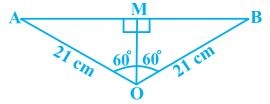
or, \(\begin{aligned} \frac{x}{21} & =\frac{1}{2} \quad\left(\cos 60^{\circ}=\frac{1}{2}\right) \\ \end{aligned}\)
or, \(\begin{aligned} x & =\frac{21}{2} \\ \end{aligned}\)
So, \(\begin{aligned} \mathrm{OM} & =\frac{21}{2} \mathrm{~cm} \\ \end{aligned}\)
Also,\(\begin{aligned} \frac{\mathrm{AM}}{\mathrm{OA}} & =\sin 60^{\circ}=\frac{\sqrt{3}}{2} \\ \end{aligned}\)
So, \(\begin{aligned} \mathrm{AM} & =\frac{21 \sqrt{3}}{2} \mathrm{~cm} \end{aligned}\)
Therefore, \(\mathrm{AB}=2 \mathrm{AM}=\frac{2 \times 21 \sqrt{3}}{2} \mathrm{~cm}=21 \sqrt{3} \mathrm{~cm}\)
So, area of \(\begin{aligned} \Delta \mathrm{OAB} & =\frac{1}{2} \mathrm{AB} \times \mathrm{OM}=\frac{1}{2} \times 21 \sqrt{3} \times \frac{21}{2} \mathrm{~cm}^2 \\ \end{aligned}\)
\(\begin{aligned} =\frac{441}{4} \sqrt{3} \mathrm{~cm}^2 \end{aligned}\) (3)
Therefore, are of the segment \(\mathrm{AYB}=\left(462-\frac{441}{4} \sqrt{3}\right) \mathrm{cm}^2\) [From (1), (2) and (3)]
\(=\frac{21}{4}(88-21 \sqrt{3}) \mathrm{cm}^2\)
8.
(i) 77 cm2
(ii) 44 cm
9.
We have, radius =14 cm
\(\angle\)BAD = 45°
According to the question,
Perimeter = 2 (radius)+ arc BCD
\(\therefore \text { Length of arc }=\frac{\theta}{360^{\circ}} \times 2 \pi r=\frac{45^{\circ}}{360^{\circ}} \times 2 \times \frac{22}{7} \times 14\)
= 11 cm
\(\therefore\) Perimeter = 2 \(\times\)14 + 11 = 28 + 11 = 39 cm
Hence, perimeter of the sector ABCDA is 39 cm.
10.
In a given figure, the sum of angles of three sectors of a circle = 60° + 80° + 40° = 180°
\(\therefore\) Area of shaded region = Sum of areas of three sectors separately
= Area of sector makes by 180° ...(i)
Now, length on an arc of sector makes by 180°,
\(\begin{aligned} l & =\frac{\theta}{360^{\circ}} \times 2 \pi r \end{aligned}\)
\(\begin{aligned} =\frac{180^{\circ}}{360^{\circ}} \times 2 \times \frac{22}{7} \times 7 \quad[\because r=7 \mathrm{~cm} \text { given }] \end{aligned}\)
l = 22 cm
\(\therefore\) From Eq. (i), we get
Area of shaded region = \(\frac{1}{2} l r\)
\(=\frac{1}{2} \times 22 \times 7=77 \mathrm{~cm}^2\)
Hence, area of the shaded region is 77 cm2.
11.
Given: D is the mid-point of BC, E is the mid-point of AD. BE produced meets AC at M.
To Prove: BE = 3 EM
Construction: Draw DN ll BM
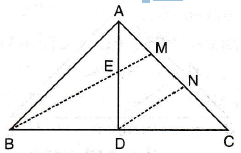
Proof: In ∆ADN, EM ll DN (Construction)
∆AEM ~ ∆ADN (AA similarity)
\(\frac{EM}{DN}=\frac{AE}{AD}\) (By BPT)
But AD = 2AE
\(\frac{EM}{DN}=\frac{AE}{2AE}\)
DN = 2EM...(i)
In ΔBCM, DN || BM (Construction)
∆CDN ~ ΔCBM
\(\frac{DN}{BM}=\frac{CD}{2CD}\)
BM=2DN...(ii)
From (i) and (ii)
BM = 2(2EM)
BM = 4EM
BE = BM - EM = 4EM - EM
= 3EM.
Hence proved.
12.
| C.I | fi | xi | xifi |
| 0-20 | 15 | 10 | 150 |
| 20-40 | 22 | 30 | 660 |
| 40-60 | 37 | 50 | 1850 |
| 60-80 | 25 | 70 | 1750 |
| 80-100 | 21 | 90 | 1800 |
| Total | \(\Sigma fi=120\) | \(\Sigma xifi=6300\) |
Mean x= \(\frac { \Sigma f_{ i }x_{ i } }{ \Sigma f_{ i } } =\frac { 6300 }{ 120 } =52.5\)
13.
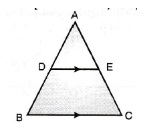
\(\therefore\) DE || BC
\(\therefore \frac { AD }{ DB } =\frac { AE }{ EC } \) (By BPT )
\(\Rightarrow \frac { x+2 }{ 3x+16 } =\frac { x }{ 3x+5 } \)
\(\Rightarrow\) (x + 2)(3x + 5) = x(3x + 16)
\(\Rightarrow\)3x2 + 5x + 6x + 10 = 3x2 + 16x
\(\Rightarrow\) 11x + 10 = 16x 1
\(\Rightarrow\)16x-11x = 10
\(\Rightarrow\) 5x = 10
\(\therefore\) x = 2
14.
52
15.
(b)
Mode = 3 median – 2 mean
16.
(c)
0
17.
(a)
10 cm
18.
(c)
19
19.
(c)
\(\frac { \sqrt { 3 } a }{ 2 } \)
20.
(d)
48.375 cm sq
21.
(b)
24 πcm
22.
(c)
72°
23.
(c) If Assertion is correct but Reason is incorrect.
24.
(d) If Assertion is incorrect but Reason is correct.
25.
Let r and R be the radii of each smaller circle and larger circle respectively.
We have, \(d=\frac{1}{4} D\)
\(\Rightarrow r=\frac{1}{4} R \Rightarrow r=\frac{1}{4} \times 16 \Rightarrow r=4 \mathrm{~cm}\)
(i) (c): Area of smaller circle = \(\pi r^{2}\)
\(=\frac{22}{7} \dot{\times} 4 \times 4=50.28 \mathrm{~cm}^{2}\)
(ii) (a): Area oflarger circle = \(\pi R^{2}\)
\(=\frac{22}{7} \times 16 \times 16=\frac{5632}{7}=804.57 \mathrm{~cm}^{2}\)
(iii) (b): Area of the black colour region = Area of larger circle - Area of 4 smaller circles
= 804.57 - 4 x 50.28 = 603.45 cm2
(iv) (d): Area of quadrant of a smaller circle
\(=\frac{1}{4} \times 50.28=12.57 \mathrm{~cm}^{2}\)
(v) (c): Area between two concentric circles
\(=\pi\left(R^{2}-r^{2}\right)=\frac{22}{7}\left(5^{2}-2^{2}\right) \)
\(=\frac{22}{7}(25-4)=\frac{22}{7} \times 21=66 \mathrm{~cm}^{2}\)

10th Standard CBSE Syllabus & Materials
10th Standard CBSE
CBSE 10th Social Science PS - Federalism - New Model Questions Papers Study Material - QB365 Set A
NEW10th Standard CBSE
CBSE 10th Social Science PS - Power Sharing - New Model Questions Papers Study Material - QB365 Set A
NEW10th Standard CBSE
CBSE 10th Social Science GEO - Manufacturing Industries - New Model Questions Papers Study Material - QB365 Set A
NEW10th Standard CBSE
CBSE 10th Social Science GEO - Minerals and Energy Resources - New Model Questions Papers Study Material - QB365 Set A



NCERT Books

Syllabus

Exam Pattern

Sample Question Papers

Previous year Question Papers

Important Notes

MCQ Practice test

NCERT Exemplers

Case study Questions

Image Based Questions

Passage based Questions

HOT Questions

Value Based Questions

Model Questions Papers
NCERT ( Book Back ) Questions

Assertion and Reason
Important Questions And Answers

CBSE 10th Standard CBSE Subjects
CBSE Standards



