
 100% FREE ACCESS
10th Standard CBSE Syllabus & Materials
10th Standard CBSE
CBSE 10th Social Science ECO - Globalisation and the Indian Economy - New Model Questions Papers Study Material - QB365 Set A
NEW10th Standard CBSE
CBSE 10th Social Science ECO - Money and Credit - New Model Questions Papers Study Material - QB365 Set A
NEW10th Standard CBSE
CBSE 10th Social Science ECO - Sectors of the Indian Economy - New Model Questions Papers Study Material - QB365 Set A
NEW10th Standard CBSE
CBSE 10th Social Science ECO - Development - New Model Questions Papers Study Material - QB365 Set A
NEW10th Standard CBSE
CBSE 10th Social Science PS - Outcomes of Democracy - New Model Questions Papers Study Material - QB365 Set A
NEW10th Standard CBSE
CBSE 10th Social Science PS - Gender, Religion and Caste - New Model Questions Papers Study Material - QB365 Set A

Published on: 20/10/2025
Download CBSE Class 10th Standard CBSE Maths question papers, sample papers, important questions, and previous year solved papers in PDF format. Get free study materials, NCERT solutions, and exam preparation resources for Class 10th Standard CBSE Maths
Questions + Answers key
Take MCQ Maths Test
1.
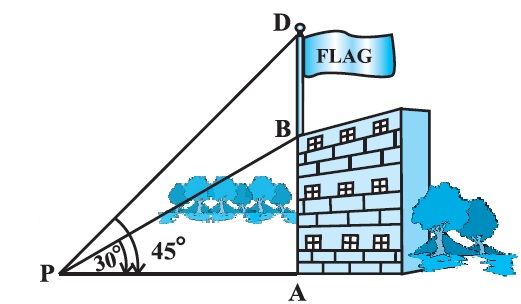
From a point P on the ground the angle of elevation of the top of a 10 m tall building is 30°. A flag is hoisted at the top of the building and the angle of elevation of the top of the flagstaff from P is 45°. Find the length of the flagstaff and the distance of the building from the point P. (You may take √3 = 1.732)
2.
In triangle ABC, right-angled at B, if tan A \(=\frac{1}{\sqrt{3}}\) find the value of : cos A cos C – sin A sin C
3.
Prove the following identities, where the angles involved are acute angles for which the expressions are defined.
\(\frac { \cos { A } -\sin { A } +1 }{ \cos { A } +\sin { A } -1 } =cosecA+\cot { A } \) using the identity \({ cosec }^{ 2 }A=1+\cot ^{ 2 }{ A } \)
4.
A vertical tower is surmounted by a flag staff of height 5metres.At a point on the ground, the angles of elevation of bottom and top of flag staff are 450 and 600 respectively.Find the height of the tower.
5.
From a point on the ground, the angles of elevation of the bottom and the top of a transmission tower fixed at the top of a 20 m high building are 45° and 60°. Find the height of the tower.
6.
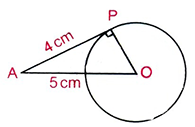
The length of a tangent from a point A at distance 5cm from the centre of the circle is 4cm.Find the radius of the circle.
7.
Prove that \(\frac{\sin A+\cos A}{\sin A-\cos A}+\frac{\sin A-\cos A}{\sin A+\cos A}=\frac{2}{2 \sin ^2 A-1}\)
8.
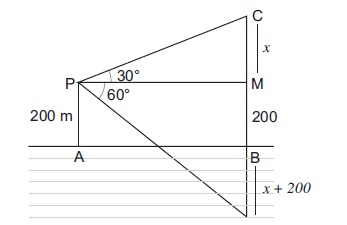
The angle of elevation of a cloud from a point 200 m above the lake is 30° and the angle of depression of its reflection in the lake is 60°, find the height of the cloud above the lake.
9.
Prove that :\(\left( \cot { \theta } -cosec\theta \right) ^{ 2 }=\frac { 1-\cos { \theta } }{ 1+\cos { \theta } } \)
10.
Prove that \(\frac { cosec\theta +cot\theta }{ cosec\theta -cot\theta } =1+2{ cot }^{ 2 }\theta +2{ cosec }^{ 2 }\theta cos\theta \)
11.
Prove that \(\frac { \sin { \theta } -\cos { \theta } +1 }{ \sin { \theta } +\cos { \theta } -1 } =\frac { 1 }{ \sec { \theta } -\tan { \theta } } \) using the identity \(\sec ^{ 2 }{ \theta } =1+\tan ^{ 2 }{ \theta } .\)
12.
A vertical tower is \(2\sqrt { 3 } m\) high and the length of its shadow is 2 m. Find the angle of elevation of the source of light.
13.
Prove that in two concentric circles, the chord of the larger circle, which touches the smaller circle, is bisected at the point of contact.
14.
Prove that opposite sides of a quadrilateral circumscribing a circle subtend supplementary angles at the centre of the circle.
15.
Prove that \(\frac{\cot A-\cos A}{\cot A+\cos A}=\frac{\operatorname{cosec} A-1}{\operatorname{cosec} A+1}\)
16.
If \(\sin { \alpha =\frac { 1 }{ 2 } } \) then find the value of \(3\sin { \alpha } -4\sin ^{ 3 }{ \alpha } \)
17.
If \(7\tan { \theta } =4,\) then find the value of \(\frac { 7\sin { \theta } -3\cos { \theta } }{ 7\sin { \theta } -3\cos { \theta } } \)
18.
If the length of a tangent from an external point A, 5cm away from the centre of the circle is 3 cm, then find the radius of the circle.
19.
A bicycle wheel makes 5000 revolutions in moving 11 km. Find the diameter of the wheel. (use \(\pi ={22\over 7}\))
20.
A chord of a circle of radius 10 cm subtends a right angle at the centre. Find area of the corresponding
(i) minor segment
(ii) major sector \(( Take, \quad \pi = 3.14)\)
21.
The length of the minute hand of a clock is 14 cm. Find the area swept by the minute hand in 5 minutes.
22.
The angle of elevation of the top of a building from the foot of a tower is 30o and the angle of elevation of the top of the tower from the foot of the building is 60o. If the tower is 50 m high, find the height of the building.
23.
\(\frac{2 \tan 30^{\circ}}{1+\tan ^2 30^{\circ}}\) is equal to
sin 60°
cos 60°
tan 60°
Sin 30°
24.
A tangent PQ at a point P of a circle of radius 5 cm meets a line through the centre O at a point Q, so that OQ= 12 cm. Length of PQ is
12 cm
13 cm
8.5 cm
\(\sqrt119\) cm
25.
If tangents PA and PB from a point P to a circle with centre O are inclined to each other at angle of 80°, then \(\angle POA \) is equal to
50°
60°
70°
80°
26.
Tick the correct answer in the following:
Area of a sector of angle P (in degrees) of a circle with radius R is
\({P \over 180^o}\times 2\pi R\)
\({P \over 180^o}\times \pi R^2\)
\({P \over 360^o}\times 2\pi R\)
\({P \over 720^o}\times 2\pi R^2\)
27.
\(\frac{2 \tan 30^{\circ}}{1-\tan ^{2} 30^{\circ}}\) =
cos 60°
sin 60°
tan 60°
sin 30°
28.
sin 2A = 2 sin A is true, when A =
0°
30o
45°
60°
29.
If sinθ = cosθ, then the value of θ is:
45°
30°
90°
60°
30.
if tan θ+cot θ =2 then the value of tan2 θ+cot2 θ is
0
2
3
1
31.
If cos (∝+β)=0 , then sin (∝-β) can be reduced to
cos β
sin α
sin 2α
cos 2β
32.
The square root \(\frac { 1+sin\quad A }{ 1-sin\quad A } \)=
cot A – cosec A
sec A – tan A
sec A + tan A
cot A + cosec A
33.
The radius of a circle if its perimeter and area are numerically equal is
2 units
8 units
5 units
4 units
34.
If the perimeter and area of a circle are numerically equal, then the radius of the circle is
2 units
7 units
4 units
π units
35.
If the angle of elevation of a cloud from a point 100 metres above a lake is 30° and the angle of depression of its reflection in the lake is 60°, then the height of the cloud above the lake is
200 m
30 m
500 m
100 m
36.
Two pillars are a metres apart and the height of one is double that of the other. If from the middle point of the line joining their feet, an observer finds the angular elevation of their tops to be complementary, then the height of the taller pillar is
a√2m
2a m
a m
a/√2 m
37.
A kite is flying, attached to a thread which is 165m long. The thread makes an angle of 300 with the ground. The height of the kite from the ground, assuming that there is no slack in the thread is
84 m
82.5 m
81.5 m
80 m
38.
Number of tangents from a point lying inside the circle is
None
Infinitely many
Two
One
39.
PQ is a tangent drawn from a point P to a circle with centre O and QOR is a diameter of the circle such that ∠POR=120°, then ∠OPQ is
60o
30o
90o
45o
40.
Number of tangents, that can be drawn to a circle, parallel to a given chord is
3
zero
Infinite
2
41.
Assertion : If tangents PA and PB from a point P to a circle with centre O are inclined to each other at angle of 76°, then L.POA is 52°.
Reason :Two tangents AP and AQ are drawn to a circle with centre O from a point A. Then,\(\angle A P O=\angle A Q O\)
Codes :
(a) If both Assertion and Reason are correct and Reason is the correct explanation of Assertion.
(b) If both Assertion and Reason are correct, but Reason is not the correct explanation of Assertion.
(c) If Assertion is correct but Reason is incorrect
(d) If Assertion is incorrect but Reason is correct
42.
Assertion The equation \(\sec ^{2} \theta=\frac{4 x y}{(x+y)^{2}} \text { is }\) only possible, when x = y.
Reason \(\sec ^{2} \theta \geq 1\) and therefore \((x-y)^{2} \leq 0\)
Codes:
(a) If both Assertion and Reason are correct and Reason is the correct explanation of Assertion.
(b) If both Assertion and Reason are correct, but Reason is not the correct explanation of Assertion.
(c) If Assertion is correct but Reason is Incorrect.
(d) If Assertion is incorrect but Reason is correct.
43.
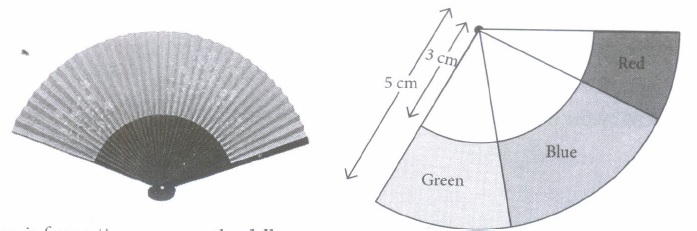
Sara hold a japanese folding fan in her hand as shown in the figure. It is shaped like a sector of a circle and made of a thin material such as paper or feather. The inner and outer radii are 3 em and 5 ern respectively. The fan has three colours i.e., red, blue and green.
Based on the above information, answer the following questions.
(i) If the region containing blue colour makes an angle of 80° at the centre, then find the area of the region having blue colour.
| (a) 9.17 cm2 | (b) 10.1 cm2 | (c) 11.17 cm2 | (d) 13.17 cm2 |
(ii) If the region containing green colour makes an angle of 60° at the centre, then find the area of the region having green colour
| (a) 6.2 cm2 | (b) 8.38 cm2 | (c) 9.9 cm2 | (d) 11.12 cm2 |
(iii) If the region containing red colour makes an angle oflOo at the centre, then find the perimeter of the region containing red colour.
| (a) 2.9 cm | (b) 4.2 cm | (c) 5.4 cm | (d) 6.79 cm |
(iv) Find the area of the region having radius 3 cm.
| (a) 12.57 cm2 | (b) 14.8 cm2 | (c) 20 cm2 | (d) 26.57 cm2 |
(v) The region given in the figure represents
| (a) minor sector | (b) major sector | (c) minor segment | (d) major segment |
44.
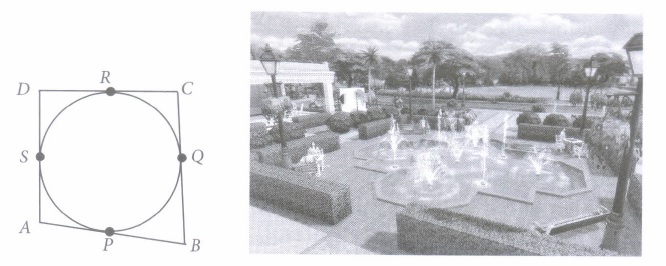
In a park, four poles are standing at positions A, B, C and D around the fountain such that the cloth joining the poles AB, BC, CD and DA touches the fountain at P, Q, Rand S respectively as shown in the figure.
Based on the above information, answer the following questions.
(i) If 0 is the centre of the circular fountain, then \(\angle\)OSA =
| (a) 60° | (b) 90° |
| (c) 45° | (d) None of these |
(ii) Which of the following is correct?
| (a) AS = AP | (b) BP= BQ | (c) CQ = CR | (d) All of these |
(iii) If DR = 7 cm and AD = 11 ern, then AP =
| (a) 4 cm | (b) 18 cm | (c) 7 cm | (d) 11 cm |
(iv) If O is the centre of the fountain, with \(\angle\)QCR = 60°, then \(\angle\)QOR
| (a) 60° | (b) 120° | (c) 90° | (d) 30° |
(v) Which of the following is correct?
| (a) AB + BC = CD + DA | (b) AB + AD = BC + CD |
| (c) AB + CD = AD + BC | (d) All of these |
45.
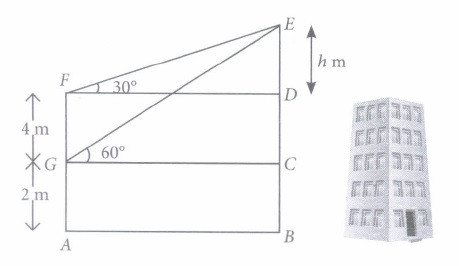
There are two windows in a house. First window is at the height of 2 m above the ground and other window is 4 m vertically above the lower window. Ankit and Radha are sitting inside the two windows at points G and F respectively. At an instant, the angles of elevation of a balloon from these windows are observed to be 60° and 30° as shown below
Based on the above information, answer the following questions.
(i) Who is more closer to the balloon?
| (a) Ankit | (b) Radha |
| (c) Both are at equal distance | (d) Can't be determined |
(ii) Value of DF is equal to
| \((a) \frac{h}{\sqrt{3}} \mathrm{~m}\) | \((b) h \sqrt{3} \mathrm{~m}\) | \((c) \frac{h}{2} \mathrm{~m}\) | \((d) 2 h \mathrm{~m}\) |
(iii) Value of h is
| (a) 2 | (b) 3 | (c) 4 | (d) 5 |
(iv) Height of the balloon from the ground is
| (a) 4 m | (b) 6 m | (c) 8 m | (d) 10 m |
(v) If the balloon is moving towards the building, then both angle of elevation will
| (a) remain same | (b) increases | (c) decreases | (d) can't be determined |
1.
In Figure AB denotes the height of the building, BD the flagstaff and P the given point. Note that there are two right triangles PAB and PAD. We are required to find the length of the flagstaff, i.e., DB and the distance of the building from the point P, i.e., PA.
Since, we know the height of the building AB, we will first consider the right \(\Delta\) PAB.
We have \(\tan 30^{\circ}=\frac{\mathrm{AB}}{\mathrm{AP}}\)
i.e., \(\frac{1}{\sqrt{3}}=\frac{10}{\mathrm{AP}}\)
Therefore, \(\mathrm{AP}=10 \sqrt{3}\)
i.e., the distance of the building from P is 10 \(\sqrt3\) m = 17.32 m.
Next, let us suppose DB = x m. Then AD = (10 + x) m.
Now, in right Δ PAD, \(\tan 45^{\circ}=\frac{\mathrm{AD}}{\mathrm{AP}}=\frac{10+x}{10 \sqrt{3}}\)
Therefore, \(1=\frac{10+x}{10 \sqrt{3}}\)
i.e., \(x=10(\sqrt{3}-1)=7.32\)
So, the length of the flagstaff is 7.32 m.
2.
cos A cos C − sin A sin C
\(=\left(\frac{\sqrt{3}}{2}\right)\left(\frac{1}{2}\right)-\left(\frac{1}{2}\right)\left(\frac{\sqrt{3}}{2}\right)=\frac{\sqrt{3}}{4}-\frac{\sqrt{3}}{4}=0\)
3.
LHS = \(\frac { \cos { A } -\sin { A } +1 }{ \cos { A } +\sin { A } -1 } \)
On dividing numerator and denominator by sin A, we get
\(=\frac { \frac { \cos { A } }{ \sin { A } } -\frac { \sin { A } }{ \sin { A } } +\frac { 1 }{ \sin { A } } }{ \frac { \cos { A } }{ \sin { A } } +\frac { \sin { A } }{ \sin { A } } -\frac { 1 }{ \sin { A } } } =\frac { \cot { A } -1+cosecA }{ \cot { A } +1-1cosecA } \) \(\left[ \because \cot { A } =\frac { \cos { \theta } }{ \sin { \theta } } and\frac { 1 }{ \sin { \theta } } =cosec \theta \right] \)
\(=\frac { \cot { A } +cosecA-1 }{ \cot { A } +1-1cosecA } \)
\(=\frac { (\cot { A } +cosecA)-({ cosec }^{ 2 }A-\cot ^{ 2 }{ A } ) }{ \cot { A } +1-1cosecA } \left[ \because 1={ cosec }^{ 2 }A-\cot ^{ 2 }{ A } \right] \)
\(=\frac { (\cot { A } +cosecA)-\left[ (\cot { A } +cosecA)(\cot { A } -cosecA) \right] }{ \cot { A } +1-1cosecA } \) \(\left[ \because \quad { a }^{ 2 }-{ b }^{ 2 }=(a+b)(a-b) \right] \)
\(=\frac { (\cot { A } +cosecA)-\left[ 1-(cosecA-\cot { A } ) \right] }{ \cot { A } +1-1cosecA } \)
\(\quad =\frac { (\cot { A } +cosecA)-\left[ 1-cosecA+\cot { A } \right] }{ \cot { A } +1-1cosecA } \)
\(=cosecA+\cot { A } =RHS\)
Hence proved.
4.
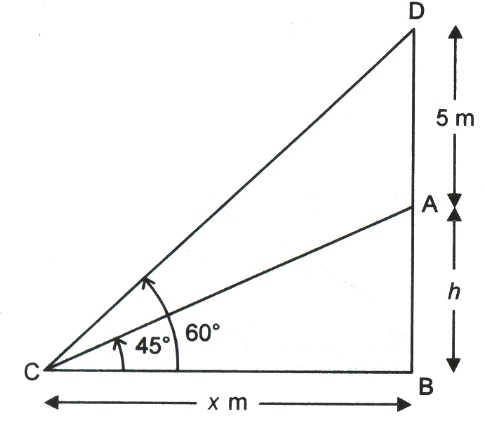
Let AB=h m be the height of the tower. Let C is point on ground and AD=5 m be height of flag staff .
Let BC=x m, ㄥACB=45o and ㄥDCB=60o
Consider rt . angled ∆ABC, we have
\(\frac { AB }{ BC } \)=tan450
⇒ \(\frac { h }{ x } \)=1 ⇒ h=x
\(\frac { BD }{ BC } \)=tan60o
⇒ \(\frac { h+5 }{ x } =\sqrt { 3 } \)
⇒ h+5=\(\sqrt { 3 } \)
⇒ h+5=\(\sqrt { 3 } \)h [∵ from (i), h=x]
5=\(\sqrt { 3 } \)h-h
⇒ h(\(\sqrt { 3 } \)-1)=5
⇒ h=\(\frac { 5 }{ \sqrt { 3 } -1 } \times \frac { \sqrt { 3 } +1 }{ \sqrt { 3 } +1 } \)
=\(\frac { 5(\sqrt { 3 } +1) }{ 3-1 } =\frac { 5(1.732+1) }{ 2 } \)
=\(\frac { 5\times 2.732 }{ 2 } \)=5 x 1.366
=6.83
5.
Let BC be the building, AB be the transmission tower and D be the point on the ground from where the angles of elevations are to be measured.
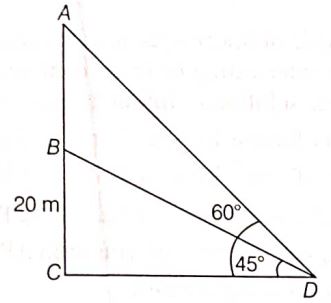
\(\begin{array}{rlrl}
\text { In } \triangle B C D, & \tan 45^{\circ} =\frac{B C}{C D} \\
\end{array}\)
\(\begin{array}{rlrl}
\Rightarrow 1 =\frac{20}{C D} \Rightarrow C D=20 \mathrm{~m}
\end{array}\)
\(\begin{array}{llrl}
\text { In } \triangle A C D, & \tan 60^{\circ} =\frac{A C}{C D}
\end{array}\)
\(\begin{array}{llrl}
\Rightarrow \sqrt{3} =\frac{A B+B C}{C D} \\
\end{array}\)
\(\begin{array}{llrl}
\Rightarrow \sqrt{3} =\frac{A B+20}{20} \\
\end{array}\)
\(\Rightarrow A B =20 \sqrt{3}-20=20(\sqrt{3}-1) \mathrm{m}\)
Thus, the height of the tower is \(20(\sqrt{3}-1) \mathrm{m}\).
6.
OP = Radius of the circle OA = 5 cm; AP = 4 cm
OA2 = AP2 + OP2 [By pythagoras theorem]
52 = 42 + OP2
⇒ 25 = 16 + OP2 ⇒ 25 - 16 = OP2 ⇒ 9 = OP2 ⇒ OP = \(\sqrt9\) = 3
Radius = 3 cm
7.
\(\begin{aligned}
\mathrm{LHS} & =\frac{\sin A+\cos A}{\sin A-\cos A}+\frac{\sin A-\cos A}{\sin A+\cos A} \\
\end{aligned}\)
\(\begin{aligned}
=\frac{(\sin A+\cos A)^2+(\sin A-\cos A)^2}{(\sin A-\cos A)(\sin A+\cos A)}
\end{aligned}\)
\(=\frac{\left[\begin{array}{c}
\sin ^2 A+2 \sin A \cos A+\cos ^2 A+\sin ^2 A \\
-2 \sin A \cos A+\cos ^2 A
\end{array}\right]}{\sin ^2 A-\cos ^2 A}\)
\(\left[\because(a \pm b)^2=a^2+b^2 \pm 2 a b\right]\)
\(\begin{aligned}
& =\frac{2 \sin ^2 A+2 \cos ^2 A}{\sin ^2 A-\cos ^2 A}=\frac{2\left(\sin ^2 A+\cos ^2 A\right)}{\sin ^2 A-\cos ^2 A}
\end{aligned}\)
\(\begin{aligned}
=\frac{2}{\sin ^2 A-\cos ^2 A}
\end{aligned}\)
\(\begin{aligned}
=\frac{2}{\sin ^2 A-\left(1-\sin ^2 A\right)}
\end{aligned}\)
\(\begin{aligned}
=\frac{2}{\sin ^2 A-1+\sin ^2 A}
\end{aligned}\)
\(\begin{aligned}
=\frac{2}{2 \sin ^2 A-1}
\end{aligned}\)
= RHS Hence proved.
8.
In \(\Delta ADC\), tan 30°=\(\frac { H-200 }{ x } \)
\(\frac { 1 }{ \sqrt { 3 } } =\frac { H-200 }{ x } \)
x =\(\sqrt{3}\)(H-200)m
In \(\Delta ADF\), tan 60° =\(\frac { H+200 }{ x } \)
\(\sqrt{3}\)=\(\frac { H+200 }{ x } \)
\(\sqrt{3}\)=\(\frac { H-200 }{ \sqrt { 3 } (H-200) } \)
3(H -200) = H + 200
3H - H = 200 + 600
2H=800
So, required height H = 400 m
9.
To prove \(\left( \cot { \theta } -cosec\theta \right) ^{ 2 }=\frac { 1-\cos { \theta } }{ 1+\cos { \theta } } \)
\(LHS=\left( \cot { \theta } -cosec\theta \right) ^{ 2 }\)
\(=\left( \frac { \cos { \theta } }{ \sin { \theta } } -\frac { 1 }{ \sin { \theta } } \right) ^{ 2 }\)
\(=\left( \frac { \cos { \theta } -1 }{ \sin { \theta } } \right) ^{ 2 }\)
\(=\frac { { \left( 1-\cos { \theta } \right) }^{ 2 } }{ \sin ^{ 2 }{ \theta } } \) \(\left( \because \quad \sin ^{ 2 }{ \theta } +\cos ^{ 2 }{ \theta } =1 \right) \)
\(=\frac { { \left( 1-\cos { \theta } \right) }^{ 2 } }{ \left( 1-\cos ^{ 2 }{ \theta } \right) } \)
\(=\frac { \left( 1-\cos { \theta } \right) \left( 1-\cos { \theta } \right) }{ \left( 1-\cos { \theta } \right) \left( 1+\cos { \theta } \right) } \)
\(\frac { 1-\cos { \theta } }{ 1+\cos { \theta } } \)
= RHS
10.
\(LHS=\frac { cosec\theta +cot\theta }{ cosec\theta -cot\theta } =\frac { \frac { 1 }{ sin\theta } +\frac { cos\theta }{ sin\theta } }{ \frac { 1 }{ sin\theta } -\frac { cos\theta }{ sin\theta } } \)
\(=\frac { (1+cos\theta )/sin\theta }{ (1-cos\theta )/sin\theta } =\frac { 1+cos\theta }{ 1-cos\theta } \)
\(=\frac { 1+cos\theta }{ 1-cos\theta } \times \frac { 1+cos\theta }{ 1+cos\theta } \)
\(=\frac { { \left( 1+cos\theta \right) }^{ 2 } }{ (1-cos\theta )(1+cos\theta ) } =\frac { { \left( 1+cos\theta \right) }^{ 2 } }{ 1-{ cos }^{ 2 }\theta } \)
\(=\frac { 1+{ cos }^{ 2 }\theta +2cos\theta }{ { sin }^{ 2 }\theta } \)
\(=\frac { 1 }{ { sin }^{ 2 }\theta } +\frac { { cos }^{ 2 }\theta }{ { sin }^{ 2 }\theta } +\frac { 2cos\theta }{ { sin }^{ 2 }\theta } \)
\(={ cosec }^{ 2 }\theta +{ cot }^{ 2 }\theta +2{ cosec }^{ 2 }\theta cos\theta \)
\(=1+{ cot }^{ 2 }\theta +{ cot }^{ 2 }\theta +2{ cosec }^{ 2 }\theta cos\theta \)
\(=1+2{ cot }^{ 2 }\theta +2{ cosec }^{ 2 }\theta cos\theta =RHS\)
11.
Since we will apply the identity involving sec \(\theta\) and tan \(\theta\), let us first convert the LHS (of the identity we need to prove) in terms of sec \(\theta\) and tan \(\theta\) by dividing numerator and denominator by cos \(\theta\).
\(\begin{aligned} \text { LHS } & =\frac{\sin \theta-\cos \theta+1}{\sin \theta+\cos \theta-1}=\frac{\tan \theta-1+\sec \theta}{\tan \theta+1-\sec \theta} \\ \end{aligned}\)
\(\begin{aligned} & =\frac{(\tan \theta+\sec \theta)-1}{(\tan \theta-\sec \theta)+1}=\frac{\{(\tan \theta+\sec \theta)-1\}(\tan \theta-\sec \theta)}{\{(\tan \theta-\sec \theta)+1\}(\tan \theta-\sec \theta)} \\ \end{aligned}\)
\(\begin{aligned} & =\frac{\left(\tan ^2 \theta-\sec ^2 \theta\right)-(\tan \theta-\sec \theta)}{\{\tan \theta-\sec \theta+1\}(\tan \theta-\sec \theta)} \\ \end{aligned}\)
\(\begin{aligned} & =\frac{-1-\tan \theta+\sec \theta}{(\tan \theta-\sec \theta+1)(\tan \theta-\sec \theta)} \end{aligned}\)
\(=\frac{-1}{\tan \theta-\sec \theta}=\frac{1}{\sec \theta-\tan \theta}\)
which is the RHS of the identity, we are required to prove.
12.
60°
13.
We are given two concentric circles C1 and C2 with centre O and a chord AB of the larger circle C1 which touches the smaller circle C2 at the point P (see Fig). We need to prove that AP = BP.
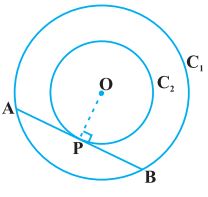
Let us join OP. Then, AB is a tangent to C2 at P and OP is its radius. Therefore, by Theorem.
OP \(\perp\) AB
Now AB is a chord of the circle C1 and OP \(\perp\) AB. Therefore, OP is the bisector of the chord AB, as the perpendicular from the centre bisects the chord,
i.e., AP = BP
14.
Let ABCD is a quadrilateral circumscribing a circle with centre O. Let circle touches the sides of a quadrilatcral at points E, F, G and H.
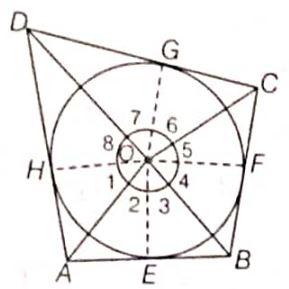
To prove \(\angle\)AOB + \(\angle\)COD = 180°
and \(\angle\) AOD + \(\angle\)BOC = 180°
Construction Join OE, OF, OG and OH.
Proof We know that two tangents drawn from an external point to a circle subtend equal angles at the centre.
and 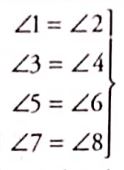 ....(i)
Also, we know that the sum of all angles subtended at a point is 360°.
\(\begin{array}{rlrl} \therefore \angle 1+\angle 2+\angle 3+\angle 4+\angle 5+\angle 6+\angle 7+\angle 8 & =360^{\circ} \\ \end{array}\) ...(ii)
\(\begin{array}{rlrl} \Rightarrow 2(\angle 2+\angle 3+\angle 6+\angle 7) & =360^{\circ} \\ \end{array}\)
\(\begin{array}{rlrl} \Rightarrow & (\angle 2+\angle 3)+(\angle 6+\angle 7)=180^{\circ} \\ \end{array}\)
\(\begin{array}{rlrl} \Rightarrow & \angle A O B+\angle C O D=180^{\circ} \end{array}\)
Similarly, we have
\(\begin{aligned} 2(\angle 1+\angle 8+\angle 4+\angle 5) & =360^{\circ} \\ \end{aligned}\) [from Eq. (i) and (ii)]
\(\begin{aligned} & \Rightarrow(\angle 1+\angle 8)+(\angle 4+\angle 5)=180^{\circ} \\ \end{aligned}\)
\(\begin{aligned} \Rightarrow \quad \angle A O D+\angle B O C=180^{\circ} \end{aligned}\) Hence proved.
15.
\(L H S=\frac{\cot A-\cos A}{\cot A+\cos A}=\frac{\frac{\cos A}{\sin A}-\cos A}{\frac{\cos A}{\sin A}+\cos A}\)
\(=\frac{\cos A\left(\frac{1}{\sin A}-1\right)}{\cos A\left(\frac{1}{\sin A}+1\right)}=\frac{\left(\frac{1}{\sin A}-1\right)}{\left(\frac{1}{\sin A}+1\right)}=\frac{\operatorname{cosec} A-1}{\operatorname{cosec} A+1}=\operatorname{RHS}\)
16.
Given, \(\sin { \alpha =\frac { 1 }{ 2 } } \)
then \(3\sin { \alpha } -4\sin ^{ 3 }{ \alpha } =3\times \frac { 1 }{ 2 } -4\times { \left( \frac { 1 }{ 2 } \right) }^{ 3 }\)
\(=\frac { 3 }{ 2 } -\frac { 4 }{ 8 } =1\)
17.
\(\frac {1}{7}\)
18.
4 cm
19.
Distance covered in 5000 revolutions = 11 km.
Distance covered in 1 revolution
Distance covered in 1 revolution \(={11000\over 5000}m={11\over 5}m\)
Distance covered in 1 revolution = circumference of the wheel
\(\Rightarrow\)\(2\ \pi r ={11\over 5} \Rightarrow 2\times {22\over 7}\times r = {11\over 5}\)
\(\Rightarrow\) \(r \Rightarrow {11\over 5}\times 7\times {1\over 2\times 22}={7\over 20}m\)
\(\therefore\) Diameter \(=2\times r=2\times {7\over 20}={7\over 10}\times 100 cm=70cm\)
20.
Given, radius of a circle, AO = 10 cm and \(\angle\)AOC = 90°
Area of \(\triangle A O C=\frac{1}{2} \times O A \times O C=\frac{1}{2} \times 10 \times 10=50 \mathrm{~cm}^2\)
\(\begin{aligned} \text { Area of sector } O A E C O & =\frac{\theta}{360^{\circ}} \times \pi r^2 \\ \end{aligned}\)
\(\begin{aligned} =\frac{90^{\circ}}{360^{\circ}} \times 3.14 \times(10)^2 \\ \end{aligned}\)
\(\begin{aligned} =\frac{314}{4}=78.5 \mathrm{~cm}^2 \end{aligned}\)
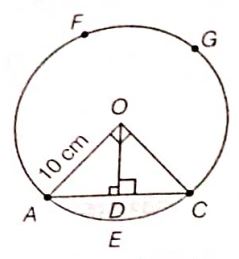
(i) Area of minor segment AECDA
= Area of sector OAECO - Area of \(\Delta\)AOC
= 78.5 - 50 = 28.5 cm2
(ii) Area of major sector OAFGCO
= Area of circle - Area of sector OAECO
= 3.14 \(\times\)(10)2 - 78.5
= 314 - 78.5 = 235.5 cm2
21.
We know that in 1 hour (i.e., 60 minutes), the minute hand rotates 360°.
In 5 minutes, minute hand will rotate = 360^@/60xx5 = 30^@
Therefore, the area swept by the minute hand in 5 minutes will be the area of a sector of 30° in a circle of 14 cm radius.
Area of sector of angle θ = \(\frac{\theta}{360^{\circ}} \times \pi r^{2}\)
Area of sector of 30° \(=\frac{30^{\circ}}{360^{\circ}} \times \frac{22}{7} \times 14 \times 14\)
\(\begin{array}{l} =\frac{22}{12} \times 2 \times 14 \\ =\frac{11 \times 14}{3} \end{array}\)
=154/3 cm2
Therefore, the area swept by the minute hand in 5 minutes is 154/3 cm2
22.

Let BC = 50 m be the height of the tower and AD = h m be the height of the building. Angle of elevation of the top of the building from the foot of the tower is \(\angle\)DBA = 30° and angle of elevation of the top of the tower from the foot of the building \(\angle\)CAB = 60°. Also, let AB = x m be the distance between foots of the tower and the building.
In right angled \(\Delta\)BAD, tan 30°=\(\frac{P}{B}=\frac{A D}{A B}\)
\(\begin{array}{lll}
\Rightarrow & \frac{1}{\sqrt{3}}=\frac{h}{x} & {\left[\because \tan 30^{\circ}=\frac{1}{\sqrt{3}}\right]} \\
\end{array}\)
\(\begin{array}{lll}
\Rightarrow & b=\frac{x}{\sqrt{3}}
\end{array}\) ...(i)
and in right angled \(\Delta\)CBA, tan 60° = \(\frac{B C}{A B}\)
\(\begin{array}{lll}
\Rightarrow & \sqrt{3}=\frac{50}{x} & {\left[\because \tan 60^{\circ}=\sqrt{3}\right]} \\
\end{array}\)
\(\begin{array}{lll}
\Rightarrow & x=\frac{50}{\sqrt{3}} \mathrm{~m}
\end{array}\)
On putting \(x=\frac{50}{\sqrt{3}}\) in Eq. (i), we get
\(h=\frac{50}{\sqrt{3}} \times \frac{1}{\sqrt{3}}=\frac{50}{3}=16 \frac{2}{3} \mathrm{~m}\)
Hence, the height of the building is \(16 \frac{2}{3} \mathrm{~m}\).
23.
(a)
sin 60°
24.
(d)
\(\sqrt119\) cm
25.
(a)
50°
26.
(d)
\({P \over 720^o}\times 2\pi R^2\)
27.
(c)
tan 60°
28.
(a)
0°
29.
(a)
45°
30.
(b)
2
31.
(d)
cos 2β
32.
(c)
sec A + tan A
33.
(a)
2 units
34.
(b)
7 units
35.
(d)
100 m
36.
(a)
a√2m
37.
(b)
82.5 m
38.
(a)
None
39.
(b)
30o
40.
(d)
2
41.
If both Assertion and Reason are correct, but Reason is not the correct explanation of Assertion.
42.
(a) If both Assertion and Reason are correct and Reason is the correct explanation of Assertion.
43.
(i) (c): Area of the region containing blue colour
\(=\frac{22}{7} \times 5 \times 5 \times \frac{80^{\circ}}{360^{\circ}}-\frac{22}{7} \times 3 \times 3 \times \frac{80^{\circ}}{360^{\circ}}\)
\(=\frac{22}{7} \times \frac{2}{9} \times[25-9]=\frac{44}{63}(16)=11.17 \mathrm{~cm}^{2}\)
(ii) (b) : Area of the region containing green colour
\(=\frac{22}{7} \times \frac{60^{\circ}}{360^{\circ}}[5 \times 5-3 \times 3]=\frac{22}{7} \times \frac{1}{6} \times 16=8.38 \mathrm{~cm}^{2}\)
(iii) (d): Perimeter of the region containing red colour
= 2 + 2 + length of arc of sector having radius 3 cm + length of arc of sector having radius 5 cm.
\(=4+2 \times \frac{22}{7} \times 3 \times \frac{20^{\circ}}{360^{\circ}}+2 \times \frac{22}{7} \times 5 \times \frac{20^{\circ}}{360^{\circ}}\)
\(=4+\frac{44}{7} \times \frac{1}{18} \times 8=4+\frac{176}{63}=4+2.79=6.79 \mathrm{~cm}\)
(iv) (a): Required area \(=\frac{22}{7} \times 3 \times 3 \times \frac{160^{\circ}}{360^{\circ}}\)
\(=\frac{88}{7}=12.57 \mathrm{~cm}^{2}\)
(v) (a): Angle of given sector = 800 + 600 + 200 = 1600
Thus, the given region represents minor sector of a circle.
44.
(i) (b):
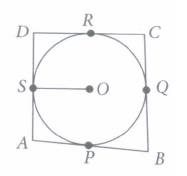
Here, OS the is radius of circle.
Since radius at the point of contact is perpendicularto tangent.
So, \(\angle\)OSA = 90°
(ii) (d): Since, length of tangents drawn from an external point to a circle are equal.
\(\therefore\) AS=AP,BP=BQ,
CQ = CR and DR = DS
(iii) (a): AP = AS = AD _ DS = AD _ DR (Using (1)
= 11 - 7 = 4 cm
(iv) (b): In quadrilateral OQCR,
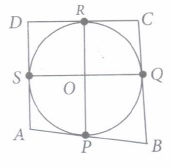
\(\angle\)QCR = 60° (Given)
And \(\angle\)OQC = \(\angle\)ORC = 90° [Since, radius at the point of contact is perpendicular to tangent.]
\(\therefore\) \(\angle\)QOR = 360° - 90° - 90° - 60° = 120°
(v) (c): From (1), we have AS = AP, DS = DR,
BQ = BP and CQ = CR
Adding all above equations, we get
AS + DS + BQ + CQ = AP + DR + BP + CR
\(\Rightarrow\) AD + BC = AB + CD
45.
(i) (b): The person who makes small angle of elevation is more closer to the balloon.
\(\therefore\) Radlra is more closer to the balloon.
(ii) (b): \(\text { In } \Delta E F D, \tan 30^{\circ}=\frac{E D}{D F}\)
\(\Rightarrow \quad \frac{1}{\sqrt{3}}=\frac{h}{D F} \)
\(\Rightarrow \quad D F=h \sqrt{3} \mathrm{~m}\)
(iii) (a): In \(\Delta\)GCE,
\(\begin{array}{l}
\tan 60^{\circ}=\frac{E C}{G C}=\frac{h+4}{D F} \\
\Rightarrow \quad \sqrt{3}=\frac{h+4}{\sqrt{3} h} \Rightarrow 3 h=h+4 \Rightarrow h=2
\end{array}\)
(iv) (c): Height of the balloon from the ground = BE = BC + CD + DE = 2 + 4 + 2 = 8 m
(v) (b)

10th Standard CBSE Syllabus & Materials
10th Standard CBSE
CBSE 10th Social Science PS - Federalism - New Model Questions Papers Study Material - QB365 Set A
NEW10th Standard CBSE
CBSE 10th Social Science PS - Power Sharing - New Model Questions Papers Study Material - QB365 Set A
NEW10th Standard CBSE
CBSE 10th Social Science GEO - Manufacturing Industries - New Model Questions Papers Study Material - QB365 Set A
NEW10th Standard CBSE
CBSE 10th Social Science GEO - Minerals and Energy Resources - New Model Questions Papers Study Material - QB365 Set A



NCERT Books

Syllabus

Exam Pattern

Sample Question Papers

Previous year Question Papers

Important Notes

MCQ Practice test

NCERT Exemplers

Case study Questions

Image Based Questions

Passage based Questions

HOT Questions

Value Based Questions

Model Questions Papers
NCERT ( Book Back ) Questions

Assertion and Reason
Important Questions And Answers

CBSE 10th Standard CBSE Subjects
CBSE Standards



