
 100% FREE ACCESS
10th Standard CBSE Syllabus & Materials
10th Standard CBSE
CBSE 10th Social Science ECO - Globalisation and the Indian Economy - New Model Questions Papers Study Material - QB365 Set A
NEW10th Standard CBSE
CBSE 10th Social Science ECO - Money and Credit - New Model Questions Papers Study Material - QB365 Set A
NEW10th Standard CBSE
CBSE 10th Social Science ECO - Sectors of the Indian Economy - New Model Questions Papers Study Material - QB365 Set A
NEW10th Standard CBSE
CBSE 10th Social Science ECO - Development - New Model Questions Papers Study Material - QB365 Set A
NEW10th Standard CBSE
CBSE 10th Social Science PS - Outcomes of Democracy - New Model Questions Papers Study Material - QB365 Set A
NEW10th Standard CBSE
CBSE 10th Social Science PS - Gender, Religion and Caste - New Model Questions Papers Study Material - QB365 Set A

Published on: 20/10/2025
Download CBSE Class 10th Standard CBSE Maths question papers, sample papers, important questions, and previous year solved papers in PDF format. Get free study materials, NCERT solutions, and exam preparation resources for Class 10th Standard CBSE Maths
Questions + Answers key
Take MCQ Maths Test
1.
Evaluate the following : sin 60° cos 30° + sin 30° cos 60°
2.
In △ ABC, right-angled at B, AB = 5 cm and ∠ ACB = 30° (see Fig). Determine the lengths of the sides BC and AC.
3.
An aeroplane, when 3000 m high, passes vertically above another aeroplane at an instant, when the angles of elevation of the two aeroplanes from the same point on the ground are \({ 60 }^{ ° }\)and \({ 45 }^{ ° }\), respectively, Find the vertical distance between the two aeroplanes.
4.
An aeroplane is at an altitude of 1200 m. Find that two ships are sailing towards it in the same direction. The angles of depression of the ships as observed from the aeroplane are \(60°\) and \(30°\) , respectively. Find the distance between both ships.
5.
Prove that in two concentric circles, the chord of the larger circle, which touches the smaller circle, is bisected at the point of contact.
6.
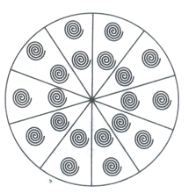
A brooch is made with silver wire in the form of a circle with diameter 35 mm. The wire is also used in making 5 diameters which divide the circle into 10 equal sectors as shown in figure.
Find:
(i) the total length of the silver wire required.
(ii) the area of each sector of the brooch.
7.
Prove that the perpendicular at the point of contact to the tangent to a circle passes through the centre.
8.
Two tangents TP and TQ are drawn to a circle with centre O from an external point T. Prove that \(\angle \mathrm{PTQ}=2 \angle \mathrm{OPQ}\).
9.
Prove the following identities, where the angles involved are acute angles for which the expressions are defined.
\(\frac { \cos { A } -\sin { A } +1 }{ \cos { A } +\sin { A } -1 } =cosecA+\cot { A } \) using the identity \({ cosec }^{ 2 }A=1+\cot ^{ 2 }{ A } \)
10.
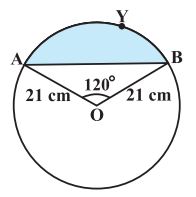
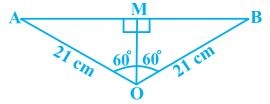
Find the area of the segment AYB shown in Figure, if radius of the circle is 21 cm and \(\angle \mathrm{AOB}=120^{\circ} .\left(\text { Use } \pi=\frac{22}{7}\right)\)
11.
A 1.5 m tall boy is standing at some distance from a 30 m tall building. The angle of elevation from his eyes to the top of the building increases from 30\(\unicode{xb0} \) to 60\(\unicode{xb0} \) as he walks towards the building. Find the distance he walked towards the building.
12.
The tangent at any point of a circle is perpendicular to the radius through the point of contact.
13.
Prove that \(\frac{\cot A-\cos A}{\cot A+\cos A}=\frac{\operatorname{cosec} A-1}{\operatorname{cosec} A+1}\)
14.
If two towers of heights x m and y m subtend angles of \(30°\& 60°\) respectively at the centre of a line joining their feet, then find the ratio of x : y.
15.
How many tangents can a circle have?
16.
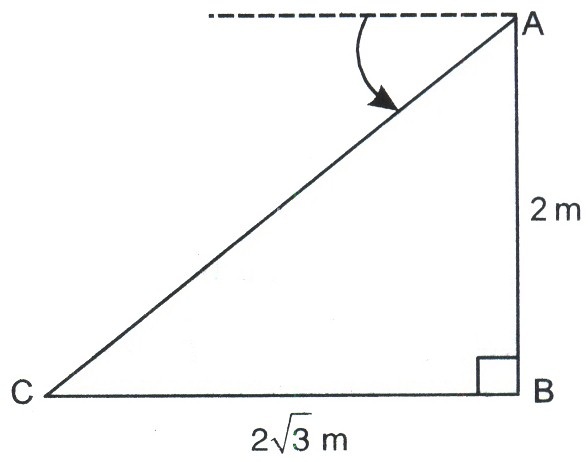
The figure shows the observation of point C from point A. Find the angle of depression from point A.
17.
To warn ships for underwater rocks, a lighthouse spreads a red coloured light over a sector of angle \(80^o\) to a distance of 16.5 km. Find the area of the sea over which the ships are warned. \((Use\ \ \pi = 3.14)\)
18.
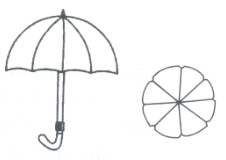
An umbrella has 8 ribs which are equally spaced (see the figure). Assuming umbrella to be a flat circle of radius 45 cm, find the area between the two consecutive ribs of the umbrella.
19.
Which of the following is defined?
cot 0°
cosec 90°
tan 90°
sec 90°
20.
The area swept by the minute hand of a circular clock in 5 minutes forms a
Circle
Segment
Cone
Sector
21.
An electrician has to repair an electric fault on a pole of height 4 m. He needs to reach a point 1.3 m below the top of the pole to undertake the repair work. The length of the ladder he should use which when inclined at an angle of 60° to the horizontal would enable him to reach the required position is:
\(\frac { 9\sqrt { 3 } }{ 5 } \)m
\(\frac { 5 }{ 9 } \)m
\(\frac { \sqrt { 3 } }{ 5 } \)m
\(\frac { 9 }{ 5 } \)m
22.
A circle can pass through
3 non- collinear points
3 collinear points
4 collinear points
2 collinear points
23.
Director of a company select a round glass trophy for awarding their employees on annual function. Design of each trophy is made as shown in the figure, where its base ABCD is golden plated from the front side at the rate of Rs 6 per cm2
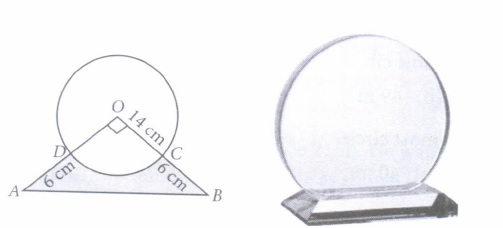
(i) Find the area of sector ODCO.
| (a) 154 cm2 | (b) 155 cm2 | (c) 156 cm2 | (d) 157cm2 |
(ii) Find the area of \(\Delta\)AOB=
| (a) 150 cm2 | (b) 200 cm2 | (c) 250 cm2 | (d) 300 cm2 |
(iii) Find the total cost of golden plating.
| (a) Rs 276 | (b) Rs 280 | (c) Rs 284 | (d) Rs 200 |
(iv) Find the area of major sector formed in the given figure.
| (a) 400 cm2 | (b) 450 cm2 | (c) 462 cm2 | (d) 472 cm2 |
(v) Find the length of arc DC.
| (a) 16 cm | (b) 18 cm | (c) 20 cm | (d) 22 cm |
24.
Smita always finds it confusing with the concepts of tangent and secant of a circle. But this time she has determined herself to get concepts easier. So, she started listing down the differences between tangent and secant of a circle along with their relation. Here, some points in question form are listed by Smita in her notes. Try answering them to clear your concepts also.

(i) A line that intersects a circle exactly at two points is called
| (a) Secant | (b) Tangent | (c) Chord | (d) Both (a) and (b) |
(ii) Number of tangents that can be drawn on a circle is
| (a) 1 | (b) 0 | (c) 2 | (d) Infinite |
(iii) Number of tangents that can be drawn to a circle from a point not on it, is
| (a) 1 | (b) 2 | (c) 0 | (d) Infinite |
(iv) Number of secants that can be drawn to a circle from a point on it is
| (a) Infinite | (b) 1 | (c) 2 | (d) 0 |
(v) A line that touches a circle at only one point is called
| (a) Secant | (b) Chord | (c) Tangent | (d) Diameter |
25.
Two hoardings are put on two poles of equal heights standing on either side of the road. From a point between them on the road the angle of elevation of the top of poles are 60° and 30° respectively. Height of the each pole is 20 m.
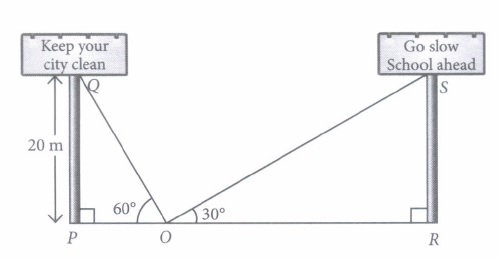
Based on the above information, answer the following questions. (Take \(\sqrt{3}\) = 1.73).
(i) Find the length of PO.
| (a) 20 m | \((b) 20 \sqrt{3} \mathrm{~m}\) | \((c) \frac{20}{\sqrt{3}} \mathrm{~m}\) | (d) None of these |
(ii) Find the length of RO.
| (a) 20 m | \((b) 20 \sqrt{3} \mathrm{~m}\) | \((c) \frac{20}{\sqrt{3}} \mathrm{~m}\) | (d) None of these |
(iii) The width of the road is
| (a) 31.23m | (b) 35.68 m | (c) 39.73 m | (d) 46.24 m |
(iv) If the angle of elevation made by pole PQ is 45°, then the length of PO =
| (a) 20 m | \((b) 20 \sqrt{3} \mathrm{~m}\) | \((c) \frac{20}{\sqrt{3}} \mathrm{~m}\) | (d) None of these |
(v) Angle formed by the line of sight with the horizontal when the point being viewed is above the horizontal level is known as
| (a) angle of depression | (b) angle of elevation | (c) right Angle | (d) reflex angle |
26.
Two aeroplanes leave an airport, one after the other. After moving on runway, one flies due North and other flies due South. The speed of two aeroplanes is 400 km/hr and 500 km/hr respectively. Considering PQ as runway and A and B are any two points in the path followed by two planes, then answer the following questions.
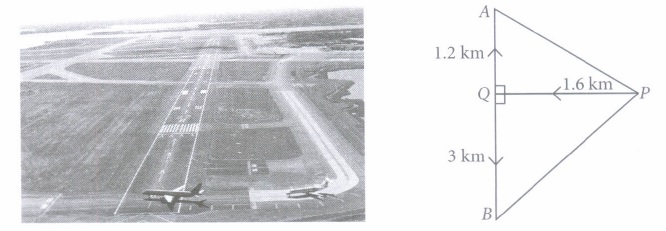
(i) Find \(\tan \theta ; \text { if } \angle A P Q=\theta\)
| \((a) \frac{1}{2}\) | \((b) \frac{1}{\sqrt{2}}\) | \((c) \frac{\sqrt{3}}{2}\) | \((d) \frac{3}{4}\) |
(ii) Find cot B
| \((a) \frac{3}{4}\) | \((b) \frac{15}{4}\) | \((c) \frac{3}{8}\) | \((d) \frac{15}{8}\) |
(iii) Find tanA.
| \((a) 2\) | \((b) \sqrt{2}\) | \((c) \frac{4}{3}\) | \((d) \frac{2}{\sqrt{3}}\) |
(iv) Find secA.
| \((a) 1\) | \((b) \frac{2}{3}\) | \((c) \frac{4}{3}\) | \((d) \frac{5}{3}\) |
(v) Find cosecB.
| \((a) \frac{17}{8}\) | \((b) \frac{12}{5}\) | \((c) \frac{5}{12}\) | \((d) \frac{8}{17}\) |
1.
sin 60° cos 30° + sin 30° cos 60°
\(=\frac{\sqrt{3}}{2} \times \frac{\sqrt{3}}{2}+\frac{1}{2} \times \frac{1}{2}\)
\(\left[\because \sin 60^{\circ}=\cos 30^{\circ}=\frac{\sqrt{3}}{2} \text { and } \sin 30^{\circ}=\cos 60^{\circ}=\frac{1}{2}\right]\)
\(=\frac{3}{4}+\frac{1}{4}=\frac{3+1}{4}=\frac{4}{4}=1\)
2.
To find the length of the side BC, we will choose the trigonometric ratio involving BC and the given side AB. Since BC is the side adjacent to angle C and AB is the side opposite to angle C, therefore
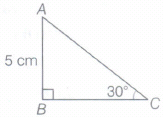
\(\begin{aligned} & \frac{\mathrm{AB}}{\mathrm{BC}}=\tan \mathrm{C} \\ \end{aligned}\)
i.e., \(\begin{aligned} & \frac{5}{\mathrm{BC}}=\tan 30^{\circ}=\frac{1}{\sqrt{3}} \\ \end{aligned}\)
which gives \(\begin{aligned} & \mathrm{BC}=5 \sqrt{3} \mathrm{~cm} \end{aligned}\)
To find the length of the side AC, we consider
\(\begin{aligned} \sin 30^{\circ} & =\frac{\mathrm{AB}}{\mathrm{AC}} \\ \end{aligned}\)
i.e., \(\begin{aligned} \frac{1}{2} & =\frac{5}{\mathrm{AC}} \\ \end{aligned}\)
i.e., AC = 10 cm
Note that alternatively we could have used Pythagoras theorem to determine the third side in the example above,
i.e., \(\mathrm{AC}=\sqrt{\mathrm{AB}^2+\mathrm{BC}^2}=\sqrt{5^2+(5 \sqrt{3})^2} \mathrm{~cm}=10 \mathrm{~cm} .\)
3.
1268 m
4.
Let aeroplane be at B and let the two ships at C and D, such that their angles of depression from B are \(30°\)and\(60°\), respectively.Then, angles of elevation of D and C from B are \(30°\)and \(60°\)respectively.
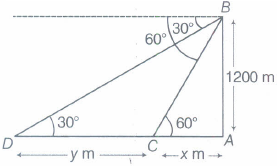
We have, AB=1200 m
Here, one side AB is common in both triangles.
Let AC=x m and CD= y m
In \(\Delta BAC\) , we have
\(tan\quad 60°=\frac { A }{ B } \Rightarrow \sqrt { 3 } =\frac { 1200 }{ x } \)
⇒ \(x=\frac { 1200 }{ \sqrt { 3 } } \times \frac { \sqrt { 3 } }{ \sqrt { 3 } } =\frac { 1200\sqrt { 3 } }{ 3 } =400\sqrt { 3 } \) ....(i)
In \(\Delta BAD\) , We have
\(tan\quad 30°=\frac { AB }{ AD }=\frac { AB }{ DC+CA }\) [∵ AD=DC+CA]
On putting the value of x from Eq.(i) in Eq. (ii) we get
\(y=1200\sqrt { 3 } -400\sqrt { 3 } \)
⇒ y = 1800\(\sqrt { 3 } \)
⇒ y = 800 x 1.732 \(\left[ \because \sqrt { 3 } =1.732 \right] \)
\(\Rightarrow y=1385.6m\)
Hence, the distance between both ships is 1385. 6m.
5.
We are given two concentric circles C1 and C2 with centre O and a chord AB of the larger circle C1 which touches the smaller circle C2 at the point P (see Fig). We need to prove that AP = BP.
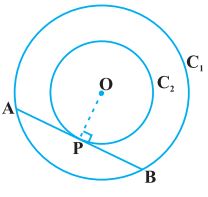
Let us join OP. Then, AB is a tangent to C2 at P and OP is its radius. Therefore, by Theorem.
OP \(\perp\) AB
Now AB is a chord of the circle C1 and OP \(\perp\) AB. Therefore, OP is the bisector of the chord AB, as the perpendicular from the centre bisects the chord,
i.e., AP = BP
6.
Given, diameter of circle, d = 35 mm
\(\therefore\) Circumference of circle = \(\pi\)d [\(\because\) d = 2r]
\(=\frac{22}{7} \times 35=110 \mathrm{~mm}^2\)
Now, length of 5 diameters = 5 \(\times\) 35 = 175 mm
(i) Total length of the silver wire = \(\pi\)d + 5d
= 110 + 175 = 285 mm2
(ii) Here, we see that total circle is divided into 10 sectors.
\(\therefore\) Angle of each sector = \(\frac{360^{\circ}}{10}=36^{\circ}\)
Then, area of each sector ofthe brooch = \(=\frac{\theta}{360^{\circ}} \times \pi r^2\)
\(\begin{aligned} & =\frac{36^{\circ}}{360^{\circ}} \times \frac{22}{7}\left(\frac{35}{2}\right)^2 \quad\left[\because r=\frac{d}{2}=\frac{35}{2} \mathrm{~mm}\right] \\ \end{aligned}\)
\(\begin{aligned} & =\frac{1}{10} \times \frac{22}{1} \times \frac{5}{2} \times \frac{35}{2}=\frac{11 \times 35}{2 \times 2}=\frac{385}{4} \mathrm{~mm}^2 \end{aligned}\)
7.
Let AB be the tangent drawn at a point C on the circle with centre O.
To prove Perpendicular at point C passes through the centre O. If possible, let the perpendicular passing through some other point say O'.
Construction Join OC and O' C.
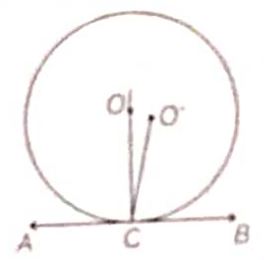
Proof Since, tangent at any point of a circle is perpendicular to the radius through the point of contact.
\(\therefore\) OC \(\perp\) AB \(\Rightarrow\) \(\angle\)OCB = 90o
Also, \(\angle\)O'CB = 90o [as it is supposed that CO' \(\perp\)AB]
\(\therefore\) \(\angle\)OCB = \(\angle\)O' CB
which is possible only when points O and O' coincide.
So, our assumption is wrong.
Hence, the perpendicular at the point of contact to the tangent to a circle always passes through the centre.
Hence proved.
8.
We are given a circle with centre O, an external point T and two tangents TP and TQ to the circle, where P, Q are the points of contact Fig. We need to prove that
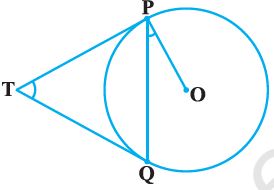
\(\angle \mathrm{PTQ}=2 \angle \mathrm{OPQ}\)
Let \(\angle \mathrm{PTQ}=\theta\)
Now, TP = TQ. So, TPQ is an isosceles triangle.
Therefore, \(\angle \mathrm{TPQ}=\angle \mathrm{TQP}=\frac{1}{2}\left(180^{\circ}-\theta\right)=90^{\circ}-\frac{1}{2} \theta\)
Also, \(\angle \mathrm{OPT}=90^{\circ}\)
So, \(\angle \mathrm{OPQ}=\angle \mathrm{OPT}-\angle \mathrm{TPQ}=90^{\circ}-\left(90^{\circ}-\frac{1}{2} \theta\right)\)
\(=\frac{1}{2} \theta=\frac{1}{2} \angle \mathrm{PTQ}\)
This gives \(\angle \mathrm{PTQ}=2 \angle \mathrm{OPQ}\)
9.
LHS = \(\frac { \cos { A } -\sin { A } +1 }{ \cos { A } +\sin { A } -1 } \)
On dividing numerator and denominator by sin A, we get
\(=\frac { \frac { \cos { A } }{ \sin { A } } -\frac { \sin { A } }{ \sin { A } } +\frac { 1 }{ \sin { A } } }{ \frac { \cos { A } }{ \sin { A } } +\frac { \sin { A } }{ \sin { A } } -\frac { 1 }{ \sin { A } } } =\frac { \cot { A } -1+cosecA }{ \cot { A } +1-1cosecA } \) \(\left[ \because \cot { A } =\frac { \cos { \theta } }{ \sin { \theta } } and\frac { 1 }{ \sin { \theta } } =cosec \theta \right] \)
\(=\frac { \cot { A } +cosecA-1 }{ \cot { A } +1-1cosecA } \)
\(=\frac { (\cot { A } +cosecA)-({ cosec }^{ 2 }A-\cot ^{ 2 }{ A } ) }{ \cot { A } +1-1cosecA } \left[ \because 1={ cosec }^{ 2 }A-\cot ^{ 2 }{ A } \right] \)
\(=\frac { (\cot { A } +cosecA)-\left[ (\cot { A } +cosecA)(\cot { A } -cosecA) \right] }{ \cot { A } +1-1cosecA } \) \(\left[ \because \quad { a }^{ 2 }-{ b }^{ 2 }=(a+b)(a-b) \right] \)
\(=\frac { (\cot { A } +cosecA)-\left[ 1-(cosecA-\cot { A } ) \right] }{ \cot { A } +1-1cosecA } \)
\(\quad =\frac { (\cot { A } +cosecA)-\left[ 1-cosecA+\cot { A } \right] }{ \cot { A } +1-1cosecA } \)
\(=cosecA+\cot { A } =RHS\)
Hence proved.
10.
Now, area of the sector OAYB = \(=\frac{120}{360} \times \frac{22}{7} \times 21 \times 21 \mathrm{~cm}^2=462 \mathrm{~cm}^2\) (2)
For finding the area of \(\Delta\)OAB, draw OM \(\perp\) AB as shown in Figure.
Note that OA = OB. Therefore, by RHS congruence, \(\Delta\)AMO \(\cong\) BMO.
So, M is the mid-point of AB and \(\angle\)AOM = \(\angle\)BOM = \(\frac{1}{2} \times 120^{\circ}=60^{\circ}\)
Let OM = x cm
So, from \(\Delta\)OMA, \(\frac{\mathrm{OM}}{\mathrm{OA}}=\cos 60^{\circ}\)
or, \(\begin{aligned} \frac{x}{21} & =\frac{1}{2} \quad\left(\cos 60^{\circ}=\frac{1}{2}\right) \\ \end{aligned}\)
or, \(\begin{aligned} x & =\frac{21}{2} \\ \end{aligned}\)
So, \(\begin{aligned} \mathrm{OM} & =\frac{21}{2} \mathrm{~cm} \\ \end{aligned}\)
Also,\(\begin{aligned} \frac{\mathrm{AM}}{\mathrm{OA}} & =\sin 60^{\circ}=\frac{\sqrt{3}}{2} \\ \end{aligned}\)
So, \(\begin{aligned} \mathrm{AM} & =\frac{21 \sqrt{3}}{2} \mathrm{~cm} \end{aligned}\)
Therefore, \(\mathrm{AB}=2 \mathrm{AM}=\frac{2 \times 21 \sqrt{3}}{2} \mathrm{~cm}=21 \sqrt{3} \mathrm{~cm}\)
So, area of \(\begin{aligned} \Delta \mathrm{OAB} & =\frac{1}{2} \mathrm{AB} \times \mathrm{OM}=\frac{1}{2} \times 21 \sqrt{3} \times \frac{21}{2} \mathrm{~cm}^2 \\ \end{aligned}\)
\(\begin{aligned} =\frac{441}{4} \sqrt{3} \mathrm{~cm}^2 \end{aligned}\) (3)
Therefore, are of the segment \(\mathrm{AYB}=\left(462-\frac{441}{4} \sqrt{3}\right) \mathrm{cm}^2\) [From (1), (2) and (3)]
\(=\frac{21}{4}(88-21 \sqrt{3}) \mathrm{cm}^2\)
11.
Let AB = 30 m be the height of the building and DC = 1.5 m be the height of the boy. The point D be the boy's eye.
Draw the line DF || CA.
Then, CD = AF = 1.5 m
The angle of elevation is \(\angle\)BDF = 30°.
Let he walked DE = xm towards the building. Then, the angle of elevation is \(\angle\)BEF = 60°.
Let EF = y m
Now, BF = AB - AF = 30 - 1.5 = 28.5 m.

In right angled \(\Delta\)BFD,
\(\begin{aligned} & \tan 30^{\circ}=\frac{P}{B}=\frac{B F}{D F}=\frac{B F}{D E+E F} \quad[\because D F=D E+E F] \\ \end{aligned}\)
\(\begin{aligned} & \Rightarrow \quad \frac{1}{\sqrt{3}}=\frac{28.5}{x+y} \quad\left[\because \tan 30^{\circ}=\frac{1}{\sqrt{3}}\right] \\ \end{aligned}\)
\(\begin{aligned} \Rightarrow \quad x+y=28.5 \sqrt{3} \mathrm{~m} \\ \end{aligned}\) ...(i)
and in right angled \(\Delta\)BFE,
\(\begin{aligned} \tan 60^{\circ} & =\frac{B F}{E F} \end{aligned}\)
\(\begin{aligned} \Rightarrow \quad \sqrt{3} & =\frac{28.5}{y} \quad\left[\because \tan 60^{\circ}=\sqrt{3}\right] \\ \end{aligned}\)
\(\begin{aligned} \Rightarrow \quad y & =\frac{28.5}{\sqrt{3}} \mathrm{~m} \end{aligned}\)
On putting \(y=\frac{28.5}{\sqrt{3}} \text { in Eq. (i), we get } x+\frac{28.5}{\sqrt{3}}=28.5 \sqrt{3}\)
\(\begin{aligned} \Rightarrow \quad x & =28.5\left(\sqrt{3}-\frac{1}{\sqrt{3}}\right)=28.5\left(\frac{3-1}{\sqrt{3}}\right) \\ \end{aligned}\)
\(\begin{aligned} & =\frac{28.5 \times 2}{\sqrt{3}} \times \frac{\sqrt{3}}{\sqrt{3}} \end{aligned}\) [rationalising]
\(\begin{aligned} =\frac{57 \sqrt{3}}{3}=19 \sqrt{3} \mathrm{~m} \end{aligned}\)
Hence, the distance he walked towards the building, is 19\(\sqrt3\)m.
12.
We are given a circle with centre O and a tangent XY to the circle at a point P. We need to prove that OP is perpendicular to XY.
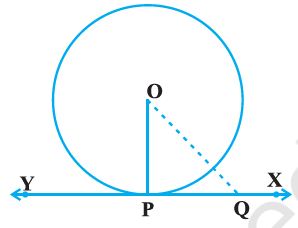
Take a point Q on XY other than P and join OQ see Fig.The point Q must lie outside the circle. (Why? Note that if Q lies inside the circle, XY will become a secant and not a tangent to the circle). Therefore, OQ is longer than the radius OP of the circle. That is, OQ > OP.
Since this happens for every point on the line XY except the point P, OP is the shortest of all the distances of the point O to the points of XY. So OP is perpendicular to XY.
13.
\(L H S=\frac{\cot A-\cos A}{\cot A+\cos A}=\frac{\frac{\cos A}{\sin A}-\cos A}{\frac{\cos A}{\sin A}+\cos A}\)
\(=\frac{\cos A\left(\frac{1}{\sin A}-1\right)}{\cos A\left(\frac{1}{\sin A}+1\right)}=\frac{\left(\frac{1}{\sin A}-1\right)}{\left(\frac{1}{\sin A}+1\right)}=\frac{\operatorname{cosec} A-1}{\operatorname{cosec} A+1}=\operatorname{RHS}\)
14.
Let AB be the tower of height x m, and CD be the tower of height y m.
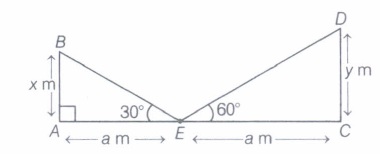
Let E be the mid-point of the line AC.
Then ∠AEB = 30° and ∠CED = 60°.
Also, AE = EC = a m (let)
In fight angled ΔBAE tan 30° \(=\frac{P}{B}=\frac{A B}{A E}=\frac{x}{a}\)
and in right angled ΔDCE, tan 60° \(=\frac{D C}{C E}=\frac{y}{a}\)
1 : 3
15.
From every point of a circle, we can draw a tengent. Therefore, infinite tangents can be drawn.
16.
In art. \(\triangle\)ABC, \(\angle\)B = 90°
\(\therefore\) AB = 2 m, BC = \(2\sqrt{3}\)m
Let \(\angle\)ACB = \(\theta\)
\(\therefore\) tan \(\theta={{AB}\over{BC}}={{2}\over{2\sqrt{3}}}\)
tan \(\theta ={{1}\over{\sqrt{3}}}\Rightarrow{\theta}=30°\)
17.
Given, sector angle, \(\theta\)= 80°
and distance or radius, r = 16.5 km
\(\begin{aligned} \therefore \text { Area of sector } & =\frac{\theta}{360^{\circ}} \times \pi r^2=\frac{80^{\circ}}{360^{\circ}} \times 3.14 \times(16.5)^2 \\ \end{aligned}\)
\(\begin{aligned} =\frac{2 \times 3.14 \times 272.25}{9} \end{aligned}\)
\(\begin{aligned} =\frac{1709.73}{9} \end{aligned}\)
= 189.97 km2
which is the required area of the sea over which the ships are warned.
18.
Given, umbrella to be a flat circle. So, the central angle of an umbrella is 360°.
Since, umbrella has 8 ribs.
\(\therefore\) Angle between two ribs.
\(=\frac{360^{\circ}}{8}=45^{\circ}\)
Area between two ribs = Area of one sector of the umbrella
\(=\frac{\theta}{360^{\circ}} \times \pi r^2=\frac{45^{\circ}}{360^{\circ}} \times \frac{22}{7} \times(45)^2[\because r=45, \text { given }]\)
\(\begin{aligned} & =\frac{22}{7 \times 8}(45)^2 \\ \end{aligned}\)
\(\begin{aligned} & =\frac{22275}{28} \mathrm{~cm}^2 \end{aligned}\)
19.
(b)
cosec 90°
20.
(d)
Sector
21.
(a)
\(\frac { 9\sqrt { 3 } }{ 5 } \)m
22.
(a)
3 non- collinear points
23.
(i) (a): Area of sector ODCO \(=\frac{1}{4} \pi r^{2}\)
\(=\frac{1}{4} \times \frac{22}{7} \times 14 \times 14=154 \mathrm{~cm}^{2}\)
(ii) (b): Area of \(\triangle A O B=\frac{1}{2} \times O A \times O B=\frac{1}{2}(20 \times 20)\)
= 200 cm2
(iii) (a) : Area of region which is golden plated
= area of \(\Delta\)OAB - area of sector ODCO.
= 200 - 154 = 46 cm2
\(\therefore\) Total cost of golden plating = Rs (6 x 46) = Rs 276
(iv) (c): Area of major sector = area of circle - area of minor sector
\(=\pi r^{2}-\frac{1}{4} \pi r^{2}=\frac{3 \pi r^{2}}{4}=\frac{3}{4} \times \frac{22}{7} \times 14 \times 14=462 \mathrm{~cm}^{2}\)
(v) (d): Length of arc DC \(=\frac{90^{\circ}}{360^{\circ}} \times 2 \times \frac{22}{7} \times 14\)
= 22cm
24.
(i) (a)
(ii) (d)
(iii) (b)
(iv) (a)
(v) (c)
25.
(i) (c): \(\text { In } \Delta O P Q\), we have
\(\tan 60^{\circ}=\frac{P Q}{P O} \)
\(\Rightarrow \sqrt{3}=\frac{20}{P O} \)
\(\Rightarrow P O=\frac{20}{\sqrt{3}} \mathrm{~m}\)
(ii) (b): In \(\Delta\)ORS, we have
\(\tan 30^{\circ}=\frac{R S}{O R} \Rightarrow \frac{1}{\sqrt{3}}=\frac{20}{O R} \Rightarrow O R=20 \sqrt{3} \mathrm{~m}\)
(iii) (d): Clearly, width of the road = PR
\(\begin{array}{l}
=P O+O R=\left(\frac{20}{\sqrt{3}}+20 \sqrt{3}\right) \mathrm{m} \\
=20\left(\frac{4}{\sqrt{3}}\right) \mathrm{m}=\frac{80}{\sqrt{3}} \mathrm{~m}=46.24 \mathrm{~m}
\end{array}\)
(iv) (a): \(\text { In } \Delta O P Q \text { , if } \angle P O Q=45^{\circ} \text { , then }\)
\(\tan 45^{\circ}=\frac{P Q}{P O} \Rightarrow 1=\frac{20}{P O} \Rightarrow P O=20 \mathrm{~m}\)
(v) (b)
26.
(i) (d) : \(\text { In } \Delta A P Q, \tan \theta=\frac{A Q}{P Q}=\frac{1.2}{1.6}=\frac{3}{4}\)
(ii) (d) : \(\text { In } \Delta P B Q, \cot B=\frac{Q B}{P Q}=\frac{3}{1.6}=\frac{15}{8}\) ...(i)
(iii) (c): \(\text { In } \Delta A P Q, \tan A=\frac{P Q}{A Q}=\frac{1.6}{1.2}=\frac{4}{3}\) ...(ii)
(iv) (d): We have, tan2A + 1 = sec2A
\(\Rightarrow \sec A =\sqrt{\left(\frac{4}{3}\right)^{2}+1}
\)
\(=\sqrt{\frac{16}{9}+1}=\sqrt{\frac{25}{9}}=\frac{5}{3}\)
(v) (a): Since \(\operatorname{cosec} B=\sqrt{\cot ^{2} B+1}\)
\(\begin{array}{l}
=\sqrt{\left(\frac{15}{8}\right)^{2}+1} \\
=\frac{17}{8}
\end{array}\)

10th Standard CBSE Syllabus & Materials
10th Standard CBSE
CBSE 10th Social Science PS - Federalism - New Model Questions Papers Study Material - QB365 Set A
NEW10th Standard CBSE
CBSE 10th Social Science PS - Power Sharing - New Model Questions Papers Study Material - QB365 Set A
NEW10th Standard CBSE
CBSE 10th Social Science GEO - Manufacturing Industries - New Model Questions Papers Study Material - QB365 Set A
NEW10th Standard CBSE
CBSE 10th Social Science GEO - Minerals and Energy Resources - New Model Questions Papers Study Material - QB365 Set A



NCERT Books

Syllabus

Exam Pattern

Sample Question Papers

Previous year Question Papers

Important Notes

MCQ Practice test

NCERT Exemplers

Case study Questions

Image Based Questions

Passage based Questions

HOT Questions

Value Based Questions

Model Questions Papers
NCERT ( Book Back ) Questions

Assertion and Reason
Important Questions And Answers

CBSE 10th Standard CBSE Subjects
CBSE Standards



