
 100% FREE ACCESS
10th Standard CBSE Syllabus & Materials
10th Standard CBSE
CBSE 10th Social Science ECO - Globalisation and the Indian Economy - New Model Questions Papers Study Material - QB365 Set A
NEW10th Standard CBSE
CBSE 10th Social Science ECO - Money and Credit - New Model Questions Papers Study Material - QB365 Set A
NEW10th Standard CBSE
CBSE 10th Social Science ECO - Sectors of the Indian Economy - New Model Questions Papers Study Material - QB365 Set A
NEW10th Standard CBSE
CBSE 10th Social Science ECO - Development - New Model Questions Papers Study Material - QB365 Set A
NEW10th Standard CBSE
CBSE 10th Social Science PS - Outcomes of Democracy - New Model Questions Papers Study Material - QB365 Set A
NEW10th Standard CBSE
CBSE 10th Social Science PS - Gender, Religion and Caste - New Model Questions Papers Study Material - QB365 Set A

Published on: 22/10/2025
Download CBSE Class 10th Standard CBSE Maths question papers, sample papers, important questions, and previous year solved papers in PDF format. Get free study materials, NCERT solutions, and exam preparation resources for Class 10th Standard CBSE Maths
Questions + Answers key
Take MCQ Maths Test
1.
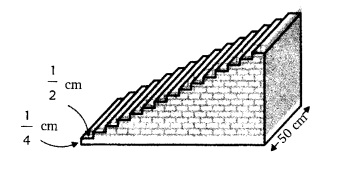
A small terrace at a football ground comprises of 15 steps each of which is 50 m long and built of solid concrete.
Each step has a rise of \(\frac{1}{4}\) m and a tread of \(\frac{1}{2}\) m. (see Fig) Calculate the total volume of concrete required to build the terrace. [Hint : Volume of concrete required to build the first step \(\left.=\frac{1}{4} \times \frac{1}{2} \times 50 \mathrm{~m}^{3}\right]\)
2.
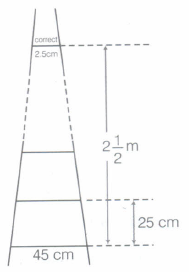
A ladder has rungs 25 cm apart. The rungs decrease uniformly in length from 45 cm at the bottom to 25 cm at the top. If the top and the bottom rungs are 2\(\frac{1}{2}\)m apart, then what is the length of the wood required for the rungs? [Number of rungs \(\left.=\frac{250}{25}+1\right]\)
3.
In an AP of 50 terms, the sum of first 10 terms is 210 and the sum of its last 15 terms is 2565. Find the AP.
4.
The ratio of the 11th term to the 18th term of an AP is 2 : 3. Find the ratio of the 5th term to the 21st term, and also the ratio of the sum of the first five terms to the sum of the first five terms to the sum of the first 21 terms.
5.
How many multiples of 4 lie between 10 and 250? Also find their sum.
1.
Clearly, volume of concrete required to build the I step, II step, III step,.. are respectively,
\(\begin{aligned} \frac{1}{4} \times \frac{1}{2} \times 50, \\ \end{aligned}\)
\(\begin{aligned} & \left(2 \times \frac{1}{4}\right) \times \frac{1}{2} \times 50,\left(3 \times \frac{1}{4}\right) \times \frac{1}{2} \times 50, \ldots, \\ \end{aligned}\)
\(\begin{aligned} \text { i.e. } \quad \frac{50}{8}, 2 \times \frac{50}{8}, 3 \times \frac{50}{8}, \ldots \end{aligned}\)
Now, total volume of concrete,
\(V=\frac{50}{8}+2 \times \frac{50}{8}+3 \times \frac{50}{8}+\ldots=\frac{50}{8}[1+2+3+\ldots]\)
Note that the numbers in the bracket forms an AP with first term (a) = 1, common difference(d) = 2-1=1 and number of terms(n) =15
\(\begin{aligned} \therefore V & =\frac{50}{8} \times \frac{15}{2}[2 \times 1+(15-1) \times 1] \\ \end{aligned}\)
\(\begin{aligned} & {\left[\because S_n=\frac{n}{2}\{2 a+(n-1) d\}\right] } \\ \end{aligned}\)
\(\begin{aligned} =\frac{50}{8} \times \frac{15}{2} \times(2+14)=\frac{25 \times 15}{8} \times 16=750 \mathrm{~m}^3 \end{aligned}\)
Hence, the total volume of concrete required to build the terrace is 750 m3.
2.
According to the question,
Number of rungs = \(=\frac{\text { Distance between top and bottom rungs }}{\text { Distance between two rungs }}+1\)
\(\begin{aligned} & =\frac{2 \frac{1}{2} \mathrm{~m}}{25 \mathrm{~cm}}+1=\frac{\frac{5}{2} \times 100 \mathrm{~cm}}{25 \mathrm{~cm}}+1 \quad[\because 1 \mathrm{~m}=100 \mathrm{~cm}] \\ \end{aligned}\)
\(\begin{aligned} =\frac{250 \mathrm{~cm}}{25 \mathrm{~cm}}+1=10+1=11 \end{aligned}\)
Hence, there are 11 rungs.
The length of the wood required for the rungs = Sum of length of 11 rungs
\(=\frac{11}{2}(25+45)\)
\(\begin{array}{r} {\left[\begin{array}{r} \because \text { length of rungs forms an AP with first term } \\ (a)=25 \text { and last term }(l)=45 \text { and } S_n=\frac{n}{2}(a+l) \end{array}\right]} \\ \end{array}\)
\(\begin{array}{r} =\frac{11}{2} \times 70=11 \times 35=385 \mathrm{~cm} \end{array}\)
Hence, the length of the wood required for the rungs is 385 cm.
3.
Let a be the first term and d be the common difference of the given AP.
\(\therefore\) According to question,
a1 + a2 + ... + a10 = 210
and a36 + a37 + .... + a50 = 2565
Consider, a1 + a2 + ... + a10 = 210
\(\Rightarrow\) \({10\over 2}[{a}_{1}+{a}_{10}]=210\)
[ Using Sn = \({n\over 2}(a+l)\)where l is the last term ]
\(\Rightarrow\) 5 [ a + a + 9d ] = 210
\(\Rightarrow\) 2a + 9d = 42 ...(i)
Again consider,
a36 + a37 + ... + a50 = 2565
\(\Rightarrow\) \({15\over2}[{a}_{36}+{a}_{50}]=2565\)
\(\Rightarrow\) a + 35d + a + 49d = 171 x 2
\(\Rightarrow\) 2a + 84d = 171 x 2
\(\Rightarrow\) a + 42d = 171 x 2 ...(ii)
On multiplying eq.(ii) by 2 and then subtracting from (i), we get
2a + 9d = 42
-2a \(\pm\) 84d = 342
-75d = -300 \(\Rightarrow\) d = 4
\(\therefore\) From (ii), a + 42 x 4 = 171
\(\Rightarrow\) a = 171 - 168 = 3
\(\therefore\) a = 3 and d = 4.
Hence, AP is 3, 7, 11, 15, .....
4.
\(\because \) \({{t}_{11} \over{t}_{18}}={2\over3}\Rightarrow{a+10d\over a+17d}={2\over3}\)
\(\Rightarrow\) 3a + 30d = 2a + 34d \(\Rightarrow\) a = 4d
and \({{t}_{5}\over{t}_{21}}={a+4d\over a+20d}={4d+4d \over 4d+20d}\)
\(={8d\over 24d}={1\over 3}\)
\(\Rightarrow\) t5 : t21 = 1 : 3
\(\therefore\) \({{S}_{5}\over{S}_{21}}={{{5}\over{2}}[2a+4d]\over{{21}\over2}[2a+20d]}={5(2a+4d)\over21(2a+20d)}\)
\(={5(8d+4d)\over21[8d+20d]=}{60d\over588d}\)
\(={30\over294}={15\over147}={5\over49}\)
\(\Rightarrow\) S5: S21 = 5:49.
5.
The multiples of 4 between 10 and 250 be 12, 16, 20, ..., 248.
Here, a = 12, d = 16 - 12 = 4 and an = 248.
From formula, an = a + ( n - 1 )d, we get
12 + ( n - 1 )4 = 248
\(\Rightarrow\) 4 ( n - 1) = 248 - 12 \(\Rightarrow\) 4 ( n - 1 ) = 236
\(\Rightarrow\) n - 1 = \({236 \over 4}\) = 59 \(\Rightarrow\) n = 59 + 1 = 60
\(\because\) Sn = \({n\over2}\) ( a + l ) \(\Rightarrow\) S60 = \({60\over2}\) ( 12 + 248 ) = 30 x 260 = 7800

10th Standard CBSE Syllabus & Materials
10th Standard CBSE
CBSE 10th Social Science PS - Federalism - New Model Questions Papers Study Material - QB365 Set A
NEW10th Standard CBSE
CBSE 10th Social Science PS - Power Sharing - New Model Questions Papers Study Material - QB365 Set A
NEW10th Standard CBSE
CBSE 10th Social Science GEO - Manufacturing Industries - New Model Questions Papers Study Material - QB365 Set A
NEW10th Standard CBSE
CBSE 10th Social Science GEO - Minerals and Energy Resources - New Model Questions Papers Study Material - QB365 Set A



NCERT Books

Syllabus

Exam Pattern

Sample Question Papers

Previous year Question Papers

Important Notes

MCQ Practice test

NCERT Exemplers

Case study Questions

Image Based Questions

Passage based Questions

HOT Questions

Value Based Questions

Model Questions Papers
NCERT ( Book Back ) Questions

Assertion and Reason
Important Questions And Answers

CBSE 10th Standard CBSE Subjects
CBSE Standards



