
 100% FREE ACCESS
10th Standard CBSE Syllabus & Materials
10th Standard CBSE
CBSE 10th Social Science ECO - Globalisation and the Indian Economy - New Model Questions Papers Study Material - QB365 Set A
NEW10th Standard CBSE
CBSE 10th Social Science ECO - Money and Credit - New Model Questions Papers Study Material - QB365 Set A
NEW10th Standard CBSE
CBSE 10th Social Science ECO - Sectors of the Indian Economy - New Model Questions Papers Study Material - QB365 Set A
NEW10th Standard CBSE
CBSE 10th Social Science ECO - Development - New Model Questions Papers Study Material - QB365 Set A
NEW10th Standard CBSE
CBSE 10th Social Science PS - Outcomes of Democracy - New Model Questions Papers Study Material - QB365 Set A
NEW10th Standard CBSE
CBSE 10th Social Science PS - Gender, Religion and Caste - New Model Questions Papers Study Material - QB365 Set A

Published on: 22/10/2025
Download CBSE Class 10th Standard CBSE Maths question papers, sample papers, important questions, and previous year solved papers in PDF format. Get free study materials, NCERT solutions, and exam preparation resources for Class 10th Standard CBSE Maths
Questions + Answers key
Take MCQ Maths Test
1.
Which term of the AP : 120, 116, 112, ... is first negative term?
2.
Check that the list of numbers defined by the following term is an AP or not. Also give reason.
tn= 9 - 11n2
3.
If ΔABC and ΔDEF are two triangles such that \(\frac{AB}{DE}=\frac{BC}{EF}=\frac{AC}{DF}=\frac{4}{7}\) . Find \(\frac{area\quad\Delta ABC}{area\quad\Delta DEF}\) .
4.
In an equilateral triangle ABC, AD is drawn perpendicular to BC meeting BC in D. Prove that AD2=3BD2.
5.
ABC is a right triangle right angled at C. Let BC=1, CA=b, AB=c and p be the length of perpendicular from C on AB. Prove that cp=ab.
6.
In the given figure, PQR is a triangle right angled at Q and XY || QR. If PQ=6 cm, PY=4 cm and PX : XQ=1 : 2. Calculate the lengths of PR and QR.
7.
The sides AB and AC and the perimeter P1 of ABC are respectively three times the corresponding sides DE and DF and the perimeter P2 of DEF, Are the two triangles similar? If yes, find \(\frac { ar(\triangle ABC) }{ ar(\triangle DEF) } \)
8.
In the figure, PQ is parallel to MN. If \(\frac { K }{ PM } =\frac { 4 }{ 13 } \) and KN=20.4 cm, then find KQ.
9.
Are two triangle with equal corresponding sides always similar? Two triangles having corresponding sides equal are similar.
10.
Find the HCF of 1,656 and 4,025 by Euclid's division algorithm.
11.
Find the missing numbers a, b, c and d in the given factor tree
12.
Find HCF of the numbers given below: k, u, 3k, 4k and 5k, where k is any positive integer.
13.
What is the HCF of the smallest composite number and the smallest prime number?
14.
Explain why 13233343563715 is a composite number?
15.
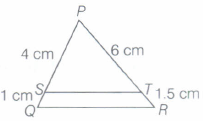
In the given figure, PS, SQ, PT and TR are 4 cm, 1 cm, 6 cm and 1.5 cm respectively.
Prove that \(ST\parallel QR\) . Also, find \(\frac { ar\left( \triangle PST \right) }{ ar\left( trapezium\quad QRTS \right) } \)
16.
A vertical stick 1 m long casts a shadow 80 cm long. At the same time a tower casts a shadow 30 m long. Determine the height of the tower.
17.
If (m)n = 64, where m and n are positive integers, find the value of (n)mn .
18.
Can the number 6n , where n being a natural number, ends with digit 5? Give reason.
19.
Express \(0.5\overline { 4 } \) recurring decimals as fraction in their lowest term.
20.
Which term of the Arithmetic Progression 3, 10, 17,....... will be 84 more than its 13th term?
21.
If the numbers a, b, c, d and e form an AP, then find the value of a - 4b + 6c - 4d + e.
22.
Find the sum of all 2-digit positive numbers divisible by 3.
23.
In an AP, the sum of first n terms is \(\frac{5n^2}{2}+\frac{3n}{2}\). Find its 20th term.
24.
If the sum of the first n term of an AP is 4n - n2, what is the first term (that is S1)? What is the sum of first two terms?What is the second term? Similarly, find the 3rd, the 10th and nth terms.
25.
In an AP, the 24th term is twice the 10th term. Prove that the 36th term is twice the 16th term.
26.
Which term of the AP 21, 18, 15,....., is zero?
27.
Find the 31st term of an AO whose 11th term is 38 and the 16th term is 73.
1.
32nd term
2.
No
3.
\(\frac{AB}{DE}=\frac{BC}{EF}=\frac{AC}{DF}\)
∆ABC∼ΔDEF
⇒ \(\frac{area\Delta ABC}{area\Delta DEF}=\frac{AB^{2}}{DE^{2}}\)
=\(\left(\frac{AB}{DE}\right)^{2}=\left(\frac{4}{7}\right)^{2}=\frac{16}{49}\)
4.
In \(\triangle\)ABC from Pythagoras theorem,
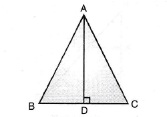
\(\Rightarrow\) AB2 = AD2 + BD2
\(\Rightarrow\) BC2 = AD2 + BD2 (as AB = BC = CA)
\(\Rightarrow\) (2BD)2 = AD2 + BD2, ( \(\bot \)is the median in an equilateral)
\(\therefore\) 3BD2 = AD2.
5.
Let \(CD\bot AB,\)
then CD=p
Area of \(\triangle\)ABC= \(\frac {1}{2}\) x base x height
\(\Rightarrow\)Area of \(\triangle\)ABC=\(\frac {1}{2}\) x AB x CD= cp
Also, Area of \(\triangle\)ABC=\(\frac {1}{2}\) x BC x AC= ab
\(\frac {1}{2}\)cp=\(\frac {1}{2}\)ab
\(\Rightarrow\)cp=ab.
6.
Since, XY || QR
\(\therefore \frac { PX }{ XQ } =\frac { PY }{ YR } \)
\(\Rightarrow \frac { 1 }{ 2 } =\frac { PY }{ PR-PY } \)
\(\Rightarrow\) PR-4=8
\(\Rightarrow\) PR=12 cm
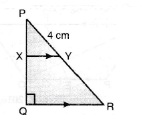
In right \(\triangle\)PQR, QR2=PR2-PQ2
= 122-62
= 144-36=108
QR = 6\(\sqrt3\)cm
7.
In \(\triangle\)ABC and \(\triangle\)DEF,
AB = 3DE and AB = 3DF
\(\Rightarrow \frac { AB }{ DE } =3; \frac { AC }{ DF } =3;\)
P1 = 3P2
BC = 3EF
\(\Rightarrow \frac { AB }{ DE } =\frac { AC }{ DF } =\frac { BC }{ EF } =3\)
\(\triangle\)ABC~\(\triangle\)DEF
\(\Rightarrow\frac { ar(\triangle ABC) }{ ar(\triangle DEF) } ={ \left( \frac { AB }{ DE } \right) }^{ 2 }={ (3) }^{ 2 }=9.\)
8.
PQ || MN
So, \(\frac { KP }{ PM } =\frac { KQ }{ QN } \)
\(\Rightarrow \quad \frac { KP }{ PM } =\frac { KQ }{ KN-KQ } \)
\(\Rightarrow \quad \frac { 4 }{ 13 } =\frac { KQ }{ 20.4-KQ } \)
\(\Rightarrow \) 4 x 20.4-4KQ=13 KQ
\(\Rightarrow \)17 KQ=4 x 20.4
\(\therefore \quad KQ=\frac { 20.4\times 4 }{ 17 } =4.8\quad cm,\)
9.
No, Angle included should be same.
10.
Hence HCF (1,656,4,025)= 23
11.
\(a=\frac { 9,009 }{ 3,003 } =3\)
\(b=\frac { 1,001 }{ 143 } =7\)
Since 143 = 11 x 13, so c=11 or 13
and d=13 or 11.
12.
HCF of K
k.2
k.3
k.22
k.5 is k
13.
The smallest prime number is 2 and the smallest composite number is 22 Hence, required HCF (22,2) = 2.
14.
The given number ends in 5. Hence it is a multiple of 5. Therefore it is a composite number
15.
\(\frac{16}{9}\)
16.
Let h be the height of the tower.
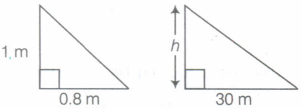
[\(\because\) 80 cm = 0.8 m]
Since, it is clear that both the triangles will be similar.
\(\therefore \frac{1}{0.8}=\frac{h}{30} \quad \Rightarrow h = \frac{30}{0.8}\) = 37.5 m
17.
312
18.
No, because 6n = (2 x 3)n = 2n x 3n
If the number 6n ends with digit 5, then it will be divisible by 5, i.e. its one factor will be 5. But the only primes in the factorisation of 6n are 2 and 3, but not 5.
Hence, it cannot end with digit 5.
19.
Let y = \(0.5\overline { 4 } \) = 0.54444...
On multiplying both sides by 10, we get
10 y = 5.4444 ....(i)
On multiplying Eq.(i) by 10, we get
100 y = 54.4444 ....(ii)
On subtracting Eq.(i) from Eq.(ii), we get
90 y = 49 \(\Rightarrow \quad y=\frac { 49 }{ 90 } \)
20.
Here, a = 3 and d = 10 - 3 = 7
a13 = a + 12d
= 3 + 12 X 7 = 87
Let an is84 more than 13th terms.
an = a13 + 84
\(\Rightarrow\) a + ( n - 1 )d = 87 + 84
\(\Rightarrow\) 3 + ( n - 1 )7 = 171
\(\Rightarrow\) 3 + 7n - 7 = 171
\(\Rightarrow\) 7n = 175
\(\Rightarrow\) n = 25
\(\therefore\) 25th term is 84 more than 13th term.
21.
Let the 1st term of the AP = a and common difference = d
Then \(S_{ 6 }\frac { 6 }{ 2 } \left\{ 2a+(6-1d) \right\} \)
\(\Rightarrow 42=3(2a+5d)\)
\(\Rightarrow 2a+5d=14\) ...(i)
Also, \(\frac { a_{ 10 } }{ a_{ 30 } } =\frac { 1 }{ 3 } \)
\(\Rightarrow \frac { a+9d }{ a+29d } =\frac { 1 }{ 3 } \)
\(\Rightarrow \) 3a+27d=a+29d
\(\Rightarrow \) 2a=2d \(\Rightarrow \) a=d
Substituting the value of d in equation (i)
we get
2a+5a=14 \(\Rightarrow \) a=2
\(\therefore \) d=2
Now a13 = a+12d
\(\Rightarrow \) a13 =2+12x2=26
\(\therefore \) 1st term =2
Thirteenth term =26
22.
Two-digit positive numbers divisible by
3 are 12, 15, 18, ..., 99
These numbers are in A.P. with a - 12,
d = 15 - 12 = 3 and an = 99
\(\therefore\) a + ( n - 1 )d = 99
\(\Rightarrow\) 12 + ( n - 1 )3 = 99
\(\Rightarrow\) ( n - 1 )3 = 87
\(\Rightarrow\) n - 1 = 29 \(\Rightarrow\) n = 30
Now Sn = \(\frac{n}{2}(a+l)\)
\(\Rightarrow\) S30 = \(\frac{30}{2}(12+99)=1665
\)
23.
Sn = \(\frac{5{n}^{2}}{2}+\frac{3n}{2}\)
\(\Rightarrow\) S1 = \(\frac{5\times{1}^{2}}{2}+\frac{3\times1}{2}=4={a}_{1}\)
S2 = \(\frac{5\times{2}^{2}}{2}+\frac{3\times2}{2}=13\)
\(\Rightarrow\) a1 + a2 = 13 \(\Rightarrow\) 4 + a2 = 13 [Using eq.(i)]
\(\Rightarrow\) a2 = 9
d = a2 - a1 = 9 - 4 = 5
Now, a20 = a + 19d = 4 + 19 x 5 = 99.
24.
Sn = 4n - n2
Puttuing n = 1, 2, 3, ...
S1 = 4 X 1 - 12 = 4 - 1 = 3
a1 = 3
S2 = 4(2) - 22 = 8 - 4 = 4
a1 + a2 = 4
\(\Rightarrow\) 3 + a2 = 4
\(\Rightarrow\) a2 = 4 - 3 = 1
d = a2 - a1 = 1 - 3 = - 2
a3 = a2 + d = 1 (-2) = -1
a10 = a + 9d = 3 + 9 (-2)= 3 - 18 = - 15
an = a + ( n - 1 ) d = 3 + ( n - 1 ) ( -2 ) = 3 - 2n + 2 = 5 - 2n
25.
Let Is term = a, common difference = d.
a10 = a + 9d, a24 = a + 23d
According to the question, a24 = 2 X a10
\(\Rightarrow\) a + 23d = 2 ( a + 9d ) \(\Rightarrow\) a + 23d = 2a + 18d \(\Rightarrow\) a = 5d
Now, a16 = a + 15d = 5d + 15d = 20d ..(i)
a36 = a + 35d = 5d + 35d = 40d ..(ii)
From (i) and (ii), we get
a36 = 2 x a16
Hence proved.
26.
Here, a = 21, d = 18 - 21 = -3
Let an= 0
\(\Rightarrow\) a + (n - 1)d = 0
\(\Rightarrow\) 21 + (n - 1)(-3) = 0
\(\Rightarrow\) (n - 1)(-3) = -21
\(\Rightarrow\) n - 1 =\(\frac{-21}{-3}\)= 7
\(\Rightarrow\) n = 8
8th term is zero.
27.
Given; \({ a }_{ 11 }=38\) and \({ a }_{ 16 }=73\)
\(a + 10d = 38\) and \(a + 15d = 73\)
\(\Rightarrow\) \(a + 15d - a - 10d = 73 - 38\)
\(5d = 35\)
\(d =\)\(\frac{35}{5}\) \(= 7\)
\({ a }_{ 11 }=a+10x7=38\) \(\Rightarrow\) \(a = -32\)
\({ a }_{ 31 }=a+30d=178\)

10th Standard CBSE Syllabus & Materials
10th Standard CBSE
CBSE 10th Social Science PS - Federalism - New Model Questions Papers Study Material - QB365 Set A
NEW10th Standard CBSE
CBSE 10th Social Science PS - Power Sharing - New Model Questions Papers Study Material - QB365 Set A
NEW10th Standard CBSE
CBSE 10th Social Science GEO - Manufacturing Industries - New Model Questions Papers Study Material - QB365 Set A
NEW10th Standard CBSE
CBSE 10th Social Science GEO - Minerals and Energy Resources - New Model Questions Papers Study Material - QB365 Set A



NCERT Books

Syllabus

Exam Pattern

Sample Question Papers

Previous year Question Papers

Important Notes

MCQ Practice test

NCERT Exemplers

Case study Questions

Image Based Questions

Passage based Questions

HOT Questions

Value Based Questions

Model Questions Papers
NCERT ( Book Back ) Questions

Assertion and Reason
Important Questions And Answers

CBSE 10th Standard CBSE Subjects
CBSE Standards



