
 100% FREE ACCESS
10th Standard CBSE Syllabus & Materials
10th Standard CBSE
CBSE 10th Social Science ECO - Globalisation and the Indian Economy - New Model Questions Papers Study Material - QB365 Set A
NEW10th Standard CBSE
CBSE 10th Social Science ECO - Money and Credit - New Model Questions Papers Study Material - QB365 Set A
NEW10th Standard CBSE
CBSE 10th Social Science ECO - Sectors of the Indian Economy - New Model Questions Papers Study Material - QB365 Set A
NEW10th Standard CBSE
CBSE 10th Social Science ECO - Development - New Model Questions Papers Study Material - QB365 Set A
NEW10th Standard CBSE
CBSE 10th Social Science PS - Outcomes of Democracy - New Model Questions Papers Study Material - QB365 Set A
NEW10th Standard CBSE
CBSE 10th Social Science PS - Gender, Religion and Caste - New Model Questions Papers Study Material - QB365 Set A

Published on: 26/10/2025
Download CBSE Class 10th Standard CBSE Maths question papers, sample papers, important questions, and previous year solved papers in PDF format. Get free study materials, NCERT solutions, and exam preparation resources for Class 10th Standard CBSE Maths
Questions + Answers key
Take MCQ Maths Test
1.
The tangent at any point of a circle is perpendicular to the radius through the point of contact.
2.
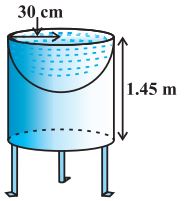
Mayank made a bird-bath for his garden in the shape of a cylinder with a hemispherical depression at one end (see fig.). The height of the cylinder is 1.45 m and its radius is 30 cm. Find the total surface area of the bird-bath.\(\left[ Take\quad \pi =\frac { 22 }{ 7 } \right] \)
3.
If P(E) = 0.05, what is the probability of 'not E'?
4.
Find the area of a sector of a circle with radius 6 cm, if angle of the sector is \(60^o\)
5.
Find the sum of the following AP: 2, 7, 12, ...., to 10 terms.
6.
Prove that the tangents drawn at the ends of a diameter of a circle are parallel.
7.
The following frequency distribution gives the monthly consumption of electricity of 68 consumers of a locality. Find (i) median, (ii) mean and (iii) mode of the data and compare them. (iv) How electricity consumption can be reduced?
| Monthly consumption (in units) | Number of consumers |
| 65-85 | 4 |
| 85-105 | 5 |
| 105-125 | 13 |
| 125-145 | 20 |
| 145-165 | 14 |
| 165-185 | 8 |
| 185-205 | 4 |
8.
In \(\Delta\)ABC, right-angled at B, if tan A \(=\frac{1}{\sqrt{3}}\) then find the value of
sin A cos C + cos A sin C
9.
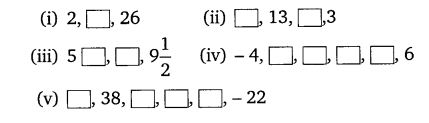
In the following APs, find the missing terms in the boxes :
10.
The median of the following data is 525. Find the values of x and y if the total frequency is 100.
| Class Interval | 0-100 | 100-200 | 200-300 | 300-400 | 400-500 | 500-600 | 600-700 | 700-800 | 800-900 | 900-1000 |
| Frequency | 2 | 5 | x | 12 | 17 | 20 | y | 9 | 7 | 4 |
11.
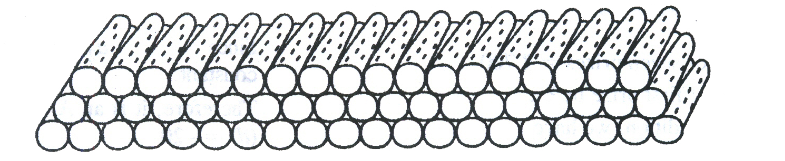
200 logs are stacked in the following manner: 20 logs in the bottom row, 19 in the next row, 18 in the row next to it and so on.
(i) In how many rows are the 200 logs placed and how many logs are in the top row?
(ii) Which value is depicted in the pattern of log?
12.
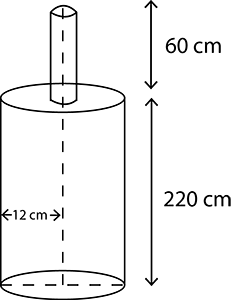
A solid iron pole consists of a cylinder of height 220 cm and base diameter 24 cm, which is surmounted by another cylinder of height 60 cm and radius 8 cm.Find the mass of the pole, given that 1cm3 of iron has approximately 8g mass.(use \(\pi\)=3.14)
13.
A box contains 90 discs which are numbered from 1 to 90. If one disc is drawn at random from the box, find the probability that is bears
(i) a two digit number
(ii) a perfect square number
(iii) a number divisible by 5
14.
A chord of a circle of the radius 12 cm subtends an angle of \(120^o\) at the centre. Find the area of the corresponding segment of the circle. \((USE\ \pi = 3.14\ and \ \sqrt3 = 1.73).\)
15.
A straight highway leads to the foot of a tower. A man standing at the top of the tower observes a car at an angle of depression of 30o , which is approaching the foot of the tower with a uniform speed. Six seconds later, the angle of depression of the car is found to be 60o . Find the time taken by the car to reach the foot of the tower from this point.
16.
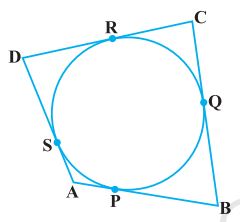
A quadrilateral ABCD is drawn to circumscribe a circle (see figure). Prove that AB+CD=AD+BC.
17.
A bag contains a red ball, a blue ball and a yellow ball, all the balls being of the same size. Kritika takes out a ball from the bag without looking into it. What is the probability that she takes out the
(i) yellow ball?
(ii) red ball?
(iii) blue ball?
18.
Evaluate the following \(\frac{5 \cos ^{2} 60^{\circ}+4 \sec ^{2} 30^{\circ}-\tan ^{2} 45^{\circ}}{\sin ^{2} 30^{\circ}+\cos ^{2} 30^{\circ}}\)
19.
Prove that in two concentric circles, the chord of the larger circle, which touches the smaller circle, is bisected at the point of contact.
20.
If the sum of the first 14 terms of an AP is 1050 and its first term is 10, find the 20th term.
21.
A sum of Rs 1000 is invested at 8% simple interest per year. Calculate the interest at the end of each year. Do these interests form an AP? If so, find the interest at the end of 30 years making use of this fact.
22.
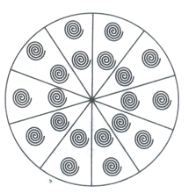
A brooch is made with silver wire in the form of a circle with diameter 35 mm. The wire is also used in making 5 diameters which divide the circle into 10 equal sectors as shown in figure.
Find:
(i) the total length of the silver wire required.
(ii) the area of each sector of the brooch.
1.
We are given a circle with centre O and a tangent XY to the circle at a point P. We need to prove that OP is perpendicular to XY.
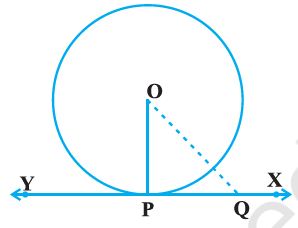
Take a point Q on XY other than P and join OQ see Fig.The point Q must lie outside the circle. (Why? Note that if Q lies inside the circle, XY will become a secant and not a tangent to the circle). Therefore, OQ is longer than the radius OP of the circle. That is, OQ > OP.
Since this happens for every point on the line XY except the point P, OP is the shortest of all the distances of the point O to the points of XY. So OP is perpendicular to XY.
2.
Let h be height of the cylinder, and r the common radius of the cylinder and hemisphere. Then, the total surface area of the bird-bath = CSA of cylinder + CSA of hemisphere
= 2\(\pi\)rh + 2\(\pi\)r2 = 2\(\pi\)r(h + r)
\(=2 \times \frac{22}{7} \times 30(145+30) \mathrm{cm}^2\)
= 33000 cm2 = 3.3 m2
3.
Given, P(E) = 0.05
we know that P(E) + P(\(\bar{E}\)) = 1
\(\therefore\) P(\(\bar{E}\)) = 1 - P(E) \(\Rightarrow\) P(\(\bar{E}\)) = 1 - 0.05 = 0.95
4.
We know that area of sector of a circle =\(\frac{\theta}{360^{\circ}} \times \pi r^2\)
Given, radius of circle, r = 6 cm
and angle of sector, \(\theta\)= 60°
\(\therefore\) Area of sector of a circle \(=\frac{60^{\circ}}{360^{\circ}} \times \frac{22}{7} \times(6)^2=\frac{132}{7} \mathrm{~cm}^2\)
5.
Given, AP is 2, 7, 12, ..., to 10 terms.
Here, a = 2, d = 7 - 2 = 5 and n = 10
\(\because\) Sum of first n terms of an AP,
\(S_n=\frac{n}{2}[2 a+(n-1) d]\)
\(\therefore\) On putting a = 2, d = 5 and n = 10, we get
\(\begin{aligned} S_{10} & =\frac{10}{2}[2 \times 2+(10-1) 5] \\ \end{aligned}\)
\(\begin{aligned} & =5(4+9 \times 5)=5(4+45)=5 \times 49=245 \end{aligned}\)
6.
Let AB be a diameter of a given circle and LM and PQ be the tangent lines drawn to the circle at points A and B, respectively.
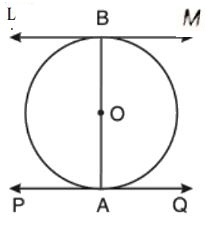
To prove LM || PQ
Proof We know that the tangent at any point of a circle is perpendicular to the radius through the point of contact.
\(\therefore\) OA \(\perp\) PQ and OB \(\perp\) LM
\(\Rightarrow\) AB \(\perp\) PQ
and AB \(\perp\) LM
\(\Rightarrow\) \(\angle\)PAB = 90°
and \(\angle\)ABM = 90°
\(\Rightarrow\) \(\angle\)PAB = \(\angle\)ABM
[each = 90°]
But these are alternate angles.
\(\therefore\) PQ || LM
Hence, the tangents drawn at the ends of a diameter of a circle are parallel.
Hence proved.
7.
(i) The cumulative frequency table of given frequency distribution is
| Monthly consumption (in units) | Number of consumers (fi) | Cumulative frequency (cf) |
| 65-85 | 4 | 4 |
| 85-105 | 5 | 9 |
| 105-125 | 13 | 22 = cf |
| 125-145 | 20 = f | 42 |
| 145-165 | 14 | 56 |
| 165-185 | 8 | 64 |
| 185-205 | 4 | 68 |
| Total | n = 68 |
Here, n = 68
\(\therefore \quad \frac{n}{2}=34\)
Since, the cumulative frequency just greater than 34 is 42 and the corresponding class is 125- 145. So, the median class is 125-145.
Now, l = 125, f = 20, cf = 22 and h = 20
\(\begin{aligned} & \therefore \text { Median }=l+\left\{\frac{\frac{n}{2}-c f}{f}\right\} \times h \\ \end{aligned}\)
\(\begin{aligned} \quad=125+\left\{\frac{34-22}{20}\right\} \times 20=125+12=137 \text { units } \end{aligned}\)
(ii) Let the assumed mean, a = 135
and width of the class, h = 20
Table for the given data is
| Monthly consumption (in units) | Number of consumers (fi) | Class marks (xi) | \(u_1=\frac{x_i-135}{20}\) | fiui |
| 65-85 | 4 | 75 | -3 | -12 |
| 85-105 | 5 | 95 | -2 | -10 |
| 105-125 | 13 | 115 | -1 | -13 |
| 125-145 | 20 | a = 135 | 0 | 0 |
| 145-165 | 14 | 155 | 1 | 14 |
| 165-185 | 8 | 175 | 2 | 16 |
| 185-205 | 4 | 195 | 3 | 12 |
| Total | N = 68 | \(\sum\)fiui = 7 |
We have, N = 68, and \(\sum\)fiui = 7
By step deviation method,
Mean = \(\begin{aligned} \text { Mean } & =a+b \times \frac{1}{N} \times \Sigma f_i u_i=135+20 \times \frac{1}{68} \times 7 \\ \end{aligned}\)
\(\begin{aligned} & =135+\frac{35}{17}=135+2.05=137.05 \text { units } \end{aligned}\)
(iii) Here, the modal class is 125-145 having maximum frequency, f1 = 20.
Now, f0 = 13, f2 = 14, l = 125 and h = 20
\(\begin{aligned} \therefore \text { Mode } & =l+\left\{\frac{f_1-f_0}{2 f_1-f_0-f_2}\right\} \times h \\ \end{aligned}\)
\(\begin{aligned} & =125+\left\{\frac{20-13}{40-13-14}\right\} \times 20 \\ \end{aligned}\)
\(\begin{aligned} & =125+\frac{7 \times 20}{13}=125+\frac{140}{13} \end{aligned}\)
= 125 + 10.77 = 135.77 units
Hence, median = 137 units, mean = 137.05 units and mode = 135.77 units
So, we conclude that three measures are approximately the same.
(iv) Electricity consumption can be reduced by
(a) switching off electric appliances when not in use.
(b) using star rated AC's, refrigerators.
8.
Given, \(\begin{array}{ll} \tan A=\frac{1}{\sqrt{3}} \end{array}\)
\(\begin{array}{ll} \Rightarrow \quad & \frac{P}{B}=\frac{1}{\sqrt{3}} \end{array}\)
Let, P = k and B = \(\sqrt{3}\)k, where k is any positive integer.
Draw a right angled \(\Delta\)ABC, right angled at B.
In right angled \(\Delta\)ABC,
H2 = B2 = P2 [by using Pythagoras theorem]
\(\Rightarrow \quad H^2=(\sqrt{3} k)^2+(k)^2=3 k^2+k^2=4 k^2\)
\(\therefore\) H = 2k [taking positive square root since, side cannot be negative]
With reference to \(\angle\)A, we have
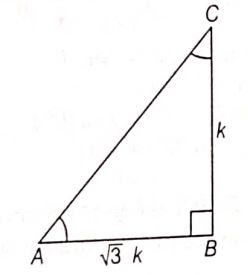
Base = AB = \(\sqrt{3}\)k, perpendicular = BC = k
and hypotenuse = AC = 2k
With reference to \(\angle\)C, we have
Base = BC = k, perpendicular = AB = \(\sqrt{3}\)k
and hypotenuse = AC = 2k
sin A cos C + cos A sin C
\(\begin{aligned} & =\left(\frac{B C}{A C}\right)\left(\frac{B C}{A C}\right)+\left(\frac{A B}{A C}\right)\left(\frac{A B}{A C}\right) \\ \end{aligned}\)
\(\begin{aligned} {\left[\because \sin \theta=\frac{P}{H} \text { and } \cos \theta=\frac{B}{H}\right]} \end{aligned}\)
\(\begin{aligned} & =\left(\frac{k}{2 k}\right)\left(\frac{k}{2 k}\right)+\left(\frac{\sqrt{3} k}{2 k}\right)\left(\frac{\sqrt{3} k}{2 k}\right) \\ \end{aligned}\)
\(\begin{aligned} & =\frac{k^2}{4 k^2}+\frac{3 k^2}{4 k^2}=\frac{4 k^2}{4 k^2}=1 \end{aligned}\)
9.
(i) For this A.P.,
a = 2
a3 = 26
We know that, an = a + (n − 1) d
a3 = 2 + (3 − 1) d
26 = 2 + 2d
24 = 2d
d = 12
a2 = 2 + (2 − 1) 12
= 14
Therefore, 14 is the missing term.
(ii) For this A.P.,
a2 = 13 and
a4 = 3
We know that, an = a + (n − 1) d
a2 = a + (2 − 1) d
13 = a + d (I)
a4 = a + (4 − 1) d
3 = a + 3d (II)
On subtracting (I) from (II), we obtain
−10 = 2d
d = −5
From equation (I), we obtain
13 = a + (−5)
a = 18
a3 = 18 + (3 − 1) (−5)
= 18 + 2 (−5) = 18 − 10 = 8
Therefore, the missing terms are 18 and 8 respectively.
(iii) For this A.P.,
a = 5 and
\(a_{4}=\frac{19}{2}\)
We know that, an = a + (n − 1) d
a4 = a + (4 - 1) d
\(\frac{19}{2}=5+3 \mathrm{~d}\)
\(\frac{19}{2}-5=3 d\)
\(\frac{9}{2}=3 d\)
d = 3 / 2
a2 = a + (2 - 1) d
a2 = 5 + 3 / 2
a2 = 13 / 2
a3 = a + (3 - 1) d
a3 = 5 + 2 x 3/2
a3 = 8
Therefore, the missing terms are 13/2 and 8 respectively.
(iv) For this A.P.,
a = −4 and
a6 = 6
We know that,
an = a + (n − 1) d
a6 = a + (6 − 1) d
6 = − 4 + 5d
10 = 5d
d = 2
a2 = a + d = − 4 + 2 = −2
a3 = a + 2d = − 4 + 2 (2) = 0
a4 = a + 3d = − 4 + 3 (2) = 2
a5 = a + 4d = − 4 + 4 (2) = 4
Therefore, the missing terms are −2, 0, 2, and 4 respectively.
(v) For this A.P.,
a2 = 38
a6 = −22
We know that
an = a + (n − 1) d
a2 = a + (2 − 1) d
38 = a + d (1)
a6 = a + (6 − 1) d
−22 = a + 5d (2)
On subtracting equation (1) from (2), we obtain
− 22 − 38 = 4d
−60 = 4d
d = −15
a = a2 − d = 38 − (−15) = 53
a3 = a + 2d = 53 + 2 (−15) = 23
a4 = a + 3d = 53 + 3 (−15) = 8
a5 = a + 4d = 53 + 4 (−15) = −7
Therefore, the missing terms are 53, 23, 8, and −7 respectively.
10.
| Class interval | Frequency | Cumalative frequency |
| 0-100 | 2 | 2 |
| 100-200 | 5 | 7 |
| 200-300 | x | 7+x |
| 300-400 | 12 | 19+x |
| 400-500 | 17 | 36+x |
| 500-600 | 20 | 56+x |
| 600-700 | y | 56+x+y |
| 600-700 | y | 56+x+y |
| 700-800 | 9 | 65+x+y |
| 800-900 | 7 | 72+x+y |
| 900-1000 | 4 | 76+x+y |
| N=100 |
It is given that n = 100
So, 76 + x + y = 100, i.e., x + y = 24
The median is 525, which lies in the class 500 – 600
So, l = 500, f = 20, cf = 36 + x, h = 100
Using the formula : Median \(=l+\left(\frac{\frac{n}{2}-\mathrm{cf}}{f}\right) h, \text { we get }\)
\(525=500+\left(\frac{50-36-x}{20}\right) \times 100\)
i.e. 525 - 500 = (14 - x) \(\times\) 5
i.e. 25 = 70 - 5 x
i.e. 5 x = 70 - 25 = 45
So, x = 9
Therefore, from (1), we get 9 + y = 24
i.e. y = 15
11.
(i) Number of logs stacked in each row form a sequence 20, 19, 18, 17,...., which is an AP with first term, a= 20 and common difference, d = 19 - 20 = -1.
Suppose number of rows is n, then Sn= 200
\(\begin{aligned} \Rightarrow \frac{n}{2}[2 \times 20+(n-1)(-1)] & =200 \\ \end{aligned}\)
\(\begin{aligned} {\left[\because S_n\right.} & \left.=\frac{n}{2}\{2 a+(n-1) d\}\right] \end{aligned}\)
\(\begin{array}{lr} \Rightarrow & 400=40 n-n^2+n \\ \end{array}\)
\(\begin{array}{lr} \Rightarrow & n^2-41 n+400=0 \\ \end{array}\)
\(\begin{array}{lr} \Rightarrow & n^2-25 n-16 n+400=0 \\ \end{array}\)
\(\begin{array}{lr} \Rightarrow & n(n-25)-16(n-25)=0 \\ \end{array}\)
\(\begin{array}{lr} \Rightarrow & (n-25)(n-16)=0 \\ \end{array}\)
\(\begin{array}{lr} \Rightarrow & n=16 \text { or } n=25 \end{array}\)
Hence, the number of rows is either 25 or 16.
When, n = 16,
an= a + (n -1) d = 20 + (16 - 1) ( - 1)
= 20 - 15 = 5
When, n = 25,
an = a + (n - 1) d = 20 + (25-1) (-1)
= 20 - 24 = - 4
[\(\because\) number of logs cannot be negative]
Hence, the number of rows is 16 and number of logs in the top row is 5.
(ii) The pattern of logs show space saving creativity, reasoning and balancing.
12.
Height (h1) of larger cylinder = 220 cm
Radius (r1) of larger cylinder = \(\frac{24}{2}\)= 12 cm
Height (h2) of smaller cylinder = 60 cm
Radius (r2) of smaller cylinder = 8 cm
Total volume of pole = Volume of larger cylinder + Volume of smaller cylinder
\(\begin{aligned} & =\pi r_1^2 h_1+\pi r_2^2 h_2 \\ \end{aligned}\)
\(\begin{aligned} & =\left(\pi(12)^2 \times 220\right)+\left(\pi(8)^2 \times 60\right) \\ \end{aligned}\)
\(\begin{aligned} & =\pi[144 \times 220+64 \times 60] \\ \end{aligned}\)
\(\begin{aligned} & =3.14[31,680+3,840] \\ \end{aligned}\)
\(\begin{aligned} & =3.14 \times 35520=111,532.8 \mathrm{~cm}^3 \end{aligned}\)
Mass of 1 cm3 iron = 8 g
Mass of 111532.8 cm3 iron = 11532.8 \(\times\)8 = 892262.4 g
13.
(i) Total number of discs in a box = 90
\(\therefore\) Number of all possible outcomes = 90
Let E1 = Event of getting a disc bearing a two-digit number
Here, two-digit numbers are 10, 11, .., 90
\(\therefore\)Number of outcomes favourable to E1 =81
Hence, probability of getting a disc bearing a two-digit number, \(P\left(E_1\right)=\frac{81}{90}=\frac{9}{10}\)
(ii) Let E2 = Event of getting a disc bearing a perfect square number
Here, perfect square number are 1, 4, 9, 16, 25, 36, 49, 64 and 81.
\(\therefore\) Number of outcomes favourable to E2 =9
Hence, probability of getting a disc bearing a perfect square number, \(P\left(E_2\right)=\frac{9}{90}=\frac{1}{10}\)
(iii) Let E3 = Event of getting a disc bearing a number divisible by 5
Here, the numbers divisible by 5 are
5, 10, 15, 20, 25, 30, 35, 40, 45, 50, 55, 60, 65, 70, 75, 80, 85 and 90
\(\therefore\) Number of outcomes favourable to E3 = 18
Hence, required probability = \(P\left(E_3\right)=\frac{18}{90}=\frac{1}{5}\)
14.
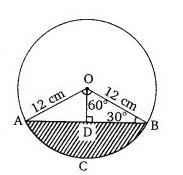
Let us draw a perpendicular OV on chord ST. It will bisect the chord ST.
SV = VT
In ΔOVS,
OV/OS = cos 60º
OV/12 = 1/2
OV = 6 cm
\(S \frac{V}{S} O=\sin 60^{\circ}=\frac{\sqrt{3}}{2}\)
\(\frac{S V}{12}=\frac{\sqrt{3}}{2} \)
\(S V=6 \sqrt{3} \mathrm{~cm} \)
\(S T=2 S V=2 \times 6 \sqrt{3}=12 \sqrt{3} \mathrm{~cm}\)
Area of ΔOST = 1/2 x ST x OV
\(\frac{1}{2} \times 12 \sqrt{3} \times 6 \)
\(=36 \sqrt{3}=36 \times 1.73=62.28 \mathrm{~cm}^{2}\)
Area of sector OSUT \(=\frac{120^{\circ}}{360^{\circ}} \times \pi(12)^{2}\)
Area of segment SUT = Area of sector OSUT − Area of ΔOST
= 150.72 − 62.28
= 88.44 cm2
15.
Let CD = h m be the height of the tower. At point D of the tower, a man is standing and observes the car at an angle of depression of 30°. After six seconds, the angle of depression of the car is 60°.
i.e. \(\angle\)ODA = 30° and \(\angle\)ODB = 60°
\(\Rightarrow\) \(\angle\)DAC = \(\angle\)ODA = 30° [alternate angles]
and \(\angle\)DBC = \(\angle\)ODB = 60° [alternate angles]
Let AB = y m and BC = x m
In right angled \(\Delta\)BCD,

\(\begin{array}{rlrl} \tan 60^{\circ} & =\frac{P}{B}=\frac{C D}{B C} \\ \end{array}\)
\(\begin{array}{rlrl} \Rightarrow \quad \sqrt{3} & =\frac{h}{x} \\ \end{array}\)
\(\begin{array}{rlrl} \Rightarrow \quad h & =\sqrt{3} x & {\left[\because \tan 60^{\circ}=\sqrt{3}\right]} \end{array}\)
\(\Rightarrow \quad h = \sqrt3 x\)....(i)
In right angled \(\Delta\)ACD,
\(\begin{array}{rlrl} \tan 30^{\circ} & =\frac{C D}{A C}=\frac{C D}{A B+B C} & & {[\because A C=A B+B C]} \\ \end{array}\)
\(\begin{array}{rlrl} \Rightarrow \quad \frac{1}{\sqrt{3}} & =\frac{h}{x+y} & & {\left[\because \tan 30^{\circ}=\frac{1}{\sqrt{3}}\right]} \\ \end{array}\)
\(\begin{array}{rlrl} \Rightarrow \quad x+y & =h \sqrt{3} & \end{array}\)
\(\Rightarrow \quad x + y=\sqrt3 x(\sqrt3)\) [from Eq. (i)]
\(\Rightarrow\) x + y = 3x .....(ii)
It is given that a car moves from point A to B in six seconds. Let its speed be k km/s.
\(\therefore \quad \text { Time }=\frac{\text { Distance }}{\text { Speed }}\)
\(\Rightarrow \quad 6=\frac{y}{k} \Rightarrow y=6 k\)
On putting y = 6k in Eq. (ii), we get
x + 6k = 3x \(\Rightarrow\) 6k - 2x \(\Rightarrow\) x = 3k
\(\therefore \quad \text { Time }=\frac{\text { Distance }}{\text { Speed }}=\frac{x}{k}=\frac{3 k}{k}=3 \mathrm{~s}\)
Hence, the car moves from point B to point C in 3s.
16.
Given A quadrilateral ABCD, circumscribing a circde.
To prove AB + CD = AD + BC
Proof We know that the lengths of tangents drawn from an external point to a circde are equal.
\(\therefore\) AP = AS ...(i)
[\(\because\) both are tangents to a circle from point A]
Similarly, BP = BQ, ...(ii)
CR = CQ ....(iii)
and DR = DS .....(iv)
On adding Eqs. (i), (ii), (ii) and (iv), we get
(AP + BP) + (CR + DR) = (AS + BQ) + (CQ + DS)
\(\Rightarrow\) AB + CD = (AS + DS) + (BQ + CQ)
\(\Rightarrow\) AB + CD = AD + BC
Hence Proved.
17.
Kritika takes out a ball from the bag without looking into it. So, it is equally likely that she takes out any one of them.
Let Y be the event ‘the ball taken out is yellow’, B be the event ‘the ball taken out is blue’, and R be the event ‘the ball taken out is red’. Now, the number of possible outcomes = 3.
(i) The number of outcomes favourable to the event Y = 1.
So, P(Y) = \(\frac{1}{3}\)
Similarly, (ii) P(R) = \(\frac{1}{3}\)and
(iii) P(B) =\(\frac{1}{3}\)
18.
\(\frac{5 \cos ^{2} 60^{\circ}+4 \sec ^{2} 30^{\circ}-\tan ^{2} 45^{\circ}}{\sin ^{2} 30^{\circ}+\cos ^{2} 30^{\circ}}\)
\(\frac{5\left(\frac{1}{2}\right)^{2}+4\left(\frac{2}{\sqrt{3}}\right)^{2}-(1)^{2}}{\left(\frac{1}{2}\right)^{2}+\left(\frac{\sqrt{3}}{2}\right)^{2}}\)
\(=\frac{5\left(\frac{1}{4}\right)+\left(\frac{16}{3}\right)-1}{\frac{1}{4}+\frac{3}{4}}\)
\(=\frac{\frac{15+64-12}{12}}{\frac{4}{4}}=\frac{67}{12}\)
19.
We are given two concentric circles C1 and C2 with centre O and a chord AB of the larger circle C1 which touches the smaller circle C2 at the point P (see Fig). We need to prove that AP = BP.
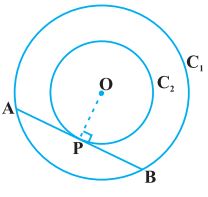
Let us join OP. Then, AB is a tangent to C2 at P and OP is its radius. Therefore, by Theorem.
OP \(\perp\) AB
Now AB is a chord of the circle C1 and OP \(\perp\) AB. Therefore, OP is the bisector of the chord AB, as the perpendicular from the centre bisects the chord,
i.e., AP = BP
20.
Here, S14 = 1050, n = 14, a = 10.
As \(\begin{aligned} \mathrm{S}_n & =\frac{n}{2}[2 a+(n-1) d] \\ \end{aligned}\)
So, \(\begin{aligned} 1050 & =\frac{14}{2}[20+13 d]=140+91 d \end{aligned}\)
i.e., 910 = 91d
or, d = 10
Therefore, a20 = 10 + (20 - 1) \(\times\) 10 = 200, i.e. 20th term is 200.
21.
We know that the formula to calculate simple interest is given by
Simple Interest \(=\frac{\mathrm{P} \times \mathrm{R} \times \mathrm{T}}{100}\)
So, the interest at the end of the 1st year = \(Rs \frac{1000 \times 8 \times 1}{100}=Rs 80\)
The interest at the end of the 2nd year = \(Rs \frac{1000 \times 8 \times 2}{100}=Rs 160\)
The interest at the end of the 3rd year = \(RS \frac{1000 \times 8 \times 3}{100}=Rs 240\)
Similarly, we can obtain the interest at the end of the 4th year, 5th year, and so on.
So, the interest (in Rs) at the end of the 1st, 2nd, 3rd, . . . years, respectively are 80, 160, 240, .
It is an AP as the difference between the consecutive terms in the list is 80, i.e., d = 80. Also, a = 80
So, to find the interest at the end of 30 years, we shall find a30
Now, a30 = a + (30 – 1) d = 80 + 29 x 80 = 2400
So, the interest at the end of 30 years will be Rs. 2400
22.
Given, diameter of circle, d = 35 mm
\(\therefore\) Circumference of circle = \(\pi\)d [\(\because\) d = 2r]
\(=\frac{22}{7} \times 35=110 \mathrm{~mm}^2\)
Now, length of 5 diameters = 5 \(\times\) 35 = 175 mm
(i) Total length of the silver wire = \(\pi\)d + 5d
= 110 + 175 = 285 mm2
(ii) Here, we see that total circle is divided into 10 sectors.
\(\therefore\) Angle of each sector = \(\frac{360^{\circ}}{10}=36^{\circ}\)
Then, area of each sector ofthe brooch = \(=\frac{\theta}{360^{\circ}} \times \pi r^2\)
\(\begin{aligned} & =\frac{36^{\circ}}{360^{\circ}} \times \frac{22}{7}\left(\frac{35}{2}\right)^2 \quad\left[\because r=\frac{d}{2}=\frac{35}{2} \mathrm{~mm}\right] \\ \end{aligned}\)
\(\begin{aligned} & =\frac{1}{10} \times \frac{22}{1} \times \frac{5}{2} \times \frac{35}{2}=\frac{11 \times 35}{2 \times 2}=\frac{385}{4} \mathrm{~mm}^2 \end{aligned}\)

10th Standard CBSE Syllabus & Materials
10th Standard CBSE
CBSE 10th Social Science PS - Federalism - New Model Questions Papers Study Material - QB365 Set A
NEW10th Standard CBSE
CBSE 10th Social Science PS - Power Sharing - New Model Questions Papers Study Material - QB365 Set A
NEW10th Standard CBSE
CBSE 10th Social Science GEO - Manufacturing Industries - New Model Questions Papers Study Material - QB365 Set A
NEW10th Standard CBSE
CBSE 10th Social Science GEO - Minerals and Energy Resources - New Model Questions Papers Study Material - QB365 Set A



NCERT Books

Syllabus

Exam Pattern

Sample Question Papers

Previous year Question Papers

Important Notes

MCQ Practice test

NCERT Exemplers

Case study Questions

Image Based Questions

Passage based Questions

HOT Questions

Value Based Questions

Model Questions Papers
NCERT ( Book Back ) Questions

Assertion and Reason
Important Questions And Answers

CBSE 10th Standard CBSE Subjects
CBSE Standards



