
 100% FREE ACCESS
10th Standard CBSE Syllabus & Materials
10th Standard CBSE
CBSE 10th Social Science ECO - Globalisation and the Indian Economy - New Model Questions Papers Study Material - QB365 Set A
NEW10th Standard CBSE
CBSE 10th Social Science ECO - Money and Credit - New Model Questions Papers Study Material - QB365 Set A
NEW10th Standard CBSE
CBSE 10th Social Science ECO - Sectors of the Indian Economy - New Model Questions Papers Study Material - QB365 Set A
NEW10th Standard CBSE
CBSE 10th Social Science ECO - Development - New Model Questions Papers Study Material - QB365 Set A
NEW10th Standard CBSE
CBSE 10th Social Science PS - Outcomes of Democracy - New Model Questions Papers Study Material - QB365 Set A
NEW10th Standard CBSE
CBSE 10th Social Science PS - Gender, Religion and Caste - New Model Questions Papers Study Material - QB365 Set A

Published on: 26/10/2025
Download CBSE Class 10th Standard CBSE Maths question papers, sample papers, important questions, and previous year solved papers in PDF format. Get free study materials, NCERT solutions, and exam preparation resources for Class 10th Standard CBSE Maths
Questions + Answers key
Take MCQ Maths Test
1.
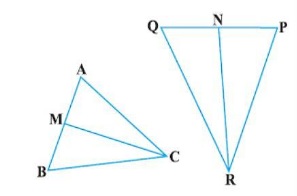
In figure CM and RN are respectively the medians of Δ ABC and Δ PQR. If Δ ABC ~ Δ PQR, prove that :
Δ CMB ~ Δ RNQ
2.
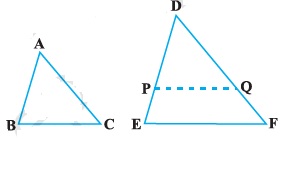
If in two triangles, corresponding angles are equal, then their corresponding sides are in the same ratio (or proportion) and hence the two triangles are similar.
3.
On comparing the ratios \(\frac { { a }_{ 1 } }{ { a }_{ 2 } } ,\frac { { b }_{ 1 } }{ { b }_{ 2 } } \) and \(\frac { { c }_{ 1 } }{ { c }_{ 2 } } ,\) find out whether the lines representing the following pair of linear equations intersect at a point are parallel or coincident.
6x – 3y + 10 = 0
2x – y + 9 = 0
4.
Solve the following pair of linear equations by the substitution method
\(\sqrt { 2 } x+\sqrt { 3 } y=0\)
\(\sqrt { 3 } x-\sqrt { 8 } y=0\)
5.
Prove that \(\sqrt { 2 } \) is an irrational .
6.
Find a quadratic polynomial, the sum and product of whose zeroes are -3 and 2, respectively.
7.
If the sum of the first n terms of an AP is \(4n-{ n }^{ 2 }\), then what is the first term (i.e \(S_1\))? What is the sum of first two terms? What is the second term? Similarly, find the 3rd, 10th and the nth terms.
8.
A spiral is made up of successive semicircles, with centres alternately at A and B, starting with centre at A, of radii 0.5 cm, 1.0 cm, 1.5 cm, 2.0 cm, ... as show in fig. What is the total length of such a spiral made-up of 13 consecutive semicircles? (Take \(\pi=\frac{22}{7}\))

( Length of successive semicircles is l1, l2, l3, l4, . . . with centres at A, B,. . ., respectively.]
9.
Represent the following situations mathematically:
John and Jivanti together have 45 marbles. Both of them lost 5 marbles each, and the product of the number of marbles they now have is 124. We would like to find out how many marbles they had to start with.
10.
Check whether the following are quadratic equations:
(i) (x – 2)2 + 1 = 2x – 3
(ii) x(x + 1) + 8 = (x + 2) (x – 2)
(iii) x (2x + 3) = x2 + 1
(iv) (x + 2)3 = x3 – 4
11.
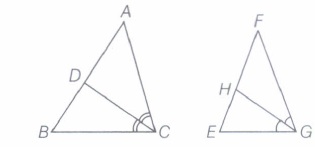
CD and GH are respectively the bisectors of ∠ACB and ∠EGF such that D and H lie on sides AB and FE of ΔABC and ΔEFG respectively. If ΔABC ~ ΔFEG, Show that
ΔDCA ~ ΔHGF
12.
Find the zeroes of the following quadratic polynomials and verify the relationship between the zeroes and the coefficients.
4u2 + 8u
13.
Let p be a prime number. If p divides a2 , then p divides a, where a is a positive integer.
14.
Form the pair of linear equations in the following problems, and find their solutions (if they exist) by the elimination method :
A lending library has fixed charge for the first three days and an additional charge for each day thereafter. Saritha paid Rs 27 for a book kept for seven days, while Susy paid Rs 21 for the book she kept for five days. Find the fixed charge and the charge for each extra day.
15.
In a flower bed, there are 23 rose plants in the first row, 21 in the second, 19 in the third, and so on. There are 5 rose plants in the last row. How many rows are there in the flower bed?
16.
Find two consecutive positive integers, sum of whose squares in 365.
17.
In the following figure, altitudes AD and CE of ΔABC intersect each other at the point P. Show that:
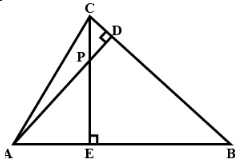
ΔABD ∼ ΔCBE
18.
On comparing the ratios \(\frac{a_{1}}{a_{2}}, \frac{b_{1}}{b_{2}} and \frac{c_{1}}{c_{2}}\) find out whether the following pairs of linear equations are consistent, or inconsistent.
2x – 3y = 8 ; 4x – 6y = 9
19.
Find the distance between the points (0,0) and (36,15). Can you now find the distance between the two towns A and B by using Pythagoras Theorem?
20.
In an AP: given a12 = 37, d = 3, find a and S12.
21.
Find the nature of the roots of the following quadratic equation. If the real roots exist, then find them: 2x2-3x+5=0
22.
11th term of the AP: – 3 ,\(-\frac{1}{2}\) ,2 , ..., is
28
22
- 38
\(-48 \frac{1}{2}\)
23.
30th term of the AP: 10, 7, 4, . . . , is
97
77
- 77
- 87
1.
Again, \(\frac{\mathrm{AB}}{\mathrm{PQ}}=\frac{\mathrm{BC}}{\mathrm{QR}}\) [From (1)]
Therefore, \(\frac{C M}{R N}=\frac{B C}{Q R}\) [From (8)]
Also, \(\frac{C M}{R N}=\frac{A B}{P Q}=\frac{2 B M}{2 Q N}\)
i.e., \(\frac{\mathrm{CM}}{\mathrm{RN}}=\frac{\mathrm{BM}}{\mathrm{QN}}\)
i.e., \(\frac{\mathrm{CM}}{\mathrm{RN}}=\frac{\mathrm{BC}}{\mathrm{QR}}=\frac{\mathrm{BM}}{\mathrm{QN}}\) [From (9) and (10)]
Therefore, Δ CMB ~ Δ RNQ (SSS similarity)
2.
This criterion is referred to as the AAA (Angle - Angle - Angle) criterion of similarity of two triangles.
This theorem can be proved by taking two triangles ABC and DEF such that
∠ A = ∠ D, ∠ B = ∠ E and ∠ C = ∠ F
Cut DP = AB and DQ = AC and join PQ
So, ∠ ABC ≅ ∠ DPQ
This gives ∠ B = ∠ P = ∠ E and PQ || EF
Therefore, \(\frac{\mathrm{DP}}{\mathrm{PE}}=\frac{\mathrm{DQ}}{\mathrm{QF}}\)
i.e., \(\frac{\mathrm{AB}}{\mathrm{DE}}=\frac{\mathrm{AC}}{\mathrm{DF}}\)
Similarly, \(\frac{\mathrm{AB}}{\mathrm{DE}}=\frac{\mathrm{BC}}{\mathrm{EF}} \text { and so } \frac{\mathrm{AB}}{\mathrm{DE}}=\frac{\mathrm{BC}}{\mathrm{EF}}=\frac{\mathrm{AC}}{\mathrm{DF}}\)
3.
Comparing the given equations with standard forms of equations \(a_{1} x+b_{1} y+c_{1}=0 \text { and } a_{2} x+b_{2} y+c_{2}=0\)
\(a 1=6, b_{1}=-3, c_{1}=10\)
\(a_{2}=2, b_{2}=-6, c_{2}=9\)
\(\therefore \frac{a_{1}}{a_{2}}=\frac{6}{2}=3, \frac{b_{1}}{b_{2}}=\frac{-3}{-1}=3\)
\(\Rightarrow \frac{a_{1}}{a_{2}}=\frac{b_{1}}{b_{2}} \neq \frac{c_{1}}{c_{2}}\)
Thus, the lines representing the pair of linear equations are parallel.
4.
Given, a pair of linear equation is:
\(\sqrt { 2 } x+\sqrt { 3 } y=0\) ......(i)
and \(\sqrt { 3 } x-\sqrt { 8 } y=0\quad or\quad y=\frac { \sqrt { 3 } x }{ \sqrt { 8 } } \) ......(ii)
On substituting y from eqn. (ii) in eqn. (i),
\(\sqrt { 2 } x+\sqrt { 3 } \times \left( \frac { \sqrt { 3 } x }{ \sqrt { 8 } } \right) =0\)
\(\Rightarrow \quad \sqrt { 2 } x\times \sqrt { 8 } +3x=0\)
\(\Rightarrow \quad \sqrt { 2 } x+\frac { 3x }{ \sqrt { 8 } } =0\)
\(\Rightarrow \quad \sqrt { 2 } x\times \sqrt { 8 } +3x=0\)
\(\\ \Rightarrow \) 4x + 3x = 0
\(\\ \Rightarrow \) 7x = 0
\(\therefore\) x = 0
On substituting x = 0 in eqn. (ii),
\(y=\frac { \sqrt { 3 } \times 0 }{ \sqrt { 8 } } =0\)
\(\therefore\)y = 0
Hence, x = 0, y = 0
5.
Let us assume, to the contrary, that \(\sqrt 2\) is rational.
So, we can find integers r and s (≠ 0) such that \(\sqrt 2\) =\(\frac{r}{s}\) .
Suppose r and s have a common factor other than 1. Then, we divide by the common factor to get \(\sqrt 2\) = \(\frac{a}{b}\) , where a and b are coprime.
So, b\(\sqrt 2\) = a.
Squaring on both sides and rearranging, we get 2b 2 = a 2 .Therefore, 2 divides a 2 .
Now, by it follows that 2 divides a.
So, we can write a = 2c for some integer c.
Substituting for a, we get 2b2 = 4c2 , that is, b2 = 2c2 .
This means that 2 divides b2 , and so 2 divides b (again using Theorem 1.3 with p = 2).
Therefore, a and b have at least 2 as a common factor.
But this contradicts the fact that a and b have no common factors other than 1.
This contradiction has arisen because of our incorrect assumption that \(\sqrt 2\) is rational.
So, we conclude that \(\sqrt 2\) is irrational.
6.
Let the quadratic polynomial be ax2 + bx + c, and its zeroes be \(\alpha \text { and } \beta \text { . }\)
We have
\(\alpha+\beta=-3=\frac{-b}{a}\)
and \(\alpha \beta=2=\frac{c}{a}\)
If a = 1, then b = 3 and c = 2.
So, one quadratic polynomial which fits the given conditions is x2 + 3x + 2.
You can check that any other quadratic polynomial that fits these conditions will be of the form k(x2 + 3x + 2), where k is real.
Let us now look at cubic polynomials. Do you think a similar relation holds between the zeroes of a cubic polynomial and its coefficients
Let us consider p(x) = 2x3 – 5x2 – 14x + 8.
You can check that p(x) = 0 for x = 4,\(-2, \frac{1}{2}\) .Since p(x) can have atmost three zeroes, these are the zeores of 2x3 – 5x2 – 14x + 8. Now,
sum of the zeroes = \(4+(-2)+\frac{1}{2}=\frac{5}{2}=\frac{-(-5)}{2}=\frac{-\left(\text { Coefficient of } x^{2}\right)}{\text { Coefficient of } x^{3}}\)
product of the zeroes = \(4 \times(-2) \times \frac{1}{2}=-4=\frac{-8}{2}=\frac{-\text { Constant term }}{\text { Coefficient of } x^{3}}\)
However, there is one more relationship here. Consider the sum of the products of the zeroes taken two at a time. We have
\(\{4 \times(-2)\}+\left\{(-2) \times \frac{1}{2}\right\}+\left\{\frac{1}{2} \times 4\right\}\)
\(=-8-1+2=-7=\frac{-14}{2}=\frac{\text { Coefficient of } x}{\text { Coefficient of } x^{3}}\)
In general, it can be proved that if \(\alpha, \beta, \gamma\) are the zeroes of the cubic polynomial ax3 + bx2 + cx + d, then
\(\alpha+\beta+\gamma=\frac{-b}{a}\)
\(\alpha \beta+\beta \gamma+\gamma \alpha=\frac{c}{a}\)
\(\alpha \beta \gamma=\frac{-d}{a}\)
7.
Given, the sum of first n terms,
\({ S }_{ n }=4n-{ n }^{ 2 }\) ...(i)
On putting n = 1 in Eq. (i), we get
\({ S }_{ 1 }=4\times 1-{ 1 }^{ 2 }=4-1=3\)
Thus, sum of first term = 3
On putting n = 2 in Eq. (i), we get
\({ S }_{ 2 }=4\times 2-{ 2 }^{ 2 }=8-4=4\)
Thus, sum of first two terms = 4
\(\because\) the n th term of an AP, an = Sn - Sn-1
\(\therefore\) Second term = S2 - S1 = 4 - 3 = 1
On putting n = 3 in Eq. (i), we get
S3 = 4 \(\times\) 3 - 32 = 12 - 9 = 3
\(\therefore\) third term = S3 - S2 = 3 - 4 = -1
On putting n = 9 in eq. (i), we get
S9 = 4 \(\times\) 9 - 92 = 36 - 81 = -45
Again, putting n = 10 in Eq. (i), we get
S10 = 4 \(\times\)10 - 102 = 40 - 100 = -60
\(\therefore\) 10th term = S10 - S9
= -60 - (-45) = -60 + 45 = -15
Now, on replacing n by n - 1 in Eq. (i), we get
\(\begin{aligned} S_{n-1} & =4(n-1)-(n-1)^2 \\ \end{aligned}\)
\(\begin{aligned} & =4 n-4-n^2+2 n-1=-n^2+6 n-5 \\ \end{aligned}\)
\(\begin{aligned} \therefore \quad n \text {th term } & =S_n-S_{n-1} \\ \end{aligned}\)
\(\begin{aligned} & =4 n-n^2-\left(-n^2+6 n-5\right) \end{aligned}\)
\(\begin{aligned} & =4 n-n^2+n^2-6 n+5=5-2 n \end{aligned}\)
8.
Length of spiral made up of thirteen consecutive semi-circles
\(=(\pi \times 0.5+\pi \times 1.0+\pi \times 1.5+\pi \times 2.0+\ldots+\pi \times 6.5)\)
[\(\because\) circumference of semi-circle= \(\pi\)r, where, r is radius of circle]
\(\begin{aligned} & =0.5 \pi[1+2+3+4+\ldots+13] \\ \end{aligned}\)
\(\begin{aligned} & =\pi \times 0.5 \times \frac{13}{2}[2 \times 1+(13-1) \times 1] \end{aligned}\)
[\(\because\) the numbers 1, 2,3, .,.13, forms an AP with a =1, d = 2 - 1 = 1. Also,
\(\left.S_n=\frac{n}{2}\{2 a+(n-1) d\}\right]\)
\(=\frac{22}{7} \times \frac{5}{10} \times \frac{13}{2} \times 14=143 \mathrm{~cm}\)
9.
Let the number of marbles John had be x
Then the number of marbles Jivanti had be = 45 – x (Why?).
The number of marbles left with john, when he lost 5 marbles = x – 5
The number of marbles left with Jivanti, when she lost 5 marble = 45 – x – 5 = 40 – x
Therefore, their product = (x – 5) (40 – x)
= 40x – x2 – 200 + 5x
= – x2 + 45x – 200
So, – x2 + 45x – 200 = 124 (Given that product = 124)
i.e., – x2 + 45x – 324 = 0
i.e., x2 – 45x + 324 = 0
Therefore, the number of marbles John had, satisfies the quadratic equation
x2 – 45x + 324 = 0
which is the required representation of the problem mathematically
10.
(i) LHS = (x – 2)2 + 1 = x2 – 4x + 4 + 1 = x2 – 4x + 5
Therefore, (x – 2)2 + 1 = 2x – 3 can be rewritten as
x2 – 4x + 5 = 2x – 3
i.e., x2 – 6x + 8 = 0
It is of the form ax2 + bx + c = 0.
Therefore, the given equation is a quadratic equation
(ii) Since x(x + 1) + 8 = x2 + x + 8 and (x + 2)(x – 2) = x2 – 4
Therefore, x2 + x + 8 = x2 – 4
i.e., x + 12 = 0
It is not of the form ax2 + bx + c = 0.
Therefore, the given equation is not a quadratic equation
(iii) Here, LHS = x (2x + 3) = 2x2 + 3x
So, x (2x + 3) = x2 + 1 can be rewritten as
2x2 + 3x = x2 + 1
Therefore, we get x2 + 3x – 1 = 0
It is of the form ax2 + bx + c = 0.
So, the given equation is a quadratic equation
(iv) Here, LHS = (x + 2)3 = x3 + 6x2 + 12x + 8
Therefore, (x + 2)3 = x3 – 4 can be rewritten as
x3 + 6x2 + 12x + 8 = x3 – 4
i.e., 6x2 + 12x + 12 = 0 or, x2 + 2x + 2 = 0
It is of the form ax2 + bx + c = 0.
So, the given equation is a quadratic equation
11.
In ΔDCA = ΔHGF,
∠DAC = ∠HFG ......(i)
\(\left[\begin{array}{l} \because \quad \Delta A B C \sim \Delta F E G \\ \therefore \angle C A B=\angle G F E \\ \Rightarrow \angle C A D=\angle G F H \text { or } \angle D A C=\angle H F G \end{array}\right]\)
and ∠DCA = ∠HGF ........(ii)
\(\left[\begin{array}{l} \because \Delta A B C \sim \Delta F E G \\ \therefore \angle A C B=\angle F G E \\ \Rightarrow \frac{1}{2} \angle A C B=\frac{1}{2} \angle F G E \Rightarrow \angle D C A=\angle H G F \end{array}\right]\)
From Eqs. (i) and (ii),
ΔDCA - ΔHGF [by AA similarity criterion)
12.
Let p(u) = 4u2 + 8u = 4u(u+2)
To find zeroes, put p(u) = 0
\(\Rightarrow\) 4u(u+2) = 0 \(\Rightarrow\) u = 0 or u + 2 = 0 [\(\because\) 4 \(\neq\)0]
\(\Rightarrow\) u = 0 or u = -2
Hence, zeroes of the given polynonial are 0 and -2.
Verification
Here, sum of zeroes = 0 - 2 = -2 = -(8/4)
=-\(\frac{Coefficient \quad of \quad u}{Coefficient \quad of \quad u^{2}}\)
and product of zeroes
=0 \(\times\)-2 = 0 = (0/4) = \(\frac{Constant \quad term}{Coefficient \quad of \quad u^{2}}\)
so, the relationship between the zeroes and its coefficients is verified.
13.
Proof : Let the prime factorisation of a be as follows :
a = p1 p2 . . . pn , where p1 ,p2 , . . ., pn are primes, not necessarily distinct. Therefore, a2 = ( p1 p2 . . . pn )( p1 p2 . . . pn ) = p21 p22 . . . p 2n .
Now, we are given that p divides a 2 . Therefore, from the Fundamental Theorem of Arithmetic, it follows that p is one of the prime factors of a 2 . However, using the uniqueness part of the Fundamental Theorem of Arithmetic, we realise that the only prime factors of a2 are p1 ,p2 , . . ., pn . So p is one of p1 , p2 , . . ., pn .
Now, since a = p1 p2 . . . pn ,p divides a.
We are now ready to give a proof that \(\sqrt 2\) is irrational.
The proof is based on a technique called ‘proof by contradiction’.
14.
Let the fixed charges for the first three days be Rs x.
Let the additional change per day be Rs y.
According to the given conditions,
Sarita paid for 7 days = Rs 27
i.e.. x + 4 \(\times\) y = 27
i.e., x + 4y = 27 ... (i)
[\(\because\) Rs 4y are to be paid for extra 4 days]
In the case of Susy,
x + 2y = 21 ...(ii)
[\(\because\) Rs 2y are to be paid for extra 2 days]
On substracting eqn. (ii) from eqn. (i),
2y = 27 - 21
\(\Rightarrow\) 2y = 6
\(\therefore\) y = 3
On substituting y = 3 in eqn. (i),
x + 4 \(\times\) 3 = 27
\(\Rightarrow\)x = 27 -12
\(\therefore\) x = 15
Hence, fixed charge for first three days = Rs 15 Additional charge per extra day = Rs 3.
15.
The number of rose plants in the 1st, 2nd, 3rd, . . ., rows are :
23, 21, 19, . . ., 5
It forms an AP . Let the number of rows in the flower bed be n.
Then a = 23, d = 21 – 23 = – 2, an = 5
As, an = a + (n – 1) d
We have, 5 = 23 + (n – 1) (– 2)
i.e., – 18 = (n – 1) (– 2)
i.e., n = 10
So, there are 10 rows in the flower bed.
16.
Let the two consecutive integers be x and x+1
ATQ x2+(x+1)2=365
\(\Rightarrow\) x2+x2+2x+1=365 \(\Rightarrow\) 2x2+2x-364=0
\(\Rightarrow\) x2+x-182=0 \(\Rightarrow\) x2+14x-13x-182=0
\(\Rightarrow\) x(x+14)-13(x+14)=0 \(\Rightarrow\) (x-13)(x+14)=0
\(\Rightarrow\) x=13, -14 (-14 is rejected because it is a negative integer)
Hence, the two consecutive positive integers are 13 and 13+1=14
17.
Given, AD and CE are altitudes which intersect each other at the point P.
In ΔABD and ΔCBE,
∠ADB = ∠CEB [each 90°]
and ∠ABD = ∠CBE [Common angle]
\(\therefore\) ΔABD ∼ ΔCBE [by AA similarity criterion]
18.
The given equations can be rewritten as
2x - 3y - 8 = 0 and 4x - 6y - 9 = 0
On comparing with standard form of pair of linear equations, we get
a1 = 2, b1 = -3, c1 = -8
and a2 = 4, b2 = -6, c2 = -9
Now, \(\frac{a_{1}}{a_{2}}=\frac{2}{4}=\frac{1}{2},\frac{b_{1}}{b_{2}}=\frac{-3}{-6}=\frac{1}{2} and \frac{c_{1}}{c_{2}}=\frac{-8}{-9}=\frac{8}{9}\)
Thus, \(\frac{1}{2}=\frac{1}{2}\neq \frac{8}{9}\) i.e.,\(\frac{a_{1}}{a_{2}}=\frac{b_{1}}{b_{2}} \neq \frac{c_{1}}{c_{2}}\)
Hence, the pair of linear equations is inconsistent.
19.
Given points are A(0,0) and B(36,15)
Now, using distance formula, we have
AB = \(\sqrt {(36-0)^{2}+(15-0)^{2}}\)
=\(\sqrt{{36}^{2}+{15}^{2}}\) = \(\sqrt{1296+225}\)
=\(\sqrt{1521}\) =39 units
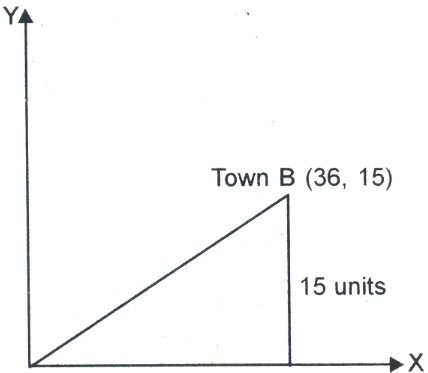
Let us take position of the town A as che origin and the position of the town B as the point B IS) in the coordinate axis as Shown in figure.
Now, |AB|= \(\sqrt{(36^{2}+(15)^{2}}\)
=\(\sqrt{{36}^{2}+{15}^{2}}\) = \(\sqrt{1296+225}\)
=\(\sqrt{1521}\) =39 units
20.
Here, a12 = 37 and d = 3
then, a12 = 37
\(\Rightarrow\) a + 11d = 37 [\(\because\) an = a + (n - 1) d]
\(\Rightarrow\) a + 11(3) = 37 [\(\because\) d = 3]
\(\Rightarrow\) a = 37 - 33 = 4
On putting n = 12, a = 4 and l = a12 = 37 in
\(\begin{aligned} & S_n=\frac{n}{2}(a+l) \text {, we get } \\ \end{aligned}\)
\(\begin{aligned} & \qquad S_{12}=\frac{12}{2}(4+37)=6 \times 41=246 \end{aligned}\)
Hence, a = 4 and S12 = 246.
21.
Consider the equation
x2 - 3x + 5 = 0
Comparing it with ax2 + bx + c = 0, we get
a = 2, b = -3 and c = 5
Discriminant = b2 - 4ac
= (-3)2 - 4 (2) (5) = 9 - 40
= - 31
As b2 - 4ac < 0,
Therefore, no real root is possible for the given equation.
22.
(b)
22
23.
(c)
- 77

10th Standard CBSE Syllabus & Materials
10th Standard CBSE
CBSE 10th Social Science PS - Federalism - New Model Questions Papers Study Material - QB365 Set A
NEW10th Standard CBSE
CBSE 10th Social Science PS - Power Sharing - New Model Questions Papers Study Material - QB365 Set A
NEW10th Standard CBSE
CBSE 10th Social Science GEO - Manufacturing Industries - New Model Questions Papers Study Material - QB365 Set A
NEW10th Standard CBSE
CBSE 10th Social Science GEO - Minerals and Energy Resources - New Model Questions Papers Study Material - QB365 Set A



NCERT Books

Syllabus

Exam Pattern

Sample Question Papers

Previous year Question Papers

Important Notes

MCQ Practice test

NCERT Exemplers

Case study Questions

Image Based Questions

Passage based Questions

HOT Questions

Value Based Questions

Model Questions Papers
NCERT ( Book Back ) Questions

Assertion and Reason
Important Questions And Answers

CBSE 10th Standard CBSE Subjects
CBSE Standards



