
 100% FREE ACCESS
10th Standard CBSE Syllabus & Materials
10th Standard CBSE
CBSE 10th Social Science ECO - Globalisation and the Indian Economy - New Model Questions Papers Study Material - QB365 Set A
NEW10th Standard CBSE
CBSE 10th Social Science ECO - Money and Credit - New Model Questions Papers Study Material - QB365 Set A
NEW10th Standard CBSE
CBSE 10th Social Science ECO - Sectors of the Indian Economy - New Model Questions Papers Study Material - QB365 Set A
NEW10th Standard CBSE
CBSE 10th Social Science ECO - Development - New Model Questions Papers Study Material - QB365 Set A
NEW10th Standard CBSE
CBSE 10th Social Science PS - Outcomes of Democracy - New Model Questions Papers Study Material - QB365 Set A
NEW10th Standard CBSE
CBSE 10th Social Science PS - Gender, Religion and Caste - New Model Questions Papers Study Material - QB365 Set A

Published on: 26/10/2025
Download CBSE Class 10th Standard CBSE Maths question papers, sample papers, important questions, and previous year solved papers in PDF format. Get free study materials, NCERT solutions, and exam preparation resources for Class 10th Standard CBSE Maths
Questions + Answers key
Take MCQ Maths Test
1.
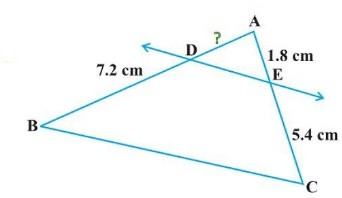
See the given Figure. DE || BC. Find AD
2.
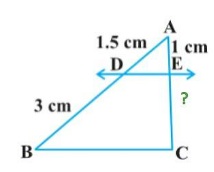
See the given Figure. DE || BC. Find EC
3.
Find a relation between x and y such that the point (x , y) is equidistant from the points A (7, 1) and B (3, 5).
4.
Find the distance between the points (0,0) and (36,15). Can you now find the distance between the two towns A and B by using Pythagoras Theorem?
5.
Check whether 301 is a term of the list of numbers 5, 11, 17, 23,......
6.
If (1,2),(4,y),(x,6) and (3,5) are the vertices of the parallelogram taken in order, find x and y.
7.
Find the 10th term of the AP : 2, 7, 12, . . .
8.
How many three-digit numbers are divisible by 7?
9.
Which of the following are APs? If they form an AP, find the common difference d and write three more terms.
- 10, - 6, - 2, 2.......
10.
How many terms of the AP : 24, 21, 18, . . . must be taken so that their sum is 78?
11.
In the given figure, if LM II CB and LN II CD. Prove that \(\frac { AM }{ AB } =\frac { AN }{ AD } .\)
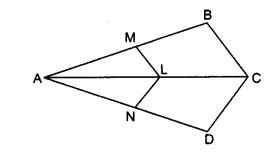
Use the basic proportionality theorem in both \(\Delta\)ABC and \(\Delta\)ACD
12.
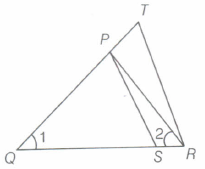
In the given figure, \(\frac { QR }{ QS } =\frac { QT }{ PR } \) and \(\angle 1=\angle 2\) . Show that \(\triangle PQS\sim \triangle TQR\) .
13.
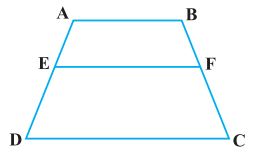
ABCD is a trapezium with AB || DC. E and F are points on non-parallel sides AD and BC respectively such that EF is parallel to AB. Show that \(\frac{AE}{ED}=\frac{BF}{FC}\).
14.
Check whether the points A(0, 0), B(5, -5) and C(-5, 5) are collinear?
15.
Show that the points (7,10), (-2,5) and (3,-4) are the vertices of an isosceles right triangle.
16.
Show that the points A(1,2), B(5,4), C(3,8) and D(-1,6) are the vertices of a square.
17.
How many terms of AP : 9, 17, 25,........ must be taken to give a sum of 636?
18.
State and prove Basic Proportionality theorem.
19.
If the sum of first n terms of an A.P.is given by Sn= 3n2+ 4n.Determine the A.P.and the nth term.
20.
Prove that the points A(2,3), B(-2,2), C(-1,-2) and D(3,-1) are the vertices of a square ABCD.
21.
The point of intersection of the line represented by 3x - y = 3 and Y -axis is given by
(0,-3)
(0,3)
(2,0)
(-2,0)
22.
The distance between the points \(P\left(-\frac{11}{3}, 5\right)\) and \(Q\left(-\frac{2}{3}, 5\right)\) is
6 units
2 units
4 units
3 units
23.
If -5, x, 3 are three consecutive terms of an AP then the value of x is
-2
2
-1
1
24.
In a right angled \(\Delta\)ABC, \(\angle\)A = 90° and AB = AC. The value of sin C is
0
\(\frac{\sqrt{3}}{2}\)
\(\frac{1}{2}\)
\(\frac{1}{\sqrt{2}}\)
25.
11th term of the AP: – 3 ,\(-\frac{1}{2}\) ,2 , ..., is
28
22
- 38
\(-48 \frac{1}{2}\)
26.
30th term of the AP: 10, 7, 4, . . . , is
97
77
- 77
- 87
27.
The 8th term of 117, 104, 91, 78, …….is.....
26
27
4
17
28.
The nth term of the AP 9, 13, 17, 21, 25, ………….. is:
3n+2
4n+5
5n+3
4n-5
29.
The first term of an A.P. is 12, the last term is -8, the common difference is -2. Find the sum of the A.P.
18
16
22
20
30.
What is the sum of the first 20 whole numbers
190
200
100
140
31.
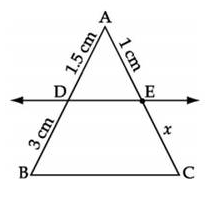
In figure, DE || BC, then x equals to :
1.4 cm
2 cm
4 cm
2.5 cm
32.
Two congruent triangles are actually similar triangles with the ratio of corresponding sides as.
1:2
1:1
1:3
2:1
33.
In triangle ABC, D and E are points on AB and AC such that DE || BC. If AD = 4x-3, AE = 8x-7, BD = 3x-1 and CE = 5x-3, find the value of x
1
1/2
1/2, -1
1, -1/2
34.
Given two triangles ABC and PQR such that, AB = 2 cm , PQ = 3cm, ∠B = ∠Q BC = 5 cm, QR = 7.5 cm. AG and PS are medians .Find \(\frac { AG }{ PS } \) =?
2/5
1/5
4/5
2/3
35.
A vertical stick 30 m long casts a shadow 15 m long on the ground. At the same time, a tower casts a shadow 75 m long on the ground. The height of the tower is:
200 m
150 m
25 m
100 m
36.
The point on y-axis that is equidistant from (2,3) and (-4,1) is
(0,-1)
(0,-2)
(1,0)
(1,2)
37.
The distance between the points (3,4) and (8,-6) is
2√5 units
3√5 units
√5 units
5√5 units
38.
The value of k, if the point P(0,2) is equidistant from A(3,k) and B(k,5) is
0
1
-3
3
39.
Find the distance of the point (–6, 8) from the origin
8
11
10
9
40.
Find the value of P for which the point (–1, 3), (2, p) and (5, –1) are collinear.
4
3
2
1
41.
The Chief Minister of Delhi launched the, 'Switch Delhi: an electric vehicle mass awareness campaign in the National Capital. The government has also issued tenders for setting up 100 charging stations across the city. Each station will have five charging points. For demo charging station is set up along a straight line and has charging points at \(A\left(\frac{-7}{3}, 0\right), B\left(0, \frac{7}{4}\right)\), C(3, 4), D(7, 7) and E(x, y). Also, the distance between C and E is 10 units.
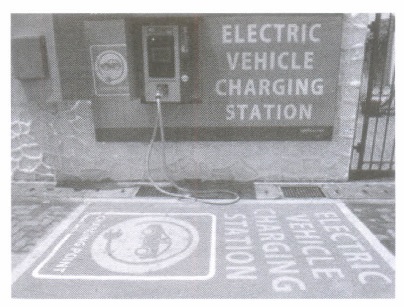
Based on the above information, answer the following questions.
(i) The distance DE is
| (a) 5 units | (b) 10 units | (c) 4 units | (d) 6units |
(ii) The value of x + y is
| (a) 20 | (b) 21 | (c) 22 | (d) 23 |
(iii) Which of the following is true?
| (a) The points C, D and E are vertices of a triangle |
| (b) The points C, D and E are collinear |
| (c) The points C, D and E lie on a circle |
| (d) None of these |
(iv) The ratio in which B divides AC is
| (a) 9:7 | (b) 4:7 | (c) 7:4 | (d) 7:9 |
(v) Which of the following equations is satisfied by the given points?
| (a) x + y = 0 | (b) x - y = 0 | (c) 3x - 4y + 7 = 0 | (d) 3x+4y+7=0 |
42.
In the backyard of house, Shikha has some empty space in the shape of a \(\Delta\)PQR. She decided to make it a garden. She divided the whole space into three parts by making boundaries AB and CD using bricks to grow flowers and
vegetables where ABIICDIIQR as shown in figure.
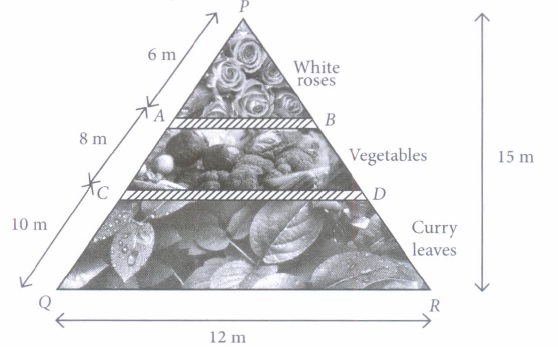
Based on the above information, answer the following questions.
(i) The length of AB is
| (a) 3m | (b) 4m | (c) 5m | (d) 6m |
(ii) The length of CD is
| (a) 4m | (b) 5m | (c) 6m | (d) 7m |
(iii) Area of whole empty land is
| (a) 90 m2 | (b) 60m2 | (c) 32m2 | (d) 72m2 |
(iv) Area of \(\Delta\)PAB is
| \((a) \frac{45}{4} \mathrm{~m}^{2}\) | \((b) \frac{45}{8} \mathrm{~m}^{2}\) | \((c) \frac{8}{45} \mathrm{~m}^{2}\) | \((d) \frac{4}{45} \mathrm{~m}^{2}\) |
(v) Area of \(\Delta\)PCD is
| \((a) \frac{12}{245} \mathrm{~m}^{2}\) | \((b) \frac{245}{12} \mathrm{~m}^{2}\) | \((c) \frac{243}{8} \mathrm{~m}^{2}\) | \((d) \frac{245}{8} \mathrm{~m}^{2}\) |
43.
In a class the teacher asks every student to write an example of A.P. Two friends Geeta and Madhuri writes their progressions as -5, -2, 1,4, ... and 187, 184, 181, .... respectively. Now, the teacher asks various students of the class the following questions on these two progressions. Help students to find the answers of the questions.
(i) Find the 34th term of the progression written by Madhuri.
| (a) 286 | (b) 88 | (c) -99 | (d) 190 |
(ii) Find the sum of common difference of the two progressions.
| (a) 6 | (b) -6 | (c) 1 | (d) 0 |
(iii) Find the 19th term of the progression written by Geeta.
| (a) 49 | (b) 59 | (c) 52 | (d) 62 |
(iv) Find the sum of first 10 terms of the progression written by Geeta.
| (a) 85 | (b) 95 | (c) 110 | (d) 200 |
(v) Which term of the two progressions will have the same value?
| (a) 31 | (b) 33 | (c) 32 | (d) 30 |
1.
Let AD = x cm
It is given that DE || BC.
By using basic proportionality theorem, we obtain
\( \frac{A D}{D B}=\frac{A E}{E C} \)
\(\frac{x}{7.2}=\frac{1.8}{5.4} \)
\(x=\frac{1.8 \times 7.2}{5.4}\)
x = 2.4
∴ AD = 2.4 cm
2.
Let EC = x cm
It is given that DE || BC.
By using basic proportionality theorem, we obtain
\(\frac{A D}{D B}=\frac{A E}{E C}\)
\(\frac{1.5}{3}=\frac{1}{x}\)
\(x=\frac{3 \times 1}{1.5}\)
x = 2
∴ EC = 2 cm
3.
Given point P(x, y) is equidistant from the points A(7, 1) and B(3, 5).
So, AP = BP
\(\Rightarrow\) AP2 = BP2
\(\Rightarrow\) (x - 7)2 + (y - 1)2 = (x - 3)2 + (y - 5)2
\(\left[\because \text { distance }=\sqrt{\left(x_2-x_1\right)^2+\left(y_2-y_1\right)^2}\right]\)
\(\Rightarrow\) x2 + 49 - 14x + y2 + 1 - 2y
= x2 + 9 - 6x + y2 + 25 - 10y
\(\Rightarrow\) -14x - 2y + 50 = -6x - 10y + 34
\(\Rightarrow\) -6x - 10y + 14x + 2y = 50 - 34
\(\Rightarrow\) 8x - 8y = 16
\(\Rightarrow\) x - y = 2
[dividing by 8 on both sides]
Hence, the relation between x and y is x - y = 2.
4.
Given points are A(0,0) and B(36,15)
Now, using distance formula, we have
AB = \(\sqrt {(36-0)^{2}+(15-0)^{2}}\)
=\(\sqrt{{36}^{2}+{15}^{2}}\) = \(\sqrt{1296+225}\)
=\(\sqrt{1521}\) =39 units
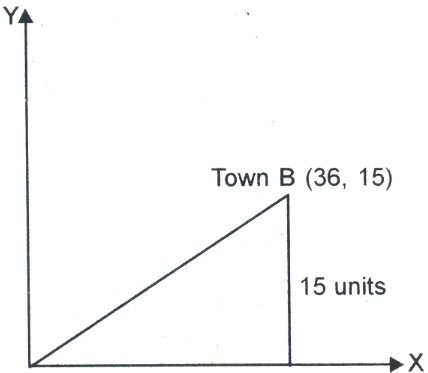
Let us take position of the town A as che origin and the position of the town B as the point B IS) in the coordinate axis as Shown in figure.
Now, |AB|= \(\sqrt{(36^{2}+(15)^{2}}\)
=\(\sqrt{{36}^{2}+{15}^{2}}\) = \(\sqrt{1296+225}\)
=\(\sqrt{1521}\) =39 units
5.
We have :
a2 – a1 = 11 – 5 = 6,
a3 – a2 = 17 – 11 = 6,
a4 – a3 = 23 – 17 = 6
As ak + 1 – ak is the same for k = 1, 2, 3, etc., the given list of numbers is an AP.
Now, a = 5 and d = 6.
Let 301 be a term, say, the nth term of this AP.
We know that
an = a + (n – 1) d
So, 301 = 5 + (n – 1) x 6
i.e., 301 = 6n – 1
So, \(n=\frac{302}{6}=\frac{151}{3}\)
But n should be a positive integer . So, 301 is not a term of the given list of numbers.
6.
Let A(1, 2), B(4, y), C(x, 6) and D(3, 5) are the vertices of a parallelogram.
Since, ABCD is a parallelogram.
\(\therefore\) Diagonals AC and BD will bisect each other. So, the mid-point of AC and mid-point of BD will be same
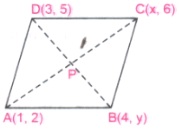
Thus mid-point of AC = Mid-point of BD
\(\begin{aligned} \Rightarrow \quad & \left(\frac{1+x}{2}, \frac{2+6}{2}\right)=\left(\frac{4+3}{2}, \frac{y+5}{2}\right) \\ \end{aligned}\)
\(\begin{aligned} & {\left[\because \text { coordinates of mid-point }=\left(\frac{x_1+x_2}{2}, \frac{y_1+y_2}{2}\right)\right] } \end{aligned}\)
On comparing the coordinate from both sides,we get
\(\frac{1+x}{2}=\frac{4+3}{2} \text { and } \frac{2+6}{2}=\frac{5+y}{2}\)
\(\Rightarrow\) 1 + x = 7 and 8 = 5 + y
\(\therefore\) x = 6 and y = 3
7.
Here, a = 2, d = 7 – 2 = 5 and n = 10.
We have an = a + (n – 1) d
So, a10 = 2 + (10 – 1) × 5 = 2 + 45 = 47
Therefore, the 10th term of the given AP is 47.
8.
We know that 105 is the first and 994 is the last three-digit numbers divisible by 7. Thus, we have to determine the number of terms in the list 105, 112, 119,... , 994.
Clearly, the successive difference of the terms is same. So, above list of numbers forms an AP, with first term (a) = 105
and common difference (d) =112- 105 =7
Let there be n terms in the AP.
Then, nth term = 994
\(\Rightarrow\) 105 + (n - 1) 7 = 994 [\(\because\) an = a + (n -1)d]
\(\Rightarrow\) 7 (n -1) = 994 - 105
\(\Rightarrow\) 7 (n - 1) = 889
\(\Rightarrow\) n = 127 + 1 = 128
Hence, there are 128 numbers of three-digit which are divisible by 7.
9.
It is in AP with common difference d=−6+10=4, and a=−10
Next three terms are
a+(5−1)d=6,
a+(6−1)d=10,
a+(7−1)d=14
Yes, d = 4 and next three terms are 6, 10, 14.
10.
Here, a = 24, d = 21 – 24 = –3, Sn = 78. We need to find n.
We know that \(\mathrm{S}_{n}=\frac{n}{2}[2 a+(n-1) d]\)
So, \(78=\frac{n}{2}[48+(n-1)(-3)]=\frac{n}{2}[51-3 n]\)
or 3n2 – 51n + 156 = 0
or n2 – 17n + 52 = 0
or (n – 4) (n – 13) = 0
or n = 4 or 13
Both values of n are admissible. So, the number of terms is either 4 or 13.
11.
In \(\Delta\)ACB, LM || CB [given]
\(\Rightarrow \quad \frac{A M}{M B}=\frac{A L}{L C}\) ....(i)
[ by basic proportionality theorem]
In \(\Delta\)ACD, LN ||CD [given]
\(\Rightarrow \quad \frac{A N}{N D}=\frac{A L}{L C}\) ....(ii)
[by basic proportionality theorem]
From Eqs. (i) and (ii), we get
\(\frac{A M}{M B}=\frac{A N}{N D} \Rightarrow \frac{M B}{A M}=\frac{N D}{A N}\)
[on taking reciprocal of the terms]
\(\Rightarrow \quad \frac{M B}{A M}+1=\frac{N D}{A N}\) + 1 [adding 1 on both sides]
\(\begin{aligned} & \Rightarrow \quad \frac{M B+A M}{A M}=\frac{N D+A N}{A N} \\ \end{aligned}\)
\(\begin{aligned} \Rightarrow \quad \frac{A M}{A M+M B}=\frac{A N}{A N+N D} \end{aligned}\)
[on taking reciprocal of the terms]
\(\therefore \quad \frac{A M}{A B}=\frac{A N}{A D} \quad\left[\begin{array}{c} \because A D=A N+N D \\ \text { and } A B=A M+M B \end{array}\right]\)
Hence proved.
12.
In \(\triangle PQR, \angle 1=\angle 2\) [given]
\(\Rightarrow \) PR = PQ [since, sides opposite to equal angles of a triangle are not equal]
Given that, \(\frac { QR }{ QS } =\frac { QT }{ PR } \Rightarrow \quad \frac { QR }{ QS } =\frac { QT }{ PQ } \)
[\(\because \) PQ = PR, proved above]
\(\Rightarrow \frac { QS }{ QR } =\frac { PQ }{ QT } \)
[on taking of the terms reciprocals] ... (i)
In \(\triangle PQS\) and \(\triangle TQR\), we have
\(\angle PQS=\angle TQR\) [common]
and \(\Rightarrow \frac { QS }{ QR } =\frac { QP }{ QT } \) [from Eq.(i)]
\(\therefore \triangle PQS\sim \triangle TQR\) [by SAS similarity criterion]
Hence proved.
13.
Let us join AC to intersect EF at G
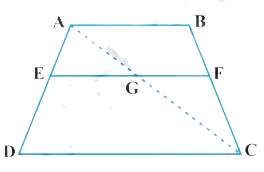
AB || DC and EF || AB (Given)
So, EF || DC (Lines parallel to the same line are parallel to each other)
Now, in \(\Delta\) ADC,
EG || DC (As EF || DC)
So, \(\frac{AE}{ED}=\frac{AG}{GC}\)
Similarly, from \(\Delta\)CAB,
\(\begin{aligned} & \frac{C G}{A G}=\frac{C F}{B F} \\ \end{aligned}\)
\(\begin{aligned} & \frac{A G}{G C}=\frac{B F}{F C} \end{aligned}\)
Therefore, from (1) and (2),
\(\frac{\mathrm{AE}}{\mathrm{ED}}=\frac{\mathrm{BF}}{\mathrm{FC}}\)
14.
No
15.
AB2=(-2-7)2+(5-10)2 = (-9)2+(-5)2 =81+25 =106
BC2=(3-(-2))2+(-4-5)2=(5)2+(-9)2=25+81=106
AC2=(3-7)2+(-4-10)2=(4)2+(14)2=16+196=212
Since AB2+BC2=AC2
∴ ABC is a right triangle.
AB = \(\sqrt { 106 } \) and BC = \(\sqrt { 106 } \)
∵ AB = BC
∴ ABC is an isosceles right triangle.
16.
A(1,2), B(5,4), C(3,8) and D(-1, 6)
\(AB=\sqrt{4^2+2^2}=\sqrt{16+4}=\sqrt{20};\ BC=\sqrt{(-2)^2+(4)^2}=\sqrt{4+16}=\sqrt{20}\)
\(CD=\sqrt{(-4)^2+(-2)^2}=\sqrt{16+4}=\sqrt{20};\ DA=\sqrt{(-2)^2+(4)^2}=\sqrt{4+16}=\sqrt{20}\)
Here AB=BC=CA=DA
\(AC=\sqrt{2^2+6^2}=\sqrt{40}\ and\ BD=\sqrt{(-6)^2+(2)^2}=\sqrt{36+4}=\sqrt{40}\)
All sides of quadrilateral are equal and diagonals are equal.
ABCD is square.
17.
Given, a = 9, d = 17 - 9 = 8,
Sn = 636
Sn = \(\frac{n}{2}[2a+(n-1)d]\)
\(\Rightarrow\) 636 = \(\frac{n}{2}[2\times9+(n-1)8]\Rightarrow636\times 2=n[18+8n-8]\)
\(\Rightarrow\) 636 X 2 = n ( 10 + 8n ) \(\Rightarrow\) 636 x 2 = 2n ( 5 + 4n )
\(\Rightarrow\) \(\frac{636\times2}{2}\) = 5n + 4n2 \(\Rightarrow\) 4n2 + 5n - 636 = 0
\(\Rightarrow\) 4n2 + 53n + 48n - 636 = 0 \(\Rightarrow\) 4n( n + 53 ) - 48 ( n + 53 ) = 0
\(\Rightarrow\) ( 4n - 48 ) ( n + 53 ) = 0 \(\Rightarrow\) Either 4n = 48 or n + 53 = 0
\(\Rightarrow\) n = \(\frac{48}{4}\) or n = -53 (rejected)
\(\Rightarrow\) n = 12
Hence n = 12
18.
Basic Proportionality theorem It states that if a line is parallel to a side of a triangle which intersects the other sides into two distinct points, then the line divides those sides of the triangle in proportion.
Given Let ABC be a triangle.
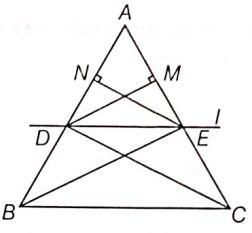
In the given triangle, line I is parallel to BC which intersect AB at D and AC at E.
To prove \(\frac{A D}{D B}=\frac{A E}{E B}\)
Construction Join BE and CD. Draw perpendicular lines DM and EN to the sides AC and AB of \(\Delta\)ABC respectively, as shown in the figure.
Proof Consider the given \(\Delta\)ABC.
\(\Delta\)ADE and \(\Delta\)DEB have equal heights i.e. EN.
So, area of \(\Delta\)ADE = \(\frac{1}{2} \times A D \times E N\)
Area of \(\Delta\)DEB = \(\frac{1}{2} \times D B \times E N\)
Thus, \(\frac{\text { Area }(\triangle A D E)}{\text { Area }(\triangle D E B)}=\frac{A D}{D B}\) ...(i)
Similarly, consider the \(\Delta\)ADE with base AE and height DM.
\(\begin{aligned}
& \text { Area of } \triangle A D E=\frac{1}{2} \times A E \times D M \\
\end{aligned}\)
\(\begin{aligned}
& \text { Area of } \triangle C D E=\frac{1}{2} \times E C \times D M \\
\end{aligned}\)
\(\begin{aligned}
& \frac{\text { Area }(\triangle A D E)}{\text { Area }(\triangle C D E)}=\frac{A E}{E C}
\end{aligned}\) ...(ii)
It is known that triangles with the same base and between same parallel lines have an equal area
Here, \(\Delta\)BDE and \(\Delta\)CDE have the same base DE and lie between the parallel lines DE and BC
\(\Rightarrow\) \(A(\triangle D E B)=A(\triangle D E C)\) ...(iii)
From Eqs. (i), (ii) and (iii), we get
\(\begin{array}{rlrl}
\frac{A(\triangle A D E)}{A(\triangle D E B)} =\frac{A(\triangle A D E)}{A(\triangle D E C)} \\
\end{array}\)
\(\Rightarrow \quad \frac{A D}{D B}=\frac{A E}{E C}\) Hence proved
19.
Sn = 3n2 + 4n.
a1=S1= 3(1)2 + 4(1) = 7
a1 + a2 = S2 = 3(2)2 + 4(2)
= 12 + 8 = 20
a2 = S2 - S1 = 20 - 7 = 13
\(\Rightarrow\) a + d = 13
\(\Rightarrow\) 7 + d = 13
\(\therefore\) d = 13 - 7 = 6
\(\therefore\) A.P. becomes 7, 13, 19, ......
Now, an = a + (n - 1)d
\(\Rightarrow\) = 7 + (n - 1)(6)
= 7+ 6n - 6
= 6n + 1
\(\Rightarrow\) an = 6n+ 1
20.
Here, |AB|= \(\sqrt { (-2-2)^{ 2 }+(2-3)^{ 2 } } \)
= \(\sqrt { (-4)^{ 2 }+(-1)^{ 2 } } \)
=\(\sqrt { 16+1 } =\sqrt { 17 } \) Units
|BC|= \(\sqrt { (-1+2)^{ 2 }+(-2-2)^{ 2 } } \)
= \(\sqrt { (1)^{ 2 }+(-4)^{ 2 } } \)
=\(\sqrt { 1+16 } =\sqrt { 17 } \) units
|CD|= \(\sqrt { (3+1)^{ 2 }+(-1+2)^{ 2 } } \)
=\(\sqrt { 4^{ 2 }+1^{ 2 } } \)
= \(\sqrt { 17 } \)=units
|DA|=\(\sqrt { (2-3)^{ 2 }+(3+1)^{ 2 } } \)
= \(\sqrt { (-1)^{ 2 }+4^{ 2 } } \)=\(\sqrt { 1+16 } \)
= \(\sqrt { 17 } \) units
\(\Rightarrow \) AB=BC=CD=DA= units
Now,Diagonal |AC| =\(\sqrt { (-1-2)^{ 2 }+(-2-3)^{ 2 } } \)
= \(\sqrt { (-3)^{ 2 }+(-5)^{ 2 } } \)
=\(\sqrt { 9+25 } =\sqrt { 34 } \) units
Diagonal |BD|= \(\sqrt { (3+2)^{ 2 }+(-1-2)^{ 2 } } \)
= \(\sqrt { { 5 }^{ 2 }+(-3)^{ 2 } } \)
= \(\sqrt { 25+9 } =\sqrt { 34 } \) units
\(\Rightarrow \) Diagonal AC=Diagonal BD= units
Hence ABCD is a square
21.
(b)
(0,3)
22.
(d)
3 units
23.
(d)
1
24.
(d)
\(\frac{1}{\sqrt{2}}\)
25.
(b)
22
26.
(c)
- 77
27.
(a)
26
28.
(b)
4n+5
29.
(c)
22
30.
(a)
190
31.
(b)
2 cm
32.
(b)
1:1
33.
(b)
1/2
34.
(d)
2/3
35.
(b)
150 m
36.
(a)
(0,-1)
37.
(d)
5√5 units
38.
(b)
1
39.
(c)
10
40.
(d)
1
41.
(i) (a): Here, CD = \(\sqrt{(7-3)^{2}+(7-4)^{2}}\)
\(=\sqrt{4^{2}+3^{2}}\) = 5 units
Also, it is given that CE = 10 units
Thus, DE = CE - CD = 10 - 5 = 5 units (\(\because\) A, B, C, E are a line)
(ii) (b): Since, CD = DE = 5 units
\(\therefore\) Dis the midpoint of CE.
\(\therefore \quad \frac{x+3}{2}=7 \text { and } \frac{y+4}{2}=7 \)
\(\Rightarrow \quad x=11 \text { and } y=10 \Rightarrow x+y=21\)
(iii) (b)
(iv) (d): Let B divides AC in the ratio k:1, then
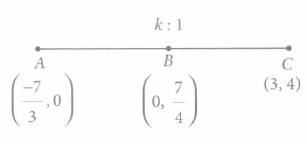
\(\frac{7}{4}=\frac{4 k+0}{k+1} \)
\(\Rightarrow 7 k+7=16 k \)
\(\Rightarrow 7=9 k \)
\(\Rightarrow k=\frac{7}{9}\)
Thus, the required ratio is 7 : 9
(v) (c): It can be easily verify that all the given points lie on the line represented by 3x - 4y + 7 = 0.
42.
(i) (a): In \(\Delta\)PAB and \(\Delta\)PQR,
\(\angle\)P = \(\angle\)P (Common)
\(\angle\)A = \(\angle\)Q (Corresponding angles)
By AA similarity criterion, \(\Delta\)PAB \(\sim\) \(\Delta\)PQR
\(\therefore \frac{A B}{Q R}=\frac{P A}{P Q} \Rightarrow \frac{A B}{12}=\frac{6}{24} \Rightarrow A B-3 \mathrm{~m}\)
(ii) (d): Similarly, \(\Delta\)PCD and \(\Delta\)PQR are similar
\(\therefore \frac{P C}{P Q}=\frac{C D}{Q R} \Rightarrow \frac{14}{24}=\frac{C D}{12} \Rightarrow C D=7 \mathrm{~m}\)
(iii) (a): Area of whole empty land
= \(\frac{1}{2}\)x base x height = \(\frac{1}{2}\) x 1 x15= 90 m2.
(iv) (b): Since, \(\Delta\)PAB \(\sim\) \(\Delta\)PQR
\(\therefore \frac{\operatorname{ar}(\Delta P A B)}{a r(\Delta P Q R)}=\left(\frac{P A}{P Q}\right)^{2}=\left(\frac{6}{24}\right)^{2}=\frac{1}{16}\)
\(\Rightarrow \quad \operatorname{ar}(\Delta P A B)=\frac{1}{16} \times 90=\frac{45}{8} \mathrm{~m}^{2}\) \(\left[\because \operatorname{ar}(\Delta P Q R)=90 \mathrm{~m}^{2}\right]\)
(v) (d): Since, \(\Delta\)PCD \(\sim\) \(\Delta\)PQR
\(\therefore \frac{\operatorname{ar}(\Delta P C D)}{\operatorname{ar}(\Delta P Q R)}=\left(\frac{P C}{P Q}\right)^{2}=\left(\frac{14}{24}\right)^{2}=\left(\frac{7}{12}\right)^{2}\)
\(\Rightarrow \operatorname{ar}(\Delta P C D)=\frac{90 \times 49}{144}=\frac{245}{8} \mathrm{~m}^{2}\)
43.
Geeta's A.P. is -5, -2, 1,4, ...
Here, first term (a1) = -5 and common difference (d1) = -2 + 5 = 3
Similarly, Madhuri's A.P. is 187, 184, 181, ...
Here first term (a2) = 187 and common difference (d2) = 184 - 187 = -3
(i) (b): t34 = a2 + 33d2 = 187 + 33(-3) = 88
(ii) (d): Required sum = 3 + (-3) = 0
(iii) (a): t19 = a1 + 18d1 = (-5) + 18(3) = 49
(iv) (a) : \(S_{10}=\frac{n}{2}\left[2 a_{1}+(n-1) d_{1}\right]=\frac{10}{2}[2(-5)+9(3)]=85\)
(v) (b): Let nth terms of the two A.P:s be equal.
\(\therefore\) -5 + (n - 1)3 = 187 + (n - 1)(-3)
\(\Rightarrow\) 6(n - 1) = 192 \(\Rightarrow\) n = 33

10th Standard CBSE Syllabus & Materials
10th Standard CBSE
CBSE 10th Social Science PS - Federalism - New Model Questions Papers Study Material - QB365 Set A
NEW10th Standard CBSE
CBSE 10th Social Science PS - Power Sharing - New Model Questions Papers Study Material - QB365 Set A
NEW10th Standard CBSE
CBSE 10th Social Science GEO - Manufacturing Industries - New Model Questions Papers Study Material - QB365 Set A
NEW10th Standard CBSE
CBSE 10th Social Science GEO - Minerals and Energy Resources - New Model Questions Papers Study Material - QB365 Set A



NCERT Books

Syllabus

Exam Pattern

Sample Question Papers

Previous year Question Papers

Important Notes

MCQ Practice test

NCERT Exemplers

Case study Questions

Image Based Questions

Passage based Questions

HOT Questions

Value Based Questions

Model Questions Papers
NCERT ( Book Back ) Questions

Assertion and Reason
Important Questions And Answers

CBSE 10th Standard CBSE Subjects
CBSE Standards



