
 100% FREE ACCESS
10th Standard CBSE Syllabus & Materials
10th Standard CBSE
CBSE 10th Social Science ECO - Globalisation and the Indian Economy - New Model Questions Papers Study Material - QB365 Set A
NEW10th Standard CBSE
CBSE 10th Social Science ECO - Money and Credit - New Model Questions Papers Study Material - QB365 Set A
NEW10th Standard CBSE
CBSE 10th Social Science ECO - Sectors of the Indian Economy - New Model Questions Papers Study Material - QB365 Set A
NEW10th Standard CBSE
CBSE 10th Social Science ECO - Development - New Model Questions Papers Study Material - QB365 Set A
NEW10th Standard CBSE
CBSE 10th Social Science PS - Outcomes of Democracy - New Model Questions Papers Study Material - QB365 Set A
NEW10th Standard CBSE
CBSE 10th Social Science PS - Gender, Religion and Caste - New Model Questions Papers Study Material - QB365 Set A

Published on: 26/10/2025
Download CBSE Class 10th Standard CBSE Maths question papers, sample papers, important questions, and previous year solved papers in PDF format. Get free study materials, NCERT solutions, and exam preparation resources for Class 10th Standard CBSE Maths
Questions + Answers key
Take MCQ Maths Test
1.
If tan A = cot B, prove that A + B = 90°.
2.
If the 2nd term of an AP is 13 and 5th term is 25, then what is its 7th term?
3.
If in an Ap, a = 15, d = -3 and an = 0, then find the value of n.
4.
Given that \(\sin { \alpha } =\frac { 1 }{ 2 } \) and \(\cos { \beta } =\frac { 1 }{ 2 } ,\) what is the value of \((\alpha +\beta )?\)
5.
A tower stands vertically on the ground. From a point on the ground 100 m away from the foot of the tower, the angle of elevation of the top of the tower is 45o . Find the height of the tower.
6.
Find the angle of the elevation of the sun if the length of the shadow of the tower of height 20 m is \(20\sqrt { 3 } \).
7.
Check whether -150 is a term of the AP: 11, 8, 5, 2,...
8.
Given, \(\sec { \theta } =\frac { 13 }{ 12 } \) calculate all other trigonometric ratios.
9.
Prove the following identities, where the angles involved are acute angles for which the expressions are defined.
\(\frac { \tan { \theta } }{ 1-\cot { \theta } } +\frac { \cot { \theta } }{ 1-\tan { \theta } } =1+\sec { \theta } cosec\theta \)
10.
From the top of a building 60 m high, the angles of depression of the top and bottom of a vertical lamp post are observed to be 30o and 60o respectively. Find
(i) The horizontal distance between the building and the lamp post.
(ii) The height of the lamp post, \(\sqrt { 3 } =1.732\).
11.
If the pth terms of an AP is \(\frac{1}{q}\) and the qth term is \(\frac{1}{p}\), show that the sum of pq terms is \(\frac{1}{2}\) (pq + 1).
12.
If the sum of first 6 terms of an AP is 36 and that of the first 16 terms is 256, find the sum of first 10 terms.
13.
A TV tower stands vertically on a bank of a canal. From a point on the other bank directly opposite the tower, the angle of elevation of the top of the tower is 60\(\unicode{xb0} \). From another point 20 m away from this point on the line joining this point to the foot of the tower, the angle of elevation of the top of the tower is 30\(\unicode{xb0} \) (see the given figure). Find the height of the tower and the width of the canal.

14.
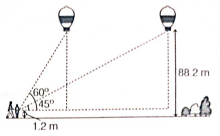
A 1.2 m tall girls pots a balloon moving with the wind in a horizontal linc at a height 88.2 m from the ground. The angle of elevation of the balloon from the eyes of the girlat any instant is 60°. After sometime, the angle of clevation reduces 45°. Find the distance travelled by the balloon during the interval.
15.
If \(\cos { \theta } +\sin { \theta } =\sqrt { 2 } \cos { \theta } \), show that \(\cos { \theta } -\sin { \theta } =\sqrt { 2 } \sin { \theta } \).
16.
The sum of first n terms of an A.P.is given by Sn = 3n2 - 4n. Determine the A.P.and the 12th term.
17.
If sin (A – B) = \(\frac{1}{2}\) cos (A + B) = \(\frac{1}{2}\) 0° < A + B \(\leq\) 90°, A > B, find A and B.
18.
How many multiples of 9 lie between 10 and 300?
19.
The horizontal distance between two poles is 15 m. The angle of depression of the top of first pole as seen from the top of second pole is 30o . If the height of the second pole is 24 m, find the height of the first pole. \((Use\sqrt { 3 } =1.732)\)
20.
A statue 1.46 m tall stand on the top of a pedestal. From a point on the ground, the angle of elevation of the top of the statue is 60o and from the same point, the angle of elevation of the top of the pedestal is 45o . Find the height of the pedestal. \((\sqrt { 3 } =1.73)\) .
21.
A man standing on the deck of a ship, which is 10 m above water level, observes the angle of elevation of the top of a hill as 60o and angle of depression of the base of the hill as 30o. Find the distance of the hill from the ship and height of the hill.
22.
In a right-angled ΔPQR, ∠Q=90°. If ∠P=45°, then value of tan P - cos2 R is
0
1
1/2
3/2
23.
If \(\sin \theta-\cos \theta=0\), then the value of θ is
30°
45°
90°
0°
24.
If the sum of the first n terms of an AP be \(3 n^2+n\) and its common difference is 6 , then its first term is
2
3
1
4
25.
If sin \(\theta=\frac{a}{b},\) then cos \(\theta\) is equal to
\(\frac{b}{\sqrt{b^{2}-a^{2}}}\)
\(\frac{b}{a}\)
\(\frac{\sqrt{b^{2}-a^{2}}}{b}\)
\(\frac{a}{\sqrt{b^{2}-a^{2}}}\)
26.
Let a be a sequence defined by a1 = 1, a2 = 1 and an = an - 1 + an - 2 for all n > 2, then the value of \(\frac{a_{4}}{a_{3}}\) is
\(\frac{2}{3}\)
\(\frac{5}{4}\)
\(\frac{4}{5}\)
\(\frac{3}{2}\)
27.
In an AP,if d = - 4,n = 7 and an = 4,thena is equal to
6
7
20
28
28.
15th term of the A.P. x – 7, x – 2, x + 3 … is
x + 83
x + 63
x + 53
x + 73
29.
The nth term of the AP 9, 13, 17, 21, 25, ………….. is:
3n+2
4n+5
5n+3
4n-5
30.
The first term of an A.P. is 12, the last term is -8, the common difference is -2. Find the sum of the A.P.
18
16
22
20
31.
If 3cot A=4, then find cos2 A – sin2 A
25/7
1/25
22/7
7/25
32.
If tan\(\theta =\frac { 12 }{ 5 } \) then\(\frac { 1+sin\theta }{ 1-sin\theta } \) is equal to
9
12/13
24
25
33.
The value of cosec2 30° sin2 45° – sec2 60° is
2
1
-2
0
34.
A man on a top of a tower observes a truck at an angle of depression α where tanα = 1/ √5 and sees that it is moving towards the base of the tower. Ten minutes later, the angle of depression of the truck is found to be β where tan β = √5 . If the truck is moving at a uniform speed, then how much more time it will take to reach the base of the tower.
150√5 sec
1500 sec
150 sec
150/ √5 sec
35.
Consider a ladder which makes an angle of 60° with a wall of height 10 m and its top just touches the top of the wall. If the ladder is now rotated in such a way that its top now touches the top of the opposite wall which has a height of 10/√3 m. What is the angle by which the ladder is rotated.
45°
60°
90°
30°
36.
The angle of depression of a car, standing on the ground, from the top of a 75 m high tower, is 30°. The distance of the car from the base of the tower (in m.) is:
75√3
25√3
150
50√3
37.
A tower stands vertically on the ground from a point on the ground which is 15 m away from the foot of tower. If the height of tower is 15√3 meters find the angle of elevation
30°
60°
90°
120°
38.
A tower stands vertically on the ground. From a point on the ground 30 m away from the foot of the tower, the angle of elevation of the top of the tower is 45°. The height of the tower will be
30√3 m
30 m
40 m
40√3 m
39.
An electrician has to repair an electric fault on a pole of height 4 m. He needs to reach a point 1.3 m below the top of the pole to undertake the repair work. The length of the ladder he should use which when inclined at an angle of 60° to the horizontal would enable him to reach the required position is:
\(\frac { 9\sqrt { 3 } }{ 5 } \)m
\(\frac { 5 }{ 9 } \)m
\(\frac { \sqrt { 3 } }{ 5 } \)m
\(\frac { 9 }{ 5 } \)m
40.
Assertion In right triangle ABC and DEF\(\left(\angle C=\angle F=90^{\circ}\right), \angle B \text { and } \angle E\) are acute angles, such that sin B = sin E, then \(\angle B=\angle E\)
Reason \(\Delta A B C \sim \Delta D E F\)
Codes:
(a) If both Assertion and Reason are correct and Reason is the correct explanation of Assertion.
(b) If both Assertion and Reason are correct, but Reason is not the correct explanation of Assertion.
(c) If Assertion is correct but Reason is Incorrect.
(d) If Assertion is incorrect but Reason is correct
41.
Assertion If the nth term of an AP be (2n2 - 1),then the sum of its first n terms is n3.
Reason If a,l and n are first term, last term and number of terms of an Ap, respectively then \(S_{n}=\frac{n}{2}(a+l)\)
Codes:
(a) If both Assertion and Reason are correct and Reason is the correct explanation of Assertion.
(b) If both Assertion and Reason are correct, but Reason is not the correct explanation of Assertion.
(c) If Assertion is correct but Reason is incorrect.
(d) If Assertion is incorrect but Reason is correct.
42.
A group of students of class X visited India Gate on an education trip. The teacher and students had interest in history as well.The teacher narrated that India Gate, official name Delhi Memorial, originally called All India War Memorial, monumental sandstone arch in New Delhi, dedicated to the troops of British India who died in wars fought between 1914 and 1919.The teacher also said that India Gate, which is located at the eastern end of the Rajpath (formerly called the Kingsway), is about 138 ft (42 m) in height.

(i) What is the angle of elevation if they are standing at a distance of 42 m away from the monument?
(a) 30° (b) 45° (c) 60° (d) 0°
(ii) They want to see the tower at an angle of 60°. So, they want to know the distance where they should stand and hence find the distance.
(a) 24.25 m (b) 20.12 m (c) 42 m (d) 24.64 m
(iii) If the altitude of the Sun is at 60°, then the height of the vertical tower that will cast a shadow of length 20 m is
(a) 20\(\sqrt3\)m (b) \(\frac{20}{\sqrt3}m\) (c) \(\frac{15}{\sqrt3}m\) (d) 15\(\sqrt3\)m
(iv) The ratio of the length of a rod and its shadow is 1:1. The angle of elevation of the Sun is
(a) 30° (b) 45° (c) 60° (d) 90°
(v) The angle formed by the line of sight with the horizontal when the object viewed is below the horizontal level is
(a) corresponding angle (b) angle of elevation (c) angle of depression (d) complete angle
43.
The production of TV sets in a factory increases uniformly by a fixed number every year. It produced 16000 sets in 6th year and 22600 in 9th year.
(i) Find the production during first year.
| (a) Rs. 5000 | (b) Rs. 2200 | (c) Rs. 10000 | (d) none of these |
(ii) Find the production during 8th year
| (a) Rs. 7200 | (b) Rs. 22000 | (c) Rs. 20400 | (d) none of these |
(iii) Find the production during first 3 years.
| (a) Rs. 21600 | (b) Rs. 22000 | (c) Rs. 20400 | (d) none of these |
(iv) In which year, the production is Rs. 29,200.
| (a) 10 | (b) 11 | (c) 12 | (d) 13 |
(v) Find the difference of the production during 7th year and 4th year.
| (a) Rs. 5000 | (b) Rs. 2200 | (c) Rs. 10000 | (d) none of these |
44.
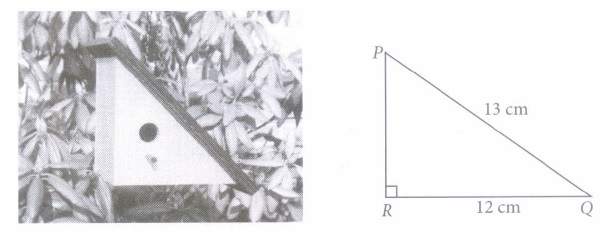
Anita, a student of class 10th, has to made a project on 'Introduction to Trigonometry' She decides to make a bird house which is triangular in shape. She uses cardboard to make the bird house as shown in the figure. Considering the front side of bird house as right angled triangle PQR, right angled at R, answer the following questions.
(i) If \(\angle P Q R=\theta, \text { then } \cos \theta=\)
| \((a) \frac{12}{5}\) | \((b) \frac{5}{12}\) | \((c) \frac{12}{13}\) | \((d) \frac{13}{12}\) |
(ii) The value of sec \(\theta\) =
| \((a) \frac{5}{12}\) | \((b) \frac{12}{5}\) | \((c) \frac{13}{12}\) | \((d) \frac{12}{13}\) |
(iii) The value of \(\frac{\tan \theta}{1+\tan ^{2} \theta}=\)
| \((a) \frac{5}{12}\) | \((b) \frac{12}{5}\) | \((c) \frac{60}{169}\) | \((d) \frac{169}{60}\) |
(iv) The value of \(\cot ^{2} \theta-\operatorname{cosec}^{2} \theta=\)
| (a) -1 | (b) 0 | (c) 1 | (d) 2 |
(v) The value of \(\sin ^{2} \theta+\cos ^{2} \theta=\)
| (a) 0 | (b) 1 | (c) -1 | (d) 2 |
1.
∵ tan A = cot B
tan A = tan (90° – B)
A = 90° – B
A + B = 90°. Proved
2.
Let the first term of the AP be a , and the common difference be d . It is given that the \(2^{\text {nd }}\) term is 13 ie and also that the \(5^{\text {th }}\) term is 25 , i.e.
\(t_5=a+4 d\)
Solving for d, we get \((a+4 d)-(a+d)=25-13=12\)
Thus, \(3 \mathrm{~d}=12\)
Or, d = 4.
Hence, a=13-4=9. To find the 7th term, we need to find the value of a+6 d i.e. 9+6(4)=33.
Thus the 7th term of the given arithmetic progression is 33
3.
6
4.
\(sin\ \alpha =\frac { 1 }{ 2 } and\ cos\ \beta =\frac { 1 }{ 2 }\)
\( \\ \Rightarrow d sin\ \alpha =sin\ 30°\left[ \because \ sin\ 30°=\frac { 1 }{ 2 } \right] \ \)
\(\ and\ cos\ \beta \ =\ cos\ 60°\ \left[ \because \ cos\ 60°=\frac { 1 }{ 2 } \right] \)
\(\\ \Rightarrow \ \alpha \ =\ 30°\ and\ \ beta \ = \ 60°\)
\(\\ \therefore \ \alpha \ +\ \beta \ =\ 30°+60°=90°\)
5.
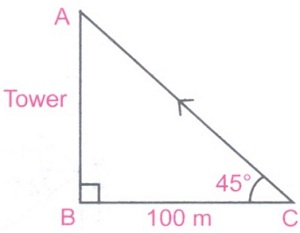
Let AB is tower and C is a point on the ground such that BC = 100 m
In right \(\Delta\)ABC,
\(\frac { AB }{ BC } =\tan { { 45 }^{ o } } \)
\(\Rightarrow\) \(\frac { AB }{ 100 } =1\)
\(\Rightarrow\) AB = 100 m
6.
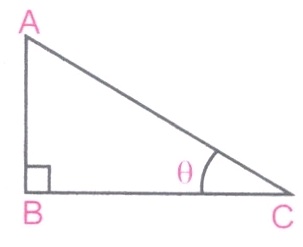
Let AB is tower and BC is its shadow
∴ AB = 20 m and BC = 20\(\sqrt { 3 } \)
In right ΔABC, \(\frac { AB }{ BC } \) = tanፀ
⇒ tanፀ = \(\frac { 20 }{ 20\sqrt { 3 } } \)
⇒ tanፀ = \(\frac { 1 }{ \sqrt { 3 } } \)
⇒ ፀ = 30o
7.
Here, a = 11 and d = 8 - 11 = -3
Assume that, -150 be the nth term of the given AP.
We know that the nth term of an AP is
an = a + (n - 1)d
\(\Rightarrow\) -150 = 11 + (n - 1) (-3)
\(\Rightarrow n-1=\frac{161}{3}\)
\(\Rightarrow n=\frac{161}{3}+1=\frac{164}{3}\)
But n should be a positive integer.
So, - 150 is not a term of the given AP.
8.
Given, \(\sec { \theta } =\frac { 13 }{ 12 } \)
\(\Rightarrow \quad \frac{P R}{P Q}=\frac{13}{12} \quad\left[\because \sec \theta=\frac{H}{B}\right]\)
Let, PR = 13k and PQ = 12k
Where, k is any positive integer.
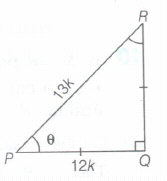
In right angled \(\triangle PQR,\)
PQ2 + RQ2 = PR2
[By using Pythagoras theorem]
\(\Rightarrow\) RQ2 + (12k)2 =( 13k)2
\(\Rightarrow\) RQ2 + 144k2 = 169k2
\(\Rightarrow\) RQ2 = 169k2 - 144k2 = 25k2
\(\Rightarrow\) PQ - 5k [using positive square for since, side cannot be negative]
\(\sin { \theta } =\frac { P }{ H } =\frac { 5k }{ 13k } =\frac { 5 }{ 13 } \)
\(\cos { \theta } =\frac { B }{ H } =\frac { 12k }{ 13k } =\frac { 12 }{ 13 } \)
\(\begin{aligned} & \tan \theta=\frac{\sin \theta}{\cos \theta}=\frac{5 / 13}{12 / 13}=\frac{5}{13} \times \frac{13}{12}=\frac{5}{12} \\ \end{aligned}\)
\(\begin{aligned} & \operatorname{cosec} \theta=\frac{1}{\sin \theta}=\frac{13}{5} \text { and } \cot \theta=\frac{1}{\tan \theta}=\frac{12}{5} \end{aligned}\)
9.
LHS = \(\frac { \tan { \theta } }{ 1-\cot { \theta } } +\frac { \cot { \theta } }{ 1-\tan { \theta } } =\frac { \frac { \sin { \theta } }{ \cos { \theta } } }{ 1-\frac { \cos { \theta } }{ \sin { \theta } } } +\frac { \frac { \cos { \theta } }{ \sin { \theta } } }{ 1-\frac { \sin { \theta } }{ \cos { \theta } } } \) \(\left[ \because \tan { A } =\frac { \sin { A } }{ \cos { A } } ,\cot { A } =\frac { \cos { A } }{ \sin { A} } \right] \)
\(=\frac { \frac { \sin { \theta } }{ \cos { \theta } } }{ \frac { \sin { \theta } -\cos { \theta } }{ \sin { \theta } } } +\frac { \frac { \cos { \theta } }{ \sin { \theta } } }{ \frac { \cos { \theta } -\sin { \theta } }{ \cos { \theta } } } \)
\(=\frac { \sin { \theta } }{ \cos { \theta } } \times \frac { \sin { \theta } }{ \sin { \theta } -\cos { \theta } } +\frac { \cos { \theta } }{ \sin { \theta } } \times \frac { \cos { \theta } }{ \cos { \theta } -\sin { \theta } } \)
\(=\frac { \sin ^{ 2 }{ \theta } }{ \cos { \theta } (\sin { \theta } -\cos { \theta } ) } -\frac { \cos ^{ 2 }{ \theta } }{ \sin { \theta } (\sin { \theta } -\cos { \theta } ) } \)
\(=\frac { \sin ^{ 3 }{ \theta } -\cos ^{ 3 }{ \theta } }{ \cos { \theta } \sin { \theta } (\sin { \theta } -\cos { \theta } ) } \)
\(=\frac { (\sin { \theta } -\cos { \theta } )(\sin ^{ 2 }{ \theta } +\cos ^{ 2 }{ \theta } +\sin { \theta } \cos { \theta } ) }{ \cos { \theta } \sin { \theta } (\sin { \theta } -\cos { \theta } ) } \) \(\left[ \because { x }^{ 3 }-{ y }^{ 3 }=(x-y)({ x }^{ 2 }+{ y }^{ 2 }+xy) \right] \)
\(=\frac { 1+\sin { \theta } \cos { \theta } }{ \cos { \theta } \sin { \theta } } \quad \left[ \because \sin ^{ 2 }{ \theta } +\cos ^{ 2 }{ \theta } =1 \right] \)
\(=\frac { 1 }{ \cos { \theta } \sin { \theta } } +\frac { \sin { \theta } \cos { \theta } }{ \sin { \theta } \cos { \theta } } =\frac { 1 }{ \cos { \theta } \sin { \theta } } +1\)
\(=1+\sec { \theta } cosec\theta \quad \left[ \because \frac { 1 }{ \sin { \theta } } =cosec\theta \quad and\quad \frac { 1 }{ \cos { \theta } } =\sec { \theta } \right] \)
= RHS
Hence proved.
10.
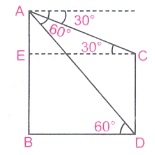
Let AB=60 m is height of building and CD is lamp post
(i) In rt ΔABD, \(\frac { AB }{ BD } \)=tan600
⇒ \(\frac { 60 }{ BD } =\sqrt { 3 } \Rightarrow \frac { 60 }{ \sqrt { 3 } } \)=BD
⇒ BD=\(\frac { 60\times \sqrt { 3 } }{ 3 } =20\sqrt { 3 } \)m
⇒ BD=20 x 1.732=34.64 m
(ii) In rt. ΔAEC, \(\frac { AE }{ EC } \)=tan300
⇒ \(\frac { AE }{ 20\sqrt { 3 } } =\frac { 1 }{ \sqrt { 3 } } \) [∵ EC=BD]
⇒ AE=20 m
and EB=AB-AE=60-20=40 m
Also EB=CD
⇒ CD=40 m
∴ Height of lamp post =40 m.
11.
Tp = a + ( p - 1 )d
\(\Rightarrow\) \({1\over q}=a+(p-1)d\) ...(i)
Tq = a + ( p - 1 )d
\(\Rightarrow\) \({1\over q}a+(q-1)d\) ...(ii)
Subtracting (ii) from (i), we get
\({p-q\over pq}=(p-q)d\Rightarrow d={1\over pq}\)
Putting d = \({1 \over pq}\) in (i), we have
\({1\over q}=a+{(p-q)\over pq}\Rightarrow a={1\over pq}\)
\(\therefore\) Spq = \({pq\over2}[2a+(pq-1)d]\)
or, Spq = \({pq\over2}\left[ {{2\over pq}+{(pq-1)\over pq}} \right]\)
\(={1\over 2}(pq+1)\)
12.
\(\because\) S6 = 36 and S16 = 256.
\(\Rightarrow\) S6 = \({6\over2}\) [ 2a + 5d ]
[ \(\because\) Sn = \({n\over2} [ 2a + ( n - 1)d ]\)
\(\Rightarrow\) S6 = 3 ( 2a + 5d )
\(\Rightarrow\) \({36\over3}\) = 2a + 5d
\(\Rightarrow\) 12 = 2a + 5d ...(i)
and S16 = \({16\over2}[2a+15d]\)
\(\Rightarrow\) \({256\over8}=2a+15d\)
\(\Rightarrow\) 32 = 2a + 15d ...(ii)
Subtracting (i) and (ii), 2n + 5d = 12
2a + 15d = 32
- - -
-10d = -20 \(\Rightarrow\) d = 2
\(\therefore\) From (i), 12 = 2a + 5(2)
12 - 10 = 2a \(\Rightarrow\) 2a = 2 \(\Rightarrow\) a = 1
Hence S10 = \({10\over2}[2a+9d]\)
= 5 ( 2 x 1 + 9 x 2 )
= 5 ( 2 + 18 )
\(\Rightarrow\) S10 = 5 x 20 = 100.
13.
Let BC = x m be the width of the canal and AB = h m be the height of the tower.
Given, \(\angle\)ACB = 60\(\unicode{xb0} \) and \(\angle\)ADB = 30\(\unicode{xb0} \)
In right angled \(\Delta\)ABD,
\(\tan 30^{\circ}=\frac{P}{B}=\frac{A B}{D B}\)
\(\Rightarrow \quad \frac{1}{\sqrt{3}}=\frac{h}{D C+C B}\)

\(\left[\because \tan 30^{\circ}=\frac{1}{\sqrt{3}} \text { and } D B=D C+C B\right]\)
\(\Rightarrow \quad \frac{1}{\sqrt{3}}=\frac{h}{20+x} \Rightarrow 20+x=\sqrt{3} h\) ...(i)
and in right angled \(\Delta\)ABC,
\(\tan 60^{\circ}=\frac{A B}{B C} \Rightarrow \sqrt{3}=\frac{h}{x} \quad\left[\because \tan 60^{\circ}=\sqrt{3}\right]\)
\(\Rightarrow \quad h=\sqrt{3} x\) ..(ii)
On putting h = \(\sqrt{3}\)x in Eq. (i), we get
20 + x = \(\sqrt{3}\) (\(\sqrt{3}\)x)
\(\Rightarrow\) 20 + x = 3x
\(\Rightarrow\) 2x = 20 \(\Rightarrow\) x = 10 m
On putting x = 10 m in Eq. (ii), we get h = \(\sqrt{3}\)(10)
\(\Rightarrow\) h = 10\(\sqrt{3}\) m
Hence, the height of the tower is 10\(\sqrt{3}\) m and width of the canal is 10 m.
14.
Trigonometric ratio involving AB, BC, OD, OA and angles is tanθ. [Refer AB, BC, OA and OD from the figure.]
Distance travelled by the balloon OB = AB - OA
From the figure, OD = BC, and it can be calculated as
88.2 m - 1.2 m = 87 m --- (1)
In ΔAOD,
tan 60° = OD/OA
√3 = 87/OA
OA = 87 / √3
= 87 × √3 / √3 × √3
= (87 × √3) / 3
= 29√3 m
15.
\(\cos { \theta } +\sin { \theta } =\sqrt { 2 } \cos { \theta } \)
\(\Rightarrow \quad \sin { \theta } =\cos { \theta } \left( \sqrt { 2 } -1 \right) \)
\(\Rightarrow \quad \sin { \theta } =\frac { \cos { \theta } \left( \sqrt { 2 } -1 \right) \left( \sqrt { 2 } +1 \right) }{ \left( \sqrt { 2 } +1 \right) } \)
\(\Rightarrow \quad \sin { \theta } =\frac { \cos { \theta } \left( 2-1 \right) }{ \sqrt { 2 } +1 } \)
\(\Rightarrow \quad \left( \sqrt { 2 } +1 \right) \sin { \theta } =\cos { \theta } \)
\(\Rightarrow \quad \sqrt { 2 } \sin { \theta } +\sin { \theta } =\cos { \theta } \)
\(\Rightarrow \quad \cos { \theta } -\sin { \theta } =\sqrt { 2 } \sin { \theta } \)
16.
Sn = 3n2 - 4n
S1 = 3(1)2 - 4(1) = - 1
S2 = 3(2)2- 4(2) = 4
a1 = S1 =- 1
a2 = S2- S1 = 4 - (- 1) = 5
d = a2 - a1 = 5 - (-1) = 6
A.P. is - 1, 5, 11,............
a12 = a + 11d
=-1 +11 \(\times\) 6
= 65.
17.
since, sin (A - B) = \(\frac{1}{2}\), therefore, A - B = 30° (1)
Also, since cos (A + B) = \(\frac{1}{2}\), therefore, A + B = 60° (2)
Solving (1) and (2), we get : A = 45° and B = 15°.
18.
32
19.
Let AB is Ist pole and CD is IInd pole.
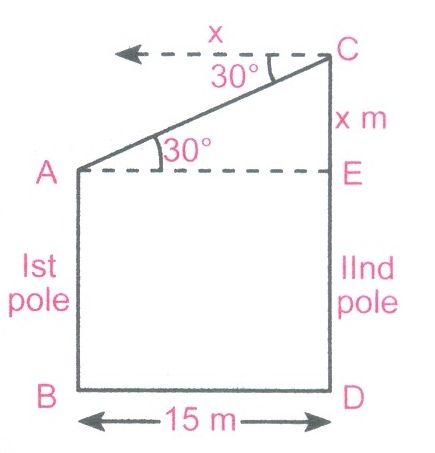
CD = 24 m and BD = 15 m
AE is horizontal line.
In rectangle
ABDE,
AE = BD = 15 m
Let CE = x m.
In right \(\Delta \) CEA,
\(\frac { CE }{ AE } =tan{ 30 }^{ o }\Rightarrow \frac { x }{ 15 } =\frac { 1 }{ \sqrt { 3 } } \)m
20.
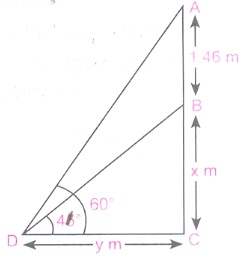
Let AB is statue, BC is pedestal and BC=x m, CD=y m.
In right ΔBCD, ΔBCD, \(\frac { BC }{ CD } \)=tan 45o
⇒, \(\frac { x }{ y } \)=1 ⇒ x=y .....(i)
In right ΔACD, \(\frac { AC }{ CD } \)=tan 600
⇒ \(\frac { x+1.46 }{ y } =\sqrt { 3 } \)
⇒ \(\frac { x+1.46 }{ x } \)=1.73 [Using (i)]
⇒ x+1.46=1.73x ⇒ 0.73x=1.46 ⇒ x=2
21.
Let a man is standing on the deck of a ship at point A such that AB = 10 m and let CD be the hill.
Then, ∠EAD = 60° and ∠CAE = ∠BCA = 30° [alternate angles]
Let BC = x m = AE and DE = h m
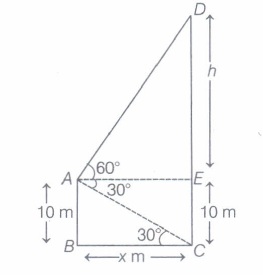
In right angled ΔAED,
\(\tan 60^{\circ}=\frac{P}{B}=\frac{D E}{E A}=\frac{h}{x}\)
In right angled ΔABC,
\(\tan 30^{\circ}=\frac{A B}{B C} \Rightarrow \frac{1}{\sqrt{3}}=\frac{10}{x}\left[\because \tan 30^{\circ}=\frac{1}{\sqrt{3}}\right]\)
distance of the hill from the ship is 10\(\sqrt3\) m and height of the hill is 40 m.
22.
(c)
1/2
23.
(b)
45°
24.
(d)
4
25.
(c)
\(\frac{\sqrt{b^{2}-a^{2}}}{b}\)
26.
(d)
\(\frac{3}{2}\)
27.
(d)
28
28.
(b)
x + 63
29.
(b)
4n+5
30.
(c)
22
31.
(d)
7/25
32.
(d)
25
33.
(c)
-2
34.
(c)
150 sec
35.
(c)
90°
36.
(a)
75√3
37.
(b)
60°
38.
(b)
30 m
39.
(a)
\(\frac { 9\sqrt { 3 } }{ 5 } \)m
40.
(a) If both Assertion and Reason are correct and Reason is the correct explanation of Assertion.
41.
(a) If both Assertion and Reason are correct and Reason is the correct explanation of Assertion.
42.
(i) (b) Let AB be the monument of height 42 m and C is the point where they are standing such that BC = 42 m.

Now, in \(\Delta\)ABC,
\(\begin{aligned}
& \tan \theta=\frac{A B}{B C} \Rightarrow \tan \theta=\frac{42}{42}=1 \\
\end{aligned}\)
\(\begin{aligned}
\Rightarrow \quad \tan \theta & =1 \quad \Rightarrow \quad \theta=45^{\circ}
\end{aligned}\)
(ii) (a) In \(\Delta\)ABC,

\(\begin{aligned}
\tan 60^{\circ} & =\frac{A B}{B C} \\
\end{aligned}\)
\(\begin{aligned}
\Rightarrow \quad \sqrt{3} & =\frac{42}{B C} \\
\end{aligned}\)
\(\begin{aligned}
\Rightarrow \quad B C & =\frac{42}{\sqrt{3}}=\frac{42 \sqrt{3}}{3}=14 \sqrt{3} \\
\end{aligned}\)
\(\begin{aligned}
=14 \times 1.732=24.248=24.25 \mathrm{~m}
\end{aligned}\)
(iii) (a) Let AB be the height of the tower.

Then, in \(\Delta\)ABC, tan 60°\(=\frac{A B}{B C} \Rightarrow \sqrt{3}=\frac{h}{20}\)
\(\Rightarrow\) h = 20\(\sqrt3\) m
(b) Let h and x be the height and length of shadow of the vertical tower.

Then, in \(\Delta\)ABC,
\(\begin{array}{rlrl}
\tan \theta & =\frac{A B}{B C} \Rightarrow \tan \theta=\frac{h}{x} \\
\end{array}\)
\(\begin{array}{rlrl}
\Rightarrow & & \tan \theta & =1 \\
\end{array}\)
\(\begin{array}{rlrl}
\Rightarrow & \theta & =45^{\circ} & {[\because h: x=1: 1]}
\end{array}\)
(v) (c) The angle of depression of an object viewed, is the angle formed by the line of sight with the horizontal, when it is below the horizontal level.

43.
(i) (a): Let the production during first year be a and let d be the increase in production every year. Then,
a6 = 16000 \(\Rightarrow\)a + 5d = 16,000 (i)
and a9 = 22600 \(\Rightarrow\)a + 8d = 22600 (ii)
On substracting (i) from (ii) , we get
3d = 6600 \(\Rightarrow\) d = 2200
Putting d = 2200 in (i) we get,
a + 5 x 2200 = 16000
\(\Rightarrow\) a + 11000 = 16000 \(\Rightarrow\) a = 16000 - 11000 = 5000
Thus , a = 5000 and d = 2200
Production during first year, a = 5000.
(ii) (c): Production during 8th year is given by a8
= (a + 7d)
= (5000 + 7(2200))
= (5000 + 15400)
= 20400.
(iii) (a): a2 = (a + d)
= (5000 + 2200) = 7200.
a3 = (a2 + d)
= 7200 + 2200 = 9400.
Production during first 3 years = 5000 + 7200 + 9400 = 21600
(iv) (c): an = 5000 + (n – 1)2200 = 29200
(n – 1)2200 = 29200 – 5000 = 24200
⇒ n – 1 = 11
⇒ n = 12
(v) (d): a4 = (a + 3d)
= (5000 + 3(2200)) = 5000 + 6600 = 11600.
a7 = (a6 + d)
= 16000 + 2200 = 18200.
Difference = 18200 – 11600 = 6600
44.
\(\because \Delta\)PQR is a right angled triangle.
\(\therefore\) PR2 + RQ2 = PQ2
\(\Rightarrow P R^{2}=(13)^{2}-(12)^{2}=25 \Rightarrow P R=5 \mathrm{~cm}\)
(i) (c) : \(\cos \theta=\frac{Q R}{P Q}=\frac{12}{13} \)
(ii) (c) : \(\sec \theta=\frac{1}{\cos \theta}=\frac{13}{12} \)
(iii) (c) : \(\tan \theta=\frac{P R}{R Q}=\frac{5}{12}\)
\(\therefore \frac{\tan \theta}{1+\tan ^{2} \theta}=\frac{\frac{5}{12}}{1+\frac{25}{144}}=\frac{\frac{5}{12}}{\frac{169}{144}}=\frac{60}{169}\)
(iv) (a): \(\cot \theta=\frac{1}{\tan \theta}=\frac{12}{5}\) [Using (1)]
\(\operatorname{cosec} \theta=\frac{P Q}{P R}=\frac{13}{5} \)
\(\therefore \quad \cot ^{2} \theta-\operatorname{cosec}^{2} \theta=\frac{144}{25}-\frac{169}{25}=-1\)
(v) (b): \(\sin ^{2} \theta+\cos ^{2} \theta=1\) (Using identity)

10th Standard CBSE Syllabus & Materials
10th Standard CBSE
CBSE 10th Social Science PS - Federalism - New Model Questions Papers Study Material - QB365 Set A
NEW10th Standard CBSE
CBSE 10th Social Science PS - Power Sharing - New Model Questions Papers Study Material - QB365 Set A
NEW10th Standard CBSE
CBSE 10th Social Science GEO - Manufacturing Industries - New Model Questions Papers Study Material - QB365 Set A
NEW10th Standard CBSE
CBSE 10th Social Science GEO - Minerals and Energy Resources - New Model Questions Papers Study Material - QB365 Set A



NCERT Books

Syllabus

Exam Pattern

Sample Question Papers

Previous year Question Papers

Important Notes

MCQ Practice test

NCERT Exemplers

Case study Questions

Image Based Questions

Passage based Questions

HOT Questions

Value Based Questions

Model Questions Papers
NCERT ( Book Back ) Questions

Assertion and Reason
Important Questions And Answers

CBSE 10th Standard CBSE Subjects
CBSE Standards



